REVIEW 3 major objections 5 minor 1 cited by
SENSE: Semantic Embedding Navigation with Soft-gated Evaluation for Retrieval-based Speculative Decoding
T0 review · 3 major / 5 minor · reviewed 2026-07-12 · grok-4.5
Pith's one-line read SENSE accelerates LLM decoding by retrieving and accepting drafts that match meaning, not exact tokens.
desk verdict Solid systems paper that actually moves RSD past exact-match brittleness; the ID-datastore confound is real but does not erase the contribution. read the letter →
The pith
A machine-rendered reading of the paper's core claim, the machinery that carries it, and where it could break.
The reading
What carries the argument
Semantic Embedding Navigation (SEN) plus Soft-gated Evaluation (SE): SEN queries a hybrid static/dynamic datastore with a projected hidden state; SE accepts a draft token if it is an exact match or, when entropy exceeds a threshold, if it is top-k or an isolated local error.
What would settle it
On a well-calibrated model, raise the entropy gate so that almost every position is treated as high-uncertainty and measure whether task accuracy collapses while acceptance length stays high; if accuracy remains stable, the entropy proxy is safer than claimed; if it falls, the soft-gate is over-accepting.
Extended reading notes
Core claim
Anchoring retrieval on the target model’s hidden states and verifying with entropy-gated top-k and neighborhood-fusion masks liberates retrieval-based speculative decoding from exact lexical matching, yielding mean acceptance lengths up to 4.09 and speedups up to 3.26 imes without measurable quality loss.
Load-bearing premise
The model’s own predictive entropy is a reliable signal that a non-greedy but high-probability token is still semantically safe to accept.
Editorial extensions
If this is right
- Retrieval-based speculative decoding no longer requires the draft’s first token to equal the greedy prediction, enlarging the usable candidate pool.
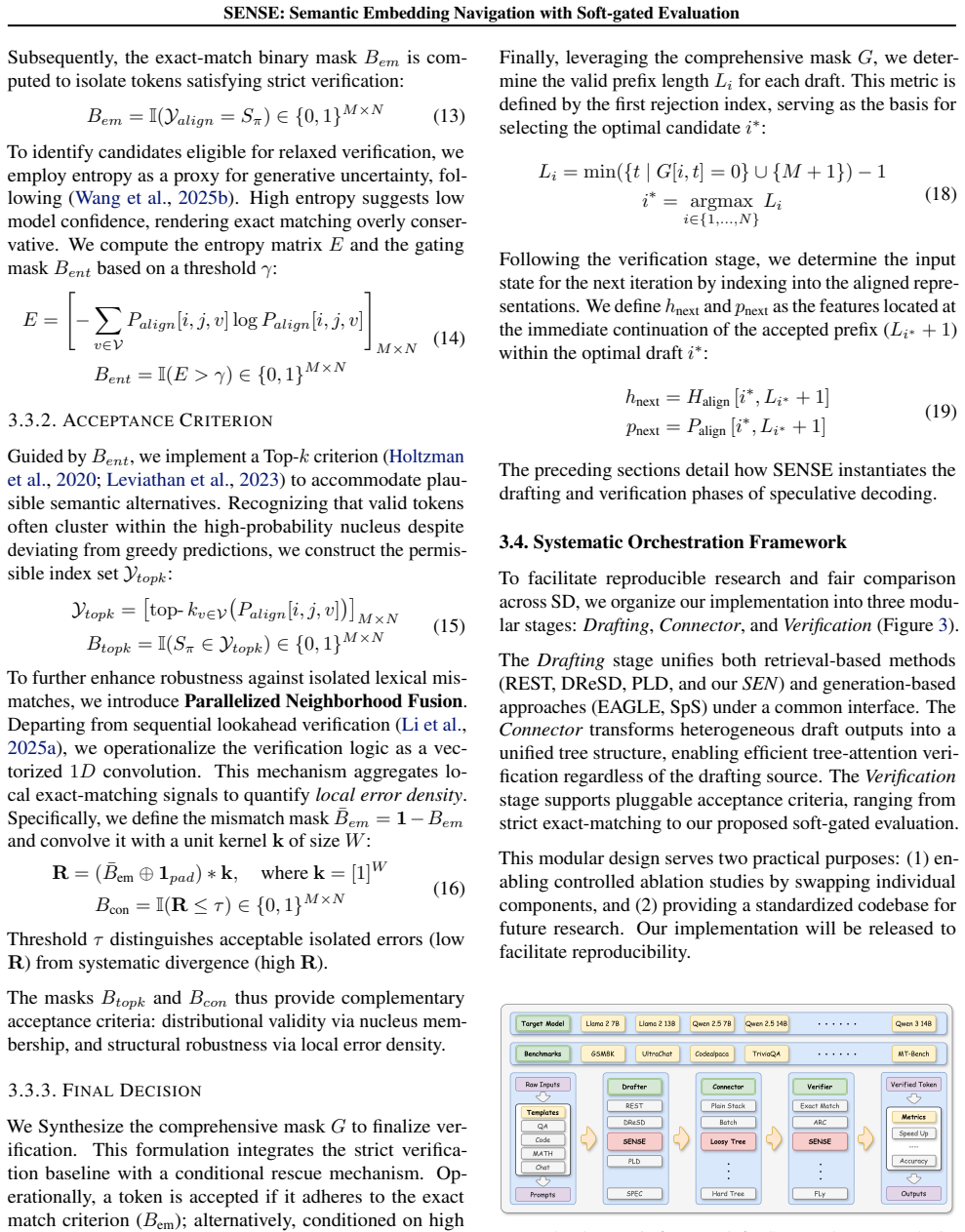
- A single modular pipeline can swap drafting sources and verification rules, enabling controlled ablations of every component.
- As models grow more confident, exact-match drafts become rarer, so semantic verification becomes the dominant remaining bottleneck.
- Datastores built from the target model’s own outputs (ID) usually outperform external ground-truth stores (OOD), except for weak, high-entropy models where OOD can act as a corrective.
Reading between the lines
- The same hidden-state key could be reused as a cheap draft source for models that share an embedding space, reducing the need to build a separate datastore per model size.
- If entropy calibration drifts across domains, an online estimate of recent perplexity could replace the fixed threshold without any extra training.
- Neighborhood-fusion verification may transfer to tree-structured speculative methods that currently prune entire branches after a single lexical mismatch.
Signed reviews
Editorial analysis
A structured set of objections, weighed in public.
Referee Report
Summary. The paper introduces SENSE, a training-free retrieval-based speculative decoding (RSD) framework that replaces rigid lexical n-gram keys with Semantic Embedding Navigation (SEN): retrieval is anchored on PCA-projected, L2-normalized hidden states of the target LLM from a hybrid static+dynamic datastore, followed by composite scoring and Sorted-LCP Loose Trie compression. Soft-gated Evaluation (SE) then verifies candidates via cascaded masks (exact-match OR (high-entropy AND (top-k membership OR convolutional neighborhood fusion))), accepting semantically plausible tokens under uncertainty (Eqs. 12–18). A modular Drafting–Connector–Verification framework decomposes prior SD methods into interchangeable primitives for fair comparison. Experiments on Llama-2 (7B/13B) and Qwen (2.5/3, 7–14B) across GSM8K, CodeAlpaca, UltraChat and TriviaQA report mean acceptance lengths up to ~4.1 and wall-clock speedups up to 3.26× (primarily SENSE(ID)), outperforming REST, DReSD, PLD, SpS and even EAGLE-2/3 on several metrics, with claimed ~98% relative quality preservation.
Significance. If the speed-ups and quality claims hold under tighter controls, SENSE supplies a practical, architecture-agnostic, training-free acceleration path for LLM serving that relaxes exact-match brittleness without draft-model training or vocabulary alignment. The modular atomic framework, component ablations (Table 3), hyper-parameter grids (Fig. 6 / Table 5), latency breakdowns, Loose-Trie compression ratios, ID/OOD datastore distinction, and explicit quality tables (Table 6, Fig. 5) plus promised code release are concrete strengths that raise the bar for reproducible RSD research and enable future plug-and-play extensions.
major comments (3)
- Section 4.1 and Table 1: the headline numbers cited in the abstract (and the bulk of the superiority claims) are driven by SENSE(ID) rows, where the datastore is built from responses generated by the identical target LLM. This creates a distributional self-match confound: high acceptance lengths may largely reflect near-exact retrieval of the model’s own continuations rather than the claimed power of hidden-state semantic navigation + soft gating. OOD (ground-truth) results are substantially weaker and sometimes trail PLD/REST. A controlled experiment that freezes datastore content and ablate only the retrieval key (token n-gram vs. projected hidden state) and the verification gate is required to isolate the contribution of SEN+SE; without it the central “liberates RSD from lexical rigidity” claim remains under-supported.
- Section 3.3.1 (Eq. 14) and Appendix D.2: Soft-gated Evaluation treats predictive entropy as a reliable proxy for “semantic flexibility.” The paper itself documents that this assumption fails for poorly calibrated models (Llama-2-7B inversion and the ARC/FLY comparison), yet the main claims and default hyper-parameters (θe=0.05) are presented as generally applicable. Either an adaptive/calibrated gate or a clear scope restriction to well-calibrated modern models is needed; otherwise the quality-preservation guarantee (and the 98% relative-accuracy figure) rests on an untested assumption for a non-negligible fraction of the evaluated regime.
- Abstract vs. Table 1 / Table 2: the abstract’s “up to 4.09 mean acceptance length and 3.26× speedup” does not cleanly match any single reported mean (Qwen3-14B ID mean τ=4.13 / speedup=3.03; UltraChat ID speedup=3.26 with τ=6.57). The “up to” phrasing therefore selectively highlights peak cells while the mean columns that support the multi-domain claim are lower. Either report the actual maxima with their provenance or replace the abstract numbers with the means that the tables actually establish.
minor comments (5)
- Throughout (e.g., §3.2.3, Fig. 8 caption, Algorithm 3): “Losse Trie” / “losse trie” is a consistent misspelling of “Loose Trie”; correct for readability.
- Table 6 and Fig. 5: several ROUGE-L and accuracy drops appear (e.g., Qwen3-14B CodeAlpaca, Qwen2.5-14B GSM8K ID); the 98.02% average is reassuring but the per-cell degradations should be discussed rather than averaged away.
- No error bars or multi-seed statistics are reported for speed-up or τ; even 3–5 runs with standard deviation would strengthen Tables 1–3.
- §3.2.2 Eq. (8): the composite score weights α ≫ β are stated but never numerically specified; list the concrete values used in the experiments.
- Figure 1 caption and several places use “losse” / “Losse”; also “Soft-gated Evaluation module to validate semantic equivalence rather than surface forms” over-claims relative to the actual top-k + neighborhood heuristic.
Circularity Check
No circularity: purely empirical engineering paper whose acceptance-length and speedup claims are measured against external baselines, not derived by construction from fitted inputs.
full rationale
SENSE is a training-free retrieval-based speculative-decoding system. Its core modules (Semantic Embedding Navigation via hidden-state ANN retrieval + Soft-gated Evaluation via entropy/top-k/neighborhood masks) are defined operationally in Sections 3.2–3.3 and Algorithms 1–4; the acceptance length ℓn and speedup are then measured on held-out benchmarks against vanilla decoding and published baselines (Tables 1–2, Figures 4–5). Hyper-parameters (θe = 0.05, k = 3, w = 6) are selected by grid search (Figure 6, Table 5) but never enter the definition of the success metrics themselves. There are no self-definitional equations, no uniqueness theorems imported from prior author work, no ansatz smuggled via self-citation, and no renaming of a known empirical pattern. The ID/OOD datastore distinction is an experimental design choice that may confound interpretation of “semantic” gains, yet it does not render any claimed quantity tautological by construction. The derivation chain is therefore self-contained and non-circular.
Assumptions & free parameters
free parameters (6)
- entropy threshold θe (γ) =
0.05
- top-k =
3
- mismatch window w =
6
- PCA projection dimension v =
64
- retrieval N / draft length M =
3 / 10
- composite score weights α ≫ β
assumptions (4)
- domain assumption Speculative decoding with tree attention preserves the target model's output distribution under exact-match verification.
- domain assumption Predictive entropy is a reliable proxy for generative uncertainty and therefore for semantic flexibility.
- ad hoc to paper PCA + L2-normalized hidden states preserve enough semantic geometry for useful ANN retrieval.
- domain assumption Approximate nearest-neighbor search (FAISS IVF-PQ) returns sufficiently relevant candidates for the subsequent soft verifier.
invented entities (3)
-
Semantic Embedding Navigation (SEN)
-
Soft-gated Evaluation (SE / SGE)
-
Loose Trie (Sorted-LCP Alignment)
Cite this review
Pith. "Pith review of SENSE: Semantic Embedding Navigation with Soft-gated Evaluation for Retrieval-based Speculative Decoding." pith.science (2026). https://pith.science/paper/F7H4ZH6V
@misc{pith2026260600021,
  author       = {Pith},
  title        = {Pith review of: SENSE: Semantic Embedding Navigation with Soft-gated Evaluation for Retrieval-based Speculative Decoding},
  year         = {2026},
  howpublished = {\url{https://pith.science/paper/F7H4ZH6V}},
  note         = {Machine review of arXiv:2606.00021}
}
read the original abstract
Speculative Decoding (SD) accelerates Large Language Model (LLM) inference by employing a lightweight draft model to propose candidate tokens, which are verified in parallel by the target model, without compromising generation quality. While Retrieval-based Speculative Decoding (RSD) is favored for its plug-and-play versatility, its potential is impeded by rigid lexical dependencies, rendering both retrieval and verification brittle to surface-level variations. To address this, we propose SENSE (Semantic Embedding Navigation with Soft-gated Evaluation). By anchoring retrieval on the hidden states of the target model, SENSE establishes robust semantic alignment, which empowers the Soft-gated Evaluation module to validate semantic equivalence rather than surface forms. To ensure rigorous benchmarking, we deconstruct existing methods into atomic primitives within a unified framework, facilitating granular, component-level comparison. Extensive experiments across diverse domains demonstrate that SENSE outperforms multiple baselines on the LLaMA and Qwen families, attaining up to 4.09 mean acceptance length and 3.26x speedup, while preserving generation quality. Our code will be released upon publication.
Figures


Figures from the paper (8 more)


Forward citations
Cited by 1 Pith paper
-
Oilbird: Training-Free Speculative Decoding with Keys the Verifier Already Computes
A training-free speculative decoder using the verifier's hidden states as a semantic key retrieves correct continuations unreachable by exact suffix matching, lifting accepted length 24-29%.
Reference graph
Works this paper leans on
-
[1]
URL http://arxiv.org/abs/2502. 15572. arXiv:2502.15572 [cs]. Guo, D., Yang, D., Zhang, H., Song, J., Wang, P., Zhu, Q., Xu, R., Zhang, R., Ma, S., Bi, X., Zhang, X., Yu, X., Wu, Y ., Wu, Z. F., Gou, Z., Shao, Z., Li, Z., Gao, Z., Liu, A., Xue, B., Wang, B., Wu, B., Feng, B., Lu, C., Zhao, C., Deng, C., Ruan, C., Dai, D., Chen, D., Ji, D., Li, E., Lin, F.,...
work page Pith review arXiv doi:10.1038/s41586-025-09422-z 2025
-
[2]
Weng, Y ., Hu, Q., Chen, X., Liu, L., Mei, D., Qiu, H., Tian, J., and Shi, Z
GitHub and Hugging Face repositories. Weng, Y ., Hu, Q., Chen, X., Liu, L., Mei, D., Qiu, H., Tian, J., and Shi, Z. Traversal Verification for Speculative Tree Decoding, November 2025. URLhttp://arxiv. org/abs/2505.12398. arXiv:2505.12398 [cs]. Yang, N., Ge, T., Wang, L., Jiao, B., Jiang, D., Yang, L., Majumder, R., and Wei, F. Inference with Refer- ence:...
arXiv 2025
-
[3]
”happy”), SE accepts the token if it resides within the top-k probability mass
Distributional Rescue (Btopk):For high-entropy positions where the model is uncertain (e.g., synonyms like ”glad” vs. ”happy”), SE accepts the token if it resides within the top-k probability mass. This captures semantic equivalence that exact-match or strict risk bounds often miss
-
[4]
If the mismatch is an isolated event within a correct neighborhood, the token is retained
Structural Rescue ( Bcon):For positions with isolated lexical mismatches (e.g., singular/plural variations), the convolutional mask ( Bcon) aggregates local error density. If the mismatch is an isolated event within a correct neighborhood, the token is retained. This combination allows SE to salvage valid drafts that baselines would erroneously prune, dir...
-
[5]
The mean absolute accuracy drop is only 2.3%, indicating that the soft-gated verification mechanism effectively maintains reasoning integrity
Mathematical Reasoning (GSM8K):Accuracy degradation is minimal, with SENSE configurations achieving 0.89– 0.93 compared to vanilla’s 0.92–0.95. The mean absolute accuracy drop is only 2.3%, indicating that the soft-gated verification mechanism effectively maintains reasoning integrity
-
[6]
0.427 on Qwen3-8B), suggesting that high-quality retrieved drafts can provide beneficial semantic guidance
Code Generation (CodeAlpaca):SENSE-OOD occasionally outperforms vanilla (e.g., 0.443 vs. 0.427 on Qwen3-8B), suggesting that high-quality retrieved drafts can provide beneficial semantic guidance. However, Qwen3-14B shows degraded ROUGE-L scores for both SENSE variants, warranting further investigation
-
[7]
Dialogue (UltraChat):ROUGE-L scores remain stable across most configurations, with variations typically within 0.02 of vanilla baselines. 18 SENSE: Semantic Embedding Navigation with Soft-gated Evaluation Table 6.Accuracy preservation analysis across models and datasets. We compare vanilla decoding (baseline) against SENSE-OOD and SENSE-ID configurations....
-
[8]
Who had a 70s No.1 hit with Kiss You All Over?
Question Answering (TriviaQA):Performance remains robust under the SENSE method as measured by the ACC metric. Overall, these results validate that SENSE achieves substantial speedup (2–3 × as shown in Table 1) while maintaining task performance within acceptable margins for most configurations. The observed trade-off aligns with the hyperparam- eter sens...
1978
Reviewed July 12, 2026 · model on record in the stance chip above.
Discussion (0). Continue with ORCID to comment.