REVIEW 3 major objections 5 minor 79 references
Glissando-Net: Deep sinGLe vIew category level poSe eStimation ANd 3D recOnstruction
T0 review · 3 major / 5 minor · reviewed 2026-08-10 · deepseek-v4-flash
Pith's one-line read Glissando-Net claims that a single RGB image of an object from a known category is enough to recover both its 6D pose and a complete canonical 3D point cloud, and that it outperforms prior category-level methods on NOCS and Pix3D.
desk verdict Solid incremental improvement over CPS for RGB-only category-level pose and shape, with one unvalidated inference-time design choice (zero latent code) that a referee should ask to fix. read the letter →
The pith
A machine-rendered reading of the paper's core claim, the machinery that carries it, and where it could break.
The reading
What carries the argument
The load-bearing mechanism is the feature transform module that couples a U-Net image autoencoder with a PointNet++-based point cloud variational autoencoder. Using Eq. (1), the module projects the sampled points of the point cloud encoder's set-abstraction layers into the image decoder's feature maps with the ground-truth rotation and translation, applies RoI align, and concatenates the resulting local image features with the 3D point features. It also converts each scale of the image decoder to a vector and concatenates it into the corresponding layer of the point cloud decoder. These two connections give the decoder a dense image-conditioning signal at inference, so the same decoder can emit a canonical point cloud and a 6D pose without ever seeing a point cloud at test time.
What would settle it
Retrain Glissando-Net with the latent code $z$ fixed to zero during training and test on the same NOCS real split. If the resulting Chamfer distance and pose accuracy match the paper's reported numbers, the learned latent distribution is unnecessary and the all-zero inference code is harmless; if they are much worse, the reported accuracy depends on the train/test shift that the paper does not ablate.
Extended reading notes
Core claim
The central discovery is that category-level 6D pose and canonical 3D shape can be predicted together from a single RGB image by making the point-cloud variational autoencoder the predictor at inference time, conditioned on transformed image features instead of a point cloud input. During training, ground-truth pose projects sampled 3D points onto the image decoder's feature maps, establishing per-point 2D-3D correspondences that teach the decoder to link appearance to geometry; image features are injected at every scale of the point cloud decoder. At test time the point cloud encoder is discarded, the latent code is set to zero, and the same decoder regresses both the pose-invariant shape and the 6D pose. The authors report that this beats CPS on NOCS in most categories and surpasses Mesh R-CNN on Pix3D category-level reconstruction, while ablations show that removing the point cloud encoder or the decoder-side transform degrades accuracy substantially.
Load-bearing premise
The test-time procedure feeds a fixed all-zero latent code into a shape decoder that was trained on codes sampled from a learned posterior, assuming the decoder generalizes to that out-of-distribution input even though the paper reports no experiment that checks this.
Editorial extensions
If this is right
- A single RGB model can handle multiple object categories through a shared latent space, so there is no need to train one network per class or to have instance-specific CAD models at test time.
- Because shape and pose are produced by the same point-cloud decoder with a joint loss, improving shape reconstruction should directly improve pose accuracy, and vice versa.
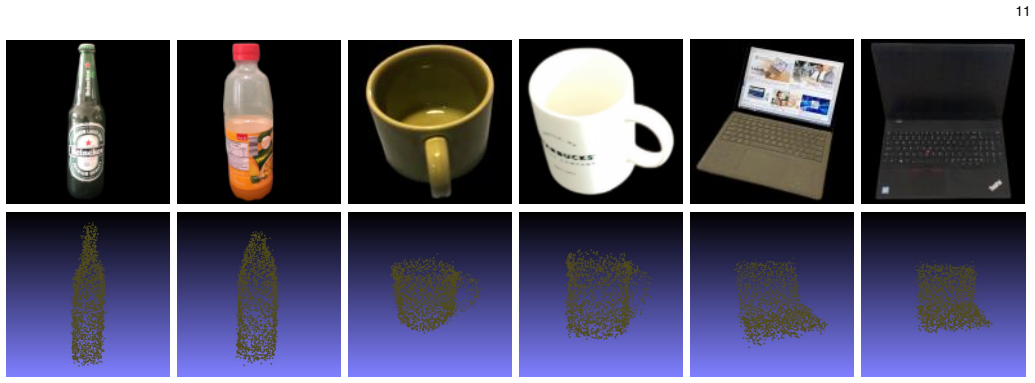
- The category-level shape prior lets the network complete occluded parts, so side, center, and bottom occlusions cause only mild degradation in Chamfer distance and pose accuracy.
- On Pix3D the same architecture also beats a strong category-level baseline for furniture shape reconstruction, indicating the approach transfers beyond NOCS object classes.
Reading between the lines
- The unablated all-zero latent code is a train/test distribution shift; an obvious extension is to train with $z$ occasionally zeroed or to learn a small image-conditioned prior, which could close the remaining gap to CPS++ on real data.
- Since the feature transform needs ground-truth pose to project points during training, pose annotation quality bounds the learned 2D-3D alignment; a second stage that replaces ground truth with predicted poses would enable self-supervised fine-tuning on unlabeled video.
- The method assumes a detector provides clean crops, so end-to-end integration with an object detector is needed before the claimed accuracy carries over to cluttered scenes.
- Top occlusions fail because the opening and handle of mugs are lost; multi-view or temporal inputs of the kind available in Objectron would supply exactly that missing structure and likely restore accuracy for top-occluded objects.
Editorial analysis
A structured set of objections, weighed in public.
Referee Report
Summary. The paper presents Glissando-Net, a deep model for category-level 6D pose estimation and 3D point cloud reconstruction from a single RGB image. The architecture combines a U-Net for images and a VAE for point clouds, with two feature-transform modules that inject image features into the point-cloud encoder and decoder. During training, the VAE encodes ground-truth canonical point clouds; at inference, the point-cloud encoder is removed and the latent code is fixed to zero. The model is trained on NOCS and Pix3D with a multi-term loss (shape, KL, per-point pose). Experiments report improved Chamfer distance and pose metrics compared with CPS and other baselines on NOCS, and improved shape reconstruction on Pix3D versus Mesh R-CNN and Total3D. Ablations show the importance of the decoder-side feature transform and of the pose sub-network.
Significance. If the central claim holds, Glissando-Net is a practical RGB-only, category-level joint pose-and-shape method that improves over the strongest RGB-only baseline (CPS) on most metrics and provides a clean architecture for combining 2D and 3D features. The paper is empirically thorough: it includes ablation studies for code size, pose-network placement, and feature transforms; occlusion robustness experiments; and a zero-shot cross-domain qualitative evaluation on Objectron. The main weaknesses are the unvalidated inference-time choice of z=0 and the overstatement of the state-of-the-art comparison against CPS++.
major comments (3)
- [Section 3, Inference Stage; Eq. (3); Section 4.1; Table 7] The inference protocol sets the VAE latent z to zero while training samples z from the posterior q(z|pc_gt). The paper provides no posterior statistics and no ablation that isolates replacing posterior samples with zero. The Glissando-Net* baseline in Tables 1-3 and 7 removes the point cloud encoder from training, changing the training objective, so it does not test the train/test shift at hand. If the decoder is sensitive to the latent code, the reported RGB-only performance is contingent on an arbitrary, untested input. Please validate by reporting the empirical distribution of the posterior mean/variance, or by training a variant that uses the zero latent during training, and show that the test-time results are stable under this choice.
- [Section 1, Contribution 3; Table 3] The contribution statement claims 'better performance than the state-of-the-art', but Table 3 shows that on the real NOCS subset, CPS++ outperforms Glissando-Net (EMD) on both 10°&10 cm (22.3% vs 19.08%) and APP (α=0.2/0.5) (41.0%/73.6% vs 34.06%/63.90%). The text acknowledges this, but the contribution statement remains an overclaim. Please qualify the claim to 'better than prior RGB-only methods' or 'better than CPS', and discuss CPS++ as a stronger baseline when assessing state-of-the-art status.
- [Section 4.3, Table 4] The text states 'The mean error of Glissando-Net on S2 is computed over 7 categories. The mean error over 9 categories is 14.39', but Table 4 reports mean 11.83 for the same S2 row. The discrepancy likely arises because 11.83 is the mean over 7 categories (excluding tool and wardrobe) while 14.39 is over all 9. Please clarify in both the text and the table which categories are included in each reported mean, and ensure the numbers are consistent.
minor comments (5)
- [Table 4 caption and Section 4.3] The table caption should explicitly state that Mesh R-CNN and Glissando-Net (S2) means exclude the tool and wardrobe categories, since the table still lists values for those categories in the Glissando-Net row.
- [Tables 2-3, Section 4.6] The notation for the pose metric appears as '10◦& 10 cm' in some places and '10◦10 cm' in others (e.g., Section 4.6). Please standardize the degree symbol and ampersand throughout.
- [Tables 1-3] The paper would be strengthened by reporting variance or multiple-seed results, since some differences between Glissando-Net (EMD) and CPS are small (e.g., Table 2, camera category on synthetic data).
- [Section 4.2] The statement 'CPS does not report shape reconstruction results on real data' should be verified and, if correct, the comparison on real data should be clearly annotated as pose-only for that baseline.
- [Figure 2 caption] The Figure 2 caption contains confusing fragments such as 'Inference Point Cloud Encoder' under the training diagram; please rewrite the caption to clearly separate training and inference stages.
Circularity Check
No significant circularity: Glissando-Net is an empirical deep-learning study whose predictions are not constructed from its training targets or from self-cited results.
full rationale
The paper's central claim is that a jointly trained image/point-cloud auto-encoder pair can predict category-level 6D pose and canonical 3D shape from a single RGB image. This is an empirical claim, not a derivation. The loss functions in Eqs. (2) and (3) regress predicted pose and shape against ground-truth annotations, and the predicted outputs are produced by the network at test time from RGB input only. The one place where ground-truth pose directly enters the architecture is Eq. (1), where it is used during training to project 3D points into the RGB feature map for RoI-Align; this is a standard supervised feature-alignment mechanism, and the test-time pose is not this training input renamed as a prediction. The inference choice to set the VAE latent code z to the all-zero vector is a train/test distribution shift and a potential robustness concern, but it is not circular: the predicted shape and pose still come from RGB-conditioned decoder features and are evaluated against held-out ground truth. No load-bearing self-citation appears: the references to CPS, CPS++, NOCS, OLD-Net, and the NOCS/Pix3D benchmarks are external comparisons, and no uniqueness theorem or prior-work ansatz is invoked to force the design. The paper is self-contained against external benchmarks, and any weaknesses, such as the unablated zero-latent inference or reliance on pose annotations for feature projection, are correctness risks rather than instances of circular reasoning.
Assumptions & free parameters
free parameters (4)
- Loss weight wshape =
1
- Loss weight wkld =
100
- Loss weight wpose =
100
- VAE latent dimension =
256
assumptions (3)
- domain assumption Canonical pose alignment across instances within a category is a valid and consistent supervision signal.
- domain assumption A category-level shape prior can be learned from paired RGB images and canonical point clouds, then transferred to RGB-only inference with a zero latent code.
- domain assumption Ground-truth pose is available for every training image and is accurate enough to project 3D points in the feature transform.
Cite this review
Pith. "Pith review of Glissando-Net: Deep sinGLe vIew category level poSe eStimation ANd 3D recOnstruction." pith.science (2026). https://pith.science/paper/F7HWRGQF
@misc{pith2026250114896,
  author       = {Pith},
  title        = {Pith review of: Glissando-Net: Deep sinGLe vIew category level poSe eStimation ANd 3D recOnstruction},
  year         = {2026},
  howpublished = {\url{https://pith.science/paper/F7HWRGQF}},
  note         = {Machine review of arXiv:2501.14896}
}
read the original abstract
We present a deep learning model, dubbed Glissando-Net, to simultaneously estimate the pose and reconstruct the 3D shape of objects at the category level from a single RGB image. Previous works predominantly focused on either estimating poses(often at the instance level), or reconstructing shapes, but not both. Glissando-Net is composed of two auto-encoders that are jointly trained, one for RGB images and the other for point clouds. We embrace two key design choices in Glissando-Net to achieve a more accurate prediction of the 3D shape and pose of the object given a single RGB image as input. First, we augment the feature maps of the point cloud encoder and decoder with transformed feature maps from the image decoder, enabling effective 2D-3D interaction in both training and prediction. Second, we predict both the 3D shape and pose of the object in the decoder stage. This way, we better utilize the information in the 3D point clouds presented only in the training stage to train the network for more accurate prediction. We jointly train the two encoder-decoders for RGB and point cloud data to learn how to pass latent features to the point cloud decoder during inference. In testing, the encoder of the 3D point cloud is discarded. The design of Glissando-Net is inspired by codeSLAM. Unlike codeSLAM, which targets 3D reconstruction of scenes, we focus on pose estimation and shape reconstruction of objects, and directly predict the object pose and a pose invariant 3D reconstruction without the need of the code optimization step. Extensive experiments, involving both ablation studies and comparison with competing methods, demonstrate the efficacy of our proposed method, and compare favorably with the state-of-the-art.
Figures


Figures from the paper (10 more)




Reference graph
Works this paper leans on
-
[1]
CodeSLAM—learning a compact, optimisable representation for dense visual SLAM,
M. Bloesch, J. Czarnowski, R. Clark, S. Leutenegger, and A. J. Davison, “CodeSLAM—learning a compact, optimisable representation for dense visual SLAM,” in IEEE Conference on Computer Vision and Pattern Recognition, 2018, pp. 2560–2568
work page 2018
-
[2]
A point set generation network for 3d object reconstruction from a single image,
H. Fan, H. Su, and L. Guibas, “A point set generation network for 3d object reconstruction from a single image,” in IEEE Conference on Computer Vision and Pattern Recognition , 2017, pp. 2463–2471
work page 2017
-
[3]
Learning local RGB- to-CAD correspondences for object pose estimation,
G. Georgakis, S. Karanam, Z. Wu, and J. Kosecka, “Learning local RGB- to-CAD correspondences for object pose estimation,” in International Conference on Computer Vision , 2019, pp. 8967–8976
work page 2019
-
[4]
Normalized object coordinate space for category-level 6d object pose and size estimation,
H. Wang, S. Sridhar, J. Huang, J. Valentin, S. Song, and L. J. Guibas, “Normalized object coordinate space for category-level 6d object pose and size estimation,” in Proceedings of the IEEE Conference on Com- puter Vision and Pattern Recognition , 2019, pp. 2642–2651
work page 2019
-
[5]
SSD-6D: Making RGB-based 3D detection and 6D pose estimation great again,
W. Kehl, F. Manhardt, F. Tombari, S. Ilic, and N. Navab, “SSD-6D: Making RGB-based 3D detection and 6D pose estimation great again,” in International Conference on Computer Vision , 2017, pp. 1521–1529
work page 2017
-
[6]
PoseCNN: A convolu- tional neural network for 6d object pose estimation in cluttered scenes,
Y . Xiang, T. Schmidt, V . Narayanan, and D. Fox, “PoseCNN: A convolu- tional neural network for 6d object pose estimation in cluttered scenes,” in RSS, 2018
work page 2018
-
[8]
F. Manhardt, G. Wang, B. Busam, M. Nickel, S. Meier, L. Minciullo, X. Ji, and N. Navab, “CPS++: Improving Class-level 6D Pose and Shape Estimation From Monocular Images With Self-Supervised Learning,” arXiv preprint arXiv:2003.05848v3, 2020
arXiv 2003
-
[9]
Z. Fan, Z. Song, J. Xu, Z. Wang, K. Wu, H. Liu, and J. He, “Object level depth reconstruction for category level 6d object pose estimation from monocular rgb image,” in European Conference on Computer Vision . Springer, 2022, pp. 220–236
work page 2022
Show all 79 references
-
[10]
Leveraging geometry for shape estimation from a single rgb image,
F. Langer, I. Budvytis, and R. Cipolla, “Leveraging geometry for shape estimation from a single rgb image,” arXiv preprint arXiv:2111.05615 , 2021
2021 arXiv
-
[11]
Category-level metric scale object shape and pose estimation,
T. Lee, B.-U. Lee, M. Kim, and I. S. Kweon, “Category-level metric scale object shape and pose estimation,” IEEE Robotics and Automation Letters, vol. 6, no. 4, pp. 8575–8582, 2021
2021
-
[12]
Multi-view consistency as super- visory signal for learning shape and pose prediction,
S. Tulsiani, A. Efros, and J. Malik, “Multi-view consistency as super- visory signal for learning shape and pose prediction,” in IEEE Con- ference on Computer Vision and Pattern Recognition (CVPR) , 2018, p. 2897–2905
2018
-
[13]
Unsupervised learning of shape and pose with differentiable point clouds,
E. Insafutdinov and A. Dosovitskiy, “Unsupervised learning of shape and pose with differentiable point clouds,” inAdvances in Neural Information Processing Systems, 2018, pp. 2802–2812
2018
-
[14]
Pix3d: Dataset and methods for single-image 3d shape modeling,
X. Sun, J. Wu, X. Zhang, Z. Zhang, C. Zhang, T. Xue, J. B. Tenenbaum, and W. T. Freeman, “Pix3d: Dataset and methods for single-image 3d shape modeling,” in Proceedings of the IEEE Conference on Computer Vision and Pattern Recognition, 2018, pp. 2974–2983
2018
-
[15]
To- tal3DUnderstanding: Joint Layout, Object Pose and Mesh Reconstruc- tion for Indoor Scenes from a Single Image,
Y . Nie, X. Han, S. Guo, Y . Zheng, J. Chang, and J. J. Zhang, “To- tal3DUnderstanding: Joint Layout, Object Pose and Mesh Reconstruc- tion for Indoor Scenes from a Single Image,” in IEEE Conference on Computer Vision and Pattern Recognition , 2020
2020
-
[16]
Corenet: Coherent 3d scene reconstruction from a single rgb image,
S. Popov, P. Bauszat, and V . Ferrari, “Corenet: Coherent 3d scene reconstruction from a single rgb image,” in European Conference on Computer Vision, 2020
2020
-
[17]
Holistic 3d scene understanding from a single image with implicit representation,
C. Zhang, Z. Cui, Y . Zhang, B. Zeng, M. Pollefeys, and S. Liu, “Holistic 3d scene understanding from a single image with implicit representation,” in IEEE Conference on Computer Vision and Pattern Recognition , 2021, pp. 8833–8842
2021
-
[18]
GSNet: Joint Vehicle Pose and Shape Reconstruction with Geometrical and Scene-aware Supervision,
L. Ke, S. Li, Y . Sun, Y .-W. Tai, and C.-K. Tang, “GSNet: Joint Vehicle Pose and Shape Reconstruction with Geometrical and Scene-aware Supervision,” in European Conference on Computer Vision , 2020. 12 Fig. 9: Qualitative results on synthetic NOCS data. Top to bottom: input i...
2020
-
[19]
Multiview aggregation for learning category-specific shape reconstruction,
S. Sridhar, D. Rempe, J. Valentin, B. Sofien, and L. J. Guibas, “Multiview aggregation for learning category-specific shape reconstruction,” in Ad- vances in Neural Information Processing Systems , 2019, pp. 2351–2362
2019
-
[20]
Learning canonical shape space for category- level 6D object pose and size estimation,
D. Chen, J. Li, and K. Xu, “Learning canonical shape space for category- level 6D object pose and size estimation,” in IEEE Conference on Computer Vision and Pattern Recognition , 2020
2020
-
[21]
SceneCode: Monocular Dense Semantic Reconstruction using Learned Encoded Scene Representations,
S. Zhi, M. Bloesch, S. Leutenegger, and A. J. Davison, “SceneCode: Monocular Dense Semantic Reconstruction using Learned Encoded Scene Representations,” in Proceedings of the IEEE Conference on Computer Vision and Pattern Recognition , 2019, pp. 11 776–11 785
2019
-
[22]
Learning meshes for dense visual slam,
M. Bloesch, T. Laidlow, R. Clark, S. Leutenegger, and A. J. Davison, “Learning meshes for dense visual slam,” in Proceedings of the IEEE International Conference on Computer Vision , 2019, pp. 5855–5864
2019
-
[23]
Monoc- ular 3d object detection for autonomous driving,
X. Chen, K. Kundu, Z. Zhang, H. Ma, S. Fidler, and R. Urtasun, “Monoc- ular 3d object detection for autonomous driving,” in IEEE Conference on Computer Vision and Pattern Recognition , 2016, pp. 2147–2156
2016
-
[24]
3d bounding box estimation using deep learning and geometry,
A. Mousavian, D. Anguelov, J. Flynn, and J. Kosecka, “3d bounding box estimation using deep learning and geometry,” in Proceedings of the IEEE Conference on Computer Vision and Pattern Recognition , 2017, pp. 7074–7082
2017
-
[25]
Data-driven 3D voxel patterns for object category recognition,
Y . Xiang, W. Choi, Y . Lin, and S. Savarese, “Data-driven 3D voxel patterns for object category recognition,” in Proceedings of the IEEE Conference on Computer Vision and Pattern Recognition , 2015, pp. 1903–1911
2015
-
[26]
Izadinia, Q
H. Izadinia, Q. Shan, and S. M. Seitz, “IM2CAD,” in IEEE Conference on Computer Vision and Pattern Recognition , 2017, pp. 5134–5143
2017
-
[27]
Category level object pose estimation via neural analysis-by-synthesis,
X. Chen, Z. Dong, J. Song, A. Geiger, and O. Hilliges, “Category level object pose estimation via neural analysis-by-synthesis,” in European Conference on Computer Vision , 2020
2020
-
[28]
K. Park, A. Mousavian, Y . Xiang, and D. Fox, “Latentfusion: End- 13 Fig. 11: Overlay results on NOCS data. Top to bottom: input image, project the predicted point cloud to the input image. Fig. 12: Some examples where our algorithm fails. The two examples on the left are form...
2020
-
[29]
Neural object learning for 6d pose estimation using a few cluttered images,
K. Park, T. Patten, and M. Vincze, “Neural object learning for 6d pose estimation using a few cluttered images,” in European Conference on Computer Vision, 2020
2020
-
[30]
Category-specific object reconstruction from a single image,
A. Kar, S. Tulsiani, J. Carreira, and J. Malik, “Category-specific object reconstruction from a single image,” in IEEE Conference on Computer Vision and Pattern Recognition, 2015
2015
-
[31]
3D-R2N2: A unified approach for single and multi-view 3D object reconstruction,
C. B. Choy, D. Xu, J. Gwak, K. Chen, and S. Savarese, “3D-R2N2: A unified approach for single and multi-view 3D object reconstruction,” in European Conference on Computer Vision , 2016, pp. 628–644
2016
-
[32]
Weakly supervised 3d reconstruction with adversarial constraint,
J. Gwak, C. B. Choy, M. Chandraker, A. Garg, and S. Savarese, “Weakly supervised 3d reconstruction with adversarial constraint,” in International Conference on 3D Vision (3DV) , 2017
2017
-
[33]
Domain-adaptive single- view 3d reconstruction,
P. O. Pinheiro, N. Rostamzadeh, and S. Ahn, “Domain-adaptive single- view 3d reconstruction,” in Proceedings of the IEEE International Conference on Computer Vision , 2019, pp. 7638–7647
2019
-
[34]
Multi-view supervision for single-view reconstruction via differentiable ray consistency,
S. Tulsiani, T. Zhou, A. A. Efros, and J. Malik, “Multi-view supervision for single-view reconstruction via differentiable ray consistency,” inIEEE Conference on Computer Vision and Pattern Recognition (CVPR) , 2017
2017
-
[35]
Perspective transformer nets: Learning single-view 3d object reconstruction without 3d supervi- sion,
X. Yan, J. Yang, E. Yumer, Y . Guo, and H. Lee, “Perspective transformer nets: Learning single-view 3d object reconstruction without 3d supervi- sion,” in Advances in Neural Information Processing Systems , 2016, pp. 1696–1704
2016
-
[36]
Pix2vox++: multi- scale context-aware 3d object reconstruction from single and multiple images,
H. Xie, H. Yao, S. Zhang, S. Zhou, and W. Sun, “Pix2vox++: multi- scale context-aware 3d object reconstruction from single and multiple images,” International Journal of Computer Vision , vol. 128, no. 12, pp. 2919–2935, 2020
2020
-
[37]
SDFDiff: Differentiable rendering of signed distance fields for 3d shape optimization,
Y . Jiang, D. Ji, Z. Han, and M. Zwicker, “SDFDiff: Differentiable rendering of signed distance fields for 3d shape optimization,” in IEEE Conference on Computer Vision and Pattern Recognition , 2020, pp. 1251–1261
2020
-
[38]
Ladybird: Quasi-monte carlo sampling for deep implicit field based 3d reconstruction with symmetry,
Y . Xu, T. Fan, Y . Yuan, and G. Singh, “Ladybird: Quasi-monte carlo sampling for deep implicit field based 3d reconstruction with symmetry,” in European Conference on Computer Vision , 2020, pp. 248–263
2020
-
[39]
Mesh R-CNN,
G. Gkioxari, J. Malik, and J. Johnson, “Mesh R-CNN,” in International Conference on Computer Vision , 2019
2019
-
[40]
Learning single-image 3d reconstruction by generative modelling of shape, pose and shading,
P. Henderson and V . Ferrari, “Learning single-image 3d reconstruction by generative modelling of shape, pose and shading,” International Journal of Computer Vision, vol. 128, no. 4, p. 835–854, 2020
2020
-
[41]
Learning category- specific mesh reconstruction from image collections,
A. Kanazawa, S. Tulsiani, A. A. Efros, and J. Malik, “Learning category- specific mesh reconstruction from image collections,” in European Con- ference on Computer Vision , 2018, pp. 371–386
2018
-
[42]
Deep mesh reconstruction from single rgb images via topology modification networks,
J. Pan, X. Han, W. Chen, J. Tang, and K. Jia, “Deep mesh reconstruction from single rgb images via topology modification networks,” in Proceed- ings of the IEEE International Conference on Computer Vision , 2019, pp. 9964–9973
2019
-
[43]
FroDO: From Detections to 3D Objects,
M. Runz, K. Li, M. Tang, L. Ma, C. Kong, T. Schmidt, I. Reid, L. Agapito, J. Straub, S. Lovegrove et al. , “FroDO: From Detections to 3D Objects,” in IEEE Conference on Computer Vision and Pattern Recognition, 2020, pp. 14 720–14 729
2020
-
[44]
Pixel2mesh: Generating 3d mesh models from single rgb images,
N. Wang, Y . Zhang, Z. Li, Y . Fu, W. Liu, and Y .-G. Jiang, “Pixel2mesh: Generating 3d mesh models from single rgb images,” in European Conference on Computer Vision , 2018, pp. 52–67
2018
-
[45]
Front2Back: Single View 3D Shape Reconstruction via Front to Back Prediction,
Y . Yao, N. Schertler, E. Rosales, H. Rhodin, L. Sigal, and A. Sheffer, “Front2Back: Single View 3D Shape Reconstruction via Front to Back Prediction,” in IEEE Conference on Computer Vision and Pattern Recog- nition, 2020, pp. 531–540
2020
-
[46]
A papier- mˆach´e approach to learning 3d surface generation,
T. Groueix, M. Fisher, V . G. Kim, B. C. Russell, and M. Aubry, “A papier- mˆach´e approach to learning 3d surface generation,” in IEEE Conference on Computer Vision and Pattern Recognition , 2018
2018
-
[47]
MarrNet: 3D Shape Reconstruction via 2.5D Sketches,
J. Wu, Y . Wang, T. Xue, X. Sun, W. T. Freeman, and J. B. Tenenbaum, “MarrNet: 3D Shape Reconstruction via 2.5D Sketches,” in Advances in Neural Information Processing Systems , 2017
2017
-
[48]
From image collections to point clouds with self-supervised shape and pose networks,
K. Navaneet, A. Mathew, S. Kashyap, W.-C. Hung, V . Jampani, and R. V . Babu, “From image collections to point clouds with self-supervised shape and pose networks,” in IEEE Conference on Computer Vision and Pattern Recognition, 2020, pp. 1132–1140
2020
-
[49]
Learning to Reconstruct Shapes from Unseen Classes,
X. Zhang, Z. Zhang, C. Zhang, J. B. Tenenbaum, W. T. Freeman, and J. Wu, “Learning to Reconstruct Shapes from Unseen Classes,” in Advances in Neural Information Processing Systems (NeurIPS) , 2018
2018
-
[50]
Shelf-supervised mesh prediction in the wild,
Y . Ye, S. Tulsiani, and A. Gupta, “Shelf-supervised mesh prediction in the wild,” in IEEE Conference on Computer Vision and Pattern Recognition , 2021, pp. 8843–8852
2021
-
[51]
A review on object pose recovery: From 3d bounding box detectors to full 6d pose estimators,
C. Sahin, G. Garcia-Hernando, J. Sock, and T.-K. Kim, “A review on object pose recovery: From 3d bounding box detectors to full 6d pose estimators,” Image and Vision Computing , p. 103898, 2020
2020
-
[52]
BOP: Benchmark for 6D Object Pose Estimation,
T. Hoda ˇn, F. Michel, E. Brachmann, W. Kehl, A. GlentBuch, D. Kraft, B. Drost, J. Vidal, S. Ihrke, X. Zabulis, C. Sahin, F. Manhardt, F. Tombari, T.-K. Kim, J. Matas, and C. Rother, “BOP: Benchmark for 6D Object Pose Estimation,” in European Conference on Computer Vision , 2018
2018
-
[53]
Scan2CAD: Learning CAD model alignment in RGB-D scans,
A. Avetisyan, M. Dahnert, A. Dai, M. Savva, A. X. Chang, and M. Nießner, “Scan2CAD: Learning CAD model alignment in RGB-D scans,” in IEEE Conference on Computer Vision and Pattern Recognition, 2019, pp. 2614–2623
2019
-
[54]
G2l-Net: Global to local network for real-time 6D pose estimation with embedding vector features,
W. Chen, X. Jia, H. J. Chang, J. Duan, and A. Leonardis, “G2l-Net: Global to local network for real-time 6D pose estimation with embedding vector features,” in IEEE Conference on Computer Vision and Pattern Recognition, 2020, pp. 4233–4242
2020
-
[55]
3D pose estimation of daily objects using an RGB-D camera,
C. Choi and H. I. Christensen, “3D pose estimation of daily objects using an RGB-D camera,” in IROS, 2012, pp. 3342–3349
2012
-
[56]
End-to-End CAD Model Retrieval and 9DoF Alignment in 3D Scans,
A. Avetisyan, A. Dai, and M. Nießner, “End-to-End CAD Model Retrieval and 9DoF Alignment in 3D Scans,” arXiv preprint arXiv:1906.04201, 2019. 14 Fig. 13: Qualitative results on Pix3D. Top to bottom: input image, ground-truth 3D shape with ground-truth rotation, and our predict...
1906 arXiv
-
[57]
Detec- tion and fine 3d pose estimation of texture-less objects in rgb-d images,
T. Hoda ˇn, X. Zabulis, M. Lourakis, ˇS. Obdrˇz´alek, and J. Matas, “Detec- tion and fine 3d pose estimation of texture-less objects in rgb-d images,” in IROS, 2015, pp. 4421–4428
2015
-
[58]
Deep learning of local rgb-d patches for 3d object detection and 6d pose estimation,
W. Kehl, F. Milletari, F. Tombari, S. Ilic, and N. Navab, “Deep learning of local rgb-d patches for 3d object detection and 6d pose estimation,” in European Conference on Computer Vision , 2016, pp. 205–220
2016
-
[59]
Latent-class hough forests for 6 dof object pose estimation
A. Tejani, R. Kouskouridas, A. Doumanoglou, D. Tang, and T. Kim, “Latent-class hough forests for 6 dof object pose estimation.” IEEE Transactions on Pattern Analysis and Machine Intelligence , vol. 40, no. 1, pp. 119–132, 2018
2018
-
[60]
6-pack: Category-level 6d pose tracker with anchor-based keypoints,
C. Wang, R. Mart ´ın-Mart´ın, D. Xu, J. Lv, C. Lu, L. Fei-Fei, S. Savarese, and Y . Zhu, “6-pack: Category-level 6d pose tracker with anchor-based keypoints,” in ICRA, 2020, pp. 10 059–10 066
2020
-
[61]
Densefusion: 6d object pose estimation by iterative dense fusion,
C. Wang, D. Xu, Y . Zhu, R. Mart ´ın-Mart´ın, C. Lu, L. Fei-Fei, and S. Savarese, “Densefusion: 6d object pose estimation by iterative dense fusion,” in IEEE Conference on Computer Vision and Pattern Recogni- tion, 2019, pp. 3343–3352
2019
-
[62]
Uncertainty-driven 6D pose estimation of objects and scenes from a single RGB image,
E. Brachmann, F. Michel, A. Krull, M. Ying Yang, S. Gumhold et al. , “Uncertainty-driven 6D pose estimation of objects and scenes from a single RGB image,” in IEEE Conference on Computer Vision and Pattern Recognition, 2016, pp. 3364–3372
2016
-
[63]
GP2C: Geometric Projection Parameter Consensus for Joint 3D Pose and Focal Length Estimation in the Wild,
A. Grabner, P. M. Roth, and V . Lepetit, “GP2C: Geometric Projection Parameter Consensus for Joint 3D Pose and Focal Length Estimation in the Wild,” in International Conference on Computer Vision , 2019, pp. 2222–2231
2019
-
[64]
CDPN: Coordinates-Based Disentangled Pose Network for Real-Time RGB-Based 6-DoF Object Pose Estimation,
Z. Li, G. Wang, and X. Ji, “CDPN: Coordinates-Based Disentangled Pose Network for Real-Time RGB-Based 6-DoF Object Pose Estimation,” in The IEEE International Conference on Computer Vision (ICCV) , 2019
2019
-
[65]
Pix2pose: Pixel-wise coordinate regression of objects for 6d pose estimation,
K. Park, T. Patten, and M. Vincze, “Pix2pose: Pixel-wise coordinate regression of objects for 6d pose estimation,” in Proceedings of the IEEE International Conference on Computer Vision , 2019, pp. 7668–7677
2019
-
[66]
PVNet: Pixel-wise V oting Network for 6DoF Pose Estimation,
S. Peng, Y . Liu, Q. Huang, X. Zhou, and H. Bao, “PVNet: Pixel-wise V oting Network for 6DoF Pose Estimation,” inProceedings of the IEEE Conference on Computer Vision and Pattern Recognition , 2019, pp. 4561–4570
2019
-
[67]
Hybridpose: 6d object pose estimation under hybrid representations,
C. Song, J. Song, and Q. Huang, “Hybridpose: 6d object pose estimation under hybrid representations,” in IEEE Conference on Computer Vision and Pattern Recognition, 2020, pp. 431–440
2020
-
[68]
Multi-path learning for object pose estimation across domains,
M. Sundermeyer, M. Durner, E. Y . Puang, Z.-C. Marton, and R. Triebel, “Multi-path learning for object pose estimation across domains,” in IEEE Conference on Computer Vision and Pattern Recognition , 2020
2020
-
[69]
Real-time seamless single shot 6d object pose prediction,
B. Tekin, S. N. Sinha, and P. Fua, “Real-time seamless single shot 6d object pose prediction,” in Proceedings of the IEEE Conference on Computer Vision and Pattern Recognition , 2018, pp. 292–301
2018
-
[70]
DeepIM: Deep iterative matching for 6d pose estimation,
Y . Li, G. Wang, X. Ji, Y . Xiang, and D. Fox, “DeepIM: Deep iterative matching for 6d pose estimation,” in European Conference on Computer Vision, 2018, pp. 683–698
2018
-
[71]
U-Net: Convolutional networks for biomedical image segmentation,
O. Ronneberger, P.Fischer, and T. Brox, “U-Net: Convolutional networks for biomedical image segmentation,” in Medical Image Computing and Computer-Assisted Intervention (MICCAI) , ser. LNCS, vol. 9351, 2015, pp. 234–241
2015
-
[72]
Group normalization,
Y . Wu and K. He, “Group normalization,” in European Conference on Computer Vision, September 2018
2018
-
[73]
PointNet++: Deep hierarchical feature learning on point sets in a metric space,
C. R. Qi, L. Yi, H. Su, and L. J. Guibas, “PointNet++: Deep hierarchical feature learning on point sets in a metric space,” in Advances in Neural Information Processing Systems, 2017, pp. 5099–5108
2017
-
[74]
Mask R-CNN,
K. He, G. Gkioxari, P. Doll ´ar, and R. Girshick, “Mask R-CNN,” in International Conference on Computer Vision , 2017, pp. 2961–2969
2017
-
[75]
ShapeNet: An information-rich 3d model repository,
A. X. Chang, T. Funkhouser, L. Guibas, P. Hanrahan, Q. Huang, Z. Li, S. Savarese, M. Savva, S. Song, H. Su, J. Xiao, L. Yi, and F. Yu, “ShapeNet: An information-rich 3d model repository,” arXiv preprint arXiv:1512.03012, 2015
2015 arXiv
-
[76]
Objectron: A large scale dataset of object-centric videos in the wild with pose annotations,
A. Ahmadyan, L. Zhang, A. Ablavatski, J. Wei, and M. Grundmann, “Objectron: A large scale dataset of object-centric videos in the wild with pose annotations,” in IEEE Conference on Computer Vision and Pattern Recognition, 2021
2021
-
[77]
On evaluation of 6d object pose estimation,
T. Hoda ˇn, J. Matas, and ˇS. Obdrˇz´alek, “On evaluation of 6d object pose estimation,” in European Conference on Computer Vision, 2016, pp. 606– 619
2016
-
[78]
Multimodal templates for real-time detection of texture- less objects in heavily cluttered scenes,
S. Hinterstoisser, S. Holzer, C. Cagniart, S. Ilic, K. Konolige, N. Navab, and V . Lepetit, “Multimodal templates for real-time detection of texture- less objects in heavily cluttered scenes,” in International Conference on Computer Vision, 2011, pp. 858–865
2011
-
[79]
U2-net: Going deeper with nested u-structure for salient object detection,
X. Qin, Z. Zhang, C. Huang, M. Dehghan, O. R. Zaiane, and M. Jager- sand, “U2-net: Going deeper with nested u-structure for salient object detection,” Pattern recognition, vol. 106, p. 107404, 2020. 15 Bo Sun is a researcher at Adobe Inc. He earned his PhD from the Stevens Ins...
2020
-
[2016]
Before that, he was director of research with Wormpex AI Research, a Re- searcher with AiBee and Adobe Research
He is currently Chief Scientist with Pixo- cial Technology. Before that, he was director of research with Wormpex AI Research, a Re- searcher with AiBee and Adobe Research. His research interests include human face process- ing and analysis, computer vision, and robotics. He w...
2020
Reviewed August 10, 2026 · model on record in the stance chip above.
Discussion (0). Continue with ORCID to comment.