Stable and Near-Reversible Diffusion ODE Solvers for Image Editing
Pith reviewed 2026-05-20 22:00 UTC · model grok-4.3
The pith
Near-reversible Runge-Kutta methods with vector-field smoothing stabilize diffusion inversion for large image edits.
A machine-rendered reading of the paper's core claim, the machinery that carries it, and where it could break.
Core claim
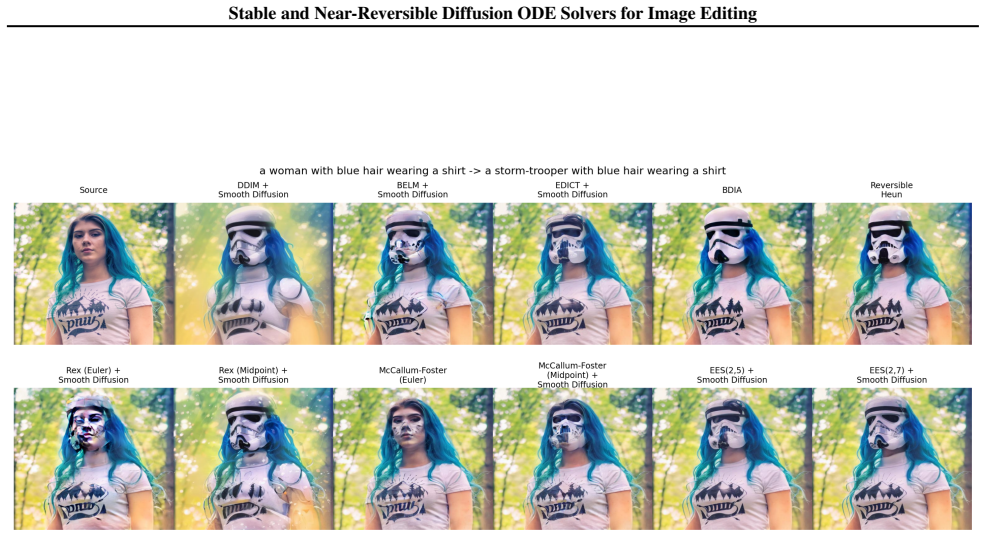
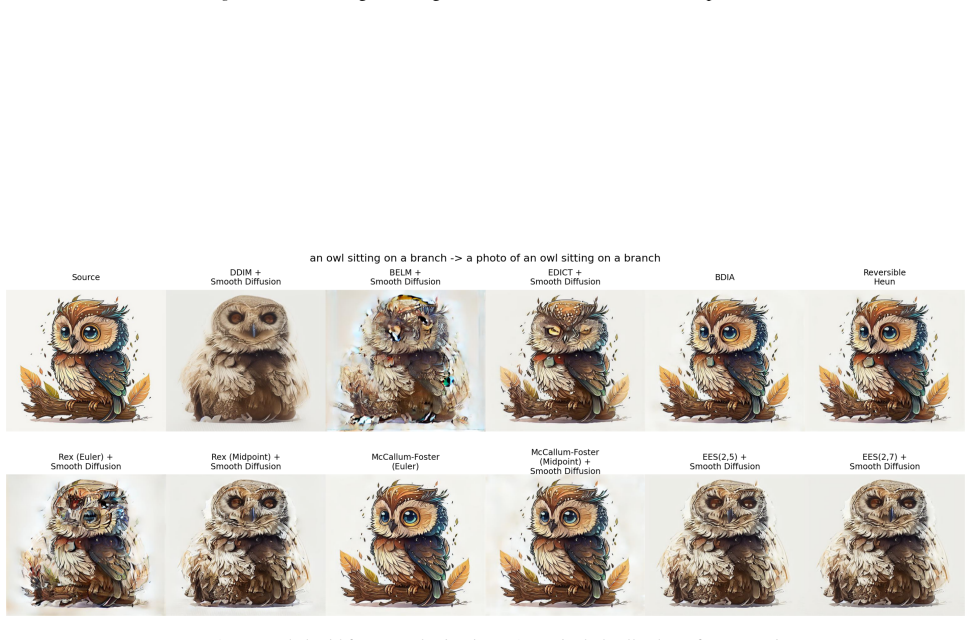
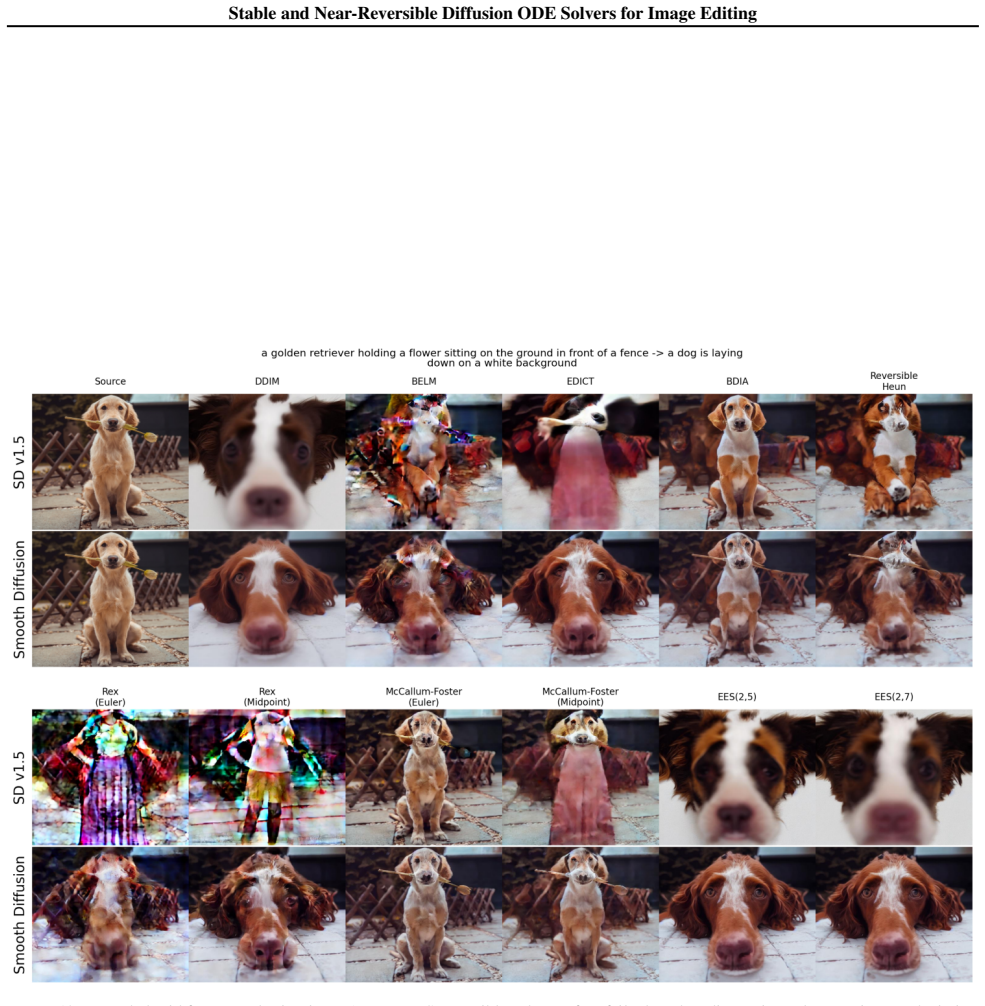
Algebraically reversible ODE solvers eliminate inversion error for diffusion-based image editing but exhibit instabilities under large edits that cause sharp quality drops. Near-reversible Runge-Kutta methods combined with vector-field smoothing mitigate these instabilities, improving edit fidelity and remaining stable for substantial changes while largely retaining the background-preservation benefits of reversible solvers.
What carries the argument
Near-reversible Runge-Kutta methods for diffusion ODEs that relax exact reversibility to improve numerical stability, used together with a vector-field smoothing strategy applied during inversion.
If this is right
- Large semantic or visual edits become feasible without the previous sharp drops in output quality.
- Text-guided edits achieve stronger alignment with the input prompt.
- Background elements remain largely unchanged, similar to results from reversible solvers.
- The method works with standard diffusion models for practical editing pipelines.
Where Pith is reading between the lines
- These solvers could extend to video editing to reduce temporal inconsistencies across frames.
- The degree of near-reversibility might be tuned automatically based on edit size for optimal results.
- Similar smoothing techniques could stabilize inversion in other ODE-based generative tasks.
Load-bearing premise
The instabilities seen with exactly reversible solvers are mainly numerical and can be fixed by relaxing exact reversibility without creating new problems that cancel the gains.
What would settle it
Experiments on diverse large-edit cases that still show instabilities, quality drops, or loss of background preservation with the near-reversible approach would disprove the claimed benefits.
Figures


read the original abstract
The inversion of diffusion models plays a central role in image editing. Algebraically reversible ODE solvers provide an appealing approach to diffusion inversion for text-guided image editing, by eliminating the inversion error inherent in DDIM-based editing pipelines. However, empirical results indicate that reversibility alone is insufficient. As edits require larger semantic or visual changes, reversible diffusion solvers often exhibit instabilities and suffer sharp drops in output quality. In this paper, we show that the trade-off between exact reversibility and numerical stability manifests empirically as a trade-off between background preservation and prompt alignment in image editing. We then investigate the use of near-reversible Runge-Kutta methods as a more stable alternative to exactly reversible diffusion schemes. When combined with a vector-field smoothing strategy, the resulting approach improves edit fidelity, remains stable under large edits, and largely retains the background-preservation benefits of reversible solvers.
Editorial analysis
A structured set of objections, weighed in public.
Referee Report
Summary. The paper claims that exactly reversible diffusion ODE solvers, while eliminating inversion error and preserving background in text-guided image editing, become unstable for large semantic edits; it proposes near-reversible Runge-Kutta methods plus vector-field smoothing as a practical alternative that improves edit fidelity and stability while largely retaining the background-preservation benefits.
Significance. If the empirical trade-off between exact reversibility and stability is validated with quantitative evidence, the work would supply a concrete engineering improvement for diffusion inversion pipelines that balances fidelity and robustness without requiring new model training.
major comments (2)
- [Abstract and §4] Abstract and §4 (Experiments): the central claim that near-reversible RK methods plus smoothing resolve instabilities rests on unshown quantitative metrics, ablation tables, or diagnostic plots separating numerical solver error from latent-space sensitivity to small trajectory deviations; without these the improvement cannot be assessed as load-bearing.
- [§3] §3 (Method): the assumption that observed instabilities are primarily numerical (and therefore fixable by relaxing exact reversibility) is not tested against the alternative that large prompt-driven edits amplify any inversion error through the diffusion ODE's inherent sensitivity; a controlled diagnostic (e.g., fixed prompt, varying solver tolerance) is needed to confirm the root cause.
minor comments (2)
- [§4.2] Figure captions and §4.2: add explicit definitions or references for the background-preservation and prompt-alignment metrics used in the qualitative comparisons.
- [§2] Notation in §2: the precise mathematical definition of 'near-reversibility' (e.g., the tolerance or step-size relaxation relative to exact reversibility) should be stated as an equation rather than described only in prose.
Simulated Author's Rebuttal
We thank the referee for the constructive feedback. We address each major comment below and have revised the manuscript to incorporate additional quantitative support and diagnostics where feasible.
read point-by-point responses
-
Referee: [Abstract and §4] Abstract and §4 (Experiments): the central claim that near-reversible RK methods plus smoothing resolve instabilities rests on unshown quantitative metrics, ablation tables, or diagnostic plots separating numerical solver error from latent-space sensitivity to small trajectory deviations; without these the improvement cannot be assessed as load-bearing.
Authors: We agree that stronger quantitative backing is needed to substantiate the central claim. The revised manuscript now includes quantitative metrics such as prompt alignment (CLIP similarity) and background preservation (PSNR and LPIPS on unchanged regions) evaluated across a range of edit strengths. We have added ablation tables comparing exact reversible solvers against near-reversible RK variants with and without vector-field smoothing. Diagnostic plots showing error accumulation and sensitivity to trajectory perturbations have also been included in the updated Section 4 and a new appendix to separate numerical solver effects from latent-space dynamics. revision: yes
-
Referee: [§3] §3 (Method): the assumption that observed instabilities are primarily numerical (and therefore fixable by relaxing exact reversibility) is not tested against the alternative that large prompt-driven edits amplify any inversion error through the diffusion ODE's inherent sensitivity; a controlled diagnostic (e.g., fixed prompt, varying solver tolerance) is needed to confirm the root cause.
Authors: We acknowledge the importance of isolating the root cause. In the revised Section 3, we have added a controlled diagnostic experiment that fixes the target prompt and systematically varies solver tolerance (including step size and integration order) during inversion and editing. The results indicate that instabilities scale with reduced numerical precision even under fixed prompts, supporting a substantial numerical contribution. We also discuss the interaction with the ODE's inherent sensitivity to prompt-driven changes and how the proposed smoothing strategy addresses both aspects. While perfect isolation of factors remains difficult due to their coupling in the diffusion process, the new experiment provides direct evidence for the role of numerical stability. revision: yes
Circularity Check
No significant circularity; empirical engineering proposal remains self-contained
full rationale
The paper's central contribution is an empirical observation that exact reversibility in diffusion ODE solvers trades off against numerical stability during large edits, followed by the proposal to use near-reversible Runge-Kutta methods plus vector-field smoothing. No derivation chain reduces any claimed result to a fitted parameter, self-defined quantity, or self-citation loop. The abstract explicitly frames the trade-off as manifesting 'empirically' and the solution as an 'investigation' of alternatives, without algebraic identities or uniqueness theorems that loop back to the inputs. The approach is presented as an engineering choice validated by results rather than a first-principles identity equivalent to its own assumptions.
Axiom & Free-Parameter Ledger
Lean theorems connected to this paper
-
IndisputableMonolith/Cost/FunctionalEquation.leanwashburn_uniqueness_aczel unclear?
unclearRelation between the paper passage and the cited Recognition theorem.
We propose using near-reversible EES Runge–Kutta methods... trade-off between exact reversibility and numerical stability manifests empirically as a trade-off between background preservation and prompt alignment
What do these tags mean?
- matches
- The paper's claim is directly supported by a theorem in the formal canon.
- supports
- The theorem supports part of the paper's argument, but the paper may add assumptions or extra steps.
- extends
- The paper goes beyond the formal theorem; the theorem is a base layer rather than the whole result.
- uses
- The paper appears to rely on the theorem as machinery.
- contradicts
- The paper's claim conflicts with a theorem or certificate in the canon.
- unclear
- Pith found a possible connection, but the passage is too broad, indirect, or ambiguous to say the theorem truly supports the claim.
Reference graph
Works this paper leans on
-
[1]
Explicit and Effectively Symmetric Runge-Kutta Methods
Explicit and Effectively Symmetric Runge-Kutta Methods , author=. arXiv preprint arXiv:2507.21006 , year=
work page internal anchor Pith review Pith/arXiv arXiv
-
[2]
Explicit and Effectively Symmetric Schemes for Neural SDEs on Lie Groups
Explicit and Effectively Symmetric Schemes for Neural SDEs , author=. arXiv preprint arXiv:2509.20599 , year=
work page internal anchor Pith review Pith/arXiv arXiv
-
[3]
arXiv preprint arXiv:2410.11648 , year=
Efficient, accurate and stable gradients for neural odes , author=. arXiv preprint arXiv:2410.11648 , year=
-
[4]
Rex: A Family of Reversible Exponential (Stochastic) Runge-Kutta Solvers , author=. 2026 , eprint=
work page 2026
-
[5]
Advances in Neural Information Processing Systems , volume=
Efficient and accurate gradients for neural sdes , author=. Advances in Neural Information Processing Systems , volume=
-
[6]
arXiv preprint arXiv:2102.04668 , year=
Mali: A memory efficient and reverse accurate integrator for neural odes , author=. arXiv preprint arXiv:2102.04668 , year=
-
[7]
Geometric numerical integration , author=. Oberwolfach Reports , volume=
-
[8]
Symplectic Geometric Algorithms for Hamiltonian Systems , pages=
Symplectic difference schemes for Hamiltonian systems , author=. Symplectic Geometric Algorithms for Hamiltonian Systems , pages=. 2010 , publisher=
work page 2010
-
[9]
Chartier, Philippe. Symmetric Methods. Encyclopedia of Applied and Computational Mathematics. 2015. doi:10.1007/978-3-540-70529-1_151
-
[10]
Advances in neural information processing systems , volume=
Neural ordinary differential equations , author=. Advances in neural information processing systems , volume=
-
[11]
BIT Numerical Mathematics , volume=
Symmetric general linear methods , author=. BIT Numerical Mathematics , volume=. 2016 , publisher=
work page 2016
-
[12]
Path integral sampler: a stochastic control approach for sam- pling.arXiv preprint arXiv:2111.15141,
Path integral sampler: a stochastic control approach for sampling , author=. arXiv preprint arXiv:2111.15141 , year=
-
[13]
2025 IEEE/CVF Winter Conference on Applications of Computer Vision (WACV) , pages=
Negative-prompt inversion: Fast image inversion for editing with text-guided diffusion models , author=. 2025 IEEE/CVF Winter Conference on Applications of Computer Vision (WACV) , pages=. 2025 , organization=
work page 2025
-
[14]
arXiv preprint arXiv:2306.05414 , year=
Improving tuning-free real image editing with proximal guidance , author=. arXiv preprint arXiv:2306.05414 , year=
-
[15]
Proceedings of the IEEE/CVF Conference on Computer Vision and Pattern Recognition , pages=
Smooth diffusion: Crafting smooth latent spaces in diffusion models , author=. Proceedings of the IEEE/CVF Conference on Computer Vision and Pattern Recognition , pages=
-
[16]
Denoising Diffusion Implicit Models
Denoising diffusion implicit models , author=. arXiv preprint arXiv:2010.02502 , year=
work page internal anchor Pith review Pith/arXiv arXiv 2010
-
[17]
Proceedings of the IEEE/CVF conference on computer vision and pattern recognition , pages=
Null-text inversion for editing real images using guided diffusion models , author=. Proceedings of the IEEE/CVF conference on computer vision and pattern recognition , pages=
-
[18]
Proceedings of the IEEE/CVF Conference on Computer Vision and Pattern Recognition , pages=
Edict: Exact diffusion inversion via coupled transformations , author=. Proceedings of the IEEE/CVF Conference on Computer Vision and Pattern Recognition , pages=
-
[19]
European Conference on Computer Vision , pages=
Exact diffusion inversion via bidirectional integration approximation , author=. European Conference on Computer Vision , pages=. 2024 , organization=
work page 2024
-
[20]
Advances in Neural Information Processing Systems , volume=
Belm: Bidirectional explicit linear multi-step sampler for exact inversion in diffusion models , author=. Advances in Neural Information Processing Systems , volume=
-
[21]
Direct inversion: Boosting diffusion-based editing with 3 lines of code , author=. arXiv preprint arXiv:2310.01506 , year=
-
[22]
Machine Intelligence Research , pages=
Dpm-solver++: Fast solver for guided sampling of diffusion probabilistic models , author=. Machine Intelligence Research , pages=. 2025 , publisher=
work page 2025
-
[23]
European conference on computer vision , pages=
Microsoft coco: Common objects in context , author=. European conference on computer vision , pages=. 2014 , organization=
work page 2014
-
[24]
Proceedings of the IEEE/CVF Conference on Computer Vision and Pattern Recognition (CVPR) , month =
Rombach, Robin and Blattmann, Andreas and Lorenz, Dominik and Esser, Patrick and Ommer, Bj\"orn , title =. Proceedings of the IEEE/CVF Conference on Computer Vision and Pattern Recognition (CVPR) , month =. 2022 , pages =
work page 2022
-
[25]
Proceedings of the IEEE/CVF Conference on Computer Vision and Pattern Recognition , pages=
Splicing vit features for semantic appearance transfer , author=. Proceedings of the IEEE/CVF Conference on Computer Vision and Pattern Recognition , pages=
-
[26]
Proceedings of the IEEE conference on computer vision and pattern recognition , pages=
The unreasonable effectiveness of deep features as a perceptual metric , author=. Proceedings of the IEEE conference on computer vision and pattern recognition , pages=
-
[27]
IEEE transactions on image processing , volume=
Image quality assessment: from error visibility to structural similarity , author=. IEEE transactions on image processing , volume=. 2004 , publisher=
work page 2004
-
[28]
Godiva: Generating open- domain videos from natural descriptions.arXiv preprint arXiv:2104.14806,
Godiva: Generating open-domain videos from natural descriptions , author=. arXiv preprint arXiv:2104.14806 , year=
-
[29]
Advances in neural information processing systems , volume=
Dpm-solver: A fast ode solver for diffusion probabilistic model sampling in around 10 steps , author=. Advances in neural information processing systems , volume=
-
[30]
Prompt-to-Prompt Image Editing with Cross Attention Control
Prompt-to-prompt image editing with cross attention control , author=. arXiv preprint arXiv:2208.01626 , year=
work page internal anchor Pith review Pith/arXiv arXiv
-
[31]
International conference on machine learning , pages=
Deep unsupervised learning using nonequilibrium thermodynamics , author=. International conference on machine learning , pages=. 2015 , organization=
work page 2015
-
[32]
Advances in neural information processing systems , volume=
Denoising diffusion probabilistic models , author=. Advances in neural information processing systems , volume=
-
[33]
Score-Based Generative Modeling through Stochastic Differential Equations
Score-based generative modeling through stochastic differential equations , author=. arXiv preprint arXiv:2011.13456 , year=
work page internal anchor Pith review Pith/arXiv arXiv 2011
-
[34]
Advances in neural information processing systems , volume=
Variational diffusion models , author=. Advances in neural information processing systems , volume=
-
[35]
NeurIPS 2021 Workshop on Deep Generative Models and Downstream Applications , year=
Classifier-Free Diffusion Guidance , author=. NeurIPS 2021 Workshop on Deep Generative Models and Downstream Applications , year=
work page 2021
-
[36]
Proceedings of the IEEE/CVF international conference on computer vision , pages=
Masactrl: Tuning-free mutual self-attention control for consistent image synthesis and editing , author=. Proceedings of the IEEE/CVF international conference on computer vision , pages=
-
[37]
ACM SIGGRAPH 2023 conference proceedings , pages=
Zero-shot image-to-image translation , author=. ACM SIGGRAPH 2023 conference proceedings , pages=
work page 2023
-
[38]
Proceedings of the IEEE/CVF conference on computer vision and pattern recognition , pages=
Plug-and-play diffusion features for text-driven image-to-image translation , author=. Proceedings of the IEEE/CVF conference on computer vision and pattern recognition , pages=
-
[39]
Advances in neural information processing systems , volume=
Generative modeling by estimating gradients of the data distribution , author=. Advances in neural information processing systems , volume=
-
[40]
GLIDE: Towards Photorealistic Image Generation and Editing with Text-Guided Diffusion Models
Glide: Towards photorealistic image generation and editing with text-guided diffusion models , author=. arXiv preprint arXiv:2112.10741 , year=
work page internal anchor Pith review Pith/arXiv arXiv
-
[41]
Mathematica Scandinavica , pages=
Convergence and stability in the numerical integration of ordinary differential equations , author=. Mathematica Scandinavica , pages=. 1956 , publisher=
work page 1956
-
[42]
BIT Numerical Mathematics , volume=
A special stability problem for linear multistep methods , author=. BIT Numerical Mathematics , volume=. 1963 , publisher=
work page 1963
-
[43]
SDEdit: Guided Image Synthesis and Editing with Stochastic Differential Equations
Sdedit: Guided image synthesis and editing with stochastic differential equations , author=. arXiv preprint arXiv:2108.01073 , year=
work page internal anchor Pith review Pith/arXiv arXiv
-
[44]
Proceedings of the IEEE/CVF international conference on computer vision , pages=
Adding conditional control to text-to-image diffusion models , author=. Proceedings of the IEEE/CVF international conference on computer vision , pages=
-
[45]
Proceedings of the IEEE/CVF conference on computer vision and pattern recognition , pages=
Repaint: Inpainting using denoising diffusion probabilistic models , author=. Proceedings of the IEEE/CVF conference on computer vision and pattern recognition , pages=
-
[46]
International conference on machine learning , pages=
Learning transferable visual models from natural language supervision , author=. International conference on machine learning , pages=. 2021 , organization=
work page 2021
-
[47]
Advances in neural information processing systems , volume=
Pick-a-pic: An open dataset of user preferences for text-to-image generation , author=. Advances in neural information processing systems , volume=
-
[48]
Advances in Neural Information Processing Systems , volume=
Imagereward: Learning and evaluating human preferences for text-to-image generation , author=. Advances in Neural Information Processing Systems , volume=
-
[49]
SDXL: Improving Latent Diffusion Models for High-Resolution Image Synthesis
Sdxl: Improving latent diffusion models for high-resolution image synthesis , author=. arXiv preprint arXiv:2307.01952 , year=
work page internal anchor Pith review Pith/arXiv arXiv
-
[50]
arXiv preprint arXiv:2410.23530 , year=
There and back again: On the relation between noise and image inversions in diffusion models , author=. arXiv preprint arXiv:2410.23530 , year=
discussion (0)
Sign in with ORCID, Apple, or X to comment. Anyone can read and Pith papers without signing in.