Impact of sky localization uncertainty on ringdown inference
Pith reviewed 2026-05-20 08:48 UTC · model grok-4.3
The pith
Fixing sky location to a point estimate in ringdown analyses artificially narrows uncertainties on quasinormal-mode amplitudes.
A machine-rendered reading of the paper's core claim, the machinery that carries it, and where it could break.
Core claim
Fixing sky localization to a point estimate from the full signal breaks degeneracies and underestimates the uncertainty on quasinormal-mode amplitudes; joint sampling with uninformative priors or use of informed priors drawn from the full-signal posterior produces wider marginal posteriors on amplitudes while keeping amplitude ratios consistent.
What carries the argument
Joint sampling of sky position, polarization, and inclination together with remnant black-hole parameters and quasinormal-mode amplitudes and phases inside the ringdown likelihood.
Load-bearing premise
That either uninformative priors or priors taken from the full-signal posterior capture the relevant degeneracies without adding new biases to the ringdown-only likelihood.
What would settle it
Re-analyze a set of simulated ringdown signals with known sky locations using both fixed-sky and jointly sampled extrinsic parameters and check whether the recovered amplitude uncertainties match the expected increase.
Figures


read the original abstract
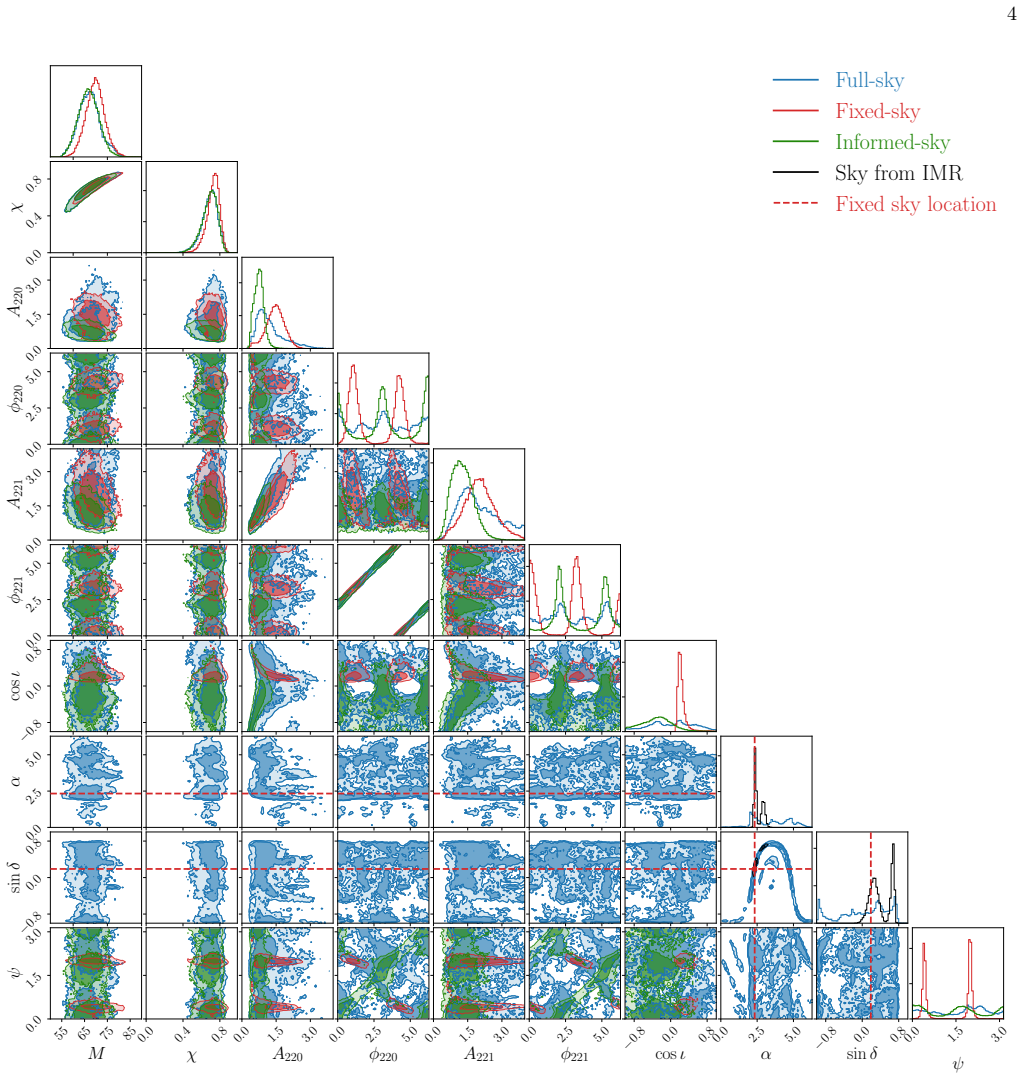
As gravitational-wave ringdown signals grow louder, quasinormal-mode inference depends increasingly on the treatment of extrinsic parameters. Standard analyses fix sky localization - and sometimes also polarization and inclination - to point estimates from a prior inspiral-merger-ringdown analysis, artificially breaking degeneracies and underestimating the true uncertainty of mode-amplitude values. We test two alternatives: uninformative priors on the extrinsic parameters, sampled jointly with the remnant mass, spin, mode amplitudes, and phases; and informed priors on sky position from the full signal posterior. The former yields wider marginal constraints on amplitude posteriors, and both avoid potential bias introduced by fixing the sky localization. In contrast, mode amplitude ratios remain consistent across approaches, making them a robust observable for Kerr spectroscopy. Our publicly available pipeline enables fast ringdown analyses capable of sampling all parameters, requiring tens of minutes on a laptop for a full inference. Applied to GW250114 and GW190521, our methods confirm the robust detection of the $(2,2,1)$ overtone in GW250114, and, for GW190521, find only mild evidence for the $(3,3,0)$ mode.
Editorial analysis
A structured set of objections, weighed in public.
Referee Report
Summary. The paper claims that standard ringdown analyses, which fix sky localization (and sometimes polarization/inclination) to point estimates from a prior full-signal analysis, artificially break degeneracies and underestimate uncertainties in quasinormal-mode amplitudes. It tests two alternatives—joint sampling with uninformative priors on extrinsic parameters, and informed priors drawn from the full-signal posterior—on GW250114 and GW190521. Both alternatives yield wider marginal amplitude posteriors and avoid potential bias from fixed sky position, while amplitude ratios remain consistent across methods and support robust Kerr spectroscopy. A publicly available pipeline enables fast full-parameter ringdown inference.
Significance. If the central results hold, the work is significant for highlighting a systematic underestimation of uncertainties in ringdown parameter estimation as signals strengthen, and for demonstrating that mode-amplitude ratios are robust observables. The public pipeline for sampling all parameters in tens of minutes on a laptop is a practical strength that supports reproducibility. Application to real events (confirming the (2,2,1) overtone in GW250114 and mild evidence for (3,3,0) in GW190521) provides concrete, falsifiable demonstrations.
major comments (2)
- [Methods and Results sections (informed-prior implementation)] The central claim that informed priors from the full-signal posterior avoid bias while correctly capturing extrinsic degeneracies for the ringdown-only likelihood is load-bearing but rests on an untested assumption. Because the full-signal posterior encodes sky-position correlations driven by inspiral and merger antenna patterns (different from the damped-sinusoid ringdown likelihood), feeding it as a prior risks importing inconsistent correlations that could either bias or artificially inflate the marginal amplitude posteriors. This needs explicit validation, e.g., via injection studies comparing the informed-prior posterior against a true ringdown-only ground truth.
- [Results for GW250114 and GW190521] The manuscript reports that amplitude ratios remain consistent across the three approaches, but without quantitative comparison of the ratio posteriors (e.g., overlap integrals or credible-interval widths) it is unclear whether the consistency is merely qualitative or statistically robust enough to support the claim that ratios are a reliable observable for Kerr spectroscopy.
minor comments (2)
- [Methods] Clarify the exact data-selection window and tapering used for the ringdown-only likelihood; this detail is essential for reproducibility of the reported posteriors.
- [Results] The abstract states 'wider posteriors when sky position varies' but the main text should explicitly tabulate the 90% credible-interval widths for the dominant-mode amplitudes under each prior choice for direct comparison.
Simulated Author's Rebuttal
We thank the referee for the constructive comments and the recommendation for major revision. We address each major comment point by point below, agreeing where revisions are warranted to strengthen the manuscript.
read point-by-point responses
-
Referee: [Methods and Results sections (informed-prior implementation)] The central claim that informed priors from the full-signal posterior avoid bias while correctly capturing extrinsic degeneracies for the ringdown-only likelihood is load-bearing but rests on an untested assumption. Because the full-signal posterior encodes sky-position correlations driven by inspiral and merger antenna patterns (different from the damped-sinusoid ringdown likelihood), feeding it as a prior risks importing inconsistent correlations that could either bias or artificially inflate the marginal amplitude posteriors. This needs explicit validation, e.g., via injection studies comparing the informed-prior posterior against a true ringdown-only ground truth.
Authors: We agree that this is an important point and that the assumption requires validation. The informed prior is used to marginalize over the uncertainty in sky localization informed by the full signal, which is reasonable given that the ringdown provides weak constraints on extrinsic parameters. Nevertheless, to directly address the concern about potential inconsistent correlations, we will perform and include injection studies in the revised manuscript. These studies will involve generating simulated ringdown signals with known sky positions and amplitudes, analyzing them with the informed-prior method, and comparing the recovered posteriors to the known ground truth to assess any bias or inflation in uncertainties. revision: yes
-
Referee: [Results for GW250114 and GW190521] The manuscript reports that amplitude ratios remain consistent across the three approaches, but without quantitative comparison of the ratio posteriors (e.g., overlap integrals or credible-interval widths) it is unclear whether the consistency is merely qualitative or statistically robust enough to support the claim that ratios are a reliable observable for Kerr spectroscopy.
Authors: We concur that adding quantitative metrics will better substantiate the robustness of the amplitude ratios. In the revised manuscript, we will compute the overlap integrals between the posterior distributions of the amplitude ratios from the different sampling approaches. We will also tabulate and compare the widths of the credible intervals for these ratios. These additions will provide a statistical basis for claiming that the ratios are consistent and thus reliable for Kerr spectroscopy. revision: yes
Circularity Check
No circularity: empirical posterior sampling on real data
full rationale
The paper performs direct Bayesian sampling of ringdown posteriors on actual detector data (GW250114, GW190521) under three treatments of extrinsic parameters: fixed point estimates, uninformative joint priors, and informed priors drawn from the full-signal posterior. All reported outcomes—wider amplitude uncertainties, consistent mode ratios, and mode detections—are numerical results of the sampling procedure itself. No algebraic derivation, parameter fit, or self-referential definition is claimed or used; the comparisons are external to any equation within the paper and are benchmarked against real strain data. The analysis is therefore self-contained and does not reduce any claimed result to its own inputs by construction.
Axiom & Free-Parameter Ledger
axioms (2)
- domain assumption The ringdown waveform is accurately described by a linear superposition of Kerr quasinormal modes with amplitudes and phases as free parameters.
- standard math Standard Bayesian sampling (e.g., nested sampling or MCMC) correctly explores the joint posterior over intrinsic and extrinsic parameters.
Lean theorems connected to this paper
-
IndisputableMonolith/Foundation/RealityFromDistinction.leanreality_from_one_distinction unclear?
unclearRelation between the paper passage and the cited Recognition theorem.
We investigate the impact of the sky-position treatment on ringdown inference, comparing three approaches: Fixed-sky... Full-sky... Informed-sky...
What do these tags mean?
- matches
- The paper's claim is directly supported by a theorem in the formal canon.
- supports
- The theorem supports part of the paper's argument, but the paper may add assumptions or extra steps.
- extends
- The paper goes beyond the formal theorem; the theorem is a base layer rather than the whole result.
- uses
- The paper appears to rely on the theorem as machinery.
- contradicts
- The paper's claim conflicts with a theorem or certificate in the canon.
- unclear
- Pith found a possible connection, but the passage is too broad, indirect, or ambiguous to say the theorem truly supports the claim.
Reference graph
Works this paper leans on
-
[1]
Black Hole Spectroscopy: Testing General Relativity through Gravitational Wave Observations
O. Dreyer, B. J. Kelly, B. Krishnan, L. S. Finn, D. Garrison, and R. Lopez-Aleman, “Black hole spectroscopy: Testing general relativity through gravitational wave observations,” Class. Quant. Grav. 21(2004) 787–804,arXiv:gr-qc/0309007
work page internal anchor Pith review Pith/arXiv arXiv 2004
-
[2]
On gravitational-wave spectroscopy of massive black holes with the space interferometer LISA
E. Berti, V. Cardoso, and C. M. Will, “On gravitational-wave spectroscopy of massive black holes with the space interferometer LISA,” Phys. Rev. D73 (2006) 064030,arXiv:gr-qc/0512160
work page internal anchor Pith review Pith/arXiv arXiv 2006
-
[3]
Quasinormal modes of black holes and black branes
E. Berti, V. Cardoso, and A. O. Starinets, “Quasinormal modes of black holes and black branes,” Class. Quant. Grav.26(2009) 163001, arXiv:0905.2975 [gr-qc]
work page internal anchor Pith review Pith/arXiv arXiv 2009
-
[4]
Spectroscopy of Kerr black holes with Earth- and space-based interferometers
E. Berti, A. Sesana, E. Barausse, V. Cardoso, and K. Belczynski, “Spectroscopy of Kerr black holes with Earth- and space-based interferometers,” Phys. Rev. Lett.117no. 10, (2016) 101102,arXiv:1605.09286 [gr-qc]
work page internal anchor Pith review Pith/arXiv arXiv 2016
-
[5]
S. Bhagwat, C. Pacilio, E. Barausse, and P. Pani, “Landscape of massive black-hole spectroscopy with LISA and the Einstein Telescope,” Phys. Rev. D105 no. 12, (2022) 124063,arXiv:2201.00023 [gr-qc]
-
[6]
Black hole spectroscopy: from theory to experiment
J. Abedi et al., “Black hole spectroscopy: from theory to experiment,”arXiv:2505.23895 [gr-qc]
work page internal anchor Pith review Pith/arXiv arXiv
-
[7]
Black hole ringdown: the importance of overtones,
M. Giesler, M. Isi, M. A. Scheel, and S. Teukolsky, “Black Hole Ringdown: The Importance of Overtones,” Phys. Rev. X9no. 4, (2019) 041060,arXiv:1903.08284 [gr-qc]. 7 0.0 0.4 0.8 χ 0.0 1.5 3.0 A220 0.0 2.5 5.0 φ220 0 2 4 A221 0.0 2.5 5.0 φ221 −0.8 0.0 0.8 cos ι 0.0 2.5 5.0 α −0.8 0.0 0.8 sin δ 55 65 75 85 M 0.0 1.5 3.0 ψ 0.0 0.4 0.8 χ 0.0 1.5 3.0 A220 0.0 ...
-
[8]
Testing the no-hair theorem with GW150914
M. Isi, M. Giesler, W. M. Farr, M. A. Scheel, and S. A. Teukolsky, “Testing the no-hair theorem with GW150914,” Phys. Rev. Lett.123no. 11, (2019) 111102,arXiv:1905.00869 [gr-qc]
work page internal anchor Pith review Pith/arXiv arXiv 2019
-
[9]
R. Cotesta, G. Carullo, E. Berti, and V. Cardoso, “Analysis of Ringdown Overtones in GW150914,” Phys. Rev. Lett.129no. 11, (2022) 111102, arXiv:2201.00822 [gr-qc]
-
[10]
Revisiting the ringdown of GW150914,
M. Isi and W. M. Farr, “Revisiting the ringdown of GW150914,”arXiv:2202.02941 [gr-qc]
-
[11]
Searching for a ringdown overtone in GW150914,
E. Finch and C. J. Moore, “Searching for a ringdown overtone in GW150914,” Phys. Rev. D106no. 4, (2022) 043005,arXiv:2205.07809 [gr-qc]
-
[12]
Neural posterior estimation with guaranteed exact coverage: The ringdown of GW150914,
M. Crisostomi, K. Dey, E. Barausse, and R. Trotta, “Neural posterior estimation with guaranteed exact coverage: The ringdown of GW150914,” Phys. Rev. D 8 0.0 0.4 0.8 χ 0 2 4 A220 0.0 2.5 5.0 φ220 0.0 0.5 1.0 A330 0.0 2.5 5.0 φ330 −0.8 0.0 0.8 cos ι 0.0 2.5 5.0 α −0.8 0.0 0.8 sin δ 240 280 320 M 0.0 1.5 3.0 ψ 0.0 0.4 0.8 χ 0 2 4 A220 0.0 2.5 5.0 φ220 0.0 0...
-
[13]
Y.-F. Wang, C. D. Capano, J. Abedi, S. Kastha, B. Krishnan, A. B. Nielsen, A. H. Nitz, and J. Westerweck, “Gating-and-inpainting perspective on GW150914 ringdown overtone: Understanding the data analysis systematics,” Phys. Rev. D112no. 8, (2025) 083023,arXiv:2310.19645 [gr-qc]
-
[14]
A. Correia, Y.-F. Wang, J. Westerweck, and C. D. Capano, “Low evidence for ringdown overtone in GW150914 when marginalizing over time and sky location uncertainty,” Phys. Rev. D110no. 4, (2024) L041501,arXiv:2312.14118 [gr-qc]
-
[15]
C. D. Capano, M. Cabero, J. Westerweck, J. Abedi, S. Kastha, A. H. Nitz, Y.-F. Wang, A. B. Nielsen, and B. Krishnan, “Multimode Quasinormal Spectrum from a Perturbed Black Hole,” Phys. Rev. Lett.131no. 22, 9 0.5 1.0 1.5 2.0 A221/A220 Full-sky Fixed-sky (a) 0.2 0.4 0.6 0.8 A330/A220 Full-sky Fixed-sky (b) FIG. 7. Posteriors (68% shaded region) of the mode-...
-
[16]
Searching for ringdown higher modes with a numerical relativity-informed post-merger model,
V. Gennari, G. Carullo, and W. Del Pozzo, “Searching for ringdown higher modes with a numerical relativity-informed post-merger model,” Eur. Phys. J. C 84no. 3, (2024) 233,arXiv:2312.12515 [gr-qc]. [17]LIGO Scientific, VIRGO, KAGRACollaboration, R. Abbott et al., “Tests of General Relativity with GWTC-3,” Phys. Rev. D112no. 8, (2025) 084080, arXiv:2112.06...
-
[17]
A nonlinear voice from GW250114 ringdown,
Y.-F. Wang, S. Ma, N. Khera, and H. Yang, “A nonlinear voice from GW250114 ringdown,” arXiv:2601.05734 [gr-qc]
-
[18]
Observational Black Hole Spectroscopy: A time-domain multimode analysis of GW150914
G. Carullo, W. Del Pozzo, and J. Veitch, “Observational Black Hole Spectroscopy: A time-domain multimode analysis of GW150914,” Phys. Rev. D99no. 12, (2019) 123029,arXiv:1902.07527 [gr-qc]. [Erratum: Phys.Rev.D 100, 089903 (2019)]
work page internal anchor Pith review Pith/arXiv arXiv 2019
-
[19]
Frequency-domain analysis of black-hole ringdowns,
E. Finch and C. J. Moore, “Frequency-domain analysis of black-hole ringdowns,” Phys. Rev. D104no. 12, (2021) 123034,arXiv:2108.09344 [gr-qc]
-
[20]
Gravitational Wave Ringdown Analysis Using the F-statistic,
H.-T. Wang, G. Yim, X. Chen, and L. Shao, “Gravitational Wave Ringdown Analysis Using the F-statistic,” Astrophys. J.974no. 2, (2024) 230, arXiv:2409.00970 [gr-qc]
- [21]
-
[22]
Nested sampling for general Bayesian computation,
J. Skilling, “Nested sampling for general Bayesian computation,” Bayesian Anal.1no. 4, (2006) 833–859
work page 2006
-
[23]
JAXNS: a high-performance nested sampling package based on JAX,
J. G. Albert, “JAXNS: a high-performance nested sampling package based on JAX,”arXiv:2012.15286 [astro-ph.IM]. [28]https://git.ligo.org/lscsoft/lalsuite
-
[24]
Ringdown of GW190521: Hints of multiple quasinormal modes with a precessional interpretation,
H. Siegel, M. Isi, and W. M. Farr, “Ringdown of GW190521: Hints of multiple quasinormal modes with a precessional interpretation,” Phys. Rev. D108no. 6, (2023) 064008,arXiv:2307.11975 [gr-qc]
-
[25]
2008, Contemporary Physics, 49, 71, doi: 10.1080/00107510802066753
R. Trotta, “Bayes in the sky: Bayesian inference and model selection in cosmology,” Contemporary Physics 49no. 2, (Mar., 2008) 71–104. http://dx.doi.org/10.1080/00107510802066753
-
[26]
Novel Ringdown Amplitude-Phase Consistency Test,
X. J. Forteza, S. Bhagwat, S. Kumar, and P. Pani, “Novel Ringdown Amplitude-Phase Consistency Test,” Phys. Rev. Lett.130no. 2, (2023) 021001, arXiv:2205.14910 [gr-qc]
-
[27]
Nonlinear quasinormal mode detectability with next-generation gravitational wave detectors,
S. Yi, A. Kuntz, E. Barausse, E. Berti, M. H.-Y. Cheung, K. Kritos, and A. Maselli, “Nonlinear quasinormal mode detectability with next-generation gravitational wave detectors,” Phys. Rev. D109no. 12, (2024) 124029,arXiv:2403.09767 [gr-qc]
-
[28]
Systematic bias in LISA ringdown analysis due to waveform inaccuracy,
L. Capuano, M. Vaglio, R. S. Chandramouli, C. L. Pitte, A. Kuntz, and E. Barausse, “Systematic bias in LISA ringdown analysis due to waveform inaccuracy,” Phys. Rev. D112no. 10, (2025) 104031, arXiv:2506.21181 [gr-qc]
- [29]
-
[30]
K. Dey, M. Crisostomi, R. Trotta, and E. Barausse, May, 2026. https://doi.org/10.5281/zenodo.20089762
discussion (0)
Sign in with ORCID, Apple, or X to comment. Anyone can read and Pith papers without signing in.