Cosmology from Synergies Between SKAO Surveys and Gravitational Wave Observations
Pith reviewed 2026-06-25 19:32 UTC · model grok-4.3
The pith
SKA radio surveys can supply redshifts to gravitational wave standard sirens, constraining the cosmic expansion history H(z) and H0.
A machine-rendered reading of the paper's core claim, the machinery that carries it, and where it could break.
Core claim
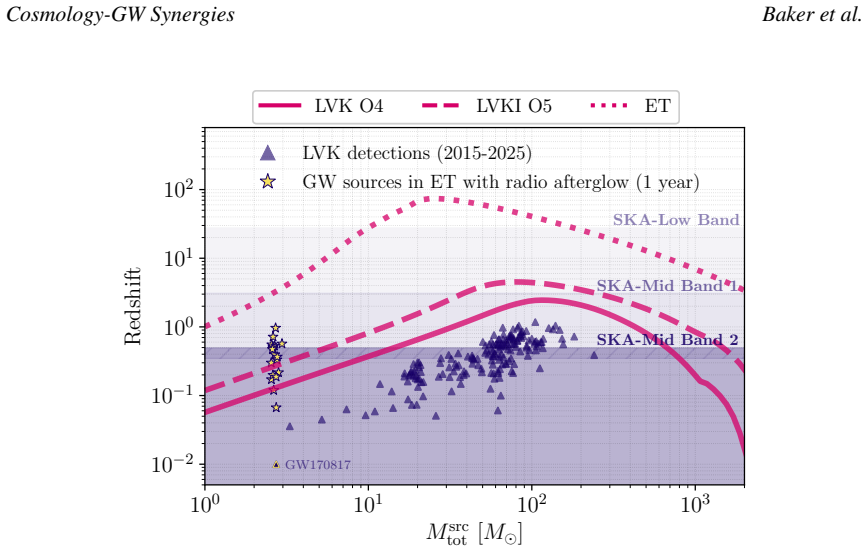
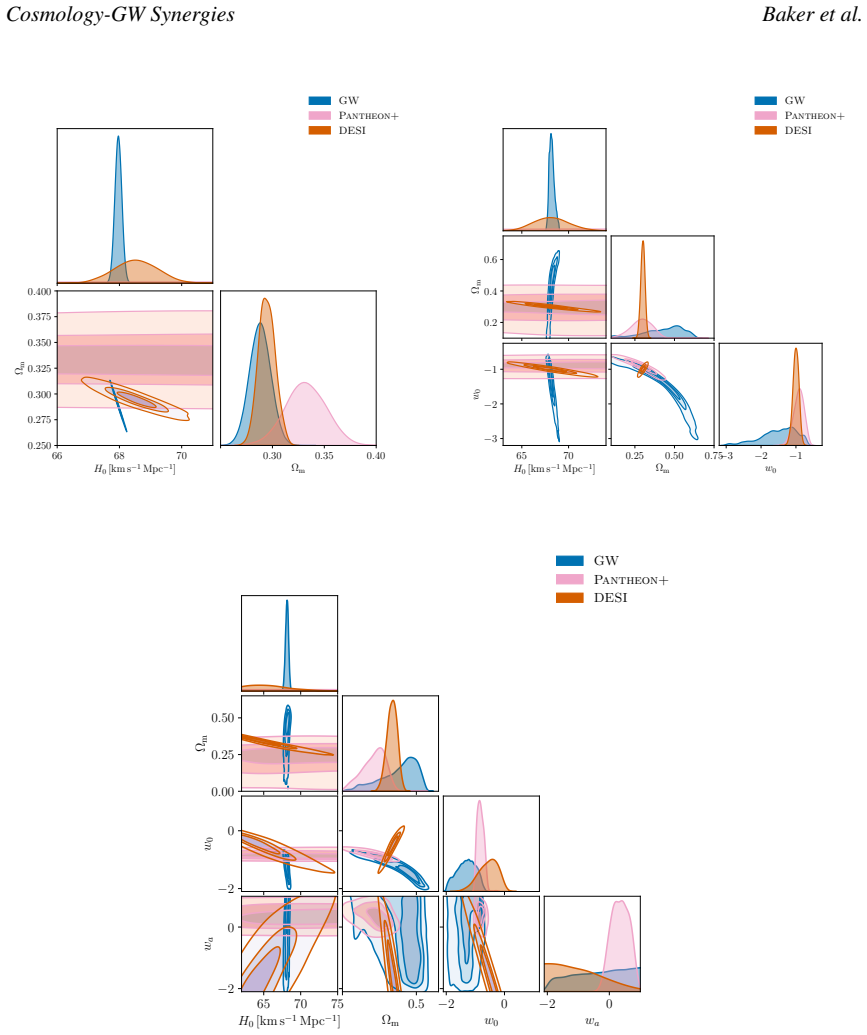
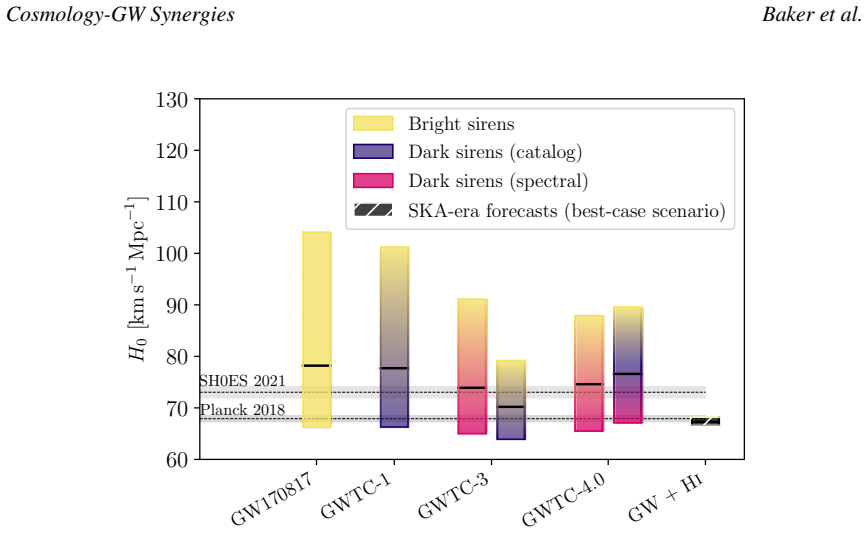
By using SKA-Mid HI intensity maps, HI galaxy redshift surveys, and continuum galaxy surveys as electromagnetic tracers of large-scale structure, redshifts can be assigned to gravitational wave standard sirens. This linkage converts luminosity distances into a measurement of the expansion history H(z) and provides constraints on the Hubble constant H0, with radio surveys offering unique high-redshift and large-volume coverage compared to contemporaneous optical surveys.
What carries the argument
Radio large-scale structure tracers (HI intensity maps, HI galaxy surveys, continuum surveys) matched to GW events to furnish redshifts for standard sirens.
If this is right
- Direct constraints on H(z) over a wide redshift range using GW luminosity distances.
- Improved determination of H0 through the radio-GW combination.
- Complementary high-redshift information that augments optical survey coverage.
- Cosmological constraints with systematics independent of traditional electromagnetic probes.
Where Pith is reading between the lines
- The method could be tested on existing GW catalogs by searching for spatial correlations with SKA precursor survey fields.
- If successful, the same matching technique might extend to future GW detectors and other radio facilities for even higher-redshift reach.
- Cross-checks against baryon acoustic oscillation measurements at overlapping redshifts would strengthen the case for the approach.
Load-bearing premise
Radio tracers from SKAO can be matched to GW sources to provide accurate, unbiased redshifts without significant selection effects or contamination.
What would settle it
Detection of large systematic offsets between the H(z) derived from matched radio-GW pairs and independent measurements from other probes, or failure to find sufficient clean matches in overlapping sky areas.
Figures
read the original abstract
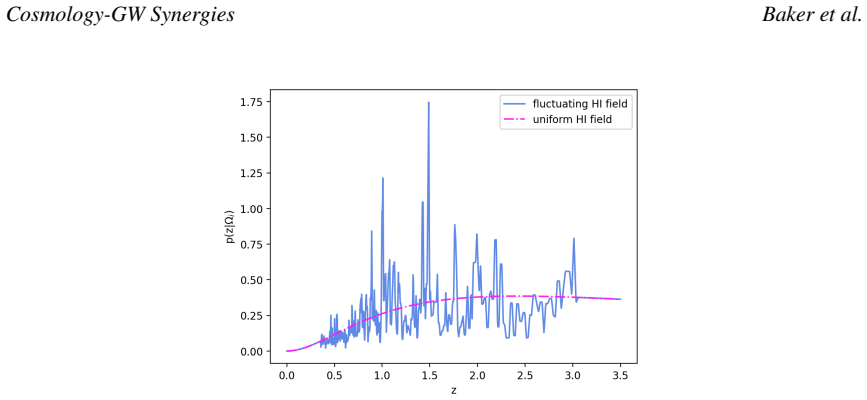
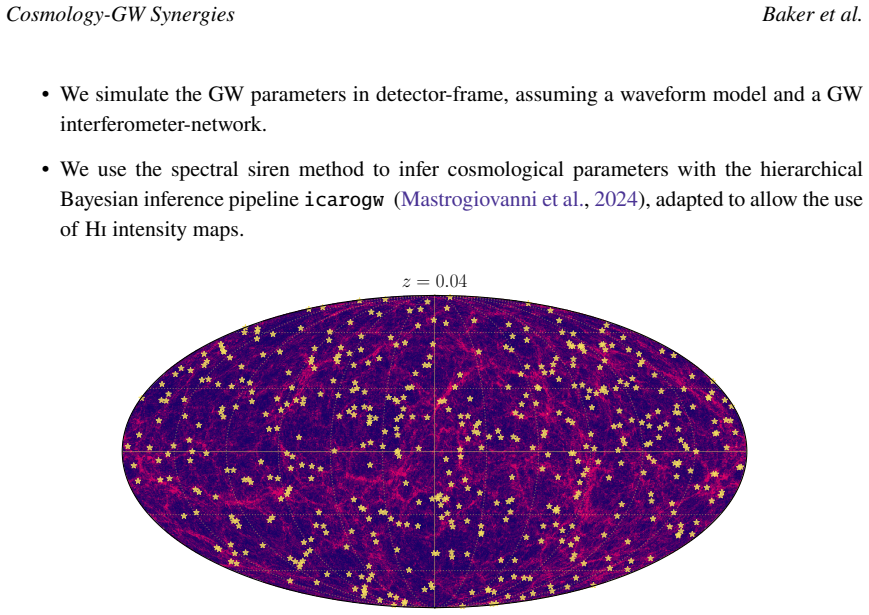
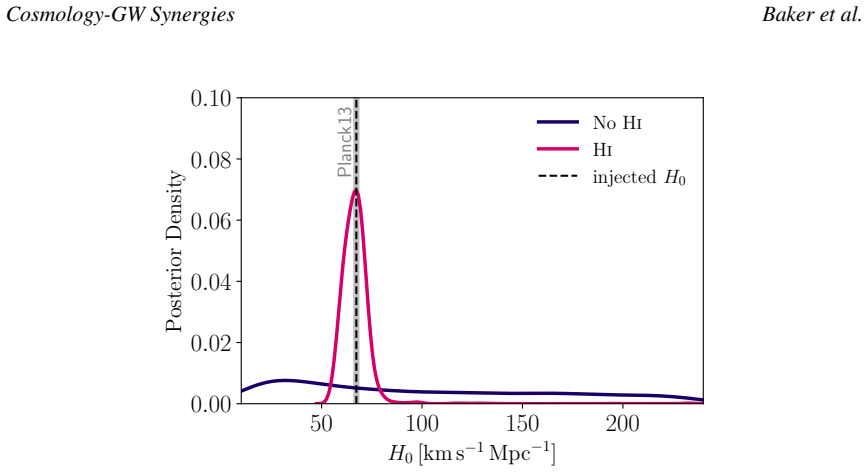
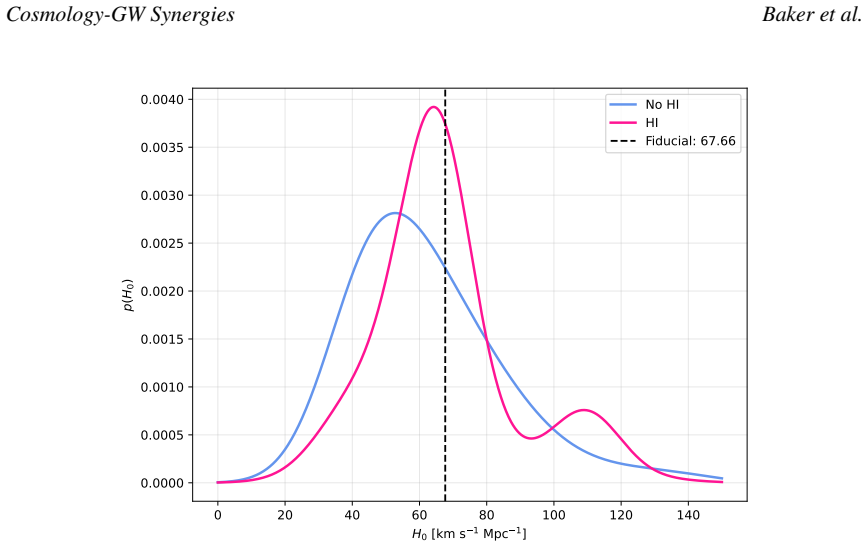
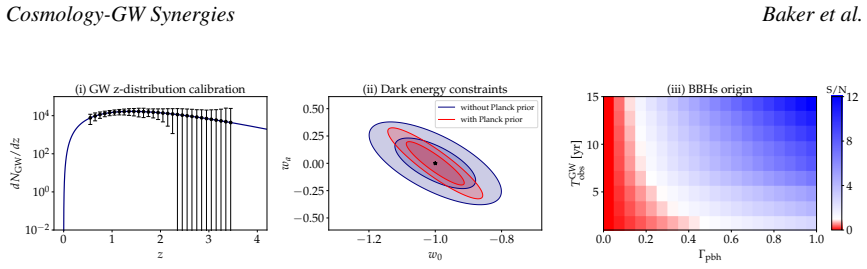
Both radio surveys and gravitational wave observations have the potential to probe unprecedented volumes in the Universe with systematics independent of existing cosmological probes. This gives them the potential, especially in combination, to solve some of the outstanding issues in cosmology. Here we show how the use of radio observations as electromagnetic signals tracing large scale structures can be used to provide information on gravitational wave \textit{standard sirens}. By providing a way to link luminosity distance to redshift, this combination can constrain the expansion history of the Universe, and provide information on the Hubble constant ($H_0$). We describe the utility of SKA-Mid neutral hydrogen (\hi) intensity maps, \hi\ galaxy redshift surveys, and continuum galaxy surveys compared to and in conjunction with large contemporaneous optical surveys. Such radio tracers provide a unique, large volume and high redshift information for gravitational wave source, capable of probing effectively the expansion history of the Universe $H(z)$.
Editorial analysis
A structured set of objections, weighed in public.
Referee Report
Summary. The manuscript claims that SKA-Mid neutral hydrogen intensity maps, HI galaxy redshift surveys, and continuum galaxy surveys can supply redshift information for gravitational wave standard sirens. By linking luminosity distance to redshift, this synergy is said to constrain the expansion history H(z) and H0, offering unique advantages in volume and redshift reach compared to contemporaneous optical surveys.
Significance. If a reliable, unbiased association between radio tracers and GW events can be demonstrated, the approach would add an independent multi-messenger route to H(z) and H0, potentially helping address the Hubble tension with systematics orthogonal to optical and CMB probes. The emphasis on radio-specific large-volume coverage at high redshift is a conceptual strength.
major comments (1)
- [Abstract] Abstract: the central claim that radio tracers 'provide a way to link luminosity distance to redshift' and thereby constrain H(z) rests on the viability of cross-matching without significant selection effects or contamination, yet no modeling, simulation results, or error budgets for this step are supplied.
Simulated Author's Rebuttal
We thank the referee for their constructive feedback. We address the single major comment below and indicate where revisions will be made to the manuscript.
read point-by-point responses
-
Referee: [Abstract] Abstract: the central claim that radio tracers 'provide a way to link luminosity distance to redshift' and thereby constrain H(z) rests on the viability of cross-matching without significant selection effects or contamination, yet no modeling, simulation results, or error budgets for this step are supplied.
Authors: We agree that the viability of cross-matching between radio tracers and GW events is a central assumption underlying the proposed synergy, and that the manuscript does not supply explicit modeling, simulations, or quantitative error budgets for selection effects or contamination. The paper is framed as a conceptual exploration of the unique volume and redshift reach offered by SKA-Mid HI intensity mapping, HI galaxy surveys, and continuum surveys relative to optical counterparts. In the revised manuscript we will add a dedicated subsection (in the methods or discussion) that qualitatively discusses the challenges of reliable association, cites existing multi-messenger cross-identification studies, and outlines the main sources of potential bias. We will also revise the abstract to clarify that the work presents a proposed route whose practical implementation requires further detailed validation. revision: yes
Circularity Check
No significant circularity detected
full rationale
The paper advances a conceptual proposal that SKAO radio tracers (HI intensity maps, galaxy surveys, continuum surveys) can supply redshifts for GW standard sirens, thereby linking luminosity distance to redshift and constraining H(z) and H0. No equations, fitted parameters, or derivation steps appear in the abstract or described content. The central claim rests on the viability of cross-matching methods rather than any self-referential construction, self-citation chain, or renaming of known results. This constitutes a self-contained methods-oriented discussion with no load-bearing step that reduces to its own inputs by construction.
Axiom & Free-Parameter Ledger
Reference graph
Works this paper leans on
-
[1]
doi: 10.1088/1475-7516/2026/03/081. A. G. Abac et al. 8
-
[2]
doi: 10.1103/PhysRevD.93.122003. B. P. Abbott et al.Nature, 551(7678):85–88, 2017a. doi: 10.1038/nature24471. B. P. Abbott et al.Astrophys.J.Lett., 848(2):L12, 2017b. doi: 10.3847/2041-8213/aa91c9. B. P. Abbott et al.Astrophys.J., 909(2):218,
-
[3]
23 Cosmology-GW Synergies Baker et al
doi: 10.3847/1538-4357/abdcb7. 23 Cosmology-GW Synergies Baker et al. R. Abbott et al.Astrophys.J., 949(2):76,
-
[4]
doi: 10.3847/1538-4357/ac74bb. R. Abbott et al. 9
-
[5]
doi: 10.1088/1475-7516/2025/02/021. P. A. R. Ade et al.Astron.Astrophys., 571:A16,
-
[6]
doi: 10.1051/0004-6361/201321591. N. Aghanim et al.Astron.Astrophys., 641:A1,
-
[7]
doi: 10.1051/0004-6361/201833880. J. Asorey&Hale et al. InAdvancing Astrophysics with the SKA –II (AASKAII)
-
[8]
Jamieson, Likert scales: how to (ab)use them, Medical Education 38 (2004) 1217–1218
doi: 10.1111/j. 1365-2966.2004.08416.x. N. Bellomo et al.Journal of Cosmology and Astroparticle Physics, 2020(10):016–016, oct
work page doi:10.1111/j 2004
-
[9]
doi: 10.1088/1475-7516/2020/10/016. S. Bharadwaj, B. Nath, B. B. Nath, and S. K. Sethi.J. Astrophys. Astron., 22:21,
-
[10]
doi: 10.1007/BF02933588. S. Bird et al.Phys.Rev.Lett., 116:201301, May
-
[11]
M.Bosi,N.Bellomo,andA.Raccanelli
doi: 10.1103/PhysRevLett.116.201301. M.Bosi,N.Bellomo,andA.Raccanelli. JCAP,2023(11):086,nov2023. doi: 10.1088/1475-7516/ 2023/11/086. M. Branchesi et al.JCAP, 07:068,
-
[12]
doi: 10.1088/1475-7516/2023/07/068. D. Brout et al.Astrophys.J., 938(2):110,
-
[13]
The Pantheon+ analysis: cosmological constraints
doi: 10.3847/1538-4357/ac8e04. C.Carbone,M.Petkova,andK.Dolag. JCAP,07:034,2016.doi: 10.1088/1475-7516/2016/07/034. B.J.CarrandS.W.Hawking. MonthlyNoticesoftheRoyalAstronomicalSociety,168(2):399–415,
-
[14]
doi: 10.1088/1475-7516/2015/07/043. T.-C. Chang, U.-L. Pen, J. B. Peterson, and P. McDonald.Phys.Rev.Lett., 100:091303,
-
[15]
doi: 10.1103/PhysRevLett.100.091303. H.-Y. Chen, M. Fishbach, and D. E. Holz.Nature, 562(7728):545–547,
-
[16]
doi: 10.1088/1475-7516/2025/05/021. S. Cunnington and L. Wolz.MNRAS, 528:5586–5600,
-
[17]
mnras513(2), 1600–1608 (2022) arXiv:2112.10000 [astro-ph.CO]
doi: 10.1093/mnras/ stac3060. S.Cunnington&Wangetal. In AdvancingAstrophysicswiththeSKA–II(AASKAII).2026. arXiv search: Report number AASKAII/Cunnington01. 24 Cosmology-GW Synergies Baker et al. W. Del Pozzo.Phys.Rev.D, 86:043011,
-
[18]
doi: 10.1103/PhysRevD.86.043011. E. Di Valentino et al.Class.Quant.Grav., 38(15):153001,
-
[19]
doi: 10.1088/1361-6382/ac086d. U. Dupletsa et al. 5
-
[20]
In AdvancingAstrophysicswiththeSKA–II(AASKAII).2026
K.M.A.Elahietal. In AdvancingAstrophysicswiththeSKA–II(AASKAII).2026. arXivsearch: Report number AASKAII/Elahi01. M. Evans et al. 9
2026
-
[21]
doi: 10.1103/PhysRevLett. 129.061102. K. B. Fisher, C. A. Scharf, and O. Lahav.Monthly Notices of the RoyalAstronomical Society, 266(1):219–226, 01
-
[22]
ISSN 0035-8711. doi: 10.1093/mnras/266.1.219. URLhttps: //doi.org/10.1093/mnras/266.1.219. J. Fonseca, S. Zazzera, T. Baker, and C. Clarkson.jcap, 2023(8):050, Aug
-
[23]
doi: 10.1088/ 1475-7516/2023/08/050. J. R. Gair et al.Astron.J., 166(1):22,
2023
-
[24]
doi: 10.3847/1538-3881/acca78. R. Gray, C. Messenger, and J. Veitch.Mon. Not.Roy.Astron.Soc., 512(1):1127–1140,
-
[25]
doi: 10.1093/mnras/stac366. R. Gray et al.PRD, 101:122001,
-
[26]
doi: 10.1088/1361-6382/ad7b99. S. Hawking.MonthlyNoticesoftheRoyalAstronomicalSociety, 152(1):75–78,
-
[27]
doi: 10.1086/431341. E. Hubble. Proceedings of the National Academy of Science, 15(3):168–173, mar
-
[28]
doi: 10.1073/pnas.15.3.168. M. Ishak et al.JCAP, 09:053,
-
[29]
doi: 10.1088/1475-7516/2025/09/053. O. Lahav et al.apjl, 423:L93, Mar
-
[30]
doi: 10.1086/187244. K. Lodha et al.Phys.Rev.D, 111(2):023532, 2025a. doi: 10.1103/PhysRevD.111.023532. K. Lodha et al.Phys.Rev.D, 112(8):083511, 2025b. doi: 10.1103/w4c6-1r5j. P. Madau and M. Dickinson.Ann. Rev.Astron. Astrophys., 52:415–486,
-
[31]
doi: 10.1088/1475-7516/2020/03/050. M. Mancarella et al. Phys. Rev. Lett., 133(26):261001,
-
[32]
doi: 10.1103/PhysRevLett.133. 261001. I. Mandel, W. M. Farr, and J. R. Gair.Mon. Not.Roy.Astron.Soc., 486(1):1086–1093,
-
[33]
25 Cosmology-GW Synergies Baker et al
doi: 10.1093/mnras/stz896. 25 Cosmology-GW Synergies Baker et al. S. Mastrogiovanni et al.Phys.Rev.D, 104(6):062009,
-
[34]
doi: 10.1103/PhysRevD.104.062009. S. Mastrogiovanni et al.Phys.Rev.D, 108(4):042002,
-
[35]
doi: 10.1103/PhysRevD.108.042002. S.Mastrogiovannietal. Astron.Astrophys.,682:A167,2024. doi: 10.1051/0004-6361/202347007. MeerKLASSCollaborationetal. Mon.Not.Roy.Astron.Soc.,537(4):3632–3661,Mar.2025. doi: 10.1093/mnras/staf195. S. Mukherjee, A. Krolewski, B. D. Wandelt, and J. Silk.Astrophys. J., 975(2):189,
-
[36]
doi: 10.3847/1538-4357/ad7d90. D. Nanadoumgar-Lacroze et al. Cosmological inference with gravitational-wave dark sirens and 21-cm intensity mapping: Forecasts for LIGO-Virgo-KAGRA with MeerKAT and SKAO. Un- published manuscript, n.d. A. Nasirudin et al. InAdvancingAstrophysicswiththeSKA–II(AASKAII)
-
[37]
doi: 10.1103/PhysRevD.93.083511. G. Parimbelli et al.JCAP, 12(12):044,
-
[38]
doi: 10.1088/1475-7516/2021/12/044. Planck Collaboration et al. Astron. Astrophys., 641:A6, Sept
-
[39]
doi: 10.1051/0004-6361/ 201833910. M. Punturo et al.Class.Quant.Grav., 27:194002,
-
[40]
doi: 10.1088/0264-9381/27/19/194002. E. Regos and A. S. Szalay.APJ, 345:627, Oct
-
[41]
doi: 10.1086/167936. D. Reitze et al.Bull. Am.Astron.Soc., 51(7):035,
-
[42]
doi: 10.3847/2041-8213/ac5c5b. M. Santos et al.in MeerKATScience: Onthe PathwaytotheSKA, 32,
-
[43]
doi: 10.1088/ 0264-9381/29/12/124013. G. Scelfo et al.JCAP, 2018(09):039–039, sep
2018
-
[44]
doi: 10.1088/1475-7516/2018/09/039. G. Scelfo et al.JCAP, 01(01):004,
-
[45]
Gravitational waves HI intensity mapping: cosmological and astrophysical applications
doi: 10.1088/1475-7516/2022/01/004. G.Scelfo,M.Berti,A.Silvestri,andM.Viel. JCAP,2023(02):010,2023. doi: 10.1088/1475-7516/ 2023/02/010. C.Scharf,Y.Hoffman,O.Lahav,andD.Lynden-Bell. MonthlyNoticesoftheRoyalAstronomical Society, 256(2):229–237, 05
-
[46]
ISSN 0035-8711. doi: 10.1093/mnras/256.2.229. URL https://doi.org/10.1093/mnras/256.2.229. M. Schulz et al. Tracing Large Scale Structure with angular cross-correlation of GWs and HI line for cosmology. Unpublished manuscript, n.d. Schutz. Nature, 323(6086):310–311, sep
-
[47]
26 Cosmology-GW Synergies Baker et al. SKAOCosmologySWGetal. Publ.Astron.Soc.Austral.,37:e007,2020. doi: 10.1017/pasa.2019
-
[48]
S.Vitale,D.Gerosa,W.M.Farr,andS.R.Taylor
arXiv search: Report number AASKAII/Spinelli01. S.Vitale,D.Gerosa,W.M.Farr,andS.R.Taylor. 72020. doi: 10.1007/978-981-15-4702-7_45-1. J.Wangetal. Mon.Not.Roy.Astron.Soc.,505(3):3698–3721,2021. doi: 10.1093/mnras/stab1365. L. Wolz et al. InAdvancing Astrophysics with the SKA –II (AASKAII)
-
[49]
2007, MNRAS, 376, 1145, doi: 10.1111/j.1365-2966.2007.11495.x
arXiv search: Report number AASKAII/Wolz01. S.Wyithe,A.Loeb,andP.Geil. MNRAS,383:1195,2008. doi: 10.1111/j.1365-2966.2007.12631. x. S.Yahyaetal. Mon.Not.Roy.Astron.Soc.,450(3):2251–2260,2015. doi: 10.1093/mnras/stv695. S. Zazzera, J. Fonseca, T. Baker, and C. Clarkson. 5
discussion (0)
Sign in with ORCID, Apple, or X to comment. Anyone can read and Pith papers without signing in.