2D magnetohydrodynamic jet simulations: properties of recollimation shocks
Pith reviewed 2026-06-26 19:49 UTC · model grok-4.3
The pith
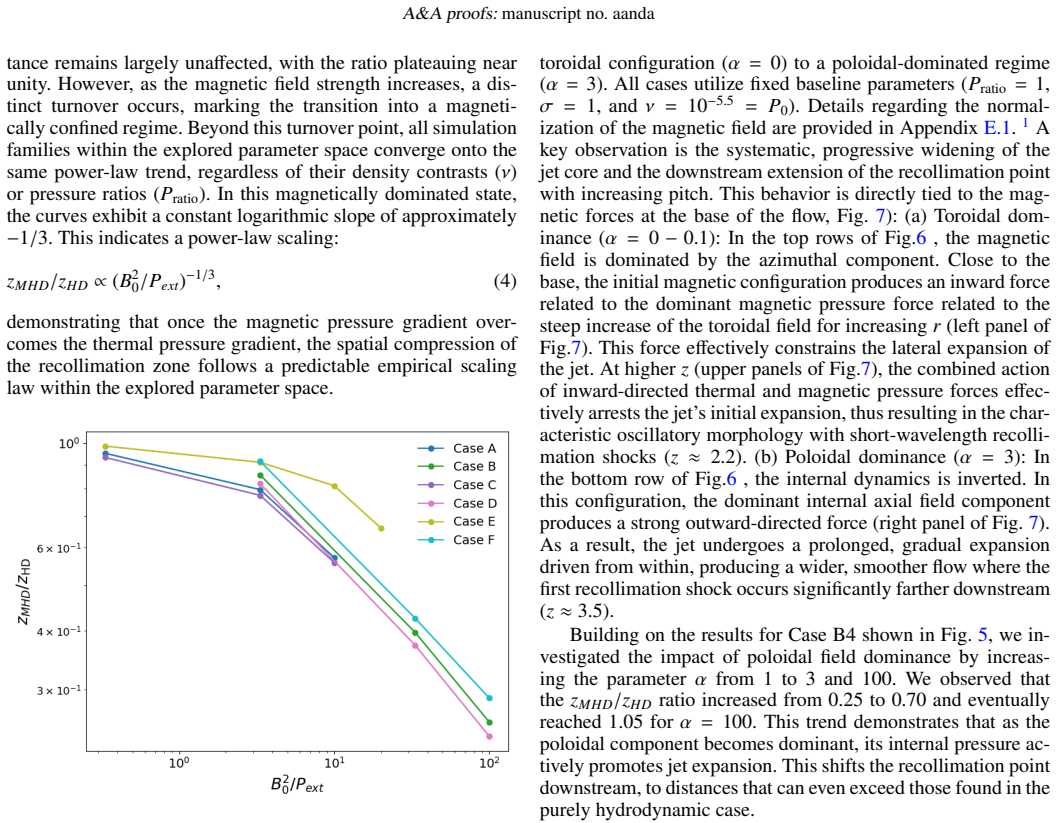
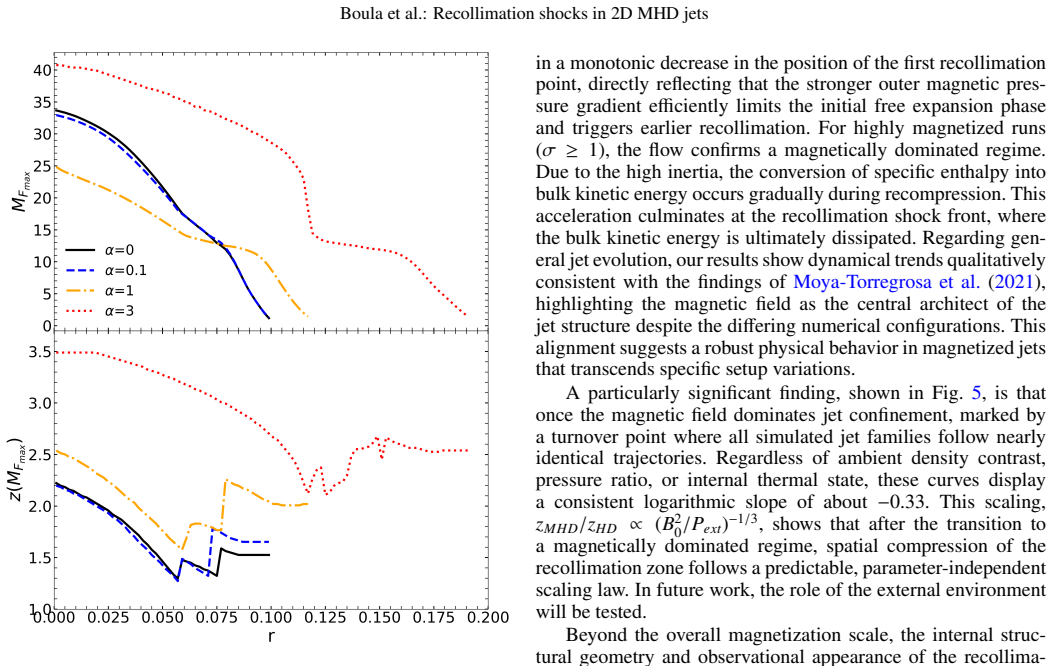
In the magnetically dominated regime, the recollimation distance ratio z_MHD/z_HD scales as (B₀²/P_ext)^{-1/3}.
A machine-rendered reading of the paper's core claim, the machinery that carries it, and where it could break.
Core claim
In the magnetically dominated regime, the ratio of the magnetized recollimation distance (z_MHD) to its purely hydrodynamic counterpart (z_HD) converges onto a power-law scaling, z_MHD/z_HD ∝ (B₀²/P_ext)^{-1/3}, where B₀ is the initial magnetic field and P_ext the external pressure.
What carries the argument
The recollimation distance ratio z_MHD/z_HD, which quantifies how magnetic forces limit jet expansion compared with the hydrodynamic case.
If this is right
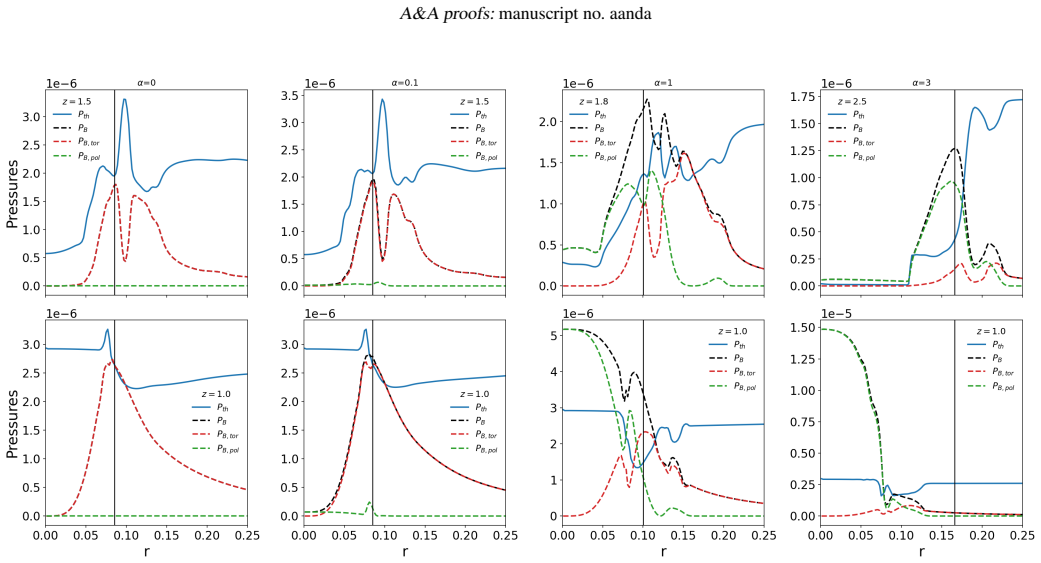
- Recollimation distance decreases monotonically as magnetization increases.
- High density contrast or high internal pressure further compresses the magnetic field.
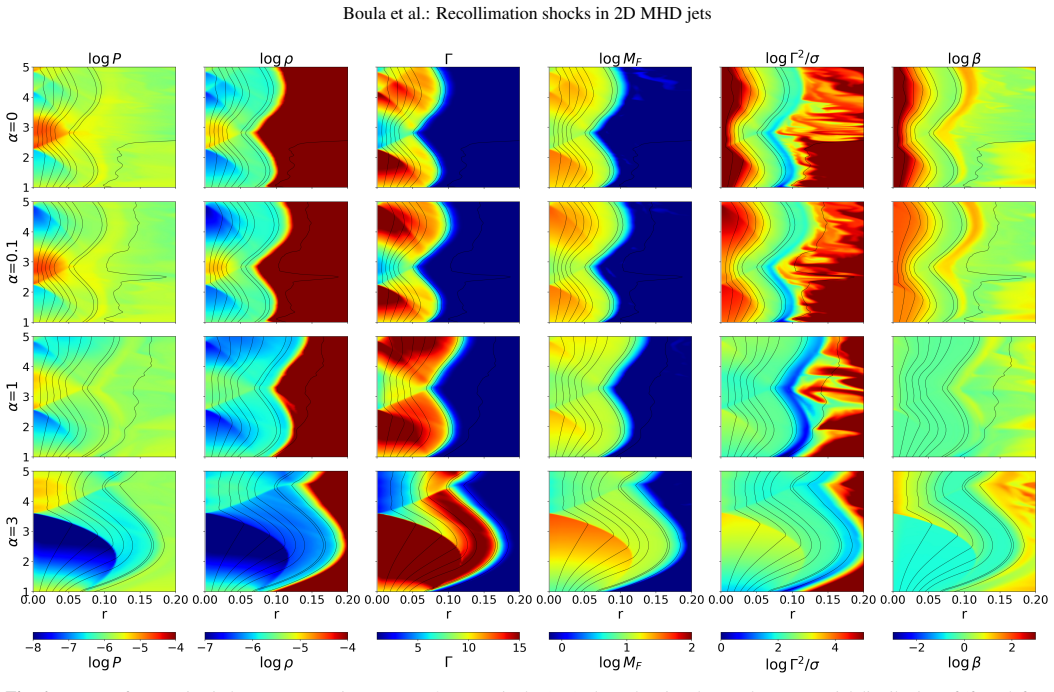
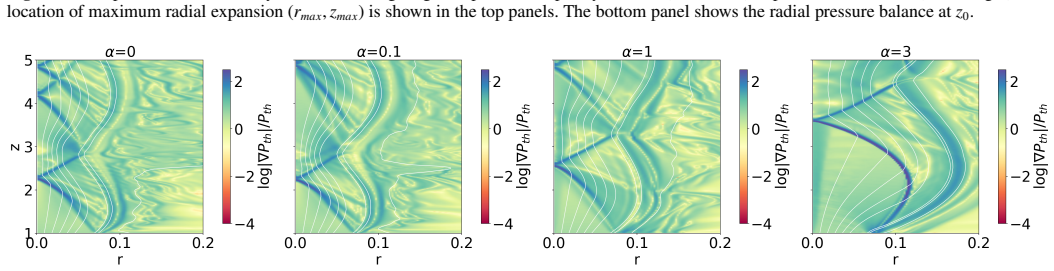
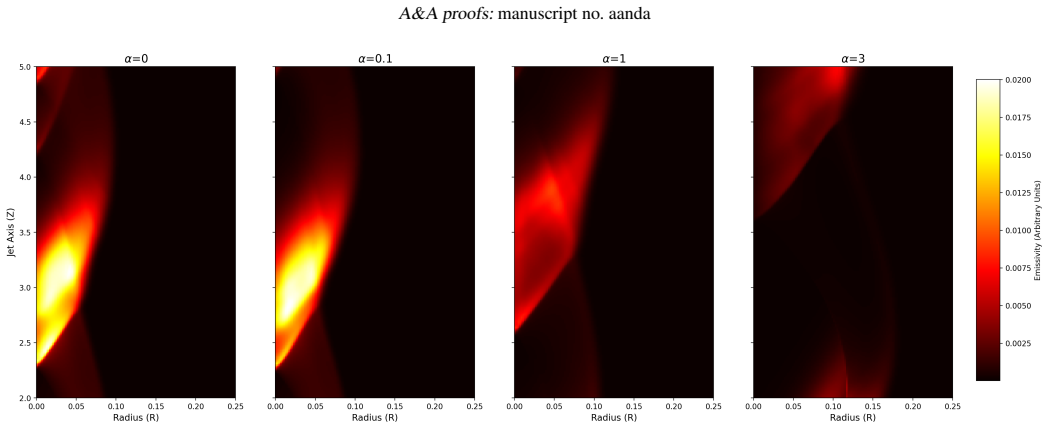
- A dominant toroidal field produces highly boosted, localized synchrotron knots at the shock.
- A strong poloidal field yields diffuse emission and shifts the recollimation zone downstream.
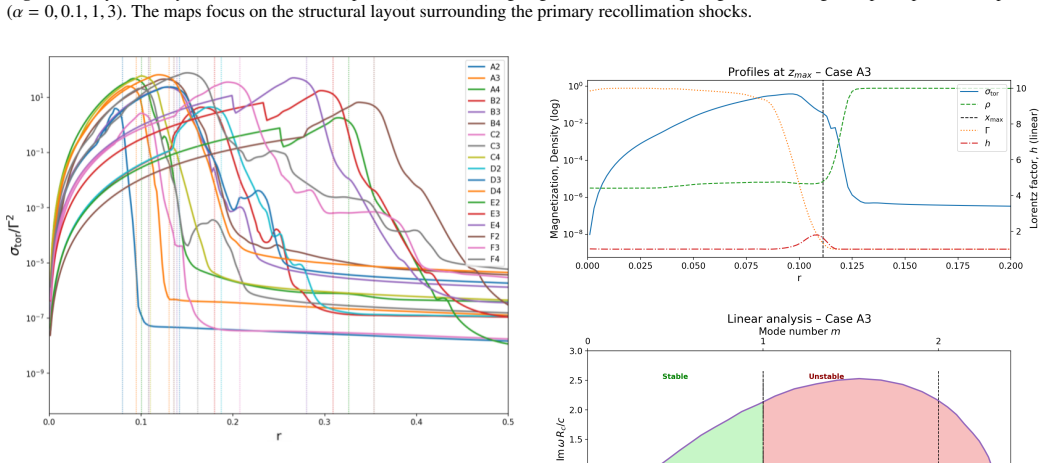
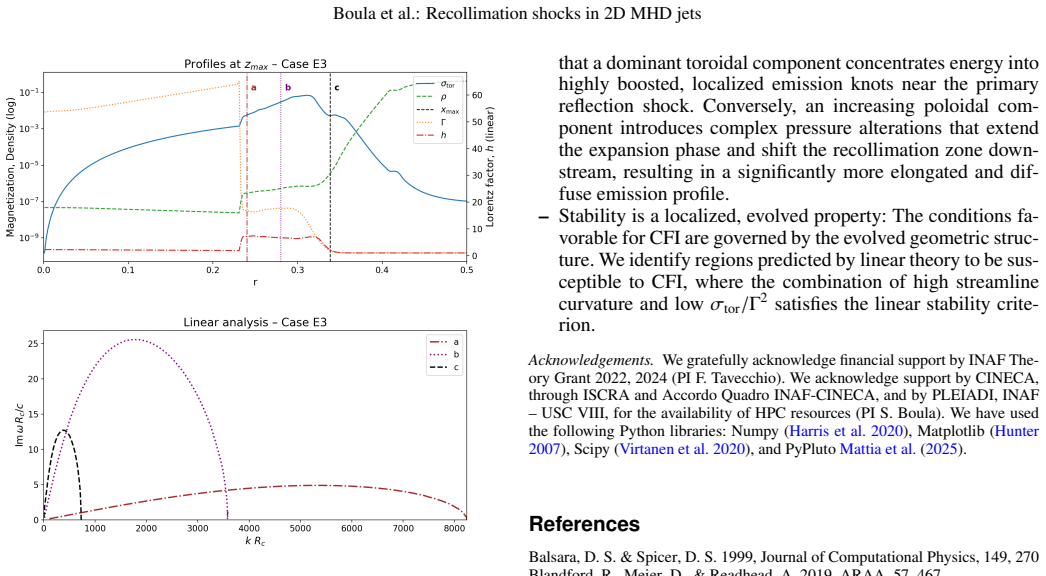
- Centrifugal-instability regions are set by the local toroidal magnetization over Lorentz factor squared and by the streamline curvature during recollimation.
Where Pith is reading between the lines
- If the scaling survives in three dimensions it could be inverted to estimate jet magnetization from the locations of stationary radio features.
- The toroidal versus poloidal difference implies that polarization maps could distinguish which field geometry dominates the observed knots.
- The same geometric conditions that set CFI susceptibility may also control the onset of other fluid instabilities once the flow becomes three-dimensional.
Load-bearing premise
Two-dimensional axisymmetric geometry together with the chosen initial magnetic-field configurations are sufficient to capture the essential recollimation physics without three-dimensional effects or alternate launch conditions changing the reported scaling.
What would settle it
A sample of AGN jets with independent magnetization estimates whose observed recollimation distances deviate systematically from the (B₀²/P_ext)^{-1/3} relation would falsify the scaling.
Figures
read the original abstract
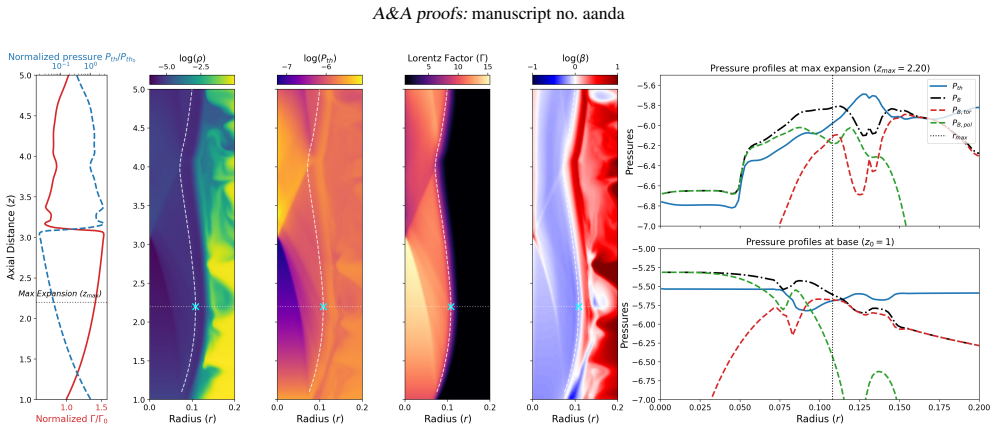
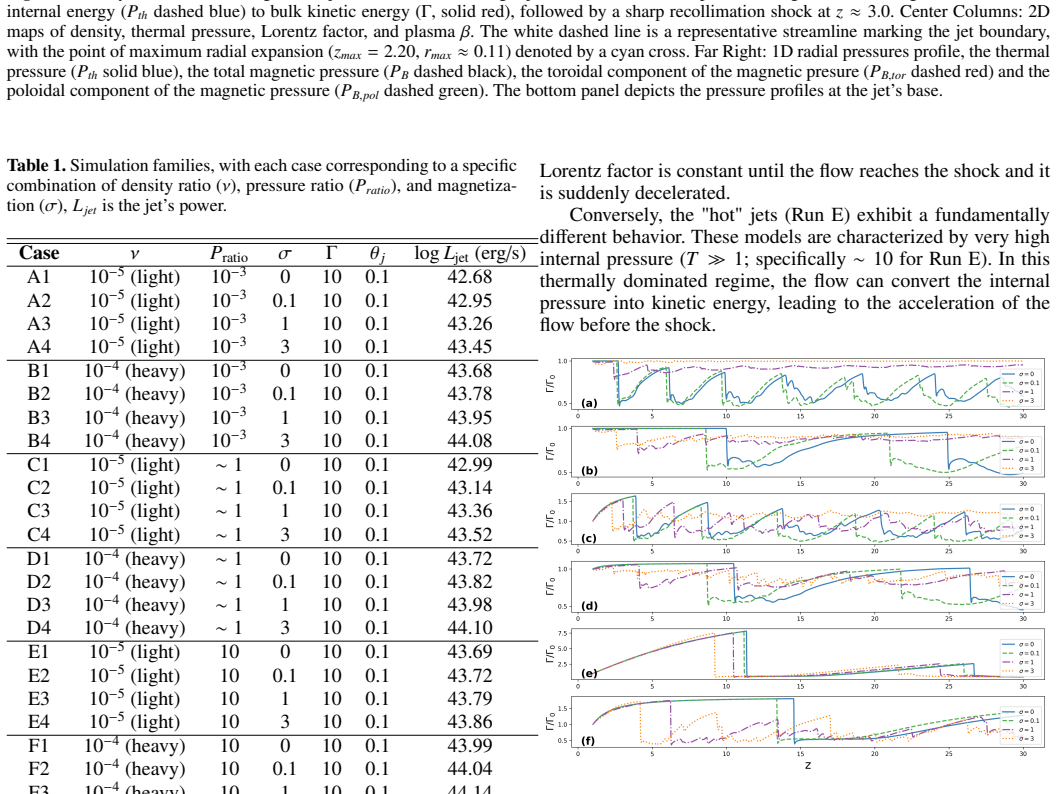
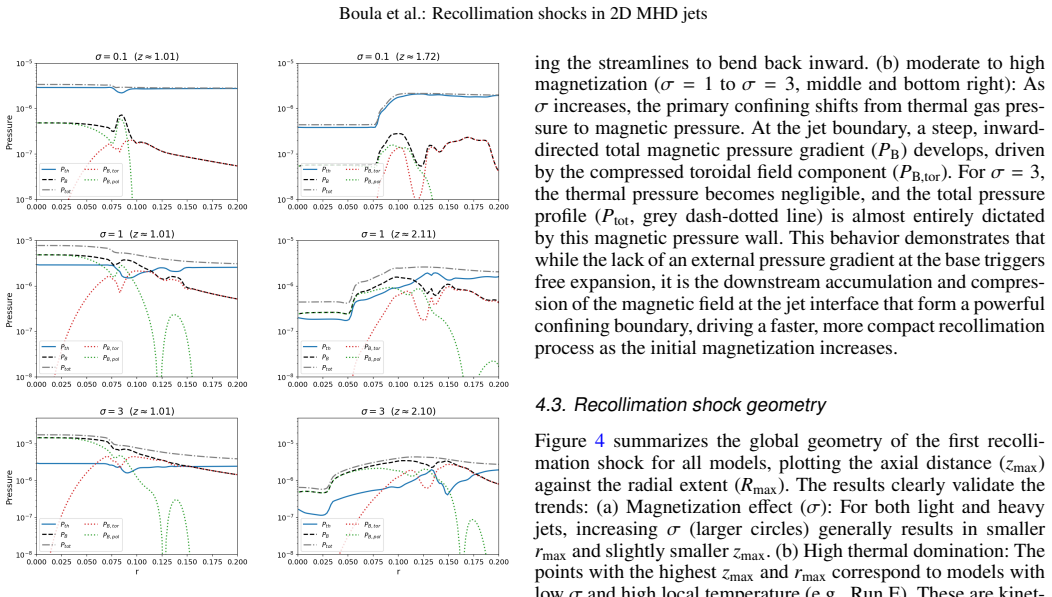
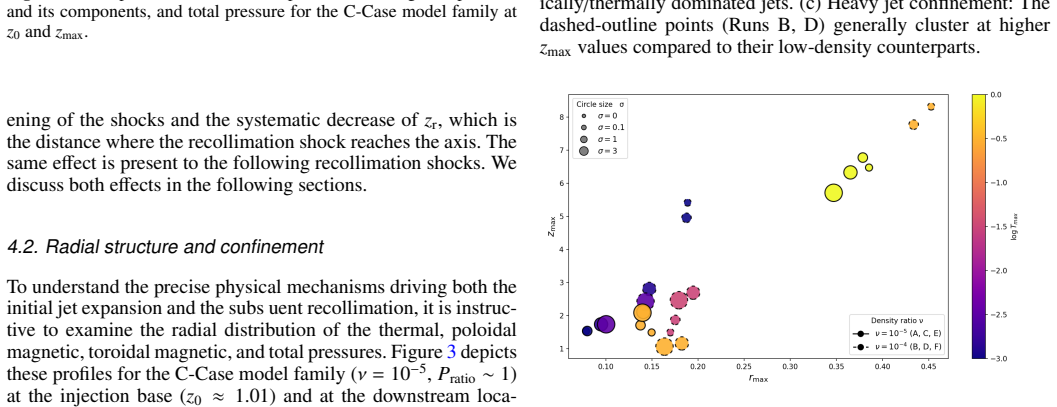
Recollimation shocks are a frequent outcome in overpressured relativistic jets and are crucial for interpreting stationary features in Active Galactic Nuclei. The precise influence of magnetic fields on jet stability, energy dissipation, and variability remains debated, particularly as different field configurations can significantly alter shock properties and the onset of fluid instabilities. We perform a study of 2D axisymmetric RMHD jets to quantify how the ambient density contrast ($\nu$), pressure ratio ($P$), magnetization ($\sigma$), and magnetic pitch parameter ($\alpha$) govern the formation and strength of the first recollimation shock. We also assess how these parameters create the local geometric conditions favorable for the centrifugal instability (CFI), utilizing linear theory as a diagnostic. We find that the jet's global geometry is affected by the magnetic pressure. The recollimation distance decreases monotonically with increasing magnetization $\sigma$, as increased magnetic forces immediately limit jet expansion. Remarkably, in the magnetically dominated regime, the ratio of the magnetized recollimation distance ($z_{\rm MHD}$) to its purely hydrodynamic counterpart ($z_{\rm HD}$) converges onto a power-law scaling, $z_{MHD}/z_{HD} \propto (B_0^2/P_{ext})^{-1/3}$, where $B_0$ the initial magnetic field and $P_{ext}$ the external pressure. Jets with high density contrast relative to the ambient medium or high internal pressure further enhance field compression. Furthermore, synthetic synchrotron maps show that a dominant toroidal field yields highly boosted, localized emission knots, whereas a strong poloidal field creates a diffuse profile and shifts the recollimation zone downstream. Regions susceptible to CFI are determined primarily by the local $\sigma_{\text{tor}}/\Gamma^2$ profile and streamline curvature created during recollimation.
Editorial analysis
A structured set of objections, weighed in public.
Referee Report
Summary. The manuscript reports 2D axisymmetric RMHD simulations of overpressured relativistic jets, systematically varying ambient density contrast (ν), pressure ratio (P), magnetization (σ), and magnetic pitch parameter (α). It finds that recollimation distance decreases with increasing σ due to magnetic forces limiting expansion, and reports that in the magnetically dominated regime the ratio z_MHD/z_HD converges to a power-law scaling ∝ (B₀²/P_ext)^{-1/3}. The work also diagnoses regions prone to centrifugal instability (CFI) via local σ_tor/Γ² and streamline curvature, and presents synthetic synchrotron maps showing differences between toroidal and poloidal field configurations.
Significance. If the scaling is numerically robust, the direct parameter variation (independent inputs ν, P, σ, α) yields a falsifiable, non-circular relation useful for modeling stationary features in AGN jets and separating magnetic from hydrodynamic effects on recollimation. The CFI diagnostic linking simulations to linear theory and the emission maps add interpretive value for jet stability and variability studies.
major comments (2)
- [Abstract] Abstract: The central claim that z_MHD/z_HD converges onto the power-law scaling ∝ (B₀²/P_ext)^{-1/3} in the magnetically dominated regime is presented without any information on grid resolution, convergence tests, or quantitative uncertainties on the fitted exponent. This is load-bearing because resolution-dependent artifacts could alter the reported scaling or the CFI diagnostic.
- [Abstract] Abstract (parameter study and CFI diagnostic): The reported scaling and CFI assessment are obtained exclusively in 2D axisymmetric geometry with specific initial B-field configurations (toroidal vs. poloidal pitch α). No test is provided of whether 3D kink or current-driven modes would modify the effective expansion, field compression, and thus the z_MHD/z_HD scaling itself; a concrete test would be a limited set of 3D runs at fixed σ to check invariance of the exponent.
minor comments (2)
- [Abstract] The symbols B_0 and P_ext are used in the scaling relation but their precise definitions (initial field strength at launch, external pressure) should be stated explicitly when the scaling is first introduced.
- The manuscript would benefit from a brief statement of the numerical scheme, Riemann solver, and grid setup (even if details are in a methods section) to allow immediate assessment of the parameter study.
Simulated Author's Rebuttal
We thank the referee for the constructive report and detailed comments. We address each major comment point by point below, indicating planned revisions to the manuscript.
read point-by-point responses
-
Referee: [Abstract] Abstract: The central claim that z_MHD/z_HD converges onto the power-law scaling ∝ (B₀²/P_ext)^{-1/3} in the magnetically dominated regime is presented without any information on grid resolution, convergence tests, or quantitative uncertainties on the fitted exponent. This is load-bearing because resolution-dependent artifacts could alter the reported scaling or the CFI diagnostic.
Authors: We agree that supporting details on numerical resolution and convergence are necessary to substantiate the reported scaling. The revised manuscript will incorporate a dedicated subsection on the numerical setup, including the grid resolution used across the parameter survey, results of convergence tests at selected σ values, and the formal uncertainties on the fitted exponent obtained from the power-law regression. These additions will directly address potential concerns about resolution-dependent effects on both the scaling and the CFI diagnostic. revision: yes
-
Referee: [Abstract] Abstract (parameter study and CFI diagnostic): The reported scaling and CFI assessment are obtained exclusively in 2D axisymmetric geometry with specific initial B-field configurations (toroidal vs. poloidal pitch α). No test is provided of whether 3D kink or current-driven modes would modify the effective expansion, field compression, and thus the z_MHD/z_HD scaling itself; a concrete test would be a limited set of 3D runs at fixed σ to check invariance of the exponent.
Authors: The present work is a controlled 2D axisymmetric parameter study intended to isolate the effects of σ and α on recollimation distance and CFI conditions. While 3D kink or current-driven modes could in principle alter the effective expansion and field compression, conducting even a limited set of 3D runs lies outside the scope of this manuscript. We will revise the discussion section to explicitly acknowledge this limitation of the 2D geometry and to identify 3D extensions as a natural direction for follow-up work. revision: partial
Circularity Check
No circularity: scaling is empirical output from independent parameter sweeps in simulations
full rationale
The paper reports results from direct 2D axisymmetric RMHD simulations in which ν, P, σ, and α are varied as independent inputs. The claimed power-law scaling z_MHD/z_HD ∝ (B₀²/P_ext)^{-1/3} is presented as an observed convergence in the magnetically dominated regime, not as an analytical derivation, fitted parameter, or quantity obtained by construction from the same data. No self-citations are invoked as load-bearing premises, no ansatz is smuggled via prior work, and no uniqueness theorem or renaming of known results is used to justify the central claim. The derivation chain is therefore self-contained against external benchmarks (the simulations themselves).
Axiom & Free-Parameter Ledger
free parameters (4)
- ambient density contrast (ν)
- pressure ratio (P)
- magnetization (σ)
- magnetic pitch parameter (α)
axioms (3)
- standard math Ideal relativistic magnetohydrodynamics equations govern the jet evolution
- domain assumption Linear stability theory supplies a reliable diagnostic for centrifugal instability onset
- domain assumption 2D axisymmetric geometry captures the dominant recollimation and instability physics
Reference graph
Works this paper leans on
-
[1]
Simulations of Superluminal Radio Sources. , keywords =. doi:10.1093/mnras/288.4.833 , adsurl =
-
[2]
Quasi-Periodic Polarized Emissions from Kink Structure in Magnetized Relativistic Jets. arXiv e-prints , keywords =. doi:10.48550/arXiv.2511.03140 , archivePrefix =. 2511.03140 , primaryClass =
-
[3]
2025 , eprint=
Spectral curvature and breaks from Fermi acceleration at oblique shocks , author=. 2025 , eprint=
2025
-
[4]
Instabilities at recollimation shocks in magnetohydrodynamic jets. , keywords =. doi:10.1051/0004-6361/202557516 , archivePrefix =. 2510.01742 , primaryClass =
-
[5]
Consideration of gusts, blasts and prolonged velocity bursts in supersonic overpressured jets. , keywords =. doi:10.1093/mnras/stag742 , adsurl =
-
[6]
How do recollimation-induced instabilities shape the propagation of hydrodynamic relativistic jets?. , keywords =. doi:10.1051/0004-6361/202554698 , archivePrefix =. 2503.18602 , primaryClass =
-
[7]
Numerical simulations of jets. , keywords =. doi:10.1016/j.newar.2021.101610 , adsurl =
-
[8]
Simulating radio emission from flickering AGN jets: travelling shocks and hotspot brightening. , keywords =. doi:10.1093/mnras/stag131 , archivePrefix =. 2601.13138 , primaryClass =
-
[9]
Physica D Nonlinear Phenomena , keywords =
Rayleigh-Taylor and Richtmyer-Meshkov instabilities: A journey through scales. Physica D Nonlinear Phenomena , keywords =. doi:10.1016/j.physd.2020.132838 , adsurl =
-
[10]
Annual Review of Fluid Mechanics , year = 2002, month = jan, volume =
The richtmyer-meshkov instability. Annual Review of Fluid Mechanics , year = 2002, month = jan, volume =. doi:10.1146/annurev.fluid.34.090101.162238 , adsurl =
-
[11]
Particle acceleration in shearing flows: the self-generation of turbulent spine-sheath structures in relativistic magnetohydrodynamic jet simulations. , keywords =. doi:10.1093/mnras/stac3616 , archivePrefix =. 2212.03226 , primaryClass =
-
[12]
Causality and stability of cosmic jets
Causality and stability of cosmic jets. , keywords =. doi:10.1093/mnras/stv1295 , archivePrefix =. 1408.3318 , primaryClass =
work page internal anchor Pith review Pith/arXiv arXiv doi:10.1093/mnras/stv1295
-
[13]
On the Stability of Magnetized Rotating Jets: The Axisymmetric Case. , keywords =. doi:10.1086/167522 , adsurl =
-
[14]
Linear stability analysis of magnetized relativistic rotating jets
Linear stability analysis of magnetized relativistic rotating jets. , keywords =. doi:10.1093/mnras/stz591 , archivePrefix =. 1902.10781 , primaryClass =
work page internal anchor Pith review Pith/arXiv arXiv doi:10.1093/mnras/stz591 1902
-
[15]
Rotation and toroidal magnetic field effects on the stability of two-component jets
Rotation and toroidal magnetic field effects on the stability of two-component jets. , keywords =. doi:10.1093/mnras/stx1288 , archivePrefix =. 1706.06912 , primaryClass =
work page internal anchor Pith review Pith/arXiv arXiv doi:10.1093/mnras/stx1288
-
[16]
Studies of the Jet in Bl Lacertae. II. Superluminal Alfv \'e n Waves. , keywords =. doi:10.1088/0004-637X/803/1/3 , archivePrefix =. 1409.3599 , primaryClass =
work page internal anchor Pith review Pith/arXiv arXiv doi:10.1088/0004-637x/803/1/3
-
[17]
The Structure and Dynamics of the Subparsec Jet in M87 Based on 50 VLBA Observations over 17 Years at 43 GHz. , keywords =. doi:10.3847/1538-4357/aaafcc , archivePrefix =. 1802.06166 , primaryClass =
work page internal anchor Pith review Pith/arXiv arXiv doi:10.3847/1538-4357/aaafcc
-
[18]
Multi-epoch Modeling of TXS 0506+056 and Implications for Long-term High-energy Neutrino Emission. , keywords =. doi:10.3847/1538-4357/ab76d0 , archivePrefix =. 1911.04010 , primaryClass =
-
[19]
and Haberland, Matt and Reddy, Tyler and Cournapeau, David and Burovski, Evgeni and Peterson, Pearu and Weckesser, Warren and Bright, Jonathan and
Virtanen, Pauli and Gommers, Ralf and Oliphant, Travis E. and Haberland, Matt and Reddy, Tyler and Cournapeau, David and Burovski, Evgeni and Peterson, Pearu and Weckesser, Warren and Bright, Jonathan and. Nature Methods , year =
-
[20]
Nature585(7825), 357–362 (Sep 2020)
Charles R. Harris and K. Jarrod Millman and St. Array programming with. 2020 , month = sep, journal =. doi:10.1038/s41586-020-2649-2 , publisher =
-
[21]
Hunter, J. D. , Title =. Computing in Science & Engineering , Volume =
-
[22]
Linear stability analysis of relativistic magnetized jets. The Kelvin-Helmholtz mode. , keywords =. doi:10.1051/0004-6361/202347647 , adsurl =
-
[23]
Spectral evolution of flaring blazars from numerical simulations
Spectral evolution of flaring blazars from numerical simulations. , keywords =. doi:10.1051/0004-6361/201527139 , archivePrefix =. 1601.03181 , primaryClass =
work page internal anchor Pith review Pith/arXiv arXiv doi:10.1051/0004-6361/201527139
-
[24]
Stochastic particle acceleration in the lobes of giant radio galaxies. , keywords =. doi:10.1111/j.1365-2966.2009.15442.x , archivePrefix =. 0903.1259 , primaryClass =
-
[25]
The polarization of the synchrotron radiation from a recollimated jet: Application to high-energy BL Lacs. , keywords =. doi:10.1051/0004-6361/202554490 , archivePrefix =. 2503.09180 , primaryClass =
-
[26]
How do recollimation-induced instabilities shape the propagation of hydrodynamic relativistic jets?. arXiv e-prints , keywords =. doi:10.48550/arXiv.2503.18602 , archivePrefix =. 2503.18602 , primaryClass =
-
[27]
Current-driven kink instabilities in relativistic jets: dissipation properties. , keywords =. doi:10.1093/mnras/stab3492 , archivePrefix =. 2111.14575 , primaryClass =
-
[28]
Journal of Computational Physics , year = 1999, month = mar, volume =
A Staggered Mesh Algorithm Using High Order Godunov Fluxes to Ensure Solenoidal Magnetic Fields in Magnetohydrodynamic Simulations. Journal of Computational Physics , year = 1999, month = mar, volume =. doi:10.1006/jcph.1998.6153 , adsurl =
-
[29]
On the divergence-free condition in Godunov-type schemes for ideal magnetohydrodynamics: the upwind constrained transport method. Journal of Computational Physics , keywords =. doi:10.1016/j.jcp.2003.09.016 , archivePrefix =. astro-ph/0310183 , primaryClass =
work page internal anchor Pith review Pith/arXiv arXiv doi:10.1016/j.jcp.2003.09.016 2003
-
[30]
The Journal of Open Source Software , keywords =
PyPLUTO: a data analysis Python package for the PLUTO code. The Journal of Open Source Software , keywords =. doi:10.21105/joss.08448 , archivePrefix =. 2501.09748 , primaryClass =
-
[31]
Tavecchio, F. and Ghisellini, G. and Bonnoli, G. and Ghirlanda, G. , title = ". Monthly Notices of the Royal Astronomical Society: Letters , volume =. 2010 , month =. doi:10.1111/j.1745-3933.2010.00867.x , url =
-
[32]
A shocking outcome: Jet dynamics and polarimetric signatures of the multi-band flare in blazar OJ 248. , keywords =. doi:10.1051/0004-6361/202553689 , archivePrefix =. 2502.12232 , primaryClass =
-
[33]
Expanding one-zone model for blazar emission. , keywords =. doi:10.1051/0004-6361/202142126 , archivePrefix =. 2110.05325 , primaryClass =
-
[34]
title Relativistic Jets from Active Galactic Nuclei
Relativistic Jets from Active Galactic Nuclei. , keywords =. doi:10.1146/annurev-astro-081817-051948 , archivePrefix =. 1812.06025 , primaryClass =
-
[35]
Studies of the Jet in Bl Lacertae. I. Recollimation Shock and Moving Emission Features. , keywords =. doi:10.1088/0004-637X/787/2/151 , archivePrefix =. 1404.0976 , primaryClass =
work page internal anchor Pith review Pith/arXiv arXiv doi:10.1088/0004-637x/787/2/151
-
[36]
Linear Stability Analysis of Relativistic Magnetized Jets: Methodology. Universe , keywords =. doi:10.3390/universe9090386 , archivePrefix =. 2306.16835 , primaryClass =
-
[37]
Linear Stability Analysis of Relativistic Magnetized Jets: The Minimalist Approach. Universe , keywords =. doi:10.3390/universe10040183 , archivePrefix =. 2404.10613 , primaryClass =
-
[38]
On the linear stability of sheared and magnetized jets without current sheets - relativistic case. , keywords =. doi:10.1093/mnras/stx3065 , adsurl =
-
[39]
Instabilities in Astrophysical Jets. , keywords =. doi:10.1007/BF00645111 , adsurl =
-
[40]
Linear stability analysis of magnetized relativistic jets: the nonrotating case
Linear stability analysis of magnetized relativistic jets: the non-rotating case. , keywords =. doi:10.1093/mnras/stt1225 , archivePrefix =. 1307.6388 , primaryClass =
work page internal anchor Pith review Pith/arXiv arXiv doi:10.1093/mnras/stt1225
-
[41]
Two-dimensional Numerical Study for Rayleigh-Taylor and Richtmyer-Meshkov Instabilities in Relativistic Jets. , keywords =. doi:10.1088/2041-8205/772/1/L1 , archivePrefix =. 1306.1046 , primaryClass =
work page internal anchor Pith review Pith/arXiv arXiv doi:10.1088/2041-8205/772/1/l1 2041
-
[42]
A five-wave Harten-Lax-van Leer Riemann solver for relativistic magnetohydrodynamics. , keywords =. doi:10.1111/j.1365-2966.2008.14221.x , archivePrefix =. 0811.1483 , primaryClass =
-
[43]
Magnetic inhibition of the recollimation instability in relativistic jets. , keywords =. doi:10.1093/mnras/stab828 , archivePrefix =. 2010.11012 , primaryClass =
-
[44]
Recollimation Shocks in Magnetized Relativistic Jets
Recollimation Shocks in Magnetized Relativistic Jets. , keywords =. doi:10.1088/0004-637X/809/1/38 , archivePrefix =. 1505.00933 , primaryClass =
work page internal anchor Pith review Pith/arXiv arXiv doi:10.1088/0004-637x/809/1/38
-
[45]
Three-Dimensional Relativistic Magnetohydrodynamic Simulations of Current-Driven Instability. I. Instability of a Static Column. , keywords =. doi:10.1088/0004-637X/700/1/684 , archivePrefix =. 0903.5358 , primaryClass =
work page internal anchor Pith review Pith/arXiv arXiv doi:10.1088/0004-637x/700/1/684
-
[46]
Three-dimensional Simulations of AGN Jets: Magnetic Kink Instability versus Conical Shocks
Simulations of AGN jets: magnetic kink instability versus conical shocks. , keywords =. doi:10.1093/mnras/stx1165 , archivePrefix =. 1612.06929 , primaryClass =
work page internal anchor Pith review Pith/arXiv arXiv doi:10.1093/mnras/stx1165
-
[47]
The Piecewise Parabolic Method for Multidimensional Relativistic Fluid Dynamics
The Piecewise Parabolic Method for Multidimensional Relativistic Fluid Dynamics. , keywords =. doi:10.1086/430905 , archivePrefix =. astro-ph/0505200 , primaryClass =
work page internal anchor Pith review Pith/arXiv arXiv doi:10.1086/430905
-
[48]
FR0 jets and recollimation-induced instabilities. , keywords =. doi:10.1051/0004-6361/202348954 , adsurl =
-
[49]
Recollimation shocks and radiative losses in extragalactic relativistic jets
Recollimation shocks and radiative losses in extragalactic relativistic jets. , keywords =. doi:10.1051/0004-6361/201732000 , archivePrefix =. 1710.06713 , primaryClass =
work page internal anchor Pith review Pith/arXiv arXiv doi:10.1051/0004-6361/201732000
-
[50]
PLUTO: a Numerical Code for Computational Astrophysics
PLUTO: A Numerical Code for Computational Astrophysics. , keywords =. doi:10.1086/513316 , archivePrefix =. astro-ph/0701854 , primaryClass =
work page internal anchor Pith review Pith/arXiv arXiv doi:10.1086/513316
-
[51]
Reconfinement and Loss of Stability in Jets from Active Galactic Nuclei
Reconfinement and loss of stability in jets from active galactic nuclei. Nature Astronomy , keywords =. doi:10.1038/s41550-017-0338-3 , archivePrefix =. 1806.05683 , primaryClass =
work page internal anchor Pith review Pith/arXiv arXiv doi:10.1038/s41550-017-0338-3
-
[52]
The structure of weakly magnetized -ray burst jets. , keywords =. doi:10.1093/mnras/staa2567 , archivePrefix =. 2007.11590 , primaryClass =
-
[53]
Magnetic inhibition of centrifugal instability. , keywords =. doi:10.1093/mnras/stz1973 , adsurl =
-
[54]
Numerical investigation of instabilities in over-pressured magnetized relativistic jets. , keywords =. doi:10.1051/0004-6361/202451573 , archivePrefix =. 2411.17389 , primaryClass =
-
[55]
, year = 1974, month = aug, volume =
3C236, DA240; the largest radio sources known. , year = 1974, month = aug, volume =. doi:10.1038/250625a0 , adsurl =
-
[56]
Kelvin-Helmholtz instability for relativistic fluids. , keywords =. doi:10.1103/PhysRevE.70.036304 , adsurl =
-
[57]
Relativistic Centrifugal Instability
Relativistic centrifugal instability. , keywords =. doi:10.1093/mnrasl/sly016 , archivePrefix =. 1710.01345 , primaryClass =
work page internal anchor Pith review Pith/arXiv arXiv doi:10.1093/mnrasl/sly016
-
[58]
Internal instabilities in magnetized jets
Internal instabilities in magnetized jets. , keywords =. doi:10.1093/mnras/sty2675 , archivePrefix =. 1807.11480 , primaryClass =
work page internal anchor Pith review Pith/arXiv arXiv doi:10.1093/mnras/sty2675
-
[59]
Evolution of current- and pressure-driven instabilities in relativistic jets. , keywords =. doi:10.1093/mnras/stae1788 , archivePrefix =. 2407.15477 , primaryClass =
-
[60]
Probing an X-Ray Flare Pattern in Mrk 421 Induced by Multiple Stationary Shocks: A Solution to the Bulk Lorentz Factor Crisis. , keywords =. doi:10.3847/1538-4357/ab1906 , archivePrefix =. 1904.06802 , primaryClass =
work page internal anchor Pith review Pith/arXiv arXiv doi:10.3847/1538-4357/ab1906 1904
-
[61]
Magnetic acceleration of relativistic active galactic nucleus jets. , keywords =. doi:10.1111/j.1365-2966.2007.12050.x , archivePrefix =. astro-ph/0703146 , primaryClass =
-
[62]
Asymptotic structure of Poynting dominated jets
Asymptotic Structure of Poynting-Dominated Jets. , keywords =. doi:10.1088/0004-637X/698/2/1570 , archivePrefix =. 0902.3357 , primaryClass =
work page internal anchor Pith review Pith/arXiv arXiv doi:10.1088/0004-637x/698/2/1570
-
[63]
Efficient generation of jets from magnetically arrested accretion on a rapidly spinning black hole. , keywords =. doi:10.1111/j.1745-3933.2011.01147.x , archivePrefix =. 1108.0412 , primaryClass =
-
[64]
MOJAVE: Monitoring of Jets in Active galactic nuclei with VLBA Experiments. IX. Nuclear opacity. , keywords =. doi:10.1051/0004-6361/201219173 , archivePrefix =. 1207.5457 , primaryClass =
work page internal anchor Pith review Pith/arXiv arXiv doi:10.1051/0004-6361/201219173
-
[65]
Magnetized relativistic jets and helical magnetic fields. I. Dynamics. , keywords =. doi:10.1051/0004-6361/202037898 , adsurl =
-
[66]
Probing the Innermost Regions of AGN Jets and Their Magnetic Fields with RadioAstron. III. Blazar S5 0716+71 at Microarcsecond Resolution. , keywords =. doi:10.3847/1538-4357/ab7dae , archivePrefix =. 2003.08776 , primaryClass =
discussion (0)
Sign in with ORCID, Apple, or X to comment. Anyone can read and Pith papers without signing in.