REVIEW 3 major objections 4 minor 14 references
ORCESTRA claims that one mixed-reality plan pipeline, shared by no-code teaching and VLM commands, can program four robot embodiments safely by previewing and confirming every move on a digital twin.
Reviewed by Pith at T0; open to challenge. T0 means a machine referee read the full paper against a public rubric. the ladder, T0–T4 →
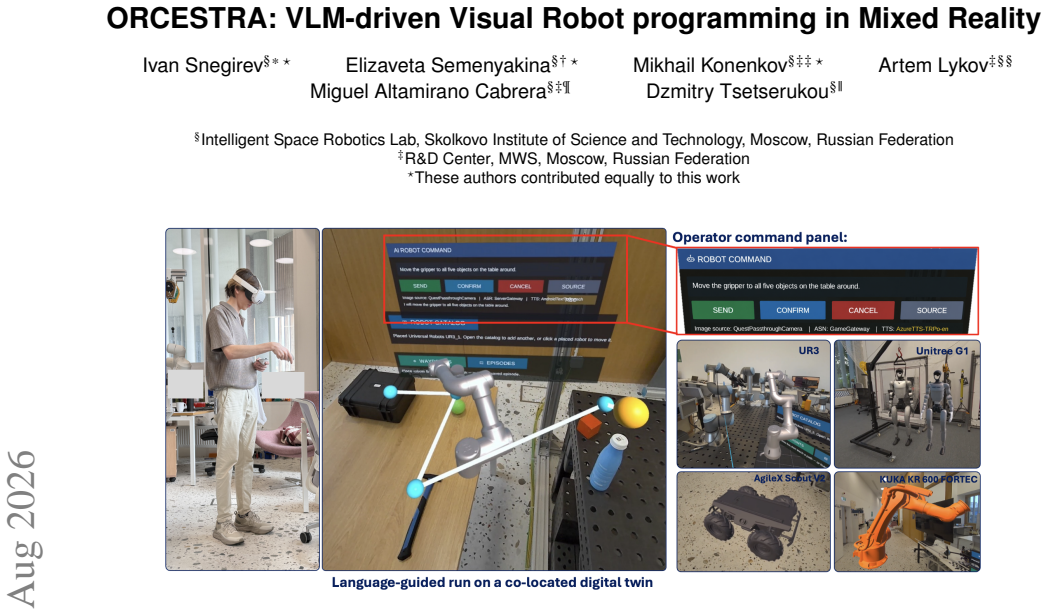
A mixed-reality system combines no-code waypoint teaching and VLM-guided language control for programming heterogeneous robot digital twins with confirmation-gated execution.
T0 review reviewed 2026-08-05 challenge →
load-bearing objection Competent integration, overclaimed safety; the confirmation gate is a human check, not a neutralizer. the 3 major comments →
ORCESTRA: VLM-driven Visual Robot programming in Mixed Reality
The pith
A machine-rendered reading of the paper's core claim, the machinery that carries it, and where it could break.
The reading
Core claim
The paper's central claim is that a single typed digital-twin plan can carry both manually taught and VLM-generated tasks across heterogeneous robot embodiments, and that separating VLM reasoning from metric execution is what makes the language channel safe enough to use. A command from the operator is converted by a vision-language model into structured output containing intent, image-space references, an intermediate plan, and diagnostics; the client then ray-casts those references into metric 3D targets, checks the plan against the selected embodiment's reach and feasibility, rejects invalid plans, renders the proposed trajectory as an editable preview, and executes only after confirmatio
What carries the argument
The central object is the shared typed-plan backend, expressed in the paper's equations (2) and (4): a structured plan produced by either modality, combined with the acceptance condition VALID(P_AI) that requires the target robot to be placed, the plan kind to match its embodiment, every visual reference grounded above a confidence threshold, all waypoints finite, and the plan feasible for that embodiment, with contact disallowed unless explicitly flagged. This backend does the work of unifying modalities and embodiments, and it is what makes the vision-language model interchangeable: any model that emits the same typed structure can replace the deployed model without touching metric groundi
Load-bearing premise
The safety claim rests on a 20-trial user study with five participants, all done on a digital twin with no physical robot, no adversarial language inputs, and no test of what happens when the preview itself is misread; the paper assumes these results carry over to real deployments.
What would settle it
Run the same four object categories with the same interface but inject deliberately misleading commands—wrong object names, ambiguous referents, targets behind obstacles or outside reach—and count how many invalid plans pass the VALID gate and reach execution after confirmation. If a substantial fraction of hallucinated plans are confirmed and executed on the twin, the claim that the confirmation-gated preview neutralizes VLM errors fails.
If this is right
- The same backend can validate plans from any vision-language model that emits the typed schema, making the language module replaceable without re-engineering the client.
- Because every language-generated plan is grounded, validated, previewed, and confirmed before execution, VLM grounding errors can be caught while the physical robot remains idle; in the user study, all observed failures were caught at the preview stage.
- Episodes store waypoints in robot-relative coordinates, so repositioning a digital twin keeps saved trajectories valid, and the same format is a basis for future export to physical robot controllers.
- Large, voluminous objects represent a clear boundary for single-point grounding (only 1/5 success for boxes), indicating that such tasks require multi-contact or bimanual grounding rather than single-end-effector approach points.
- Co-located mixed-reality digital twins reduce the cost and risk of trial-and-error robot programming by letting operators author, test, and correct behavior on a twin before any hardware motion.
Where Pith is reading between the lines
- The 20-trial user study ran entirely on a digital twin with no physical robot, so the claim that preview catches hallucinations is only demonstrated for simulated execution; real-world transfer would need tests with depth noise, tracking drift, and physical collisions present.
- The typed-plan schema suggests a direct adversarial test: deliberately feed commands with wrong object names, ambiguous referents, or physically impossible targets, and measure how many invalid plans pass the VALID gate and reach execution after confirmation.
- If the language module is genuinely interchangeable, comparing different vision-language models on the same grounding task would quantify how much of the observed success rate comes from the model versus from the safety backend.
- The robot-relative episode format may enable cross-embodiment transfer of taught behaviors once mapping between different kinematic structures is added, though the paper only claims portability for repositioning the same robot twin.
Editorial analysis
A structured set of objections, weighed in public.
Referee Report
Summary. ORCESTRA is a mixed-reality system for programming robot digital twins through two modalities: no-code waypoint teaching and VLM-guided natural-language commands. The paper describes a Unity/Quest-3 implementation with a FastAPI gateway to Qwen3-VL, covering four embodiments (UR3, KUKA KR 600 FORTEC, AgileX Scout V2, Unitree G1). Both modalities feed a shared typed-plan backend that performs metric grounding, embodiment-aware validation, preview/refinement, and operator confirmation before digital-twin execution. A robot-relative episode format is introduced for saving and replaying behaviors. The central claims are that a single plan representation and validation pipeline work across embodiments and input channels, and that the confirmation-gated preview neutralizes hallucinated VLM outputs before any motion is committed. The validation consists of a no-code teaching demonstration on three platforms and a 20-trial user study of language-guided grounding (5/5 simple geometric, 5/5 everyday, 4/5 unconventional, 1/5 large box), with the conclusion that common object categories are sufficiently reliable and that all failures were caught at the preview stage.
Significance. If the system performs as described, the main contribution is an integration of established components into a coherent end-to-end pipeline: a common embodiment abstraction, a portable robot-relative episode format, a modality-independent validation/preview/confirmation backend, and an MR workspace that works across four different robot types. This is a useful engineering demonstration, and the architecture cleanly separates VLM reasoning from metric execution, which is a sensible design choice. The paper does not claim a new learning method or a new theoretical result; its contribution is the system design and its feasibility demonstration. The evaluation, however, is at prototype level: there are no physical robot executions, no statistics beyond raw counts, no rejection-rate or operator-correction data, and no adversarial hallucination tests. Consequently, the stronger safety and reliability claims in Sections 4 and 5 are not yet supported by the evidence presented.
major comments (3)
- [Section 4.2 and Section 5, Eq. (4)] The claim that the confirmation-gated preview 'neutralizes hallucinated outputs before any motion is committed' is not supported by the reported data. The user study measures VLM grounding success, not whether an operator would detect and reject an incorrect proposal; no rejection rates, correction counts, or confirmation outcomes are reported. Eq. (4) checks only placement, plan kind, grounding confidence, finiteness, feasibility, and the contact-allowed flag; it does not check whether the grounded object is the intended referent or whether the destination is semantically appropriate. A hallucinated but high-confidence, feasible plan can therefore pass validation and be previewed, leaving operator vigilance as the only remaining barrier. Since all trials were run on a digital twin with no physical consequences, the evidence does not support the 'neutralizes' wording. Either temper the c
- [Section 4.2, Table 1] The grounding evaluation uses 5 participants, one trial per object category, for 20 trials total. This sample size is too small to support the conclusion that the grounding pipeline is 'sufficiently reliable for common object categories'; there is no statistical analysis, no confidence interval, and no inter-participant variability. The large/voluminous category success rate (1/5, 20%) directly contradicts the 'practical input channel' claim for that category. The manuscript itself calls this a 'preliminary user study' and defers a larger study to future work, so the broad conclusion in Section 5 needs to be scaled accordingly. At a minimum, report per-participant and per-category details, provide binomial confidence intervals, and explicitly restrict claims to the tested object set.
- [Section 4.2 and Section 5] No physical robot execution is reported for the language-guided modality, and the conclusion lists 'export episodes to physical controllers' as future work. Therefore the framing of ORCESTRA as a safety layer 'before physical deployment' is a design rationale rather than an evaluated property. A confirmation-gated preview on a digital twin may behave very differently when a wrong confirmation can lead to a collision on hardware; the near-zero cost of errors in the digital-twin trials likely inflates the apparent safety benefit. Please either add a physical-hardware validation for at least one embodiment, or explicitly limit the safety claim to digital-twin authoring and state that physical-deployment safety remains unverified.
minor comments (4)
- [Figure 2 caption / Section 3.5] The caption describes the backend as performing 'safety checks,' but Eq. (4) is a syntactic and geometric consistency check, not a semantic safety check. Consider using 'consistency checks' or 'validation checks' to avoid overstating the role of the automated component.
- [Eq. (3)] The notation Π for the fallback floor plane is used before being defined. Define the ray-casting variables and the meaning of 'first valid intersection' more explicitly, and clarify why the fallback to the floor plane does not create false groundings for objects not on the floor.
- [Section 4.1] The no-code teaching validation is reported as a functionality demonstration without quantitative metrics such as completion time, error rate, or user feedback. This is acceptable for a system demo, but please label the subsection as a functional test rather than a user evaluation.
- [Abstract and Section 3.4] The phrase 'language-guided control' may be misleading because the current system only controls digital twins, not physical robots. Suggest 'language-guided digital-twin control' in the abstract and in Section 3.4 to be precise.
Circularity Check
No significant circularity: ORCESTRA is an implementation/system paper; its central claims are architectural and its validation is an external user study, so no prediction reduces to a fitted input or self-citation. Minor self-citations are not load-bearing; the Section 5 safety overclaim is an evidence gap, not circularity.
full rationale
The paper does not claim a first-principles derivation or a quantitative prediction. The shared typed-plan backend is a design description (Sections 3.4-3.5), not a result derived from an input. Eq. (4) defines acceptance conditions (placement, kind, confidence threshold, finiteness, feasibility, contact flag) as a system specification; tau is a free threshold and is not fitted to the reported outcomes. The VLM grounding accuracy in Table 1 is measured by independent external criteria (correct object, plausible grasp point), not by the system's validation predicate, so the success rates are not forced by construction. The statement 'all failures were caught at the preview stage' (Section 4.2) and the conclusion that the system 'neutralizes hallucinated outputs before any motion is committed' (Section 5) are not supported by reported rejection/cancellation counts, and Eq. (4) checks only syntactic/feasibility validity, not semantic correctness, so the safety claim ultimately rests on operator vigilance. This is a missing-evidence concern, not a circular one: no equation or fitted parameter is renamed as a prediction. Self-citations [6] and [7] (WareVR, HumanoidVLM) appear only as related-work motivation and do not carry the argument; they are not load-bearing. Accordingly the circularity burden is minimal (score 2 covers the minor non-load-bearing self-citations).
Axiom & Free-Parameter Ledger
free parameters (1)
- grounding confidence threshold tau =
not specified
axioms (4)
- domain assumption A co-located MR digital twin with ray-cast grounding is a valid proxy for physical robot programming and safety validation.
- domain assumption CCD IK pre-solve and reach checks are sufficient to certify trajectory feasibility for manipulators.
- domain assumption Qwen3-VL produces image-space references reliable enough for metric grounding.
- domain assumption Horizontal-plane fallback is sufficient when no scene collider is hit.
Cite this review
Pith. "Pith review of ORCESTRA: VLM-driven Visual Robot programming in Mixed Reality." pith.science (2026). https://pith.science/paper/FK7F4J2G
@misc{pith2026260800775,
  author       = {Pith},
  title        = {Pith review of: ORCESTRA: VLM-driven Visual Robot programming in Mixed Reality},
  year         = {2026},
  howpublished = {\url{https://pith.science/paper/FK7F4J2G}},
  note         = {Machine review of arXiv:2608.00775}
}
read the original abstract
ORCESTRA is a mixed-reality system for programming robot digital twins through no-code waypoint teaching and language-guided control. In a passthrough mixed-reality workspace, users place robot twins on real surfaces, teach trajectories, save robot-relative episodes, or issue spoken/typed commands that a vision-language model converts into structured digital-twin plans. Both interaction modes share a backend for metric grounding, embodiment-aware validation, preview, confirmation, and digital-twin execution. The system supports heterogeneous robot embodiments, including fixed-base manipulators, a mobile base, and a humanoid robot, demonstrating MR validation as a safety layer for language-guided robot programming before physical deployment.
Figures


Reference graph
Works this paper leans on
-
[1]
Kirillov, Alexander and Mintun, Eric and Ravi, Nikhila and Mao, Hanzi and Rolland, Chloe and Gustafson, Laura and Xiao, Tete and Whitehead, Spencer and Berg, Alexander C. and Lo, Wan-Yen and Doll. Proc. IEEE/CVF Int. Conf. on Computer Vision (ICCV) , pages =
-
[2]
Cheng, Tianheng and Song, Lin and Ge, Yixiao and Liu, Wenyu and Wang, Xinggang and Shan, Ying , title =. Proc. IEEE/CVF Conf. on Computer Vision and Pattern Recognition (CVPR) , pages =
-
[3]
arXiv preprint arXiv:2511.21631 , year =
Bai, Shuai and Cai, Yuxuan and Chen, Ruizhe and Chen, Keqin and Chen, Xionghui and Cheng, Zesen and Deng, Lianghao and Ding, Wei and Gao, Chang and Ge, Chunjiang and others , title =. arXiv preprint arXiv:2511.21631 , year =
-
[4]
and Trinitatova, Daria and Agishev, Ruslan T
Yashin, Grigoriy A. and Trinitatova, Daria and Agishev, Ruslan T. and Ibrahimov, Roman and Tsetserukou, Dzmitry , title =. Proc. 19th Int. Conf. on Advanced Robotics (ICAR) , pages =. 2019 , doi =
work page 2019
-
[5]
Huang, Wenlong and Wang, Chen and Li, Yunzhu and Zhang, Ruohan and Fei-Fei, Li , title =. Proc. Conf. on Robot Learning (CoRL) , series =
-
[6]
Huang, Wenlong and Wang, Chen and Zhang, Ruohan and Li, Yunzhu and Wu, Jiajun and Li, Fei-Fei , title =. Conf. on Robot Learning (CoRL) , year =
-
[7]
Ostanin, Mikhail and Mikhel, Stanislav and Evlampiev, Alexey and Skvortsova, Valeria and Klimchik, Alexandr , title =. Proc. IEEE Int. Conf. on Robotics and Automation (ICRA) , pages =. 2020 , doi =
work page 2020
-
[8]
Garg, Gaurav and Kuts, Vladimir and Anbarjafari, Gholamreza , title =. Sustainability , volume =. 2021 , doi =
work page 2021
-
[9]
Kalinov, Ivan and Trinitatova, Daria and Tsetserukou, Dzmitry , title =. Proc. IEEE Int. Conf. on Systems, Man, and Cybernetics (SMC) , pages =. 2021 , doi =
work page 2021
-
[10]
Mahmoud, Yara and Yaqoot, Yasheerah and Altamirano Cabrera, Miguel and Tsetserukou, Dzmitry , title =. Proc. ACM/IEEE Int. Conf. on Human-Robot Interaction (HRI) , pages =
-
[11]
Gubernatorov, Kirill and Mikhalchuk, Ivan and Sannikov, Maxim and Kuznetsov, Egor and Artemov, Mikhail and Ogunwoye, Faruq O. and Fernando, M. J. and Asanov, Artem and Guo, Zhi and Tsetserukou, Dzmitry , title =. Proc. IEEE/RSJ Int. Conf. on Intelligent Robots and Systems (IROS) , year =
-
[12]
Suzuki, Ryo and Karim, Adnan and Xia, Tian and Hedayati, Hooman and Marquardt, Nicolai , title =. Proc. CHI Conf. on Human Factors in Computing Systems (CHI) , pages =. 2022 , doi =
work page 2022
-
[13]
Quintero, Camilo Perez and Li, Sarah and Pan, Matthew K. X. J. and Chan, Wesley P. and Van der Loos, H. F. Machiel and Croft, Elizabeth , title =. Proc. IEEE/RSJ Int. Conf. on Intelligent Robots and Systems (IROS) , pages =. 2018 , doi =
work page 2018
-
[14]
Enabling Waypoint Generation for Collaborative Robots using LLMs and Mixed Reality
Fang, Cathy Mengying and Zieli\'nski, Krzysztof and Maes, Pattie and Paradiso, Joe and Blumberg, Bruce and Kj. Enabling Waypoint Generation for Collaborative Robots Using. arXiv preprint arXiv:2403.09308 , year =
work page internal anchor Pith review Pith/arXiv arXiv
This paper was first reviewed by deepseek-v4-flash on August 5, 2026.
discussion (0)
Sign in with ORCID, Apple, or X to comment. Anyone can read and Pith papers without signing in.