Symbolic Classification-Enabled LHC Limits Online BSM Global Fits
Pith reviewed 2026-05-22 04:59 UTC · model grok-4.3
The pith
Symbolic regression lets LHC exclusion limits be evaluated directly inside pMSSM global fits.
A machine-rendered reading of the paper's core claim, the machinery that carries it, and where it could break.
Core claim
A mathematical expression obtained via symbolic regression from ATLAS constraints on electroweakino searches can classify points throughout the pMSSM parameter space as allowed or excluded by LHC limits with errors small enough to permit its use inside online global fits.
What carries the argument
The symbolic-regression classifier: a compact algebraic formula that maps pMSSM input parameters to an allowed/excluded decision based on ATLAS electroweakino search results.
If this is right
- Global fits of the pMSSM can now include the latest LHC Run-2 direct-search limits at essentially no extra computational cost per point.
- The same technique can be retrained on updated experimental datasets whenever new LHC results appear.
- Other BSM models and additional LHC searches become feasible to incorporate online once analogous classifiers are derived.
- Tighter joint constraints on supersymmetry parameters result from treating direct limits on equal footing with precision observables inside one scan.
Where Pith is reading between the lines
- If the classifier remains accurate far from the training region, it could be combined with similar approximations for dark-matter or flavor observables to produce fully online multi-sector fits.
- Periodic retraining on fresh ATLAS and CMS results would keep the global-fit pipeline synchronized with new data releases.
- The method suggests that symbolic regression might replace expensive Monte Carlo steps in other areas of BSM phenomenology where binary decisions dominate.
Load-bearing premise
The derived expression reproduces the true LHC exclusion boundaries across the entire pMSSM parameter space with errors too small to change the outcome of the global fit.
What would settle it
Run the classifier on a large set of pMSSM points never seen during training and compare its allowed/excluded labels against full ATLAS simulation results; a statistically significant mismatch in the excluded fraction would show the approximation fails.
Figures


read the original abstract
Global fits of Beyond the Standard Model (BSM) physics often involve a two-way interplay between theory and experiment. Theoretical models provide guidance for experimental searches, while experimental results, in turn, constrain theoretical frameworks. A crucial aspect of this feedback loop is the direct inclusion of measurements and exclusion limits ``online'' global fits, i.e. during the parameter scans aspects of the global fits. However, incorporating the Large Hadron Collider (LHC) limits into such analyses has been computationally prohibitive, often due to time taken per parameter point exceeding the scales acceptable for global fit frameworks. In this study, we show that LHC limits can be incorporated ``online'' global fits by leveraging approximations derived from symbolic regression techniques. We utilize a dataset of ATLAS constraints from searches for electroweakino productions to derive a mathematical expression capable of classifying the phenomenological Minimal Supersymmetric Standard Model (pMSSM) parameter space as allowed or excluded. This is subsequently incorporated for making a global fit of the pMSSM to data, including the LHC Run-2 limits.
Editorial analysis
A structured set of objections, weighed in public.
Referee Report
Summary. The paper proposes a method to incorporate LHC exclusion limits from ATLAS searches for electroweakino production directly into global fits of the pMSSM by deriving a compact mathematical expression via symbolic regression on existing ATLAS constraint data. This expression is intended to classify points in the 19-dimensional pMSSM parameter space as allowed or excluded, thereby enabling 'online' inclusion of these limits during parameter scans without the computational overhead of full detector simulation for each point.
Significance. If the derived symbolic classifier reproduces the true ATLAS exclusion boundaries with errors small enough not to distort posterior distributions, the approach would address a long-standing computational bottleneck in BSM global fits, allowing LHC Run-2 constraints to be treated on equal footing with other observables during scans. The use of symbolic regression to obtain an interpretable, fast-to-evaluate approximation is a potentially useful technical contribution, though its practical impact hinges on demonstrated accuracy.
major comments (1)
- [Abstract and method description] The central claim that the symbolic regression expression 'accurately reproduces the true exclusion boundaries across the full pMSSM parameter space with errors small enough not to distort the global fit results' is load-bearing but unsupported by any quantitative evidence. No classification accuracy, false-positive/false-negative rates, or ROC metrics are reported on a held-out test set drawn from the ATLAS electroweakino dataset, nor are there extrapolation tests in regions of the 19-dimensional pMSSM volume (e.g., different mass hierarchies or mixing angles) outside the training distribution. Without these, it is impossible to assess whether misclassifications would bias the global-fit posteriors.
minor comments (1)
- [Method] The manuscript should clarify the exact functional form of the derived symbolic expression, including any assumptions about the input variables (e.g., which pMSSM parameters are used as inputs) and the precise definition of the classification threshold.
Simulated Author's Rebuttal
We thank the referee for their careful reading of the manuscript and for highlighting the need for quantitative validation of the symbolic classifier. We address the major comment below and will revise the manuscript to strengthen the supporting evidence.
read point-by-point responses
-
Referee: [Abstract and method description] The central claim that the symbolic regression expression 'accurately reproduces the true exclusion boundaries across the full pMSSM parameter space with errors small enough not to distort the global fit results' is load-bearing but unsupported by any quantitative evidence. No classification accuracy, false-positive/false-negative rates, or ROC metrics are reported on a held-out test set drawn from the ATLAS electroweakino dataset, nor are there extrapolation tests in regions of the 19-dimensional pMSSM volume (e.g., different mass hierarchies or mixing angles) outside the training distribution. Without these, it is impossible to assess whether misclassifications would bias the global-fit posteriors.
Authors: We agree that the central claim requires quantitative backing and that the current manuscript does not report the specific metrics requested. The presented work focuses on deriving the symbolic expression from the ATLAS dataset and demonstrating its use in an example global fit, but does not include a dedicated performance evaluation section. In the revised version we will add explicit results on a held-out test set, reporting classification accuracy, false-positive and false-negative rates, and ROC-AUC. We will also include extrapolation tests across different mass hierarchies and mixing angles not represented in the training data, together with an assessment of how any residual misclassifications propagate into the posterior distributions of the global fit. These additions will directly address the concern about potential bias. revision: yes
Circularity Check
No circularity: classifier derived from independent ATLAS data
full rationale
The derivation trains a symbolic regression expression on an external ATLAS electroweakino exclusion dataset and then applies the resulting classifier to pMSSM points during global fits. This chain does not reduce by construction to its inputs: the training data are independent experimental results, the learned expression is an approximation fitted to those data rather than a self-definition or renaming of the target global-fit posteriors, and no load-bearing self-citation or uniqueness theorem is invoked to force the outcome. The central claim therefore remains self-contained against external benchmarks.
Axiom & Free-Parameter Ledger
axioms (1)
- domain assumption Symbolic regression can recover a sufficiently accurate decision boundary from the ATLAS electroweakino search results.
Lean theorems connected to this paper
-
IndisputableMonolith/Cost/FunctionalEquation.leanwashburn_uniqueness_aczel unclear?
unclearRelation between the paper passage and the cited Recognition theorem.
We utilize a dataset of ATLAS constraints from searches for electroweakino productions to derive a mathematical expression capable of classifying the phenomenological Minimal Supersymmetric Standard Model (pMSSM) parameter space as allowed or excluded.
-
IndisputableMonolith/Foundation/RealityFromDistinction.leanreality_from_one_distinction unclear?
unclearRelation between the paper passage and the cited Recognition theorem.
The performance of the mathematical expression extracted has been evaluated based on receiver operating characteristic (ROC) curve ... AUC achieved ... about 0.97
What do these tags mean?
- matches
- The paper's claim is directly supported by a theorem in the formal canon.
- supports
- The theorem supports part of the paper's argument, but the paper may add assumptions or extra steps.
- extends
- The paper goes beyond the formal theorem; the theorem is a base layer rather than the whole result.
- uses
- The paper appears to rely on the theorem as machinery.
- contradicts
- The paper's claim conflicts with a theorem or certificate in the canon.
- unclear
- Pith found a possible connection, but the passage is too broad, indirect, or ambiguous to say the theorem truly supports the claim.
Reference graph
Works this paper leans on
-
[1]
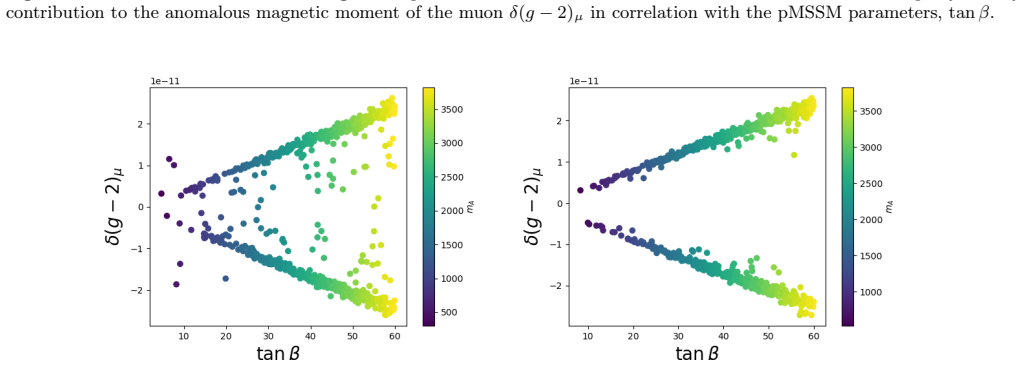
applied. Again, in this plot also, it can be seen that the anomalous posterior points that tends to spoil the relationshipδ(g−2) µ ∝tanβrela- tively get cleared out for the case of the global fit with the ATLAS limits applied. From the posterior samples, there are indications that theATLASlimitsand ’naturalnessline’aresqueezing the pMSSM parameters in opp...
-
[2]
A Full 24-Parameter MSSM Exploration
S. S. AbdusSalam, “The Full 24-Parameter MSSM Exploration,” AIP Conf. Proc.1078no. 1, (2009) 297–299, [arXiv:0809.0284 [hep-ph]]
work page internal anchor Pith review Pith/arXiv arXiv 2009
-
[3]
Fitting the Phenomenological MSSM
S. S. AbdusSalam, B. C. Allanach, F. Quevedo, F. Feroz, and M. Hobson, “Fitting the Phenomenological MSSM,” Phys. Rev. D81(2010) 095012, [arXiv:0904.2548 [hep-ph]]
work page internal anchor Pith review Pith/arXiv arXiv 2010
-
[4]
Butter,Global Fits for New Physics at the LHC and Beyond
A. Butter,Global Fits for New Physics at the LHC and Beyond. PhD thesis, U. Heidelberg (main), 2017
work page 2017
-
[5]
J. C. Costa,Global analyses of BSM theories using LHC Run 2. PhD thesis, Imperial Coll., London, 2020
work page 2020
-
[6]
J. de Blas, A. Goncalves, V. Miralles, L. Reina, L. Silvestrini, and M. Valli, “Constraining new physics effective interactions via a global fit of electroweak, Drell-Yan, Higgs, top, and flavour observables,” JHEP 03(2026) 013, [arXiv:2507.06191 [hep-ph]]. [6]GAMBITCollaboration, P. Athronet al., “Global fits and the search for new physics: past, present...
-
[7]
S. S. AbdusSalamet al., “Simple and statistically sound recommendations for analysing physical theories,” Rept. Prog. Phys.85no. 5, (2022) 052201, [arXiv:2012.09874 [hep-ph]]. [9]LHC Reinterpretation F orumCollaboration, J. Butterworthet al., “Reinterpretation and preservation of data and analyses in HEP,” [arXiv:2504.00256 [hep-ph]]
-
[8]
CheckMATE 2: From the model to the limit
D. Dercks, N. Desai, J. S. Kim, K. Rolbiecki, J. Tattersall, and T. Weber, “CheckMATE 2: From the model to the limit,” Comput. Phys. Commun.221 (2017) 383–418, [arXiv:1611.09856 [hep-ph]]
work page internal anchor Pith review Pith/arXiv arXiv 2017
-
[9]
Confronting new physics theories to LHC data with MadAnalysis 5
E. Conte and B. Fuks, “Confronting new physics theories to LHC data with MADANALYSIS 5,” Int. J. Mod. Phys. A33no. 28, (2018) 1830027, [arXiv:1808.00480 [hep-ph]]
work page internal anchor Pith review Pith/arXiv arXiv 2018
-
[10]
HackAnalysis 2: A powerful and hackable recasting tool,
M. D. Goodsell, “HackAnalysis 2: A powerful and hackable recasting tool,” [arXiv:2406.10042 [hep-ph]]. [13]GAMBITCollaboration, C. Balázset al., “ColliderBit: a GAMBIT module for the calculation of high-energy collider observables and likelihoods,” Eur. Phys. J. C77 no. 11, (2017) 795, [arXiv:1705.07919 [hep-ph]]
-
[11]
Impact of CMS Multi-jets and Missing Energy Search on CMSSM Fits
B. C. Allanach, “Impact of CMS Multi-jets and Missing Energy Search on CMSSM Fits,” Phys. Rev. D83 (2011) 095019, [arXiv:1102.3149 [hep-ph]]
work page internal anchor Pith review Pith/arXiv arXiv 2011
-
[12]
LHC-7 supersymmetry search interpretation within the pMSSM
S. S. AbdusSalam, “LHC-7 supersymmetry search interpretation within the phenomenological MSSM,” Phys. Rev. D87no. 11, (2013) 115012, [arXiv:1211.0999 [hep-ph]]
work page internal anchor Pith review Pith/arXiv arXiv 2013
-
[13]
Interpreting LHC searches for new physics with SModelS
U. Laa, “Interpreting LHC searches for new physics with SModelS,” PoSEPS-HEP2015(2015) 105, [arXiv:1510.01999 [hep-ph]]
work page internal anchor Pith review Pith/arXiv arXiv 2015
-
[14]
Status and prospects of the nMSSM after LHC Run-1
D. Barducci, G. Bélanger, C. Hugonie, and A. Pukhov, “Status and prospects of the nMSSM after LHC Run-1,” JHEP01(2016) 050, [arXiv:1510.00246 [hep-ph]]
work page internal anchor Pith review Pith/arXiv arXiv 2016
-
[15]
S. Kraml, S. Kulkarni, U. Laa, A. Lessa, W. Magerl, D. Proschofsky-Spindler, and W. Waltenberger, “SModelS: a tool for interpreting simplified-model results from the LHC and its application to supersymmetry,” Eur. Phys. J. C74(2014) 2868, [arXiv:1312.4175 [hep-ph]]
work page internal anchor Pith review Pith/arXiv arXiv 2014
-
[16]
Fastlim: a fast LHC limit calculator
M. Papucci, K. Sakurai, A. Weiler, and L. Zeune, “Fastlim: a fast LHC limit calculator,” Eur. Phys. J. C 74no. 11, (2014) 3163, [arXiv:1402.0492 [hep-ph]]
work page internal anchor Pith review Pith/arXiv arXiv 2014
-
[17]
L. Constantin, S. Kraml, A. Lessa, T. Reymermier, and W. Waltenberger, “On the coverage of electroweak-inos within the pMSSM with SModelS – a comparison with the ATLAS pMSSM study,” [arXiv:2512.14502 [hep-ph]]
work page internal anchor Pith review Pith/arXiv arXiv
-
[18]
The BSM-AI project: SUSY-AI - Generalizing LHC limits on Supersymmetry with Machine Learning
S. Caron, J. S. Kim, K. Rolbiecki, R. Ruiz de Austri, and B. Stienen, “The BSM-AI project: SUSY-AI–generalizing LHC limits on supersymmetry with machine learning,” Eur. Phys. J. C77no. 4, (2017) 257, [arXiv:1605.02797 [hep-ph]]
work page internal anchor Pith review Pith/arXiv arXiv 2017
- [19]
-
[20]
M. Feickert and B. Nachman, “A Living Review of Machine Learning for Particle Physics,” [arXiv:2102.02770 [hep-ph]]
-
[21]
Bayesian active search on parameter space: A 95 GeV spin-0 resonance in the (B−L)SSM,
M. A. Diaz, G. Cerro, S. Dasmahapatra, and S. Moretti, “Bayesian active search on parameter space: A 95 GeV spin-0 resonance in the (B−L)SSM,” SciPost Phys. Core8(2025) 068, [arXiv:2404.18653 [hep-ph]]
-
[22]
M. J. A. Diaz,Machine learning methods for exploring beyond standard model parameters. PhD thesis, Southampton U., 2025
work page 2025
-
[23]
Exploring the BSM parameter space with neural network aided Simulation-Based Inference,
A. Chatterjee, A. Choudhury, S. Mitra, A. Mondal, and S. Mondal, “Exploring the BSM parameter space with neural network aided Simulation-Based Inference,” JHEP12(2025) 138, [arXiv:2502.11928 [hep-ph]]
-
[24]
DLScanner: A parameter 8 space scanner package assisted by deep learning methods,
A. Hammad and R. Ramos, “DLScanner: A parameter 8 space scanner package assisted by deep learning methods,” Comput. Phys. Commun.314(2025) 109659, [arXiv:2412.19675 [hep-ph]]
-
[25]
A. Choudhury, A. Mondal, and S. Sarkar, “Searches for the BSM scenarios at the LHC using decision tree-based machine learning algorithms: a comparative study and review of random forest, AdaBoost, XGBoost and LightGBM frameworks,” Eur. Phys. J. ST233 no. 15-16, (2024) 2425–2463, [arXiv:2405.06040 [hep-ph]]
-
[26]
Probing intractable beyond-standard-model parameter spaces armed with machine learning,
R. Baruah, S. Mondal, S. K. Patra, and S. Roy, “Probing intractable beyond-standard-model parameter spaces armed with machine learning,” Eur. Phys. J. ST 233no. 15-16, (2024) 2597–2618, [arXiv:2404.02698 [hep-ph]]. [30]A TLASCollaboration, G. Aadet al., “ATLAS Run 2 searches for electroweak production of supersymmetric particles interpreted within the pMS...
-
[27]
J. R. Koza,Genetic Programming: On the Programming of Computers by Means of Natural Selection. MIT Press, Cambridge, MA, USA, 1992. https://www.bibsonomy.org/bibtex/ 27573e564bc5369e1a853e74b3ac62607/emanuel
work page 1992
-
[28]
AI Feynman: a Physics-Inspired Method for Symbolic Regression, April 2020
S.-M. Udrescu and M. Tegmark, “AI Feynman: a Physics-Inspired Method for Symbolic Regression,” Sci. Adv.6no. 16, (2020) eaay2631, [arXiv:1905.11481 [physics.comp-ph]]
-
[29]
Back to the formula - LHC edition,
A. Butter, T. Plehn, N. Soybelman, and J. Brehmer, “Back to the formula - LHC edition,” SciPost Phys.16 no. 1, (2024) 037, [arXiv:2109.10414 [hep-ph]]
-
[30]
Exhaustive Symbolic Regression,
D. J. Bartlett, H. Desmond, and P. G. Ferreira, “Exhaustive Symbolic Regression,” IEEE Trans. Evol. Comput.28no. 4, (2024) 964, [arXiv:2211.11461 [astro-ph.CO]]
-
[31]
S. M. Koksbang, “Cosmological parameter constraints using phenomenological symbolic expressions: On the significance of symbolic expression complexity and accuracy,” Phys. Rev. D108no. 4, (2023) 043539, [arXiv:2307.16468 [astro-ph.CO]]
-
[32]
Optimal inflationary potentials,
T. Sousa, D. J. Bartlett, H. Desmond, and P. G. Ferreira, “Optimal inflationary potentials,” Phys. Rev. D109no. 8, (2024) 083524, [arXiv:2310.16786 [astro-ph.CO]]
-
[33]
Symbolic regression for beyond the standard model physics,
S. AbdusSalam, S. Abel, and M. Crispim Romão, “Symbolic regression for beyond the standard model physics,” Phys. Rev. D111no. 1, (2025) 015022, [arXiv:2405.18471 [hep-ph]]
-
[34]
CP-analyses with symbolic regression,
H. Bahl, E. Fuchs, M. Menen, and T. Plehn, “CP-analyses with symbolic regression,” SciPost Phys. 20no. 2, (2026) 040, [arXiv:2507.05858 [hep-ph]]
-
[35]
Angular coefficients from interpretable machine learning with symbolic regression,
J. Bendavid, D. Conde, M. Morales-Alvarado, V. Sanz, and M. Ubiali, “Angular coefficients from interpretable machine learning with symbolic regression,” JHEP02 (2026) 081, [arXiv:2508.00989 [hep-ph]]
-
[36]
Symbolic Regression and Differentiable Fits in Beyond the Standard Model Physics,
S. AbdusSalam, S. Abel, D. Bartlett, and M. Crispim Romão, “Symbolic Regression and Differentiable Fits in Beyond the Standard Model Physics,” [arXiv:2510.20453 [hep-ph]]
-
[37]
Interpretable symbolic regression for data science: Analysis of the 2022 competition,
F. O. de Franca, M. Virgolin, M. Kommenda, M. S. Majumder, M. Cranmer, G. Espada, L. Ingelse, A. Fonseca, M. Landajuela, B. Petersen, R. Glatt, N. Mundhenk, C. S. Lee, J. D. Hochhalter, D. L. Randall, P. Kamienny, H. Zhang, G. Dick, A. Simon, B. Burlacu, J. Kasak, M. Machado, C. Wilstrup, and W. G. L. Cava, “Interpretable symbolic regression for data scie...
-
[38]
Learning symbolic physics with graph networks,
M. D. Cranmer, R. Xu, P. W. Battaglia, and S. Ho, “Learning symbolic physics with graph networks,” CoRRabs/1909.05862(2019) , [1909.05862]. http://arxiv.org/abs/1909.05862
-
[39]
Discovering Symbolic Models from Deep Learning with Inductive Biases,
M. D. Cranmer, A. Sanchez-Gonzalez, P. W. Battaglia, R. Xu, K. Cranmer, D. N. Spergel, and S. Ho, “Discovering symbolic models from deep learning with inductive biases,” CoRRabs/2006.11287(2020) , [2006.11287].https://arxiv.org/abs/2006.11287
-
[40]
Contemporary symbolic regression methods and their relative performance,
W. G. L. Cava, P. Orzechowski, B. Burlacu, F. O. de França, M. Virgolin, Y. Jin, M. Kommenda, and J. H. Moore, “Contemporary symbolic regression methods and their relative performance,” CoRR abs/2107.14351(2021) , [2107.14351]. https://arxiv.org/abs/2107.14351
-
[41]
Interpretable Machine Learning for Science with PySR and SymbolicRegression.jl
M. Cranmer, “Interpretable machine learning for science with pysr and symbolicregression.jl,” 2023. https://doi.org/10.48550/arXiv.2305.01582
work page internal anchor Pith review Pith/arXiv arXiv doi:10.48550/arxiv.2305.01582 2023
-
[42]
Operon c++: An efficient genetic programming framework for symbolic regression,
B. Burlacu, G. Kronberger, and M. Kommenda, “Operon c++: An efficient genetic programming framework for symbolic regression,” inProceedings of the 2020 Genetic and Evolutionary Computation Conference Companion, R. Allmendingeret al., eds., GECCO ’20, pp. 1562–1570. Association for Computing Machinery, internet, July 8-12, 2020. https://doi.org/10.1145/337...
-
[43]
An approach to symbolic regression using feyn,
K. R. BrolÞs, M. V. Machado, C. Cave, J. Kasak, V. Stentoft-Hansen, V. G. Batanero, T. Jelen, and C. Wilstrup, “An approach to symbolic regression using feyn,” 2021.https://arxiv.org/abs/2104.05417
-
[44]
AI Poincaré: Machine Learning Conservation Laws from Trajectories,
Z. Liu and M. Tegmark, “AI Poincaré: Machine Learning Conservation Laws from Trajectories,” Phys. Rev. Lett.126no. 18, (2021) 180604, [arXiv:2011.04698 [cs.LG]]
-
[45]
Machine learning conservation laws from differential equations,
Z. Liu, V. Madhavan, and M. Tegmark, “Machine learning conservation laws from differential equations,” Physical Review E106no. 4, (Oct., 2022) . http://dx.doi.org/10.1103/PhysRevE.106.045307
-
[46]
Ai descartes: Combining data and theory for derivable scientific discovery,
C. Cornelio, S. Dash, V. Austel, T. Josephson, J. Goncalves, K. Clarkson, N. Megiddo, B. E. Khadir, and L. Horesh, “Ai descartes: Combining data and theory for derivable scientific discovery,” 2023. https://arxiv.org/abs/2109.01634. [51]A TLASCollaboration, G. Aadet al., “Search for electroweak production of charginos and sleptons decaying into final stat...
-
[47]
pyhf: pure-Python implementation of HistFactory statistical models,
L. Heinrich, M. Feickert, G. Stark, and K. Cranmer, “pyhf: pure-Python implementation of HistFactory statistical models,” J. Open Source Softw.6no. 58, (2021) 2823
work page 2021
-
[48]
Presentation of search results: TheCLs technique,
A. L. Read, “Presentation of search results: TheCLs technique,” J. Phys. G28(2002) 2693–2704
work page 2002
-
[49]
The Muon Magnetic Moment and Supersymmetry
D. Stockinger, “The Muon Magnetic Moment and Supersymmetry,” J. Phys. G34(2007) R45–R92, [arXiv:hep-ph/0609168]
work page internal anchor Pith review Pith/arXiv arXiv 2007
-
[50]
J. Cao, X. Jia, and J. Lian, “Unified interpretation of the muon g-2 anomaly, the 95 GeV diphoton, and bb¯ excesses in the general next-to-minimal supersymmetric standard model,” Phys. Rev. D110no. 11, (2024) 115039, [arXiv:2402.15847 [hep-ph]]
-
[51]
The muon magnetic moment and physics beyond the standard model,
P. Athron, K. Möhling, D. Stöckinger, and H. Stöckinger-Kim, “The muon magnetic moment and physics beyond the standard model,” Prog. Part. Nucl. Phys.148(2026) 104225, [arXiv:2507.09289 [hep-ph]]. [67]PlanckCollaboration, N. Aghanimet al., “Planck 2018 results. V. CMB power spectra and likelihoods,” Astron. Astrophys.641(2020) A5, [arXiv:1907.12875 [astro...
-
[52]
F. Feroz and M. P. Hobson, “Multimodal nested sampling: an efficient and robust alternative to MCMC methods for astronomical data analysis,” Mon. Not. Roy. Astron. Soc.384(2008) 449, [arXiv:0704.3704 [astro-ph]]
work page internal anchor Pith review Pith/arXiv arXiv 2008
-
[53]
J. Skilling, “Nested Sampling,” AIP Conf. Proc.735 no. 1, (2004) 395
work page 2004
-
[54]
Nested sampling for general Bayesian computation,
J. Skilling, “Nested sampling for general Bayesian computation,” Bayesian Analysis1no. 4, (2006) 833–859
work page 2006
-
[55]
Nested sampling for physical scientists,
G. Ashtonet al., “Nested sampling for physical scientists,” Nature2(2022) , [arXiv:2205.15570 [stat.CO]]
-
[56]
SUSY Les Houches Accord: Interfacing SUSY Spectrum Calculators, Decay Packages, and Event Generators
P. Z. Skandset al., “SUSY Les Houches accord: Interfacing SUSY spectrum calculators, decay packages, and event generators,” JHEP07(2004) 036, [arXiv:hep-ph/0311123]
work page internal anchor Pith review Pith/arXiv arXiv 2004
-
[57]
W. Porod, “SPheno, a program for calculating supersymmetric spectra, SUSY particle decays and SUSY particle production at e+ e- colliders,” Comput. Phys. Commun.153(2003) 275–315, [arXiv:hep-ph/0301101]
work page internal anchor Pith review Pith/arXiv arXiv 2003
-
[58]
Precision calculations in the MSSM Higgs-boson sector with FeynHiggs 2.14,
H. Bahl, T. Hahn, S. Heinemeyer, W. Hollik, S. Paßehr, H. Rzehak, and G. Weiglein, “Precision calculations in the MSSM Higgs-boson sector with FeynHiggs 2.14,” Comput. Phys. Commun.249(2020) 107099, [arXiv:1811.09073 [hep-ph]]
-
[59]
micrOMEGAs 6.0: N-component dark matter,
G. Alguero, G. Belanger, F. Boudjema, S. Chakraborti, A. Goudelis, S. Kraml, A. Mjallal, and A. Pukhov, “micrOMEGAs 6.0: N-component dark matter,” Comput. Phys. Commun.299(2024) 109133, [arXiv:2312.14894 [hep-ph]]
-
[60]
Where to look for natural supersymmetry
S. S. AbdusSalam and L. Velasco-Sevilla, “Where to look for natural supersymmetry,” Phys. Rev. D94 no. 3, (2016) 035026, [arXiv:1506.02499 [hep-ph]]
work page internal anchor Pith review Pith/arXiv arXiv 2016
-
[61]
Can the LHC rule out the MSSM ?
S. S. AbdusSalam, “Can the LHC rule out the MSSM?,” Phys. Lett. B705(2011) 331–336, [arXiv:1106.2317 [hep-ph]]. 10
work page internal anchor Pith review Pith/arXiv arXiv 2011
discussion (0)
Sign in with ORCID, Apple, or X to comment. Anyone can read and Pith papers without signing in.