REVIEW 2 major objections 6 minor 1 cited by
No fixed harness is universally best for LLM-guided discovery; adaptive online selection beats fixed recipes.
Reviewed by Pith at T0; open to challenge. T0 means a machine referee read the full paper against a public rubric. the ladder, T0–T4 →
T0 review · deepseek-v4-flash
2026-08-01 15:35 UTC pith:FNNTEUVA
load-bearing objection A careful large-scale negative result plus reusable run pools; the adaptive-allocation claim is real but needs an out-of-sample test. the 2 major comments →
Automated Discovery Has No Universally Superior Harness
The pith
A machine-rendered reading of the paper's core claim, the machinery that carries it, and where it could break.
Core claim
On its own terms, this paper's central claim is that discovery harnesses have a generalization problem: across the 12 evaluated model–problem pairs (four LLMs from 3B to 120B parameters and three mathematical discovery tasks), no fixed harness is reliably superior to a budget-matched Sequential Best-of-N baseline, and OpenEvolve-style variants generally rank below simpler lightweight-exploration and PUCT-style alternatives. The evidence base is more than 3.1 million budget-matched LLM rollouts, five independent runs per harness, 100-run (or 30-run) baseline pools, bootstrap and permutation tests, and a cross-pair majority-win statistic. The paper further claims that early discovery progress
What carries the argument
The load-bearing machinery is a decomposition of composite discovery harnesses into individual design choices, grafted one at a time onto a greedy Sequential Best-of-N baseline: elite-archive size K, epsilon-greedy exploration probability, breadth–depth budget allocation (N children vs. T iterations), MAP-Elites/inspiration sampling and islands (OpenEvolve branch), and UCT/PUCT subtree-value parent selection with multiple parents (TTT-Discover branch). This lets the authors attribute gains and losses to specific choices rather than to whole recipes. Around it stands a statistical apparatus: repeated Sequential BoN reference pools, best-of-five bootstrap tests against that null, a cross-pair
Load-bearing premise
The suite of 12 model–problem pairs is built from only three mathematical tasks and four LLMs, all in the same evolutionary-search ecosystem; the claim that no fixed harness is universally superior presumes these pairs represent discovery problems broadly enough that a transfer failure here indicates a general failure.
What would settle it
A budget-matched, repeated-trial evaluation on discovery problems outside these three tasks—say, code generation, scientific equation discovery, or non-mathematical optimization—that finds a fixed harness significantly outperforming Sequential Best-of-N on a majority of pairs after multiplicity correction would refute the no-universal-harness claim. A second, independent refutation would be a task family where early-run scores do not rank-correlate with final outcomes above chance, which would undercut the adaptive-allocation rationale.
If this is right
- Treating harness choice as a hyperparameter means single-harness evaluations are insufficient; future discovery systems should be benchmarked across models and problems, not a single pair.
- The released run pools and null distributions give future harness proposals a reusable statistical baseline, letting claims of improvement be tested against empirical reference distributions rather than a few runs.
- Since early progress is predictive by the halfway point, practitioners can safely prune weak discovery runs at 25–50% checkpoints and redirect compute to stronger trajectories without hurting expected outcomes.
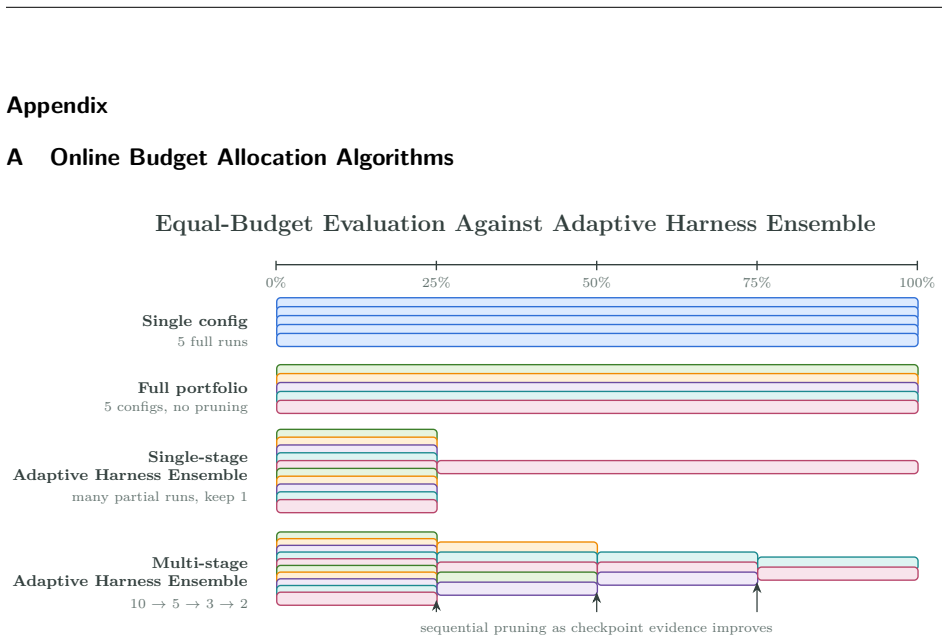
- The budget-matched adaptive schedule (e.g., 12→5→2→1) yields higher average scores than spending the same compute on five full runs of one harness, so online adaptation is a concrete way to spend a fixed discovery budget.
- Because OpenEvolve-style complexity often reversed gains from simpler intermediate variants, simpler harnesses with one or two added components (lightweight exploration or PUCT) may capture most of the available benefit.
Where Pith is reading between the lines
- If the generalization failure extends beyond mathematics, the same non-transfer is likely to appear in code generation, scientific modeling, and non-mathematical search—an empirical prediction that a broader task suite could test.
- The adaptive-allocation result is essentially Successive Halving applied to harnesses; an implication the author leaves implicit is that the policy itself (start breadth, checkpoint positions, survivor counts) is a tunable object, so meta-optimizing the schedule may push average scores further.
- The reported margins are modest in absolute score (about 1.4 points over Sequential BoN on average); whether they matter will depend on whether such differences compound across repeated discoveries or on harder problems, where the best harness is unknown in advance.
- The paper's framing suggests a two-level search: the outer loop selects harnesses while the inner loop searches solutions; if true, discovery systems should be built with explicit outer-loop adaptation rather than a permanently fixed harness.
Editorial analysis
A structured set of objections, weighed in public.
Referee Report
Summary. The paper studies whether the choice of search harness in LLM-guided discovery transfers across models and problems. The authors decompose OpenEvolve-style and TTT-Discover-style harnesses into components, evaluate 30 budget-matched configurations on 12 model–problem pairs (4 LLMs × 3 mathematical tasks), and report three findings: (1) no fixed harness is significantly better than Sequential BoN after multiple-testing correction; (2) partial-run scores correlate with final performance, especially by 50% of the budget; (3) a budget-matched adaptive ensemble that prunes weak partial runs and reallocates compute outperforms single-harness commitment and an unpruned ensemble. The paper releases run pools and baseline null distributions.
Significance. This is a substantial empirical contribution: more than 3.1 million rollouts, matched budgets, repeated trials, bootstrap and permutation tests with 100,000 resamples, Holm correction, and public release of run pools. The negative result on fixed-harness generalization, if accepted, is useful for the field and supports treating harness choice as a hyperparameter. The adaptive-allocation result would be a valuable positive contribution, but it currently rests on an in-sample evaluation. The paper's strengths—careful statistical machinery, honest reporting of non-significance after correction, and release of reusable null distributions—are real and should be credited.
major comments (2)
- [Section 5.2, Table 1, Appendix G, Algorithm 3] The adaptive-ensemble evaluation is in-sample in a way that undermines Finding 3. The policy-level simulations resample with replacement from the same five-run pools that define the policy. With n=5 per harness, the empirical distribution of each harness is coarsely estimated, and the pruning rule selects runs that are lucky at the checkpoint; the final score of a retained survivor comes from the same run whose partial score drove the pruning. The reported SE (0.02) is Monte Carlo error conditional on the pools, not the sampling error of the pools themselves. The advantage of the best adaptive schedule over the unpruned portfolio (85.75 vs 84.54) is small and could plausibly shrink or reverse under a proper out-of-sample protocol. I recommend an out-of-sample evaluation (e.g., leave-one-run-out or a fresh run pool for each harness) or at minimum a bias-corrected estimate explicitly accou
- [Finding 3 / Section 5.2 / Appendix G] The claim that the adaptive ensemble outperforms the unpruned harness portfolio is based on point estimates only. The only vector-battle significance test reported is against the Sequential BoN reference (Appendix G). No test or confidence interval is given for the adaptive-vs-unpruned difference, which is the key control isolating the value of pruning. Given the small margins and the in-sample issue above, this comparison needs a direct significance test or interval, and the claim should be tempered until such evidence is provided.
minor comments (6)
- [Title / Abstract] The word "universally" overstates the scope. The evidence covers 12 model–problem pairs from three mathematical tasks; the abstract's own qualification "across the evaluated model–problem pairs" is more accurate. Suggest aligning the title with the actual scope.
- [Abstract / Section 1] The abstract says "We release all run pools" while the introduction says "we will release"; make the tense consistent.
- [Section 3.3 / Eq. (5)] In the text after Eq. (5), "ˆpcross(h)(h)" has a duplicated argument; the equation itself is clear.
- [Table 1 vs Appendix G] Main-text Table 1 uses column labels CP Q3B, CP Q4B, etc., while Appendix G uses Q2.5, Q3, GPT-20B. Use consistent model naming to avoid confusion.
- [Section 3.2] The five-run protocol is acknowledged as larger than prior work, but the low power of best-of-five significance tests should be noted more prominently when interpreting the non-significant cross-pair results. Absence of evidence after Holm correction is not strong evidence of absence.
- [Abstract / Section 1] The phrase "reusable statistical infrastructure against for future harness proposals" is garbled; should be "against which future harness proposals can be compared".
Circularity Check
No load-bearing circular step; the paper's claims are empirical comparisons against budget-matched baselines.
full rationale
The paper's central claims — that no fixed harness is universally superior, that early progress is informative, and that adaptive allocation improves average performance — are empirical results rather than derivations that reduce to their own inputs. The fixed-harness comparisons use separate baseline pools and bootstrap/permutation tests against Sequential BoN, and the strongest observed fixed configuration is explicitly reported as non-significant after Holm correction (Section 4.2), the opposite of a self-fulfilling claim. The adaptive-allocation experiment replays a generic pruning policy over released run pools: the policy prunes using partial-run scores, and the reported final score is the final score of the same replayed run. This is an in-sample policy evaluation with a small number of empirical runs per harness, which limits external validity, but it is not equivalent by construction to the claimed outcome; if early and final scores were uncorrelated, selection on early scores would not systematically improve average final scores. No load-bearing uniqueness theorem or ansatz is imported from the authors' prior work. The only apparent self-citation (AdaEvolve, Cemri et al. 2026, which shares an author) appears in related work and is not used to justify the paper's conclusions. I therefore find no circular step.
Axiom & Free-Parameter Ledger
axioms (4)
- domain assumption The three chosen tasks are representative of LLM-guided discovery problems.
- domain assumption The component-wise reconstruction faithfully captures OpenEvolve and TTT-Discover search harnesses.
- standard math Bootstrap resampling and permutation tests provide valid null distributions for the heavy-tailed final-score data.
- domain assumption Resampling full trajectories with replacement from the available run pools is a valid way to estimate the expected performance of allocation policies.
read the original abstract
Autonomous discovery systems such as OpenEvolve and TTT-Discover are often used as general-purpose harnesses. However, in practice these are composite systems combining several design choices about archives, parent selection, exploration, and budget allocation into a single recipe. Because discovery runs are expensive and inherently stochastic, existing harnesses are often compared using too few independent trials to distinguish key methodological improvements from run-to-run variance. We systematically decompose OpenEvolve-style evolutionary search and the TTT-Discover search harness into its constituent components and systematically evaluate 30 budget-matched harnesses across 12 model-problem pairs using more than 3.1 million LLM rollouts and repeated-trial statistical analysis. Our results show that discovery harnesses have a generalization problem: No fixed harness is reliably superior across the evaluated model-problem pairs, and variants of OpenEvolve generally underperform simpler alternatives. Thus, harness choice is better viewed as a hyperparameter rather than as a universal recipe, and should be tailored to the specific problem and underlying model. We also find that early discovery progress predicts final performance, and use this property to present a budget-matched adaptive-allocation experiment that starts multiple harnesses, prunes weak partial runs, and reallocates compute to stronger survivors, outperforming both commitment to a randomly sampled fixed harness and a non-adaptive harness ensemble. Together, these results motivate shifting from fixed harness selection to online adaptation guided by early performance. We release all run pools including baseline null distributions for every model-problem pair as reusable statistical infrastructure against for future harness proposals.
Figures




Forward citations
Cited by 1 Pith paper
-
Efficiency Matters in Autonomous Research
On twelve code-optimization tasks, no fixed search structure wins on efficiency, and fluid—a UCB portfolio over hill-climbing chains—nearly matches a per-task oracle on AUC of the reward frontier.
Reference graph
Works this paper leans on
-
[7]
Algorithm portfolios
Carla P Gomes and Bart Selman. Algorithm portfolios. Artificial Intelligence, 126 0 (1-2): 0 43--62, 2001
2001
-
[8]
Deep reinforcement learning that matters
Peter Henderson, Riashat Islam, Philip Bachman, Joelle Pineau, Doina Precup, and David Meger. Deep reinforcement learning that matters. In Proceedings of the AAAI conference on artificial intelligence, volume 32, 2018
2018
-
[9]
Automated design of agentic systems
Shengran Hu, Cong Lu, and Jeff Clune. Automated design of agentic systems. In International Conference on Learning Representations, volume 2025, pp.\ 21344--21377, 2025
2025
-
[11]
Non-stochastic best arm identification and hyperparameter optimization
Kevin Jamieson and Ameet Talwalkar. Non-stochastic best arm identification and hyperparameter optimization. In Artificial intelligence and statistics, pp.\ 240--248. PMLR, 2016
2016
-
[16]
Bandit based monte-carlo planning
Levente Kocsis and Csaba Szepesv \'a ri. Bandit based monte-carlo planning. In European conference on machine learning, pp.\ 282--293. Springer, 2006
2006
-
[19]
Abandoning objectives: Evolution through the search for novelty alone
Joel Lehman and Kenneth O Stanley. Abandoning objectives: Evolution through the search for novelty alone. Evolutionary computation, 19 0 (2): 0 189--223, 2011
2011
-
[20]
Random search and reproducibility for neural architecture search
Liam Li and Ameet Talwalkar. Random search and reproducibility for neural architecture search. In Uncertainty in artificial intelligence, pp.\ 367--377. PMLR, 2020
2020
-
[21]
A system for massively parallel hyperparameter tuning
Liam Li, Kevin Jamieson, Afshin Rostamizadeh, Ekaterina Gonina, Jonathan Ben-Tzur, Moritz Hardt, Benjamin Recht, and Ameet Talwalkar. A system for massively parallel hyperparameter tuning. Proceedings of machine learning and systems, 2: 0 230--246, 2020
2020
-
[22]
Hyperband: A novel bandit-based approach to hyperparameter optimization
Lisha Li, Kevin Jamieson, Giulia DeSalvo, Afshin Rostamizadeh, and Ameet Talwalkar. Hyperband: A novel bandit-based approach to hyperparameter optimization. Journal of machine learning research, 18 0 (185): 0 1--52, 2018
2018
-
[25]
Eoh-s: Evolution of heuristic set using llms for automated heuristic design
Fei Liu, Yilu Liu, Qingfu Zhang, Tong Xialiang, and Mingxuan Yuan. Eoh-s: Evolution of heuristic set using llms for automated heuristic design. In Proceedings of the AAAI Conference on Artificial Intelligence, volume 40, pp.\ 37090--37098, 2026 a
2026
-
[33]
Qwen2.5 technical report, 2025
Qwen: , An Yang, Baosong Yang, Beichen Zhang, Binyuan Hui, Bo Zheng, Bowen Yu, Chengyuan Li, Dayiheng Liu, Fei Huang, Haoran Wei, Huan Lin, Jian Yang, Jianhong Tu, Jianwei Zhang, Jianxin Yang, Jiaxi Yang, Jingren Zhou, Junyang Lin, Kai Dang, Keming Lu, Keqin Bao, Kexin Yang, Le Yu, Mei Li, Mingfeng Xue, Pei Zhang, Qin Zhu, Rui Men, Runji Lin, Tianhao Li, ...
Pith/arXiv arXiv 2025
-
[34]
The algorithm selection problem
John R Rice. The algorithm selection problem. In Advances in computers, volume 15, pp.\ 65--118. Elsevier, 1976
1976
-
[35]
Mathematical discoveries from program search with large language models
Bernardino Romera-Paredes, Mohammadamin Barekatain, Alexander Novikov, Matej Balog, M Pawan Kumar, Emilien Dupont, Francisco JR Ruiz, Jordan S Ellenberg, Pengming Wang, Omar Fawzi, et al. Mathematical discoveries from program search with large language models. Nature, 625 0 (7995): 0 468--475, 2024
2024
-
[38]
Agentsquare: Automatic llm agent search in modular design space
Yu Shang, Yu Li, Keyu Zhao, Likai Ma, Jiahe Liu, Fengli Xu, and Yong Li. Agentsquare: Automatic llm agent search in modular design space. In International Conference on Learning Representations, volume 2025, pp.\ 3841--3865, 2025
2025
-
[39]
OpenEvolve : An open-source evolutionary coding agent
Asankhaya Sharma. OpenEvolve : An open-source evolutionary coding agent. GitHub repository, 2025. URL https://github.com/algorithmicsuperintelligence/openevolve
2025
-
[40]
Mastering the game of go without human knowledge
David Silver, Julian Schrittwieser, Karen Simonyan, Ioannis Antonoglou, Aja Huang, Arthur Guez, Thomas Hubert, Lucas Baker, Matthew Lai, Adrian Bolton, et al. Mastering the game of go without human knowledge. nature, 550 0 (7676): 0 354--359, 2017
2017
-
[46]
Large language models as optimizers
Chengrun Yang, Xuezhi Wang, Yifeng Lu, Hanxiao Liu, Quoc V Le, Denny Zhou, and Xinyun Chen. Large language models as optimizers. In International Conference on Learning Representations, volume 2024, pp.\ 12028--12068, 2024
2024
-
[47]
Reevo: Large language models as hyper-heuristics with reflective evolution
Haoran Ye, Jiarui Wang, Zhiguang Cao, Federico Berto, Chuanbo Hua, Haeyeon Kim, Jinkyoo Park, and Guojie Song. Reevo: Large language models as hyper-heuristics with reflective evolution. Advances in neural information processing systems, 37: 0 43571--43608, 2024
2024
-
[50]
arXiv preprint arXiv:2506.13131 , year=
Alphaevolve: A coding agent for scientific and algorithmic discovery , author=. arXiv preprint arXiv:2506.13131 , year=
-
[51]
arXiv preprint arXiv:2509.19349 , year=
Shinkaevolve: Towards open-ended and sample-efficient program evolution , author=. arXiv preprint arXiv:2509.19349 , year=
-
[52]
Nature , volume=
Mathematical discoveries from program search with large language models , author=. Nature , volume=. 2024 , publisher=
2024
-
[53]
arXiv preprint arXiv:2601.16175 , year=
Learning to discover at test time , author=. arXiv preprint arXiv:2601.16175 , year=
-
[54]
arXiv preprint arXiv:2602.20133 , year=
Adaevolve: Adaptive llm driven zeroth-order optimization , author=. arXiv preprint arXiv:2602.20133 , year=
-
[55]
Sharma, Asankhaya , year =
-
[56]
arXiv preprint arXiv:2602.02919 , year=
DeltaEvolve: Accelerating Scientific Discovery through Momentum-Driven Evolution , author=. arXiv preprint arXiv:2602.02919 , year=
-
[57]
nature , volume=
Mastering the game of go without human knowledge , author=. nature , volume=. 2017 , publisher=
2017
-
[58]
European conference on machine learning , pages=
Bandit based monte-carlo planning , author=. European conference on machine learning , pages=. 2006 , organization=
2006
-
[59]
arXiv preprint arXiv:2602.16805 , year=
Simple Baselines are Competitive with Code Evolution , author=. arXiv preprint arXiv:2602.16805 , year=
-
[60]
arXiv preprint arXiv:2603.28052 , year=
Meta-harness: End-to-end optimization of model harnesses , author=. arXiv preprint arXiv:2603.28052 , year=
-
[61]
2025 , eprint=
Qwen2.5 Technical Report , author=. 2025 , eprint=
2025
-
[62]
arXiv preprint arXiv:2505.09388 , year=
Qwen3 technical report , author=. arXiv preprint arXiv:2505.09388 , year=
-
[63]
arXiv preprint arXiv:2508.10925 , year=
gpt-oss-120b & gpt-oss-20b model card , author=. arXiv preprint arXiv:2508.10925 , year=
-
[64]
Journal of Machine learning research , volume=
Statistical comparisons of classifiers over multiple data sets , author=. Journal of Machine learning research , volume=
-
[65]
arXiv preprint arXiv:2602.23413 , year=
Evox: Meta-evolution for automated discovery , author=. arXiv preprint arXiv:2602.23413 , year=
-
[66]
arXiv preprint arXiv:2606.09498 , year=
Self-Harness: Harnesses That Improve Themselves , author=. arXiv preprint arXiv:2606.09498 , year=
-
[67]
arXiv preprint arXiv:2604.25850 , year=
Agentic harness engineering: Observability-driven automatic evolution of coding-agent harnesses , author=. arXiv preprint arXiv:2604.25850 , year=
-
[68]
arXiv preprint arXiv:2603.03329 , year=
Autoharness: improving llm agents by automatically synthesizing a code harness , author=. arXiv preprint arXiv:2603.03329 , year=
-
[69]
arXiv preprint arXiv:2606.01779 , year=
HarnessForge: Joint Harness and Policy Evolution for Adaptive Agent Systems , author=. arXiv preprint arXiv:2606.01779 , year=
-
[70]
arXiv preprint arXiv:2605.18747 , year=
Code as Agent Harness , author=. arXiv preprint arXiv:2605.18747 , year=
-
[71]
2026 , publisher=
Harness engineering for language agents: The harness layer as control, agency, and runtime , author=. 2026 , publisher=
2026
-
[72]
International Conference on Learning Representations , volume=
Large language models as optimizers , author=. International Conference on Learning Representations , volume=
-
[73]
arXiv preprint arXiv:2510.14150 , year=
Codeevolve: An open source evolutionary coding agent for algorithm discovery and optimization , author=. arXiv preprint arXiv:2510.14150 , year=
-
[74]
arXiv preprint arXiv:2510.06056 , year=
Scientific algorithm discovery by augmenting alphaevolve with deep research , author=. arXiv preprint arXiv:2510.06056 , year=
-
[75]
arXiv preprint arXiv:2511.17592 , year=
GigaEvo: An Open Source Optimization Framework Powered By LLMs And Evolution Algorithms , author=. arXiv preprint arXiv:2511.17592 , year=
-
[76]
arXiv preprint arXiv:2507.19457 , year=
Gepa: Reflective prompt evolution can outperform reinforcement learning , author=. arXiv preprint arXiv:2507.19457 , year=
-
[77]
Advances in neural information processing systems , volume=
Reevo: Large language models as hyper-heuristics with reflective evolution , author=. Advances in neural information processing systems , volume=
-
[78]
arXiv preprint arXiv:2401.02051 , year=
Evolution of heuristics: Towards efficient automatic algorithm design using large language model , author=. arXiv preprint arXiv:2401.02051 , year=
-
[79]
Proceedings of the AAAI Conference on Artificial Intelligence , volume=
Eoh-s: Evolution of heuristic set using llms for automated heuristic design , author=. Proceedings of the AAAI Conference on Artificial Intelligence , volume=
-
[80]
arXiv preprint arXiv:1504.04909 , year=
Illuminating search spaces by mapping elites , author=. arXiv preprint arXiv:1504.04909 , year=
-
[81]
Evolutionary computation , volume=
Abandoning objectives: Evolution through the search for novelty alone , author=. Evolutionary computation , volume=. 2011 , publisher=
2011
-
[82]
Advances in computers , volume=
The algorithm selection problem , author=. Advances in computers , volume=. 1976 , publisher=
1976
-
[83]
Artificial Intelligence , volume=
Algorithm portfolios , author=. Artificial Intelligence , volume=. 2001 , publisher=
2001
-
[84]
Artificial intelligence and statistics , pages=
Non-stochastic best arm identification and hyperparameter optimization , author=. Artificial intelligence and statistics , pages=. 2016 , organization=
2016
-
[85]
Journal of machine learning research , volume=
Hyperband: A novel bandit-based approach to hyperparameter optimization , author=. Journal of machine learning research , volume=
-
[86]
Proceedings of machine learning and systems , volume=
A system for massively parallel hyperparameter tuning , author=. Proceedings of machine learning and systems , volume=
-
[87]
arXiv preprint arXiv:2511.23473 , year=
Thetaevolve: Test-time learning on open problems , author=. arXiv preprint arXiv:2511.23473 , year=
-
[88]
Proceedings of the AAAI conference on artificial intelligence , volume=
Deep reinforcement learning that matters , author=. Proceedings of the AAAI conference on artificial intelligence , volume=
-
[89]
Uncertainty in artificial intelligence , pages=
Random search and reproducibility for neural architecture search , author=. Uncertainty in artificial intelligence , pages=. 2020 , organization=
2020
-
[90]
arXiv preprint arXiv:1912.12522 , year=
NAS evaluation is frustratingly hard , author=. arXiv preprint arXiv:1912.12522 , year=
Pith/arXiv arXiv 1912
-
[91]
arXiv preprint arXiv:2407.21787 , year=
Large language monkeys: Scaling inference compute with repeated sampling , author=. arXiv preprint arXiv:2407.21787 , year=
-
[92]
arXiv preprint arXiv:2407.01502 , year=
Ai agents that matter , author=. arXiv preprint arXiv:2407.01502 , year=
-
[93]
arXiv preprint arXiv:2605.09764 , year=
LEVI: Stronger Search Architectures Can Substitute for Larger LLMs in Evolutionary Search , author=. arXiv preprint arXiv:2605.09764 , year=
-
[94]
arXiv preprint arXiv:2605.29268 , year=
Compute Allocation in Evolutionary Search: From Depth-Breadth to Multi-Armed Bandits , author=. arXiv preprint arXiv:2605.29268 , year=
-
[95]
arXiv preprint arXiv:2605.15221 , year=
Effective Harness Engineering for Algorithm Discovery with Coding Agents , author=. arXiv preprint arXiv:2605.15221 , year=
-
[96]
arXiv preprint arXiv:2604.20938 , year=
Harbor: Automated harness optimization , author=. arXiv preprint arXiv:2604.20938 , year=
-
[97]
arXiv preprint arXiv:2605.09998 , year=
Continual harness: Online adaptation for self-improving foundation agents , author=. arXiv preprint arXiv:2605.09998 , year=
-
[98]
arXiv preprint arXiv:2605.20086 , year=
What Do Evolutionary Coding Agents Evolve? , author=. arXiv preprint arXiv:2605.20086 , year=
-
[99]
International Conference on Learning Representations , volume=
Automated design of agentic systems , author=. International Conference on Learning Representations , volume=
-
[100]
International Conference on Learning Representations , volume=
Agentsquare: Automatic llm agent search in modular design space , author=. International Conference on Learning Representations , volume=
-
[101]
arXiv preprint arXiv:2409.15254 , year=
Archon: An architecture search framework for inference-time techniques , author=. arXiv preprint arXiv:2409.15254 , year=
discussion (0)
Sign in with ORCID, Apple, or X to comment. Anyone can read and Pith papers without signing in.