REVIEW 1 major objections 4 minor 119 references
Integrable systems connected with black holes
T0 review · 1 major / 4 minor · reviewed 2026-08-14 · deepseek-v4-flash
Pith's one-line read This thesis establishes that geodesic motion in the near-horizon geometry of extremal Myers-Perry black holes is integrable in arbitrary even and odd dimensions, with explicit first integrals and Killing tensors, and it derives a…
desk verdict A PhD thesis compiling the author's published work on NHEMP integrability and a new covariant memory formulation; the partially isotropic EVH integrability claim needs explicit support before it can be taken at face value. read the letter →
The pith
A machine-rendered reading of the paper's core claim, the machinery that carries it, and where it could break.
The reading
What carries the argument
Three devices carry the arguments. For the memory part, the B-tensor $B_{\alpha\beta}=\nabla_\beta T_\alpha$ — the gradient of the geodesic vector field — has a discontinuity across the null shell, with the jump in expansion governed by shell energy density and currents, and the jump in shear by the gravitational-wave component. For integrability, the reduction to angular mechanics uses the $\mathrm{SL}(2,\mathbb{R})$ isometry of the near-horizon metric to write the mass-shell condition as a Casimir invariant $\mathcal{I}=HK-D^2$, leaving a lower-dimensional Hamiltonian on the latitudinal sphere. Separability in ellipsoidal coordinates turns the Hamilton-Jacobi equation into ordinary differential equations whose integration constants become the explicit first integrals (119) and, in turn, second-rank Killing tensors. For the quantum part, Klein-Gordonization is a conformal rescaling $\tilde{g}_{\mu\nu}=\Omega^2 g_{\mu\nu}$, $\tilde{\phi}=\Omega^{(1-d)/2}\phi$ that converts a static Schrödinger-type equation into a Klein-Gordon equation; the conformal factor solves the nonlinear elliptic equation (193), which for $m^2=0$ becomes linear and is solved by the ground-state wavefunction.
What would settle it
Compute the Poisson brackets of the first integrals in (119) for a nine-dimensional NHEMP background with two equal and two unequal rotation parameters; any non-zero bracket among the $d$ claimed invariants falsifies the claim. A numerical Poincaré section of the reduced angular mechanics should in that case show curves, not a filled region.
Extended reading notes
Core claim
The central claim is that the reduced 'angular mechanics' describing probe particles in the near-horizon extremal Myers-Perry (NHEMP) background separates in ellipsoidal coordinates, so the geodesic problem is Liouville integrable — as many independent conserved quantities as degrees of freedom — in arbitrary dimension. The thesis writes the geometry in a unified form for even and odd dimensions, constructs mutually commuting first integrals (Eq. 119) plus the constants associated with Killing vectors, and identifies the corresponding second-rank Killing tensors. It shows that when rotation parameters are grouped into equal blocks the system becomes superintegrable, while the fully isotropic odd-dimensional case is maximally superintegrable. It also treats the extremal vanishing horizon case, where an extra $\mathrm{SL}(2,\mathbb{R})$ factor appears but yields no new independent conserved charges, so the system remains integrable rather than superintegrable. In the second part, the thesis claims that every quantum Hamiltonian of the form $H=-\Delta_\gamma+V(x)$ with spectrum $E_N=A(N+B)^2-C$ can be conformally mapped to a Klein-Gordon equation; for zero mass and $B=0$ the conformal factor is the ground-state wavefunction, producing spacetimes with perfectly resonant frequencies.
Load-bearing premise
The load-bearing assumption of the Klein-Gordonization construction is that the target Klein-Gordon field is massless and the spectral parameter $B$ in $E_N=A(N+B)^2-C$ is zero, so the ground-state wavefunction can serve as the conformal factor; for non-zero mass or $B$, the nonlinear equation (193) is left unsolved and the spacetime family (226) is not derived.
Editorial extensions
If this is right
- In every dimension and for every pattern of equal and unequal rotation parameters, geodesic motion near an extremal Myers-Perry horizon is Liouville integrable; partially isotropic cases are superintegrable and the fully isotropic odd-dimensional case is maximally superintegrable.
- The explicit first integrals provide second-rank Killing tensors, making the hidden symmetries of these near-horizon geometries explicit; in the generic case $d$ independent conserved charges exist, $[d/2]$ from Killing tensors.
- For extremal vanishing horizon Myers-Perry black holes, the extra $\mathrm{SL}(2,\mathbb{R})$ symmetry of the $\mathrm{AdS}_3$ throat does not generate new conserved charges; the system remains integrable but not superintegrable.
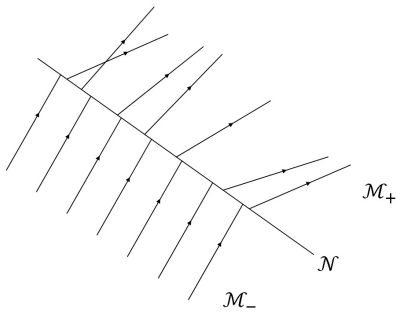
- An impulsive null shell produces a jump in the expansion proportional to the shell's energy density and currents, and a jump in the shear proportional to the gravitational-wave component; this B-memory gives a covariant form of gravitational memory.
- Quantum systems with quadratic spectra map to spacetimes whose massless wave equations have perfectly resonant frequency spectra; the Rosochatius family yields the explicit metric (226), of which AdS is a special case.
Reading between the lines
- If Klein-Gordonization generically preserves hidden symmetries, the generated resonant spacetimes should possess extra Killing or Killing-Yano tensors inherited from the superintegrable system; checking this for the Rosochatius family is a direct next step.
- The B-memory discontinuity may be the classical shadow of a vacuum reorganisation across the shell: since BMS supertranslations relate inequivalent vacua, the eikonal wavefront distortion seen in the thesis hints at a quantum memory effect, a direction the thesis leaves open.
- The same separation-of-variables machinery likely applies to probe fields (scalar, Dirac, or higher-spin) on these near-horizon backgrounds, using principal or Killing-Yano tensors; the thesis explicitly lists this as unexplored.
- Because the claimed first integrals are explicit quadratic polynomials in momenta, their involutivity can be checked algebraically in any given dimension, offering a computational verification independent of the geometric separation argument.
Signed reviews
Editorial analysis
A structured set of objections, weighed in public.
Referee Report
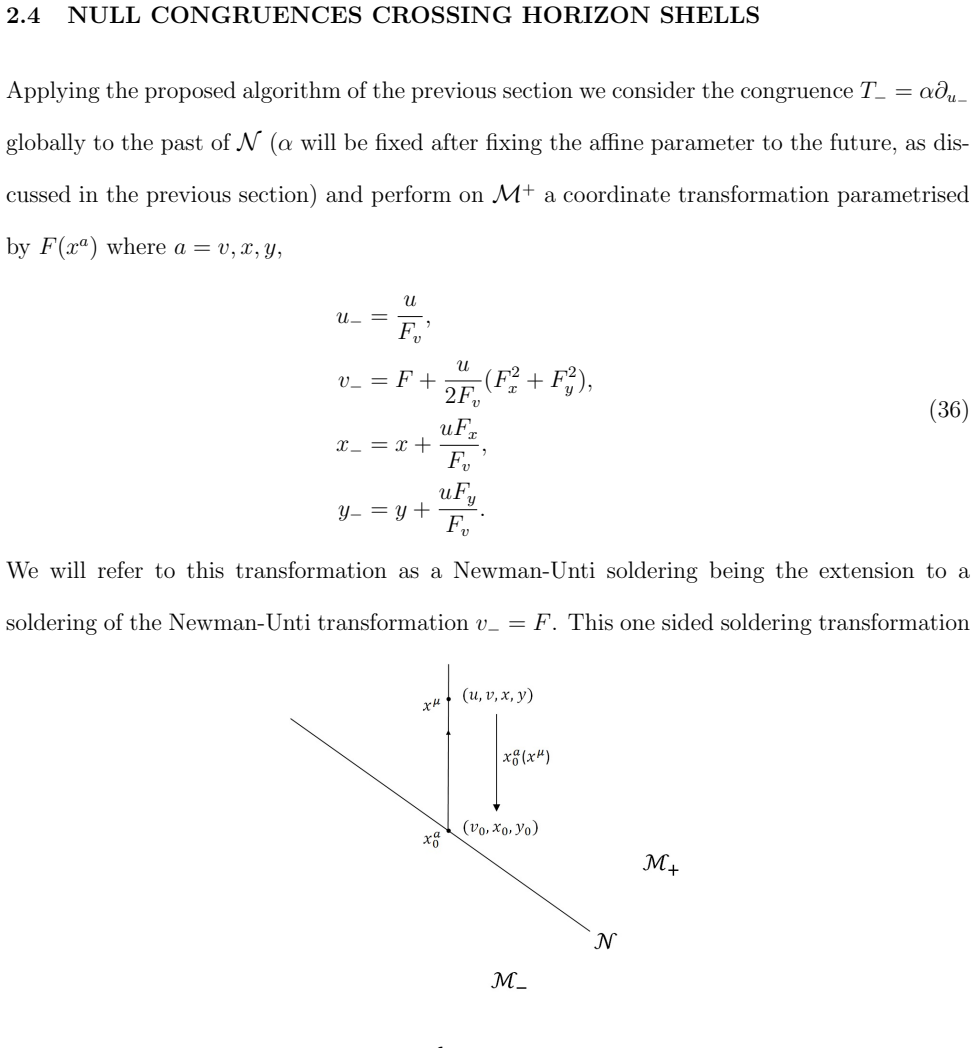
Summary. The manuscript is a PhD thesis combining three lines of work. Chapter 2 develops a method for computing the effect of a null shell, modeled as an impulsive gravitational wave, on a null geodesic congruence. The method gives a covariant 'B-memory' formulation of gravitational memory, with explicit formulas for the jumps in expansion and shear in terms of the shell's stress-energy and gravitational-wave content. Chapters 3-4 address geodesic integrability in near-horizon extremal Myers-Perry (NHEMP) geometries. A unified description of odd and even dimensions is given, and the fully non-isotropic, fully isotropic, and partially isotropic cases are analyzed. The chapter claims an arbitrary-dimensional integrability result with explicit first integrals and second-rank Killing tensors, and it also treats the extremal vanishing horizon (EVH) case. Chapter 5 proposes a 'Klein-Gordonization' procedure that conformally maps a nonrelativistic quantum system with a quadratic energy spectrum to a Klein-Gordon equation on a static spacetime with a resonant frequency spectrum. The procedure is applied explicitly to the Higgs oscillator and to the superintegrable Rosochatius system.
Significance. If the claims hold, the thesis gives a complete integrability picture for geodesic motion in NHEMP geometries, including explicit constants of motion and Killing tensors in arbitrary even and odd dimensions, and it isolates the new conserved charges that appear in the near-horizon limit. The partially isotropic and EVH cases, once fully established, would close the gap between the two previously known corner cases. Chapter 5 provides a constructive and falsifiable mechanism for generating highly resonant spacetimes from known superintegrable systems; the explicit family (226) is a concrete output with direct relevance to studies of weakly nonlinear dynamics and hidden symmetries. The derivations are analytic and largely self-contained, and the thesis is based on the author's published papers [72-77], which lends credibility to the central computations. The main weakness is that one advertised sector, the partially isotropic EVH case, is asserted rather than derived, and this is load-bearing for the chapter's claim of covering the general EVH family.
major comments (1)
- [Section 4.2, partially isotropic EVH paragraph] The integrability claim for the partially isotropic EVH case is not derived. The text states that 'it is straightforward to separate the variables' and that the result is 'a spherical mechanics similar to (149)', but no coordinate transformation, separated Hamilton-Jacobi equation, first integrals, or Poisson-commutation check is provided. This is not merely a matter of presentation: the EVH Hamiltonian (172) contains the prefactor (1 - sum_c x_c^2/m_c), which is not the same as the prefactor A(y) used in the non-EVH partially isotropic construction (140), (149). After introducing spherical coordinates for each block of equal rotation parameters, the analogous prefactor would be (1 - sum_a y_a^2/tilde m_a), and one must show that the adapted ellipsoidal coordinates still separate the system and that the spherical-subsystem constants can be promoted to globally commuting constants of motion. Without this step, the advertised independent integrals for the general EVH case have not actually been produced, and the section leaves a gap between the explicit fully non-isotropic case (173)-(176) and the fully isotropic case (177)-(178).
minor comments (4)
- [Section 2.4] The inversion of the geodesic projection x^a_0(x^alpha) is acknowledged to suffer from caustics, but the subsequent formulas for the evolution of the B-tensor to the future of the shell require the Jacobian of this inverse map. The explicit computation is given only for BMS solderings in Section 2.5.2; for a general Newman-Unti soldering the paper should state the regularity assumptions under which the local inversion is a diffeomorphism and the future evolution is well defined.
- [Section 5.2, Eqs. (193)-(197)] The construction of resonant spacetimes from ground-state wavefunctions applies only in the massless case m^2=0 and requires the additional condition B=0 in the spectrum (180). The thesis does state this restriction, but it should appear prominently in the summary of Chapter 5 and in the abstract, since the general nonlinear equation (193) is left unsolved and the resulting spacetime family (226) is a codimension-one subfamily of the Rosochatius systems (208).
- [Section 4.2, Eqs. (164)-(172)] The domain of the coordinates x_a in the EVH metric is not stated. The prefactor (1 - sum x_a^2/m_a) changes sign and vanishes on an ellipsoid, so the text should specify the coordinate range or the constraint, as this is needed to interpret the Hamiltonian and the subsequent separation of variables.
- [General] The manuscript contains several typographical and notational inconsistencies, such as 'Rossochatius' in Section 3.4, inconsistent use of tildes on parameters in Section 4.1.1, and occasional mixed use of N and N_sigma in counting arguments. These do not affect the derivations but should be cleaned up in a final version.
Circularity Check
No significant circularity: the integrability derivations are self-contained, and the resonant-spacetime construction is an explicit conformal mapping rather than a fitted prediction.
full rationale
The central derivations in Chapters 3 and 4 are self-contained. The reduced angular Hamiltonian (86) is separated in ellipsoidal coordinates through the explicit generating function (103), and the first integrals are given directly by the inverse Vandermonde construction (107) and in initial coordinates by (119). The even-dimensional case follows from the same unified description with sigma = 1, so it is not imported from a self-citation. The partially isotropic NHEMP case is reduced by an explicit mixed spherical/ellipsoidal coordinate construction (145)-(150) to a lower-dimensional Hamiltonian of the already-solved non-isotropic form (90); this is a valid reduction to previously proven cases, not a circular invocation. The EVH case similarly separates explicitly for the fully non-isotropic case (173)-(176) and the isotropic case (177)-(178). The partially isotropic EVH paragraph in Section 4.2 is admittedly only a sketch ('it is straightforward to separate the variables'), which is an omitted proof or gap in presentation, but it is not circularity, because no equation is being replaced by its own input. In Chapter 5, the 'resonant spacetime' property is derived from the quadratic spectrum (180) by Eq. (185), w_N = sqrt(A)(N+B), which is an explicit algebraic consequence of the input spectrum. The massless simplification uses the ground-state wavefunction as the conformal factor via (195)-(197), and the spacetime family (226) is then written explicitly. This is a constructive correspondence, not a fitted parameter renamed as a prediction. Self-citations to the author's prior papers [72-77] are present, but the load-bearing derivations are reproduced in the thesis text, and no uniqueness theorem or ansatz is imported solely through a self-citation. Overall, the paper does not exhibit circularity; its main weaknesses are gaps in fully exhibiting the partially isotropic EVH separation, which are matters of completeness rather than circular reasoning.
Assumptions & free parameters
assumptions (3)
- domain assumption The geodesic vector of a test particle is continuous across a null shell when continuous coordinates are used.
- domain assumption The NHEMP metric in the unified Gaussian null coordinates (76) is the correct near-horizon limit of the Myers-Perry metric.
- ad hoc to paper Equation (193) admits a solution for the conformal factor when m^2=0 and B=0, namely the ground state wavefunction.
Cite this review
Pith. "Pith review of Integrable systems connected with black holes." pith.science (2026). https://pith.science/paper/FOMROTIE
@misc{pith2026190801322,
  author       = {Pith},
  title        = {Pith review of: Integrable systems connected with black holes},
  year         = {2026},
  howpublished = {\url{https://pith.science/paper/FOMROTIE}},
  note         = {Machine review of arXiv:1908.01322}
}
read the original abstract
This work is devoted to the study of some important questions in general relativity. They include topics related to astrophysical shock waves, impulsive signals, gravitational memory effect, black hole geometries and integrable systems connected with them.
Figures

Reference graph
Works this paper leans on
-
[1]
Israel, Singular Hypersurfaces and Thin Shells in General Relativity , Nuovo Cimento B 44, 1966 1–14
W. Israel, Singular Hypersurfaces and Thin Shells in General Relativity , Nuovo Cimento B 44, 1966 1–14
1966
-
[2]
Selected solutions of Einstein’s field equations: Their role in general relativity and astrophysics,
J. Bicak, “Selected solutions of Einstein’s field equations: Their role in general relativity and astrophysics,” Lect. Notes Phys. 540, 1 (2000) [arXiv:0004016 [gr-qc]]
2000
-
[3]
Exact solutions of Einstein’s field equations,
P. S. Negi, “Exact solutions of Einstein’s field equations,” Int. J. Theor. Phys. 45, 1684 (2006) [arXiv:0401024 [gr-qc]]
2006
-
[4]
A., 1963, MNRAS, 125, 169
Hoyle F., Fowler W. A., 1963, MNRAS, 125, 169
1963
-
[5]
A., 1963, Nature, 197, 533
Hoyle F., Fowler W. A., 1963, Nature, 197, 533
1963
-
[6]
Evolution of supermassive stars as a pathway to black hole formation,
M. C. Begelman, “Evolution of supermassive stars as a pathway to black hole formation,” Mon. Not. Roy. Astron. Soc. 402, 673 (2010) [arXiv:0910.4398 [astro-ph.CO]]
arXiv 2010
-
[7]
The role of black holes in galaxy formation and evolution,
Cattaneo, A., Faber, S. M., Binney, J. et al., “The role of black holes in galaxy formation and evolution,” 2009, Nature, 460, 213, arXiv:0907.1608 [astro-ph.CO]
arXiv 2009
-
[8]
A Fundamental relation between supermassive black holes and their host galaxies,
L. Ferrarese and D. Merritt, “A Fundamental relation between supermassive black holes and their host galaxies,” Astrophys. J. 539, L9 (2000) [arXiv:astro-ph/0006053]
arXiv 2000
Show all 119 references
-
[9]
A Relationship between nuclear black hole mass and galaxy velocity dispersion,
K. Gebhardt et al., “A Relationship between nuclear black hole mass and galaxy velocity dispersion,” Astrophys. J. 539, L13 (2000) [arXiv:astro-ph/0006289]
2000 arXiv
-
[10]
Electromagnetic extraction of energy from Kerr black holes
Blandford, R. D., & Znajek, R. L. 1977, “Electromagnetic extraction of energy from Kerr black holes” MNRAS, 179, 433
1977
-
[11]
GRMHD Simulations of Magnetized Advection Dominated Accretion on a Non-Spinning Black Hole: Outflows 90 and Convection,
R. Narayan, A. Sadowski, R. F. Penna and A. K. Kulkarni, “GRMHD Simulations of Magnetized Advection Dominated Accretion on a Non-Spinning Black Hole: Outflows 90 and Convection,” Mon. Not. Roy. Astron. Soc. 426, 3241 (2012) arXiv:1206.1213 [astro- ph.HE]
2012 arXiv
-
[12]
Astrophysical evidence for black holes,
M. J. Rees, “Astrophysical evidence for black holes,” [arXiv:9701161 [astro-ph]]
-
[13]
Astrophysical evidence for black hole event horizons,
K. Menou, E. Quataert and R. Narayan, “Astrophysical evidence for black hole event horizons,” [arXiv:9712015 [astro-ph]]
-
[14]
Carr, B. J. (1996) Black Holes in Cosmology and Astrophysics, in General Relativity (Proceedings of the 46th Scottish Universities Summer School in Physics), Institute of Physics Publishing, London
1996
-
[15]
P., Gravitational Field of a Spinning Mass as an Example of Algebraically Special Metrics, 1963, Physical Review Letters, 11, 237
Kerr, R. P., Gravitational Field of a Spinning Mass as an Example of Algebraically Special Metrics, 1963, Physical Review Letters, 11, 237
1963
-
[16]
Confirmation Via the Continuum-Fitting Method that the Spin of the Black Hole in Cygnus X-1 is Extreme,
L. Gou et al., “Confirmation Via the Continuum-Fitting Method that the Spin of the Black Hole in Cygnus X-1 is Extreme,” Astrophys. J. 790, no. 1, 29 (2014) [arXiv:1308.4760 [astro-ph.HE]]
2014 arXiv
-
[17]
Constraining Black Hole Spin Via X-ray Spec- troscopy,
L. W. Brenneman and C. S. Reynolds, “Constraining Black Hole Spin Via X-ray Spec- troscopy,” Astrophys. J. 652, 1028 (2006) [arXiv:0608502 [astro-ph]]
2006
-
[18]
Measurements of general relativistic effects in the binary pulsar PSR 1913+16,
J. H. Taylor, L. A. Fowler and P. M. McCulloch, “Measurements of general relativistic effects in the binary pulsar PSR 1913+16,” Nature 277, 437 (1979)
1979
-
[19]
No evidence for black hole spin powering of jets in X-ray binaries
Fender, R. P. Gallo E., Russell D., “No evidence for black hole spin powering of jets in X-ray binaries” 2010, MNRAS, 406, 1425 [arXiv:1003.5516 [astro-ph.HE]]
2010 arXiv
-
[20]
Foundations of Black Hole Accretion Disk The- ory
Abramowicz, Marek A., P. Chris Fragile.“Foundations of Black Hole Accretion Disk The- ory”. Living Reviews in Relativity 16.1 (2013): 1. PMC. Web. 28 July 2017
2013
-
[21]
Walker, R
M. Walker, R. Penrose, Commun. Math. Phys. 18 (1970) 265
1970
-
[22]
Thin shells in general relativity and cosmology: The Lightlike limit,
C. Barrabes and W. Israel, “Thin shells in general relativity and cosmology: The Lightlike limit,” Phys. Rev. D 43 (1991) 1129. 91
1991
-
[23]
Horizon Shells and BMS-like Soldering Transformations,
M. Blau and M. O’Loughlin, “Horizon Shells and BMS-like Soldering Transformations,” JHEP 1603, 029 (2016) arXiv:1512.02858 [hep-th]
2016 arXiv
-
[25]
Soft Hair on Black Holes
S.W. Hawking, M.J. Perry, A. Strominger, “Soft Hair on Black Holes” Phys.Rev.Lett. 116 (2016) 231301. arXiv:1601.00921 [hep-th]
2016 arXiv
-
[26]
Gravitational Memory, BMS Supertranslations and Soft Theorems,
A. Strominger and A. Zhiboedov, “Gravitational Memory, BMS Supertranslations and Soft Theorems,” JHEP 1601, 086 (2016) arXiv:1411.5745 [hep-th]
2016 arXiv
-
[27]
Zeldovich and A
Y. Zeldovich and A. Polnarev, Radiation of gravitational waves by a cluster of superdense stars, Sov. Astron. AJ (Engl. Transl.), v. 18, no. 1, pp. 17-23 (Jul, 1974) 143. V. B. Braginsky and L. P. Grishchuk, Kinematic Resonance and Memory Effect in Free Mass Gravitational Anten...
1985 arXiv
-
[28]
Strominger, “Lectures on the Infrared Structure of Gravity and Gauge Theory, arXiv:1703.05448 [hep-th]
A. Strominger, “Lectures on the Infrared Structure of Gravity and Gauge Theory, arXiv:1703.05448 [hep-th]. Section 6. and references therein
-
[29]
Null infinity, the BMS group and infrared issues,
A. Ashtekar, M. Campiglia and A. Laddha, “Null infinity, the BMS group and infrared issues,” arXiv:1808.07093 [gr-qc]
-
[30]
Singular null hypersurfaces in general relativity
C. Barrabes and P. A. Hogan, “Singular null hypersurfaces in general relativity”, World Scientific (2002)
2002
-
[31]
Detection of impulsive light - like signals in general rela- tivity,
C. Barrabes and P. A. Hogan, “Detection of impulsive light - like signals in general rela- tivity,” Int. J. Mod. Phys. D 10 (2001) 711, arXiv:[gr-qc/0105033]
2001 arXiv
-
[32]
A Relativist’s Toolkit: The Mathematics of Black-Hole Mechanics
E. Poisson, “A Relativist’s Toolkit: The Mathematics of Black-Hole Mechanics” (pp. 28- 58), Cambridge: Cambridge University Press (2004)
2004
-
[33]
Near horizon extremal Myers- Perry black holes and integrability of associated conformal mechanics,
T. Hakobyan, A. Nersessian and M. M. Sheikh-Jabbari, “Near horizon extremal Myers- Perry black holes and integrability of associated conformal mechanics,” Phys. Lett. B772, 586 (2017)
2017
-
[34]
Integrable and superintegrable systems,
B. A. Kupershmidt, “Integrable and superintegrable systems,” Singapore, Singapore: World Scientific (1990) 388 p
1990
-
[35]
Classical and Quantum Superintegrability with Applications,
W. Miller, Jr., S. Post and P. Winternitz, “Classical and Quantum Superintegrability with Applications,” J. Phys. A 46, 423001 (2013). 93
2013
-
[36]
Harnad and O
J. Harnad and O. Yermolayeva, Superintegrability, Lax matrices and separation of vari- ables, CRM Proc. Lect. Notes 37 (2004) 65
2004
-
[37]
Global structure of the Kerr family of gravitational fields,
B. Carter, “Global structure of the Kerr family of gravitational fields,” Phys. Rev. 174, 1559 (1968); B. Carter, “Hamilton-Jacobi and Schrodinger separable solutions of Einstein’s equations,” Commun. Math. Phys. 10, 280 (1968). M. Walker and R. Penrose, “On quadratic first inte...
1968
-
[38]
spacetimes,” Commun. Math. Phys. 18, 265 (1970)
1970
-
[39]
Black holes and superconformal mechanics,
P. Claus, M. Derix, R. Kallosh, J. Kumar, P. K. Townsend and A. Van Proeyen, “Black holes and superconformal mechanics,” Phys. Rev. Lett. 81 (1998) 4553 [hep-th/9804177]
1998 arXiv
-
[40]
Particle and light motion in a space-time of a five- dimensional rotating black hole,
V. P. Frolov and D. Stojkovic, “Particle and light motion in a space-time of a five- dimensional rotating black hole,” Phys. Rev. D 68, 064011 (2003) [gr-qc/0301016]
2003 arXiv
-
[41]
Particle dynamics on AdS2×S2 background with two-form flux,
A. Galajinsky, “Particle dynamics on AdS2×S2 background with two-form flux,” Phys. Rev. D 78 (2008) 044014 [arXiv:0806.1629 [hep-th]]
2008 arXiv
-
[42]
Particle dynamics near extreme Kerr throat and supersymmetry,
A. Galajinsky, “Particle dynamics near extreme Kerr throat and supersymmetry,” JHEP 1011, 126 (2010) [arXiv:1009.2341 [hep-th]]
2010 arXiv
-
[43]
Conformal mechanics inspired by extremal black holes in d=4,
A. Galajinsky and A. Nersessian, “Conformal mechanics inspired by extremal black holes in d=4,” JHEP 1111, 135 (2011) [arXiv:1108.3394 [hep-th]]
2011 arXiv
-
[44]
Near horizon black holes in diverse dimensions and integrable models,
A. Galajinsky, “Near horizon black holes in diverse dimensions and integrable models,” Phys. Rev. D 87, no. 2, 024023 (2013) [arXiv:1209.5034 [hep-th]]
2013 arXiv
-
[45]
N=2 superparticle near horizon of extreme Kerr-Newman- AdS-dS black hole,
A. Galajinsky and K. Orekhov, “N=2 superparticle near horizon of extreme Kerr-Newman- AdS-dS black hole,” Nucl. Phys. B 850, 339 (2011) [arXiv:1103.1047 [hep-th]]
2011 arXiv
-
[46]
Action-Angle Variables for the Particle Near Extreme Kerr Throat,
S. Bellucci, A. Nersessian and V. Yeghikyan, “Action-Angle Variables for the Particle Near Extreme Kerr Throat,” Mod. Phys. Lett. A 27 (2012) 1250191, [arXiv:1112.4713[hep-th]]. 94
2012 arXiv
-
[47]
Near-horizon dynamics of particle in extreme Reissner-Nordstr¨ om and Clement-Gal’tsov black hole backgrounds: action-angle variables,
A. Saghatelian, “Near-horizon dynamics of particle in extreme Reissner-Nordstr¨ om and Clement-Gal’tsov black hole backgrounds: action-angle variables,” Class. Quant. Grav. 29 (2012) 245018, [arXiv:1205.6270[hep-th]]
2012 arXiv
-
[48]
On the near horizon rotating black hole geometries with NUT charges,
A. Galajinsky and K. Orekhov, “On the near horizon rotating black hole geometries with NUT charges,” Eur. Phys. J. C 76, no. 9, 477 (2016) [arXiv:1604.08056 [gr-qc]]
2016 arXiv
-
[50]
Action-angle variables for spherical mechanics related to near horizon extremal MyersPerry black hole,
A. Galajinsky, A. Nersessian and A. Saghatelian, “Action-angle variables for spherical mechanics related to near horizon extremal MyersPerry black hole,” J. Phys. Conf. Ser. 474, 012019 (2013)
2013
-
[51]
Separability of Hamilton-Jacobi and Klein- Gordon Equations in General Kerr-NUT-AdS Spacetimes,
V. P. Frolov, P. Krtous and D. Kubiznak, “Separability of Hamilton-Jacobi and Klein- Gordon Equations in General Kerr-NUT-AdS Spacetimes,” JHEP 0702, 005 (2007). P. Krtous, D. Kubiznak, D. N. Page and M. Vasudevan, “Constants of geodesic motion in higher-dimensional black-hole...
2007
-
[52]
Benenti and M
S. Benenti and M. Francaviglia, Gen. Rel. Grav. 10, 79 (1979)
1979
-
[53]
Killing-Yano Tensors, Rank- 2 Killing Tensors, and Conserved Quantities in Higher Dimensions,
P. Krtous, D. Kubiznak, D. N. Page and V. P. Frolov, “Killing-Yano Tensors, Rank- 2 Killing Tensors, and Conserved Quantities in Higher Dimensions,” JHEP 0702, 004 (2007)
2007
-
[54]
On conformal Killing-Yano tensors for Plebanski-Demianski family of solutions,
D. Kubiznak and P. Krtous, “On conformal Killing-Yano tensors for Plebanski-Demianski family of solutions,” Phys. Rev. D 76, 084036 (2007). 95
2007
-
[55]
Dirac Equation in Kerr-NUT-(A)dS Spacetimes: Intrinsic Characterization of Separability in All Dimensions,
M. Cariglia, P. Krtous and D. Kubiznak, “Dirac Equation in Kerr-NUT-(A)dS Spacetimes: Intrinsic Characterization of Separability in All Dimensions,” Phys. Rev. D 84, 024008 (2011)
2011
-
[56]
On Hidden Symmetries of d> 4 NHEK-N-AdS Geometry,
J. Xu and R. H. Yue, “On Hidden Symmetries of d> 4 NHEK-N-AdS Geometry,” Com- mun. Theor. Phys. 63, no. 1, 31 (2015). D. Chernyavsky, “Reducibility of Killing tensors in d > 4 NHEK geometry,” J. Geom. Phys. 83, 12 (2014)
2015
-
[57]
(Non)-Integrability of Geodesics in D-brane Backgrounds,
Y. Chervonyi and O. Lunin, “(Non)-Integrability of Geodesics in D-brane Backgrounds,” JHEP 1402, 061 (2014) [arXiv:1311.1521 [hep-th]]; Y. Chervonyi and O. Lunin, “Killing(-Yano) Tensors in String Theory,” JHEP 1509, 182 (2015) [arXiv:1505.06154 [hep-th]]. O. Lunin, “Maxwells ...
2014 arXiv
-
[58]
Black holes, hidden symmetries, and complete integrability,
V. Frolov, P. Krtous and D. Kubiznak, “Black holes, hidden symmetries, and complete integrability,” Living Rev. Rel. 20, no. 1, 6 (2017)
2017
-
[59]
The Extreme Kerr throat geometry: A Vacuum analog of AdS2×S2,
J. M. Bardeen and G. T. Horowitz, “The Extreme Kerr throat geometry: A Vacuum analog of AdS2×S2,” Phys. Rev. D 60 (1999) 104030. H. K. Kunduri, J. Lucietti and H. S. Reall, “Near-horizon symmetries of extremal black holes,” Class. Quant. Grav. 24, 4169 (2007). H. K. Kunduri an...
1999
-
[60]
The Spin of the Near-Extreme Kerr Black Hole GRS 1915+105,
J. E. McClintock, R. Shafee, R. Narayan, R. A. Remillard, S. W. Davis and L. X. Li, “The Spin of the Near-Extreme Kerr Black Hole GRS 1915+105,” Astrophys. J. 652, 518 (2006)
2006
-
[61]
Viewing the shadow of the black hole at the galactic center,
H. Falcke, F. Melia and E. Agol, “Viewing the shadow of the black hole at the galactic center,” Astrophys. J. 528 (2000) L13
2000
-
[62]
Extremal vacuum black holes in higher dimensions,
P. Figueras, H. K. Kunduri, J. Lucietti and M. Rangamani, “Extremal vacuum black holes in higher dimensions,” Phys. Rev. D 78 (2008) 044042
2008
-
[63]
Cuboctahedric Higgs oscillator from the Calogero model,
T. Hakobyan, A. Nersessian and V. Yeghikyan, “Cuboctahedric Higgs oscillator from the Calogero model,” J. Phys. A 42 (2009) 205206 [arXiv:0808.0430 [math-ph]]
2009 arXiv
-
[64]
Hidden symmetries of integrable conformal mechanical systems,
T. Hakobyan, S. Krivonos, O. Lechtenfeld and A. Nersessian, “Hidden symmetries of integrable conformal mechanical systems,” Phys. Lett. A 374 (2010) 801 [arXiv:0908.3290 [hep-th]]
2010 arXiv
-
[65]
The spherical sector of the Calogero model as a reduced matrix model,
T. Hakobyan, O. Lechtenfeld and A. Nersessian, “The spherical sector of the Calogero model as a reduced matrix model,” Nucl. Phys. B 858 (2012) 250 [arXiv:1110.5352 [hep- th]]
2012 arXiv
-
[67]
On Dunkl angular momenta algebra,
M. Feigin and T. Hakobyan, “On Dunkl angular momenta algebra,” JHEP 1511 (2015) 107 [arXiv:1409.2480 [math-ph]]
2015 arXiv
-
[68]
The tetrahexahedric angular Calogero model,
F. Correa and O. Lechtenfeld, “The tetrahexahedric angular Calogero model,” JHEP 1510 (2015) 191 [arXiv:1508.04925 [hep-th]]
2015 arXiv
-
[69]
Lobachevsky geometry in TTW and PW systems,
T. Hakobyan, A. Nersessian and H. Shmavonyan, “Lobachevsky geometry in TTW and PW systems,” Phys. Atom. Nucl. 80, no. 3, 598 (2017) [arXiv:1512.07489 [math-ph]]. 97
2017 arXiv
-
[70]
Symmetries in superintegrable defor- mations of oscillator and Coulomb systems: Holomorphic factorization,
T. Hakobyan, A. Nersessian and H. Shmavonyan, “Symmetries in superintegrable defor- mations of oscillator and Coulomb systems: Holomorphic factorization,” Phys. Rev. D 95, no. 2, 025014 (2017) [arXiv:1612.00794 [hep-th]]
2017 arXiv
-
[71]
Constants of motion in deformed os- cillator and Coulomb systems,
T. Hakobyan, A. Nersessian and H. Shmavonyan, “Constants of motion in deformed os- cillator and Coulomb systems,” Phys. Part. Nucl. Lett. 14, no. 2, 400 (2017)
2017
-
[72]
Invariants of the spher- ical sector in conformal mechanics,
T. Hakobyan, O. Lechtenfeld, A. Nersessian and A. Saghatelian, “Invariants of the spher- ical sector in conformal mechanics,” J. Phys. A 44, 055205 (2011) [arXiv:1008.2912 [hep- th]]
2011 arXiv
-
[73]
Geodesic congruences, impulsive gravitational waves and gravitational memory,
M. O’Loughlin and H. Demirchian, “Geodesic congruences, impulsive gravitational waves and gravitational memory,” Phys. Rev. D 99, no. 2, 024031 (2019) arXiv:1808.04886 [hep- th]
2019 arXiv
-
[74]
Integrability of geodesics in near-horizon extremal geometries: Case of Myers-Perry black holes in arbitrary dimensions,
H. Demirchian, A. Nersessian, S. Sadeghian and M. M. Sheikh-Jabbari, “Integrability of geodesics in near-horizon extremal geometries: Case of Myers-Perry black holes in arbitrary dimensions,” Phys. Rev. D 97, no. 10, 104004 (2018) arXiv:1802.03551 [hep-th]
2018 arXiv
-
[75]
Integrability of Geodesics in Near-Horizon Extremal Vanishing Horizon MyersPerry Black Holes,
H. Demirchyan, A. Nersessian, S. Sadeghian and M. M. Sheikh-Jabbari, “Integrability of Geodesics in Near-Horizon Extremal Vanishing Horizon MyersPerry Black Holes,” Phys. Atom. Nucl. 81, no. 6, 907 (2018)
2018
-
[76]
MyersPerry Con- formal Mechanics,
H. Demirchian, T. Hakobyan, A. Nersessian and M. M. Sheikh-Jabbari, “MyersPerry Con- formal Mechanics,” Phys. Part. Nucl. 49, no. 5, 860 (2018)
2018
-
[77]
Mapping superintegrable quantum mechan- ics to resonant spacetimes,
O. Evnin, H. Demirchian and A. Nersessian, “Mapping superintegrable quantum mechan- ics to resonant spacetimes,” Phys. Rev. D 97, no. 2, 025014 (2018) [arXiv:1711.03297 [hep-th]]
2018 arXiv
-
[78]
Note on constants of motion in conformal mechanics associated with near horizon extremal Myers-Perry black holes,
H. Demirchian, “Note on constants of motion in conformal mechanics associated with near horizon extremal Myers-Perry black holes,” Mod. Phys. Lett. A 32 (2017) 1750144. 98
2017
-
[79]
Black Holes in Higher Dimensional Space-Times,
R. C. Myers and M. J. Perry, “Black Holes in Higher Dimensional Space-Times,” Annals Phys. 172 (1986) 304. R. C. Myers, “Myers-Perry black holes”
1986
-
[80]
EVH Black Holes, AdS3 Throats and EVH/CFT Proposal,
M. M. Sheikh-Jabbari and H. Yavartanoo, “EVH Black Holes, AdS3 Throats and EVH/CFT Proposal,” JHEP 1110, 013 (2011)
2011
-
[81]
Emergent IR Dual 2d CFTs in Charged AdS5 Black Holes,
J. de Boer, M. Johnstone, M. M. Sheikh-Jabbari and J. Simon, “Emergent IR Dual 2d CFTs in Charged AdS5 Black Holes,” Phys. Rev. D 85 (2012) 084039. H. Golchin, M. M. Sheikh-Jabbari and A. Ghodsi, “Dual 2d CFT Identification of Extremal Black Rings from Holes,” JHEP 1310, 194 (2013)
2012
-
[82]
Burdik and A
C. Burdik and A. Nersessian, Remarks on Multi-Dimensional Conformal Mechanics, SIGMA 5 (2009) 004
2009
-
[83]
NUT-like and near-horizon limits of Kerr-NUT-(A)dS space- times,
I. Kolar and P. Krtous, “NUT-like and near-horizon limits of Kerr-NUT-(A)dS space- times,” Phys. Rev. D 95, no. 12, 124044 (2017)
2017
-
[84]
The Lie Algebraic Interpretation of the Complete Integrability of the Rosochatius System,
E. Rosochatius, Uber die Bewegung eines Punktes , (Inaugural Dissertation, Universitat Gottingen, Gebr. Unger) 1877 (Berlin); T. Ratiu, “ The Lie Algebraic Interpretation of the Complete Integrability of the Rosochatius System,” in Mathematical Methods in Hydrodynamics and Int...
1982
-
[85]
Three Theorems on Near Horizon Extremal Vanishing Horizon Geometries,
S. Sadeghian, M. M. Sheikh-Jabbari, M. H. Vahidinia and H. Yavartanoo, “Three Theorems on Near Horizon Extremal Vanishing Horizon Geometries,” Phys. Lett. B 753, 488 (2016); S. Sadeghian, M. M. Sheikh-Jabbari, M. H. Vahidinia and H. Yavartanoo, “Near Horizon Structure of Extre...
2016
-
[86]
AdS 3 to dS3 transition in the near horizon of asymp- totically de Sitter solutions,
S. Sadeghian and M. H. Vahidinia, “AdS 3 to dS3 transition in the near horizon of asymp- totically de Sitter solutions,” Phys. Rev. D 96, no. 4, 044004 (2017)
2017
-
[87]
Hidden Symmetries of Higher Dimensional Rotating Black Holes,
V. P. Frolov and D. Kubiznak, “Hidden Symmetries of Higher Dimensional Rotating Black Holes,” Phys. Rev. Lett. 98, 011101 (2007)
2007
-
[88]
Hidden Symmetry of Higher Dimensional Kerr-NUT-AdS Spacetimes,
D. Kubiznak and V. P. Frolov, “Hidden Symmetry of Higher Dimensional Kerr-NUT-AdS Spacetimes,” Class. Quant. Grav. 24, no. 3, F1 (2007)
2007
-
[89]
Rink, Lecture notes on Geometric Mechanics and Dynamics, http://www.few.vu.nl/∼brink/Preview.pdf
B. Rink, Lecture notes on Geometric Mechanics and Dynamics, http://www.few.vu.nl/∼brink/Preview.pdf
-
[90]
G. W. Gibbons, The Jacobi-metric for timelike geodesics in static spacetimes, Class. Quant. Grav. 33 (2016) 025004 arXiv:1508.06755 [gr-qc]
2016 arXiv
-
[91]
Chanda, G
S. Chanda, G. W. Gibbons and P. Guha, Jacobi-Maupertuis-Eisenhart metric and geodesic flows, J. Math. Phys. 58 (2017) 032503 arXiv:1612.00375 [math-ph]
2017 arXiv
-
[92]
O. C. Onge, Curvature and Mechanics, Advances in Mathematics 15 (1975) 269-311
1975
-
[93]
Yamabe, On a deformation of Riemannian structures on compact manifolds, Osaka J
H. Yamabe, On a deformation of Riemannian structures on compact manifolds, Osaka J. Math. 12 (1960) 21
1960
-
[94]
J. M. Lee and T. H. Parker, The Yamabe problem, Bull. Amer. Math. Soc. 17 (1987) 37
1987
-
[95]
Aubin, Some nonlinear problems in Riemannian geometry (Springer, 1998)
T. Aubin, Some nonlinear problems in Riemannian geometry (Springer, 1998)
1998
-
[96]
Evnin and C
O. Evnin and C. Krishnan, A Hidden Symmetry of AdS Resonances, Phys. Rev. D 91 (2015) 126010 arXiv:1502.03749 [hep-th]
2015 arXiv
-
[97]
Evnin and R
O. Evnin and R. Nivesvivat, AdS perturbations, isometries, selection rules and the Higgs oscillator, JHEP 1601 (2016) 151 arXiv:1512.00349 [hep-th]
2016 arXiv
-
[98]
Evnin and R
O. Evnin and R. Nivesvivat, Hidden symmetries of the Higgs oscillator and the conformal algebra, J. Phys. A 50 (2017) 015202 arXiv:1604.00521 [nlin.SI]. 100
2017 arXiv
-
[99]
P. W. Higgs, Dynamical symmetries in a spherical geometry 1, J. Phys. A 12 (1979) 309
1979
-
[100]
H. I. Leemon, Dynamical symmetries in a spherical geometry 2, J. Phys. A 12 (1979) 489
1979
-
[101]
Craps, O
B. Craps, O. Evnin and J. Vanhoof, Renormalization group, secular term resummation and AdS (in)stability, JHEP 1410 (2014) 48 arXiv:1407.6273 [gr-qc]
2014 arXiv
-
[102]
Craps, O
B. Craps, O. Evnin and J. Vanhoof, Renormalization, averaging, conservation laws and AdS (in)stability, JHEP 1501 (2015) 108 arXiv:1412.3249 [gr-qc]
2015 arXiv
-
[103]
Yang, Missing top of the AdS resonance structure, Phys
I-S. Yang, Missing top of the AdS resonance structure, Phys. Rev. D 91 (2015) 065011 arXiv:1501.00998 [hep-th]
2015 arXiv
-
[104]
Bizo´ n and A
P. Bizo´ n and A. Rostworowski, On weakly turbulent instability of anti-de Sitter space, Phys. Rev. Lett. 107 (2011) 031102 arXiv:1104.3702 [gr-qc]
2011 arXiv
-
[105]
Craps and O
B. Craps and O. Evnin, AdS (in)stability: an analytic approach, Fortsch. Phys. 64 (2016) 336 arXiv:1510.07836 [gr-qc]
2016 arXiv
-
[106]
Harnad and O
J. Harnad and O. Yermolayeva, Superintegrability, Lax matrices and separation of vari- ables, CRM Proc. Lect. Notes 37 (2004) 65 arXiv:nlin/0303009 [nlin.SI]
2004 arXiv
-
[107]
Galajinsky, A
A. Galajinsky, A. Nersessian and A. Saghatelian, Superintegrable models related to near horizon extremal Myers-Perry black hole in arbitrary dimension, JHEP 1306 (2013) 002 arXiv:1303.4901 [hep-th]
2013 arXiv
-
[108]
Rosochatius, ¨Uber die Bewegung eines Punktes (Doctoral dissertation, University of G¨ ottingen, 1877)
E. Rosochatius, ¨Uber die Bewegung eines Punktes (Doctoral dissertation, University of G¨ ottingen, 1877)
-
[109]
Encyclopedia of integrable systems, edited by A. B. Shabat et al, http://home.itp.ac.ru/∼adler/E/e.pdf
-
[110]
Feigin, O
M. Feigin, O. Lechtenfeld and A. P. Polychronakos,The quantum angular Calogero-Moser model, JHEP 1307 (2013) 162 arXiv:1305.5841 [math-ph]. 101
2013 arXiv
-
[111]
Hakobyan, O
T. Hakobyan, O. Lechtenfeld and A. Nersessian, Superintegrability of generalized Calogero models with oscillator or Coulomb potential, Phys. Rev. D 90 (2014) 101701 arXiv:1409.8288 [hep-th]
2014 arXiv
-
[112]
Correa, T
F. Correa, T. Hakobyan, O. Lechtenfeld and A. Nersessian, Spherical Calogero model with oscillator/Coulomb potential: quantum case, Phys. Rev. D 93 (2016) 125009 arXiv:1604.00027 [hep-th]
2016 arXiv
-
[113]
P¨ oschl and E
G. P¨ oschl and E. Teller,Bemerkungen zur Quantenmechanik des anharmonischen Oszil- lators, Zeitschr. Phys. 83 (1933) 143
1933
-
[114]
N. D. Birrell and P. C. W. Davies, Quantum field theory in curved spacetime , (CUP, 1986)
1986
-
[115]
Correa, V
F. Correa, V. Jakubsky and M. S. Plyushchay, Aharonov-Bohm effect on AdS(2) and nonlinear supersymmetry of reflectionless Poschl-Teller system, Annals Phys. 324 (2009) 1078 arXiv:0809.2854 [hep-th]
2009 arXiv
-
[116]
Lakshmanan and K
M. Lakshmanan and K. Eswaran, Quantum dynamics of a solvable nonlinear chiral model, J. Phys. A 8 (1975) 1658
1975
-
[117]
Cardoso, T
V. Cardoso, T. Houri and M. Kimura, Mass Ladder Operators from Spacetime Conformal Symmetry, Phys. Rev. D 96 (2017) 024044 arXiv:1706.07339 [hep-th]
2017 arXiv
-
[118]
Karateev, P
D. Karateev, P. Kravchuk and D. Simmons-Duffin, Weight shifting operators and confor- mal blocks, arXiv:1706.07813 [hep-th]
-
[119]
Cardoso, T
V. Cardoso, T. Houri and M. Kimura, General first-order mass ladder operators for Klein-Gordon fields, arXiv:1707.08534 [hep-th]
-
[120]
M¨ uck, Ladder operators for Klein-Gordon equation with scalar curvature term, arXiv:1710.01283 [gr-qc]
W. M¨ uck, Ladder operators for Klein-Gordon equation with scalar curvature term, arXiv:1710.01283 [gr-qc]
-
[121]
Infeld, T
L. Infeld, T. E. Hull, The factorization method , Rev. Mod. Phys. 23 (1951) 21. 102
1951
-
[122]
Mardoyan, A
L. Mardoyan, A. Nersessian and A. Yeranyan, Relationship between quantum mechanics with and without monopoles, Phys. Lett. A 366 (2007) 30 arXiv:hep-th/0610301. 103
2007 arXiv
Reviewed August 14, 2026 · model on record in the stance chip above.
Discussion (0). Continue with ORCID to comment.