Hydrodynamic tails in chaotic spin chains with quantum group symmetry
Pith reviewed 2026-06-26 15:11 UTC · model grok-4.3
The pith
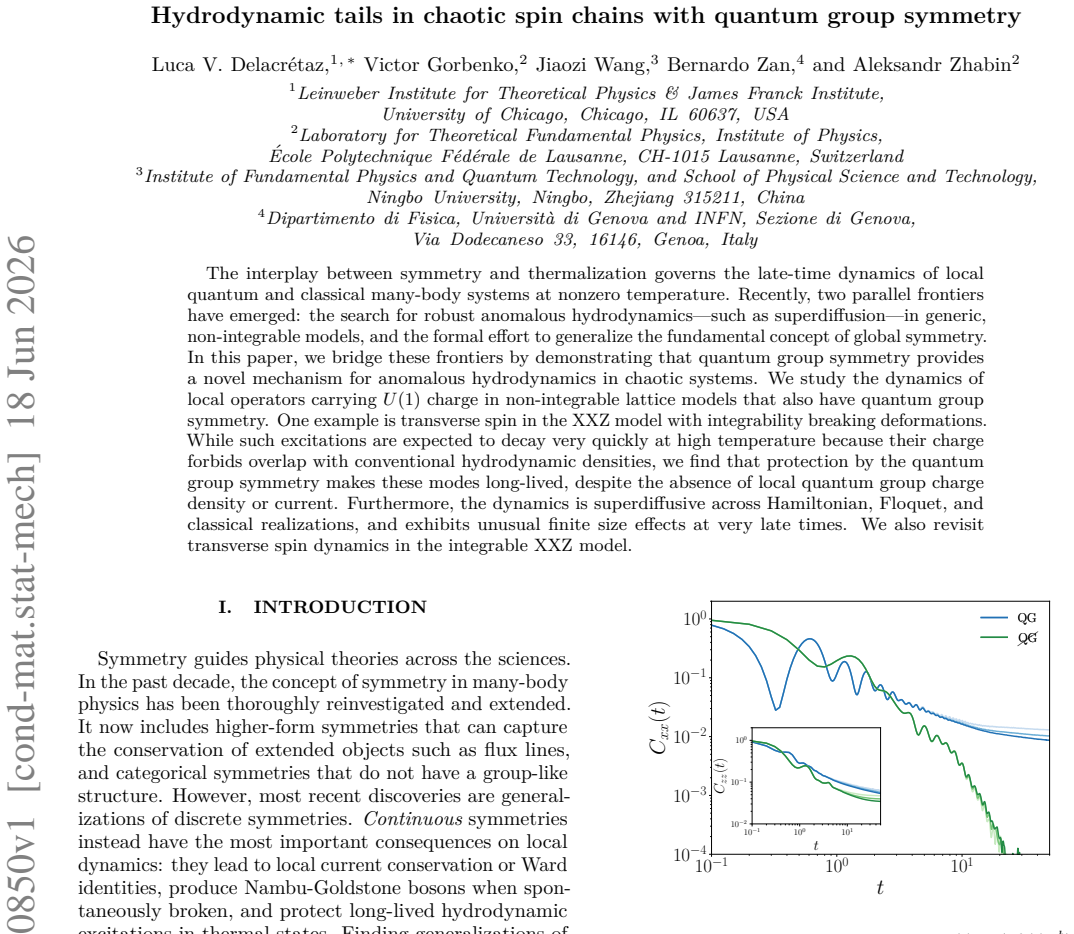
Quantum group symmetry protects long-lived transverse spin modes and drives superdiffusion in non-integrable spin chains.
A machine-rendered reading of the paper's core claim, the machinery that carries it, and where it could break.
Core claim
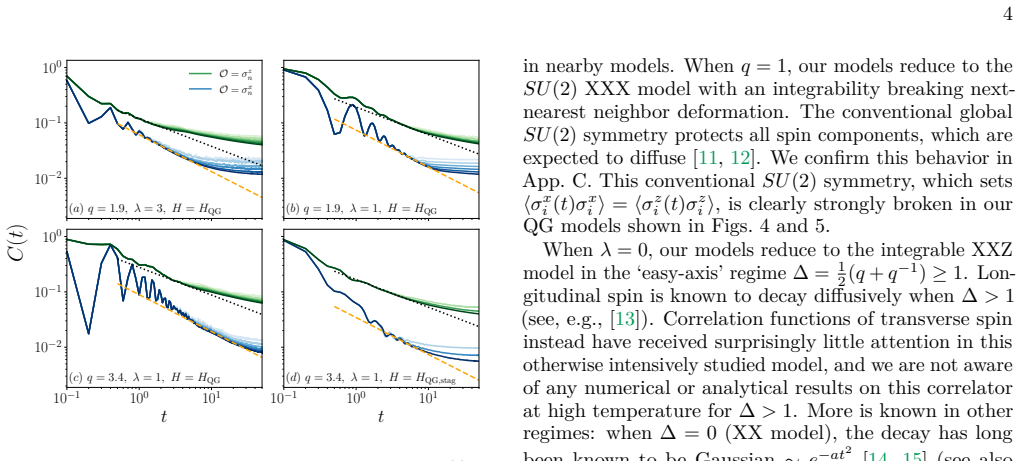
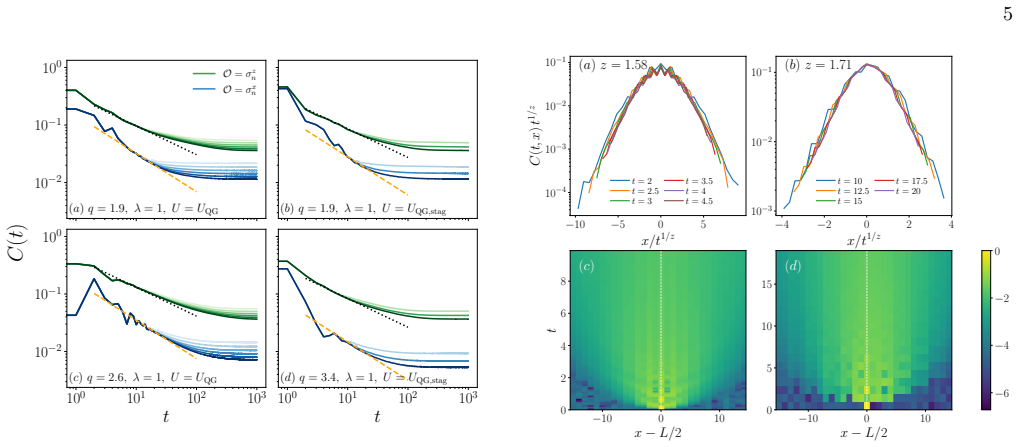
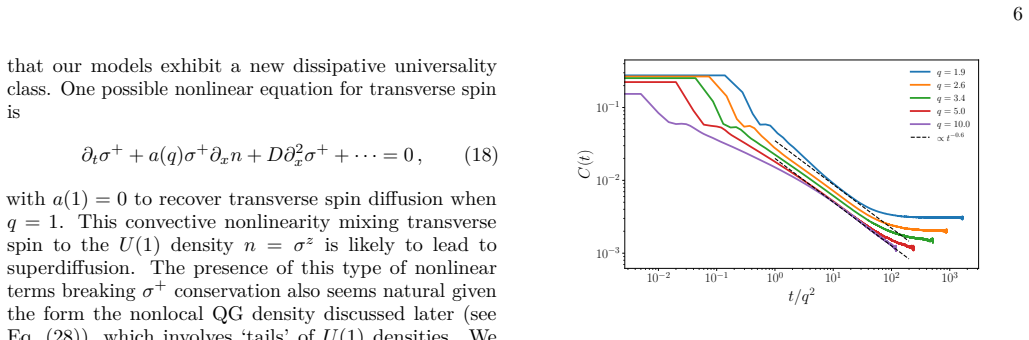
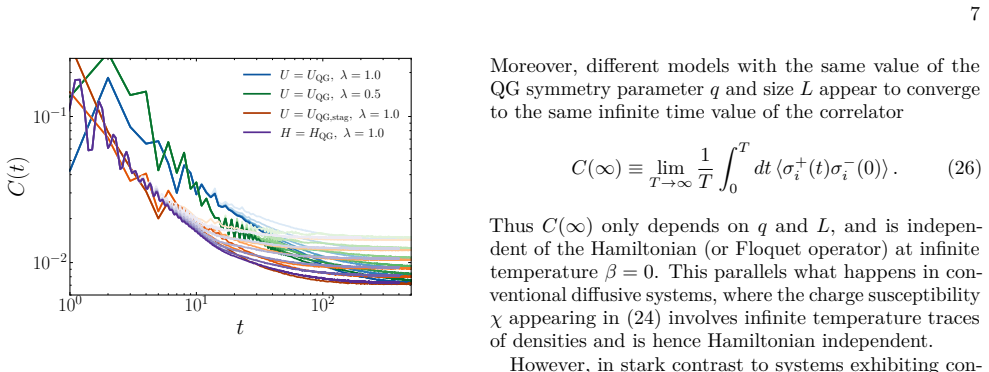
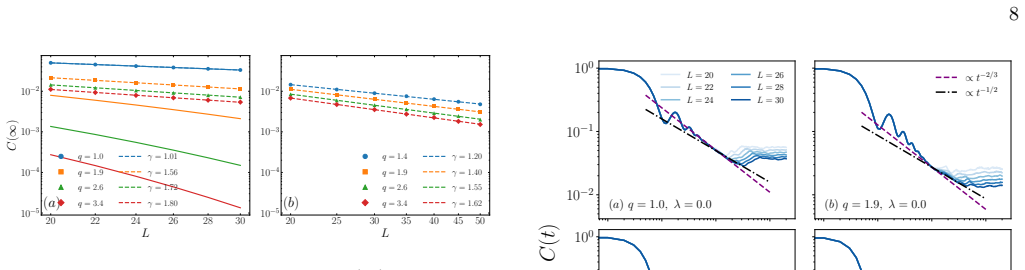
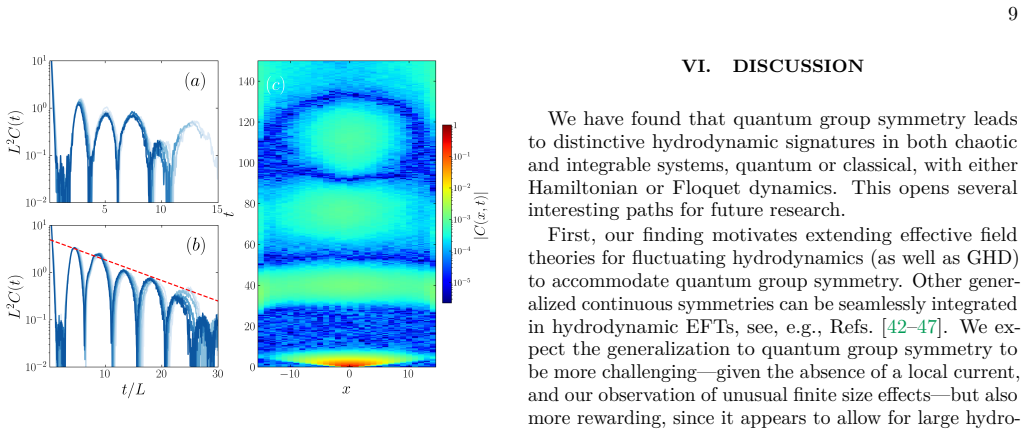
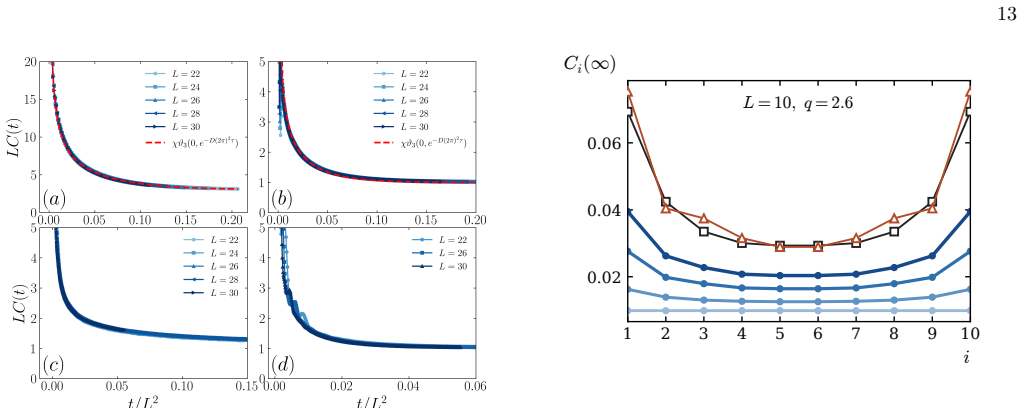
In non-integrable lattice models that retain quantum group symmetry, such as the XXZ chain with integrability-breaking deformations, local operators carrying U(1) charge display long-lived hydrodynamic tails. Protection by the quantum group symmetry keeps these modes alive despite the absence of local quantum group charge density or current, and the resulting dynamics is superdiffusive in Hamiltonian, Floquet, and classical realizations, with unusual finite-size effects at late times.
What carries the argument
Quantum group symmetry, which shields transverse spin modes from fast decay in the absence of a local conserved density or current.
If this is right
- Transverse spin dynamics remains superdiffusive rather than diffusive across Hamiltonian, Floquet, and classical realizations.
- Unusual finite-size effects persist in the relaxation at very late times.
- The protection applies to other U(1)-charged operators that overlap with the quantum group structure.
- Similar long-lived modes can appear in any non-integrable model whose deformations leave the quantum group symmetry intact.
Where Pith is reading between the lines
- The same symmetry-protection route could stabilize other non-standard hydrodynamic modes if additional generalized symmetries are realized in chaotic systems.
- Cold-atom or superconducting-qubit experiments could directly measure the predicted superdiffusive exponent by tracking transverse spin correlations in deformed XXZ chains.
- This approach suggests a broader classification of anomalous transport based on the type of symmetry that survives integrability breaking.
Load-bearing premise
Integrability-breaking deformations preserve the quantum group symmetry while rendering the model non-integrable.
What would settle it
Observation of purely exponential decay in the late-time transverse spin correlation function of a deformed XXZ chain at high temperature, instead of the predicted power-law superdiffusive tail.
Figures

read the original abstract
The interplay between symmetry and thermalization governs the late-time dynamics of local quantum and classical many-body systems at nonzero temperature. Recently, two parallel frontiers have emerged: the search for robust anomalous hydrodynamics -- such as superdiffusion -- in generic, non-integrable models, and the formal effort to generalize the fundamental concept of global symmetry. In this paper, we bridge these frontiers by demonstrating that quantum group symmetry provides a novel mechanism for anomalous hydrodynamics in chaotic systems. We study the dynamics of local operators carrying $U(1)$ charge in non-integrable lattice models that also have quantum group symmetry. One example is transverse spin in the XXZ model with integrability breaking deformations. While such excitations are expected to decay very quickly at high temperature because their charge forbids overlap with conventional hydrodynamic densities, we find that protection by the quantum group symmetry makes these modes long-lived, despite the absence of local quantum group charge density or current. Furthermore, the dynamics is superdiffusive across Hamiltonian, Floquet, and classical realizations, and exhibits unusual finite size effects at very late times. We also revisit transverse spin dynamics in the integrable XXZ model.
Editorial analysis
A structured set of objections, weighed in public.
Referee Report
Summary. The manuscript claims that quantum group symmetry protects local U(1)-charged operators (e.g., transverse spin) from rapid decay in non-integrable models, producing long-lived superdiffusive hydrodynamic tails even in the absence of local quantum-group charge densities or currents. This is reported for integrability-breaking deformations of the XXZ chain (Hamiltonian), analogous Floquet circuits, and classical realizations, with additional observations of unusual finite-size effects at late times; the integrable XXZ case is revisited for comparison.
Significance. If the central claim holds, the work supplies a concrete mechanism by which a generalized (quantum-group) symmetry can enforce anomalous hydrodynamics inside genuinely chaotic, non-integrable dynamics. The multi-platform consistency (Hamiltonian, Floquet, classical) and the explicit statement that protection occurs without a local density/current constitute a non-trivial extension beyond conventional hydrodynamic protections. Reproducible numerical evidence across realizations would be a clear strength.
minor comments (3)
- [Abstract, §1] Abstract and §1: the statement that the chosen deformations 'preserve the quantum group symmetry while rendering the model non-integrable' is load-bearing; an explicit verification (e.g., commutation of the deformed Hamiltonian with the quantum-group generators) should be shown in a dedicated subsection or appendix.
- [Numerical results sections] Numerical sections: error estimates, fitting windows, and data-selection criteria for the reported superdiffusive exponents and late-time tails are not mentioned in the abstract and should be stated clearly (including system sizes and disorder averaging).
- [Figures and captions] Figure captions and text: the distinction between 'protection by quantum group symmetry' and conventional hydrodynamic modes should be illustrated with a side-by-side comparison of correlation functions or spectral functions.
Simulated Author's Rebuttal
We thank the referee for their careful reading and positive evaluation of our work. The recommendation for minor revision is appreciated, and we are pleased that the central claim regarding quantum-group-protected superdiffusive tails in chaotic systems is viewed as a non-trivial extension. Since no specific major comments were raised, we have no point-by-point revisions to address at this stage but remain ready to incorporate any minor suggestions during the revision process.
Circularity Check
No significant circularity
full rationale
The paper asserts that chosen integrability-breaking deformations preserve quantum group symmetry while destroying integrability, and that this symmetry protects long-lived modes without local densities or currents, leading to superdiffusion. No equations, fitted parameters, or self-referential definitions appear in the provided abstract or claim descriptions. The preservation step is stated as a model property rather than derived internally via fit or self-citation chain. The derivation chain is therefore self-contained and does not reduce to its inputs by construction.
Axiom & Free-Parameter Ledger
Reference graph
Works this paper leans on
-
[1]
L. A. Takhtajan and L. D. Faddeev, Russ. Math. Surveys 34, 11 (1979)
1979
-
[2]
P. P. Kulish and N. Y. Reshetikhin, Zap. Nauchn. Semin. 101, 101 (1981)
1981
-
[3]
V. G. Drinfeld, Zap. Nauchn. Semin.155, 18 (1986)
1986
- [4]
- [5]
- [6]
-
[7]
Pasquier and H
V. Pasquier and H. Saleur, Nucl. Phys. B330, 523 (1990)
1990
-
[8]
V. F. R. Jones, Annals Math.126, 335 (1987)
1987
-
[9]
The first of these two Hamiltonians, albeit with |q|= 1 and different boundary conditions, was studied in [10]
-
[10]
Ikhlef, J
Y. Ikhlef, J. L. Jacobsen, and H. Saleur, Journal of Physics A: Mathematical and Theoretical42, 292002 (2009)
2009
-
[11]
M. Dupont and J. E. Moore, Phys. Rev. B101, 121106 (2020), arXiv:1907.12115 [cond-mat.str-el]
arXiv 2020
-
[12]
P. Glorioso, L. V. Delacr´ etaz, X. Chen, R. M. Nand- kishore, and A. Lucas, SciPost Phys.10, 015 (2021), arXiv:2007.13753 [cond-mat.stat-mech]
arXiv 2021
-
[13]
M. ˇZnidariˇ c, Phys. Rev. Lett.106, 220601 (2011), arXiv:1103.4094 [cond-mat.str-el]
Pith/arXiv arXiv 2011
-
[14]
Brandt and K
U. Brandt and K. Jacoby, Zeitschrift f¨ ur Physik B Con- densed Matter25, 181 (1976)
1976
-
[15]
Capel and J
H. Capel and J. Perk, Physica A: Statistical Mechanics and its Applications87, 211 (1977)
1977
-
[16]
G. Del Vecchio Del Vecchio and B. Doyon, J. Stat. Mech. 2205, 053102 (2022), arXiv:2111.08420 [math-ph]
arXiv 2022
-
[17]
B¨ ohm, V
M. B¨ ohm, V. S. Viswanath, J. Stolze, and G. M¨ uller, Phys. Rev. B49, 15669 (1994)
1994
-
[18]
M. Ljubotina, M. ˇZnidariˇ c, and T. Prosen, Phys. Rev. Lett.122, 210602 (2019), arXiv:1903.01329 [cond- mat.stat-mech]
Pith/arXiv arXiv 2019
-
[19]
E. McCulloch, J. A. Jacoby, C. von Keyserlingk, and S. Gopalakrishnan, (2025), arXiv:2504.05380 [quant-ph]
Pith/arXiv arXiv 2025
-
[20]
E. McCulloch, J. A. Jacoby, and S. Gopalakrishnan, (2026), arXiv:2604.27074 [quant-ph]
Pith/arXiv arXiv 2026
-
[21]
A. A. Michailidis, D. A. Abanin, and L. V. Delacr´ etaz, Phys. Rev. X14, 031020 (2024), arXiv:2310.10564 [cond- mat.stat-mech]
arXiv 2024
-
[22]
L. V. Delacretaz and R. Mishra, SciPost Phys.16, 047 (2024), arXiv:2304.03236 [cond-mat.str-el]
arXiv 2024
-
[23]
Forster, D
D. Forster, D. R. Nelson, and M. J. Stephen, Phys. Rev. A16, 732 (1977)
1977
-
[24]
O. Narayan and S. Ramaswamy, Phys. Rev. Lett.89, 200601 (2002), arXiv:cond-mat/0205295
Pith/arXiv arXiv 2002
-
[25]
Spohn, Journal of Statistical Physics154, 1191 (2014), arXiv:1305.6412 [cond-mat.stat-mech]
H. Spohn, Journal of Statistical Physics154, 1191 (2014), arXiv:1305.6412 [cond-mat.stat-mech]
Pith/arXiv arXiv 2014
-
[26]
L. V. Delacretaz, A. L. Fitzpatrick, E. Katz, and M. T. Walters, SciPost Phys.12, 119 (2022), arXiv:2105.02229 [hep-th]
arXiv 2022
-
[27]
L. V. Delacretaz and P. Glorioso, Phys. Rev. Lett.124, 236802 (2020), arXiv:2002.08365 [cond-mat.str-el]
arXiv 2020
-
[28]
J. De Nardis, S. Gopalakrishnan, and R. Vasseur, Phys. Rev. Lett.131, 197102 (2023), arXiv:2212.03696 [cond- mat.quant-gas]
arXiv 2023
-
[29]
A. J. McRoberts, T. Bilitewski, M. Haque, and R. Moess- ner, Phys. Rev. B105, L100403 (2022), arXiv:2108.11964 [cond-mat.stat-mech]
arXiv 2022
-
[30]
A. J. Friedman, A. Chan, A. De Luca, and J. T. Chalker, Phys. Rev. Lett.123, 210603 (2019), arXiv:1906.07736 [cond-mat.stat-mech]
arXiv 2019
-
[31]
M. Winer and B. Swingle, Phys. Rev. X12, 021009 (2022), arXiv:2012.01436 [cond-mat.stat-mech]. 15
arXiv 2022
-
[32]
D. Schubert, J. Richter, F. Jin, K. Michielsen, H. De Raedt, and R. Steinigeweg, Phys. Rev. B104, 054415 (2021), arXiv:2104.00472
arXiv 2021
-
[33]
I. A. Maceira and A. M. L¨ auchli, (2024), arXiv:2409.18863 [quant-ph]
arXiv 2024
-
[34]
T. Rakovszky, P. Sala, R. Verresen, M. Knap, and F. Poll- mann, Phys. Rev. B101, 125126 (2020), arXiv:1910.06341 [cond-mat.str-el]
arXiv 2020
-
[35]
S. Moudgalya and O. I. Motrunich, Phys. Rev. X12, 011050 (2022), arXiv:2108.10324 [cond-mat.stat-mech]
arXiv 2022
-
[36]
J. Lehmann, P. S. de Torres-Solanot, F. Pollmann, and T. Rakovszky, SciPost Phys.14, 140 (2023), arXiv:2208.12260 [cond-mat.stat-mech]
arXiv 2023
-
[37]
O. Hart, SciPost Phys. Core7, 040 (2024), arXiv:2308.00738 [cond-mat.stat-mech]
arXiv 2024
-
[38]
O. A. Castro-Alvaredo, B. Doyon, and T. Yoshimura, Phys. Rev. X6, 041065 (2016), arXiv:1605.07331 [cond- mat.stat-mech]
Pith/arXiv arXiv 2016
-
[39]
B. Bertini, M. Collura, J. De Nardis, and M. Fagotti, Phys. Rev. Lett.117, 207201 (2016), arXiv:1605.09790 [cond-mat.stat-mech]
Pith/arXiv arXiv 2016
- [40]
-
[41]
ˇZiga Krajnik, E. Ilievski, T. Prosen, and V. Pasquier, SciPost Phys. 11, 051 (2021) (2021), 10.21468/SciPost- Phys.11.3.051, arXiv:2104.13863 [cond-mat.stat-mech]
-
[42]
S. Grozdanov, D. M. Hofman, and N. Iqbal, Phys. Rev. D95, 096003 (2017), arXiv:1610.07392 [hep-th]
Pith/arXiv arXiv 2017
-
[43]
J. Armas, J. Gath, A. Jain, and A. V. Pedersen, JHEP 05, 192 (2018), arXiv:1803.00991 [hep-th]
Pith/arXiv arXiv 2018
- [44]
-
[45]
L. V. Delacr´ etaz, D. M. Hofman, and G. Mathys, SciPost Phys.8, 047 (2020), arXiv:1908.06977 [hep-th]
arXiv 2020
-
[46]
N. Iqbal and N. Poovuttikul, SciPost Phys.15, 063 (2023), arXiv:2010.00320 [hep-th]
arXiv 2023
-
[47]
L. V. Delacretaz, (2026), arXiv:2606.02391 [hep-th]
Pith/arXiv arXiv 2026
-
[48]
J. Richter and A. Pal, Phys. Rev. Res.4, L012003 (2022), arXiv:2107.13612 [cond-mat.stat-mech]
arXiv 2022
- [49]
-
[50]
First experimental realization of the Dirac oscillator,
C. McCarthy, H. Singh, S. Gopalakrishnan, and R. Vasseur, Physical Review B111(2025), 10.1103/phys- revb.111.184317, arXiv:2407.11110 [cond-mat.stat-mech]
-
[51]
O. Salberger, P. Padmanabhan, and V. Korepin, (2018), arXiv:1809.00709 [quant-ph]
Pith/arXiv arXiv 2018
-
[52]
M. Ljubotina, J.-Y. Desaules, M. Serbyn, and Z. Papi´ c, Phys. Rev. X13, 011033 (2023), arXiv:2210.01146 [cond- mat.stat-mech]
arXiv 2023
-
[53]
M. T. Batchelor, L. Mezincescu, R. I. Nepomechie, and V. Rittenberg, J. Phys. A23, L141 (1990)
1990
-
[54]
H. J. de Vega and A. Gonzalez-Ruiz, Nucl. Phys. B417, 553 (1994), arXiv:hep-th/9309022
Pith/arXiv arXiv 1994
-
[55]
T. Quella, Phys. Rev. B102, 081120 (2020), arXiv:2005.09072 [cond-mat.str-el]
arXiv 2020
-
[56]
T. Franke and T. Quella, SciPost Phys. Core7, 078 (2024), arXiv:2403.09287 [cond-mat.str-el]
arXiv 2024
-
[57]
T. V. Zache, D. Gonz´ alez-Cuadra, and P. Zoller, Phys. Rev. Lett.131, 171902 (2023), arXiv:2304.02527 [quant- ph]
arXiv 2023
-
[58]
P. N. Jepsen, J. Amato-Grill, I. Dimitrova, W. W. Ho, E. Demler, and W. Ketterle, Nature588, 403 (2020), arXiv:2005.09549 [cond-mat.quant-gas]
arXiv 2020
-
[59]
Weiet al., Science376, abk2397 (2022), arXiv:2107.00038 [cond-mat.quant-gas]
D. Weiet al., Science376, abk2397 (2022), arXiv:2107.00038 [cond-mat.quant-gas]
arXiv 2022
-
[60]
Schollet al., PRX Quantum3, 020303 (2022), arXiv:2107.14459 [quant-ph]
P. Schollet al., PRX Quantum3, 020303 (2022), arXiv:2107.14459 [quant-ph]
arXiv 2022
-
[61]
P. N. Jepsen, W. W. Ho, J. Amato-Grill, I. Dimitrova, E. Demler, and W. Ketterle, Phys. Rev. X11, 041054 (2021)
2021
-
[62]
A. Matthies, N. Dannenfeld, S. Pappalardi, and A. Rosch, Phys. Rev. B113, 024305 (2026), arXiv:2410.16182 [quant-ph]
arXiv 2026
discussion (0)
Sign in with ORCID, Apple, or X to comment. Anyone can read and Pith papers without signing in.