REVIEW 3 major objections 6 minor 64 references
X-Cross: Dynamic Integration of Language Models for Cross-Domain Sequential Recommendation
T0 review · 3 major / 6 minor · reviewed 2026-08-16 · deepseek-v4-flash
Pith's one-line read The paper claims that a per-layer, input-dependent recombination of frozen LoRA-adapted language models can match or beat target-domain LoRA fine-tuning for sequential recommendation while using a quarter of the parameters and 50 to 75…
desk verdict Solid parameter-efficient cross-domain recommender with an honest experimental core, but the 'any new domain' claim is only tested on nearby Amazon categories. read the letter →
The pith
A machine-rendered reading of the paper's core claim, the machinery that carries it, and where it could break.
The reading
What carries the argument
The load-bearing object is the X-Cross integrator placed at each transformer layer. It takes the concatenated LoRA-adapted hidden states $\mathbf{h}^{(l)}_{\mathrm{concat}}$, applies a trainable matrix $\mathbf{W}^{(l)}_{\mathrm{concat}}$ to produce $2n(n-1)$ signed scaling factors, and refines each domain's representation as $\tilde{\mathbf{h}}^{(l)}_m = \mathbf{h}^{(l)}_m + \sum_{m' \neq m} \left(\beta z^{(l,m)}_{[m']}\mathbf{h}^{(l)}_{m'} + \gamma z^{(l,m)}_{[m,m']}(\mathbf{h}^{(l)}_m - \mathbf{h}^{(l)}_{m'})\right)$, followed by a final weighted sum of last-layer outputs. The source LoRA weights stay frozen; only this recombination machinery is trained, which is what limits parameter cost and lets the model adapt per input.
What would settle it
Train X-Cross with the same two source domains but evaluate on a target domain whose item titles share almost no vocabulary with those sources (for example, legal filings or prescription-drug descriptions rather than Toys, Tools, Sports, Electronics). If X-Cross cannot surpass the best zero-shot source model while a LoRA adapter trained on the same limited target data does, the linear-recombination assumption is falsified. A more controlled version: construct synthetic source domains with disjoint feature sets and a target requiring features from neither; X-Cross should fail to recover them, whereas LoRA fine-tuning should.
Extended reading notes
Core claim
On its own terms, the paper's central discovery is that cross-domain transfer can be achieved without touching the source adapters: a per-layer, per-input recombination of their LoRA-adapted activations is enough to represent the target domain's recommendation signal. At each layer the model concatenates the adapted hidden states, derives scaling and interaction weights through a trainable linear map, and refines each domain representation using both direct contributions and pairwise differences; the refined states propagate to the next layer and the final layers are combined by a weighted sum. The result is a model whose trainable parameters are only the integrator matrices, two scalar coefficients, final domain weights, and the scoring head. The authors argue this design preserves domain-specific nuances while allowing suppression of irrelevant domains through signed scaling factors, and their experiments are offered as evidence that this substitutes for dedicated target-domain LoRA fine-tuning.
Load-bearing premise
The target domain's useful recommendation signal must be expressible as per-input linear combinations of the frozen source LoRA adapter activations at each layer, with only pairwise difference terms available; if a target requires a feature that none of the source adapters carries, X-Cross cannot represent it.
Editorial extensions
If this is right
- A new product domain can be served by recombining existing frozen LoRA adapters instead of training a fresh adapter for that domain.
- Per-domain parameter cost drops to roughly 25 percent of a LoRA adapter, because only the integrator, two scalars, final weights, and scorer are trainable.
- The reported learning curves imply X-Cross passes a zero-shot source model with 50 to 75 percent less target data than LoRA needs, which matters for sparse new domains.
- The ablation attributes the largest accuracy drop to removing layer-wise integration, so the evidence links cross-domain gain to the per-layer mechanism rather than to final pooling alone.
- Against the tested alternatives, X-Cross reports higher Hit@1, Hit@3, Hit@10 and MRR across all four target domains, including over XLoRA and MeteoRA.
Reading between the lines
- If the central claim generalizes, an adapter library becomes a reusable asset: adding a domain is a matter of learning a small routing layer, not retraining, and the same frozen adapters can be recombined for many targets. The paper only demonstrates two-source combinations; testing with more, and more distant, sources would show how far the span of adapter activations reaches.
- The signed scaling factors and difference terms suggest the integrator is doing something close to linear interpolation and subtraction in activation space; that predicts measurable behavior, such as degraded transfer when source representations are nearly identical, which the paper's high within-domain cosine similarities already hint at.
- Because all target knowledge must lie in the span of the frozen source activations, a practical extension is to add a lightweight 'catch-all' adapter trained on generic product text; the paper does not test this, but it follows directly from the assumed representation constraint.
Signed reviews
Editorial analysis
A structured set of objections, weighed in public.
Referee Report
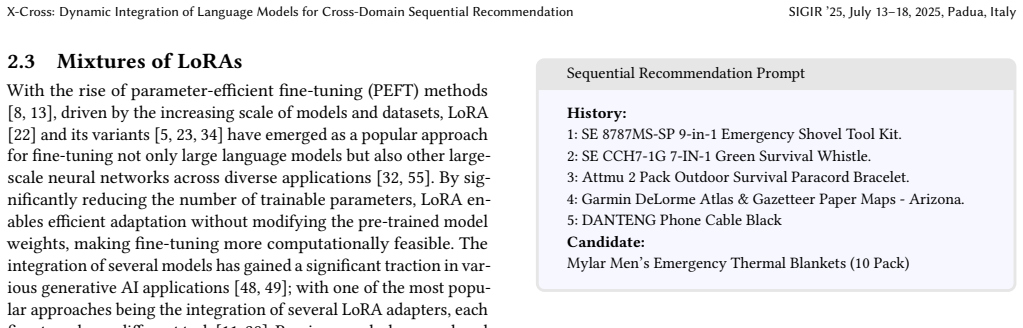
Summary. The paper introduces X-Cross, a cross-domain sequential recommendation model that combines several frozen, LoRA-adapted source-domain language models by computing, for each input and each Transformer layer, a dynamic linear recombination of the source adapter activations (Eqs. 3-6). The target-specific trainable parameters are limited to the per-layer integration matrix W_concat, the scalars beta and gamma, the final domain weights, and the pooling/scoring head; the source LoRA adapters are never updated. The authors frame next-item prediction as a multiple-choice scoring task over a candidate item and sampled negatives, train on Amazon Electronics, Sports, Tools, and Toys data, and report that X-Cross matches or exceeds a freshly LoRA-fine-tuned model while using 25% of the additional parameters and 50-75% less training data, and that it outperforms existing cross-domain and mixture-of-LoRA baselines (Tables 2 and 3).
Significance. If the results hold, X-Cross is a practically useful contribution: it turns a collection of frozen domain adapters into a compositional recommender without retraining the adapters, and the per-layer, input-dependent integration mechanism is a clear and principled alternative to existing mixture-of-LoRA methods that scale pre-trained, non-LoRA activations. The evaluation is thorough in several respects: four domains, a wide baseline set spanning single-domain, cross-domain, and integration baselines, ablations of the layer-wise integrator, interaction term, and expert contributions (Table 4), statistical significance tests, and a data-efficiency study with multiple random subsets. The central limitation is external validity: all targets are Amazon categories and the source adapters are pre-selected on a target holdout by zero-shot performance, so the experiments do not yet demonstrate adaptation to a genuinely out-of-span target domain.
major comments (3)
- [§4.1.2, Table 1; §3.2.1-3.2.3] The core claim that X-Cross adapts to arbitrary new domains is not tested by the current experimental design. In Section 4.1.2 the two source domains for each target are chosen on a target holdout by zero-shot performance, and all four targets are Amazon categories from the same corpus; under Eqs. (3)-(5) all target-specific learning is a per-layer linear recombination of the frozen source adapter activations plus pair-wise differences. If a target requires features not spanned by the union of the chosen source adapters, the model cannot represent them, and no experiment in the paper exercises that case. Please add at least one evaluation where the target is deliberately outside the source span, or where the best zero-shot source adapter is weak, and otherwise limit the generalization claim to near-neighbor transfer among related domains.
- [Abstract; §4.3, Table 3] The abstract's '50%-75% less fine-tuning data' claim is not consistent with Table 3, which reports gaps of 60.0%, 62.5%, 66.7%, and 83.3%; Electronics exceeds the stated upper bound. Moreover, the gap is computed from the first grid point at which each model crosses the zero-shot reference (Section 4.3), so it depends on the coarse sampling grid {50, 75, 100, 200, 300, 400, 500, 750, 1000} and on only five random subsets per size. Please report the crossing sizes with confidence intervals, or rephrase the claim to match the observed range.
- [§4.3, footnote 3] The '25% of the parameters' figure counts only W_concat versus the LoRA A and B matrices per layer. It excludes the pooling layer, scoring head, and final domain weights, and it assumes the same layer budget for LoRA as for X-Cross even though X-Cross integrates only the top-9 layers (Section 4.1.2) while the LoRA baseline's layer budget is not stated. Please report total additional trainable parameters with matched layer budgets and include the shared prediction head, or explicitly define the comparison as adapter-only parameters.
minor comments (6)
- [§3.2.2, Eq. (5)] The indexing conventions for z^{(l,m)}_{[m']} and z^{(l,m)}_{[m,m']} are not defined; please specify how these entries are extracted from z^{(l)} in Eq. (4) and what the two blocks of 2n(n-1) outputs represent.
- [§4.3, Table 3] The column header 'Significant for < M Samples' is not self-explanatory; define M and describe how the five random subsets are aggregated to determine the reported threshold.
- [Figure 3] The caption refers to a 'reference model' but does not define it; define the zero-shot source LoRA reference in the caption as well as in the text.
- [§4.4, Figure 4] The text says 1, 2, 4, or 8 layers are integrated, but the main configuration uses top-9 layers; clarify whether Figure 4 reports total integrated layers and how these values relate to the top-9 setting used in the main experiments.
- [§4.6] The claim that prompt length and diversity explain 86% of accuracy variance is based on a regression over four domain-level averages, or possibly the five random samples per domain; with this sample size the R^2 should be interpreted cautiously and the number of observations used in the regression should be stated.
- [General] The paper does not include a data or code availability statement; please add one if the artifacts can be shared.
Circularity Check
No circular derivation; X-Cross's claims rest on external empirical comparisons, with only a non-load-bearing background self-citation.
full rationale
X-Cross is defined by a concrete architectural chain (Eqs. 2-8) and then evaluated empirically. Eq. 3 concatenates frozen LoRA adapter activations, Eq. 4 computes per-layer scaling and interaction coefficients through a trainable W_concat, Eq. 5 refines each source representation with beta- and gamma-weighted contributions, Eq. 6 sums the final-layer outputs, and Eqs. 7-8 pool and score the result. No equation defines the reported Hit@k or MRR in terms of itself; these metrics are computed on a held-out test split after training with the softmax loss of Eq. 1. The hyperparameters beta=0.5, gamma=0.4, the top-9 layer budget, and the choice of the two source domains are selected on a holdout set, which is standard model selection rather than a fitted parameter being relabeled as a prediction. The data-efficiency results in Table 3 are learning-curve comparisons against a zero-shot LoRA reference, not constants forced by construction. The only self-citation is [40], cited in Related Work as an example of attribute-based sequential recommendation; it is background context and is not used to justify the X-Cross mechanism or the evaluation, so it does not create circularity. The paper's real limitation is representational -- target features must lie in the span of the frozen source adapter activations -- but that is a generalization risk, not a circular step, because the paper makes no claim to have derived that span condition and instead supports its claims with external baselines and held-out Amazon data.
Assumptions & free parameters
free parameters (6)
- beta (direct cross-domain weight) =
0.5
- gamma (interaction term weight) =
0.4
- LoRA rank r =
16
- LoRA alpha scaling =
32
- Number of integrated top layers =
9
- Number of source domains n =
2
assumptions (4)
- domain assumption The source-domain LoRA adapters are frozen and their activations span the representational space needed for the target domain.
- domain assumption DeBERTa V3 base's top-9 layers carry the most transferable signals.
- domain assumption A 30-candidate multiple-choice task with popularity-based negatives is a faithful proxy for sequential recommendation quality.
- domain assumption The Amazon core-5 datasets with one randomly selected interaction per day preserve valid sequential order.
Cite this review
Pith. "Pith review of X-Cross: Dynamic Integration of Language Models for Cross-Domain Sequential Recommendation." pith.science (2026). https://pith.science/paper/FSIPT363
@misc{pith2026250420859,
  author       = {Pith},
  title        = {Pith review of: X-Cross: Dynamic Integration of Language Models for Cross-Domain Sequential Recommendation},
  year         = {2026},
  howpublished = {\url{https://pith.science/paper/FSIPT363}},
  note         = {Machine review of arXiv:2504.20859}
}
read the original abstract
As new products are emerging daily, recommendation systems are required to quickly adapt to possible new domains without needing extensive retraining. This work presents ``X-Cross'' -- a novel cross-domain sequential-recommendation model that recommends products in new domains by integrating several domain-specific language models; each model is fine-tuned with low-rank adapters (LoRA). Given a recommendation prompt, operating layer by layer, X-Cross dynamically refines the representation of each source language model by integrating knowledge from all other models. These refined representations are propagated from one layer to the next, leveraging the activations from each domain adapter to ensure domain-specific nuances are preserved while enabling adaptability across domains. Using Amazon datasets for sequential recommendation, X-Cross achieves performance comparable to a model that is fine-tuned with LoRA, while using only 25% of the additional parameters. In cross-domain tasks, such as adapting from Toys domain to Tools, Electronics or Sports, X-Cross demonstrates robust performance, while requiring about 50%-75% less fine-tuning data than LoRA to make fine-tuning effective. Furthermore, X-Cross achieves significant improvement in accuracy over alternative cross-domain baselines. Overall, X-Cross enables scalable and adaptive cross-domain recommendations, reducing computational overhead and providing an efficient solution for data-constrained environments.
Figures


Figures from the paper (1 more)

Reference graph
Works this paper leans on
-
[1]
Keqin Bao, Jizhi Zhang, Yang Zhang, Wenjie Wang, Fuli Feng, and Xiangnan He. 2023. Tallrec: An effective and efficient tuning framework to align large language model with recommendation. InProceedings of the 17th ACM Conference on Recommender Systems. 1007–1014
2023
-
[2]
Tesfaye Fenta Boka, Zhendong Niu, and Rama Bastola Neupane. 2024. A survey of sequential recommendation systems: Techniques, evaluation, and future direc- tions. Information Systems 125 (2024), 102427. https://doi.org/10.1016/j.is.2024. 102427
-
[3]
Eric L Buehler and Markus J Buehler. 2024. X-LoRA: Mixture of low-rank adapter experts, a flexible framework for large language models with applications in protein mechanics and molecular design. APL Machine Learning 2, 2 (2024)
work page 2024
-
[4]
Jin Chen, Zheng Liu, Xu Huang, Chenwang Wu, Qi Liu, Gangwei Jiang, Yuanhao Pu, Yuxuan Lei, Xiaolong Chen, Xingmei Wang, et al. 2024. When large language models meet personalization: Perspectives of challenges and opportunities.World Wide Web 27, 4 (2024), 42
2024
-
[5]
Tim Dettmers, Artidoro Pagnoni, Ari Holtzman, and Luke Zettlemoyer. 2024. Qlora: Efficient finetuning of quantized llms. Advances in Neural Information Processing Systems 36 (2024)
2024
-
[6]
Jacob Devlin, Ming-Wei Chang, Kenton Lee, and Kristina Toutanova. 2019. BERT: Pre-training of Deep Bidirectional Transformers for Language Understanding. In Proceedings of the 2019 Conference of the North American Chapter of the Association for Computational Linguistics: Human Language Technologies, Volume 1 (Long and Short Papers). 4171–4186
2019
-
[7]
Hao Ding, Yifei Ma, Anoop Deoras, Yuyang Wang, and Hao Wang. 2021. Zero- shot recommender systems. arXiv preprint arXiv:2105.08318 (2021)
arXiv 2021
-
[8]
Ning Ding, Yujia Qin, Guang Yang, Fuchao Wei, Zonghan Yang, Yusheng Su, Shengding Hu, Yulin Chen, Chi-Min Chan, Weize Chen, et al. 2023. Parameter- efficient fine-tuning of large-scale pre-trained language models. Nature Machine Intelligence 5, 3 (2023), 220–235
2023
Show all 64 references
-
[9]
William Fedus, Jeff Dean, and Barret Zoph. 2022. A review of sparse expert models in deep learning. arXiv preprint arXiv:2209.01667 (2022)
2022 arXiv
-
[10]
William Fedus, Barret Zoph, and Noam Shazeer. 2022. Switch transformers: Scaling to trillion parameter models with simple and efficient sparsity. Journal of Machine Learning Research 23, 120 (2022), 1–39
2022
-
[11]
Wenfeng Feng, Chuzhan Hao, Yuewei Zhang, Yu Han, and Hao Wang. 2024. Mixture-of-loras: An efficient multitask tuning for large language models. arXiv preprint arXiv:2403.03432 (2024)
2024 arXiv
-
[12]
Junchen Fu, Fajie Yuan, Yu Song, Zheng Yuan, Mingyue Cheng, Shenghui Cheng, Jiaqi Zhang, Jie Wang, and Yunzhu Pan. 2024. Exploring adapter-based transfer learning for recommender systems: Empirical studies and practical insights. In Proceedings of the 17th ACM International Co...
2024
-
[13]
Zihao Fu, Haoran Yang, Anthony Man-Cho So, Wai Lam, Lidong Bing, and Nigel Collier. 2023. On the effectiveness of parameter-efficient fine-tuning. In Proceedings of the AAAI conference on artificial intelligence , Vol. 37. 12799–12807
2023
-
[14]
Shijie Geng, Shuchang Liu, Zuohui Fu, Yingqiang Ge, and Yongfeng Zhang. 2023. Recommendation as Language Processing (RLP): A Unified Pretrain, Personalized Prompt & Predict Paradigm (P5). arXiv:2203.13366 [cs.IR] https://arxiv.org/abs/ 2203.13366
2023 arXiv
-
[15]
Pengcheng He, Jianfeng Gao, and Weizhu Chen. 2021. DeBERTaV3: Improv- ing DeBERTa using ELECTRA-Style Pre-Training with Gradient-Disentangled Embedding Sharing. arXiv:2111.09543 [cs.CL]
2021 arXiv
-
[16]
Pengcheng He, Xiaodong Liu, Jianfeng Gao, and Weizhu Chen. 2021. DEBERTA: DECODING-ENHANCED BERT WITH DISENTANGLED ATTENTION. In Inter- national Conference on Learning Representations . https://openreview.net/forum? id=XPZIaotutsD
2021
-
[17]
Ruining He, Wang-Cheng Kang, and Julian McAuley. 2017. Translation-based recommendation. In Proceedings of the eleventh ACM conference on recommender systems. 161–169
2017
-
[18]
Dan Hendrycks and Kevin Gimpel. 2016. Gaussian error linear units (gelus). arXiv preprint arXiv:1606.08415 (2016)
2016 arXiv
-
[19]
Yupeng Hou, Zhankui He, Julian McAuley, and Wayne Xin Zhao. 2023. Learning vector-quantized item representation for transferable sequential recommenders. In Proceedings of the ACM Web Conference 2023 . 1162–1171
2023
-
[20]
Yupeng Hou, Jiacheng Li, Zhankui He, An Yan, Xiusi Chen, and Julian McAuley
-
[21]
Yupeng Hou, Shanlei Mu, Wayne Xin Zhao, Yaliang Li, Bolin Ding, and Ji-Rong Wen. 2022. Towards universal sequence representation learning for recommender systems. In Proceedings of the 28th ACM SIGKDD Conference on Knowledge Dis- covery and Data Mining . 585–593
2022
-
[22]
Edward J Hu, Yelong Shen, Phillip Wallis, Zeyuan Allen-Zhu, Yuanzhi Li, Shean Wang, Lu Wang, and Weizhu Chen. 2022. LoRA: Low-Rank Adaptation of Large Language Models. In International Conference on Learning Representations . https: //openreview.net/forum?id=nZeVKeeFYf9
2022
-
[23]
Damjan Kalajdzievski. 2023. A Rank Stabilization Scaling Factor for Fine-Tuning with LoRA. arXiv e-prints (2023), arXiv–2312
2023
-
[24]
Wang-Cheng Kang and Julian McAuley. 2018. Self-attentive sequential recom- mendation. In 2018 IEEE international conference on data mining (ICDM) . IEEE, 197–206
2018
-
[25]
Wang-Cheng Kang, Jianmo Ni, Nikhil Mehta, Maheswaran Sathiamoorthy, Lichan Hong, Ed Chi, and Derek Zhiyuan Cheng. 2023. Do llms understand user prefer- ences? evaluating llms on user rating prediction. arXiv preprint arXiv:2305.06474 (2023)
2023 arXiv
-
[26]
Sein Kim, Hongseok Kang, Seungyoon Choi, Donghyun Kim, Minchul Yang, and Chanyoung Park. 2024. Large language models meet collaborative filtering: An efficient all-round llm-based recommender system. In Proceedings of the 30th ACM SIGKDD Conference on Knowledge Discovery and D...
2024
-
[27]
Jiacheng Li, Ming Wang, Jin Li, Jinmiao Fu, Xin Shen, Jingbo Shang, and Julian McAuley. 2023. Text is all you need: Learning language representations for sequential recommendation. In Proceedings of the 29th ACM SIGKDD Conference on Knowledge Discovery and Data Mining . 1258–1267
2023
-
[28]
Jiacheng Li, Yujie Wang, and Julian McAuley. 2020. Time interval aware self- attention for sequential recommendation. In Proceedings of the 13th international conference on web search and data mining . 322–330
2020
-
[29]
Defu Lian, Qi Liu, and Enhong Chen. 2020. Personalized ranking with importance sampling. In Proceedings of The Web Conference 2020 . 1093–1103
2020
-
[30]
Jianghao Lin, Xinyi Dai, Yunjia Xi, Weiwen Liu, Bo Chen, Hao Zhang, Yong Liu, Chuhan Wu, Xiangyang Li, Chenxu Zhu, Huifeng Guo, Yong Yu, Ruiming Tang, and Weinan Zhang. 2024. How Can Recommender Systems Benefit from Large Language Models: A Survey. ACM Trans. Inf. Syst. (July ...
2024 doi
-
[31]
Dairui Liu, Boming Yang, Honghui Du, Derek Greene, Neil Hurley, Aonghus Lawlor, Ruihai Dong, and Irene Li. 2024. RecPrompt: A Self-tuning Prompting Framework for News Recommendation Using Large Language Models. InProceed- ings of the 33rd ACM International Conference on Inform...
2024
-
[32]
Haotian Liu, Chunyuan Li, Qingyang Wu, and Yong Jae Lee. 2024. Visual instruc- tion tuning. Advances in neural information processing systems 36 (2024)
2024
-
[33]
Peng Liu, Lemei Zhang, and Jon Atle Gulla. 2023. Pre-train, Prompt, and Recom- mendation: A Comprehensive Survey of Language Modeling Paradigm Adapta- tions in Recommender Systems. Transactions of the Association for Computational Linguistics 11 (2023), 1553–1571
2023
-
[34]
Shih-yang Liu, Chien-Yi Wang, Hongxu Yin, Pavlo Molchanov, Yu-Chiang Frank Wang, Kwang-Ting Cheng, and Min-Hung Chen. 2024. DoRA: Weight- Decomposed Low-Rank Adaptation. In Forty-first International Conference on Machine Learning
2024
-
[35]
I Loshchilov. 2017. Decoupled weight decay regularization. arXiv preprint arXiv:1711.05101 (2017)
2017 arXiv
-
[36]
Sichun Luo, Bowei He, Haohan Zhao, Wei Shao, Yanlin Qi, Yinya Huang, Aojun Zhou, Yuxuan Yao, Zongpeng Li, Yuanzhang Xiao, Mingjie Zhan, and Linqi Song
-
[37]
Julian McAuley, Christopher Targett, Qinfeng Shi, and Anton Van Den Hengel
-
[38]
arXiv:2312.16018 [cs.IR] https://arxiv.org/abs/2312.16018
RecRanker: Instruction Tuning Large Language Model as Ranker for Top-k Recommendation. arXiv:2312.16018 [cs.IR] https://arxiv.org/abs/2312.16018
-
[39]
Xubin Ren, Wei Wei, Lianghao Xia, Lixin Su, Suqi Cheng, Junfeng Wang, Dawei Yin, and Chao Huang. 2024. Representation learning with large language models for recommendation. In Proceedings of the ACM on Web Conference 2024 . 3464– 3475
2024
-
[40]
Uriel Singer, Haggai Roitman, Yotam Eshel, Alexander Nus, Ido Guy, Or Levi, Idan Hasson, and Eliyahu Kiperwasser. 2022. Sequential Modeling with Multiple Attributes for Watchlist Recommendation in E-Commerce. In Proceedings of the Fifteenth ACM International Conference on Web ...
2022
-
[41]
Akshara Prabhakar, Yuanzhi Li, Karthik Narasimhan, Sham Kakade, Eran Malach, and Samy Jelassi. 2024. LoRA Soups: Merging LoRAs for Practical Skill Composi- tion Tasks. arXiv e-prints (2024), arXiv–2410
2024
-
[42]
Zuoli Tang, Zhaoxin Huan, Zihao Li, Xiaolu Zhang, Jun Hu, Chilin Fu, Jun Zhou, and Chenliang Li. 2023. One model for all: Large language models are domain- agnostic recommendation systems. arXiv preprint arXiv:2310.14304 (2023)
2023 arXiv
-
[43]
Ian Tenney, Dipanjan Das, and Ellie Pavlick. 2019. BERT Rediscovers the Classical NLP Pipeline. In Proceedings of the 57th Annual Meeting of the Association for Computational Linguistics. 4593–4601
2019
-
[44]
Fei Sun, Jun Liu, Jian Wu, Changhua Pei, Xiao Lin, Wenwu Ou, and Peng Jiang
-
[45]
Liwei Wu, Shuqing Li, Cho-Jui Hsieh, and James Sharpnack. 2020. SSE-PT: Sequential recommendation via personalized transformer. In Proceedings of the X-Cross: Dynamic Integration of Language Models for Cross-Domain Sequential Recommendation SIGIR ’25, July 13–18, 2025, Padua, ...
2020
-
[46]
Likang Wu, Zhi Zheng, Zhaopeng Qiu, Hao Wang, Hongchao Gu, Tingjia Shen, Chuan Qin, Chen Zhu, Hengshu Zhu, Qi Liu, et al . 2024. A survey on large language models for recommendation. World Wide Web 27, 5 (2024), 60
2024
-
[47]
Jingwei Xu, Junyu Lai, and Yunpeng Huang. 2024. MeteoRA: Multiple-tasks Embedded LoRA for Large Language Models. arXiv e-prints (2024), arXiv–2405
2024
-
[48]
Xiang Wang, Xiangnan He, Meng Wang, Fuli Feng, and Tat-Seng Chua. 2019. Neural graph collaborative filtering. In Proceedings of the 42nd international ACM SIGIR conference on Research and development in Information Retrieval . 165–174
2019
-
[49]
Prateek Yadav, Derek Tam, Leshem Choshen, Colin A Raffel, and Mohit Bansal
-
[50]
Fajie Yuan, Xiangnan He, Alexandros Karatzoglou, and Liguang Zhang. 2020. Parameter-efficient transfer from sequential behaviors for user modeling and recommendation. In Proceedings of the 43rd International ACM SIGIR conference on research and development in Information Retri...
2020
-
[51]
Fajie Yuan, Guoxiao Zhang, Alexandros Karatzoglou, Joemon Jose, Beibei Kong, and Yudong Li. 2021. One person, one model, one world: Learning continual user representation without forgetting. In Proceedings of the 44th International ACM SIGIR Conference on Research and Developm...
2021
-
[52]
Prateek Yadav, Derek Tam, Leshem Choshen, Colin Raffel, and Mohit Bansal. 2023. Resolving interference when merging models. arXiv preprint arXiv:2306.01708 1 (2023)
2023 arXiv
-
[53]
Tianzi Zang, Yanmin Zhu, Haobing Liu, Ruohan Zhang, and Jiadi Yu. 2022. A survey on cross-domain recommendation: taxonomies, methods, and future directions. ACM Transactions on Information Systems 41, 2 (2022), 1–39
2022
-
[54]
Advances in Neural Information Processing Systems 36 (2024)
Ties-merging: Resolving interference when merging models. Advances in Neural Information Processing Systems 36 (2024)
2024
-
[55]
Lvmin Zhang, Anyi Rao, and Maneesh Agrawala. 2023. Adding conditional con- trol to text-to-image diffusion models. InProceedings of the IEEE/CVF International Conference on Computer Vision . 3836–3847
2023
-
[56]
Tingting Zhang, Pengpeng Zhao, Yanchi Liu, Victor S Sheng, Jiajie Xu, Deqing Wang, Guanfeng Liu, Xiaofang Zhou, et al . 2019. Feature-level deeper self- attention network for sequential recommendation.. In IJCAI. 4320–4326
2019
-
[57]
Zhenrui Yue, Sara Rabhi, Gabriel de Souza Pereira Moreira, Dong Wang, and Even Oldridge. 2023. LlamaRec: Two-Stage Recommendation using Large Language Models for Ranking. arXiv:2311.02089 [cs.IR] https://arxiv.org/abs/2311.02089
2023 arXiv
-
[58]
Kun Zhou, Hui Wang, Wayne Xin Zhao, Yutao Zhu, Sirui Wang, Fuzheng Zhang, Zhongyuan Wang, and Ji-Rong Wen. 2020. S3-rec: Self-supervised learning for se- quential recommendation with mutual information maximization. In Proceedings of the 29th ACM international conference on in...
2020
-
[59]
Junjie Zhang, Ruobing Xie, Yupeng Hou, Wayne Xin Zhao, Leyu Lin, and Ji- Rong Wen. 2023. Recommendation as Instruction Following: A Large Language Model Empowered Recommendation Approach. arXiv:2305.07001 [cs.IR] https: //arxiv.org/abs/2305.07001
2023 arXiv
-
[62]
Wayne Xin Zhao, Kun Zhou, Junyi Li, Tianyi Tang, Xiaolei Wang, Yupeng Hou, Yingqian Min, Beichen Zhang, Junjie Zhang, Zican Dong, et al. 2023. A survey of large language models. arXiv preprint arXiv:2303.18223 (2023)
2023 arXiv
-
[64]
Yanqi Zhou, Tao Lei, Hanxiao Liu, Nan Du, Yanping Huang, Vincent Zhao, An- drew M Dai, Quoc V Le, James Laudon, et al . 2022. Mixture-of-experts with expert choice routing. Advances in Neural Information Processing Systems 35 (2022), 7103–7114
2022
-
[2015]
In Proceedings of the 38th international ACM SIGIR conference on research and development in information retrieval
Image-based recommendations on styles and substitutes. In Proceedings of the 38th international ACM SIGIR conference on research and development in information retrieval. 43–52
-
[2019]
In Proceedings of the 28th ACM international conference on information and knowledge management
BERT4Rec: Sequential recommendation with bidirectional encoder rep- resentations from transformer. In Proceedings of the 28th ACM international conference on information and knowledge management . 1441–1450
-
[2024]
arXiv preprint arXiv:2403.03952 (2024)
Bridging language and items for retrieval and recommendation. arXiv preprint arXiv:2403.03952 (2024)
2024 arXiv
Reviewed August 16, 2026 · model on record in the stance chip above.
Discussion (0). Continue with ORCID to comment.