REVIEW 4 major objections 4 minor 10 references
Amortized neural symbolic regression can match evolutionary-search accuracy on realistic scientific equations once expression simplification becomes fast pattern matching — and finds more concise laws as the sampling budget grows.
Reviewed by Pith at T0; open to challenge. T0 means a machine referee read the full paper against a public rubric. the ladder, T0–T4 →
T0 review · deepseek-v4-flash
2026-08-03 03:05 UTC pith:FUZF4YIK
load-bearing objection SimpliPy is a real engineering contribution, but the paper's own Figure 4 undercuts the 'comparable quality' claim at the L_max=4 setting used everywhere else. the 4 major comments →
Breaking the Simplification Bottleneck in Amortized Neural Symbolic Regression
The pith
A machine-rendered reading of the paper's core claim, the machinery that carries it, and where it could break.
Core claim
The central claim is that the simplification step, not model architecture, is the bottleneck blocking amortized symbolic regression from scaling, and that simplification can itself be amortized: a rule set over expressions of bounded size is discovered once offline; runtime simplification then reduces to hash lookups and local cancellations on token sequences. With this engine feeding a transformer trained on 512M on-the-fly expressions, the largest model recovers 55.8% of benchmark equations to 32-bit machine precision at a thousand-second budget, versus 50.0% for the genetic-programming baseline, while earlier amortized models top out near 10%. The same evaluation shows a parsimony inversi
What carries the argument
The carrying mechanism is SimpliPy, a pattern-matching simplification engine. It operates directly on tokenized prefix expressions and uses two interleaved passes: a rule-application pass that matches precomputed rewrite patterns, and a cancellation pass that merges associative and commutative clusters and cancels inverse pairs. The rules are discovered offline by building a directed minimum spanning forest over a graph of expressions up to seven symbols and four variables, so runtime normalization reduces to bounded lookups. Around this engine, Flash-ANSR trains an encoder-decoder transformer on a synchronous on-the-fly data stream, and at inference samples many candidate skeletons, simplif
Load-bearing premise
The whole claimed advantage rests on the bounded simplification rule set (patterns no longer than four symbols) being complete enough to normalize the expressions the model will meet; the paper trains with that cap but shows simplification quality only reaches parity with the general-purpose simplifier when longer patterns are allowed.
What would settle it
Train the same model family with the simplification rule cap raised to five or six symbols and measure recovery on the same benchmark; if the recovery rate does not improve, the bounded rule set is not the binding constraint. Independently, count what fraction of benchmark expressions (with constants pruned) the four-symbol rule set fails to reduce to the same normal form as the full rule set — a non-negligible fraction would mean the model was trained on redundant targets despite the speedup.
If this is right
- Training data for amortized symbolic regression can be generated at a scale (512M expressions) that was previously impractical, because simplifying each expression costs milliseconds rather than roughly a tenth of a second.
- At machine-precision criteria, a learned posterior can match or slightly exceed a strong evolutionary search at medium-to-high inference budgets, making amortized models a viable alternative rather than a toy.
- With more inference compute, the recovered expressions become shorter, so spending additional time does not trade interpretability for accuracy the way evolutionary search does.
- The paper's decontamination and time-normalized evaluation protocol gives a reproducible standard for separating genuine generalization from leakage.
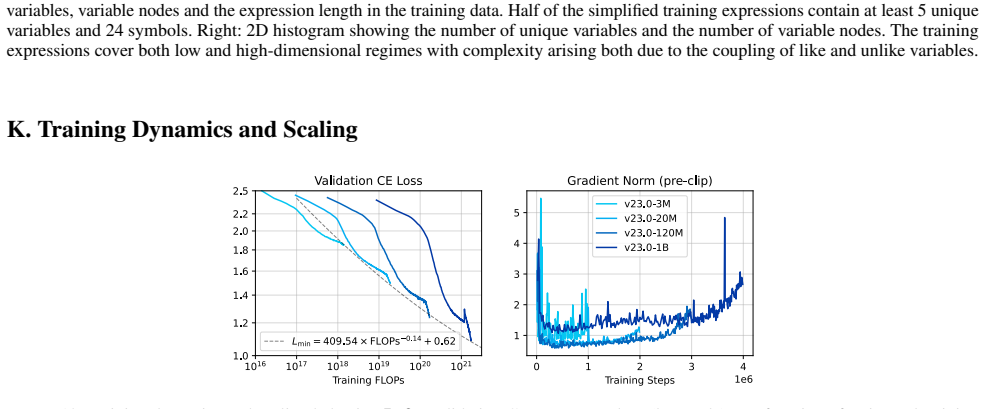
- Scaling model size and sampling budget follows a power law in recovery, so the gains observed at the smaller model sizes are expected to continue.
Where Pith is reading between the lines
- The paper trains and evaluates with the rule cap at four symbols, yet its own quality comparison shows the engine matches the general-purpose simplifier only when the cap is five or higher. A natural next experiment is training with the larger rule set; the paper leaves this untested.
- The parsimony inversion suggests a broader principle: a learner that assigns probability mass near concise forms spends additional budget sampling rare, simple candidates, whereas a local mutator spends it refining complex approximations. Other sampling-based generative models should show similar 'concise-first' scaling if their training targets are normalized.
- The decontamination trick — pruning constants and comparing structural images on random inputs — could be lifted out of symbolic regression and applied to any benchmark where equivalent syntactic variants of a target are plausible.
- If noise is added during training, the observed drop in noise robustness may disappear, because the encoder would no longer treat every fluctuation as signal; this is a direct, testable fix suggested by the paper's own diagnosis.
Editorial analysis
A structured set of objections, weighed in public.
Referee Report
Summary. The paper identifies the computational cost of CAS-based simplification (e.g., SymPy) as a bottleneck for amortized neural symbolic regression and proposes SimpliPy, a rule-based/hash-based simplification engine that operates directly on tokenized prefix expressions. SimpliPy precomputes a bounded set of rewriting rules offline and applies them via pattern matching, claiming up to 100× speedup over SymPy at comparable quality. The authors integrate SimpliPy into Flash-ANSR, an encoder-decoder Transformer trained on 512M on-the-fly generated and simplified expression–dataset pairs. On the FastSRB benchmark they report that Flash-ANSR outperforms static/unsimplified amortized baselines (NeSymReS, E2E) and matches or partially surpasses PySR at larger inference budgets, while exhibiting a decreasing expression-length ratio with more compute. The paper also emphasizes rigorous evaluation protocols, including machine-precision recovery thresholds, bootstrapped confidence intervals, and symbolic/numeric decontamination of training data.
Significance. If the central claims hold, the paper makes a strong practical contribution: it provides a fast simplification engine that could enable large-scale dynamic generation of high-quality symbolic regression training data, and it demonstrates that amortized methods can be competitive with genetic programming on realistic benchmarks. The manuscript also contains several commendable practices: detailed hyperparameter tables, release of code (though not all artifacts are verifiable here), bootstrapped confidence intervals, and a thoughtful test-time-compute evaluation protocol. However, the headline claim of '100× speed-up at comparable quality' is not actually demonstrated for the configuration used in training and inference (L_max=4), because the paper's own Figure 4 shows quality parity with SymPy only at L_max≥5. This gap is load-bearing for the method's motivation and for the downstream performance claims. Additional fairness concerns about the expression-length comparison and the SymPy baseline further weaken the current evidence. With targeted additional experiments and clarifications, the paper could be a significant contribution to amortized symbolic regression.
major comments (4)
- [§5.2, Fig. 4; §3.3; App. B] The paper's central premise is that SimpliPy provides 'comparable quality' to SymPy, but the quality comparison in Fig. 4 (right) explicitly shows that this holds only for L_max ≥ 5. All training (§3.3), inference (§3.5), and the reported speedup use L_max = 4. The under-simplified tail at L_max=4 means training targets may retain the syntactic redundancy that the method is designed to eliminate, and the downstream results do not isolate the benefit of the simplifier at the deployed configuration. Please either retrain/evaluate with L_max ≥ 5 or quantify how the simplification-quality gap affects the Flash-ANSR results.
- [§5.1, Fig. 2 (right); §4.4; §3.5] The parsimony comparison ('parsimony inversion') may be unfair: Flash-ANSR candidates are explicitly simplified with SimpliPy before evaluation (§3.5), but the paper does not state whether PySR and NeSymReS outputs are also normalized before computing expression length ratios. If PySR expressions are not simplified, their increasing length ratio over time could largely reflect accumulated algebraic redundancy rather than genuine complexity growth. Please clarify the protocol or apply the same simplifier to all methods before measuring |τ̂|/|τ|.
- [§4.5, Fig. 4 (left)] The SymPy baseline is measured through a compatibility layer that substitutes random constants into expressions before parsing and then masks numerical values after simplification. This changes the simplification problem (SymPy is no longer performing symbolic simplification of constants) and conflates conversion/parsing overhead with simplify-routine cost, whereas SimpliPy operates directly on tokenized input. The claimed 100× speedup at 'comparable quality' is therefore not an apples-to-apples comparison. A fairer benchmark would use SymPy's native symbolic simplification (or state clearly why the compatibility layer is necessary) and report both simplify-only and end-to-end times.
- [§5.1, Fig. 2 (left)] The text states that the 120M model 'partially surpasses' PySR, reaching 55.8% vNRR versus 50.0%, but does not report whether the difference is statistically significant given the bootstrapped 95% confidence intervals shown in the figure. If the intervals overlap at the relevant budgets, the claim of surpassing PySR should be softened to 'matching within uncertainty.' Please report explicit confidence intervals and the inference-time budgets at which the comparison is made.
minor comments (4)
- [Throughout] The name is written inconsistently as 'SimpliPy' and 'SIMPLIPY'; please standardize. Also, 'SimpliPy' vs 'SIMPLIPY' in the abstract and body should be unified.
- [Appendix B, Table 3] The 'Logical CPUs' row shows 4, 32, 8, 8, which seems counterintuitive for the larger models; please clarify whether this is the number of CPU workers for data generation or for evaluation.
- [§3.5] The text says 'SciPy.optimize.curve fit' — should be 'scipy.optimize.curve_fit'.
- [Algorithm 2] The condition 'if no such simplification exists' in Step 2 of Phase 1 is clear, but in Algorithm 2 τ* is always computed using SIMPLIPY_R; if τ* exists, the later loop over j starts from 1 to min(|τ*|−1, Ltgt). Please clarify whether the 'Selection' step in the main text corresponds to the case where SIMPLIPY_R returns τ unchanged or to something else.
Circularity Check
No significant circularity: central claims are tested against external benchmarks and an independent symbolic engine.
full rationale
The core derivations are not circular. SimpliPy's rule set is mined offline by numerical equivalence checks (Algorithm 1) using random constants and Levenberg-Marquardt fitting; the online simplifier then applies those mined rules. The subsequent speed/quality claim is measured against SymPy, an external system, on 64k expressions from the training distribution (Section 4.5), and quality is reported separately by Lmax (Figure 4). Flash-ANSR's recovery-rate claims are evaluated on the held-out FastSRB benchmark under a strict FVU <= epsilon_32 criterion, with an explicit decontamination procedure that removes training expressions numerically equivalent to test skeletons; comparisons to NeSymReS, E2E, and PySR are external and not fitted to the reported outcome. The main weakness is a validity/evidence gap, not circularity: the deployed simplification setting is Lmax=4 (Appendix B), while Figure 4 (right) shows quality parity with SymPy only at Lmax>=5. Thus the 'comparable quality' premise is not demonstrated at the exact configuration used to train and evaluate Flash-ANSR. This is a correctness concern, not a circular derivation: no predicted quantity is made equal to an input by construction. The Figure 3 scaling-law extrapolation is explicitly a fit to the same observed curves and is presented as extrapolation, not as an independently tested prediction; it is also not load-bearing for the paper's main results. No self-citation chain or imported uniqueness theorem forces the conclusions.
Axiom & Free-Parameter Ledger
free parameters (6)
- Simplification rule set R (rules of length ≤ L_max=4) =
not enumerated in manuscript; derived offline via Algorithm 2 on up to 7-symbol expressions
- Operator weights: +,-,*,/ = 10, others = 1 =
10 vs 1
- Parsimony regularization coefficient γ =
0.05 (0.15 for Figure 3)
- Training prior: nops ~ exp[nops^0.7], constants ~ N(0,σ=5), support M~U(1,1024), variable count U(1,min(nleaves,D)) =
various
- Decontamination threshold =
10^-4 absolute difference on X_check
- Lmax pattern cap = 4 during training/inference =
4
axioms (5)
- ad hoc to paper Algorithm 1's numeric equivalence check with random constants (K=16 challenges, retries R=16, LM fitting) correctly decides functional equivalence of generated expressions.
- domain assumption The Lample & Charton (2019) skeleton-generation procedure covers the distribution of physical laws in FastSRB.
- domain assumption FVU ≤ ε_32 on a finite validation split implies the correct law was recovered.
- domain assumption The autoregressive softmax-sampling procedure eventually assigns non-negligible probability to the correct skeleton for each FastSRB expression.
- ad hoc to paper Pre-computation of rules for expressions with up to 4 variables and 7 symbols (with literals ±1, π, e, ±∞, NaN) is sufficient to capture a large fraction of simplifications encountered in the training distribution.
invented entities (3)
-
SimpliPy rule-based simplification engine
independent evidence
-
Flash-ANSR models (v23.0-3M/20M/120M/1B)
no independent evidence
-
Masked RMSSetNorm
independent evidence
Cite this review
Pith. "Pith review of Breaking the Simplification Bottleneck in Amortized Neural Symbolic Regression." pith.science (2026). https://pith.science/paper/FUZF4YIK
@misc{pith2026260208885,
  author       = {Pith},
  title        = {Pith review of: Breaking the Simplification Bottleneck in Amortized Neural Symbolic Regression},
  year         = {2026},
  howpublished = {\url{https://pith.science/paper/FUZF4YIK}},
  note         = {Machine review of arXiv:2602.08885}
}
read the original abstract
Symbolic regression (SR) aims to discover interpretable analytical expressions that accurately describe observed data. Amortized SR promises to be much more efficient than the predominant genetic programming SR methods, but currently struggles to scale to realistic scientific complexity. We find that a key obstacle is the lack of a fast reduction of equivalent expressions to a concise normalized form. Amortized SR has addressed this with general-purpose Computer Algebra Systems (CAS) like SymPy, but the high computational cost severely limits training and inference speed. We propose SimpliPy, a rule-based simplification engine achieving a 100-fold speed-up over SymPy at comparable quality. This enables substantial improvements in amortized SR, including scalability to much larger training sets, more efficient use of the per-expression token budget, and systematic training set decontamination with respect to equivalent test expressions. We demonstrate these advantages in our Flash-ANSR framework, which achieves much better accuracy than amortized baselines (NeSymReS, E2E) on the FastSRB benchmark. Moreover, it performs on par with state-of-the-art direct optimization (PySR) while recovering more concise rather than more complex expressions with increasing inference budget.
Figures




Reference graph
Works this paper leans on
-
[1]
Skeleton draw.We samplen ops = 4and produce the prefix skeleton with a free constant placeholder ⋄ : ¯τ (1) = [ + , mult2 , sin , x1 , pow2 , ⋄ ]
-
[2]
Simplification.SimpliPy (L max = 4) absorbs pow2 into the constant placeholder and simplifies the expression to ¯τ (1)∗ = [ + , mult2 , sin , x1 , ⋄ ]
-
[3]
Assume the held-out pool contains the expression as itsi-th entry τ (i) − = [ mult2 , sin , / , x1 , ⋄ ]
Test-set guard.We drop constants from both train candidates and held-out expressions, reducing the candidate to ˜τ (1) = [ mult2 , sin , x1 ]. Assume the held-out pool contains the expression as itsi-th entry τ (i) − = [ mult2 , sin , / , x1 , ⋄ ]. which reduces to ˜τ (i) − = [ mult2 , sin , x1 ]. Since ˜τ (1) = ˜τ (i) − , we reject this instance and proc...
-
[4]
URL https: //doi.org/10.1007/978-3-031-57065-0
doi: 10.1007/978-3-031-57065-0. URL https: //doi.org/10.1007/978-3-031-57065-0. 10 Breaking the Simplification Bottleneck in Amortized Neural Symbolic Regression Schmidt, M. D. and Lipson, H. Distilling free-form nat- ural laws from experimental data.Science, 324:81 – 85, 2009. URL https://api.semanticscholar. org/CorpusID:7366016. Su, J., Lu, Y ., Pan, S...
Pith/arXiv arXiv 2009
-
[5]
easy” expressions are solved perfectly (left, green dots). In both “medium
Constant and data draw.The constant is sampled from N(0, σ= 5) as c1 = 1.15. We sample M= 137 data points with Xj ∼ U(aj, bj) where aj, bj ∼ N(0, σ= 10). Evaluating y=f ¯τ (2) (X;c 1) yields finite, real values, so the instance is accepted without further resampling. J. Data Statistics Figure 12.Training data statistics. Left: Empirical Cumulative Distrib...
2020
-
[9]
17 Breaking the Simplification Bottleneck in Amortized Neural Symbolic Regression Simplification yields ¯τ (2)∗ = [ * , / , x1 , pow2 , x2 , ⋄ ]
Resampling.A new skeleton is drawn withn ops = 6, ¯τ (2) = [ * , / , x1 , pow2 , x2 , * , ⋄ , + , x1 , neg , x1 ]. 17 Breaking the Simplification Bottleneck in Amortized Neural Symbolic Regression Simplification yields ¯τ (2)∗ = [ * , / , x1 , pow2 , x2 , ⋄ ]. which, after removing constants, becomes ˜τ (2) = [ / , x1 , pow2 , x2 ]. No held-out expression...
-
[945]
Burlacu, B., Kronberger, G., and Kommenda, M
Pmlr, 2021. Burlacu, B., Kronberger, G., and Kommenda, M. Operon c++: An efficient genetic programming framework for symbolic regression. InProceedings of the 2020 Genetic and Evolutionary Computation Conference Companion, GECCO ’20, pp. 1562–1570, New York, NY , USA, 2020. Association for Computing Machin- ery. ISBN 9781450371278. doi: 10.1145/3377929. 3...
arXiv 2021
-
[2022]
org/CorpusID:250048548
URL https://api.semanticscholar. org/CorpusID:250048548. 11 Breaking the Simplification Bottleneck in Amortized Neural Symbolic Regression A. Examples Figure 8.FLASH-ANSR fits (v23.0-120M, γ= 0.05, 32k samples ≈100 s) (red curves) on uniformly sampled data points (black dots) from several 1D expressions (M= 64, η= 0). Many ground truth expressions (bold) ...
2021
-
[2024]
doi: 10.1145/3620665.3640366. Ba, J. L., Kiros, J. R., and Hinton, G. E. Layer normaliza- tion, 2016. URL https://arxiv.org/abs/1607. 06450. Belkin, M., Hsu, D. J., Ma, S., and Mandal, S. Reconciling modern machine learning and the bias-variance trade- off.ArXiv, abs/1812.11118, 2018. URL https://api. semanticscholar.org/CorpusID:57189215. Bendinelli, T.,...
arXiv 2016
-
[5992]
doi: 10.7717/peerj-cs.103. URL https://doi. org/10.7717/peerj-cs.103. Nakkiran, P., Kaplun, G., Bansal, Y ., Yang, T., Barak, B., and Sutskever, I. Deep double descent: Where big- ger models and more data hurt, 2019. URL https: //arxiv.org/abs/1912.02292. Petersen, B. K., Landajuela, M., Mundhenk, T. N., Santi- ago, C. P., Kim, S. K., and Kim, J. T. Deep ...
Pith/arXiv arXiv 2019
discussion (0)
Sign in with ORCID, Apple, or X to comment. Anyone can read and Pith papers without signing in.