REVIEW 3 major objections 5 minor 3 cited by
Pseudo-Labeling and Confirmation Bias in Deep Semi-Supervised Learning
T0 review · 3 major / 5 minor · reviewed 2026-08-14 · deepseek-v4-flash
Pith's one-line read Semi-supervised image classifiers can learn from their own predictions if confirmation bias is controlled.
desk verdict A genuinely simple pseudo-labeling recipe that performs surprisingly well, but the state-of-the-art comparison is confounded by differences in augmentation and dropout between the proposed method and the cited baselines. read the letter →
The pith
A machine-rendered reading of the paper's core claim, the machinery that carries it, and where it could break.
The reading
What carries the argument
The central mechanism is a loss decomposition: the semi-supervised objective splits into a labeled-data term and an unlabeled pseudo-label term, and with few labels the pseudo-label term vastly outweighs the labeled term, so the model fits its own errors. The paper's two fixes target this imbalance and its confidence dynamics. Mixup, defined as training on convex combinations $\delta x_p+(1-\delta)x_q$ with labels $\delta y_p+(1-\delta)y_q$ for $\delta$ drawn from a $\beta$ distribution, acts as label smoothing that prevents overconfident wrong pseudo-labels. A minimum of $k$ labeled samples per mini-batch, with $k=16$ used in most experiments, restores the labeled term's influence by oversampling the clean labels. Around this core sit an all-classes regularization $R_A$ that prevents collapse to one class and an entropy regularization $R_H$ that concentrates soft pseudo-labels, both adapted from the noisy-label method [24], plus dropout and data augmentation that are disabled in the second forward pass so soft pseudo-labels are computed cleanly.
What would settle it
Retrain the strongest consistency baselines with the same 13-CNN, data augmentation, dropout, weight decay, learning-rate schedule, warm-up, and labeled/unlabeled splits used here, and compare CIFAR-10 test errors at 500, 1000, and 4000 labels; if any baseline meets or beats 8.80, 6.85, and 5.97 percent, the paper's central comparison is refuted.
Extended reading notes
Core claim
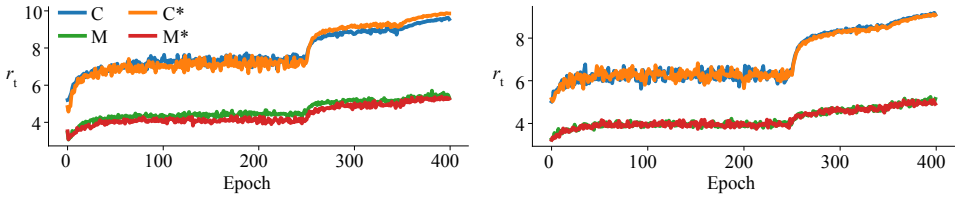
The paper's central claim is that pseudo-labeling alone, without consistency regularization, can be state of the art in deep semi-supervised image classification, contrary to the prevailing assumption in the literature. The confirmation-bias diagnosis is that when a network's own sometimes wrong predictions are reused as labels, the model grows more confident in those errors and resists correction; the authors quantify this with a per-epoch measure of the average certainty of misclassified unlabeled samples. They show that naively adapting the soft-relabeling scheme of [24] fails, but two modifications, training on mixup interpolations and enforcing at least $k$ labeled samples in every mini-batch, reduce the certainty of incorrect predictions and let the model converge. In head-to-head comparisons, the approach reports lower test error than published consistency-regularization baselines on CIFAR-10/100, SVHN, and Mini-ImageNet, including a 10-point margin on Mini-ImageNet and a large gap at 500 CIFAR-10 labels (8.80% versus 27.45% for Mean Teacher).
Load-bearing premise
The comparison with state-of-the-art assumes the published baseline numbers come from settings comparable to the authors' training protocol; if those baselines were not tuned under the same augmentation, schedule, and tuning budget, the reported margin over consistency regularization could shrink or disappear.
Editorial extensions
If this is right
- At 500 labeled CIFAR-10 images, the method's 8.80% test error is over 18 points better than the Mean Teacher baseline (27.45%) under the paper's comparison.
- On Mini-ImageNet with 4,000 labels, the method reaches 56.49% error versus 70.29% for label-propagation pseudo-labeling, a margin of more than 10 points.
- Soft pseudo-labels are reported to work better than hard one-hot pseudo-labels, confirming the noisy-label observation the method adapts.
- Purely pseudo-labeling approaches, not just consistency regularization, belong in future semi-supervised learning benchmarks as first-class contenders.
- The approach needs one network and a single extra forward pass per sample, unlike multi-network or many-pass consistency methods.
Reading between the lines
- If the diagnosis is right, any self-training pipeline that reuses model predictions as targets should inherit the same bias, so minimum-$k$ oversampling and mixup-style label smoothing may transfer to text, audio, and time-series settings where consistency regularization is less natural.
- The observation that the 13-CNN is more robust at 250 labels than a Wide ResNet or PreAct ResNet suggests that architecture capacity interacts with pseudo-label noise; a testable extension would sweep depth and width at fixed parameter count to separate capacity effects from skip-connection effects.
- Since stronger mixup ($\alpha=4$ or $8$) helped in the ablation but was not additive with dropout and extra augmentation, an adaptive $\alpha$ schedule that starts strong to suppress early confirmation bias and anneals later is a plausible extension the paper does not test.
Signed reviews
Editorial analysis
A structured set of objections, weighed in public.
Referee Report
Summary. The paper proposes a semi-supervised image classification method based on pseudo-labeling. The network's softmax predictions on unlabeled samples serve as soft pseudo-labels in a cross-entropy loss, augmented by an all-class regularization term and an entropy regularization term. To counter confirmation bias, the method uses mixup, a minimum number of labeled samples per mini-batch, dropout, and color-jitter augmentation. Experiments on CIFAR-10/100, SVHN, and Mini-ImageNet with the 13-CNN architecture and several other networks report state-of-the-art results and the claim that pseudo-labeling alone can outperform consistency-regularization methods.
Significance. If the comparative claims hold, the paper provides a valuable and conceptually simple counterpoint to the consistency-regularization paradigm that has dominated recent deep semi-supervised learning. The strengths of the work include careful ablation studies (Tables I-III), an explicit quantitative measure of confirmation bias (rt in Figure 2), averaged results with standard deviations over three runs, and released source code. However, as detailed below, the headline comparison against consistency-regularization baselines is weakened by a protocol mismatch, and the paper's central claim needs to be either supported by same-protocol baseline runs or carefully qualified.
major comments (3)
- [Section IV-E, Tables IV and V] The headline comparison is not apples-to-apples. Ours* uses the final configuration developed in Section IV-D (dropout p=0.1, color-jitter augmentation, and a second forward pass for pseudo-labels), while the consistency-regularization entries (MT, ICT, Pi-model, etc.) are unmarked numbers taken from prior papers. Section IV-A states only that supervised baselines use the same augmentation and dropout, not that the cited SSL baselines do. Table III shows that these additions are not negligible: on CIFAR-10 with 500 labels, M* improves from 13.68 to 9.16 when dropout and color jitter are added. The claimed margin over consistency regularization, e.g. 8.80 vs 27.45 (MT) in Table V, could therefore be explained by the additional regularization rather than by pseudo-labeling itself. I ask the authors to rerun the key consistency baselines under their exact training protocol, or to clearly restrict the claim so that it does not depend on unmarked baseline numbers.
- [Section IV-A] The validation set is used for hyperparameter selection in Subsections IV-B through IV-D and is then folded back into the training set for the final comparisons in Subsection IV-E. The paper states that the 5K validation samples are added back for the results in IV-E, where test results are reported from the model at the best epoch. This means the final test numbers are produced by a pipeline whose hyperparameters and epoch selection were partly determined on data that later becomes training data. While this is not unusual in the literature, it removes a layer of independence and can inflate the reported margins; the authors should either report results under a held-out validation protocol or explicitly discuss the potential optimistic bias.
- [Section IV-E, Table VI] The only consistency-regularization baseline that the authors rerun under their own protocol, ICT* on WR-28, is not used in the main comparison of Tables IV and V. Moreover, for 250 labels, Ours* on WR-28 (24.81) is much worse than the cited MixMatch result on the same architecture (11.08), and on PR-18 it also degrades sharply (23.86). This does not invalidate the method on the 13-CNN architecture, but it directly contradicts the abstract's general claim that 'pseudo-labeling alone can outperform consistency regularization methods.' The claim should be qualified by architecture and label regime, and the same-protocol baseline comparisons should be extended to the settings where the claim is made.
minor comments (5)
- [Equations (5)-(6)] The notation δ∈{0,1} is incorrect; since δ is sampled from a beta distribution, it should be δ∈[0,1] (or the text should say that δ is a continuous value in this interval).
- [Section IV-A] There is a typo: 'respectivelly' should be 'respectively'.
- [Tables IV and V captions] The caption notes that '*' denotes runs by the authors, but it does not indicate which of the unmarked baselines used the same data augmentation, dropout, or learning-rate schedule as Ours*. A clear statement is needed to interpret the comparison.
- [Equation (8)] The notation in the decomposition 𝓁* = Nl𝓁l + Nu𝓁u is slightly confusing because Nl and Nu are counts while 𝓁l and 𝓁u are averages; explicitly defining the per-sample averaged losses would remove ambiguity.
- [Section III-A] The phrase 'as well as other purely pseudo-labeling approaches and their combination with consistency regularization methods' in Section IV-E is broad; consider listing the specific methods or grouping them more precisely, since the table includes several hybrid methods.
Circularity Check
No circularity: the paper is an empirical pseudo-labeling method evaluated on external benchmarks, with no prediction that reduces to a fitted input or to a self-citation chain.
full rationale
No circular step is present. The paper proposes an empirical training procedure (soft pseudo-labels generated from network predictions, mixup, a minimum number of labeled samples per mini-batch, dropout, and extra data augmentation) and evaluates it on CIFAR-10/100, SVHN, and Mini-ImageNet. The loss equations (1)-(4), (7), and (8) define the training objective; they do not encode the final test-error comparisons. The RA and RH regularizers are taken from Tanaka et al. [24] by external citation, with lambda_A=0.8 and lambda_H=0.4 fixed, and the paper reports an ablation (Table II) rather than claiming these values are derived. Hyperparameters are chosen on a validation split, and the validation samples are added back to training for the final comparisons, which is ordinary model selection rather than circularity. The only self-citation, Arazo et al. [9], appears in the related-work discussion of label noise and is not load-bearing for the central claim. The skeptic's concern that unmarked baseline numbers in Tables IV and V may not share the authors' augmentation and dropout protocol is a question of experimental comparability and confound control, not circularity: the headline claim is an empirical benchmark claim, and the paper does not construct those baseline numbers from its own fitted parameters or equations. Accordingly, the derivation chain is self-contained with respect to the circularity criteria, and the correct score is 0.
Assumptions & free parameters
free parameters (6)
- alpha (mixup beta distribution parameter) =
1 (default; studied 0.1, 1, 4, 8)
- lambda_A (all-class regularization weight) =
0.8
- lambda_H (entropy regularization weight) =
0.4
- k (minimum number of labeled samples per mini-batch) =
16
- dropout probability p =
0.1 (for 13-CNN/WR-28), 0.3 studied
- warm-up epochs =
10 (CIFAR, Mini-ImageNet), 150 (SVHN)
assumptions (4)
- domain assumption The training and evaluation are restricted to class-balanced scenarios.
- domain assumption The validation set (5K samples) is representative of the test distribution and is used for hyperparameter selection.
- domain assumption Soft pseudo-labels from the network's softmax outputs are suitable targets for unlabeled samples.
- domain assumption Mixup's label smoothing reduces overconfidence and thus confirmation bias.
Cite this review
Pith. "Pith review of Pseudo-Labeling and Confirmation Bias in Deep Semi-Supervised Learning." pith.science (2026). https://pith.science/paper/FXU4USJG
@misc{pith2026190802983,
  author       = {Pith},
  title        = {Pith review of: Pseudo-Labeling and Confirmation Bias in Deep Semi-Supervised Learning},
  year         = {2026},
  howpublished = {\url{https://pith.science/paper/FXU4USJG}},
  note         = {Machine review of arXiv:1908.02983}
}
read the original abstract
Semi-supervised learning, i.e. jointly learning from labeled and unlabeled samples, is an active research topic due to its key role on relaxing human supervision. In the context of image classification, recent advances to learn from unlabeled samples are mainly focused on consistency regularization methods that encourage invariant predictions for different perturbations of unlabeled samples. We, conversely, propose to learn from unlabeled data by generating soft pseudo-labels using the network predictions. We show that a naive pseudo-labeling overfits to incorrect pseudo-labels due to the so-called confirmation bias and demonstrate that mixup augmentation and setting a minimum number of labeled samples per mini-batch are effective regularization techniques for reducing it. The proposed approach achieves state-of-the-art results in CIFAR-10/100, SVHN, and Mini-ImageNet despite being much simpler than other methods. These results demonstrate that pseudo-labeling alone can outperform consistency regularization methods, while the opposite was supposed in previous work. Source code is available at https://git.io/fjQsC.
Figures

Forward citations
Cited by 3 Pith papers
-
Heuristic-Free Multi-Teacher Learning
By turning each teacher's labels into a separate confidence-prediction task conditioned on a teacher token, Teacher2Task claims to outperform the best individual teacher on open-vocabulary tagging without manual aggre...
-
Denoising Mutual Knowledge Distillation in Bi-Directional Multiple Instance Learning
A two-branch MIL training method with self-confidence losses and attention calibration improves bag- and instance-level whole-slide image classification on CAMELYON16 and TCGA-NSCLC over WENO and MHIM-MIL baselines.
-
Optimising Language Models for Downstream Tasks: A Post-Training Perspective
A dissertation that repackages the author's previously published papers on continued pre-training, prompt tuning, and instruction modelling into a single narrative.
Reference graph
Works this paper leans on
-
[1]
Focal Loss for Dense Object Detection,
T. Lin, P. Goyal, R. Girshick, K. He, and P. Dollar, “Focal Loss for Dense Object Detection,” in IEEE International Conference on Computer Vision (ICCV), 2017
work page 2017
-
[2]
Learning towards Minimum Hyperspherical Energy,
W. Liu, R. Lin, Z. Liu, L. Liu, Z. Yu, B. Dai, and L. Song, “Learning towards Minimum Hyperspherical Energy,” in Advances in Neural Information Processing Systems (NeurIPS) , 2018
work page 2018
-
[3]
Multi-object Tracking with Neural Gating Using Bilinear LSTM,
C. Kim, F. Li, and J. Rehg, “Multi-object Tracking with Neural Gating Using Bilinear LSTM,” in European Conference on Computer Vision (ECCV), 2018
work page 2018
-
[4]
Rethinking Spatiotempo- ral Feature Learning: Speed-Accuracy Trade-offs in Video Classification,
S. Xie, C. Sun, J. Huang, Z. Tu, and K. Murphy, “Rethinking Spatiotempo- ral Feature Learning: Speed-Accuracy Trade-offs in Video Classification,” in European Conference on Computer Vision (ECCV) , September 2018
work page 2018
-
[5]
WebVision Database: Visual Learning and Understanding from Web Data,
W. Li, L. Wang, W. Li, E. Agustsson, and L. Van Gool, “WebVision Database: Visual Learning and Understanding from Web Data,” arXiv: 1708.02862, 2017
arXiv 2017
-
[6]
Realistic Evaluation of Deep Semi-Supervised Learning Algorithms,
A. Oliver, A. Odena, C. Raffel, E. Cubuk, and I. Goodfellow, “Realistic Evaluation of Deep Semi-Supervised Learning Algorithms,” in Advances in Neural Information Processing Systems (NeurIPS) , 2018
work page 2018
-
[7]
Exploiting Unlabeled Data in CNNs by Self-supervised Learning to Rank,
X. Liu, J. Van De Weijer, and A. D. Bagdanov, “Exploiting Unlabeled Data in CNNs by Self-supervised Learning to Rank,” IEEE Transactions on Pattern Analysis and Machine Intelligence , 2019
work page 2019
-
[8]
Deep visual domain adaptation: A survey,
M. Wang and W. Deng, “Deep visual domain adaptation: A survey,” Neurocomputing, vol. 312, pp. 135–153, 2018
2018
Show all 48 references
-
[9]
Un- supervised Label Noise Modeling and Loss Correction,
E. Arazo, D. Ortego, P. Albert, N. O’Connor, and K. McGuinness, “Un- supervised Label Noise Modeling and Loss Correction,” in International Conference on Machine Learning (ICML) , 2019
2019
-
[10]
Unsupervised Representation Learning by Predicting Image Rotations,
S. Gidaris, P. Singh, and N. Komodakis, “Unsupervised Representation Learning by Predicting Image Rotations,” in International Conference on Learning Representations (ICLR) , 2018
2018
-
[11]
Decoupled Certainty-Driven Consistency Loss for Semi-supervised Learning,
Y . Li, L. Liu, and R. Tan, “Decoupled Certainty-Driven Consistency Loss for Semi-supervised Learning,” arXiv: 1901.05657, 2019
1901 arXiv
-
[12]
Enhanced semi-supervised learning for multimodal emotion recognition,
Z. Zhang, F. Ringeval, B. Dong, E. Coutinho, E. Marchi, and B. Sch ¨uller, “Enhanced semi-supervised learning for multimodal emotion recognition,” in IEEE International Conference on Acoustics, Speech and Signal Processing (ICASSP), 2016
2016
-
[13]
Self-labeling techniques for semi-supervised time series classification: an empirical study,
M. Gonz ´alez, C. Bergmeir, I. Triguero, Y . Rodr ´ıguez, and J. Ben ´ıtez, “Self-labeling techniques for semi-supervised time series classification: an empirical study,” Knowledge and Information Systems , vol. 55, no. 2, pp. 493–528, 2018
2018
-
[14]
Adversarial Training Methods for Semi-Supervised Text Classification,
T. Miyato, A. Dai, and I. Goodfellow, “Adversarial Training Methods for Semi-Supervised Text Classification,” arXiv: 1605.07725, 2016
2016 arXiv
-
[15]
Regularization With Stochastic Transformations and Perturbations for Deep Semi-Supervised Learning,
M. Sajjadi, M. Javanmardi, and T. Tasdizen, “Regularization With Stochastic Transformations and Perturbations for Deep Semi-Supervised Learning,” in Advances in Neural Information Processing Systems (NeurIPS), 2016
2016
-
[16]
Pseudo-label: The simple and efficient semi-supervised learning method for deep neural networks,
D. Lee, “Pseudo-label: The simple and efficient semi-supervised learning method for deep neural networks,” in International Conference on Machine Learning Workshops (ICMLW) , 2013
2013
-
[17]
Label Propagation for Deep Semi-supervised Learning,
A. Iscen, G. Tolias, Y . Avrithis, and O. Chum, “Label Propagation for Deep Semi-supervised Learning,” in IEEE Conference on Computer Vision and Pattern Recognition (CVPR) , 2019
2019
-
[18]
Mean teachers are better role models: Weight-averaged consistency targets improve semi-supervised deep learning results,
A. Tarvainen and H. Valpola, “Mean teachers are better role models: Weight-averaged consistency targets improve semi-supervised deep learning results,” in Advances in Neural Information Processing Systems (NeurIPS), 2017
2017
-
[19]
Transductive Semi-Supervised Deep Learning using Min-Max Features,
W. Shi, Y . Gong, C. Ding, Z. Ma, T. Xiaoyu, and N. Zheng, “Transductive Semi-Supervised Deep Learning using Min-Max Features,” in European Conference on Computer Vision (ECCV) , 2018
2018
-
[20]
Virtual Adversarial Training: A Regularization Method for Supervised and Semi-Supervised Learning,
T. Miyato, S. Maeda, S. Ishii, and M. Koyama, “Virtual Adversarial Training: A Regularization Method for Supervised and Semi-Supervised Learning,” IEEE Transactions on Pattern Analysis and Machine Intelli- gence, 2018
2018
-
[21]
Deep Co-Training for Semi-Supervised Image Recognition,
S. Qiao, W. Shen, Z. Zhang, B. Wang, and A. Yuille, “Deep Co-Training for Semi-Supervised Image Recognition,” in European Conference on Computer Vision (ECCV) , 2018
2018
-
[22]
Smooth Neighbors on Teacher Graphs for Semi-Supervised Learning,
Y . Luo, J. Zhu, M. Li, Y . Ren, and B. Zhang, “Smooth Neighbors on Teacher Graphs for Semi-Supervised Learning,” in IEEE Conference on Computer Vision and Pattern Recognition (CVPR) , 2018
2018
-
[23]
MixMatch: A Holistic Approach to Semi-Supervised Learn- ing,
D. Berthelot, N. Carlini, I. Goodfellow, N. Papernot, A. Oliver, and C. Raffel, “MixMatch: A Holistic Approach to Semi-Supervised Learn- ing,” in Advances in Neural Information Processing Systems (NeurIPS) , 2019
2019
-
[24]
Joint Optimization Framework for Learning with Noisy Labels,
D. Tanaka, D. Ikami, T. Yamasaki, and K. Aizawa, “Joint Optimization Framework for Learning with Noisy Labels,” in IEEE Conference on Computer Vision and Pattern Recognition (CVPR) , 2018
2018
-
[25]
mixup: Beyond Empirical Risk Minimization,
H. Zhang, M. Cisse, Y . Dauphin, and D. Lopez-Paz, “mixup: Beyond Empirical Risk Minimization,” in International Conference on Learning Representations (ICLR), 2018
2018
-
[26]
On Mixup Training: Improved Calibration and Predictive Uncertainty for Deep Neural Networks,
S. Thulasidasan, G. Chennupati, J. Bilmes, T. Bhattacharya, and S. Michalak, “On Mixup Training: Improved Calibration and Predictive Uncertainty for Deep Neural Networks,” arXiv: 1905.11001, 2019
1905 arXiv
-
[27]
Dropout: A Simple Way to Prevent Neural Networks from Overfitting,
N. Srivastava, G. Hinton, A. Krizhevsky, I. Sutskever, and R. Salakhut- dinov, “Dropout: A Simple Way to Prevent Neural Networks from Overfitting,” Journal of Machine Learning Research , vol. 15, pp. 1929– 1958, 2014
1929
-
[28]
Interpola- tion Consistency Training for Semi-Supervised Learning,
V . Verma, A. Lamb, J. Kannala, Y . Bengio, and D. Lopez-Paz, “Interpola- tion Consistency Training for Semi-Supervised Learning,” inInternational Joint Conference on Artificial Intelligence (IJCAI) , 2019
2019
-
[29]
There Are Many Consistent Explanations of Unlabeled Data: Why You Should Average,
B. Athiwaratkun, M. Finzi, P. Izmailov, and A. Wilson, “There Are Many Consistent Explanations of Unlabeled Data: Why You Should Average,” in International Conference on Learning Representations (ICLR) , 2019
2019
-
[30]
Temporal Ensembling for Semi-Supervised Learning,
S. Laine and T. Aila, “Temporal Ensembling for Semi-Supervised Learning,” in International Conference on Learning Representations (ICLR), 2017
2017
-
[31]
Semi-Supervised Deep Learning with Memory,
Y . Chen, X. Zhu, and S. Gong, “Semi-Supervised Deep Learning with Memory,” in European Conference on Computer Vision (ECCV) , 2018
2018
-
[32]
Semi-supervised Learning by Entropy Minimization,
Y . Grandvalet and Y . Bengio, “Semi-supervised Learning by Entropy Minimization,” in International Conference on Neural Information Processing Systems (NIPS) , 2004
2004
-
[33]
Learning multiple layers of features from tiny images,
A. Krizhevsky and G. Hinton, “Learning multiple layers of features from tiny images,” University of Toronto, Tech. Rep., 2009
2009
-
[34]
Reading digits in natural images with unsupervised feature learning,
Y . Netzer, T. Wang, A. Coates, A. Bissacco, . Wu, B, and A. Ng, “Reading digits in natural images with unsupervised feature learning,” in Advances in Neural Information Processing Systems (NeurIPS) , 2011
2011
-
[35]
Matching Networks for One Shot Learning,
O. Vinyals, C. Blundell, T. Lillicrap, K. Kavukcuoglu, and D. Wierstra, “Matching Networks for One Shot Learning,” in Advances in Neural Information Processing Systems (NeurIPS) , 2016
2016
-
[36]
ImageNet: A large-scale hierarchical image database,
J. Deng, W. Dong, R. Socher, L. Li, K. Li, and L. Fei-Fei, “ImageNet: A large-scale hierarchical image database,” in IEEE Conference on Computer Vision and Pattern Recognition (CVPR) , 2009
2009
-
[37]
Optimization as a model for few-shot learning,
S. Ravi and H. Larochelle, “Optimization as a model for few-shot learning,” in International Conference on Learning Representations (ICLR), 2017
2017
-
[38]
Deep Residual Learning for Image Recognition,
K. He, X. Zhang, S. Ren, and J. Sun, “Deep Residual Learning for Image Recognition,” in IEEE Conference on Computer Vision and Pattern Recognition (CVPR), 2016
2016
-
[39]
Surprising Effectiveness of Few- Image Unsupervised Feature Learning,
Y . Asano, C. Rupprecht, and A. Vedaldi, “Surprising Effectiveness of Few- Image Unsupervised Feature Learning,” in IEEE International Conference on Computer Vision (ICCV) , 2019
2019
-
[40]
Weight Normalization: A Simple Repa- rameterization to Accelerate Training of Deep Neural Networks,
T. Salimans and D. Kingma, “Weight Normalization: A Simple Repa- rameterization to Accelerate Training of Deep Neural Networks,” in Advances in Neural Information Processing Systems (NeurIPS) , 2016
2016
-
[41]
DisturbLabel: Regularizing CNN on the Loss Layer,
L. Xie, J. Wang, Z. Wei, M. Wang, and Q. Tian, “DisturbLabel: Regularizing CNN on the Loss Layer,” in IEEE Conference on Computer Vision and Pattern Recognition (CVPR) , 2016
2016
-
[42]
Revisiting Self-Supervised Visual Representation Learning,
A. Kolesnikov, X. Zhai, and L. Beyer, “Revisiting Self-Supervised Visual Representation Learning,” in IEEE Conference on Computer Vision and Pattern Recognition (CVPR), 2019
2019
-
[43]
ImageNet Classification with Deep Convolu- tional Neural Networks,
I. S. G. H. A. Krizhevsky, “ImageNet Classification with Deep Convolu- tional Neural Networks,” in Advances in Neural Information Processing Systems (NeurIPS), 2012
2012
-
[44]
Deep Image Prior,
D. Ulyanov, A. Vedaldi, and V . Lempitsky, “Deep Image Prior,” in IEEE Conference on Computer Vision and Pattern Recognition (CVPR) , 2018
2018
-
[45]
Wide Residual Networks,
N. K. S. Zagoruyko, “Wide Residual Networks,” in British Machine Vision Conference (BMVC), 2016
2016
-
[46]
Identity Mappings in Deep Residual Networks,
K. He, X. Zhang, S. Ren, and J. Sun, “Identity Mappings in Deep Residual Networks,” in European Conference on Computer Vision (ECCV) , 2016
2016
-
[47]
Population Based Augmentation: Efficient Learning of Augmentation Policy Schedules,
D. Ho, E. Liang, X. Chen, I. Stoica, and P. Abbeel, “Population Based Augmentation: Efficient Learning of Augmentation Policy Schedules,” in International Conference on Machine Learning (ICML) , 2019
2019
-
[48]
Semi- Supervised Learning with Scarce Annotations,
S.-A. Rebuffi, S. Ehrhardt, K. Han, A. Vedaldi, and A. Zisserman, “Semi- Supervised Learning with Scarce Annotations,” in IEEE International Conference on Computer Vision (ICCV) , 2019
2019
Reviewed August 14, 2026 · model on record in the stance chip above.
Discussion (0). Continue with ORCID to comment.