REVIEW 3 major objections 5 minor 50 references
Fairness in Deep Learning: A Computational Perspective
T0 review · 3 major / 5 minor · reviewed 2026-08-14 · deepseek-v4-flash
Pith's one-line read Interpretability can diagnose why deep learning models discriminate, this review argues.
desk verdict A useful survey that frames fairness mitigation around a three-stage taxonomy and makes a plausible case for interpretability as a diagnostic, but its empirical table is thin and it never interrogates the faithfulness of the interpretation methods it promotes. read the letter →
The pith
A machine-rendered reading of the paper's core claim, the machinery that carries it, and where it could break.
The reading
What carries the argument
The central mechanism is the interpretability-based diagnosis pipeline. For input-level discrimination, the tool is local interpretation: a feature-importance vector that highlights which inputs drive a prediction, so fairness-sensitive features can be flagged and tested by counterfactual perturbation. For representation-level discrimination, the tool is global interpretation, in particular the concept activation vector (CAV)—a direction in a network's activation space found by training a linear classifier to separate concept examples from counterexamples—whose sensitivity measures how much a learned concept contributes to predictions. For prediction quality disparity, the mechanism is simply disaggregated evaluation: split test data by sensitive attribute and compare accuracy across groups. These detection tools then feed into mitigation: attribution-based regularization for input bias, adversarial training to strip protected attributes from representations, and calibration for output bias.
What would settle it
Train a network on a dataset with a known injected protected attribute, then apply the review's detection tools; if feature attribution or CAV sensitivity fails to flag the injected attribute in a statistically reliable way across many seeds, while the network's biased predictions remain measurable, the central claim that interpretability can diagnose discrimination is falsified. A simpler version would adversarially alter a network's gradient-based attribution to ignore a sensitive feature that actually drives its decisions, and observe whether the Section 3.1 procedure still reports bias.
Extended reading notes
Core claim
The central claim is that interpretability can serve as a useful ingredient to diagnose the reasons that lead to algorithmic discrimination, and that fairness interventions are best organized by where in the pipeline the bias enters. Concretely, local interpretation methods that produce feature-attribution heatmaps can reveal when a model leans on fairness-sensitive inputs such as surname or ZIP code; global interpretation methods such as concept activation vectors can reveal when a protected concept, such as gender or race, has been encoded in the hidden layers and how strongly it drives predictions; and subgroup accuracy analysis can quantify prediction quality disparity. The paper endorses a three-stage mitigation scheme: pre-processing to debias data, in-processing to regularize training toward fairness metrics, and post-processing to calibrate outputs. It also reports experiments on two datasets showing that naive deep networks amplify dataset bias, that fairness-accuracy trade-offs are real, and that different fairness metrics can conflict.
Load-bearing premise
The whole diagnostic approach assumes that attribution maps and concept activation vectors faithfully reflect what the network actually computes, a premise the review does not prove or test.
Editorial extensions
If this is right
- If interpretability faithfully exposes what a network uses, bias diagnosis becomes a concrete engineering step rather than a black-box mystery.
- The three-way taxonomy implies that no single fairness metric or one mitigation method can cover all unfairness; input, representation, and quality disparity require different tools.
- The reported experiments suggest that mitigation algorithms reduce demographic disparity but often at the cost of accuracy, and sometimes shift unfairness toward the majority group.
- Because fairness metrics can conflict, deployment decisions must choose a metric matched to the application's ethical and legal requirements, as the paper states.
Reading between the lines
- The authors leave implicit that the diagnostic power of interpretability depends on attribution faithfulness; a natural benchmark would inject a known protected attribute into otherwise unbiased data and test whether each detection tool flags it reliably.
- A direct extension is to apply concept activation vectors to intersectional protected groups, such as African American women, since the paper notes that intersectional fairness is underdeveloped and CAV could be trained on combined concept sets.
- The review's own three-stage taxonomy suggests a testable prediction: post-processing calibration that requires inference-time access to protected attributes will become impractical in exactly the real-world settings where those attributes are legally unavailable, so pre-processing or in-processing methods may be more deployable there.
Signed reviews
Editorial analysis
A structured set of objections, weighed in public.
Referee Report
Summary. This paper is a survey of algorithmic fairness in deep learning, organized around detection and mitigation. The authors propose a taxonomy of fairness problems—discrimination via input, discrimination via representation, and prediction quality disparity—and argue that interpretability can serve as a useful ingredient to diagnose the reasons behind algorithmic discrimination. They review local and global interpretation methods (feature attribution, concept activation vectors) as bias-detection tools, and then categorize mitigation strategies according to the three stages of the deep learning pipeline: pre-processing, in-processing, and post-processing. The paper also includes a small original empirical comparison of mitigation algorithms on the Adult and COMPAS datasets in Section 4.1.4.
Significance. If the central claim holds, this survey provides a valuable conceptual bridge between interpretability research and fairness research, and its taxonomy is a useful organizing framework. The concrete case studies—race bias in sentiment analysis, the gender concept in a doctor-image classifier, and CAM-based analysis of face recognition disparities—make the ideas accessible and plausible. The original experiments in Table 3, while limited, are commendable as a preliminary step toward quantitative comparison. However, the central claim is predicated on the fidelity of interpretation methods: if attribution maps and concept-sensitivity scores do not faithfully reflect a network's actual decision processes, the proposed diagnostics could both miss real bias and flag spurious bias. The paper does not validate this premise or even explicitly acknowledge it as a risk, which is a significant gap for a survey whose main thesis rests on it.
major comments (3)
- [Section 3 (especially Sections 3.1 and 3.2), and Section 5] The paper's central claim that interpretability can diagnose algorithmic discrimination presupposes that local attribution maps and TCAV-style concept-sensitivity scores faithfully reflect what the deep network actually uses to make predictions. The manuscript does not discuss known failure modes of these methods—such as disagreement among attribution methods, gradient-based saliency maps that can be similar for random models, and instability of CAV directions—nor does it propose any validation strategy. Section 5 lists research challenges but omits interpreter faithfulness, which is directly load-bearing for the thesis. Please add a discussion of this premise and a concrete validation protocol, for example controlled bias-injection experiments using synthetic data with known ground-truth features, or a comparison of interpretation-based diagnosis against counterfactual intervention.
- [Section 4.1.4, Table 3] The empirical evaluation of mitigation algorithms reports only point estimates averaged over three runs, with no standard deviations, confidence intervals, or significance tests. The base model is described only as 'MLP with 3 layers,' and the hyperparameters (e.g., λ1, λ2 in Eq. 1, or the training procedure for adversarial methods) are not specified. Consequently, the key claims—that 'fairness measurements could be conflicting with others' and that 'mitigation could possibly lead to discrimination towards majority groups'—are not statistically supported. This section needs either a much more thorough evaluation (with error bars, multiple seeds reported, and a description of the setup) or an explicit reframing as a small illustrative study rather than a rigorous evaluation.
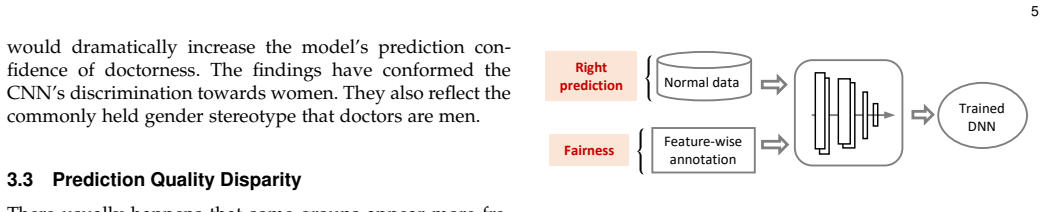
- [Section 4.1.2, Eq. (1)] The in-processing mitigation via attribution regularization depends on feature-wise annotations r, which the paper states could be 'identified through the detection methods in Sec. 3.1.' This creates a direct dependency on the same unvalidated interpretation tools identified in the first major comment. If those tools are unreliable, the regularization can reinforce spurious correlations or suppress task-relevant features, and the fairness benefit is not guaranteed. The paper should explicitly acknowledge this dependency and discuss how attribution error propagates to the fairness of the trained model.
minor comments (5)
- [Section 4.1.4] The word 'Firtly' should be 'Firstly.'
- [Section 4.1.4] 'COMP AS' should be written as 'COMPAS' without the space.
- [Section 4.2.2] 'debaised' should be 'debiased.'
- [Section 4.1.2] 'ground truthy' should be 'ground truth.'
- [Section 3.2] The description of CAV training says the vector is 'the direction orthogonal to the decision boundary'; more precisely, the CAV is the normal vector to the separating hyperplane, so the phrasing could be clarified.
Circularity Check
No circularity: the paper is a survey with no derivation whose conclusion reduces to its inputs; self-citations are background, not load-bearing.
full rationale
This is a review/survey paper, not a derivation. Its central claim is that interpretability can serve as an ingredient for diagnosing algorithmic discrimination, supported by cited examples (TCAV gender bias in a doctorness classifier, CAM face analysis, race bias in sentiment systems). There is no equation in which a predicted quantity is defined in terms of the same quantity, no fitted parameter whose output is then called a prediction, and no uniqueness theorem imported from self-citation. The only equations are the mitigation loss in Eq. (1), which uses a local interpretation function floc(x) as a regularizer, and the adversarial objective in Eq. (2); both are formulations of known mitigation approaches, not derived predictions. The empirical section 4.1.4 evaluates mitigation algorithms against fairness metrics on Adult and COMPAS; it does not validate or depend on the paper's central interpretability claim. Self-citations [18], [19], [20], and [44] appear in the context of defining interpretability categories and as examples of interpretation-based regularization; none of them is invoked to prove the central claim, and the key interpretability methods cited (e.g., TCAV [22], CAM [26]) are external prior work. The skeptical concern that attribution methods may be unfaithful is a legitimate correctness risk about an unvalidated premise, but it is not circularity: the paper does not define faithfulness in terms of the bias-detection results, nor does it derive those results from an assumption that presupposes them. Therefore the appropriate finding is no significant circularity, score 0.
Assumptions & free parameters
assumptions (2)
- domain assumption Interpretability methods provide faithful insight into the features and concepts a DNN actually uses for prediction.
- domain assumption Existing group fairness metrics, such as demographic parity, equality of opportunity, and predictive quality parity, are appropriate formal targets for evaluating deep learning fairness.
Cite this review
Pith. "Pith review of Fairness in Deep Learning: A Computational Perspective." pith.science (2026). https://pith.science/paper/FYQBEG4R
@misc{pith2026190808843,
  author       = {Pith},
  title        = {Pith review of: Fairness in Deep Learning: A Computational Perspective},
  year         = {2026},
  howpublished = {\url{https://pith.science/paper/FYQBEG4R}},
  note         = {Machine review of arXiv:1908.08843}
}
read the original abstract
Deep learning is increasingly being used in high-stake decision making applications that affect individual lives. However, deep learning models might exhibit algorithmic discrimination behaviors with respect to protected groups, potentially posing negative impacts on individuals and society. Therefore, fairness in deep learning has attracted tremendous attention recently. We provide a review covering recent progresses to tackle algorithmic fairness problems of deep learning from the computational perspective. Specifically, we show that interpretability can serve as a useful ingredient to diagnose the reasons that lead to algorithmic discrimination. We also discuss fairness mitigation approaches categorized according to three stages of deep learning life-cycle, aiming to push forward the area of fairness in deep learning and build genuinely fair and reliable deep learning systems.
Figures


Reference graph
Works this paper leans on
-
[1]
On formalizing fairness in pre- diction with machine learning,
P . Gajane and M. Pechenizkiy, “On formalizing fairness in pre- diction with machine learning,” Fairness, Accountability, and Trans- parency in Machine Learning (FAT/ML), 2018
work page 2018
-
[2]
T. Wang, J. Zhao, M. Yatskar, K.-W. Chang, and V . Ordonez, “Bal- anced datasets are not enough: Estimating and mitigating gender bias in deep image representations,” International Conference on Computer Vision(ICCV), 2019
work page 2019
-
[3]
Examining gender and race bias in two hundred sentiment analysis systems,
S. Kiritchenko and S. M. Mohammad, “Examining gender and race bias in two hundred sentiment analysis systems,”Proceedings of the 7th Joint Conference on Lexical and Computational Semantics , 2018
work page 2018
-
[4]
Gender shades: Intersectional accu- racy disparities in commercial gender classification,
J. Buolamwini and T. Gebru, “Gender shades: Intersectional accu- racy disparities in commercial gender classification,” in Conference on Fairness, Accountability and Transparency (FAT*), 2018, pp. 77–91
work page 2018
-
[5]
Annotation artifacts in natural lan- guage inference data,
S. Gururangan, S. Swayamdipta, O. Levy, R. Schwartz, S. R. Bowman, and N. A. Smith, “Annotation artifacts in natural lan- guage inference data,” North American Chapter of the Association for Computational Linguistics (NAACL), 2018
work page 2018
-
[6]
Man is to computer programmer as woman is to homemaker? debiasing word embeddings,
T. Bolukbasi, K.-W. Chang, J. Y. Zou, V . Saligrama, and A. T. Kalai, “Man is to computer programmer as woman is to homemaker? debiasing word embeddings,” in Thirtieth Conference on Neural Information Processing Systems (NIPS), 2016
work page 2016
-
[7]
Men also like shopping: Reducing gender bias amplification using corpus-level constraints,
J. Zhao, T. Wang, M. Yatskar, V . Ordonez, and K.-W. Chang, “Men also like shopping: Reducing gender bias amplification using corpus-level constraints,” 2017 Conference on Empirical Methods in Natural Language Processing (EMNLP), 2017
work page 2017
-
[8]
Assessing algorithmic fairness with unobserved protected class using data combination,
N. Kallus, X. Mao, and A. Zhou, “Assessing algorithmic fairness with unobserved protected class using data combination,” arXiv preprint arXiv:1906.00285, 2019. 9
arXiv 1906
Show all 50 references
-
[9]
Data decisions and theoretical implications when adversarially learning fair repre- sentations,
A. Beutel, J. Chen, Z. Zhao, and E. H. Chi, “Data decisions and theoretical implications when adversarially learning fair repre- sentations,” Fairness, Accountability, and Transparency in Machine Learning (FAT/ML), 2017
2017
-
[10]
Demographic dialectal variation in social media: A case study of african-american en- glish,
S. L. Blodgett, L. Green, and B. O’Connor, “Demographic dialectal variation in social media: A case study of african-american en- glish,” 2016 Conference on Empirical Methods in Natural Language Processing (EMNLP), 2016
2016
-
[11]
Incorporating dialectal variability for socially equitable language identification,
D. Jurgens, Y. Tsvetkov, and D. Jurafsky, “Incorporating dialectal variability for socially equitable language identification,” in The 55th Annual Meeting of the Association for Computational Linguistics (ACL), 2017
2017
-
[12]
Can ai help reduce disparities in general medical and mental health care?
I. Y. Chen, P . Szolovits, and M. Ghassemi, “Can ai help reduce disparities in general medical and mental health care?” AMA journal of ethics, 2019
2019
-
[13]
Auditing imagenet: Towards a model- driven framework for annotating demographic attributes of large- scale image datasets,
C. Dulhanty and A. Wong, “Auditing imagenet: Towards a model- driven framework for annotating demographic attributes of large- scale image datasets,” arXiv preprint arXiv:1905.01347, 2019
1905 arXiv
-
[14]
Fairness through awareness,
C. Dwork, M. Hardt, T. Pitassi, O. Reingold, and R. Zemel, “Fairness through awareness,” in Proceedings of the 3rd innovations in theoretical computer science conference, 2012
2012
-
[15]
Putting fairness principles into practice: Challenges, metrics, and improvements,
A. Beutel, J. Chen, T. Doshi, H. Qian, A. Woodruff, C. Luu, P . Kre- itmann, J. Bischof, and E. H. Chi, “Putting fairness principles into practice: Challenges, metrics, and improvements,” AAAI/ACM Conference on Artificial Intelligence, Ethics, and Society (AIES) , 2019
2019
-
[16]
Certifying and removing disparate im- pact,
M. Feldman, S. A. Friedler, J. Moeller, C. Scheidegger, and S. Venkatasubramanian, “Certifying and removing disparate im- pact,” in Proceedings of the 21th ACM SIGKDD International Confer- ence on Knowledge Discovery and Data Mining (KDD) . ACM, 2015
2015
-
[17]
Equality of opportunity in supervised learning,
M. Hardt, E. Price, N. Srebro et al. , “Equality of opportunity in supervised learning,” in Advances in neural information processing systems (NIPS), 2016
2016
-
[18]
Techniques for interpretable machine learning,
M. Du, N. Liu, and X. Hu, “Techniques for interpretable machine learning,” Communications of the ACM (CACM), 2020
2020
-
[19]
Towards explanation of dnn- based prediction with guided feature inversion,
M. Du, N. Liu, Q. Song, and X. Hu, “Towards explanation of dnn- based prediction with guided feature inversion,” ACM SIGKDD International Conference on Knowledge Discovery and Data Mining (KDD), 2018
2018
-
[20]
On attribution of recurrent neural network predictions via additive decomposition,
M. Du, N. Liu, F. Yang, and X. Hu, “On attribution of recurrent neural network predictions via additive decomposition,” The Web Conference (WWW), 2019
2019
-
[21]
Un- derstanding neural networks through deep visualization,
J. Yosinski, J. Clune, A. Nguyen, T. Fuchs, and H. Lipson, “Un- derstanding neural networks through deep visualization,” ICLR workshop, 2015
2015
-
[22]
Interpretability beyond feature attribution: Quantita- tive testing with concept activation vectors (tcav),
B. Kim, M. Wattenberg, J. Gilmer, C. Cai, J. Wexler, F. Viegas, and R. Sayres, “Interpretability beyond feature attribution: Quantita- tive testing with concept activation vectors (tcav),” International Conference on Machine Learning (ICML), 2018
2018
-
[23]
Certifai: A common framework to provide explanations and analyse the fairness and robustness of black-box models,
S. Sharma, J. Henderson, and J. Ghosh, “Certifai: A common framework to provide explanations and analyse the fairness and robustness of black-box models,” in Proceedings of the AAAI/ACM Conference on AI, Ethics, and Society (AIES) , 2020
2020
-
[24]
Interpretable basis decomposition for visual explanation,
B. Zhou, Y. Sun, D. Bau, and A. Torralba, “Interpretable basis decomposition for visual explanation,” in European Conference on Computer Vision (ECCV), 2018
2018
-
[25]
Net2vec: Quantifying and explaining how concepts are encoded by filters in deep neural networks,
R. Fong and A. Vedaldi, “Net2vec: Quantifying and explaining how concepts are encoded by filters in deep neural networks,” in Proceedings of the IEEE Conference on Computer Vision and Pattern Recognition (CVPR), 2018
2018
-
[26]
Learning deep features for discriminative localization,
B. Zhou, A. Khosla, A. Lapedriza, A. Oliva, and A. Torralba, “Learning deep features for discriminative localization,” in IEEE Conference on Computer Vision and Pattern Recognition (CVPR), 2016
2016
-
[27]
Deep learning for face recognition: Pride or prejudiced?
S. Nagpal, M. Singh, R. Singh, M. Vatsa, and N. Ratha, “Deep learning for face recognition: Pride or prejudiced?” arXiv preprint arXiv:1904.01219, 2019
1904 arXiv
-
[28]
Right for the right reasons: Training differentiable models by constraining their explanations,
A. S. Ross, M. C. Hughes, and F. Doshi-Velez, “Right for the right reasons: Training differentiable models by constraining their explanations,” Proceedings of the Twenty-Sixth International Joint Conference on Artificial Intelligence (IJCAI) , 2017
2017
-
[29]
Incorporating priors with feature attribution on text classification,
F. Liu and B. Avci, “Incorporating priors with feature attribution on text classification,” 57th Annual Meeting of the Association for Computational Linguistics (ACL), 2019
2019
-
[30]
A reductions approach to fair classification,
A. Agarwal, A. Beygelzimer, M. Dud ´ık, J. Langford, and H. Wal- lach, “A reductions approach to fair classification,” International Conference on Machine Learning (ICML), 2018
2018
-
[31]
Data preprocessing techniques for classification without discrimination,
F. Kamiran and T. Calders, “Data preprocessing techniques for classification without discrimination,” Knowledge and Information Systems (KAIS), 2012
2012
-
[32]
Fairness- aware classifier with prejudice remover regularizer,
T. Kamishima, S. Akaho, H. Asoh, and J. Sakuma, “Fairness- aware classifier with prejudice remover regularizer,” in Joint Eu- ropean Conference on Machine Learning and Knowledge Discovery in Databases. Springer, 2012
2012
-
[33]
Optimized pre-processing for discrimination preven- tion,
F. Calmon, D. Wei, B. Vinzamuri, K. N. Ramamurthy, and K. R. Varshney, “Optimized pre-processing for discrimination preven- tion,” in Advances in Neural Information Processing Systems (NIPS) , 2017, pp. 3992–4001
2017
-
[34]
Adversarial removal of demographic attributes from text data,
Y. Elazar and Y. Goldberg, “Adversarial removal of demographic attributes from text data,” 2018 Conference on Empirical Methods in Natural Language Processing (EMNLP), 2018
2018
-
[35]
Learning adver- sarially fair and transferable representations,
D. Madras, E. Creager, T. Pitassi, and R. Zemel, “Learning adver- sarially fair and transferable representations,” International Confer- ence on Machine Learning (ICML), 2018
2018
-
[36]
Discovering fair representations in the data domain,
N. Quadrianto, V . Sharmanska, and O. Thomas, “Discovering fair representations in the data domain,” in IEEE Conference on Computer Vision and Pattern Recognition (CVPR), 2019
2019
-
[37]
The variational fair autoencoder,
C. Louizos, K. Swersky, Y. Li, M. Welling, and R. Zemel, “The variational fair autoencoder,”arXiv preprint arXiv:1511.00830, 2015
2015 arXiv
-
[38]
Wasserstein fair classification,
R. Jiang, A. Pacchiano, T. Stepleton, H. Jiang, and S. Chiappa, “Wasserstein fair classification,” arXiv preprint arXiv:1907.12059 , 2019
1907 arXiv
-
[39]
Chalearn looking at people and faces of the world: Face analysis workshop and challenge 2016,
S. Escalera, M. Torres Torres, B. Martinez, X. Bar ´o, H. Jair Es- calante, I. Guyon, G. Tzimiropoulos, C. Corneou, M. Oliu, M. Ali Bagheri et al., “Chalearn looking at people and faces of the world: Face analysis workshop and challenge 2016,” in Proceedings of the IEEE Confer...
2016
-
[40]
Inclusivefacenet: Improving face attribute detection with race and gender diversity,
H. J. Ryu, H. Adam, and M. Mitchell, “Inclusivefacenet: Improving face attribute detection with race and gender diversity,” Fairness, Accountability, and Transparency in Machine Learning (FAT/ML) , 2018
2018
-
[41]
Age progression/regression by conditional adversarial autoencoder,
Z. Zhang, Y. Song, and H. Qi, “Age progression/regression by conditional adversarial autoencoder,” in Proceedings of the IEEE Conference on Computer Vision and Pattern Recognition (CVPR), 2017
2017
-
[42]
Mitigating bias in gender, age and ethnicity classification: a multi-task convolution neural network approach,
A. Das, A. Dantcheva, and F. Bremond, “Mitigating bias in gender, age and ethnicity classification: a multi-task convolution neural network approach,” in Proceedings of the European Conference on Computer Vision (ECCV), 2018
2018
-
[43]
Ai fairness 360: An extensible toolkit for detecting, understand- ing, and mitigating unwanted algorithmic bias,
R. K. Bellamy, K. Dey, M. Hind, S. C. Hoffman, S. Houde, K. Kannan, P . Lohia, J. Martino, S. Mehta, A. Mojsilovic et al. , “Ai fairness 360: An extensible toolkit for detecting, understand- ing, and mitigating unwanted algorithmic bias,” arXiv preprint arXiv:1810.01943, 2018
-
[44]
Learning credible deep neu- ral networks with rationale regularization,
M. Du, N. Liu, F. Yang, and X. Hu, “Learning credible deep neu- ral networks with rationale regularization,” in IEEE International Conference on Data Mining (ICDM), 2019
2019
-
[45]
Domain- adversarial training of neural networks,
Y. Ganin, E. Ustinova, H. Ajakan, P . Germain, H. Larochelle, F. Laviolette, M. Marchand, and V . Lempitsky, “Domain- adversarial training of neural networks,” The Journal of Machine Learning Research (JMLR), 2016
2016
-
[46]
Synthetic data augmentation using gan for im- proved liver lesion classification,
M. Frid-Adar, E. Klang, M. Amitai, J. Goldberger, and H. Greenspan, “Synthetic data augmentation using gan for im- proved liver lesion classification,” in IEEE international symposium on biomedical imaging (ISBI), 2018
2018
-
[47]
Compositional fairness constraints for graph embeddings,
A. J. Bose and W. Hamilton, “Compositional fairness constraints for graph embeddings,” International Conference on Machine Learn- ing (ICML), 2019
2019
-
[48]
Flexibly fair representation learning by disentanglement,
E. Creager, D. Madras, J.-H. Jacobsen, M. A. Weis, K. Swersky, T. Pitassi, and R. Zemel, “Flexibly fair representation learning by disentanglement,” International Conference on Machine Learning (ICML), 2019
2019
-
[49]
Bert: Pre- training of deep bidirectional transformers for language under- standing,
J. Devlin, M.-W. Chang, K. Lee, and K. Toutanova, “Bert: Pre- training of deep bidirectional transformers for language under- standing,” 2019 Annual Conference of the North American Chapter of the Association for Computational Linguistics (NAACL) , 2019
2019
-
[50]
Xlnet: Generalized autoregressive pretraining for language understanding,
Z. Yang, Z. Dai, Y. Yang, J. Carbonell, R. Salakhutdinov, and Q. V . Le, “Xlnet: Generalized autoregressive pretraining for language understanding,” Advances in Neural Information Processing Systems (NeurIPS), 2019
2019
Reviewed August 14, 2026 · model on record in the stance chip above.
Discussion (0). Continue with ORCID to comment.