REVIEW 3 major objections 5 minor 72 references
This paper shows that the optimal DP noise for histogram-based synthetic data is a floor-raised copy of the public distribution, and that using it as the noise source improves the privacy-utility trade-off.
Reviewed by Pith at T0; open to challenge. T0 means a machine referee read the full paper against a public rubric. the ladder, T0–T4 →
T0 review · deepseek-v4-flash
2026-08-01 16:19 UTC pith:FZTBS7FY
load-bearing objection A credible theory result—the asymptotically optimal domain-aware noise is a floor-raised public distribution—with a practical gap between the solved LP and the deployed approximation, plus hand-set gamma in two of the main experiments. the 3 major comments →
Optimal Domain-Aware Privacy Mechanisms for Synthetic Data Generation
The pith
A machine-rendered reading of the paper's core claim, the machinery that carries it, and where it could break.
Core claim
The paper establishes that inside the class of linear mixing mechanisms, the privacy constraint depends on the noise distribution only through its two smallest masses. Theorem 4.2 then reduces the worst-case utility optimization to a one-dimensional search over a floor level t, solving a linear program for the radius f(t); the optimal noise Pnse is a floor-raised version of the public distribution Pbar_pub, and the optimal mixing weight is beta*=beta_min(t*,t*). Without public data, the optimal noise is uniform, so the public ball B_{gamma,Ppub} is what redirects the perturbation toward realistic directions. This is the sense in which domain-aware DP noise outperforms domain-agnostic Gaussia
What carries the argument
The central mechanism is linear mixing, Psyn=(1-beta)Pbar_prv+beta Pnse, where Pnse is the noise distribution and beta the privacy weight. Because neighboring private histograms differ in at most two coordinates, the DP constraint tightens to a condition on the two smallest masses of Pnse, Nmin1 and Nmin2; beta_min(Nmin1,Nmin2) is the smallest mixing weight that satisfies (epsilon,delta)-DP. Floor-raising (raise bins below threshold t to t, take the excess from bins above t) is the operation that shapes Pnse: it raises Nmin1 to lower beta_min while staying near Pbar_pub to keep the worst-case TV radius small. The exact optimum is characterized by the LP in (12); PubMix uses two computable fl
Load-bearing premise
The load-bearing premise is that the actual private histogram lies inside the gamma-TV ball centered on the public histogram, with gamma chosen by hand in the experiments rather than validated; if that ball misses the private data, the utility gain over Gaussian noise is not covered by the theory.
What would settle it
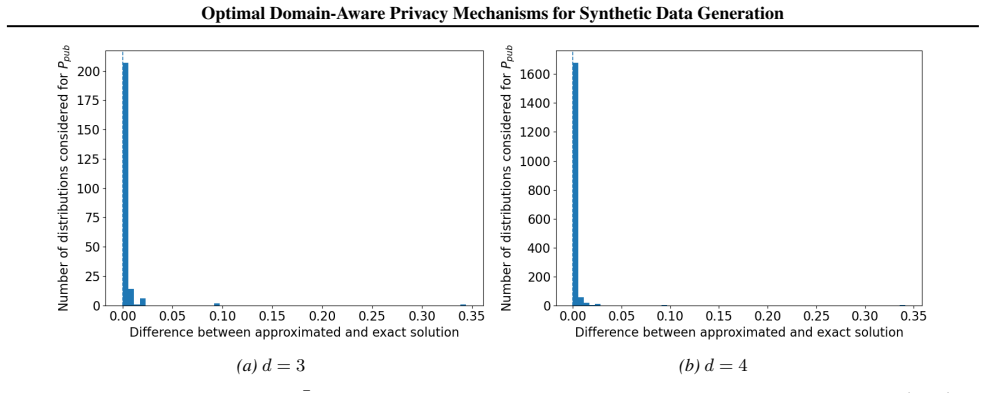
Two concrete checks: (1) brute-force solve the original min-max problem (3) for a finite alphabet (say d=4) and compare its value to min_{0<=t<=1/d} beta_min(t,t) f(t) from Theorem 4.2—a gap that does not vanish as d grows would refute the asymptotic optimality claim; (2) measure the empirical TV distance between the actual private histogram and the public histogram in a deployment where gamma was set by hand (0.9 and 0.1), and check whether the private histogram is inside B_{gamma,Ppub}.
If this is right
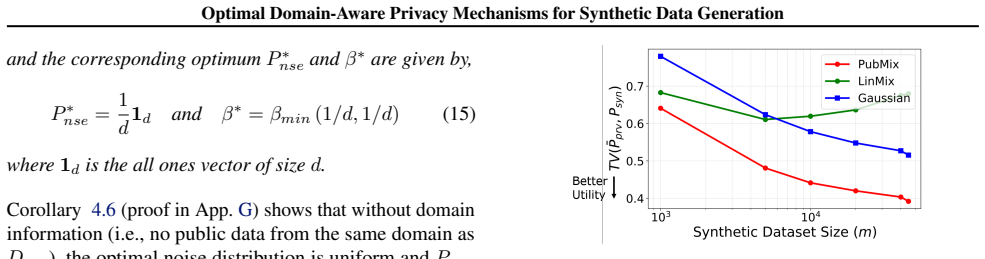
- At a fixed privacy budget, replacing domain-agnostic noise with PubMix improves the TV distance between private and synthetic distributions; in the reported experiments the gain is largest at the strictest privacy level (epsilon=1).
- Because beta_min depends only on the two smallest masses of Pnse, the design problem decouples: only the tail of the noise distribution controls the privacy cost, which is why floor-raising is the right operation.
- Without any public data, the framework recovers uniform mixing as optimal; public data is exactly what shrinks the worst-case region from the whole simplex to B_{gamma,Ppub}.
- The same floor-raised construction applies to general discrete estimators with bounded sensitivity s, with beta increased to compensate for losing the two-point sparsity of histograms.
- As the alphabet size d grows, the relaxed upper-bound problem converges to the original problem, so the LP solution is asymptotically optimal.
Where Pith is reading between the lines
- (Editorial inference) The same recipe could improve private prediction systems that already mix next-token distributions toward a public distribution: instead of fixing the public distribution as noise, optimize a floor-raised version of it, which should lower the required mixing weight.
- (Editorial inference) Gamma is the real pivot of the method: a principled calibration would set gamma from the empirical quantile of pairwise fold distances and then verify coverage on held-out data; the reported experiments set it by hand (0.9 and 0.1), so gamma's value should be treated as a hyperparameter until such a procedure exists.
- (Editorial inference) The asymptotic optimality in d suggests a finite-d refinement: explicitly optimizing Nmin1 and Nmin2, rather than replacing Nmin2 by Nmin1, would shrink the suboptimality gap that the practical floor-raising approximations are admitted to have.
Editorial analysis
A structured set of objections, weighed in public.
Referee Report
Summary. The paper proposes a public-data-aware differential privacy mechanism for histogram-based synthetic data generation. It models the synthetic distribution as a linear mix Psyn = (1-beta) Pbar_prv + beta Pnse and formulates a minimax problem over a gamma-TV ball around the public distribution Pbar_pub. The main theoretical results are: (i) Theorem 4.1 gives the minimum mixing weight beta_min for a fixed noise distribution, showing it depends only on the two smallest masses of Pnse; (ii) Theorem 4.2 characterizes an asymptotically optimal noise distribution as a floor-raised version of the public distribution, obtained by a linear program; (iii) without public data the optimal noise is uniform (Corollary 4.6). The practical mechanism PubMix uses a MIFR/water-filling approximation of the LP solution. Experiments on PUMS, Person Activity, and Yelp report improved downstream utility compared to domain-agnostic baselines when PubMix is used as a drop-in component in private-evolution pipelines.
Significance. If the main theorem is correct, the paper makes a useful conceptual contribution: it shows how public data can be incorporated directly into the noise-design step of DP mechanisms, not only in pre/post-processing. The reduction of the DP condition to a hockey-stick divergence over two changed coordinates is clean, and the proofs in Appendices C-E are detailed and plausible. The LP characterization in Theorem 4.2 is a concrete, falsifiable design rule. The empirical evaluation is also modular and compares against a strong recent baseline (TabPE, PE). However, the practical claims are conditional in two load-bearing ways: the deployed mechanism uses an admitted sub-optimal approximation (Remark 4.5), and the gamma-ball assumption is not validated in the main experiments. These gaps do not invalidate the theory, but they mean the paper's headline 'optimal domain-aware mechanism' and its utility improvements are not directly supported by the presented analysis.
major comments (3)
- [Remark 4.5, Algorithm 1, App. F] The mechanism evaluated in Section 5 is not the optimizer of Theorem 4.2. Remark 4.5 states that the MIFR/WF approximation is 'generally sub-optimal', and App. F provides only an upper bound on the objective, not a bound on the suboptimality gap relative to the LP optimum. Since Algorithm 1 instantiates this approximation, the experiments demonstrate utility of a mechanism whose performance relative to the central optimality theorem is unquantified. Moreover, the LP in (12) has 2^d subset constraints, so it is not obvious that the exact optimum is even computable for the d values used in the text experiments. Please either solve the LP (or provide a polynomial-time method) or quantify the gap between MIFR/WF and the LP optimum.
- [Sec. 5, Apps. I.1/I.2, Eq. (3), footnote 1] The utility guarantee in Theorem 4.2 is a minimax guarantee over the gamma-TV ball B_{gamma,Pbar_pub}. The paper's own footnote 1 concedes that if the true private distribution lies outside this ball, only a weaker, unquantified utility guarantee holds. In the Person Activity experiment gamma is simply set to 0.9 (App. I.1) and in the Yelp experiment to 0.1 (App. I.2). The pairwise-TV estimation procedure described in Sec. 5 is not used there, and no coverage or misestimation analysis is provided. Without validating that the actual private histograms lie in the chosen ball, the reported utility improvements are not backed by the theory. Please add a coverage analysis, a sensitivity analysis over gamma, or substantially qualify the practical claims.
- [Theorem 4.2 and Sec. 3.1 (Eq. (5))] The asymptotic optimality statement is made as d -> infinity with gamma constant, but the paper does not give finite-d bounds on the gap between the original problem in (3) and the upper-bound problem in (9). The continuity argument in App. D.1 is plausible, but the result is asymptotic; the experiments use finite, sometimes modest, d. A concrete finite-d bound or an experimental check of the gap would strengthen the claim that the floor-raised solution is the right design rule in practice.
minor comments (5)
- [Table 1 and Sec. 5.2.1] The text calls the method TABPE+PUBMIX, but Table 1 labels it PUBMIX. Clarify the name used in the table.
- [App. I.2] The text says 'We report accuracy for the category task and MAE for the star regression task,' but Tables 2 and 3 report 'Rating RMSE'. Align terminology.
- [Eq. (12)] The constraint is written as '1 T_d Pnse = 1'; use a cleaner notation such as sum_i Pnse[i] = 1. Also define Pnse(S) before using it in the LP.
- [References] Several references contain typos, e.g., 'availabe at:' in Ghalebikesabi et al., Frigerio et al., Pfitzner & Arnrich, and Dockhorn et al. Please correct.
- [Fig. 2] The axes and curves are informative, but the caption does not explain why beta_min is flat for small Nmin or the role of m. A short explanation would help.
Circularity Check
No significant circularity: Theorem 4.2 solves the stated minimax problem; the gamma-ball is an explicit assumption, not a disguised output.
full rationale
The central derivation chain is self-contained rather than circular. Theorem 4.1 computes the minimal mixing weight beta_min from the hockey-stick divergence of the m-fold product distributions, with the two-point sparsity of neighboring histograms used explicitly. Theorem 4.2 does not assume the floor-raised form; it derives it by rewriting the minimax objective, introducing t = min_i Pnse[i], and solving the LP in (12), whose constraints r + Pnse(S) >= min{Pbar_pub(S)+gamma, 1} come from Lemma E.1's exact characterization of the worst-case TV over B_{gamma,Pbar_pub}. The optimal floor-raised Pnse is therefore a consequence of the optimization, not an input. The admissible set B_{gamma,Pbar_pub} is an assumption about the domain (private distributions lie near the public distribution); the paper's footnote 1 explicitly concedes that outside this ball only a weaker, unquantified utility guarantee holds. That is a conditional guarantee and a validation concern, not circularity. The gamma values used in the experiments (0.9 and 0.1 in Apps. I.1/I.2) are hand-set hyperparameters; if they are misspecified, the theoretical utility guarantee may not apply, but this is a correctness/robustness issue, not an equation reducing a prediction to a fit. Remark 4.5 honestly states that the MIFR/WF approximation is generally sub-optimal, so no fitted quantity is being relabeled as optimal. No load-bearing self-citations appear: the only invoked external results (Gallager's floor-raising, Sason & Verdu's data-processing inequality for hockey-stick divergence) are standard and not from the authors' prior work. The empirical comparisons against external baselines (AIM, GSD, GEM, PrivSyn, TabPE, PE) are self-contained. Therefore the paper's main theoretical result is not equivalent to its inputs by construction.
Axiom & Free-Parameter Ledger
free parameters (2)
- proximity parameter gamma =
PUMS: average pairwise state TV; Person Activity: 0.9; Yelp: 0.1
- floor-raising thresholds t1/t2 (and LP threshold t*) =
optimized numerically; no closed form or exact values reported
axioms (5)
- domain assumption Neighboring private histograms differ in exactly two coordinates by +/-1/n
- domain assumption The actual private distribution lies in B_{gamma,Pbar_pub}
- domain assumption Dprv and Dpub are i.i.d. samples from the same domain
- standard math Hockey-stick divergence satisfies the data processing inequality
- standard math beta_min is continuous and non-increasing in Nmin1, Nmin2
read the original abstract
Differential privacy (DP) imposes fundamental trade-offs between privacy and statistical fidelity in synthetic data generation. While access to public data has been shown to improve these trade-offs empirically, existing approaches use public data only indirectly, through pre-processing (e.g., using pre-trained generative models) or post-processing steps (e.g., matching target statistics estimated from public datasets), while relying on domain-agnostic DP mechanisms. In this work, we lay the theoretical framework to study the principled incorporation of public data into DP mechanisms themselves. We consider normalized histograms as distribution estimators and characterize the asymptotically optimal domain-aware privacy mechanism within a specific class of DP mechanisms. We introduce PubMix, a public-data-aware DP mechanism that can be used in histogram-based data synthesis pipelines. Our experiments demonstrate that PubMix significantly improves synthetic data generation quality compared to domain-agnostic privacy mechanisms.
Figures




Reference graph
Works this paper leans on
-
[1]
IEEE Transactions on Information Theory , volume=
f -divergence Inequalities , author=. IEEE Transactions on Information Theory , volume=. 2016 , publisher=
2016
-
[2]
N. Ponomareva and Z. Xu and H. B. McMahan and P. Kairouz and L. Rosenblatt and V. Cohen-Addad and C. Guzmán and R. McKenna and G. Andrew and A. Bie and D. Yu and A. Kurakin and M. Zadimoghaddam and S. Vassilvitskii and A. Terzis , title=. arXiv preprint arXiv:2512.03238 , year=
-
[3]
Proceedings of The 27th International Conference on Artificial Intelligence and Statistics , pages =
Joint Selection: Adaptively Incorporating Public Information for Private Synthetic Data , author =. Proceedings of The 27th International Conference on Artificial Intelligence and Statistics , pages =. 2024 , volume =
2024
-
[4]
Alexey Kurakin and Natalia Ponomareva and Umar Syed and Liam MacDermed and Andreas Terzis , title=. arXiv:2306.01684 , year=
-
[5]
Frigerio and A
L. Frigerio and A. Oliveira and L. Gomez and P. Duverger , title=. ICT Systems Security and Privacy Protection , year=
-
[6]
Xie and K
L. Xie and K. Lin and S. Wang and F. Wang and J. Zhou , title=. , journal =
-
[7]
Abacha and S.G
F.Z. Abacha and S.G. Teo and L.C. Cordeiro and M.A. Mustafa , title=. Federated Learning in the Age of Foundation Models - FL 2024 International Workshops , year=
2024
-
[8]
36th International Conference on Algorithmic Learning Theory , year=
Differentially Private Multi-Sampling from Distributions , author=. 36th International Conference on Algorithmic Learning Theory , year=
-
[9]
Differentially Private Next-Token Prediction of Large Language Models
Flemings, James and Razaviyayn, Meisam and Annavaram, Murali. Differentially Private Next-Token Prediction of Large Language Models. Proceedings of the 2024 Conference of the North American Chapter of the Association for Computational Linguistics: Human Language Technologies (Volume 1: Long Papers). 2024
2024
-
[10]
Ginart and Laurens van der Maaten and James Zou and Chuan Guo , title=
Antonio A. Ginart and Laurens van der Maaten and James Zou and Chuan Guo , title=. availabe at: arXiv:2201.00971 , year=
-
[11]
Differentially Private Synthetic Data via
Toan Tran and Arturs Backurs and Zinan Lin and Victor Reis and Li Xiong and Sergey Yekhanin , year=. Differentially Private Synthetic Data via
-
[12]
Forty-second International Conference on Machine Learning , year=
Private Federated Learning using Preference-Optimized Synthetic Data , author=. Forty-second International Conference on Machine Learning , year=
-
[13]
B. Pfitzner and B. Arnrich , title=. availabe at: arXiv:2211.11591 , year=
-
[14]
Smith and Olivia Wiles and Borja Balle , title=
Sahra Ghalebikesabi and Leonard Berrada and Sven Gowal and Ira Ktena and Robert Stanforth and Jamie Hayes and Soham De and Samuel L. Smith and Olivia Wiles and Borja Balle , title=. availabe at: arXiv:2302.13861 , year=
-
[15]
Seemanand A
J. Seemanand A. Slavkovic and M. Reimherr , title=. Privacy in Statistical Databases , year=
-
[16]
Jiang and G
D. Jiang and G. Zhang and M. Karami and X. Chen and Y. Shao and Y. Yu , title=. , journal =
-
[17]
, journal =
Yuchao Tao and Ryan McKenna and Michael Hay and Ashwin Machanavajjhala and Gerome Miklau , title=. , journal =
-
[18]
Proceedings of the 38th International Conference on Machine Learning , pages =
Leveraging Public Data for Practical Private Query Release , author =. Proceedings of the 38th International Conference on Machine Learning , pages =
-
[19]
Cai, Kuntai and Lei, Xiaoyu and Wei, Jianxin and Xiao, Xiaokui , title =. Proc. VLDB Endow. , pages =. 2021 , issue_date =
2021
-
[20]
Hay, Michael and Rastogi, Vibhor and Miklau, Gerome and Suciu, Dan , title =. Proc. VLDB Endow. , pages =. 2010 , issue_date =
2010
-
[21]
2018 , booktitle =
Cormode, Graham and Kulkarni, Tejas and Srivastava, Divesh , title =. 2018 , booktitle =
2018
-
[22]
2017 , booktitle =
Wang, Tianhao and Blocki, Jeremiah and Li, Ninghui and Jha, Somesh , title =. 2017 , booktitle =
2017
-
[23]
2024 , howpublished =
2024
-
[24]
2025 , url=
Jianqing Zhang and Yang Liu and JIE FU and Yang Hua and Tianyuan Zou and Jian Cao and Qiang Yang , booktitle=. 2025 , url=
2025
-
[25]
Differentially Private Synthetic Data with Private Density Estimation , year=
Bojkovic, Nikolija and Loh, Po-Ling , booktitle=. Differentially Private Synthetic Data with Private Density Estimation , year=
-
[26]
2021 , booktitle =
Raskhodnikova, Sofya and Sivakumar, Satchit and Smith, Adam and Swanberg, Marika , title =. 2021 , booktitle =
2021
-
[27]
Transactions on Machine Learning Research , issn=
Differentially Private Diffusion Models , author=. Transactions on Machine Learning Research , issn=. 2023 , note=
2023
-
[28]
Proceedings of The 36th International Conference on Algorithmic Learning Theory , pages =
Differentially Private Multi-Sampling from Distributions , author =. Proceedings of The 36th International Conference on Algorithmic Learning Theory , pages =. 2025 , editor =
2025
-
[29]
Evaluating Differentially Private Synthetic Data Generation in High-Stakes Domains
Ramesh, Krithika and Gandhi, Nupoor and Madaan, Pulkit and Bauer, Lisa and Peris, Charith and Field, Anjalie. Evaluating Differentially Private Synthetic Data Generation in High-Stakes Domains. Findings of the Association for Computational Linguistics: EMNLP 2024. 2024
2024
-
[30]
2021 , journal=
Ryan McKenna and Gerome Miklau and Daniel Sheldon , title=. 2021 , journal=
2021
-
[31]
The Twelfth International Conference on Learning Representations , year=
Privacy-Preserving In-Context Learning with Differentially Private Few-Shot Generation , author=. The Twelfth International Conference on Learning Representations , year=
-
[32]
Park and Y
J. Park and Y. Choi and J. Lee , title=. IEEE/CVF Conference on Computer Vision and Pattern Recognition (CVPR) , year=
-
[33]
Yue and H
X. Yue and H. Inan and X. Li and G. Kumar and J. McAnallen and H. Sun and D. Levitan and R. Sim , title =. ACL 2023 , year =
2023
-
[34]
Dwork, Cynthia and Roth, Aaron , title =. Found. Trends Theor. Comput. Sci. , pages =. 2014 , volume =
2014
-
[35]
Theory of Cryptography , year=
Dwork, Cynthia and McSherry, Frank and Nissim, Kobbi and Smith, Adam , title=. Theory of Cryptography , year=
-
[36]
A Simple and Practical Algorithm for Differentially Private Data Release , year =
Hardt, Moritz and Ligett, Katrina and Mcsherry, Frank , booktitle =. A Simple and Practical Algorithm for Differentially Private Data Release , year =
-
[37]
and Srivastava, Divesh and Xiao, Xiaokui , title =
Zhang, Jun and Cormode, Graham and Procopiuc, Cecilia M. and Srivastava, Divesh and Xiao, Xiaokui , title =. 2017 , volume =
2017
-
[38]
Qardaji, Wahbeh and Yang, Weining and Li, Ninghui , title =. Proc. VLDB Endow. , pages =. 2013 , volume =
2013
-
[39]
, title =
Gallager, Robert G. , title =. 1968 , isbn =
1968
-
[40]
2023 , booktitle =
Wang, Hao and Sudalairaj, Shivchander and Henning, John and Greenewald, Kristjan and Srivastava, Akash , title =. 2023 , booktitle =
2023
-
[41]
Differentially Private Language Models for Secure Data Sharing
Mattern, Justus and Jin, Zhijing and Weggenmann, Benjamin and Schoelkopf, Bernhard and Sachan, Mrinmaya. Differentially Private Language Models for Secure Data Sharing. Proceedings of the 2022 Conference on Empirical Methods in Natural Language Processing. 2022
2022
-
[42]
Brendan and Mironov, Ilya and Talwar, Kunal and Zhang, Li , title =
Abadi, Martin and Chu, Andy and Goodfellow, Ian and McMahan, H. Brendan and Mironov, Ilya and Talwar, Kunal and Zhang, Li , title =. 2016 , pages =
2016
-
[43]
Nicolas Papernot and Shuang Song and Ilya Mironov and Ananth Raghunathan and Kunal Talwar and Úlfar Erlingsson , title=. arXiv:1802.08908 , year=
-
[44]
Long, Yunhui and Wang, Boxin and Yang, Zhuolin and Kailkhura, Bhavya and Zhang, Aston and Gunter, Carl and Li, Bo , booktitle =
-
[45]
Xie and Z
C. Xie and Z. Lin and A. Backurs and S. Gopi and D. Yu and H. Inan and H. Nori and H. Jiang and H. Zhang and Y. T. Lee and B. Li and S. Yekhanin , booktitle=. Differentially Private Synthetic Data via Foundation Model
-
[46]
Lin and S
Z. Lin and S. Gopi and J. Kulkarni and H. Nori and S. Yekhanin , booktitle=. DIFFERENTIALLY PRIVATE SYNTHETIC DATA VIA FOUNDATION MODEL
-
[47]
Hou and A
C. Hou and A. Shrivastava and H. Zhan, R. Conway and T. Le and A. Sagar and G. Fanti and D. Lazar , booktitle=. PrE-Text: Training Language Models on Private Federated Data in the Age of LLMs , year=
-
[48]
Hou and M.Y
C. Hou and M.Y. Wang and Y. Zhu and D. Lazar and G. Fanti , booktitle=. POPri: Private Federated Learning using Preference-Optimized Synthetic Data , year=
-
[49]
30th USENIX Security Symposium (USENIX Security 21) , year =
Zhikun Zhang and Tianhao Wang and Ninghui Li and Jean Honorio and Michael Backes and Shibo He and Jiming Chen and Yang Zhang , title =. 30th USENIX Security Symposium (USENIX Security 21) , year =
-
[50]
Graphical-model based estimation and inference for differential privacy , year=
Ryan McKenna and Daniel Sheldon and Gerome Miklau , booktitle=. Graphical-model based estimation and inference for differential privacy , year=
-
[51]
Boedihardjo and T
M. Boedihardjo and T. Strohmer and R. Vershynin , journal=. Privacy of Synthetic Data: A Statistical Framework , year=
-
[52]
Bojkovic and P
N. Bojkovic and P. Loh , booktitle=. Differentially Private Synthetic Data with Private Density Estimation , year=
-
[53]
availabe at: arXiv preprint arXiv:2106.12118 , year=
Ryan McKenna and Gerome Miklau and Michael Hay and Ashwin Machanavajjhala , title=. availabe at: arXiv preprint arXiv:2106.12118 , year=
-
[54]
, journal =
Mengmeng Yang and Chi-Hung Chi and Kwok-Yan Lam and Jie Feng and Taolin Guo and Wei Ni , title=. , journal =
-
[55]
2022 , booktitle =
Ye, Jiayuan and Maddi, Aadyaa and Murakonda, Sasi Kumar and Bindschaedler, Vincent and Shokri, Reza , title =. 2022 , booktitle =
2022
-
[56]
, journal =
Alexey Kurakin and Natalia Ponomareva, Umar Syed and Liam MacDermed and Andreas Terzis , title=. , journal =
-
[57]
Wang and S
H. Wang and S. Sudalairaj and J. Henning and K. Greenewald and A. Srivastava , booktitle=. Post-processing Private Synthetic Data for Improving Utility on Selected Measures , year=
-
[58]
Generating Synthetic Datasets by Interpolating along Generalized Geodesics , year=
Jiaojiao Fan and David Alvarez-Melis , booktitle=. Generating Synthetic Datasets by Interpolating along Generalized Geodesics , year=
-
[59]
2024 , series =
Donhauser, Konstantin and Abad, Javier and Hulkund, Neha and Yang, Fanny , title =. 2024 , series =
2024
-
[60]
Private prediction for large-scale synthetic text generation
Amin, Kareem and Bie, Alex and Kong, Weiwei and Kurakin, Alexey and Ponomareva, Natalia and Syed, Umar and Terzis, Andreas and Vassilvitskii, Sergei. Private prediction for large-scale synthetic text generation. Findings of the Association for Computational Linguistics: EMNLP 2024. 2024
2024
-
[61]
, howpublished =
US Census Bureau , title =. , howpublished =
-
[62]
John M. Abowd and Robert Ashmead and Ryan Cumings-Menon and Simson Garfinkel and Micah Heineck and Christine Heiss and Robert Johns and Daniel Kifer and Philip Leclerc and Ashwin Machanavajjhala and Brett Moran and William Sexton and Matthew Spence and Pavel Zhuravlev , title =. , howpublished =
-
[63]
CoRR , volume =
Yinhan Liu and Myle Ott and Naman Goyal and Jingfei Du and Mandar Joshi and Danqi Chen and Omer Levy and Mike Lewis and Luke Zettlemoyer and Veselin Stoyanov , title =. CoRR , volume =. 2019 , url =
2019
-
[64]
Sentence- BERT : Sentence Embeddings using Siamese BERT -Networks
Reimers, Nils and Gurevych, Iryna. Sentence- BERT : Sentence Embeddings using Siamese BERT -Networks. Proceedings of the 2019 Conference on Empirical Methods in Natural Language Processing. 2019
2019
-
[65]
Touvron, Hugo and Martin, Louis and Stone, Kevin and Albert, Peter and Almahairi, Amjad and Babaei, Yasmine and Bashlykov, Nikolay and Batra, Soumya and Bhargava, Prajjwal and Bhosale, Shruti and others , journal=
-
[66]
Yelp Open Dataset , year =
-
[67]
UCT opic: Unsupervised Contrastive Learning for Phrase Representations and Topic Mining
Li, Jiacheng and Shang, Jingbo and McAuley, Julian. UCT opic: Unsupervised Contrastive Learning for Phrase Representations and Topic Mining. Proceedings of the 60th Annual Meeting of the Association for Computational Linguistics (Volume 1: Long Papers). 2022
2022
-
[68]
Proceedings of the 46th International ACM SIGIR Conference on Research and Development in Information Retrieval , pages=
Personalized showcases: Generating multi-modal explanations for recommendations , author=. Proceedings of the 46th International ACM SIGIR Conference on Research and Development in Information Retrieval , pages=
-
[69]
McKenna, Ryan and Mullins, Brett and Sheldon, Daniel and Miklau, Gerome , title =. Proc. VLDB Endow. , month = jul, pages =. 2022 , volume =
2022
-
[70]
International Conference on Machine Learning , pages=
Generating private synthetic data with genetic algorithms , author=. International Conference on Machine Learning , pages=. 2023 , organization=
2023
-
[71]
Advances in Neural Information Processing Systems , volume=
Iterative methods for private synthetic data: Unifying framework and new methods , author=. Advances in Neural Information Processing Systems , volume=
-
[72]
and Lustrek, M
Vidulin, V. and Lustrek, M. and Kaluza, B. and Pitlaver, R. and Krivec, J. , title =. 2010 , howpublished =
2010
discussion (0)
Sign in with ORCID, Apple, or X to comment. Anyone can read and Pith papers without signing in.