REVIEW 4 major objections 5 minor 2 cited by
Robotouille: An Asynchronous Planning Benchmark for LLM Agents
T0 review · 4 major / 5 minor · reviewed 2026-08-09 · deepseek-v4-flash
Pith's one-line read Robotouille, a cooking-planning benchmark with time delays, drops the best LLM agent's success from 47% to 11%.
desk verdict A genuinely useful open-source benchmark for asynchronous LLM planning, but the headline 47% vs 11% gap is confounded and underpowered as a standalone finding. read the letter →
The pith
A machine-rendered reading of the paper's core claim, the machinery that carries it, and where it could break.
The reading
What carries the argument
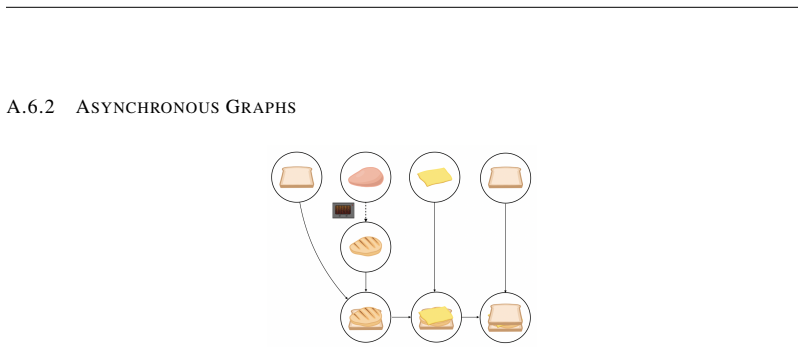
The load-bearing object is an MDP with time-delayed effects: a formal decision process whose state carries a set of timer variables, and where an action such as cook starts a countdown that adds the cooked predicate only when the timer expires. The environment is generated from domain and problem JSONs inspired by PDDL, with a special-effects mechanism that lets actions have delayed consequences, plus a flexible goal specification that accepts any state satisfying a vague language goal. The synchronous and asynchronous datasets share the same recipe style but differ in whether cooking ingredients start cooked and whether cooking takes time, so the datasets isolate the effect of time delays. The best evaluated agent is an ablated ReAct that receives only the previous reasoning-and-action step in context, which the paper found to be the cheapest variant with the same performance as the full-history version.
What would settle it
Run gpt4-o with ReAct on all 10 asynchronous tasks twice: once with the original time delays and once with every delay set to zero while keeping objects, goals, and the procedural instances identical. If the zero-delay versions do not clearly outperform the delayed ones, then the paper's central claim that asynchrony is the bottleneck is not supported.
Extended reading notes
Core claim
The paper's central claim is that Robotouille validly measures asynchronous planning and that current LLM agents are not yet capable of it. Concretely, it reports that closed-loop gpt4-o with ReAct, the strongest of the three baselines it tries, reaches 47% success on the synchronous dataset and 11% on the asynchronous dataset, and that most asynchronous failures make little progress toward the goal: about 58.6% end in the 0.5 to 1.0 bin of normalized steps remaining. The failure-mode analysis attributes the async drop mainly to transition-function errors, especially violating the 'one item at a station' rule, followed by goal misinterpretation, and shows that prioritizing asynchronous subtasks raises success from 6% to 16% in the affected tasks. The paper also reports that strengthening rules in the prompt lowers rule violations but does not raise overall success, and that an ablated ReAct that keeps only the previous reasoning and action is the most cost-effective variant.
Load-bearing premise
The load-bearing premise is that the performance gap between the synchronous and asynchronous datasets is caused by time delays themselves, not by the asynchronous tasks being longer, having more objects, or adding extra rules; the paper's controlled check covers only the first 3 tasks and reports no significance test.
Editorial extensions
If this is right
- If Robotouille's measurement is right, then the gap between 47% and 11% defines the current ceiling for closed-loop LLM planners on time-delayed tasks, and any method that closes it needs improvement on rule-following and failure recovery, not just more planning tokens.
- The finding that asynchronous failures make little progress implies that better timely feedback, not better initial planning, is the main lever for async tasks.
- Since ReAct + Prior reduced 'one item at a station' violations by half without raising total success, the paper implies that rule priors alone are insufficient; state feedback and self-verification are the next targets.
- The small gain from Reflexion, from 11% to 17%, at the cost of retrying runs suggests that trial-and-error recovery helps on asynchronous tasks but is too expensive to scale.
- The multi-agent dataset is provided but not evaluated, so the benchmark's claim about multi-agent asynchronous planning remains an unmeasured extension.
Reading between the lines
- Editorial inference: The 11%-versus-47% gap could shrink if the comparison controlled for horizon and object count across all 10 tasks; the paper's own controlled comparison covers only the first 3 asynchronous tasks with delays set to zero, so a full 10-task matched comparison is the natural next experiment.
- Editorial inference: The repeated-transition analysis suggests LLM agents act nearly open-loop after a mistake, which connects asynchronous planning failures to a broader limitation in using execution feedback; a testable extension is to give the agent a summarized 'state fact sheet' instead of raw observations and see whether recovery improves.
- Editorial inference: Because the environment JSON supports arbitrary predicates and delays, the benchmark could be extended beyond cooking to domains like laboratory workflows or warehouse order fulfillment without changing the MDP formalism.
- Editorial inference: The lack of statistical significance tests on task-level comparisons means the 11% figure should be read as a point estimate; re-running with more seeds would tell how stable the gap is.
Signed reviews
Editorial analysis
A structured set of objections, weighed in public.
Referee Report
Summary. The paper introduces Robotouille, a cooking-simulator benchmark for evaluating LLM agents on asynchronous planning in an interactive closed-loop setting. The environment is formalized as an MDP with delayed effects, with JSON-based domain/problem definitions, procedural generation, and multi-agent support. The authors curate synchronous, asynchronous, and multi-agent datasets (10 tasks x 10 instances each), evaluate open-loop (I/O, I/O CoT) and closed-loop (ReAct) baselines on GPT-4o, GPT-4o-mini, Gemini-1.5-flash, and Claude-3-haiku, and report that the best agent, GPT-4o ReAct, succeeds on 47% of synchronous tasks and 11% of asynchronous tasks. They then analyze failure modes via a taxonomy of state/action/transition/goal uncertainties, examine subtask prioritization and rule-prior prompting, and discuss feedback incorporation and self-verification as future directions.
Significance. Robotouille addresses a real gap: most LLM-agent benchmarks lack time delays and asynchronous subtask interleaving, while existing temporal-planning benchmarks do not offer an interactive closed-loop environment. If the reported findings are robust, the benchmark would be a useful community resource, and the 47%-vs-11% gap would be a striking demonstration that current LLM agents handle delayed effects poorly. The paper's strengths include public code, a flexible JSON backend, language-level goal specifications that admit multiple satisfying states, and an explicit failure-mode taxonomy with qualitative examples. However, the central empirical claim is currently not fully supported because the synchronous and asynchronous task sets differ along multiple axes beyond time delays, and the statistical evidence for the performance gap is thin (point estimates without confidence intervals, small-n ablations without significance tests). The benchmark itself is valuable and the issues are addressable, but the paper needs additional controlled experiments and proper uncertainty quantification before the headline conclusions can be taken at face value.
major comments (4)
- [Section 3, Table 2, Appendix A.16] The headline result that asynchronous planning is the bottleneck (47% vs 11%, Section 4.2.2) compares two disjoint task sets that differ in more than time delays. As Section 3 states, synchronous tasks initialize cooked ingredients and use only cutting-board stations, whereas asynchronous tasks include uncooked ingredients, additional stations (stove, fryer, sink), longer horizons (up to 82 steps vs 57), and entirely new recipes (soup, fries). The only attempt to isolate the delay variable, Appendix A.16, converts just the first three asynchronous tasks to zero-delay variants, with n=10 per task, no confidence intervals or significance test, and observed differences (50/60/50 vs 20/30/40) that are easily within plausible sampling noise at temperature 0.7. Furthermore, the paper's own failure analysis (Finding 4, Section 4.2.3) attributes the majority of asynchronous failures to violations of the 'one item at a station' rule, which scales with the number of stations rather than with temporal overlap. To support the central claim, the authors should either (i) compare matched synchronous and asynchronous versions of the same tasks across all 10 tasks (varying only delays), or (ii) explicitly control for horizon, object count, and rule complexity in the analysis, and report significance tests or bootstrap intervals for the gap.
- [Section 4.2, Table 2, Finding 6] The main success rates are point estimates from 100 procedurally generated instances per dataset, sampled with temperature 0.7 (Section 4.1), yet no confidence intervals or significance tests are reported for the primary comparisons. This matters for the paper's strongest quantitative claims: the 47% vs 11% gap, the optimality-rate comparison (55.3% vs 9.1%, Section 4.2.2, Fig. 3), and the prioritization finding (16% vs 6%, Finding 6, Section 4.2.4). The task-level results in Table 3 also appear noisy (e.g., synchronous Task 5 at 60% vs Task 4 at 40%), and the paper itself notes in Appendix A.8 that Tasks 2 and 3 of the asynchronous set are 'within standard error,' which indicates the authors already compute some variance estimates. I recommend reporting bootstrap confidence intervals or per-task variance for all headline numbers, and adding a significance test (e.g., permutation test) for Finding 6 and for the Appendix A.16 comparisons, whose current n=10 per condition cannot support a claim of difference.
- [Section 4.1, Appendix A.7] The ReAct variant used for all main results ('last-reasoning-action-mpc') was selected after an ablation on a 'small subset of data' (Appendix A.7, Table 4) with 9 problems. It is not stated whether this subset is disjoint from the 10-task evaluation sets, or whether the selection was based on the same instances that later appear in Table 2/Table 3. If the ablation subset overlaps with the test tasks, the reported performance is optimistically biased, and this would affect every result in the paper, including the headline 47%/11% numbers and the failure-mode analysis. Additionally, the variant was chosen on accuracy alone, and its 3/9 score ties with 'last-obs-reasoning-action-mpc' (also 3/9) while differing in cost; the choice therefore looks fragile. Please clarify the train/test split used for the ablation, and if the subset is not held out, re-run the main evaluations with a variant chosen on a separate development set (or argue that the selection criterion is not performance-based).
- [Section 4.2.2] The success metric depends on the 'optimal number of steps' for each instance, but the paper never states how the optimal plan length is obtained (e.g., BFS over the MDP, Dijkstra, or an external planner). Since the MDP in Section 2 has timers and a state space that grows with the number of active timers, the optimal computation is nontrivial, and an incorrect or under-specified optimal-length computation directly changes both the success labels and the optimality-rate histograms in Figs. 3 and 4. Please add a precise description (algorithm, search strategy, and any pruning) or make the script that computes optimal lengths available and referenced in the main text.
minor comments (5)
- [Section 3] The sentence 'Tasks 1 to 3 use the same ingredients as those in the synchronous setting except for an added ingredient which must be cooked or fried' is confusing because the synchronous tasks are described as having cooked ingredients initialized; please clarify that the async versions additionally require cooking/frying and that the base ingredients are the same.
- [Appendix A.9] The complexity expressions O(|S| + |A|) and O(|S| x (d+1)^n + |A|) are stated without defining |S|, |A|, d, and n in that appendix, and the second formula double-counts the |A| term; please give a precise definition of the state space and derive the expressions or hedge them as intuitions.
- [Section 4.2.3, Fig. 5, Appendix A.10] The failure-mode taxonomy is based on manual annotation, but no inter-annotator agreement (e.g., Cohen's kappa) is reported, and the tie-breaking rule in A.10 ('If the agent violates a rule and is unable to recover, we classify it as a transition function failure') may systematically inflate the transition-failure category; please report annotation reliability or at least discuss the sensitivity of the findings to tie-breaking choices.
- [Section 4.2.4, Finding 6] The 'success rate conditioned on prioritization' is an observational correlation, not a causal effect, because prioritization and success may both be driven by task difficulty; please make this limitation explicit or use a controlled intervention (e.g., reordering subtask priorities in the prompt).
- [Table 3] Table 3 appears to report percentages per task, but since each task has only 10 instances, the resolution is 10 percentage points; please state explicitly that these are percentages of 10 runs per task, and consider adding standard errors or exact counts.
Circularity Check
No significant circularity: the paper reports empirical benchmark measurements with no fitted-parameter-as-prediction, self-citation chain, or by-construction reduction.
full rationale
Robotouille is an empirical benchmark paper, and its central claims are measured LLM success rates on synchronously and asynchronously designed task sets rather than quantities derived from the benchmark's own definitions. The headline 47% versus 11% result is not forced by construction: the two datasets differ in task content, but the success rates are outputs of simulator execution and vary across models and baselines, so the comparison carries independent empirical content. The only controlled attempt to isolate time delays, Appendix A.16, converts three asynchronous tasks to zero-delay variants and reports numerical differences (50/60/50 synchronous versus 20/30/40 asynchronous); although the comparison is small and lacks significance testing, that is a validity or statistical-power concern, not circularity. The ReAct variant 'last-reasoning-action-mpc' was selected on a small ablation subset (Appendix A.7), but the reported results are evaluations on separate held-out tasks and are not computed from the ablation numbers, so this is a baseline-selection choice rather than a fitted input renamed as a prediction. The complexity formula in Appendix A.9 is an analytic statement about the formal MDP's state-space growth and is not presented as an empirical finding, nor does it imply the measured success rates. No load-bearing argument reduces to a self-citation, uniqueness theorem, or ansatz smuggled in via citation. Concerns about confounds such as longer horizons, additional stations, and extra recipes are threats to the interpretation of the synchronous-versus-asynchronous gap, but they do not make the derivation circular. Accordingly, the paper is self-contained as an empirical benchmark study and receives a circularity score of 0.
Assumptions & free parameters
free parameters (4)
- success_threshold =
1.5x optimal steps
- llm_sampling_temperature =
0.7
- time_delay_constants =
per-task (e.g., cook/fry/boil times in problem JSON)
- num_instances_per_task =
10
assumptions (3)
- domain assumption Robotouille's transition function correctly implements time-delayed effects as described in Section 2.
- domain assumption Procedurally generated instances are solvable and the optimal plan lengths used for success thresholds are accurate.
- domain assumption The manual failure-mode annotation (Appendix A.10) reliably categorizes agent errors without subjective bias.
Cite this review
Pith. "Pith review of Robotouille: An Asynchronous Planning Benchmark for LLM Agents." pith.science (2026). https://pith.science/paper/G32DUFLF
@misc{pith2026250205227,
  author       = {Pith},
  title        = {Pith review of: Robotouille: An Asynchronous Planning Benchmark for LLM Agents},
  year         = {2026},
  howpublished = {\url{https://pith.science/paper/G32DUFLF}},
  note         = {Machine review of arXiv:2502.05227}
}
read the original abstract
Effective asynchronous planning, or the ability to efficiently reason and plan over states and actions that must happen in parallel or sequentially, is essential for agents that must account for time delays, reason over diverse long-horizon tasks, and collaborate with other agents. While large language model (LLM) agents show promise in high-level task planning, current benchmarks focus primarily on short-horizon tasks and do not evaluate such asynchronous planning capabilities. We introduce Robotouille, a challenging benchmark environment designed to test LLM agents' ability to handle long-horizon asynchronous scenarios. Our synchronous and asynchronous datasets capture increasingly complex planning challenges that go beyond existing benchmarks, requiring agents to manage overlapping tasks and interruptions. Our results show that ReAct (gpt4-o) achieves 47% on synchronous tasks but only 11% on asynchronous tasks, highlighting significant room for improvement. We further analyze failure modes, demonstrating the need for LLM agents to better incorporate long-horizon feedback and self-audit their reasoning during task execution. Code is available at https://github.com/portal-cornell/robotouille.
Figures


Figures from the paper (38 more)




Forward citations
Cited by 2 Pith papers
-
TextAtari: 100K Frames Game Playing with Language Agents
TextAtari is a text-based Atari benchmark for language agents; 7-8B LLMs stay below 10% of human scores in over 90% of tested conditions, and knowledge injection helps more than chain-of-thought.
-
PLANET: A Collection of Benchmarks for Evaluating LLMs' Planning Capabilities
A survey that catalogs and categorizes existing planning benchmarks for LLM agents and lists open gaps, without introducing new benchmarks, data, or experimental results.
Reference graph
Works this paper leans on
-
[1]
Synchronous Case (d = 0): No delays, so the planner operates in O(|S| + |A|)
-
[2]
Asynchronous Case (d >0): Each delay expands the effective state space, yielding O(|S| × (d + 1)n + |A|) complexity, where n is the number of timers Hence the expanded state space requires both a conventional planner or a LLM based planner to reason over a larger range of delayed effects. A.10 F AILURE MODE TAXONOMY DETAILS Markov Decision Process To cate...
-
[3]
URL https://arxiv.org/abs/2310.00835. Jason Wei, Xuezhi Wang, Dale Schuurmans, Maarten Bosma, Brian Ichter, Fei Xia, Ed Chi, Quoc Le, and Denny Zhou. Chain-of-thought prompting elicits reasoning in large language models, 2023. URL https://arxiv.org/abs/2201.11903. Xixi Wu, Yifei Shen, Caihua Shan, Kaitao Song, Siwei Wang, Bohang Zhang, Jiarui Feng, Hong C...
-
[4]
Can Graph Learning Improve Planning in LLM-based Agents?
URL https://arxiv.org/abs/2405.19119. Lin Xu, Zhiyuan Hu, Daquan Zhou, Hongyu Ren, Zhen Dong, Kurt Keutzer, See Kiong Ng, and Jiashi Feng. Magic: Investigation of large language model powered multi-agent in cognition, adaptability, rationality and collaboration. 2023. URL https://arxiv.org/abs/2311.08562. Zhun Yang, Adam Ishay, and Joohyung Lee. Coupling ...
work page Pith review arXiv 2023
-
[5]
The fourth ingredient is bread. I see bread2 on table3 and bread1 held by robot1. I need to stack bread1 on top of cheese1 to complete the sandwich. Action: Stack bread1 on top of cheese1 using robot1 Listing 1: Example of a State failure: 0_cheese_ chicken_ sandwich_ 252 Action failures A failure is categorised by an action failure when the agent exceeds...
-
[6]
Move robot1 to table4 to stack lettuce on the chicken
-
[7]
Move robot1 to sink1 to pick up tomato1
-
[8]
Transition Function failures
Show all 60 references
-
[9]
In using the MDP as a system to categorise failures, we are better able to see how the LLM bridges its knowledge of the real world to its understanding of new environments
Goal failures We chose to use the MDP because LLMs know the MDP of the real world very well, but struggle to learn and understand the MDP of new enviornments, such as Robotouille. In using the MDP as a system to categorise failures, we are better able to see how the LLM bridge...
-
[10]
chicken1 is already cooked and in the sandwich
First, I will leave chicken1 cooking. chicken1 is already cooked and in the sandwich
-
[11]
I see bottombun1 on table3 with chicken1 on top of it
The first ingredient is the bottom bun. I see bottombun1 on table3 with chicken1 on top of it. I will leave bottombun1 in place since it is already in the correct position
-
[12]
I see chicken1 stacked on bottombun1
The second ingredient is chicken. I see chicken1 stacked on bottombun1. Since chicken1 is already stacked on bottombun1, I will leave it in place. 28
-
[13]
I see cheese1 on table3
The third ingredient is cheese. I see cheese1 on table3. Since cheese1 is directly on top of chicken1, I will leave it in place
-
[15]
Fill pot1 with water (done)
-
[16]
Boil the water in pot1 (done)
-
[17]
Add potato1 to the boiling water in pot1 (done)
-
[18]
A Station must contain a single Item to perform an action on it
Serve the soup into bowl1 on a table. Currently, potato1 has been added to boiling water in pot1, and pot1 is at stove1. I am holding bowl1 which is empty. The next step is to transfer the soup from pot1 to bowl1. Since I am already at stove1, I will transfer the soup from pot...
-
[19]
Gather and cut the onions
-
[20]
Place the cut onions into a pot with water
-
[21]
Boil the pot with the onions
-
[22]
Currently, I am holding onion1 and need to cut it
Serve the soup into a bowl on a table. Currently, I am holding onion1 and need to cut it. Since I am at board1, I will stack onion1 on top of onion2 to cut it on the cutting board. Action: Stack onion1 on top of onion2 using robot1 Listing 3: Example of an Transition Function ...
-
[23]
I am holding chicken1 at table3
-
[24]
The base of the sandwich includes bread2 and bottombun1 and is already correctly stacked on table3
-
[25]
The next step is to stack the chicken on top of the existing bottom bun and bread combination
-
[26]
After the chicken, I will need to stack cheese, which is on stove3
-
[27]
A Station must contain a single Item to perform an action on it
The final ingredient is the top bun, which is not explicitly mentioned but can be assumed to be the topmost bread slice. Therefore, the immediate action will be to stack chicken1 on top of bottombun1, which is already at table3. Listing 4: Example of an Goal failure: 0_ cheese...
-
[29]
I see chicken1 on table3
The second ingredient is chicken. I see chicken1 on table3. I must cook chicken1 before stacking it on bread1. stove4 currently has bread3 on it, which is not needed for the sandwich. I will pick up bread3 from stove4 to make space for cooking chicken1. Action: Pick up bread3 ...
-
[30]
I will leave it in place
The first ingredient, bread1, is already on table2 and will serve as the base for the sandwich. I will leave it in place
-
[31]
I see chicken1 on table3
The second ingredient is chicken. I see chicken1 on table3. I must cook chicken1 before stacking it on bread1. stove4 is currently empty, so I will place bread3 there to free up my hands. Action: Place bread3 on stove4 using robot1 Listing 5: Log for 0_ cheese_ chicken_ sandwi...
-
[32]
I see patty1 on board1 and patty2 on table2
The first ingredient is a patty. I see patty1 on board1 and patty2 on table2. Since board1 is a cutting board and not a table, I will use patty2 on table2 as the base for the burger. I will move robot1 to table2 to pick up patty2. Action: Move robot1 from table1 to table2 List...
-
[33]
Bottom bun: bottombun1 on table1
-
[34]
Onion: onion1 on table3
-
[35]
Cheese: cheese1 on table2
-
[36]
Patty: patty1 on fryer1
-
[37]
For the chicken sandwich with lettuce and tomato:
Top bun: topbun1 on board1. For the chicken sandwich with lettuce and tomato:
-
[38]
Bread: bread1 held by robot1 and bread2 on table4
-
[39]
Chicken: chicken1 on table8
-
[40]
Lettuce: lettuce1 on table5 or lettuce2 on table6
-
[41]
Tomato: tomato1 on sink1. Steps:
-
[42]
Move bread1 (held by robot1) to table4 to combine with bread2
-
[43]
Stack bread1 on top of bread2 to complete the bread part of the chicken sandwich
-
[44]
Move robot1 to table8 to pick up chicken1
-
[45]
Move robot1 to table4 to stack chicken1 on the bread
-
[46]
Move robot1 to table5 or table6 to pick up lettuce1 or lettuce2
-
[49]
For the burger:
Move robot1 to table4 to stack tomato1 on the lettuce. For the burger:
-
[50]
Move robot1 to table2 to pick up cheese1
-
[51]
Move robot1 to table1 to stack cheese1 on bottombun1
-
[52]
Move robot1 to table3 to pick up onion1
-
[53]
Move robot1 to table1 to stack onion1 on cheese1
-
[54]
Move robot1 to fryer1 to pick up patty1
-
[55]
Move robot1 to table1 to stack patty1 on onion1
-
[56]
Move robot1 to board1 to pick up topbun1
-
[57]
Move robot1 to table1 to stack topbun1 on patty1. Action: Stack bread1 on top of bread2 using robot1 Listing 7: 9_ onion_ cheese_ burger_ and_ lettuce_ tomato_ chicken_ sandwich_ 168 A.13 S TOCHASTIC FAILURES In our experiments we note that most successes have low repeated tra...
-
[58]
The agent violates a rule and is unable to recover
-
[59]
After recovery, they do not make any more mistakes; they do not repeat the mistake after recovering
The agent violates a rule at a station for a specific action, but is able to recover. After recovery, they do not make any more mistakes; they do not repeat the mistake after recovering
-
[60]
In this case, they repeat the mistake after recovering
The agent violates a rule at a station, recovers, but is later repeats the mistake by trying to perform the same action at the same type of station. In this case, they repeat the mistake after recovering
-
[61]
However, they violate the same rule for a different action at a different type of station
The agent violates a rule at a station, recovers, and does not repeat the mistake by trying to violate the same rule for the same action at the same type of action. However, they violate the same rule for a different action at a different type of station. In this case, we say ...
2024
-
[2022]
Prepare a cheese sandwich on a table
URL https://arxiv.org/abs/2204.00598. Shuyan Zhou, Frank F. Xu, Hao Zhu, Xuhui Zhou, Robert Lo, Abishek Sridhar, Xianyi Cheng, Tianyue Ou, Yonatan Bisk, Daniel Fried, Uri Alon, and Graham Neubig. Webarena: A realistic web environment for building autonomous agents. 2024. URL h...
2024 arXiv
-
[2023]
Qian Huang, Jian V ora, Percy Liang, and Jure Leskovec
URL https://arxiv.org/abs/2305.14909. Qian Huang, Jian V ora, Percy Liang, and Jure Leskovec. Mlagentbench: Evaluating language agents on machine learning experimentation. 2024. URL https://arxiv.org/abs/2310. 03302. Wenlong Huang, Fei Xia, Ted Xiao, Harris Chan, Jacky Liang, ...
2024 arXiv
-
[2024]
URL https://arxiv.org/abs/2402.14083. Patrick Lewis, Ethan Perez, Aleksandra Piktus, Fabio Petroni, Vladimir Karpukhin, Naman Goyal, Heinrich Küttler, Mike Lewis, Wen tau Yih, Tim Rocktäschel, Sebastian Riedel, and Douwe Kiela. Retrieval-augmented generation for knowledge-inte...
2021 arXiv
Reviewed August 9, 2026 · model on record in the stance chip above.
Discussion (0). Continue with ORCID to comment.