REVIEW 3 major objections 5 minor 1 cited by
A tokenizer's public vocabulary can reveal which dataset trained it
Reviewed by Pith at T0; open to challenge. T0 means a machine referee read the full paper against a public rubric. the ladder, T0–T4 →
T0 review · deepseek-v4-flash
2026-08-04 11:17 UTC pith:G3RRHNIE
load-bearing objection Tokenizer membership inference is real and carefully measured under a same-distribution shadow assumption, but the real-world LLM claims outrun the evidence. the 3 major comments →
Membership Inference Attacks on Tokenizers of Large Language Models
The pith
A machine-rendered reading of the paper's core claim, the machinery that carries it, and where it could break.
Core claim
The central claim is the distinctive-token hypothesis: the more distinctive tokens from dataset D that appear in the target tokenizer's vocabulary V, the more likely V was trained on D. The paper operationalizes this with two complementary attacks: a shadow-tokenizer approach that measures set overlap of distinctive tokens after removing non-distinctive tokens, and a shadow-free approach that computes a new metric, RTF-SI (Relative Token Frequency with Self-information), which scores each late-merge token by the product of its relative frequency in D and the estimated self-information from a power-law frequency model. Both attacks target set-level membership (which datasets, not which docume
What carries the argument
The load-bearing object is the tokenizer vocabulary with its merge indices, produced by byte-pair encoding (BPE). Distinctive tokens—strings merged only because they appear in the target dataset—are the signal. Vocabulary Overlap uses a set-overlap count between shadow vocabularies trained with and without D after subtracting tokens common to both. Frequency Estimation uses the RTF-SI score, where the self-information term is estimated by fitting a power-law tail to token counts versus merge index on a single shadow tokenizer, then bounding SI from below via the theorem RTF-SI ≥ RTF · log(Σ i^α / j^α). The max RTF-SI over late-merge tokens is the membership signal.
Load-bearing premise
For the shadow-free Frequency Estimation attack, the load-bearing premise is that the tail of token frequencies in the target tokenizer's training data follows the same power-law distribution with parameters fitted on a single shadow tokenizer; if that transfer fails (different vocabulary sizes, corpus mixtures, or BPE implementations), the estimated self-information is a heuristic with no stated guarantee.
What would settle it
Train a tokenizer on a dataset D, then postprocess its vocabulary to remove every token whose total count in the full training corpus is below a high threshold (e.g., 100), ensuring that no distinctive tokens from D survive. If the Vocabulary Overlap attack still distinguishes D from non-members above chance, the distinctive-token hypothesis is wrong or incomplete. Conversely, apply the attack to a tokenizer trained on a corpus with all rare tokens removed at train time and measure AUC; if it stays at chance, the signal's dependence on distinctive tokens is confirmed.
If this is right
- Anyone with access to an open-sourced tokenizer can test whether a candidate dataset—such as a copyrighted corpus or private user collection—was used in LLM training.
- As tokenizer vocabularies grow for better compression and model quality, membership leakage will increase, making future tokenizers more vulnerable, not less.
- Larger datasets are easier to confirm as members, so the highest-value legal claims (massive corpora) are the ones the attack handles best.
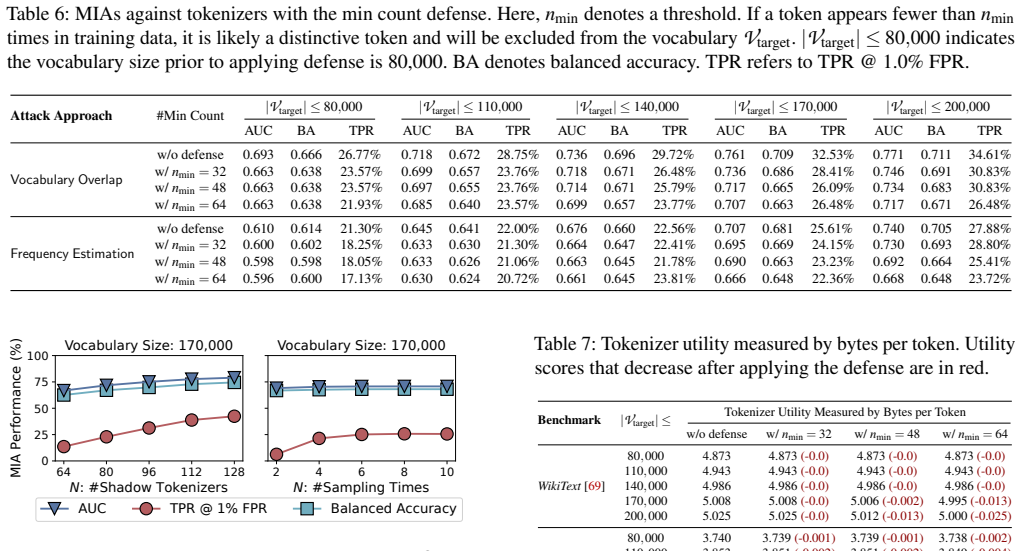
- Removing infrequent tokens (min count defense) lowers attack accuracy but also lowers compression efficiency; the attack remains above chance for large datasets even under strict filtering.
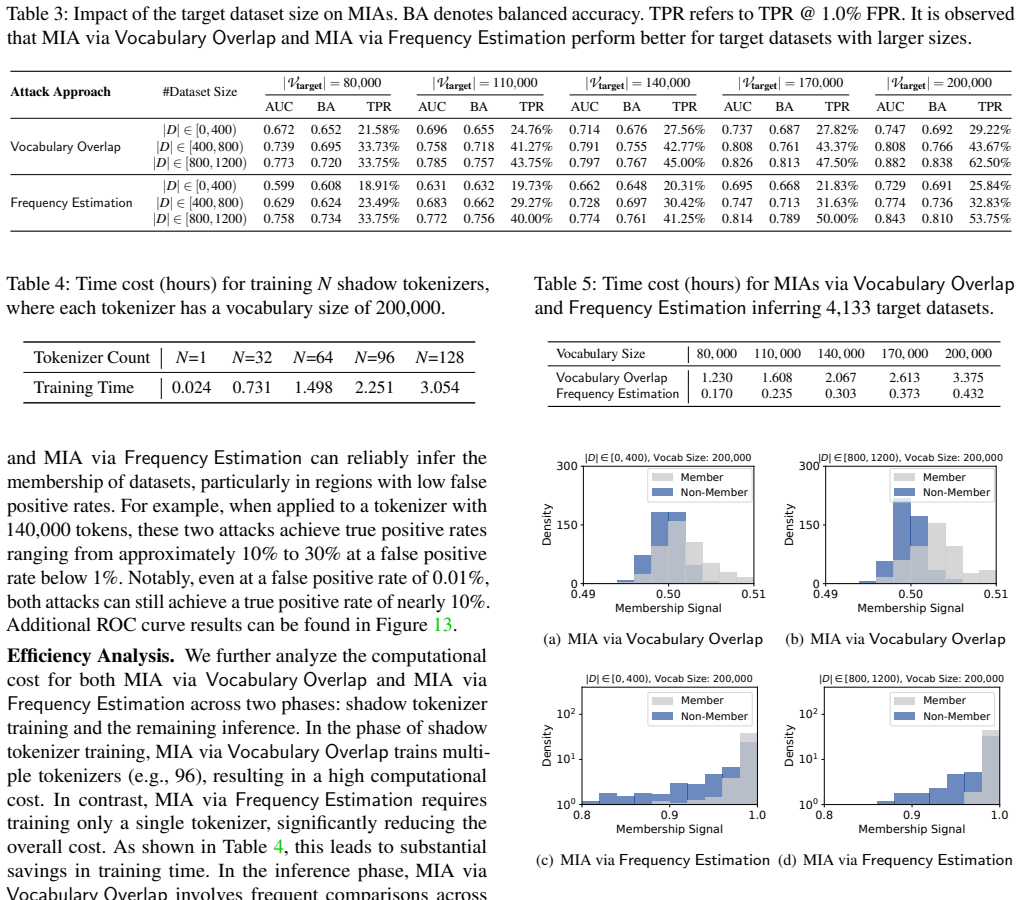
- The power-law frequency model gives an efficient shadow-free attack: one shadow tokenizer and minutes of inference instead of dozens of shadow tokenizers and hours.
Where Pith is reading between the lines
- Because tokenizer vocabularies are published as static artifacts and do not change after release, membership inference on tokenizers may be immune to defenses that perturb model outputs—so organizations should treat vocabularies as sensitive even if the LLM weights are public.
- The power-law assumption could be tested against alternative frequency estimators (e.g., neural or count-based) on out-of-distribution data, and the attack methodology may transfer to other learned subword vocabularies (SentencePiece, Unigram) if the same distinctive-token phenomenon appears.
- The distinctive-token signal might be exploitable for the inverse task: given a candidate dataset, identify which tokenizer (and thus which model) was trained on it—a tokenizer-owner attribution tool.
- Deduplication or decontamination of web corpora would likely reduce distinctive tokens; if so, the attack's success rate on a particular corpus could serve as a measure of contamination.
Editorial analysis
A structured set of objections, weighed in public.
Referee Report
Summary. The paper introduces tokenizers as a new attack surface for membership inference against LLMs. It proposes five set-level MIA methods: Merge Similarity, Vocabulary Overlap, Frequency Estimation, Naive Bayes, and Compression Rate. The two main attacks—Vocabulary Overlap and Frequency Estimation—use shadow tokenizers trained on auxiliary data drawn from the same distribution as the target tokenizer's training corpus. Experiments on C4 website datasets with tokenizer vocabulary sizes 80k–200k report AUC up to 0.771 and 0.740 respectively, with TPR around 35% and 28% at 1% FPR. The paper also analyzes distinctive tokens in commercial tokenizers and proposes a min-count defense that partially mitigates the attacks at some utility cost. The authors release code.
Significance. If the results hold, this is a useful first study of tokenizer-level membership leakage. The experimental protocol is careful in several ways: it includes a distribution-shift check (bag-of-words random forest, AUC 0.513, Figure 7), a utility comparison to commercial tokenizers (Figure 6), blind baselines, low-FPR ROC analysis, and open-sourced code. The core observation—that rare dataset-specific tokens are overfitted into BPE vocabularies—is plausible and consistent with existing evidence on distinctive tokens in commercial tokenizers. However, the real-world transfer of the attacks is not demonstrated: all end-to-end evaluations use target tokenizers trained by the authors on C4 with auxiliary data sampled from exactly the same distribution. The paper also does not position itself against the closely related prior work by Hayase et al. on BPE tokenizer leakage. These issues do not invalidate the in-distribution result, but they materially limit what can be claimed about state-of-the-art LLM tokenizers.
major comments (3)
- [Section 3, Section 5.1, Section 7] The threat model assumes the adversary can sample auxiliary datasets Daux from the same distribution D as the target tokenizer's training data. The distribution-shift check in §5.1 (BoW random forest, AUC 0.513, Figure 7) only validates that the random split into members/non-members is balanced; it does not test whether a realistic adversary can match the training distribution of a commercial tokenizer. §5.5 shows only that real-world tokenizers contain distinctive tokens, while §7 concedes that no end-to-end MIA evaluation on commercial tokenizers is possible due to missing ground truth. Consequently, the reported AUCs of 0.771 and 0.740 (Table 2) are upper bounds achieved under perfectly matched auxiliary data. Please add experiments with a mismatched auxiliary distribution (e.g., C4 target vs. auxiliary from a different corpus or a different mixture) or an end-to-end case study on an
- [Section 4.3, Table 1, Theorem 4.2] Frequency Estimation relies on the power-law assumption Pr(t_i|V) ∝ 1/i^α, with α and x_min fitted on a single shadow tokenizer and then applied to target tokenizers with different vocabulary sizes and potentially different training corpora. Table 1 reports α decreasing from 1.717 to 1.460 as vocabulary size grows, but no goodness-of-fit test or transfer analysis is given; the tiny standard errors only reflect MLE precision under the assumed model. Furthermore, Theorem 4.2 gives only a lower bound on the self-information term, and the attack in Eq. (12) substitutes that lower bound for the actual SI. If the power law does not transfer, the Frequency Estimation signal is a heuristic with no stated guarantee. Please add robustness tests (e.g., fit α on multiple shadow tokenizers and report ROC variability, or compare against direct frequency estimates when available) and clarify the role o
- [Section 1, Section 6, Refs [37,38]] The claim that 'the potential of tokenizers as an attack vector remains unexplored' (Section 1) is overstated given the prior work by Hayase et al. on data-mixture inference from BPE tokenizers, which the paper cites as [37,38] but does not compare against or explicitly differentiate from. Membership inference for a target dataset is closely related to mixture inference on training-data proportions, and the contribution needs to be positioned with respect to that work. Please add a direct comparison or an explicit technical distinction between the two problem settings.
minor comments (5)
- [Section 4.2, Eq. (3)] Equation (3) defines V_non using a set difference, but the preceding text and Algorithm 1 line 11 use an intersection. Please correct the equation to match the algorithm.
- [Section 4.3, Algorithm 2] Algorithm 2 line 7 trains V_shadow on D_aux after the sampling loop, but D_aux is only the last sampled auxiliary dataset. The main text says the shadow tokenizer is trained using 'a Daux ⊆ \tilde{D}', which is ambiguous. Clarify whether the shadow tokenizer is trained on one auxiliary dataset or on the union, and fix the pseudocode accordingly.
- [Section 5, Tables 2–3] Reported AUC/BA/TPR values have no confidence intervals or significance tests. Since the evaluation covers 4,133 datasets, standard errors or confidence intervals would help assess the stability of the rankings.
- [Figure 7] A t-SNE visualization is not a statistical confirmation of 'no distribution shifts'; the text should rely on the reported BoW RF AUC of 0.513 rather than the visual impression.
- [Section 1] Typo: 'toknizers' should be 'tokenizers'. Also, references [37] and [38] appear to be the same paper and should be merged.
Circularity Check
No significant circularity: the core signal is an empirical correlation evaluated on held-out target tokenizers; the only fitted parameter (the power-law exponent) is calibrated on an independent shadow tokenizer.
full rationale
I walked the derivation chain and found no step in which a claimed prediction is equivalent by construction to an input, or in which a load-bearing premise is imported from the authors' own prior work. The central hypothesis is stated as an empirical conjecture: "the more distinctive tokens from D that are found in Vtarget, the more likely it is that Vtarget was trained on D" (Section 4.2). The Vocabulary Overlap attack operationalizes this with shadow tokenizers trained with and without D; the target membership labels are not used to select distinctive tokens or set thresholds, and the AUC is measured on target tokenizers trained from half of the C4 datasets, so the result is a genuine out-of-sample correlation. The Frequency Estimation attack fits the power-law parameters on a single shadow tokenizer: Algorithm 2 line 9, "α,x_min ← pl.fit(V_shadow,D_aux)". Those parameters are then applied to the target vocabulary; target labels never influence the fit. Theorem 4.2 is a mathematical lower bound conditional on the stated power-law assumption (Appendix A), not a restatement of the empirical membership result. The paper explicitly acknowledges the main external-validity limitation in Section 7: "due to the absence of ground-truth training data for commercial tokenizers, we are unable to evaluate our attacks on them." This is a limitation about transfer to real-world commercial tokenizers, not circularity. The adversary's auxiliary-data assumption in Section 3 ("we assume that the adversary is able to sample auxiliary datasets Daux from the same distribution as the training data used by the target tokenizer") is likewise an explicit assumption, not a hidden equivalence. Self-citations appear only in related-work contexts (e.g., [23], [56], [108]) and are not used to justify the central derivation. No evidence of self-definition, fitted-input-renamed-as-prediction, or ansatz-smuggling was found.
Axiom & Free-Parameter Ledger
free parameters (3)
- alpha_power_law =
1.717 (80k vocab) to 1.460 (200k vocab), Table 1
- xmin_power_law_cutoff =
9,782 (Table 1)
- N_shadow_tokenizers =
96 for Vocabulary Overlap; 10 sampling times for Frequency Estimation
axioms (5)
- domain assumption The tokenizer's training data is representative of the LLM pre-training corpus and is largely public web data.
- domain assumption The adversary can access the target tokenizer's vocabulary and merge order.
- domain assumption The adversary can sample auxiliary datasets D_aux from the same distribution D as the target tokenizer's training data.
- domain assumption Token frequencies in training data follow a power law in merge index.
- ad hoc to paper Distinctive dataset-specific tokens overfit into the BPE vocabulary when that dataset is in training.
invented entities (1)
-
RTF-SI (Relative Token Frequency with Self-information)
no independent evidence
Cite this review
Pith. "Pith review of Membership Inference Attacks on Tokenizers of Large Language Models." pith.science (2026). https://pith.science/paper/G3RRHNIE
@misc{pith2026251005699,
  author       = {Pith},
  title        = {Pith review of: Membership Inference Attacks on Tokenizers of Large Language Models},
  year         = {2026},
  howpublished = {\url{https://pith.science/paper/G3RRHNIE}},
  note         = {Machine review of arXiv:2510.05699}
}
read the original abstract
Membership inference attacks (MIAs) are widely used to assess the privacy risks associated with machine learning models. However, when these attacks are applied to pre-trained large language models (LLMs), they encounter significant challenges, including mislabeled samples, distribution shifts, and discrepancies in model size between experimental and real-world settings. To address these limitations, we introduce tokenizers as a new attack vector for membership inference. Specifically, a tokenizer converts raw text into tokens for LLMs. Unlike full models, tokenizers can be efficiently trained from scratch, thereby avoiding the aforementioned challenges. In addition, the tokenizer's training data is typically representative of the data used to pre-train LLMs. Despite these advantages, the potential of tokenizers as an attack vector remains unexplored. To this end, we present the first study on membership leakage through tokenizers and explore five attack methods to infer dataset membership. Extensive experiments on millions of Internet samples reveal the vulnerabilities in the tokenizers of state-of-the-art LLMs. To mitigate this emerging risk, we further propose an adaptive defense. Our findings highlight tokenizers as an overlooked yet critical privacy threat, underscoring the urgent need for privacy-preserving mechanisms specifically designed for them.
Figures




Forward citations
Cited by 1 Pith paper
-
Security Considerations for Multi-agent Systems
No existing AI security framework covers a majority of the 193 identified multi-agent system threats in any category, with OWASP Agentic Security Initiative achieving the highest overall coverage at 65.3%.
Reference graph
Works this paper leans on
-
[1]
Deep learning with differential privacy
Martin Abadi, Andy Chu, Ian Goodfellow, H Brendan McMahan, Ilya Mironov, Kunal Talwar, and Li Zhang. Deep learning with differential privacy. InCCS, pages 308–318, 2016
2016
-
[2]
An information-theoretic perspective of tf–idf measures.Information Processing & Manage- ment, 39(1):45–65, 2003
Akiko Aizawa. An information-theoretic perspective of tf–idf measures.Information Processing & Manage- ment, 39(1):45–65, 2003
2003
-
[3]
Judge allows new york times copyright lawsuit to go forward
Bobby Allyn. Judge allows new york times copyright lawsuit to go forward. www.npr.org/2025/03/26/nx- s1-5288157/new-york-times-openai-copyright-case- goes-forward, 2025
2025
-
[4]
Tokenizer for anthropic large language models
Anthropic. Tokenizer for anthropic large language models. Tokenizer for Use with Anthropic’s Models, 2024
2024
-
[5]
Claude opus 4 & claude sonnet 4
Anthropic. Claude opus 4 & claude sonnet 4. System Card, 2025. Anthropic System Card
2025
-
[6]
An efficient recommendation generation us- ing relevant jaccard similarity.Information Sciences, 483:53–64, 2019
Sujoy Bag, Sri Krishna Kumar, and Manoj Kumar Tiwari. An efficient recommendation generation us- ing relevant jaccard similarity.Information Sciences, 483:53–64, 2019
2019
-
[7]
Xiao Bi, Deli Chen, Guanting Chen, Shanhuang Chen, Damai Dai, Chengqi Deng, Honghui Ding, Kai Dong, Qiushi Du, Zhe Fu, et al. Deepseek llm: Scaling open- source language models with longtermism.arXiv preprint arXiv:2401.02954, 2024
Pith/arXiv arXiv 2024
-
[8]
Pythia: A suite for analyzing large language models across train- ing and scaling
Stella Biderman, Hailey Schoelkopf, Quentin Gre- gory Anthony, Herbie Bradley, Kyle O’Brien, Eric Hallahan, Mohammad Aflah Khan, Shivanshu Purohit, USVSN Sai Prashanth, Edward Raff, et al. Pythia: A suite for analyzing large language models across train- ing and scaling. InICML, pages 2397–2430. PMLR, 2023
2023
-
[9]
Gpt- neox-20b: An open-source autoregressive language model.Challenges & Perspectives in Creating Large Language Models, page 95, 2022
Sid Black, Stella Biderman, Eric Hallahan, Quentin Anthony, Leo Gao, Laurence Golding, Horace He, Con- nor Leahy, Kyle McDonell, Jason Phang, et al. Gpt- neox-20b: An open-source autoregressive language model.Challenges & Perspectives in Creating Large Language Models, page 95, 2022
2022
-
[10]
Language models are few-shot learners
Tom Brown, Benjamin Mann, Nick Ryder, Melanie Subbiah, Jared D Kaplan, Prafulla Dhariwal, Arvind Neelakantan, Pranav Shyam, Girish Sastry, Amanda Askell, et al. Language models are few-shot learners. NeurIPS, 33:1877–1901, 2020
1901
-
[11]
Member- ship inference attacks from first principles
Nicholas Carlini, Steve Chien, Milad Nasr, Shuang Song, Andreas Terzis, and Florian Tramer. Member- ship inference attacks from first principles. In2022 IEEE Symposium on Security and Privacy (SP), pages 1897–1914. IEEE, 2022
1914
-
[12]
Extracting training data from large lan- guage models
Nicholas Carlini, Florian Tramer, Eric Wallace, Matthew Jagielski, Ariel Herbert-V oss, Katherine Lee, Adam Roberts, Tom Brown, Dawn Song, Ulfar Erlings- son, et al. Extracting training data from large lan- guage models. In30th USENIX Security Symposium (USENIX Security 21), pages 2633–2650, 2021
2021
-
[13]
André M Carrington, Douglas G Manuel, Paul W Fieguth, Tim Ramsay, Venet Osmani, Bernhard Wernly, Carol Bennett, Steven Hawken, Olivia Magwood, Yusuf Sheikh, et al. Deep roc analysis and auc as balanced average accuracy, for improved classifier se- lection, audit and explanation.IEEE Transactions on Pattern Analysis and Machine Intelligence, 45(1):329– 341, 2022
2022
-
[14]
Evaluating the dynamics of membership privacy in deep learning
Yuetian Chen, Zhiqi Wang, Nathalie Baracaldo, Swanand Ravindra Kadhe, and Lei Yu. Evaluating the dynamics of membership privacy in deep learning. arXiv preprint arXiv:2507.23291, 2025
Pith/arXiv arXiv 2025
-
[15]
How contaminated is your benchmark? measuring dataset leakage in large language models with kernel divergence
Hyeong Kyu Choi, Maxim Khanov, Hongxin Wei, and Yixuan Li. How contaminated is your benchmark? measuring dataset leakage in large language models with kernel divergence. InForty-second International Conference on Machine Learning, 2025
2025
-
[16]
Label-only membership inference attacks
Christopher A Choquette-Choo, Florian Tramer, Nicholas Carlini, and Nicolas Papernot. Label-only membership inference attacks. InICML, pages 1964–
1964
-
[17]
Power-law distributions in empirical data
Aaron Clauset, Cosma Rohilla Shalizi, and Mark EJ Newman. Power-law distributions in empirical data. SIAM review, 51(4):661–703, 2009
2009
-
[18]
United States Code. U.s. copyright act, title 17, section
-
[19]
Getting the most out of your tokenizer for pre- training and domain adaptation
Gautier Dagan, Gabriel Synnaeve, and Baptiste Roz- ière. Getting the most out of your tokenizer for pre- training and domain adaptation. InProceedings of the 41st International Conference on Machine Learning, pages 9784–9805, 2024
2024
-
[20]
Blind baselines beat membership inference attacks for foun- dation models
Debeshee Das, Jie Zhang, and Florian Trantèr. Blind baselines beat membership inference attacks for foun- dation models. In2025 IEEE Security and Privacy Workshops (SPW), pages 118–125. IEEE, 2025
2025
-
[21]
Bert: Pre-training of deep bidi- rectional transformers for language understanding
Jacob Devlin, Ming-Wei Chang, Kenton Lee, and Kristina Toutanova. Bert: Pre-training of deep bidi- rectional transformers for language understanding. In 14 Proceedings of the 2019 Conference of the North Amer- ican Chapter of the Association for Computational Linguistics: Human Language Technologies, Volume 1 (Long and Short Papers), pages 4171–4186, 2019
2019
-
[22]
Dp-forward: Fine-tuning and inference on language models with differential privacy in forward pass
Minxin Du, Xiang Yue, Sherman SM Chow, Tianhao Wang, Chenyu Huang, and Huan Sun. Dp-forward: Fine-tuning and inference on language models with differential privacy in forward pass. InProceedings of the 2023 ACM SIGSAC Conference on Computer and Communications Security, pages 2665–2679, 2023
2023
-
[23]
Cascading and Proxy Membership Infer- ence Attacks
Yuntao Du, Jiacheng Li, Yuetian Chen, Kaiyuan Zhang, Zhizhen Yuan, Hanshen Xiao, Bruno Ribeiro, and Ninghui Li. Cascading and Proxy Membership Infer- ence Attacks. In33th Annual Network and Distributed System Security Symposium (NDSS), 2026
2026
-
[24]
Systematic assessment of tabular data synthesis algorithms.arXiv preprint arXiv:2402.06806, 2024
Yuntao Du and Ninghui Li. Systematic assessment of tabular data synthesis algorithms.arXiv preprint arXiv:2402.06806, 2024
Pith/arXiv arXiv 2024
-
[25]
Do membership inference attacks work on large language models? InFirst Conference on Lan- guage Modeling, 2024
Michael Duan, Anshuman Suri, Niloofar Mireshghal- lah, Sewon Min, Weijia Shi, Luke Zettlemoyer, Yulia Tsvetkov, Yejin Choi, David Evans, and Hannaneh Ha- jishirzi. Do membership inference attacks work on large language models? InFirst Conference on Lan- guage Modeling, 2024
2024
-
[26]
De-cop: detecting copyrighted content in language models training data
André V Duarte, Xuandong Zhao, Arlindo L Oliveira, and Lei Li. De-cop: detecting copyrighted content in language models training data. InProceedings of the 41st International Conference on Machine Learning, pages 11940–11956, 2024
2024
-
[27]
Differential privacy
Cynthia Dwork. Differential privacy. InInternational colloquium on automata, languages, and programming, pages 1–12. Springer, 2006
2006
-
[28]
Analysis of sparse bayesian learning.Advances in neural information processing systems, 14, 2001
Anita Faul and Michael Tipping. Analysis of sparse bayesian learning.Advances in neural information processing systems, 14, 2001
2001
-
[29]
Privacy in pharmacogenetics: An {End-to-End} case study of personalized warfarin dosing
Matthew Fredrikson, Eric Lantz, Somesh Jha, Simon Lin, David Page, and Thomas Ristenpart. Privacy in pharmacogenetics: An {End-to-End} case study of personalized warfarin dosing. In23rd USENIX security symposium (USENIX Security 14), pages 17–32, 2014
2014
-
[30]
Label inference attacks against vertical federated learning
Chong Fu, Xuhong Zhang, Shouling Ji, Jinyin Chen, Jingzheng Wu, Shanqing Guo, Jun Zhou, Alex X Liu, and Ting Wang. Label inference attacks against vertical federated learning. In31st USENIX security sympo- sium (USENIX Security 22), pages 1397–1414, 2022
2022
-
[31]
Zipf’s law and the growth of cities
Xavier Gabaix. Zipf’s law and the growth of cities. American Economic Review, 89(2):129–132, 1999
1999
-
[32]
Investigating the effectiveness of bpe: The power of shorter sequences
Matthias Gallé. Investigating the effectiveness of bpe: The power of shorter sequences. InProceedings of the 2019 conference on empirical methods in natural language processing and the 9th international joint conference on natural language processing (EMNLP- IJCNLP), pages 1375–1381, 2019
2019
-
[33]
Counting gemini text tokens locally with the vertex ai sdk, July 2024
Google. Counting gemini text tokens locally with the vertex ai sdk, July 2024. Tokenizer for Use with Google’s Models
2024
-
[34]
Likelihood-based diffusion language models.Ad- vances in Neural Information Processing Systems, 36:16693–16715, 2023
Ishaan Gulrajani and Tatsunori B Hashimoto. Likelihood-based diffusion language models.Ad- vances in Neural Information Processing Systems, 36:16693–16715, 2023
2023
-
[35]
Deepseek-r1: Incentivizing reasoning capability in llms via reinforcement learning
Daya Guo, Dejian Yang, Haowei Zhang, Junxiao Song, Ruoyu Zhang, Runxin Xu, Qihao Zhu, Shirong Ma, Peiyi Wang, Xiao Bi, et al. Deepseek-r1: Incentivizing reasoning capability in llms via reinforcement learning. arXiv preprint arXiv:2501.12948, 2025
Pith/arXiv arXiv 2025
-
[36]
Weird gpt-4 behavior for “davidjl”
Hacker News. Weird gpt-4 behavior for “davidjl”. news.ycombinator.com/item?id=36242914, 2023
2023
-
[37]
Data mixture inference attack: Bpe tokenizers reveal training data compositions.Advances in Neural Information Processing Systems, 37:8956– 8983, 2024
Jonathan Hayase, Alisa Liu, Yejin Choi, Sewoong Oh, and Noah A Smith. Data mixture inference attack: Bpe tokenizers reveal training data compositions.Advances in Neural Information Processing Systems, 37:8956– 8983, 2024
2024
-
[38]
Data mixture inference attack: Bpe tokenizers reveal training data compositions
Jonathan Hayase, Alisa Liu, Yejin Choi, Sewoong Oh, and Noah A Smith. Data mixture inference attack: Bpe tokenizers reveal training data compositions. InThe Thirty-eighth Annual Conference on Neural Informa- tion Processing Systems, 2024
2024
-
[39]
Jamie Hayes, Ilia Shumailov, Christopher A Choquette- Choo, Matthew Jagielski, George Kaissis, Kather- ine Lee, Milad Nasr, Sahra Ghalebikesabi, Niloofar Mireshghallah, Meenatchi Sundaram Mutu Selva An- namalai, et al. Strong membership inference attacks on massive datasets and (moderately) large language models.arXiv preprint arXiv:2505.18773, 2025
arXiv 2025
-
[40]
Deep residual learning for image recognition
Kaiming He, Xiangyu Zhang, Shaoqing Ren, and Jian Sun. Deep residual learning for image recognition. InProceedings of the IEEE conference on computer vision and pattern recognition (CVPR), pages 770–778, 2016
2016
-
[41]
To- wards label-only membership inference attack against pre-trained large language models
Yu He, Boheng Li, Liu Liu, Zhongjie Ba, Wei Dong, Yiming Li, Zhan Qin, Kui Ren, and Chun Chen. To- wards label-only membership inference attack against pre-trained large language models. In34th USENIX Security Symposium (USENIX Security 25), 2025. 15
2025
-
[42]
Membership inference attacks against vision-language models
Yuke He, Zheng Li, Yang Zhang, Zhan Qin, Kui Ren, and Chun Chen. Membership inference attacks against vision-language models. In34th USENIX Security Symposium (USENIX Security 25), 2025
2025
-
[43]
Scaling laws for autoregressive generative modeling.arXiv preprint arXiv:2010.14701, 2020
Tom Henighan, Jared Kaplan, Mor Katz, Mark Chen, Christopher Hesse, Jacob Jackson, Heewoo Jun, Tom B Brown, Prafulla Dhariwal, Scott Gray, et al. Scaling laws for autoregressive generative modeling.arXiv preprint arXiv:2010.14701, 2020
Pith/arXiv arXiv 2010
-
[44]
Training compute- optimal large language models.arXiv preprint arXiv:2203.15556, 2022
Jordan Hoffmann, Sebastian Borgeaud, Arthur Men- sch, Elena Buchatskaya, Trevor Cai, Eliza Ruther- ford, Diego de Las Casas, Lisa Anne Hendricks, Jo- hannes Welbl, Aidan Clark, et al. Training compute- optimal large language models.arXiv preprint arXiv:2203.15556, 2022
Pith/arXiv arXiv 2022
-
[45]
Damia: Leveraging domain adaptation as a defense against membership inference attacks.IEEE Transactions on Dependable and Secure Computing, 19(5):3183–3199, 2021
Hongwei Huang, Weiqi Luo, Guoqiang Zeng, Jian Weng, Yue Zhang, and Anjia Yang. Damia: Leveraging domain adaptation as a defense against membership inference attacks.IEEE Transactions on Dependable and Secure Computing, 19(5):3183–3199, 2021
2021
-
[46]
Over-tokenized trans- former: V ocabulary is generally worth scaling
Hongzhi Huang, Defa Zhu, Banggu Wu, Yutao Zeng, Ya Wang, Qiyang Min, et al. Over-tokenized trans- former: V ocabulary is generally worth scaling. In Forty-second International Conference on Machine Learning, 2025
2025
-
[47]
Jiameng Huang, Baijiong Lin, Guhao Feng, Jierun Chen, Di He, and Lu Hou. Efficient reasoning for large reasoning language models via certainty-guided reflec- tion suppression.arXiv preprint arXiv:2508.05337, 2025
arXiv 2025
-
[48]
Tokenizer
Hugging Face. Tokenizer. https://huggingface.co/docs/ transformers/main_classes/tokenizer, 2025
2025
-
[49]
Codeparrot github code dataset
Hugging Face Datasets. Codeparrot github code dataset. https://huggingface.co/datasets/codeparrot/ github-code, 2025
2025
-
[50]
Practical blind membership inference attack via differential compar- isons
Bo Hui, Yuchen Yang, Haolin Yuan, Philippe Burlina, Neil Zhenqiang Gong, and Yinzhi Cao. Practical blind membership inference attack via differential compar- isons. InISOC Network and Distributed System Secu- rity Symposium (NDSS), 2021
2021
-
[51]
Memguard: Defend- ing against black-box membership inference attacks via adversarial examples
Jinyuan Jia, Ahmed Salem, Michael Backes, Yang Zhang, and Neil Zhenqiang Gong. Memguard: Defend- ing against black-box membership inference attacks via adversarial examples. InCCS, pages 259–274, 2019
2019
-
[52]
Scal- ing laws for neural language models.arXiv preprint arXiv:2001.08361, 2020
Jared Kaplan, Sam McCandlish, Tom Henighan, Tom B Brown, Benjamin Chess, Rewon Child, Scott Gray, Alec Radford, Jeffrey Wu, and Dario Amodei. Scal- ing laws for neural language models.arXiv preprint arXiv:2001.08361, 2020
Pith/arXiv arXiv 2001
-
[53]
Stolen memories: Leveraging model memorization for calibrated{White- Box} membership inference
Klas Leino and Matt Fredrikson. Stolen memories: Leveraging model memorization for calibrated{White- Box} membership inference. In29th USENIX security symposium (USENIX Security 20), pages 1605–1622, 2020
2020
-
[54]
Se- qmia: sequential-metric based membership inference attack
Hao Li, Zheng Li, Siyuan Wu, Chengrui Hu, Yutong Ye, Min Zhang, Dengguo Feng, and Yang Zhang. Se- qmia: sequential-metric based membership inference attack. InProceedings of the 2024 on ACM SIGSAC Conference on Computer and Communications Secu- rity, pages 3496–3510, 2024
2024
-
[55]
Enhanced label-only membership inference attacks with fewer queries
Hao Li, Zheng Li, Siyuan Wu, Yutong Ye, Min Zhang, Dengguo Feng, and Yang Zhang. Enhanced label-only membership inference attacks with fewer queries. In Proceedings of the 34th USENIX Security Symposium (USENIX Security ’25). USENIX Association, 2025
2025
-
[56]
Mem- bership inference attacks and defenses in classification models
Jiacheng Li, Ninghui Li, and Bruno Ribeiro. Mem- bership inference attacks and defenses in classification models. InProceedings of the Eleventh ACM Confer- ence on Data and Application Security and Privacy, pages 5–16, 2021
2021
-
[57]
Xuechen Li, Florian Tramer, Percy Liang, and Tat- sunori Hashimoto. Large language models can be strong differentially private learners.arXiv preprint arXiv:2110.05679, 2021
Pith/arXiv arXiv 2021
-
[58]
Membership leakage in label-only exposures
Zheng Li and Yang Zhang. Membership leakage in label-only exposures. InCCS, pages 880–895, 2021
2021
-
[59]
SuperBPE: Space travel for language models
Alisa Liu, Jonathan Hayase, Valentin Hofmann, Se- woong Oh, Noah A Smith, and Yejin Choi. SuperBPE: Space travel for language models. InSecond Confer- ence on Language Modeling, 2025
2025
-
[60]
Please tell me more: Privacy impact of explainability through the lens of membership inference attack
Han Liu, Yuhao Wu, Zhiyuan Yu, and Ning Zhang. Please tell me more: Privacy impact of explainability through the lens of membership inference attack. In 2024 IEEE Symposium on Security and Privacy (SP), pages 4791–4809. IEEE, 2024
2024
-
[61]
Roberta: A ro- bustly optimized bert pretraining approach.arXiv preprint arXiv:1907.11692, 2019
Yinhan Liu, Myle Ott, Naman Goyal, Jingfei Du, Man- dar Joshi, Danqi Chen, Omer Levy, Mike Lewis, Luke Zettlemoyer, and Veselin Stoyanov. Roberta: A ro- bustly optimized bert pretraining approach.arXiv preprint arXiv:1907.11692, 2019
Pith/arXiv arXiv 1907
-
[62]
Visu- alizing data using t-sne.Journal of machine learning research, 9(Nov):2579–2605, 2008
Laurens van der Maaten and Geoffrey Hinton. Visu- alizing data using t-sne.Journal of machine learning research, 9(Nov):2579–2605, 2008. 16
2008
-
[63]
Llm dataset inference: Did you train on my dataset?Advances in Neural Information Pro- cessing Systems, 37:124069–124092, 2024
Pratyush Maini, Hengrui Jia, Nicolas Papernot, and Adam Dziedzic. Llm dataset inference: Did you train on my dataset?Advances in Neural Information Pro- cessing Systems, 37:124069–124092, 2024
2024
-
[64]
Dataset inference: Ownership resolution in machine learning.arXiv preprint arXiv:2104.10706, 2021
Pratyush Maini, Mohammad Yaghini, and Nicolas Pa- pernot. Dataset inference: Ownership resolution in machine learning.arXiv preprint arXiv:2104.10706, 2021
Pith/arXiv arXiv 2021
-
[65]
Tokens used by gpt-4 probably come from the reddit users
Matthew Watkins. Tokens used by gpt-4 probably come from the reddit users. https://x.com/SoC_trilogy /status/1666714127438434304, 2023
arXiv 2023
-
[66]
LLMs on the line: Data determines loss-to-loss scaling laws
Prasanna Mayilvahanan, Thaddus Wiedemer, Sayak Mallick, Matthias Bethge, and Wieland Brendel. LLMs on the line: Data determines loss-to-loss scaling laws. InForty-second International Conference on Machine Learning, 2025
2025
-
[67]
Did the neurons read your book? document-level membership inference for large language models
Matthieu Meeus, Shubham Jain, Marek Rei, and Yves- Alexandre de Montjoye. Did the neurons read your book? document-level membership inference for large language models. In33rd USENIX Security Sympo- sium (USENIX Security 24), pages 2369–2385, 2024
2024
-
[68]
Sok: Membership inference attacks on llms are rushing nowhere (and how to fix it)
Matthieu Meeus, Igor Shilov, Shubham Jain, Manuel Faysse, Marek Rei, and Yves-Alexandre de Montjoye. Sok: Membership inference attacks on llms are rushing nowhere (and how to fix it). InIEEE Conference on Secure and Trustworthy Machine Learning ((SaTML, 2025). IEEE, 2025
2025
-
[69]
Pointer sentinel mixture models.arXiv preprint arXiv:1609.07843, 2016
Stephen Merity, Caiming Xiong, James Bradbury, and Richard Socher. Pointer sentinel mixture models.arXiv preprint arXiv:1609.07843, 2016
Pith/arXiv arXiv 2016
-
[70]
Large language models: A survey.arXiv preprint arXiv:2402.06196, 2024
Shervin Minaee, Tomas Mikolov, Narjes Nikzad, Meysam Chenaghlu, Richard Socher, Xavier Amatri- ain, and Jianfeng Gao. Large language models: A survey.arXiv preprint arXiv:2402.06196, 2024
Pith/arXiv arXiv 2024
-
[71]
Scaling data-constrained language models.Advances in Neural Information Processing Systems, 36:50358– 50376, 2023
Niklas Muennighoff, Alexander Rush, Boaz Barak, Teven Le Scao, Nouamane Tazi, Aleksandra Piktus, Sampo Pyysalo, Thomas Wolf, and Colin A Raffel. Scaling data-constrained language models.Advances in Neural Information Processing Systems, 36:50358– 50376, 2023
2023
-
[72]
Com- prehensive privacy analysis of deep learning: Passive and active white-box inference attacks against central- ized and federated learning
Milad Nasr, Reza Shokri, and Amir Houmansadr. Com- prehensive privacy analysis of deep learning: Passive and active white-box inference attacks against central- ized and federated learning. In2019 IEEE symposium on security and privacy (SP), pages 739–753. IEEE, 2019
2019
-
[73]
Reddit sues anthropic over its data scraping to train large language models
New York Times. Reddit sues anthropic over its data scraping to train large language models. https:// www.nytimes.com/2025/06/04/technology/reddit- anthropic-lawsuit-data.html, 2025
2025
-
[74]
System card of chatgpt-o1
OpenAI. System card of chatgpt-o1. https://cdn.openai. com/o1-system-card-20241205.pdf, 2024
2024
-
[75]
tiktoken: Tokenizer for openai models
OpenAI. tiktoken: Tokenizer for openai models. https: //github.com/openai/tiktoken, 2025
2025
-
[76]
Black-box membership inference attacks against fine-tuned diffusion models
Yan Pang and Tianhao Wang. Black-box membership inference attacks against fine-tuned diffusion models. arXiv preprint arXiv:2312.08207, 2023
Pith/arXiv arXiv 2023
-
[77]
Yan Pang, Tianhao Wang, Xuhui Kang, Mengdi Huai, and Yang Zhang. White-box membership inference attacks against diffusion models.arXiv preprint arXiv:2308.06405, 2023
Pith/arXiv arXiv 2023
-
[78]
Zipf’s word frequency law in natural language: A critical review and future direc- tions.Psychonomic bulletin & review, 21(5):1112– 1130, 2014
Steven T Piantadosi. Zipf’s word frequency law in natural language: A critical review and future direc- tions.Psychonomic bulletin & review, 21(5):1112– 1130, 2014
2014
-
[79]
Scaling up membership inference: When and how attacks succeed on large language mod- els
Haritz Puerto, Martin Gubri, Sangdoo Yun, and Seong Joon Oh. Scaling up membership inference: When and how attacks succeed on large language mod- els. In Luis Chiruzzo, Alan Ritter, and Lu Wang, ed- itors,Findings of the Association for Computational Linguistics: NAACL 2025, pages 4165–4182, Albu- querque, New Mexico, April 2025. Association for Computati...
2025
-
[80]
Text mining: use of tf-idf to examine the relevance of words to docu- ments.International journal of computer applications, 181(1):25–29, 2018
Shahzad Qaiser and Ramsha Ali. Text mining: use of tf-idf to examine the relevance of words to docu- ments.International journal of computer applications, 181(1):25–29, 2018
2018
discussion (0)
Sign in with ORCID, Apple, or X to comment. Anyone can read and Pith papers without signing in.