REVIEW 3 major objections 8 minor 45 references
Keeping uncertainty alive turns 2D snapshots into better 3D scene graphs
Reviewed by Pith at T0; open to challenge. T0 means a machine referee read the full paper against a public rubric. the ladder, T0–T4 →
T0 review · glm-5.2
2026-07-09 18:20 UTC pith:G3Z6XHMW
load-bearing objection PUF: uncertainty-aware fusion for online 3D scene graphs — solid empirical gains, one theoretical gap the 3 major comments →
PUF: Plug-and-Play Uncertainty-Aware Fusion for Online 3D Scene Graph Generation
The pith
A machine-rendered reading of the paper's core claim, the machinery that carries it, and where it could break.
Core claim
The central mechanism is the replacement of hard data association in online 3D scene graph generation with a factored probabilistic likelihood. Each new 2D observation is scored against every existing 3D node by multiplying a spatial overlap term (Bhattacharyya coefficient for Gaussians, containment score for voxels) with a semantic similarity term (exponential of Jensen-Shannon divergence between Dirichlet posterior means). These likelihoods are normalized into association probabilities using a birth term that allows new objects to enter the graph. The association probabilities then serve as soft weights for Dirichlet evidence accumulation: class and relationship evidence from the 2D model'
What carries the argument
Three components carry the argument. First, Dirichlet distributions replace one-hot labels for both nodes and edges, storing accumulated evidence as real-valued concentration parameters whose normalized posterior mean gives a proper probability distribution over labels. Second, a factored association likelihood combines spatial overlap and semantic divergence into a continuous score, replacing hard distance or overlap thresholds. Third, a class-conditional relationship prior—factored into a training-set co-occurrence distribution, a spatial decay term, and an existence gate—provides a conjugate prior that completes edge evidence for sparsely co-observed object pairs via Bayesian posterior更新.
Load-bearing premise
The factorized per-observation association probability is assumed to closely approximate the exact joint association marginals because the detector's non-maximum suppression prevents two detections of the same object in one frame. If NMS does not sufficiently separate detections of nearby same-class objects, the semantic likelihood factor may remain non-negligible for multiple detections assigned to the same track, and the approximation error could grow.
What would settle it
If one constructed scenes with multiple instances of the same object class in close spatial proximity (e.g., a row of identical chairs), the ε-separation condition underlying the factorized association could break down, and the soft evidence redistribution might scatter class evidence across duplicate nodes rather than correctly accumulating it—potentially degrading both object and relationship recall below the deterministic baseline.
If this is right
- Any incremental perception system that currently collapses 2D model outputs to argmax labels before fusing into 3D could potentially benefit from carrying full softmax distributions through the fusion stage, since the gains here come without retraining the 2D model.
- The Dirichlet evidence accumulator provides a natural per-node and per-edge uncertainty estimate (via normalized entropy), which downstream consumers—robotic planners, navigation systems, or question-answering agents—could use to decide when to re-query or avoid unreliable predictions.
- The relationship prior's largest gains appear on the sparsest co-observation bins, suggesting that statistical priors can compensate for the fundamental coverage limitation of any incremental observation system where camera viewpoint is partial.
- The representation-agnostic design (Gaussian and voxel backends both improve) suggests the uncertainty-aware fusion principle transfers to other 3D representations such as neural implicit fields or mesh-based maps.
Where Pith is reading between the lines
- The per-observation independent normalization of association probabilities is shown to approximate the exact Joint Probabilistic Data Association Filter marginals within O(NMε) error under an ε-separation condition that the detector's non-maximum suppression is assumed to enforce. If two spatially close objects of the same class produce overlapping detections that survive NMS, the factorization co
- The relationship prior is computed from training-set annotation counts and therefore encodes dataset-specific co-occurrence statistics. On ReplicaSSG, where no training split exists and no prior is used, the gains are smaller (2.8-point relationship recall improvement for Gaussian) than on 3DSSG (18.1 points with prior), raising the question of how much of the headline improvement comes from the f
- The framework's reliance on a 2D scene graph model that outputs calibrated soft distributions means the gains are bounded by the quality of those distributions. The temperature-scaling experiments suggest robustness to miscalibration, but only three temperatures are tested, and more severe miscalibration patterns could degrade the evidence accumulation.
Editorial analysis
A structured set of objections, weighed in public.
Referee Report
Summary. The paper proposes PUF, a plug-and-play, training-free fusion framework for online 3D scene graph generation. The core idea is to replace deterministic 2D-to-3D merging with uncertainty-aware probabilistic association and Dirichlet evidence accumulation. Three sources of uncertainty (observation, 2D model, 3D representation) are identified and propagated through the pipeline. The framework wraps any 2D SGG model producing soft distributions, uses a factored likelihood combining semantic (JSD-based) and spatial (Bhattacharyya or voxel containment) factors for node association, accumulates evidence via Dirichlet conjugacy, and optionally applies a class-conditional relationship prior for sparsely observed edges. The method is instantiated with both Gaussian and voxel 3D backends and evaluated on 3DSSG and ReplicaSSG, showing substantial improvements over the strongest online baseline (FROSS) while maintaining real-time latency.
Significance. The paper addresses a genuine gap in online 3D SGG: existing methods commit to hard decisions at every fusion stage, discarding uncertainty from 2D models, partial observations, and approximate 3D lifting. The Dirichlet evidence accumulation scheme is a clean, principled formulation that preserves soft distributions throughout the pipeline. The plug-and-play, training-free design is practically valuable, and the public code release strengthens reproducibility. The 18.1-point relationship recall improvement on 3DSSG at 15ms/frame is a notable empirical result. The cross-representation validation (Gaussian and voxel) demonstrates generality. The ablation studies (Tables 3–4) and the frequentist-vs-probabilistic comparison (Supp. C, Table 6) are well-designed to isolate component contributions.
major comments (3)
- Supplementary Sec. A, Proposition 1: The per-observation independent normalization (Eq. 6) is justified by an O(NMε) error bound under the ε-separation condition (Def. 1). The stress-test concern here has merit: the bound is only non-vacuous when ε is very small (on the order of 1/(NM) ≈ 0.002 for typical frame sizes), but the semantic likelihood factor L_se = exp(-JSD/σ_se) with σ_se = 0.3 (Eq. 5) can yield L_se ≈ 0.72 for same-class objects with modest JSD, and combined with non-negligible 3D spatial overlap for nearby objects, L[i,k] for non-matching pairs can be orders of magnitude above this threshold. The argument in Sec. A.5 that NMS enforces ε-separation conflates 2D box overlap (what NMS operates on) with 3D Gaussian/voxel overlap (what L_sp computes): two distinct same-class objects that are close in 3D but project to non-overlapping 2D regions survive NMS yet can have non-negl
- igible L[i,k]. The paper does not measure the empirical distribution of ε or report the fraction of observation-track pairs that violate ε-separation. This is a gap in the theoretical justification for the factorization. However, I note that this concern affects the formal proof, not necessarily the empirical method: the factorization may work in practice because the spatial factor alone disambiguates most cases, and the experimental results (Tables 1–4) stand on their own. The authors should either (a) report empirical ε statistics on the evaluation datasets to show the bound is non-vacuous in practice, or (b) reframe the proof as a motivating approximation rather than a tight guarantee, and discuss when the factorization may degrade.
- Table 2 and Sec. 4.2: The claim that 'consistent gains over FROSS are observed with both backends across both benchmarks' is slightly overstated. On ReplicaSSG, PUF-Voxel achieves 22.4% relationship recall versus FROSS's 22.5%—essentially tied, not a gain—and predicate recall drops from 28.0% to 26.9%. While object recall improves (27.9% vs 26.2%), the relationship-level performance of the voxel backend on ReplicaSSG does not show a gain. The paper should qualify this claim or investigate why the voxel backend underperforms on this specific benchmark/predicate set (the per-class breakdown in Table 10 shows regressions on 'on' and 'with' for the voxel backend, which the paper attributes to the discrete overlap metric—this explanation could be strengthened).
minor comments (8)
- Sec. 3.6: The threshold max(ϕ_prior_ij) > 0.5 for using the prior alone on unobserved edges is stated without sensitivity analysis. Given that this threshold controls how aggressively the prior completes unobserved edges, a brief analysis of its effect would strengthen the contribution.
- Eq. (12): The spatial prior P_sp(μ_i, μ_j) = exp(-|μ_i - μ_j|/2) uses a fixed scale of 2 (meters, presumably). This scale is not listed among the hyperparameters in Sec. 4.1 and its sensitivity is not analyzed. Clarify whether this is a fixed constant or tuned.
- Sec. 3.5, Eq. (8): The spatial update is applied only to k* = argmax_k β[obs,k], while semantic evidence is distributed to all k with β[obs,k] ≥ β_min. The justification ('a predicted label can be 0.6 chair - 0.4 table, but the object is not part chair, part table') is reasonable but informal. A brief note on how often multiple nodes receive semantic updates (i.e., how often the soft assignment is non-degenerate in practice) would help quantify the practical impact of this design choice.
- Table 1: The latency for PUF-Gaussian is 15ms, up from FROSS's 13ms. The paper states this is 'negligible,' which is fair, but the 2ms increase should be attributed to specific components (the ablation in Table 3 shows latency breakdowns, which is good).
- Sec. 4.1: The 2D SGG model retains 'top-10 pairwise relation scores per frame.' It would be useful to note how often the ground-truth relationship falls outside this top-10, as this sets an upper bound on achievable recall.
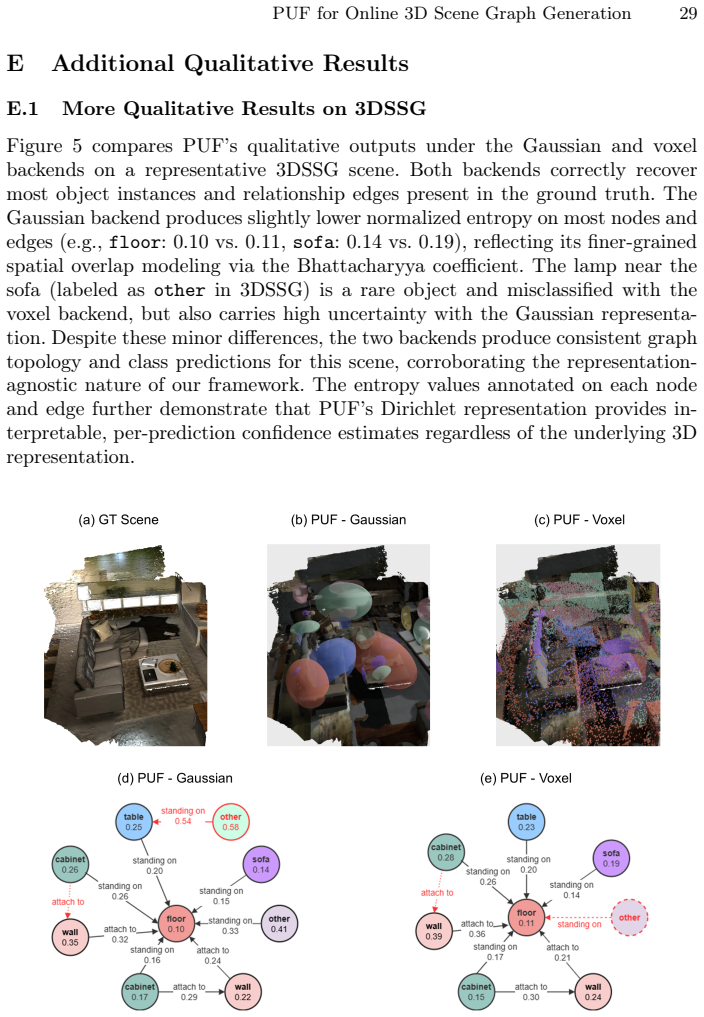
- Fig. 4: The normalized entropy visualization is a nice addition. The caption could clarify whether the entropy is computed on the Dirichlet posterior mean (ᾱ_k) or on the full Dirichlet distribution, as these have different interpretations.
- Supp. A.4, Eq. (28): The O(ε²) term is dropped without explicit bound. While this is standard for leading-order analysis, a one-line justification that the second-order term is dominated would improve rigor.
- The paper uses 'training-free' prominently. While technically accurate (no neural network training is needed), the relationship prior P_cl requires an offline pass over training annotations (Sec. 3.6). This is a minor point but could be clarified to avoid misunderstanding.
Circularity Check
No circularity found: the derivation chain is self-contained Bayesian inference validated against external benchmarks
full rationale
The paper's derivation chain is self-contained and non-circular. (1) The Dirichlet evidence accumulation (Eqs. 7, 9) is a standard Bayesian conjugate-prior update—α_k ← α_k + β[obs,k]·p̂_obs—where the posterior prediction (argmax of normalized ᾱ_k) genuinely depends on accumulated multi-view evidence, not on a fitted parameter renamed as a prediction. (2) The probabilistic node association (Eqs. 3–6) combines a spatial likelihood (Bhattacharyya coefficient or voxel containment) with a semantic likelihood (JSD-based kernel) into a factored likelihood, then normalizes per-observation. The JPDAF factorization proof (Supp. A, Proposition 1) is a genuine mathematical derivation bounding the approximation error under ε-separation; whether ε-separation holds in practice is a correctness concern, not a circularity. (3) The relationship prior P_cl (Eq. 13) uses training-set annotation counts with Laplace smoothing—standard empirical Bayes—and is combined with accumulated evidence via Dirichlet conjugacy (Eq. 14). The ablation in Table 6 explicitly separates the contribution of dataset statistics (frequentist baseline) from the probabilistic integration, showing the Bayesian framework adds value beyond naive frequency injection. (4) All central empirical claims (46.0% recall, 15ms latency, cross-representation gains) are validated against external benchmarks (3DSSG, ReplicaSSG) with independent baselines (FROSS, SGFN, MonoSSG, SCRSSG). No step reduces to its inputs by construction, no prediction is a renamed fit, and no load-bearing result depends on a self-citation chain.
Axiom & Free-Parameter Ledger
free parameters (6)
- σ_se (semantic bandwidth) =
0.3
- λ_birth (birth density) =
0.4
- β_min (evidence cut-off threshold) =
0.05
- ε (Laplace smoothing) =
0.1
- δ (voxel grid resolution) =
0.02m
- ε_d (depth filtering threshold) =
0.3m
axioms (4)
- domain assumption Non-maximum suppression (NMS) enforces ε-separation, making per-observation independent normalization a valid approximation of JPDAF marginals.
- domain assumption 2D SGG model softmax outputs are sufficiently calibrated to serve as evidence for Dirichlet accumulation.
- domain assumption The class-conditional relationship prior P_cl(r|c_i,c_j) computed from 3DSSG training annotations generalizes to the 3DSSG test split.
- domain assumption Spatial and semantic factors are independent given the association, justifying the factored likelihood L = L_sp · L_se.
read the original abstract
Online 3D scene graph generation builds a persistent, structured representation of a scene by incrementally fusing 2D observations into a global 3D graph. Existing online methods treat this fusion as a fully deterministic pipeline, where we identify three sources of uncertainty that are overlooked: observation, 2D model, and 3D representation. We propose PUF: a Plug-and-play, Uncertainty-aware, and training-free Fusion framework. Scene graph node association is reformulated as a probabilistic likelihood over semantic and spatial factors, replacing binary accept/reject gates. Dirichlet evidence accumulation distributes class and relationship evidence across plausible candidates proportional to association likelihood. An optional class-conditional prior completes edges for sparsely or never co-observed object pairs. We instantiate PUF with both a 3D Gaussian and a 3D voxel backend and observe consistent improvements, demonstrating its ability to generalize across different representations. Experiments on the 3DSSG and ReplicaSSG benchmarks show that our method substantially outperforms existing approaches while maintaining real-time latency. These results establish uncertainty-aware fusion as a principled and effective paradigm for online 3D scene understanding. The source code is publicly available at https://github.com/yyyyangyi/PUF.
Figures



Reference graph
Works this paper leans on
-
[1]
IEEE Control Systems Magazine29(6), 82–100 (2009)
Bar-Shalom, Y., Daum, F., Huang, J.: The probabilistic data association filter. IEEE Control Systems Magazine29(6), 82–100 (2009)
work page 2009
-
[2]
In: 2017 IEEE International Conference on Robotics and Automation (ICRA)
Bowman, S.L., Atanasov, N., Daniilidis, K., Pappas, G.J.: Probabilistic data as- sociation for semantic slam. In: 2017 IEEE International Conference on Robotics and Automation (ICRA). pp. 1722–1729. IEEE (2017)
work page 2017
-
[3]
IEEE Transactions on Robotics37(6), 1874–1890 (2021)
Campos, C., Elvira, R., Rodríguez, J.J.G., Montiel, J.M., Tardós, J.D.: Orb-slam3: An accurate open-source library for visual, visual–inertial, and multimap slam. IEEE Transactions on Robotics37(6), 1874–1890 (2021)
work page 2021
-
[4]
In: European Conference on Computer Vision
Carion, N., Massa, F., Synnaeve, G., Usunier, N., Kirillov, A., Zagoruyko, S.: End- to-end object detection with transformers. In: European Conference on Computer Vision. pp. 213–229. Springer (2020)
work page 2020
-
[5]
In: 2021 IEEE International Conference on Robotics and Automation (ICRA)
Chiu, H.k., Li, J., Ambruş, R., Bohg, J.: Probabilistic 3d multi-modal, multi- object tracking for autonomous driving. In: 2021 IEEE International Conference on Robotics and Automation (ICRA). pp. 14227–14233. IEEE (2021)
work page 2021
-
[6]
In: Proceed- ings of the IEEE/CVF Conference on Computer Vision and Pattern Recognition (CVPR)
Feng, M., Hou, H., Zhang, L., Wu, Z., Guo, Y., Mian, A.: 3d spatial multimodal knowledge accumulation for scene graph prediction in point cloud. In: Proceed- ings of the IEEE/CVF Conference on Computer Vision and Pattern Recognition (CVPR). pp. 9182–9191 (2023)
work page 2023
-
[7]
IEEE Transactions on Pattern Analysis and Machine Intelligence (2025)
Feng, M., Yan, C., Wu, Z., Dong, W., Wang, Y., Mian, A.: Hyperrectangle embed- ding for debiased 3d scene graph prediction from rgb sequences. IEEE Transactions on Pattern Analysis and Machine Intelligence (2025)
work page 2025
-
[8]
In: Asian Conference on Computer Vision
Gay, P., Stuart, J., Del Bue, A.: Visual graphs from motion (vgfm): Scene un- derstanding with object geometry reasoning. In: Asian Conference on Computer Vision. pp. 330–346. Springer (2018)
work page 2018
-
[9]
In: 2024 IEEE Inter- national Conference on Robotics and Automation (ICRA)
Gu, Q., Kuwajerwala, A., Morin, S., Jatavallabhula, K.M., Sen, B., Agarwal, A., Rivera, C., Paul, W., Ellis, K., Chellappa, R., et al.: Conceptgraphs: Open- vocabulary 3d scene graphs for perception and planning. In: 2024 IEEE Inter- national Conference on Robotics and Automation (ICRA). pp. 5021–5028. IEEE (2024)
work page 2024
-
[10]
In: International conference on machine learning
Guo, C., Pleiss, G., Sun, Y., Weinberger, K.Q.: On calibration of modern neural networks. In: International conference on machine learning. pp. 1321–1330. PMLR (2017)
work page 2017
-
[11]
In: The Thirty-ninth Annual Con- ference on Neural Information Processing Systems (2025)
Heo, K., Kim, G., Kim, S., Cho, M.: Object-centric representation learning for enhanced 3d semantic scene graph prediction. In: The Thirty-ninth Annual Con- ference on Neural Information Processing Systems (2025)
work page 2025
-
[12]
In: Proceedings of the IEEE/CVF International Conference on Computer Vision (ICCV)
Hou, H.Y., Lee, C.Y., Sonogashira, M., Kawanishi, Y.: Fross: Faster-than-real-time online 3d semantic scene graph generation from rgb-d images. In: Proceedings of the IEEE/CVF International Conference on Computer Vision (ICCV). pp. 28818– 28827 (2025)
work page 2025
-
[13]
In: Proceedings of the IEEE/CVF Conference on Computer Vision and Pattern Recognition (CVPR)
Im, J., Nam, J., Park, N., Lee, H., Park, S.: Egtr: Extracting graph from trans- former for scene graph generation. In: Proceedings of the IEEE/CVF Conference on Computer Vision and Pattern Recognition (CVPR). pp. 24229–24238 (2024)
work page 2024
-
[14]
IEEE Trans- actions on Cybernetics50(12), 4921–4933 (2019)
Kim, U.H., Park, J.M., Song, T.J., Kim, J.H.: 3-d scene graph: A sparse and se- mantic representation of physical environments for intelligent agents. IEEE Trans- actions on Cybernetics50(12), 4921–4933 (2019)
work page 2019
-
[15]
In: International Conference on Learning Representations (2017) 32 Y
Kipf, T.N., Welling, M.: Semi-supervised classification with graph convolutional networks. In: International Conference on Learning Representations (2017) 32 Y. Yang et al
work page 2017
-
[16]
In: Pro- ceedings of the IEEE/CVF Winter Conference on Applications of Computer Vision (WACV)
Koch, S., Hermosilla, P., Vaskevicius, N., Colosi, M., Ropinski, T.: Sgrec3d: Self- supervised 3d scene graph learning via object-level scene reconstruction. In: Pro- ceedings of the IEEE/CVF Winter Conference on Applications of Computer Vision (WACV). pp. 3404–3414 (2024)
work page 2024
-
[17]
International Journal of Computer Vision123(1), 32–73 (2017)
Krishna, R., Zhu, Y., Groth, O., Johnson, J., Hata, K., Kravitz, J., Chen, S., Kalantidis, Y., Li, L.J., Shamma, D.A., et al.: Visual genome: Connecting language and vision using crowdsourced dense image annotations. International Journal of Computer Vision123(1), 32–73 (2017)
work page 2017
-
[18]
Pattern Recognition Letters167, 30–37 (2023)
Li,X.,Wu,T.,Zheng,G.,Yu,Y.,Li,X.:Uncertainty-awarescenegraphgeneration. Pattern Recognition Letters167, 30–37 (2023)
work page 2023
-
[19]
RT-DETRv2: Improved Baseline with Bag-of-Freebies for Real-Time Detection Transformer
Lv, W., Zhao, Y., Chang, Q., Huang, K., Wang, G., Liu, Y.: Rt-detrv2: Improved baseline with bag-of-freebies for real-time detection transformer. arXiv preprint arXiv:2407.17140 (2024)
work page internal anchor Pith review Pith/arXiv arXiv 2024
-
[20]
Mahler, R.: Statistical multisource-multitarget information fusion. Artech (2007)
work page 2007
-
[21]
IEEE Transactions on Image Processing33, 671–681 (2024)
Murrugarra-Llerena, J., Kirsten, L.N., Zeni, L.F., Jung, C.R.: Probabilistic intersection-over-union for training and evaluation of oriented object detectors. IEEE Transactions on Image Processing33, 671–681 (2024)
work page 2024
-
[22]
In: Proceedings of the IEEE Conference on Computer Vision and Pattern Recognition (CVPR)
Qi, C.R., Su, H., Mo, K., Guibas, L.J.: Pointnet: Deep learning on point sets for 3d classification and segmentation. In: Proceedings of the IEEE Conference on Computer Vision and Pattern Recognition (CVPR). pp. 652–660 (2017)
work page 2017
-
[23]
IEEE Transactions on Pattern Analysis and Machine In- telligence23(6), 560–576 (2001)
Rasmussen, C., Hager, G.D.: Probabilistic data association methods for tracking complex visual objects. IEEE Transactions on Pattern Analysis and Machine In- telligence23(6), 560–576 (2001)
work page 2001
-
[24]
In: Proceedings of the IEEE International Conference on Computer Vision (ICCV)
Rezatofighi, S.H., Milan, A., Zhang, Z., Shi, Q., Dick, A., Reid, I.: Joint probabilis- tic data association revisited. In: Proceedings of the IEEE International Conference on Computer Vision (ICCV). pp. 3047–3055 (2015)
work page 2015
-
[25]
In: Proceedings of the IEEE/CVF Conference on Computer Vision and Pattern Recognition (CVPR)
Saleh, F., Aliakbarian, S., Rezatofighi, H., Salzmann, M., Gould, S.: Probabilistic tracklet scoring and inpainting for multiple object tracking. In: Proceedings of the IEEE/CVF Conference on Computer Vision and Pattern Recognition (CVPR). pp. 14329–14339 (2021)
work page 2021
-
[26]
In: 2021 IEEE International Conference on Robotics and Automation (ICRA)
Shah, D., Eysenbach, B., Kahn, G., Rhinehart, N., Levine, S.: Ving: Learning open-world navigation with visual goals. In: 2021 IEEE International Conference on Robotics and Automation (ICRA). pp. 13215–13222. IEEE (2021)
work page 2021
-
[27]
In: European Conference on Computer Vision
Silberman, N., Hoiem, D., Kohli, P., Fergus, R.: Indoor segmentation and support inference from rgbd images. In: European Conference on Computer Vision. pp. 746–760. Springer (2012)
work page 2012
-
[28]
In: Proceedings of the IEEE/CVF International Con- ference on Computer Vision (ICCV)
Singh, K.P., Salvador, J., Weihs, L., Kembhavi, A.: Scene graph contrastive learn- ing for embodied navigation. In: Proceedings of the IEEE/CVF International Con- ference on Computer Vision (ICCV). pp. 10884–10894 (2023)
work page 2023
-
[29]
The Replica Dataset: A Digital Replica of Indoor Spaces
Straub, J., Whelan, T., Ma, L., Chen, Y., Wijmans, E., Green, S., Engel, J.J., Mur-Artal, R., Ren, C., Verma, S., et al.: The replica dataset: A digital replica of indoor spaces. arXiv preprint arXiv:1906.05797 (2019)
work page internal anchor Pith review Pith/arXiv arXiv 1906
-
[30]
In: Proceedings of the IEEE/CVF International Conference on Computer Vision (ICCV)
Strecke, M., Stuckler, J.: Em-fusion: Dynamic object-level slam with probabilistic data association. In: Proceedings of the IEEE/CVF International Conference on Computer Vision (ICCV). pp. 5865–5874 (2019)
work page 2019
-
[31]
In: Proceedings of the IEEE/CVF Conference on Computer Vision and Pattern Recognition (CVPR)
Tang, Y., Zhang, J., Lan, Y., Guo, Y., Dong, D., Zhu, C., Xu, K.: Onlineanyseg: Online zero-shot 3d segmentation by visual foundation model guided 2d mask merging. In: Proceedings of the IEEE/CVF Conference on Computer Vision and Pattern Recognition (CVPR). pp. 3676–3685 (2025) PUF for Online 3D Scene Graph Generation 33
work page 2025
-
[32]
In: 2015 IEEE/RSJ International Conference on Intelligent Robots and Systems (IROS)
Tateno, K., Tombari, F., Navab, N.: Real-time and scalable incremental segmen- tation on dense slam. In: 2015 IEEE/RSJ International Conference on Intelligent Robots and Systems (IROS). pp. 4465–4472. IEEE (2015)
work page 2015
-
[33]
In: Proceedings of the IEEE/CVF International Conference on Computer Vision (ICCV)
Wald, J., Avetisyan, A., Navab, N., Tombari, F., Nießner, M.: Rio: 3d object instance re-localization in changing indoor environments. In: Proceedings of the IEEE/CVF International Conference on Computer Vision (ICCV). pp. 7658–7667 (2019)
work page 2019
-
[34]
In: Proceedings of the IEEE/CVF Conference on Computer Vision and Pattern Recognition (CVPR)
Wald, J., Dhamo, H., Navab, N., Tombari, F.: Learning 3d semantic scene graphs from 3d indoor reconstructions. In: Proceedings of the IEEE/CVF Conference on Computer Vision and Pattern Recognition (CVPR). pp. 3961–3970 (2020)
work page 2020
-
[35]
Calibration in Deep Learning: A Survey of the State-of-the-Art
Wang, C.: Calibration in deep learning: A survey of the state-of-the-art. arXiv preprint arXiv:2308.01222 (2023)
work page internal anchor Pith review Pith/arXiv arXiv 2023
-
[36]
In: Proceedings of the IEEE/CVF Conference on Computer Vision and Pattern Recognition (CVPR)
Wang, Z., Cheng, B., Zhao, L., Xu, D., Tang, Y., Sheng, L.: Vl-sat: Visual-linguistic semantics assisted training for 3d semantic scene graph prediction in point cloud. In: Proceedings of the IEEE/CVF Conference on Computer Vision and Pattern Recognition (CVPR). pp. 21560–21569 (2023)
work page 2023
-
[37]
In: Proceedings of the IEEE/CVF Conference on Computer Vision and Pattern Recognition (CVPR)
Wu, S.C., Tateno, K., Navab, N., Tombari, F.: Incremental 3d semantic scene graph prediction from rgb sequences. In: Proceedings of the IEEE/CVF Conference on Computer Vision and Pattern Recognition (CVPR). pp. 5064–5074 (2023)
work page 2023
-
[38]
In: Proceedings of the IEEE/CVF Conference on Computer Vision and Pattern Recognition (CVPR)
Wu, S.C., Wald, J., Tateno, K., Navab, N., Tombari, F.: Scenegraphfusion: In- cremental 3d scene graph prediction from rgb-d sequences. In: Proceedings of the IEEE/CVF Conference on Computer Vision and Pattern Recognition (CVPR). pp. 7515–7525 (2021)
work page 2021
-
[39]
In: Proceedings of the 32nd ACM International Conference on Multimedia
Wu, Z., Li, H., Chen, G., Yu, Z., Gu, X., Wang, Y.: 3d question answering with scene graph reasoning. In: Proceedings of the 32nd ACM International Conference on Multimedia. pp. 1370–1378 (2024)
work page 2024
-
[40]
In: Proceedings of the IEEE Conference on Computer Vision and Pattern Recognition (CVPR)
Xu, D., Zhu, Y., Choy, C.B., Fei-Fei, L.: Scene graph generation by iterative mes- sage passing. In: Proceedings of the IEEE Conference on Computer Vision and Pattern Recognition (CVPR). pp. 5410–5419 (2017)
work page 2017
-
[41]
In: Proceedings of the IEEE/CVF Conference on Computer Vision and Pattern Recognition (CVPR)
Yang, G., Zhang, J., Zhang, Y., Wu, B., Yang, Y.: Probabilistic modeling of se- mantic ambiguity for scene graph generation. In: Proceedings of the IEEE/CVF Conference on Computer Vision and Pattern Recognition (CVPR). pp. 12527– 12536 (2021)
work page 2021
-
[42]
Advances in Neural Information Processing Systems36, 69692–69705 (2023)
Yang, J., Cen, J., Peng, W., Liu, S., Hong, F., Li, X., Zhou, K., Chen, Q., Liu, Z.: 4d panoptic scene graph generation. Advances in Neural Information Processing Systems36, 69692–69705 (2023)
work page 2023
-
[43]
In: Proceedings of the IEEE/CVF In- ternational Conference on Computer Vision (ICCV)
Yeo, Q.X., Li, Y., Lee, G.H.: Statistical confidence rescoring for robust 3d scene graph generation from multi-view images. In: Proceedings of the IEEE/CVF In- ternational Conference on Computer Vision (ICCV). pp. 24999–25008 (2025)
work page 2025
-
[44]
Advances in Neural Information Process- ing Systems37, 5285–5307 (2024)
Yin, H., Xu, X., Wu, Z., Zhou, J., Lu, J.: Sg-nav: Online 3d scene graph prompting for llm-based zero-shot object navigation. Advances in Neural Information Process- ing Systems37, 5285–5307 (2024)
work page 2024
-
[45]
In: 2021 IEEE Interna- tional Conference on Robotics and Automation (ICRA)
Zhu, Y., Tremblay, J., Birchfield, S., Zhu,Y.: Hierarchical planning for long-horizon manipulation with geometric and symbolic scene graphs. In: 2021 IEEE Interna- tional Conference on Robotics and Automation (ICRA). pp. 6541–6548. Ieee (2021)
work page 2021
discussion (0)
Sign in with ORCID, Apple, or X to comment. Anyone can read and Pith papers without signing in.