REVIEW 4 major objections 5 minor 5 cited by
TIC-VLA: A Think-in-Control Vision-Language-Action Model for Robot Navigation in Dynamic Environments
T0 review · 4 major / 5 minor · reviewed 2026-08-03 · deepseek-v4-flash
Pith's one-line read The paper argues that a robot control policy can safely act on vision-language reasoning that is seconds out of date, if it is told exactly how stale that reasoning is and by how much the robot has moved since.
desk verdict A useful latency-aware VLA navigation system with a real design idea, but the core evidence for the interface is weakened by an IL-stage training/deployment mismatch and thin statistics. read the letter →
The pith
A machine-rendered reading of the paper's core claim, the machinery that carries it, and where it could break.
The reading
What carries the argument
The central mechanism is the delayed semantic-control interface. The VLM's last-layer key-value cache — the internal attended features of its final forward pass — is saved and re-served to the action policy at every control step until a new inference completes. Alongside it, the policy receives the effective delay Δt (inference time plus elapsed time since completion) and the ego-motion displacement (Δx,Δy,Δθ) accumulated since the reasoning was produced, letting the transformer action expert locate the stale semantics in the current body frame. The second half of the mechanism is latency-consistent training: the same delayed-features-plus-metadata conditioning is synthesized during imitatio
What would settle it
Measure success of the trained TIC-VLA policy under a latency distribution whose support extends well beyond 10 seconds (e.g., 15-25 s) or with a bi-modal delay profile; if success rate does not degrade relative to the 0-10 s range, the latency-conditioning hypothesis is not doing the claimed work. Similarly, if a policy trained with no injected delay matched the latency-trained policy under multi-second delays, the paper's assertion that latency-consistent training is required would be falsified.
Extended reading notes
Core claim
TIC-VLA decouples slow semantic reasoning from fast reactive control through a delayed semantic-control interface: the action policy receives the last completed VLM KV-cache features, the effective reasoning latency Δt, and the ego-motion offset accumulated during that delay, in addition to current images and robot state. The VLM is anchored to a past observation, the policy is trained with delays sampled uniformly from 0 to 10 seconds during imitation learning and roughly 5-second delays during reinforcement learning, and at test time the policy never blocks on inference. On the DynaNav benchmark the full model reports 55.29% success against 22-31% for language-conditioned baselines, and on
Load-bearing premise
The load-bearing premise is that delays sampled uniformly from 0 to 10 seconds in imitation learning and roughly 5 seconds in reinforcement learning faithfully represent the real inference-latency distribution and ego-motion error of edge hardware; if actual latency profiles, scheduling jitter, or odometry noise are very different, the claimed robustness may not carry to deployment.
Editorial extensions
If this is right
- Language-guided navigation can run on edge hardware with a small model and a slow vision-language model, without pausing the robot while the model thinks.
- Policies trained under synchronous, fresh reasoning will degrade under realistic inference latency; latency injection should be part of standard VLA training.
- Dense semantic features (KV cache) are a more effective interface for delayed guidance than sparse high-level waypoints.
- Reinforcement fine-tuning under injected delays further stabilizes success as inference latency grows and also lowers collision rate.
- Explicit ego-motion compensation allows a stale semantic state to be re-interpreted in the robot's current coordinate frame.
Reading between the lines
- The same timestamp-and-motion-offset interface could generalize to other closed-loop systems with periodic slow reasoning, such as manipulation planners or assistive driving, where a dense latent state from the past is available.
- Rather than a fixed vision-language update schedule, a learned gating policy could decide when the expected information gain of a new inference outweighs the staleness it introduces.
- If the deployment latency distribution differs from the uniform 0-10 s training range (e.g., heavy-tailed or correlated delays), the policy may need online adaptation or adversarial delay sampling to keep its robustness.
Signed reviews
Editorial analysis
A structured set of objections, weighed in public.
Referee Report
Summary. The paper proposes TIC-VLA, a vision-language-action framework for robot navigation that explicitly models the latency of VLM reasoning. The core idea is a delayed semantic-control interface: the action policy conditions on the KV-cache features of a previous VLM reasoning update, along with explicit latency and ego-motion offsets, while receiving current visual observations at 10 Hz. Training proceeds in three stages: VLM SFT on GPT-5-annotated reasoning traces, imitation learning with injected uniform [0,10] s delays, and PPO fine-tuning under an average 5 s injected delay. The authors introduce DynaNav, a new Isaac Sim-based benchmark with 85 episodes across four scenes and dynamic pedestrians. Simulation results (Table 1) show TIC-VLA with higher SR (55.29) and lower CR (28.24) than Uni-NaVid, NaVILA, and DualVLN; real-world tests on a Unitree Go2 report 85% average success across four tasks with 5 trials each. Ablations examine the semantic interface, latency metadata, ego-motion offsets, action policy architecture, and VLM backbone.
Significance. If the central claim holds, TIC-VLA addresses a real and underexplored deployment bottleneck: multi-second VLM reasoning latency in closed-loop control. The idea of treating latency as a first-class modeling variable, rather than an engineering nuisance, is timely, and the explicit pseudo-code and DynaNav benchmark are useful contributions. The paper also reports real-robot results on two edge platforms, which is commendable. However, the evidence for the load-bearing architectural claim is currently incomplete: the IL-stage ablations use ground-truth delayed reasoning traces that encode future information, and the post-RL stage does not re-ablate the interface. With no error bars or significance tests anywhere, and only 5 trials per real-world task, the quantitative claims are plausible but not yet rigorously supported.
major comments (4)
- [§3.3, Algorithm 1, Supp. B] The IL stage conditions the action policy on ground-truth delayed reasoning traces R_{t-Δ}, which are generated offline from future observations (Supp. B: 'the policy is conditioned on delayed ground-truth reasoning annotations and guidance waypoints'). At deployment, R is generated by the VLM from current/past observations only. The latency distribution is matched, but the semantic content is not. Because the interface ablations in Table 2, Table 9, Table 10, and Table 11 are reported for the IL-only variant (SR 47.06 matching TIC-VLA (no RL) in Table 1), these results likely overstate the benefit of the delayed KV-cache interface and latency metadata. The RL stage (Algorithm 2) uses free VLM generations, but only fine-tunes the final cross-attention layer and MLP of the action expert; no post-RL ablations of the interface are reported. Thus the central claim that the delayed semantic-c
- [Table 1, Table 3, Supp. Table 8, Figure 5] No error bars, confidence intervals, or significance tests are reported anywhere. Real-world results are based on only 5 trials per task; for example, in Supp. Table 8 the Outdoor Campus comparison (TIC-VLA 80% vs DualVLN 60% vs NaVILA 60%) corresponds to 4/5 vs 3/5 vs 3/5 successes, which is well within chance-level variation. Figure 5 is presented without numerical values or error bars. At minimum, report per-episode results and confidence intervals for real-world tests, and mean±std over multiple seeds for the simulation benchmark.
- [§4.1, Supp. D] The baselines are described as 'fine-tuned on the same datasets to ensure a fair and controlled comparison', but Supp. D only states that 'we follow their respective open-source implementations and training'. No details are given on the amount of fine-tuning data, number of epochs, learning rates, or how the discrete-action or mid-level-action baselines are adapted to the 10 Hz continuous control setting. This is essential for assessing the fairness of Table 1 and Table 3. Please specify the exact fine-tuning protocols, including data mixing, training steps, and action-space adaptation.
- [§3.4, §4.2] The DynaNav benchmark is authored by the same group and built in the same Isaac Sim environment used for IL/RL training, and the latency-robustness result is tested under the same type of injected delay used during training (uniform [0,10] s in IL, ~5 s in RL). This is not circular in a logical sense, but it raises a correctness-risk concern: the claimed robustness may be tuned to the authors' specific delay distribution. Please provide at least one evaluation under a held-out delay distribution (e.g., a truncated Gaussian, or delays measured from actual Jetson/GPU inference profiles) or on an independent benchmark to show that the method transfers.
minor comments (5)
- [§3.1] Typo: 'historical trajecoty' should be 'historical trajectory'.
- [Table 5] Typos: 'Drouput rate-KV cache' and 'Drouput rate-state' should be 'Dropout rate-KV cache' and 'Dropout rate-state'.
- [Supp. D, Table 8] Inconsistent naming: 'Dual-VLN' in Table 3/Table 8 vs 'DualVLN' in the text; 'NA VILA' in Supp. D should be 'NaVILA'.
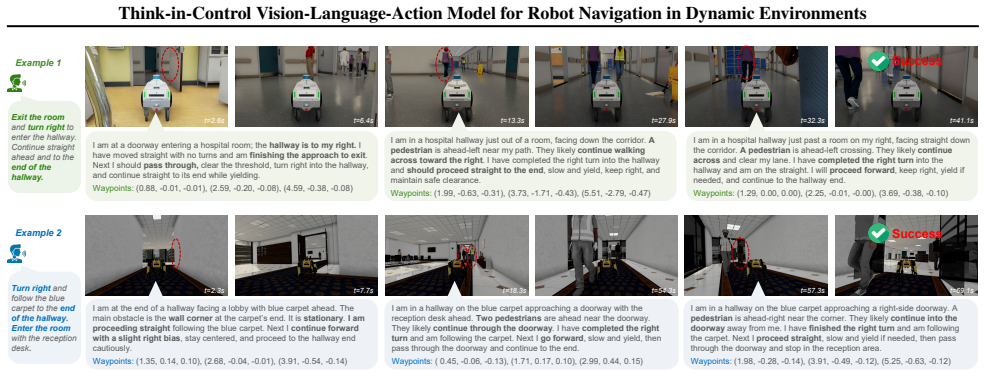
- [Figure 11] In the middle example, the text says 'passing the water fountain' and then 'stop by the fountain', but the instruction is to stop at the water dispenser; the duplicate phrase 'water water fountain' also appears. Please clarify the target and fix the wording.
- [Supp. D] The paper states 'we fine-tune only the action policy using RL while keeping the vision encoder and language model frozen', but a later sentence says 'We finetune only the final cross-attention Transformer layer and the MLP decoder of the action expert'. Please reconcile these descriptions.
Circularity Check
No significant circularity: the paper's contribution is empirical, and the final latency-robustness results are supported by deployment-like RL and real-world evaluation; the teacher-forced IL traces are a leakage/validity concern, not a derivation-level circularity.
full rationale
The paper does not claim a first-principles derivation whose output is equivalent to its input by construction. Equation (1) defines the policy input, and Eq. (3) defines the IL loss; no parameter is fitted to a subset and then renamed as a prediction of the same quantity. The main headlined results (Table 1 TIC-VLA row, Table 3 real-world) are obtained after PPO fine-tuning in Algorithm 2, which conditions on asynchronously generated VLM outputs rather than the ground-truth reasoning traces used in IL. The manuscript does contain a real validity concern: Supplementary B states 'the policy is conditioned on delayed ground-truth reasoning annotations and guidance waypoints,' and Algorithm 1 line 5 obtains the KV cache from R_{t−Δ}, where GPT-5 was prompted with future observations and future trajectory offsets. This means the IL-only ablations in Tables 2 and 9 can encode future waypoints in the input while predicting the same future trajectory in the loss, so those ablations may overstate the deployment value of the delayed semantic interface. However, this is a training/evaluation distribution mismatch and missing post-RL ablation, not a circularity of the paper's argument: the final RL-stage and real-world tests do not feed ground-truth R_{t−Δ} to the policy, and the central latency-robustness claim therefore has independent empirical support. Self-citations (e.g., Wu et al. 2023, Zhou et al. 2025) are related-work citations and are not load-bearing. DynaNav is an author-built benchmark, but the real-world robot tests provide an external check. Overall, no significant circularity is present.
Assumptions & free parameters
free parameters (5)
- Reward weights (wg=400, wp=5, wc=-100, ws=-0.1) =
400 / 5 / -100 / -0.1
- Injected reasoning delay distribution =
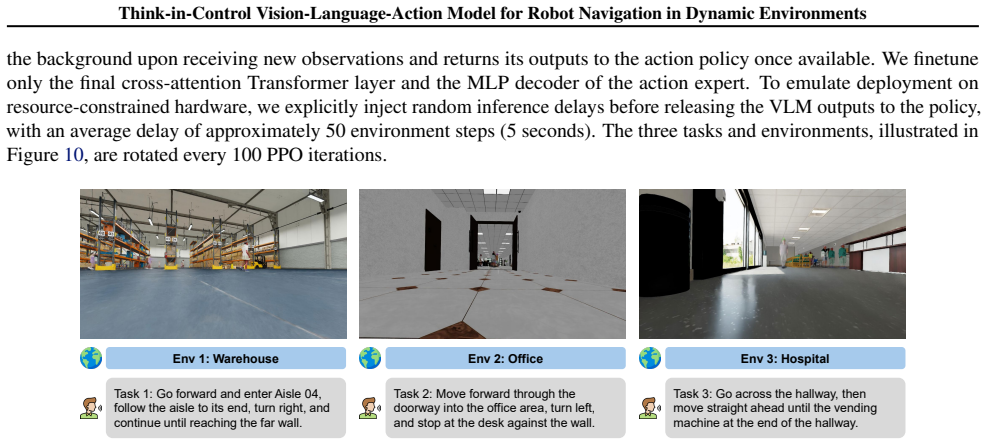
U(0,10) s in IL; ~5 s in RL
- Success and collision thresholds =
1.5 m; 0.5 m
- Action horizon and control frequency =
3 s horizon, T=30, 10 Hz
- Target speed =
1 m/s
assumptions (4)
- domain assumption GPT-5-generated reasoning annotations are accurate enough to supervise VLM fine-tuning.
- domain assumption Isaac Sim human models and physics are representative of real dynamic human-robot interaction.
- domain assumption Ego-motion offsets computed from pose are accurate enough to make latency metadata useful.
- domain assumption InternVL3-1B is a competent VLM backbone for navigation reasoning.
Cite this review
Pith. "Pith review of TIC-VLA: A Think-in-Control Vision-Language-Action Model for Robot Navigation in Dynamic Environments." pith.science (2026). https://pith.science/paper/G4CODUFK
@misc{pith2026260202459,
  author       = {Pith},
  title        = {Pith review of: TIC-VLA: A Think-in-Control Vision-Language-Action Model for Robot Navigation in Dynamic Environments},
  year         = {2026},
  howpublished = {\url{https://pith.science/paper/G4CODUFK}},
  note         = {Machine review of arXiv:2602.02459}
}
read the original abstract
Robots in dynamic, human-centric environments must follow language instructions while maintaining real-time reactive control. Vision-language-action (VLA) models offer a promising framework, but they assume temporally aligned reasoning and control, despite semantic inference being inherently delayed relative to real-time action. We introduce Think-in-Control (TIC)-VLA, a latency-aware framework that explicitly models delayed semantic reasoning during action generation. TIC-VLA defines a delayed semantic-control interface that conditions action generation on delayed vision-language semantic states and explicit latency metadata, in addition to current observations, enabling policies to compensate for asynchronous reasoning. We further propose a latency-consistent training pipeline that injects reasoning inference delays during imitation learning and online reinforcement learning, aligning training with asynchronous deployment. To support realistic evaluation, we present DynaNav, a physics-accurate, photo-realistic simulation suite for language-guided navigation in dynamic environments. Extensive experiments in simulation and on a real robot show that TIC-VLA consistently outperforms prior VLA models while maintaining robust real-time control under multi-second reasoning latency. Project website: https://ucla-mobility.github.io/TIC-VLA/
Figures


Figures from the paper (9 more)




Forward citations
Cited by 5 Pith papers
-
POINav: Benchmarking and Enhancing Final-Meters Arrival in Real-World Vision-Language Navigation
POINav-Bench provides the first high-fidelity real-world benchmark for POI-goal VLN using 3DGS reconstructions of 126k m² with 163 POIs, supported by a Brain-Action framework and 70K real signage-entrance dataset.
-
DiscreteRTC: Discrete Diffusion Policies are Natural Asynchronous Executors
Discrete diffusion policies support native asynchronous execution via unmasking for real-time chunking, delivering higher success rates and 0.7x inference cost versus flow-matching RTC on dynamic robotics benchmarks a...
-
Token-Wise Latent Streaming from Slow Reasoners to Fast Planners for Dynamic Vision Language Navigation
Streaming intermediate hidden states from a slow VLM to a fast flow-matching planner, token by token, improves dynamic social VLN success and reduces observation staleness.
-
Act on What You See: Unlocking Safe Social Navigation in Vision-Language-Action Models
SALSA aligns social features and adds future-risk signals in VLA models to cut near-collisions by 86.4% and raise social accuracy from 53% to 93% on SCAND and real robots.
-
On-Device Robotic Planning: Eliminating Inference Redundancy for Efficient Decision-Making
REIS reduces inference redundancy in embodied robotic planning via lightweight gating and routing while preserving task performance on ALFRED and real robots.
Reference graph
Works this paper leans on
-
[1]
Proceed straight toward the vending machine, turn right at the vending machine, and follow the corridor ahead
“Proceed straight toward the vending machine, turn right at the vending machine, and follow the corridor ahead.”
-
[2]
Head straight toward the vending machine, turn right at the vending machine, and continue through the corridor
“Head straight toward the vending machine, turn right at the vending machine, and continue through the corridor.”
-
[3]
Go straight to the vending machine, then turn right at the vending machine and continue down the corridor
“Go straight to the vending machine, then turn right at the vending machine and continue down the corridor.”
-
[4]
Continue forward to the vending machine, then make a right at the vending machine and go along the corridor
“Continue forward to the vending machine, then make a right at the vending machine and go along the corridor.” Generated Instruction Phase 2: Reasoning Generation per Frame Prompt GPT-5 Five ego-centric images evenly sampled over the 20-second episode Visual Observations Accumulated stepwise ego- motion offsets between consecutive frames Trajectory Info P...
2017
-
[9144]
IEEE, 2025. Shukor, M., Aubakirova, D., Capuano, F., Kooijmans, P., Palma, S., Zouitine, A., Aractingi, M., Pascal, C., Russi, M., Marafioti, A., et al. Smolvla: A vision-language- action model for affordable and efficient robotics.arXiv preprint arXiv:2506.01844, 2025. Wang, H., Chen, J., Huang, W., Ben, Q., Wang, T., Mi, B., Huang, T., Zhao, S., Chen, Y...
arXiv 2025
Reviewed August 3, 2026 · model on record in the stance chip above.
Discussion (0). Continue with ORCID to comment.