REVIEW 3 minor 69 references
Machine Learning Methods for Studying Latent Neural Activity Dynamics
T0 review · 0 major / 3 minor · reviewed 2026-06-27 · grok-4.3
Pith's one-line read Latent variable models for neural activity evolve from state-space models to deep generative models and foundation models.
desk verdict A survey that organizes existing LVM methods for neural dynamics into three categories but adds no new results or derivations. read the letter →
The pith
A machine-rendered reading of the paper's core claim, the machinery that carries it, and where it could break.
The reading
What carries the argument
The three-domain partition (Single-Region Latent Dynamics, Multi-Region Communication, Behavior-Aligned Modeling) that structures the historical progression of latent variable models from state-space to deep generative forms.
What would settle it
A sizable collection of peer-reviewed latent variable models for neural recordings that cannot be placed in any of the three domains or that shows the dominant progression running from complex deep models back to linear state-space forms.
Extended reading notes
Core claim
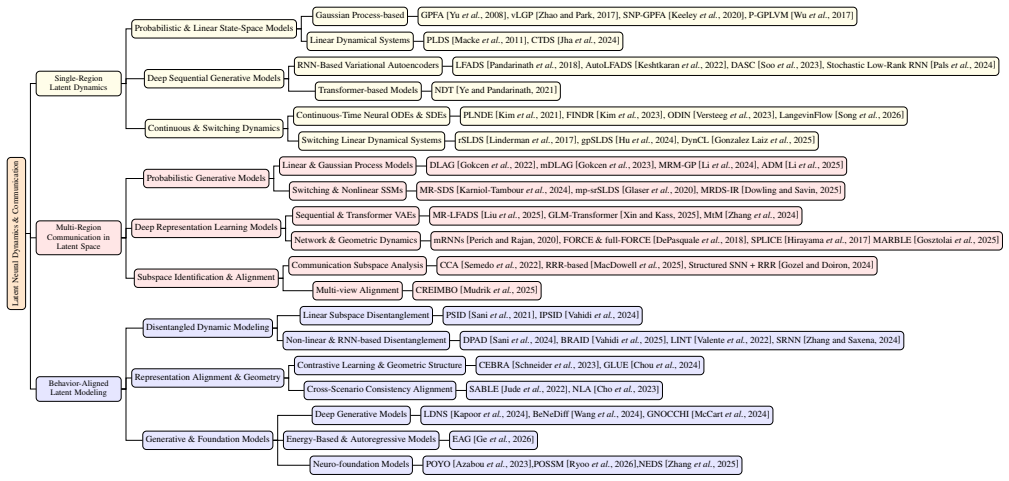
The literature on latent variable models for neural activity dynamics follows a clear trajectory from early state-space models to recent deep generative models; this trajectory can be organized into three domains of single-region latent dynamics (linear systems to RNNs and neural ODEs), multi-region communication (probabilistic and subspace methods accounting for delays and connectivity), and behavior-aligned modeling (supervised or contrastive methods that disentangle task-related activity), with large-scale pre-trained foundation models such as transformers and diffusion models now extending performance across subjects.
Load-bearing premise
The published models can be grouped into exactly these three domains without large bodies of work that would require extra categories or reverse the stated progression from simple state-space models to deep generative ones.
Editorial extensions
If this is right
- Single-region models can represent increasingly complex dynamics once RNNs and neural ODEs replace linear dynamical systems.
- Multi-region models can quantify information transfer by incorporating synaptic delays and known network connectivity.
- Behavior-aligned models can isolate task-related neural activity through supervised or contrastive objectives.
- Large-scale pre-trained transformers and diffusion models can achieve better cross-subject generalization than earlier approaches.
- Benchmarks focused on causal directionality and communication will be needed to test whether models recover interpretable links.
Reading between the lines
- The survey framework could be used to test whether hybrid models that combine all three domains improve decoding accuracy on held-out recordings.
- Open challenges around causal identification suggest experiments that compare model predictions against optogenetic or pharmacological interventions.
- The emphasis on foundation models points to possible transfer from non-neural domains such as language or vision pre-training to neural time-series data.
- Evaluation criteria listed in the paper could be applied to new datasets to check whether the three-domain narrative holds as recording technologies scale.
Signed reviews
Editorial analysis
A structured set of objections, weighed in public.
Referee Report
Summary. The manuscript is a literature survey tracing the development of latent variable models (LVMs) for neural population dynamics. It organizes the field into three domains—Single-Region Latent Dynamics (state-space models, RNNs, Neural ODEs), Multi-Region Communication (probabilistic and subspace methods accounting for delays and connectivity), and Behavior-Aligned Modeling (supervised/contrastive approaches)—while also covering large-scale foundation models (Transformers, diffusion models) and concluding with benchmarks, evaluation criteria, and open challenges such as causal identification.
Significance. A well-structured survey that explicitly maps the progression from classical dynamical systems to modern generative models and flags concrete open problems (causality, directionality) would be useful to the computational neuroscience and ML communities. The narrative organization itself is presented as a choice rather than a falsifiable partition, so its value hinges on coverage breadth rather than internal derivations.
minor comments (3)
- [Abstract / Introduction] The abstract asserts a 'comprehensive survey' without stating search methodology, inclusion/exclusion criteria, time window, or databases consulted. Adding a short 'Literature Selection' subsection would allow readers to assess potential selection bias in the three-domain partition.
- [Behavior-Aligned Modeling] In the Behavior-Aligned Modeling section, clarify whether supervised and contrastive approaches are treated as distinct sub-families or overlapping; an explicit comparison table of loss functions or alignment objectives would improve readability.
- [Large-scale neural foundation models] The discussion of neural foundation models would benefit from at least one concrete example of a pre-training objective and downstream transfer result drawn from the cited works.
Simulated Author's Rebuttal
We thank the referee for the positive summary and significance assessment of our survey on latent variable models for neural population dynamics. The recommendation of minor revision is noted. No major comments were provided in the report, so we have no specific points requiring rebuttal or revision at this stage. We will address any minor issues that arise during the revision process.
Circularity Check
No significant circularity; survey paper with no derivations
full rationale
This is a literature survey paper that organizes existing work on Latent Variable Models for neural dynamics into three narrative domains (Single-Region Latent Dynamics, Multi-Region Communication, Behavior-Aligned Modeling) plus foundation models. No equations, derivations, predictions, fitted parameters, or theorems are asserted. The central claim is the provision of an organized overview; the partition is presented as an organizational choice rather than a falsifiable or derivable result. No load-bearing steps reduce to the paper's own inputs by construction, self-citation, or renaming. The paper is self-contained as a survey against external literature benchmarks.
Assumptions & free parameters
Cite this review
Pith. "Pith review of Machine Learning Methods for Studying Latent Neural Activity Dynamics." pith.science (2026). https://pith.science/paper/G4UGMZXY
@misc{pith2026260610530,
  author       = {Pith},
  title        = {Pith review of: Machine Learning Methods for Studying Latent Neural Activity Dynamics},
  year         = {2026},
  howpublished = {\url{https://pith.science/paper/G4UGMZXY}},
  note         = {Machine review of arXiv:2606.10530}
}
read the original abstract
Recent developments in brain recording are driving a demand for machine learning tools capable of decoding the latent structure of large populations of neurons. In this paper, we provide a comprehensive survey that outlines the trajectory of Latent Variable Models (LVMs) from early state-space models to more recent deep generative models. We organize the literature into three closely related domains: (1) Single-Region Latent Dynamics, which includes models such as linear dynamical systems to more complex dynamics represented by Recurrent Neural Networks (RNNs) and Neural Ordinary Differential Equations (ODEs); (2) Multi-Region Communication, which employs probabilistic as well as subspace methods to study how information is transferred across different brain areas considering synaptic propagation delays and network connectivity; and (3) Behavior-Aligned Modeling, which seeks to disentangle neural activity related to task performance from other internal states via supervised or contrastive learning. This survey also includes large-scale neural foundation models, such as Transformers and diffusion models, that rely on large-scale pre-training for optimal performance across subjects. Finally, we conclude and discuss benchmarks, evaluation criteria, and open challenges, such as the ability to identify causal links or directionality of communication, to facilitate future research for bridging interpretable brain dynamics with reliable neural decoding.
Figures
Reference graph
Works this paper leans on
-
[1]
Multiscale low-dimensional mo- tor cortical state dynamics predict naturalistic reach-and-grasp behavior.Nat
[Abbaspourazadet al., 2021 ] Hamidreza Abbaspourazad, Mahdi Choudhury, Yan T Wong, et al. Multiscale low-dimensional mo- tor cortical state dynamics predict naturalistic reach-and-grasp behavior.Nat. Commun., 12(1):607,
2021
-
[2]
A brain-wide map of neural ac- tivity during complex behaviour.Nature, 645(8079):177–191,
[Angelakiet al., 2025 ] Dora Angelaki, Brandon Benson, Julius Benson, Daniel Birman, et al. A brain-wide map of neural ac- tivity during complex behaviour.Nature, 645(8079):177–191,
2025
-
[3]
A unified, scalable framework for neural population decoding.NeurIPS, 36:44937–44956,
[Azabouet al., 2023 ] Mehdi Azabou, Vinam Arora, Venkatara- mana Ganesh, Ximeng Mao, et al. A unified, scalable framework for neural population decoding.NeurIPS, 36:44937–44956,
2023
-
[4]
Characterizing neural manifolds’ properties and curvatures using normalizing flows
[Bouss and others, 2025] Peter Bouss et al. Characterizing neural manifolds’ properties and curvatures using normalizing flows. arXiv preprint arXiv:2506.12187,
work page Pith review arXiv 2025
-
[5]
Neural latent aligner: cross-trial alignment for learning representations of complex, naturalistic neural data
[Choet al., 2023 ] Cheol Jun Cho, Edward Chang, and Gopala Anu- manchipalli. Neural latent aligner: cross-trial alignment for learning representations of complex, naturalistic neural data. In ICML, pages 5661–5676,
2023
-
[6]
Geometry linked to untangling efficiency reveals structure and computation in neural populations.bioRxiv,
[Chouet al., 2024 ] Chi-Ning Chou, Royoung Kim, Luke A Arend, Yao-Yuan Yang, et al. Geometry linked to untangling efficiency reveals structure and computation in neural populations.bioRxiv,
2024
-
[7]
A large-scale standardized physiological survey reveals functional organization of the mouse visual cortex.Na- ture neuroscience, 23(1):138–151,
[de Vrieset al., 2020 ] Saskia EJ de Vries, Jerome A Lecoq, Michael A Buice, Peter A Groblewski, Gabriel K Ocker, Michael Oliver, David Feng, Nicholas Cain, Peter Ledochowitsch, Daniel Millman, et al. A large-scale standardized physiological survey reveals functional organization of the mouse visual cortex.Na- ture neuroscience, 23(1):138–151,
2020
-
[8]
full-force: A target- based method for training recurrent networks.PloS one, 13(2):e0191527,
[DePasqualeet al., 2018 ] Brian DePasquale, Christopher J Cueva, Kanaka Rajan, G Sean Escola, et al. full-force: A target- based method for training recurrent networks.PloS one, 13(2):e0191527,
2018
Show all 69 references
-
[9]
Nonlinear multiregion neural dynamics with parametric impulse response communication channels
[Dowling and Savin, 2025] Matthew Dowling and Cristina Savin. Nonlinear multiregion neural dynamics with parametric impulse response communication channels. InICLR,
2025
-
[10]
A theory of multineuronal dimensionality, dynamics and measure- ment.BioRxiv, page 214262,
[Gaoet al., 2017 ] Peiran Gao, Eric Trautmann, Byron Yu, et al. A theory of multineuronal dimensionality, dynamics and measure- ment.BioRxiv, page 214262,
2017
-
[11]
Energy-based autoregressive generation for neural population dynamics.Proceedings of the AAAI Conference on Artificial In- telligence, 40(1):309–317, Mar
[Geet al., 2026 ] Ningling Ge, Sicheng Dai, Yu Zhu, and Shan Yu. Energy-based autoregressive generation for neural population dynamics.Proceedings of the AAAI Conference on Artificial In- telligence, 40(1):309–317, Mar
2026
-
[12]
Recurrent switching dynam- ical systems models for multiple interacting neural populations
[Glaseret al., 2020 ] Joshua Glaser, Matthew Whiteway, John P Cunningham, Liam Paninski, et al. Recurrent switching dynam- ical systems models for multiple interacting neural populations. NeurIPS, 33:14867–14878,
2020
-
[13]
Disentangling the flow of signals between populations of neurons.Nat
[Gokcenet al., 2022 ] Evren Gokcen, Anna I Jasper, Jo ˜ao D Semedo, Amin Zandvakili, et al. Disentangling the flow of signals between populations of neurons.Nat. Comput. Sci., 2(8):512–525,
2022
-
[14]
Uncovering motifs of concurrent signal- ing across multiple neuronal populations.NeurIPS, 36:34711– 34722,
[Gokcenet al., 2023 ] Evren Gokcen, Anna Jasper, Alison Xu, Adam Kohn, et al. Uncovering motifs of concurrent signal- ing across multiple neuronal populations.NeurIPS, 36:34711– 34722,
2023
-
[15]
Self-supervised contrastive learning performs non-linear system identification
[Gonzalez Laizet al., 2025 ] Rodrigo Gonzalez Laiz, Tobias Schmidt, and Steffen Schneider. Self-supervised contrastive learning performs non-linear system identification. InInterna- tional Conference on Learning Representations, volume 2025, pages 62224–62261,
2025
-
[16]
Marble: interpretable rep- resentations of neural population dynamics using geometric deep learning.Nat
[Gosztolaiet al., 2025 ] Adam Gosztolai, Robert L Peach, Alexis Arnaudon, Mauricio Barahona, et al. Marble: interpretable rep- resentations of neural population dynamics using geometric deep learning.Nat. Methods, pages 1–9,
2025
-
[17]
Between-area communication through the lens of within-area neuronal dynamics.Sci
[Gozel and Doiron, 2024] Olivia Gozel and Brent Doiron. Between-area communication through the lens of within-area neuronal dynamics.Sci. Adv., 10(42):eadl6120,
2024
-
[18]
Splice: fully tractable hierarchical extension of ica with pooling
[Hirayamaet al., 2017 ] Jun-ichiro Hirayama, Aapo Hyv¨arinen, and Motoaki Kawanabe. Splice: fully tractable hierarchical extension of ica with pooling. InInternational Conference on Machine Learning, pages 1491–1500. PMLR,
2017
-
[19]
Modeling latent neural dynamics with gaus- sian process switching linear dynamical systems.NeurIPS, 37:33805–33835,
[Huet al., 2024 ] Amber Hu, David Zoltowski, Aditya Nair, David Anderson, et al. Modeling latent neural dynamics with gaus- sian process switching linear dynamical systems.NeurIPS, 37:33805–33835,
2024
-
[20]
Disentangling the roles of distinct cell classes with cell-type dynamical systems.NeurIPS, 37:33668–33690,
[Jhaet al., 2024 ] Aditi Jha, Diksha Gupta, Carlos Brody, and Jonathan W Pillow. Disentangling the roles of distinct cell classes with cell-type dynamical systems.NeurIPS, 37:33668–33690,
2024
-
[21]
Robust alignment of cross-session record- ings of neural population activity by behaviour via unsupervised domain adaptation.arXiv,
[Judeet al., 2022 ] Justin Jude, Matthew G Perich, Lee E Miller, and Matthias H Hennig. Robust alignment of cross-session record- ings of neural population activity by behaviour via unsupervised domain adaptation.arXiv,
2022
-
[22]
Latent diffusion for neural spiking data
[Kapooret al., 2024 ] Jaivardhan Kapoor, Auguste Schulz, Julius Vetter, Felix Pei, et al. Latent diffusion for neural spiking data. NeurIPS, 37:118119–118154,
2024
-
[23]
Modeling state- dependent communication between brain regions with switching nonlinear dynamical systems
[Karniol-Tambouret al., 2024 ] Orren Karniol-Tambour, David M Zoltowski, E Mika Diamanti, Lucas Pinto, et al. Modeling state- dependent communication between brain regions with switching nonlinear dynamical systems. InICLR,
2024
-
[24]
Identifying signal and noise structure in neural pop- ulation activity with gaussian process factor models.NeurIPS, 33:13795–13805,
[Keeleyet al., 2020 ] Stephen Keeley, Mikio Aoi, Yiyi Yu, Spencer Smith, et al. Identifying signal and noise structure in neural pop- ulation activity with gaussian process factor models.NeurIPS, 33:13795–13805,
2020
-
[25]
A large-scale neural network training framework for generalized estimation of single-trial population dynamics.Nat
[Keshtkaranet al., 2022 ] Mohammad Reza Keshtkaran, Andrew R Sedler, Raeed H Chowdhury, Raghav Tandon, et al. A large-scale neural network training framework for generalized estimation of single-trial population dynamics.Nat. Methods, 19(12):1572– 1577,
2022
-
[26]
Variational autoencoders and nonlinear ica: A unifying framework
[Khemakhemet al., 2020 ] Ilyes Khemakhem, Diederik Kingma, Ricardo Monti, and Aapo Hyvarinen. Variational autoencoders and nonlinear ica: A unifying framework. InAISTATS, pages 2207–2217,
2020
-
[27]
Inferring latent dynamics underlying neural population activity via neural differential equations
[Kimet al., 2021 ] Timothy D Kim, Thomas Z Luo, Jonathan W Pil- low, and Carlos D Brody. Inferring latent dynamics underlying neural population activity via neural differential equations. In ICML, pages 5551–5561,
2021
-
[28]
Flow-field inference from neural data using deep recurrent networks.bioRxiv,
[Kimet al., 2023 ] Timothy Doyeon Kim, Thomas Zhihao Luo, Tankut Can, Kamesh Krishnamurthy, et al. Flow-field inference from neural data using deep recurrent networks.bioRxiv,
2023
-
[29]
Multi-region markovian gaussian process: An efficient method to discover directional communications across multiple brain re- gions.PMLR, 235:28112,
[Liet al., 2024 ] Weihan Li, Chengrui Li, Yule Wang, and Anqi Wu. Multi-region markovian gaussian process: An efficient method to discover directional communications across multiple brain re- gions.PMLR, 235:28112,
2024
-
[30]
Learning time-varying multi-region brain communications via scalable markovian gaussian processes
[Liet al., 2025 ] Weihan Li, Yule Wang, Chengrui Li, and Anqi Wu. Learning time-varying multi-region brain communications via scalable markovian gaussian processes. InICML,
2025
-
[31]
Bayesian learning and inference in recurrent switching linear dynamical systems
[Lindermanet al., 2017 ] Scott Linderman, Matthew Johnson, An- drew Miller, Ryan Adams, et al. Bayesian learning and inference in recurrent switching linear dynamical systems. InAISTATS, pages 914–922,
2017
-
[32]
[Liuet al., 2025 ] Belle Liu, Jacob Sacks, and Matthew D. Golub. Accurate identification of communication between multiple in- teracting neural populations. InICML,
2025
-
[33]
Multiplexed subspaces route neural activity across brain-wide networks.Nat
[MacDowellet al., 2025 ] Camden J MacDowell, Alexandra Libby, Caroline I Jahn, Sina Tafazoli, et al. Multiplexed subspaces route neural activity across brain-wide networks.Nat. Commun., 16(1):3359,
2025
-
[34]
Empirical models of spiking in neural populations
[Mackeet al., 2011 ] Jakob H Macke, Lars Buesing, John P Cun- ningham, Byron M Yu, et al. Empirical models of spiking in neural populations. InNeurIPS, volume 24,
2011
-
[35]
Diffusion-based genera- tion of neural activity from disentangled latent codes.ArXiv,
[McCartet al., 2024 ] Jonathan D McCart, Andrew R Sedler, Christopher Versteeg, Domenick Mifsud, Mattia Rigotti- Thompson, and Chethan Pandarinath. Diffusion-based genera- tion of neural activity from disentangled latent codes.ArXiv,
2024
-
[36]
CREIMBO: Cross-regional ensemble in- teractions in multi-view brain observations
[Mudriket al., 2025 ] Noga Mudrik, Ryan Ly, Oliver Ruebel, and Adam Shabti Charles. CREIMBO: Cross-regional ensemble in- teractions in multi-view brain observations. InICLR,
2025
-
[37]
Inferring stochastic low-rank recurrent neural networks from neural data.NeurIPS, 37:18225–18264,
[Palset al., 2024 ] Matthijs Pals, A Erdem Sa ˘gtekin, Felix Pei, Manuel Gloeckler, et al. Inferring stochastic low-rank recurrent neural networks from neural data.NeurIPS, 37:18225–18264,
2024
-
[38]
Generative models of brain dynamics
[Panahiet al., 2022 ] Mahta Ramezanian Panahi, Germ ´an Abre- vaya, Jean-Christophe Gagnon-Audet, Vikram V oleti, Irina Rish, and Guillaume Dumas. Generative models of brain dynamics. Frontiers in Artificial Intelligence, 5:807406,
2022
-
[39]
Inferring single-trial neural popula- tion dynamics using sequential auto-encoders.Nat
[Pandarinathet al., 2018 ] Chethan Pandarinath, Daniel J O’Shea, Jasmine Collins, et al. Inferring single-trial neural popula- tion dynamics using sequential auto-encoders.Nat. Methods, 15(10):805–815,
2018
-
[40]
Neural latents benchmark’21: evaluating latent variable models of neural population activity.arXiv,
[Peiet al., 2021 ] Felix Pei, Joel Ye, David Zoltowski, Anqi Wu, et al. Neural latents benchmark’21: evaluating latent variable models of neural population activity.arXiv,
2021
-
[41]
Re- thinking brain-wide interactions through multi-region ‘network of networks’ models.Curr
[Perich and Rajan, 2020] Matthew G Perich and Kanaka Rajan. Re- thinking brain-wide interactions through multi-region ‘network of networks’ models.Curr. Opin. Neurobiol., 65:146–151,
2020
-
[42]
A neural manifold view of the brain.Nat
[Perichet al., 2025 ] Matthew G Perich, Devika Narain, and Juan A Gallego. A neural manifold view of the brain.Nat. Neurosci., 28(8):1582–1597,
2025
-
[43]
Generalizable, real-time neural decoding with hybrid state-space models
[Ryooet al., 2026 ] Avery Hee-Woon Ryoo, Nanda H Krishna, Xi- meng Mao, Mehdi Azabou, Eva L Dyer, Matthew G Perich, and Guillaume Lajoie. Generalizable, real-time neural decoding with hybrid state-space models. InThe Thirty-ninth Annual Confer- ence on Neural Information Proce...
2026
-
[44]
Modeling behaviorally relevant neural dynamics enabled by preferential subspace identification
[Saniet al., 2021 ] Omid G Sani, Hamidreza Abbaspourazad, Yan T Wong, Bijan Pesaran, et al. Modeling behaviorally relevant neural dynamics enabled by preferential subspace identification. Nat. Neurosci., 24(1):140–149,
2021
-
[45]
Dissociative and prioritized modeling of behaviorally relevant neural dynamics using recurrent neural networks.Nat
[Saniet al., 2024 ] Omid G Sani, Bijan Pesaran, and Maryam M Shanechi. Dissociative and prioritized modeling of behaviorally relevant neural dynamics using recurrent neural networks.Nat. Neurosci., 27(10):2033–2045,
2024
-
[46]
Learnable latent embeddings for joint behavioural and neural analysis.Nature, 617(7960):360– 368,
[Schneideret al., 2023 ] Steffen Schneider, Jin Hwa Lee, and Mackenzie Weygandt Mathis. Learnable latent embeddings for joint behavioural and neural analysis.Nature, 617(7960):360– 368,
2023
-
[47]
Modeling conditional distributions of neu- ral and behavioral data with masked variational autoencoders
[Schulzet al., 2025 ] Auguste Schulz, Julius Vetter, Richard Gao, Daniel Morales, et al. Modeling conditional distributions of neu- ral and behavioral data with masked variational autoencoders. Cell Rep., 44(3),
2025
-
[48]
Feedforward and feedback in- teractions between visual cortical areas use different population activity patterns.Nat
[Semedoet al., 2022 ] Jo˜ao D Semedo, Anna I Jasper, Amin Zand- vakili, Aravind Krishna, et al. Feedforward and feedback in- teractions between visual cortical areas use different population activity patterns.Nat. Commun., 13(1):1099,
2022
-
[49]
Survey of spiking in the mouse visual system reveals functional hierarchy.Nature, 592(7852):86–92,
[Siegleet al., 2021 ] Joshua H Siegle, Xiaoxuan Jia, S ´everine Du- rand, Sam Gale, et al. Survey of spiking in the mouse visual system reveals functional hierarchy.Nature, 592(7852):86–92,
2021
-
[50]
Anderson Keller, Yisong Yue, Pietro Perona, and Max Welling
[Songet al., 2026 ] Yue Song, T. Anderson Keller, Yisong Yue, Pietro Perona, and Max Welling. Langevin flows for modeling neural latent dynamics,
2026
-
[51]
Training biologically plausible recurrent neural net- works on cognitive tasks with long-term dependencies.NeurIPS, 36:32061–32074,
[Sooet al., 2023 ] Wayne Soo, Vishwa Goudar, and Xiao-Jing Wang. Training biologically plausible recurrent neural net- works on cognitive tasks with long-term dependencies.NeurIPS, 36:32061–32074,
2023
-
[52]
Disentangling shared and private neural dynamics with spire
[Soroushmojdehi and others, 2025] Rahil Soroushmojdehi et al. Disentangling shared and private neural dynamics with spire. arXiv preprint arXiv:2510.25023,
2025
-
[53]
Large-scale neural recordings call for new insights to link brain and behavior.Nat
[Uraiet al., 2022 ] Anne E Urai, Brent Doiron, Andrew M Leifer, and Anne K Churchland. Large-scale neural recordings call for new insights to link brain and behavior.Nat. Neurosci., 25(1):11– 19,
2022
-
[54]
Modeling and dissociation of intrinsic and input- driven neural population dynamics underlying behavior.PNAS, 121(7):e2212887121,
[Vahidiet al., 2024 ] Parsa Vahidi, Omid G Sani, and Maryam M Shanechi. Modeling and dissociation of intrinsic and input- driven neural population dynamics underlying behavior.PNAS, 121(7):e2212887121,
2024
-
[55]
Braid: Input-driven nonlinear dynamical modeling of neural-behavioral data.arXiv,
[Vahidiet al., 2025 ] Parsa Vahidi, Omid G Sani, and Maryam M Shanechi. Braid: Input-driven nonlinear dynamical modeling of neural-behavioral data.arXiv,
2025
-
[56]
Extracting computational mechanisms from neural data using low-rank rnns.NeurIPS, 35:24072–24086,
[Valenteet al., 2022 ] Adrian Valente, Jonathan W Pillow, and Srd- jan Ostojic. Extracting computational mechanisms from neural data using low-rank rnns.NeurIPS, 35:24072–24086,
2022
-
[57]
Expressive dy- namics models with nonlinear injective readouts enable reliable recovery of latent features from neural activity.arXiv,
[Versteeget al., 2023] Christopher Versteeg, Andrew R Sedler, Jonathan D McCart, and Chethan Pandarinath. Expressive dy- namics models with nonlinear injective readouts enable reliable recovery of latent features from neural activity.arXiv,
2023
-
[58]
Exploring behavior-relevant and disentangled neural dy- namics with generative diffusion models.NeurIPS, 37:34712– 34736,
[Wanget al., 2024 ] Yule Wang, Chengrui Li, Weihan Li, and Anqi Wu. Exploring behavior-relevant and disentangled neural dy- namics with generative diffusion models.NeurIPS, 37:34712– 34736,
2024
-
[59]
Animal behavioral analysis and neural encoding with transformer-based self-supervised pretraining
[Wang, 2025] others Wang. Animal behavioral analysis and neural encoding with transformer-based self-supervised pretraining. In International Conference on Learning Representations,
2025
-
[60]
Gaussian process based nonlinear latent structure discovery in multivariate spike train data.Advances in neural information processing systems, 30,
[Wuet al., 2017 ] Anqi Wu, Nicholas A Roy, Stephen Keeley, and Jonathan W Pillow. Gaussian process based nonlinear latent structure discovery in multivariate spike train data.Advances in neural information processing systems, 30,
2017
-
[61]
Identifying in- teractions across brain areas while accounting for individual- neuron dynamics with a transformer-based variational autoen- coder.arXiv,
[Xin and Kass, 2025] Qi Xin and Robert E Kass. Identifying in- teractions across brain areas while accounting for individual- neuron dynamics with a transformer-based variational autoen- coder.arXiv,
2025
-
[62]
Rep- resentation learning for neural population activity with neural data transformers.arXiv,
[Ye and Pandarinath, 2021] Joel Ye and Chethan Pandarinath. Rep- resentation learning for neural population activity with neural data transformers.arXiv,
2021
-
[63]
Gaussian-process factor analysis for low-dimensional single-trial analysis of neural population ac- tivity
[Yuet al., 2008 ] Byron M Yu, John P Cunningham, Gopal San- thanam, Stephen Ryu, et al. Gaussian-process factor analysis for low-dimensional single-trial analysis of neural population ac- tivity. InNeurIPS, volume 21,
2008
-
[64]
In- ference of neural dynamics using switching recurrent neural net- works.NeurIPS, 37:131456–131481,
[Zhang and Saxena, 2024] Yongxu Zhang and Shreya Saxena. In- ference of neural dynamics using switching recurrent neural net- works.NeurIPS, 37:131456–131481,
2024
-
[65]
universal translator
[Zhanget al., 2024 ] Yizi Zhang, Yanchen Wang, Donato Jim´enez- Benet´o, Zixuan Wang, et al. Towards a “universal translator” for neural dynamics at single-cell, single-spike resolution.NeurIPS, 37:80495–80521,
2024
-
[66]
Neural encoding and decoding at scale
[Zhanget al., 2025 ] Yizi Zhang, Yanchen Wang, Mehdi Azabou, Alexandre Andre, et al. Neural encoding and decoding at scale. arXiv,
2025
-
[67]
Varia- tional latent gaussian process for recovering single-trial dynam- ics from population spike trains.Neural Comput., 29(5):1293– 1316,
[Zhao and Park, 2017] Yuan Zhao and Il Memming Park. Varia- tional latent gaussian process for recovering single-trial dynam- ics from population spike trains.Neural Comput., 29(5):1293– 1316,
2017
-
[68]
Brain foundation models: A survey on advancements in neural signal processing and brain discovery.IEEE Signal Processing Magazine,
[Zhou and others, 2025] Zhineng Zhou et al. Brain foundation models: A survey on advancements in neural signal processing and brain discovery.IEEE Signal Processing Magazine,
2025
-
[69]
planning
A Comparison of Representative Methods Table 1 maps the surveyed methods onto the components of the unified generative process of Eqs. (1)–(2): the latent dy- namics functionf, the observation modelg, and the training objective. This structured view complements Figure 1 and ex...
2021
Reviewed June 27, 2026 · model on record in the stance chip above.
Discussion (0). Continue with ORCID to comment.