REVIEW 4 major objections 6 minor 3 cited by
ShapeLLM-Omni: A Native Multimodal LLM for 3D Generation and Understanding
T0 review · 4 major / 6 minor · reviewed 2026-08-07 · deepseek-v4-flash
Pith's one-line read This paper unifies text-to-3D, image-to-3D, 3D understanding, and 3D editing in one autoregressive model.
desk verdict Solid engineering with a valuable new 3D dataset, but the editing claim is unvalidated and the generation numbers are weaker than the prose admits. read the letter →
The pith
A machine-rendered reading of the paper's core claim, the machinery that carries it, and where it could break.
The reading
What carries the argument
The load-bearing object is the 3D VQVAE with its 8192-entry codebook. It encodes a $64^3$ voxel grid into a $16^3$ latent grid, serializes that grid into 4096 tokens, concatenates every four neighboring tokens along the channel dimension to obtain 1024 tokens with 32 channels, and quantizes them into the codebook. Those 1024 tokens are what the LLM learns to read and write, so a mesh is just another token sequence in the same transformer. A second load-bearing mechanism is the 3D-Alpaca corpus; for editing it is built by an image-mediated pipeline that renders an asset, asks ChatGPT-4o to edit the rendered image from a text instruction, and reconstructs the edited image back into a 3D mesh with Trellis, yielding 70k training pairs after filtering.
What would settle it
Take a random sample of the 70k editing pairs, reconstruct each edited mesh, and have raters check two things: whether the requested change is present and whether unchanged parts of the object still match the original. If a substantial fraction of pairs fail either check, the editing supervision is corrupted and the model's editing behavior on held-out prompts would be expected to degrade in proportion.
Extended reading notes
Core claim
On its own terms, the paper's central discovery is that 3D can be folded into a multimodal LLM's next-token prediction loop without a task-specific head: a 3D VQVAE turns a $64^{3}$ voxel grid into 1024 discrete tokens, these tokens are added to the LLM vocabulary, and after instruction tuning on 3D-Alpaca the single model handles text-to-3D, image-to-3D, 3D captioning, and instruction-based 3D editing. The same 1024 tokens serve as both the input representation for understanding and the output representation for generation, letting the model read an existing mesh, respond to a prompt, and emit an edited or new mesh in one continuous token stream. The paper reports language benchmarks close to its 7B backbone, captioning scores near a dedicated PointLLM model, and generation quality below but close to Trellis, which it uses as the performance upper bound.
Load-bearing premise
The editing capability stands on the unverified assumption that the auto-generated training pairs—ChatGPT-4o's image edits followed by Trellis 3D reconstruction—actually realize the intended edits while preserving the rest of the object; the paper gives no consistency metric for these pairs and no quantitative 3D-editing evaluation.
Editorial extensions
If this is right
- A single model can interleave text, images, and 3D tokens, so 3D generation can use multi-turn conversational context instead of a fixed one-shot prompt.
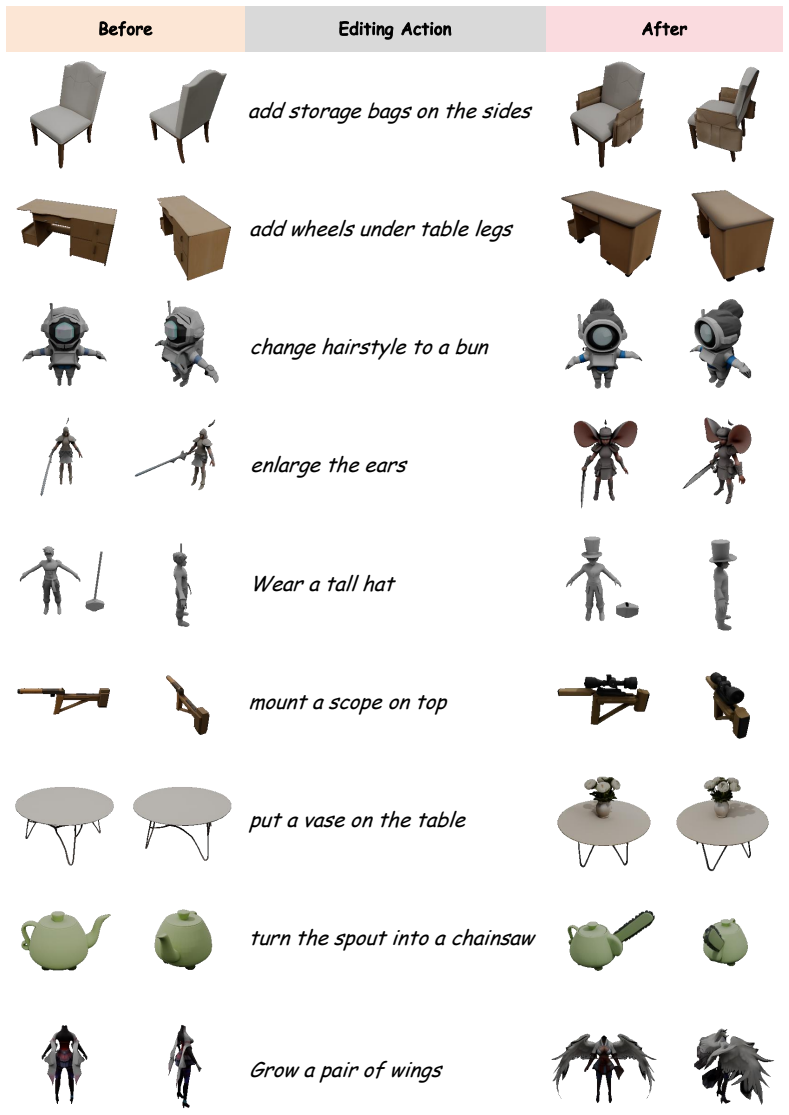
- Instruction-based 3D editing becomes an autoregressive continuation problem: the model reads the current mesh tokens plus the edit request and emits the edited mesh tokens, supporting iterative changes in one system.
- The 3D-Alpaca corpus, with 2.56M samples and 3.46B tokens covering generation, captioning, and editing, is a reusable instruction dataset for training other or larger backbones.
- The 1024-token voxel representation fits 3D within the context windows of existing LLMs while staying accurate enough for downstream reconstruction via a rectified-flow voxel-to-mesh refiner.
Reading between the lines
- If the central claim holds, the image-mediated editing pipeline could be reused to mint cheap training pairs for new categories, making 3D-editing supervision scalable.
- The paper does not explore chains like caption-then-edit; a direct test of the native claim would be whether the model can compose those steps in one session.
- A testable extension is an ablation of editing-pair count (for example 5k versus 70k pairs) to see whether editing quality is bounded by data quantity or by the fidelity of the automatically generated pairs.
- Because images stay continuous while 3D is discrete, the architecture is asymmetric, so one prediction is that the model's image-conditioned 3D reasoning should be strong while image generation itself would require a separate image tokenizer.
Signed reviews
Editorial analysis
A structured set of objections, weighed in public.
Referee Report
Summary. The paper presents ShapeLLM-Omni, a Qwen-2.5-VL-Instruct-7B model extended with a discrete 3D token vocabulary from a VQVAE that maps 64^3 voxel grids to 1024 tokens. The model is trained in a fully autoregressive next-token prediction setting on 3D-Alpaca, a newly constructed corpus containing text-to-3D, image-to-3D, 3D captioning, and language-driven 3D editing instances, together with UltraChat for language preservation. The authors report that the model retains language capabilities, achieves generation quality below Trellis but above most baselines on Toys4K metrics, is competitive with PointLLM on captioning, and qualitatively supports 3D editing. The main contributions are the unified framework and the large 3D instruction dataset.
Significance. If the empirical claims are confirmed, this is a useful step toward native 3D multimodal LLMs: the early fusion of discrete 3D tokens with text and images inside a single autoregressive model is a natural and scalable design, and the 3D-Alpaca corpus (2.56M samples, 3.46B tokens) is a substantial community resource. The authors are commendably transparent that Trellis, the model that supplies the tokenizer and decoder, outperforms the proposed system on all generation metrics. However, the paper's headline claim of a four-capability system is only partially supported: the editing leg lacks any quantitative validation, and several quantitative statements are overstated relative to the tables. These issues are local and addressable.
major comments (4)
- [§3.4, §4.3] The claimed 3D editing capability is not established. In Section 3.4, steps (5)–(6), each editing pair is produced by rendering a 3D asset to a frontal image, asking ChatGPT-4o to edit the image, and reconstructing the edited image with Trellis; no identity-preservation score, edit-success rate, or reconstruction-consistency metric is reported for the 70k pairs. The only evaluation in Section 4.3 is the qualitative Figure 6, and Appendix A.2 shows dataset examples, not an independent test. Because editing is one of the four central capabilities claimed in Section 3.2 and the paper's own Limitation states that 70k pairs are far too few for ChatGPT-4o-level editing, this claim needs either quantitative validation (e.g., held-out edit alignment and identity metrics, human study) or a substantially weakened formulation.
- [§4.2, Table 5; §3.4] No train/test separation is reported for the 3D understanding evaluation. 3D-Alpaca is built from Objaverse-XL/Objaverse plus other 3D datasets, and Table 5 evaluates captioning on PointLLM's curated Objaverse test set. The paper must state explicitly that the test assets were excluded from 3D-Alpaca; without that statement, the captioning numbers in Table 5 may be inflated by train/test overlap. The same clarification is needed for the Toys4K generation evaluation in Table 4, since the paper does not state that Toys4K test prompts/assets are disjoint from the 3D-Alpaca training collection.
- [§4.2, Tables 4 and 5] Two quantitative claims in the text are not supported by the reported numbers. First, "our generation results outperform all baseline methods except for Trellis" is contradicted by Table 4: on image-to-3D CLIP score, SAR3D obtains 84.70 while ShapeLLM-Omni obtains 84.5; moreover, Trellis is better than the proposed model on every generation metric, not merely in an unspecified way. Second, Table 5's caption "our model achieves better performance on 3D understanding/caption tasks" is misleading: PointLLM-13B* is higher on Sentence-BERT (50.15 vs. 48.34) and SimCSE (50.83 vs. 49.72), and the text in Section 4.2 calling the model "second only to PointLLM" is therefore not accurate across metrics. These overstatements should be corrected.
- [§3.4, Table 2; §4.1 and Appendix B.1] Several dataset and training numbers are internally inconsistent. The Introduction states 62k paired 3D meshes for editing, Section 3.4 reports 70k valid editing samples, and Table 2 reports 420k items for 3D-Edit; the relationship between pairs and dialogue items should be stated. The Introduction also gives 710k text/image-3D pairs while Section 3.4 and Table 2 use 712k. For training, Section 4.1 reports a learning-rate decay from 5e-5 to 5e-6 and 15 epochs, whereas Appendix B.1 reports a constant 1e-5 learning rate and 60k iterations; the schedule and stopping criterion should be reconciled.
minor comments (6)
- [Table 3] The SIQA row for Chameleon-7B appears as "5740.4", which is either a formatting error or a corrupted value; the bold/underline markers in this table are also applied inconsistently.
- [Table 5] The column header "BLUE-1" should read "BLEU-1", and the duplicate references [22] and [23] should be merged.
- [Figure 10] Figure 10 has the caption "Some cases of 3D editing result from our method" but it shows 3D-to-caption results; this caption appears to have been copied from Figure 6 and should be corrected.
- [§3.3] The description of channel concatenation ("4096 tokens with 8 channels into 1024 tokens with 32 channels") should specify how neighboring tokens are grouped, for example by reshaping the 16^3 latent grid before concatenation, so the operation is unambiguous.
- [Abstract] The abstract contains a sentence fragment: "Finally, by performing instruction-based training of the Qwen-2.5-vl-7B-Instruct model on the 3D-Alpaca dataset." should be completed or merged with the following sentence.
- [§3.4] The captioning ground truth is produced by Qwen-2.5-VL-Instruct, the same model family being fine-tuned; this self-distillation choice should be acknowledged as a limitation, since it may bias the teacher-student relationship and the diversity of captions.
Circularity Check
No significant circularity: central claims are benchmarked externally; the unvalidated 3D-editing pipeline and Qwen-based caption self-distillation are evidence gaps, not circular reductions.
full rationale
This is an empirical systems paper rather than a derivation chain. The central claims are evaluated against external benchmarks and baselines: language abilities on MMLU/PIQA/GSM8K/SIQA, 3D generation on Toys4K against CRM, SAR3D, 3DTopia-XL, and TRELLIS, and 3D-to-caption on PointLLM's Objaverse benchmark. The 3D VQVAE is trained with its own reconstruction objective and ablated on Chamfer/Hausdorff distance. No 'prediction' in the paper is a fitted parameter renamed as a prediction by construction. The closest concern is that 3D-Alpaca captions are generated by Qwen-2.5-VL-Instruct and the model is initialized from Qwen-2.5-VL-7B-Instruct (Sec. 3.4 and Sec. 4.1), making the captioning task a self-distillation; however, the paper does not present captioning as a derived theorem, and the quantitative caption evaluation uses the external PointLLM benchmark, so this is a data-construction choice rather than a circular reduction. The 3D editing leg uses an image-mediated pipeline (render, ChatGPT-4o edit, TRELLIS reconstruction) with no quantitative consistency or identity metric (Sec. 3.4 and Sec. 4.3); this is a correctness and evidence gap, not circularity, because the model's edited mesh is not identical to the pipeline input by construction. The paper cites the authors' prior works (e.g., LLaMA-Mesh, CRM, ProlificDreamer) contextually in Related Work; none is invoked as a load-bearing uniqueness theorem or as the justification for a forced choice. Overall, no step reduces to its own inputs; score 2 reflects minor non-load-bearing self-citations and the self-distillation, not a circular derivation.
Assumptions & free parameters
free parameters (6)
- 3D VQVAE codebook size =
8192
- Token concatenation factor =
4
- Editing prompts per category =
20
- Assets per editing prompt =
200
- Dialogue templates per task =
25
- Generation sampling hyperparameters =
top-k=8192, top-p=0.7, temperature=0.7
assumptions (5)
- domain assumption 64^3 voxel grids preserve enough skeletal structure for high-quality mesh reconstruction.
- domain assumption Qwen-2.5-VL-Instruct captions are high-quality ground truth for 3D captioning and text-to-3D prompts.
- domain assumption ChatGPT-4o image edits lifted through Trellis image-to-3D reconstruction produce valid, identity-preserving 3D editing pairs.
- domain assumption Trellis pretrained VQVAE and rectified-flow decoder parameters are a suitable base and remain valid after codebook fine-tuning.
- domain assumption Toys4K test prompts and images are representative for text-to-3D and image-to-3D evaluation.
invented entities (1)
-
Grey texture latent
Cite this review
Pith. "Pith review of ShapeLLM-Omni: A Native Multimodal LLM for 3D Generation and Understanding." pith.science (2026). https://pith.science/paper/G55CEGWQ
@misc{pith2026250601853,
  author       = {Pith},
  title        = {Pith review of: ShapeLLM-Omni: A Native Multimodal LLM for 3D Generation and Understanding},
  year         = {2026},
  howpublished = {\url{https://pith.science/paper/G55CEGWQ}},
  note         = {Machine review of arXiv:2506.01853}
}
read the original abstract
Recently, the powerful text-to-image capabilities of ChatGPT-4o have led to growing appreciation for native multimodal large language models. However, its multimodal capabilities remain confined to images and text. Yet beyond images, the ability to understand and generate 3D content is equally crucial. To address this gap, we propose ShapeLLM-Omni-a native 3D large language model capable of understanding and generating 3D assets and text in any sequence. First, we train a 3D vector-quantized variational autoencoder (VQVAE), which maps 3D objects into a discrete latent space to achieve efficient and accurate shape representation and reconstruction. Building upon the 3D-aware discrete tokens, we innovatively construct a large-scale continuous training dataset named 3D-Alpaca, encompassing generation, comprehension, and editing, thus providing rich resources for future research and training. Finally, by performing instruction-based training of the Qwen-2.5-vl-7B-Instruct model on the 3D-Alpaca dataset. Our work provides an effective attempt at extending multimodal models with basic 3D capabilities, which contributes to future research in 3D-native AI. Project page: https://github.com/JAMESYJL/ShapeLLM-Omni
Figures


Figures from the paper (12 more)




Forward citations
Cited by 3 Pith papers
-
PhysX-CoT: Structured Physical Reasoning from a Single Image to Simulation-Ready 3D Assets
PhysX-CoT turns single-image 3D asset generation into an explicit, ordered, supervised chain of physical states, beating an output-centric VLM baseline on geometry and physical attributes.
-
Hunyuan3D-Buffalo 1.0: A Unified Multimodal Model for Scalable 3D Generation, Understanding, and Editing
A unified 3D multimodal model combines understanding, text-to-3D generation, instruction-guided editing, and part generation in one architecture, trained on an 87M-sample corpus, with claimed state-of-the-art results.
-
ELSA3D: Elastic Semantic Anchoring for Unified 3D Understanding and Generation
ELSA3D introduces elastic semantic anchoring via sparse anchor tokens and a scale-aware octree tokenizer to unify 3D generation and captioning at reduced computational cost.
Reference graph
Works this paper leans on
-
[1]
Gpt-4 technical report.arXiv preprint arXiv:2303.08774, 2023
Josh Achiam, Steven Adler, Sandhini Agarwal, Lama Ahmad, Ilge Akkaya, Florencia Leoni Aleman, Diogo Almeida, Janko Altenschmidt, Sam Altman, Shyamal Anadkat, et al. Gpt-4 technical report.arXiv preprint arXiv:2303.08774, 2023
arXiv 2023
-
[2]
Flamingo: a visual language model for few-shot learning.Advances in neural information processing systems, 35:23716–23736, 2022
Jean-Baptiste Alayrac, Jeff Donahue, Pauline Luc, Antoine Miech, Iain Barr, Yana Hasson, Karel Lenc, Arthur Mensch, Katherine Millican, Malcolm Reynolds, et al. Flamingo: a visual language model for few-shot learning.Advances in neural information processing systems, 35:23716–23736, 2022
2022
-
[3]
Qwen technical report.arXiv preprint arXiv:2309.16609, 2023
Jinze Bai, Shuai Bai, Yunfei Chu, Zeyu Cui, Kai Dang, Xiaodong Deng, Yang Fan, Wenbin Ge, Yu Han, Fei Huang, et al. Qwen technical report.arXiv preprint arXiv:2309.16609, 2023
arXiv 2023
-
[4]
Shuai Bai, Keqin Chen, Xuejing Liu, Jialin Wang, Wenbin Ge, Sibo Song, Kai Dang, Peng Wang, Shijie Wang, Jun Tang, et al. Qwen2. 5-vl technical report.arXiv preprint arXiv:2502.13923, 2025
arXiv 2025
-
[5]
Mikołaj Bi´nkowski, Danica J Sutherland, Michael Arbel, and Arthur Gretton. Demystifying mmd gans. arXiv preprint arXiv:1801.01401, 2018
arXiv 2018
-
[6]
Piqa: Reasoning about physical common- sense in natural language
Yonatan Bisk, Rowan Zellers, Jianfeng Gao, Yejin Choi, et al. Piqa: Reasoning about physical common- sense in natural language. InProceedings of the AAAI conference on artificial intelligence, volume 34, pages 7432–7439, 2020
2020
-
[7]
Shapenet: An information-rich 3d model repository
Angel X Chang, Thomas Funkhouser, Leonidas Guibas, Pat Hanrahan, Qixing Huang, Zimo Li, Silvio Savarese, Manolis Savva, Shuran Song, Hao Su, et al. Shapenet: An information-rich 3d model repository. arXiv preprint arXiv:1512.03012, 2015
arXiv 2015
-
[8]
Pointgpt: Auto-regressively generative pre-training from point clouds.Advances in Neural Information Processing Systems, 36: 29667–29679, 2023
Guangyan Chen, Meiling Wang, Yi Yang, Kai Yu, Li Yuan, and Yufeng Yue. Pointgpt: Auto-regressively generative pre-training from point clouds.Advances in Neural Information Processing Systems, 36: 29667–29679, 2023
2023
Show all 108 references
-
[9]
Microdreamer: Zero- shot 3d generation in 20 seconds by score-based iterative reconstruction.arXiv e-prints, pages arXiv–2404, 2024
Luxi Chen, Zhengyi Wang, Chongxuan Li, Tingting Gao, Hang Su, and Jun Zhu. Microdreamer: Zero- shot 3d generation in 20 seconds by score-based iterative reconstruction.arXiv e-prints, pages arXiv–2404, 2024
2024
-
[10]
Fantasia3d: Disentangling geometry and appearance for high-quality text-to-3d content creation.arXiv preprint arXiv:2303.13873, 2023
Rui Chen, Yongwei Chen, Ningxin Jiao, and Kui Jia. Fantasia3d: Disentangling geometry and appearance for high-quality text-to-3d content creation.arXiv preprint arXiv:2303.13873, 2023
2023 arXiv
-
[11]
Meshxl: Neural coordinate field for generative 3d foundation models.Advances in Neural Information Processing Systems, 37:97141–97166, 2025
Sijin Chen, Xin Chen, Anqi Pang, Xianfang Zeng, Wei Cheng, Yijun Fu, Fukun Yin, Billzb Wang, Jingyi Yu, Gang Yu, et al. Meshxl: Neural coordinate field for generative 3d foundation models.Advances in Neural Information Processing Systems, 37:97141–97166, 2025
2025
-
[12]
Meshanything: Artist-created mesh generation with autoregressive transformers
Yiwen Chen, Tong He, Di Huang, Weicai Ye, Sijin Chen, Jiaxiang Tang, Xin Chen, Zhongang Cai, Lei Yang, Gang Yu, et al. Meshanything: Artist-created mesh generation with autoregressive transformers. arXiv preprint arXiv:2406.10163, 2024. 12
2024 arXiv
-
[13]
Meshanything v2: Artist-created mesh generation with adjacent mesh tokenization.arXiv preprint arXiv:2408.02555, 2024
Yiwen Chen, Yikai Wang, Yihao Luo, Zhengyi Wang, Zilong Chen, Jun Zhu, Chi Zhang, and Guosheng Lin. Meshanything v2: Artist-created mesh generation with adjacent mesh tokenization.arXiv preprint arXiv:2408.02555, 2024
2024 arXiv
-
[14]
Sar3d: Autoregressive 3d object generation and understanding via multi-scale 3d vqvae
Yongwei Chen, Yushi Lan, Shangchen Zhou, Tengfei Wang, and Xingang Pan. Sar3d: Autoregressive 3d object generation and understanding via multi-scale 3d vqvae. InCVPR, 2025
2025
-
[15]
3dtopia-xl: Scaling high-quality 3d asset generation via primitive diffusion.arXiv preprint arXiv:2409.12957, 2024
Zhaoxi Chen, Jiaxiang Tang, Yuhao Dong, Ziang Cao, Fangzhou Hong, Yushi Lan, Tengfei Wang, Haozhe Xie, Tong Wu, Shunsuke Saito, et al. 3dtopia-xl: Scaling high-quality 3d asset generation via primitive diffusion.arXiv preprint arXiv:2409.12957, 2024
2024 arXiv
-
[16]
Internvl: Scaling up vision foundation models and aligning for generic visual-linguistic tasks
Zhe Chen, Jiannan Wu, Wenhai Wang, Weijie Su, Guo Chen, Sen Xing, Muyan Zhong, Qinglong Zhang, Xizhou Zhu, Lewei Lu, et al. Internvl: Scaling up vision foundation models and aligning for generic visual-linguistic tasks. InProceedings of the IEEE/CVF conference on computer visi...
2024
-
[17]
Text-to-3d using gaussian splatting
Zilong Chen, Feng Wang, Yikai Wang, and Huaping Liu. Text-to-3d using gaussian splatting. In Proceedings of the IEEE/CVF conference on computer vision and pattern recognition, pages 21401– 21412, 2024
2024
-
[18]
V3d: Video diffusion models are effective 3d generators.arXiv preprint arXiv:2403.06738, 2024
Zilong Chen, Yikai Wang, Feng Wang, Zhengyi Wang, and Huaping Liu. V3d: Video diffusion models are effective 3d generators.arXiv preprint arXiv:2403.06738, 2024
2024 arXiv
-
[19]
Videollama 2: Advancing spatial-temporal modeling and audio understanding in video-llms.arXiv preprint arXiv:2406.07476, 2024
Zesen Cheng, Sicong Leng, Hang Zhang, Yifei Xin, Xin Li, Guanzheng Chen, Yongxin Zhu, Wenqi Zhang, Ziyang Luo, Deli Zhao, et al. Videollama 2: Advancing spatial-temporal modeling and audio understanding in video-llms.arXiv preprint arXiv:2406.07476, 2024
2024 arXiv
-
[20]
Training verifiers to solve math word problems, 2021.URL https://arxiv
Karl Cobbe, Vineet Kosaraju, Mohammad Bavarian, Mark Chen, Heewoo Jun, Lukasz Kaiser, Matthias Plappert, Jerry Tworek, Jacob Hilton, Reiichiro Nakano, et al. Training verifiers to solve math word problems, 2021.URL https://arxiv. org/abs/2110.14168, 9, 2021
2021 arXiv
-
[21]
Abo: Dataset and benchmarks for real-world 3d object understanding
Jasmine Collins, Shubham Goel, Kenan Deng, Achleshwar Luthra, Leon Xu, Erhan Gundogdu, Xi Zhang, Tomas F Yago Vicente, Thomas Dideriksen, Himanshu Arora, et al. Abo: Dataset and benchmarks for real-world 3d object understanding. InProceedings of the IEEE/CVF conference on comp...
2022
-
[23]
Objaverse-xl: A universe of 10m+ 3d objects.Advances in Neural Information Processing Systems, 36:35799–35813, 2023
Matt Deitke, Ruoshi Liu, Matthew Wallingford, Huong Ngo, Oscar Michel, Aditya Kusupati, Alan Fan, Christian Laforte, Vikram V oleti, Samir Yitzhak Gadre, et al. Objaverse-xl: A universe of 10m+ 3d objects.Advances in Neural Information Processing Systems, 36:35799–35813, 2023
2023
-
[24]
Enhancing chat language models by scaling high-quality instructional conversations
Ning Ding, Yulin Chen, Bokai Xu, Yujia Qin, Zhi Zheng, Shengding Hu, Zhiyuan Liu, Maosong Sun, and Bowen Zhou. Enhancing chat language models by scaling high-quality instructional conversations. arXiv preprint arXiv:2305.14233, 2023
2023 arXiv
-
[25]
Chatglm: A family of large language models from glm-130b to glm-4 all tools.arXiv preprint arXiv:2406.12793, 2024
Team GLM, Aohan Zeng, Bin Xu, Bowen Wang, Chenhui Zhang, Da Yin, Dan Zhang, Diego Rojas, Guanyu Feng, Hanlin Zhao, et al. Chatglm: A family of large language models from glm-130b to glm-4 all tools.arXiv preprint arXiv:2406.12793, 2024
2024 arXiv
-
[26]
Fila-video: Spatio-temporal compression for fine-grained long video understanding.arXiv preprint arXiv:2504.20384, 2025
Yanan Guo, Wenhui Dong, Jun Song, Shiding Zhu, Xuan Zhang, Hanqing Yang, Yingbo Wang, Yang Du, Xianing Chen, and Bo Zheng. Fila-video: Spatio-temporal compression for fine-grained long video understanding.arXiv preprint arXiv:2504.20384, 2025
2025 arXiv
-
[27]
Meshtron: High-fidelity, artist-like 3d mesh generation at scale.arXiv preprint arXiv:2412.09548, 2024
Zekun Hao, David W Romero, Tsung-Yi Lin, and Ming-Yu Liu. Meshtron: High-fidelity, artist-like 3d mesh generation at scale.arXiv preprint arXiv:2412.09548, 2024
2024 arXiv
-
[28]
Measuring massive multitask language understanding.arXiv preprint arXiv:2009.03300, 2020
Dan Hendrycks, Collin Burns, Steven Basart, Andy Zou, Mantas Mazeika, Dawn Song, and Jacob Steinhardt. Measuring massive multitask language understanding.arXiv preprint arXiv:2009.03300, 2020
2009 arXiv
-
[29]
Gans trained by a two time-scale update rule converge to a local nash equilibrium.Advances in neural information processing systems, 30, 2017
Martin Heusel, Hubert Ramsauer, Thomas Unterthiner, Bernhard Nessler, and Sepp Hochreiter. Gans trained by a two time-scale update rule converge to a local nash equilibrium.Advances in neural information processing systems, 30, 2017
2017
-
[30]
Denoising diffusion probabilistic models.Advances in neural information processing systems, 33:6840–6851, 2020
Jonathan Ho, Ajay Jain, and Pieter Abbeel. Denoising diffusion probabilistic models.Advances in neural information processing systems, 33:6840–6851, 2020. 13
2020
-
[31]
Lrm: Large reconstruction model for single image to 3d.arXiv preprint arXiv:2311.04400, 2023
Yicong Hong, Kai Zhang, Jiuxiang Gu, Sai Bi, Yang Zhou, Difan Liu, Feng Liu, Kalyan Sunkavalli, Trung Bui, and Hao Tan. Lrm: Large reconstruction model for single image to 3d.arXiv preprint arXiv:2311.04400, 2023
2023 arXiv
-
[32]
3d-llm: Injecting the 3d world into large language models.Advances in Neural Information Processing Systems, 36:20482–20494, 2023
Yining Hong, Haoyu Zhen, Peihao Chen, Shuhong Zheng, Yilun Du, Zhenfang Chen, and Chuang Gan. 3d-llm: Injecting the 3d world into large language models.Advances in Neural Information Processing Systems, 36:20482–20494, 2023
2023
-
[33]
Spar3d: Stable point-aware reconstruction of 3d objects from single images.arXiv preprint arXiv:2501.04689, 2025
Zixuan Huang, Mark Boss, Aaryaman Vasishta, James M Rehg, and Varun Jampani. Spar3d: Stable point-aware reconstruction of 3d objects from single images.arXiv preprint arXiv:2501.04689, 2025
2025 arXiv
-
[35]
Gpt-4o system card.arXiv preprint arXiv:2410.21276, 2024
Aaron Hurst, Adam Lerer, Adam P Goucher, Adam Perelman, Aditya Ramesh, Aidan Clark, AJ Ostrow, Akila Welihinda, Alan Hayes, Alec Radford, et al. Gpt-4o system card.arXiv preprint arXiv:2410.21276, 2024
2024 arXiv
-
[36]
3d gaussian splatting for real-time radiance field rendering.ACM Trans
Bernhard Kerbl, Georgios Kopanas, Thomas Leimkühler, and George Drettakis. 3d gaussian splatting for real-time radiance field rendering.ACM Trans. Graph., 42(4):139–1, 2023
2023
-
[37]
Instant3d: Fast text-to-3d with sparse-view generation and large reconstruction model.arXiv preprint arXiv:2311.06214, 2023
Jiahao Li, Hao Tan, Kai Zhang, Zexiang Xu, Fujun Luan, Yinghao Xu, Yicong Hong, Kalyan Sunkavalli, Greg Shakhnarovich, and Sai Bi. Instant3d: Fast text-to-3d with sparse-view generation and large reconstruction model.arXiv preprint arXiv:2311.06214, 2023
2023 arXiv
-
[38]
Sweetdreamer: Aligning geometric priors in 2d diffusion for consistent text-to-3d.arxiv:2310.02596, 2023
Weiyu Li, Rui Chen, Xuelin Chen, and Ping Tan. Sweetdreamer: Aligning geometric priors in 2d diffusion for consistent text-to-3d.arxiv:2310.02596, 2023
2023 arXiv
-
[39]
Craftsman: High-fidelity mesh generation with 3d native generation and interactive geometry refiner.arXiv preprint arXiv:2405.14979, 2024
Weiyu Li, Jiarui Liu, Rui Chen, Yixun Liang, Xuelin Chen, Ping Tan, and Xiaoxiao Long. Craftsman: High-fidelity mesh generation with 3d native generation and interactive geometry refiner.arXiv preprint arXiv:2405.14979, 2024
2024 arXiv
-
[40]
Llama-vid: An image is worth 2 tokens in large language models
Yanwei Li, Chengyao Wang, and Jiaya Jia. Llama-vid: An image is worth 2 tokens in large language models. InEuropean Conference on Computer Vision, pages 323–340. Springer, 2024
2024
-
[41]
Magic3d: High-resolution text-to-3d content creation
Chen-Hsuan Lin, Jun Gao, Luming Tang, Towaki Takikawa, Xiaohui Zeng, Xun Huang, Karsten Kreis, Sanja Fidler, Ming-Yu Liu, and Tsung-Yi Lin. Magic3d: High-resolution text-to-3d content creation. In IEEE Conference on Computer Vision and Pattern Recognition (CVPR), 2023
2023
-
[42]
Deepseek-v3 technical report.arXiv preprint arXiv:2412.19437, 2024
Aixin Liu, Bei Feng, Bing Xue, Bingxuan Wang, Bochao Wu, Chengda Lu, Chenggang Zhao, Chengqi Deng, Chenyu Zhang, Chong Ruan, et al. Deepseek-v3 technical report.arXiv preprint arXiv:2412.19437, 2024
2024 arXiv
-
[43]
Reconx: Reconstruct any scene from sparse views with video diffusion model, 2024
Fangfu Liu, Wenqiang Sun, Hanyang Wang, Yikai Wang, Haowen Sun, Junliang Ye, Jun Zhang, and Yueqi Duan. Reconx: Reconstruct any scene from sparse views with video diffusion model, 2024. URL https://arxiv.org/abs/2408.16767
2024 arXiv
-
[44]
World model on million-length video and language with blockwise ringattention.arXiv preprint arXiv:2402.08268, 2024
Hao Liu, Wilson Yan, Matei Zaharia, and Pieter Abbeel. World model on million-length video and language with blockwise ringattention.arXiv preprint arXiv:2402.08268, 2024
2024 arXiv
-
[45]
Visual instruction tuning.Advances in neural information processing systems, 36:34892–34916, 2023
Haotian Liu, Chunyuan Li, Qingyang Wu, and Yong Jae Lee. Visual instruction tuning.Advances in neural information processing systems, 36:34892–34916, 2023
2023
-
[46]
One-2- 3-45: Any single image to 3d mesh in 45 seconds without per-shape optimization.Advances in Neural Information Processing Systems, 36:22226–22246, 2023
Minghua Liu, Chao Xu, Haian Jin, Linghao Chen, Mukund Varma T, Zexiang Xu, and Hao Su. One-2- 3-45: Any single image to 3d mesh in 45 seconds without per-shape optimization.Advances in Neural Information Processing Systems, 36:22226–22246, 2023
2023
-
[47]
Zero-1-to-3: Zero-shot one image to 3d object
Ruoshi Liu, Rundi Wu, Basile Van Hoorick, Pavel Tokmakov, Sergey Zakharov, and Carl V ondrick. Zero-1-to-3: Zero-shot one image to 3d object. InProceedings of the IEEE/CVF international conference on computer vision, pages 9298–9309, 2023
2023
-
[48]
Syncdreamer: Generating multiview-consistent images from a single-view image.arXiv preprint arXiv:2309.03453, 2023
Yuan Liu, Cheng Lin, Zijiao Zeng, Xiaoxiao Long, Lingjie Liu, Taku Komura, and Wenping Wang. Syncdreamer: Generating multiview-consistent images from a single-view image.arXiv preprint arXiv:2309.03453, 2023
2023 arXiv
-
[49]
Wonder3d: Single image to 3d using cross-domain diffusion
Xiaoxiao Long, Yuan-Chen Guo, Cheng Lin, Yuan Liu, Zhiyang Dou, Lingjie Liu, Yuexin Ma, Song-Hai Zhang, Marc Habermann, Christian Theobalt, et al. Wonder3d: Single image to 3d using cross-domain diffusion. InProceedings of the IEEE/CVF conference on computer vision and pattern...
2024
-
[50]
Marching cubes: A high resolution 3d surface construction algorithm
William E Lorensen and Harvey E Cline. Marching cubes: A high resolution 3d surface construction algorithm. InSeminal graphics: pioneering efforts that shaped the field, pages 347–353. 1998
1998
-
[51]
Video-chatgpt: Towards detailed video understanding via large vision and language models.arXiv preprint arXiv:2306.05424, 2023
Muhammad Maaz, Hanoona Rasheed, Salman Khan, and Fahad Shahbaz Khan. Video-chatgpt: Towards detailed video understanding via large vision and language models.arXiv preprint arXiv:2306.05424, 2023
2023 arXiv
-
[52]
Nerf: Representing scenes as neural radiance fields for view synthesis.Communications of the ACM, 65(1):99–106, 2021
Ben Mildenhall, Pratul P Srinivasan, Matthew Tancik, Jonathan T Barron, Ravi Ramamoorthi, and Ren Ng. Nerf: Representing scenes as neural radiance fields for view synthesis.Communications of the ACM, 65(1):99–106, 2021
2021
-
[53]
Hierarchical transformers are more efficient language models.arXiv preprint arXiv:2110.13711, 2021
Piotr Nawrot, Szymon Tworkowski, Michał Tyrolski, Łukasz Kaiser, Yuhuai Wu, Christian Szegedy, and Henryk Michalewski. Hierarchical transformers are more efficient language models.arXiv preprint arXiv:2110.13711, 2021
2021 arXiv
-
[54]
Barron, and Ben Mildenhall
Ben Poole, Ajay Jain, Jonathan T. Barron, and Ben Mildenhall. Dreamfusion: Text-to-3d using 2d diffusion.arXiv, 2022
2022
-
[55]
Shapellm: Universal 3d object understanding for embodied interaction
Zekun Qi, Runpei Dong, Shaochen Zhang, Haoran Geng, Chunrui Han, Zheng Ge, Li Yi, and Kaisheng Ma. Shapellm: Universal 3d object understanding for embodied interaction. InEuropean Conference on Computer Vision, pages 214–238. Springer, 2024
2024
-
[56]
Richdreamer: A generalizable normal-depth diffusion model for detail richness in text-to-3d
Lingteng Qiu, Guanying Chen, Xiaodong Gu, Qi Zuo, Mutian Xu, Yushuang Wu, Weihao Yuan, Zilong Dong, Liefeng Bo, and Xiaoguang Han. Richdreamer: A generalizable normal-depth diffusion model for detail richness in text-to-3d. InProceedings of the IEEE/CVF conference on computer ...
2024
-
[57]
Learning transferable visual models from natural language supervision
Alec Radford, Jong Wook Kim, Chris Hallacy, Aditya Ramesh, Gabriel Goh, Sandhini Agarwal, Girish Sastry, Amanda Askell, Pamela Mishkin, Jack Clark, et al. Learning transferable visual models from natural language supervision. InInternational conference on machine learning, pag...
2021
-
[58]
Dreambooth3d: Subject-driven text-to- 3d generation
Amit Raj, Srinivas Kaza, Ben Poole, Michael Niemeyer, Nataniel Ruiz, Ben Mildenhall, Shiran Zada, Kfir Aberman, Michael Rubinstein, Jonathan Barron, et al. Dreambooth3d: Subject-driven text-to- 3d generation. InProceedings of the IEEE/CVF international conference on computer v...
2023
-
[59]
High-resolution image synthesis with latent diffusion models
Robin Rombach, Andreas Blattmann, Dominik Lorenz, Patrick Esser, and Björn Ommer. High-resolution image synthesis with latent diffusion models. InProceedings of the IEEE/CVF conference on computer vision and pattern recognition, pages 10684–10695, 2022
2022
-
[60]
Socialiqa: Commonsense reasoning about social interactions.arXiv preprint arXiv:1904.09728, 2019
Maarten Sap, Hannah Rashkin, Derek Chen, Ronan LeBras, and Yejin Choi. Socialiqa: Commonsense reasoning about social interactions.arXiv preprint arXiv:1904.09728, 2019
1904 arXiv
-
[61]
Zero123++: a single image to consistent multi-view diffusion base model
Ruoxi Shi, Hansheng Chen, Zhuoyang Zhang, Minghua Liu, Chao Xu, Xinyue Wei, Linghao Chen, Chong Zeng, and Hao Su. Zero123++: a single image to consistent multi-view diffusion base model. arXiv preprint arXiv:2310.15110, 2023
2023 arXiv
-
[62]
Mvdream: Multi-view diffusion for 3d generation.arXiv preprint arXiv:2308.16512, 2023
Yichun Shi, Peng Wang, Jianglong Ye, Mai Long, Kejie Li, and Xiao Yang. Mvdream: Multi-view diffusion for 3d generation.arXiv preprint arXiv:2308.16512, 2023
2023 arXiv
-
[63]
Meshgpt: Generating triangle meshes with decoder-only transformers
Yawar Siddiqui, Antonio Alliegro, Alexey Artemov, Tatiana Tommasi, Daniele Sirigatti, Vladislav Rosov, Angela Dai, and Matthias Nießner. Meshgpt: Generating triangle meshes with decoder-only transformers. InProceedings of the IEEE/CVF conference on computer vision and pattern ...
2024
-
[64]
Meta 3d assetgen: Text-to-mesh generation with high-quality geometry, texture, and pbr materials
Yawar Siddiqui, Tom Monnier, Filippos Kokkinos, Mahendra Kariya, Yanir Kleiman, Emilien Gar- reau, Oran Gafni, Natalia Neverova, Andrea Vedaldi, Roman Shapovalov, and David Novotny. Meta 3d assetgen: Text-to-mesh generation with high-quality geometry, texture, and pbr material...
2024
-
[65]
Using shape to categorize: Low-shot learning with an explicit shape bias
Stefan Stojanov, Anh Thai, and James M Rehg. Using shape to categorize: Low-shot learning with an explicit shape bias. InProceedings of the IEEE/CVF conference on computer vision and pattern recognition, pages 1798–1808, 2021. 15
2021
-
[66]
Dreamcraft3d: Hierarchical 3d generation with bootstrapped diffusion prior.arXiv preprint arXiv:2310.16818, 2023
Jingxiang Sun, Bo Zhang, Ruizhi Shao, Lizhen Wang, Wen Liu, Zhenda Xie, and Yebin Liu. Dreamcraft3d: Hierarchical 3d generation with bootstrapped diffusion prior.arXiv preprint arXiv:2310.16818, 2023
2023 arXiv
-
[67]
Rethinking the inception architecture for computer vision
Christian Szegedy, Vincent Vanhoucke, Sergey Ioffe, Jon Shlens, and Zbigniew Wojna. Rethinking the inception architecture for computer vision. InProceedings of the IEEE conference on computer vision and pattern recognition, pages 2818–2826, 2016
2016
-
[68]
Dreamgaussian: Generative gaussian splatting for efficient 3d content creation.arXiv preprint arXiv:2309.16653, 2023
Jiaxiang Tang, Jiawei Ren, Hang Zhou, Ziwei Liu, and Gang Zeng. Dreamgaussian: Generative gaussian splatting for efficient 3d content creation.arXiv preprint arXiv:2309.16653, 2023
2023 arXiv
-
[69]
Lgm: Large multi-view gaussian model for high-resolution 3d content creation.arXiv preprint arXiv:2402.05054, 2024
Jiaxiang Tang, Zhaoxi Chen, Xiaokang Chen, Tengfei Wang, Gang Zeng, and Ziwei Liu. Lgm: Large multi-view gaussian model for high-resolution 3d content creation.arXiv preprint arXiv:2402.05054, 2024
2024 arXiv
-
[70]
Edgerunner: Auto-regressive auto-encoder for artistic mesh generation.arXiv preprint arXiv:2409.18114, 2024
Jiaxiang Tang, Zhaoshuo Li, Zekun Hao, Xian Liu, Gang Zeng, Ming-Yu Liu, and Qinsheng Zhang. Edgerunner: Auto-regressive auto-encoder for artistic mesh generation.arXiv preprint arXiv:2409.18114, 2024
2024 arXiv
- [71]
-
[72]
Llama: Open and efficient foundation language models.arXiv preprint arXiv:2302.13971, 2023
Hugo Touvron, Thibaut Lavril, Gautier Izacard, Xavier Martinet, Marie-Anne Lachaux, Timothée Lacroix, Baptiste Rozière, Naman Goyal, Eric Hambro, Faisal Azhar, et al. Llama: Open and efficient foundation language models.arXiv preprint arXiv:2302.13971, 2023
2023 arXiv
-
[73]
Neural discrete representation learning.Advances in neural information processing systems, 30, 2017
Aaron Van Den Oord, Oriol Vinyals, et al. Neural discrete representation learning.Advances in neural information processing systems, 30, 2017
2017
-
[74]
Sv3d: Novel multi-view synthesis and 3d generation from a single image using latent video diffusion
Vikram V oleti, Chun-Han Yao, Mark Boss, Adam Letts, David Pankratz, Dmitry Tochilkin, Christian Laforte, Robin Rombach, and Varun Jampani. Sv3d: Novel multi-view synthesis and 3d generation from a single image using latent video diffusion. InEuropean Conference on Computer Vi...
2024
-
[75]
Yeh, and Greg Shakhnarovich
Haochen Wang, Xiaodan Du, Jiahao Li, Raymond A. Yeh, and Greg Shakhnarovich. Score jacobian chaining: Lifting pretrained 2d diffusion models for 3d generation.arXiv preprint arXiv:2212.00774, 2022
2022 arXiv
-
[76]
Imagedream: Image-prompt multi-view diffusion for 3d generation.arXiv preprint arXiv:2312.02201, 2023
Peng Wang and Yichun Shi. Imagedream: Image-prompt multi-view diffusion for 3d generation.arXiv preprint arXiv:2312.02201, 2023
2023 arXiv
-
[77]
Pf-lrm: Pose-free large reconstruction model for joint pose and shape prediction.arXiv preprint arXiv:2311.12024, 2023
Peng Wang, Hao Tan, Sai Bi, Yinghao Xu, Fujun Luan, Kalyan Sunkavalli, Wenping Wang, Zexiang Xu, and Kai Zhang. Pf-lrm: Pose-free large reconstruction model for joint pose and shape prediction.arXiv preprint arXiv:2311.12024, 2023
2023 arXiv
-
[78]
Rodin: A generative model for sculpting 3d digital avatars using diffusion
Tengfei Wang, Bo Zhang, Ting Zhang, Shuyang Gu, Jianmin Bao, Tadas Baltrusaitis, Jingjing Shen, Dong Chen, Fang Wen, Qifeng Chen, et al. Rodin: A generative model for sculpting 3d digital avatars using diffusion. InProceedings of the IEEE/CVF conference on computer vision and ...
2023
-
[79]
Emu3: Next-token prediction is all you need.arXiv preprint arXiv:2409.18869, 2024
Xinlong Wang, Xiaosong Zhang, Zhengxiong Luo, Quan Sun, Yufeng Cui, Jinsheng Wang, Fan Zhang, Yueze Wang, Zhen Li, Qiying Yu, et al. Emu3: Next-token prediction is all you need.arXiv preprint arXiv:2409.18869, 2024
2024 arXiv
-
[80]
Animatabledreamer: Text-guided non-rigid 3d model generation and reconstruction with canonical score distillation.arXiv preprint arXiv:2312.03795, 2023
Xinzhou Wang, Yikai Wang, Junliang Ye, Zhengyi Wang, Fuchun Sun, Pengkun Liu, Ling Wang, Kai Sun, Xintong Wang, and Bin He. Animatabledreamer: Text-guided non-rigid 3d model generation and reconstruction with canonical score distillation.arXiv preprint arXiv:2312.03795, 2023
2023 arXiv
-
[81]
Prolificdreamer: High-fidelity and diverse text-to-3d generation with variational score distillation
Zhengyi Wang, Cheng Lu, Yikai Wang, Fan Bao, Chongxuan Li, Hang Su, and Jun Zhu. Prolificdreamer: High-fidelity and diverse text-to-3d generation with variational score distillation. InAdvances in Neural Information Processing Systems (NeurIPS), 2023
2023
-
[82]
Llama-mesh: Unifying 3d mesh generation with language models.arXiv preprint arXiv:2411.09595, 2024
Zhengyi Wang, Jonathan Lorraine, Yikai Wang, Hang Su, Jun Zhu, Sanja Fidler, and Xiaohui Zeng. Llama-mesh: Unifying 3d mesh generation with language models.arXiv preprint arXiv:2411.09595, 2024
2024 arXiv
-
[83]
Crm: Single image to 3d textured mesh with convolutional reconstruction model.arXiv preprint arXiv:2403.05034, 2024
Zhengyi Wang, Yikai Wang, Yifei Chen, Chendong Xiang, Shuo Chen, Dajiang Yu, Chongxuan Li, Hang Su, and Jun Zhu. Crm: Single image to 3d textured mesh with convolutional reconstruction model.arXiv preprint arXiv:2403.05034, 2024. 16
2024 arXiv
-
[84]
Meshlrm: Large reconstruction model for high-quality meshes.arXiv preprint arXiv:2404.12385, 2024
Xinyue Wei, Kai Zhang, Sai Bi, Hao Tan, Fujun Luan, Valentin Deschaintre, Kalyan Sunkavalli, Hao Su, and Zexiang Xu. Meshlrm: Large reconstruction model for high-quality meshes.arXiv preprint arXiv:2404.12385, 2024
2024 arXiv
-
[85]
Consistent123: Improve consistency for one image to 3d object synthesis.arXiv preprint arXiv:2310.08092, 2023
Haohan Weng, Tianyu Yang, Jianan Wang, Yu Li, Tong Zhang, CL Chen, and Lei Zhang. Consistent123: Improve consistency for one image to 3d object synthesis.arXiv preprint arXiv:2310.08092, 2023
2023 arXiv
-
[86]
Pivotmesh: Generic 3d mesh generation via pivot vertices guidance.arXiv preprint arXiv:2405.16890, 2024
Haohan Weng, Yikai Wang, Tong Zhang, CL Chen, and Jun Zhu. Pivotmesh: Generic 3d mesh generation via pivot vertices guidance.arXiv preprint arXiv:2405.16890, 2024
2024 arXiv
-
[87]
Scaling mesh generation via compressive tokenization.arXiv preprint arXiv:2411.07025, 2024
Haohan Weng, Zibo Zhao, Biwen Lei, Xianghui Yang, Jian Liu, Zeqiang Lai, Zhuo Chen, Yuhong Liu, Jie Jiang, Chunchao Guo, et al. Scaling mesh generation via compressive tokenization.arXiv preprint arXiv:2411.07025, 2024
2024 arXiv
-
[88]
Instructblip: Towards general-purpose vision-language models with instruction tuning [c]
D Wenliang, L Junnan, L Dongxu, T Anthony Meng Huat, Z Junqi, W Weisheng, L Boyang, F Pascale, and H Steven. Instructblip: Towards general-purpose vision-language models with instruction tuning [c]. Advances in Neural Information Processing Systems, 36, 2023
2023
-
[89]
Unique3d: High-quality and efficient 3d mesh generation from a single image
Kailu Wu, Fangfu Liu, Zhihan Cai, Runjie Yan, Hanyang Wang, Yating Hu, Yueqi Duan, and Kaisheng Ma. Unique3d: High-quality and efficient 3d mesh generation from a single image. InThe Thirty-eighth Annual Conference on Neural Information Processing Systems, 2024
2024
-
[90]
Direct3d: Scalable image-to-3d generation via 3d latent diffusion transformer.arXiv preprint arXiv:2405.14832, 2024
Shuang Wu, Youtian Lin, Feihu Zhang, Yifei Zeng, Jingxi Xu, Philip Torr, Xun Cao, and Yao Yao. Direct3d: Scalable image-to-3d generation via 3d latent diffusion transformer.arXiv preprint arXiv:2405.14832, 2024
2024 arXiv
-
[91]
Structured 3d latents for scalable and versatile 3d generation.arXiv preprint arXiv:2412.01506, 2024
Jianfeng Xiang, Zelong Lv, Sicheng Xu, Yu Deng, Ruicheng Wang, Bowen Zhang, Dong Chen, Xin Tong, and Jiaolong Yang. Structured 3d latents for scalable and versatile 3d generation.arXiv preprint arXiv:2412.01506, 2024
2024 arXiv
-
[92]
Show-o: One single transformer to unify multimodal understanding and generation.arXiv preprint arXiv:2408.12528, 2024
Jinheng Xie, Weijia Mao, Zechen Bai, David Junhao Zhang, Weihao Wang, Kevin Qinghong Lin, Yuchao Gu, Zhijie Chen, Zhenheng Yang, and Mike Zheng Shou. Show-o: One single transformer to unify multimodal understanding and generation.arXiv preprint arXiv:2408.12528, 2024
2024 arXiv
-
[93]
Instantmesh: Efficient 3d mesh generation from a single image with sparse-view large reconstruction models.arXiv preprint arXiv:2404.07191, 2024
Jiale Xu, Weihao Cheng, Yiming Gao, Xintao Wang, Shenghua Gao, and Ying Shan. Instantmesh: Efficient 3d mesh generation from a single image with sparse-view large reconstruction models.arXiv preprint arXiv:2404.07191, 2024
2024 arXiv
-
[94]
Pointllm: Empow- ering large language models to understand point clouds
Runsen Xu, Xiaolong Wang, Tai Wang, Yilun Chen, Jiangmiao Pang, and Dahua Lin. Pointllm: Empow- ering large language models to understand point clouds. InEuropean Conference on Computer Vision, pages 131–147. Springer, 2024
2024
-
[95]
Dmv3d: Denoising multi-view diffusion using 3d large reconstruction model.arXiv preprint arXiv:2311.09217, 2023
Yinghao Xu, Hao Tan, Fujun Luan, Sai Bi, Peng Wang, Jiahao Li, Zifan Shi, Kalyan Sunkavalli, Gordon Wetzstein, Zexiang Xu, et al. Dmv3d: Denoising multi-view diffusion using 3d large reconstruction model.arXiv preprint arXiv:2311.09217, 2023
2023 arXiv
-
[96]
Ulip: Learning a unified representation of language, images, and point clouds for 3d understanding
Le Xue, Mingfei Gao, Chen Xing, Roberto Martín-Martín, Jiajun Wu, Caiming Xiong, Ran Xu, Juan Car- los Niebles, and Silvio Savarese. Ulip: Learning a unified representation of language, images, and point clouds for 3d understanding. InProceedings of the IEEE/CVF conference on ...
2023
-
[97]
Hunyuan3d 1.0: A unified framework for text-to-3d and image-to-3d generation.arXiv preprint arXiv:2411.02293, 2024
Xianghui Yang, Huiwen Shi, Bowen Zhang, Fan Yang, Jiacheng Wang, Hongxu Zhao, Xinhai Liu, Xinzhou Wang, Qingxiang Lin, Jiaao Yu, et al. Hunyuan3d 1.0: A unified framework for text-to-3d and image-to-3d generation.arXiv preprint arXiv:2411.02293, 2024
2024 arXiv
-
[98]
Stablenormal: Reducing diffusion variance for stable and sharp normal.ACM Transactions on Graphics (TOG), 2024
Chongjie Ye, Lingteng Qiu, Xiaodong Gu, Qi Zuo, Yushuang Wu, Zilong Dong, Liefeng Bo, Yuliang Xiu, and Xiaoguang Han. Stablenormal: Reducing diffusion variance for stable and sharp normal.ACM Transactions on Graphics (TOG), 2024
2024
-
[99]
Hi3dgen: High-fidelity 3d geometry generation from images via normal bridging.arXiv preprint arXiv:2503.22236, 3, 2025
Chongjie Ye, Yushuang Wu, Ziteng Lu, Jiahao Chang, Xiaoyang Guo, Jiaqing Zhou, Hao Zhao, and Xiaoguang Han. Hi3dgen: High-fidelity 3d geometry generation from images via normal bridging.arXiv preprint arXiv:2503.22236, 3, 2025
2025 arXiv
-
[100]
Dreamreward: Text-to-3d generation with human preference
Junliang Ye, Fangfu Liu, Qixiu Li, Zhengyi Wang, Yikai Wang, Xinzhou Wang, Yueqi Duan, and Jun Zhu. Dreamreward: Text-to-3d generation with human preference. InEuropean Conference on Computer Vision, pages 259–276. Springer, 2024. 17
2024
-
[101]
Gaussiandreamer: Fast generation from text to 3d gaussians by bridging 2d and 3d diffusion models
Taoran Yi, Jiemin Fang, Junjie Wang, Guanjun Wu, Lingxi Xie, Xiaopeng Zhang, Wenyu Liu, Qi Tian, and Xinggang Wang. Gaussiandreamer: Fast generation from text to 3d gaussians by bridging 2d and 3d diffusion models. InProceedings of the IEEE/CVF Conference on Computer Vision an...
2024
-
[102]
Geolrm: Geometry-aware large reconstruction model for high-quality 3d gaussian generation.arXiv preprint arXiv:2406.15333, 2024
Chubin Zhang, Hongliang Song, Yi Wei, Yu Chen, Jiwen Lu, and Yansong Tang. Geolrm: Geometry-aware large reconstruction model for high-quality 3d gaussian generation.arXiv preprint arXiv:2406.15333, 2024
2024 arXiv
-
[103]
Gs-lrm: Large reconstruction model for 3d gaussian splatting
Kai Zhang, Sai Bi, Hao Tan, Yuanbo Xiangli, Nanxuan Zhao, Kalyan Sunkavalli, and Zexiang Xu. Gs-lrm: Large reconstruction model for 3d gaussian splatting. InEuropean Conference on Computer Vision, pages 1–19. Springer, 2024
2024
-
[104]
Clay: A controllable large-scale generative model for creating high-quality 3d assets
Longwen Zhang, Ziyu Wang, Qixuan Zhang, Qiwei Qiu, Anqi Pang, Haoran Jiang, Wei Yang, Lan Xu, and Jingyi Yu. Clay: A controllable large-scale generative model for creating high-quality 3d assets. ACM Transactions on Graphics (TOG), 43(4):1–20, 2024
2024
-
[105]
Flexidreamer: single image-to-3d generation with flexicubes.arXiv preprint arXiv:2404.00987, 2024
Ruowen Zhao, Zhengyi Wang, Yikai Wang, Zihan Zhou, and Jun Zhu. Flexidreamer: single image-to-3d generation with flexicubes.arXiv preprint arXiv:2404.00987, 2024
2024 arXiv
-
[106]
Deepmesh: Auto-regressive artist-mesh creation with reinforcement learning.arXiv preprint arXiv:2503.15265, 2025
Ruowen Zhao, Junliang Ye, Zhengyi Wang, Guangce Liu, Yiwen Chen, Yikai Wang, and Jun Zhu. Deepmesh: Auto-regressive artist-mesh creation with reinforcement learning.arXiv preprint arXiv:2503.15265, 2025
2025 arXiv
-
[107]
Michelangelo: Conditional 3d shape generation based on shape-image-text aligned latent representation.Advances in neural information processing systems, 36:73969–73982, 2023
Zibo Zhao, Wen Liu, Xin Chen, Xianfang Zeng, Rui Wang, Pei Cheng, Bin Fu, Tao Chen, Gang Yu, and Shenghua Gao. Michelangelo: Conditional 3d shape generation based on shape-image-text aligned latent representation.Advances in neural information processing systems, 36:73969–73982, 2023
2023
-
[108]
Transfusion: Predict the next token and diffuse images with one multi-modal model.arXiv preprint arXiv:2408.11039, 2024
Chunting Zhou, Lili Yu, Arun Babu, Kushal Tirumala, Michihiro Yasunaga, Leonid Shamis, Jacob Kahn, Xuezhe Ma, Luke Zettlemoyer, and Omer Levy. Transfusion: Predict the next token and diffuse images with one multi-modal model.arXiv preprint arXiv:2408.11039, 2024
2024 arXiv
-
[109]
Long-lrm: Long-sequence large reconstruction model for wide-coverage gaussian splats.arXiv preprint arXiv:2410.12781, 2024
Chen Ziwen, Hao Tan, Kai Zhang, Sai Bi, Fujun Luan, Yicong Hong, Li Fuxin, and Zexiang Xu. Long-lrm: Long-sequence large reconstruction model for wide-coverage gaussian splats.arXiv preprint arXiv:2410.12781, 2024
2024 arXiv
-
[110]
Zangetsu
Zi-Xin Zou, Zhipeng Yu, Yuan-Chen Guo, Yangguang Li, Ding Liang, Yan-Pei Cao, and Song-Hai Zhang. Triplane meets gaussian splatting: Fast and generalizable single-view 3d reconstruction with transformers. InProceedings of the IEEE/CVF conference on computer vision and pattern ...
2024
Reviewed August 7, 2026 · model on record in the stance chip above.
Discussion (0). Continue with ORCID to comment.