Coherent collective response in many-qubit systems for dark matter detection
Pith reviewed 2026-06-26 04:27 UTC · model grok-4.3
The pith
An array of unentangled qubit superpositions detects wave-like dark matter with sensitivity scaling as 1 over square root of N.
A machine-rendered reading of the paper's core claim, the machinery that carries it, and where it could break.
Core claim
The central claim is that Ramsey-type measurements on the unentangled state (|0> + |1>)^{\otimes N} produce a signal-to-noise ratio proportional to sqrt(N) alpha after exposure to a dark-matter wave, yielding sensitivity delta alpha ~ 1/sqrt(N) that can be realized by simply increasing the number of qubits placed inside the dark-matter de Broglie wavelength.
What carries the argument
The array of Ramsey interferometers on the product superposition (|0> + |1>)^{\otimes N}, in which the dark-matter wave drives coherent phase accumulation that is read out as an imbalance between the probabilities of measuring 0 and 1.
If this is right
- Sensitivity to the dark-matter coupling improves proportionally to 1/sqrt(N) without requiring entanglement.
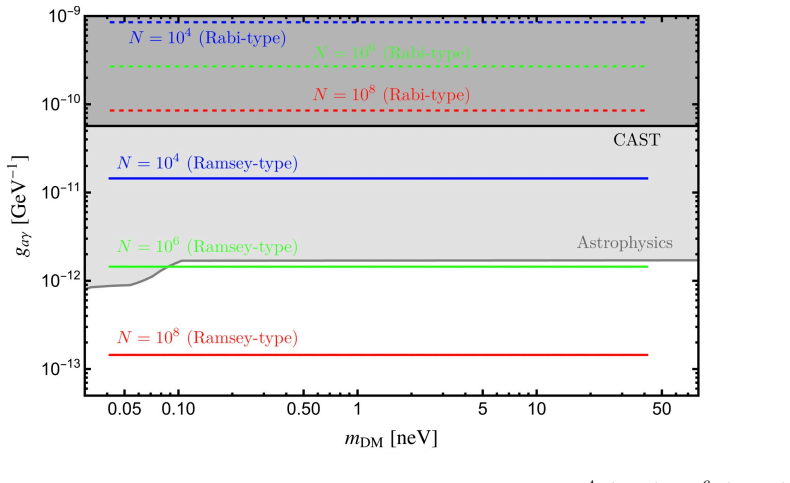
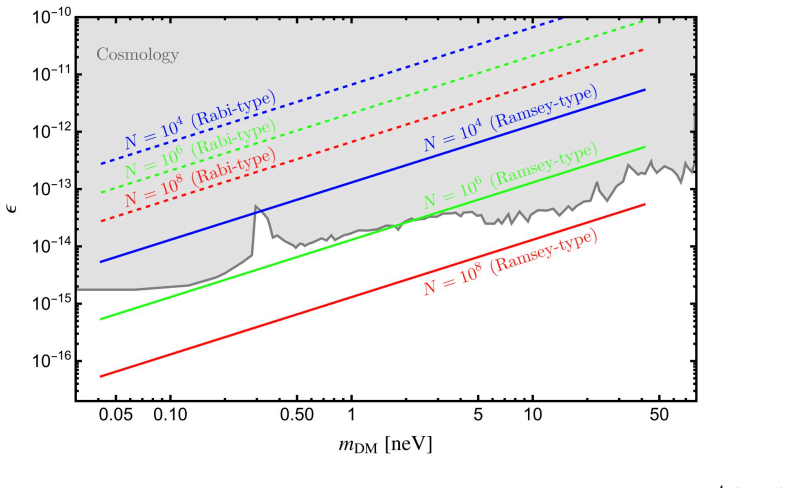
- For N greater than or equal to 10^6 trapped ions in a linear Paul trap, the reachable coupling matches or exceeds existing bounds.
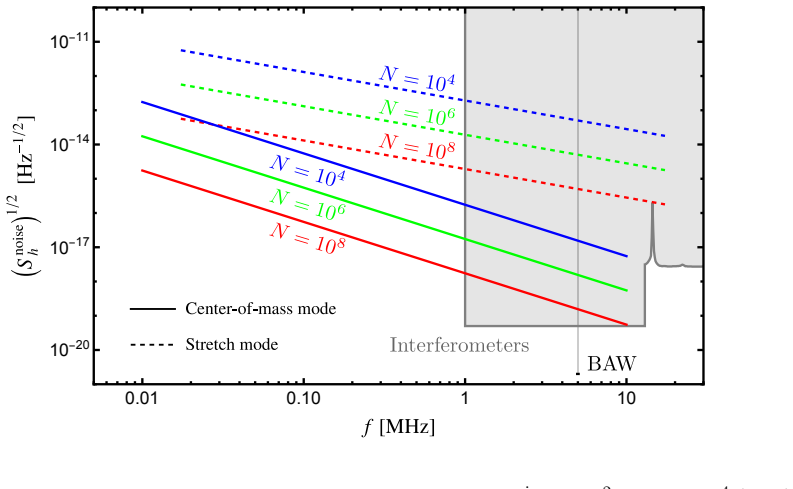
- The same setup yields sensitivity to high-frequency gravitational waves.
- The framework applies in principle to other quantum sensing platforms that can host large numbers of qubits.
Where Pith is reading between the lines
- Scaling to N of 10^6 would require verifying that the ion-trap geometry keeps all qubits inside a single dark-matter coherence volume.
- The approach could be combined with existing axion-search techniques that already use resonant cavities or magnets to enhance the effective coupling.
- If the coherence condition holds, the method offers a route to laboratory tests of dark-matter models currently constrained only by cosmology.
Load-bearing premise
A macroscopic number of qubits can be placed within the dark matter de Broglie wavelength while preserving coherent superpositions and allowing the wave to drive uniform transitions without introducing extra decoherence or phase loss.
What would settle it
An experiment showing that phase coherence across an array of 10^6 trapped-ion qubits cannot be maintained long enough for the dark-matter-induced transition to accumulate a detectable collective signal would falsify the projected sensitivity.
Figures
read the original abstract
We propose an array of the Ramsey-type interferometers using $N$ superposition states, $(|0\rangle+ |1\rangle)^{\otimes N}$, as a sensor to detect wave-like dark matter. After the exposure to the dark matter wave, which induces the coherent qubit transitions, the signal is the imbalance between the probabilities of detecting 0 and 1. The signal-to-noise ratio in this scheme is proportional to $\sqrt{N} \alpha$, where $\alpha$ is the coupling of dark matter to the qubits, and thus the sensitivity to the coupling scales as $\delta \alpha \sim 1 / \sqrt{N}$. For comparison, in the detection scheme based on the Rabi-type transition, $|0\rangle \to |1\rangle$, this scaling is achieved only when highly entangled $N$ qubits are used. Since the Ramsey-type measurement does not require entangled states, one can consider much larger $N$ by simply placing a large number of qubits within the de Broglie wavelength of the dark matter. We demonstrate that, using trapped-ion qubits in a linear Paul trap as the sensor, the projected sensitivity to the coupling matches or surpasses existing laboratory, astrophysical, and cosmological bounds for $N \gtrsim 10^6$. We also evaluate its sensitivity to high-frequency gravitational waves. Our general framework should, in principle, be useful for other quantum sensing platforms.
Editorial analysis
A structured set of objections, weighed in public.
Referee Report
Summary. The manuscript proposes using an array of Ramsey-type interferometers with N qubits prepared in the unentangled superposition state (|0⟩ + |1⟩)^{\otimes N} as a sensor for wave-like dark matter. The DM wave induces coherent qubit transitions; the observable is the imbalance between the probabilities of measuring 0 and 1. The paper claims that the signal-to-noise ratio scales as √N α (α the DM-qubit coupling), so the sensitivity to the coupling improves as δα ∼ 1/√N. This scaling is said to be achievable without entanglement, unlike Rabi-type schemes, by placing a large number of qubits inside the DM de Broglie wavelength. Using trapped-ion qubits in a linear Paul trap, the projected sensitivity is claimed to match or surpass existing laboratory, astrophysical, and cosmological bounds for N ≳ 10^6; sensitivity to high-frequency gravitational waves is also evaluated.
Significance. If the coherence and uniform-drive assumptions hold, the result would establish a scalable quantum-sensing route to DM detection that achieves √N improvement with product states rather than entangled states, potentially competitive with or stronger than current bounds at macroscopic N. The general framework is presented as applicable to other quantum platforms.
major comments (1)
- [Abstract and trapped-ion implementation] Abstract and trapped-ion implementation paragraph: The central projection that the scheme surpasses existing bounds for N ≳ 10^6 requires that the entire array experiences identical phase accumulation from the DM wave (i.e., lies well inside λ_db = 2π ħ/(m v) with negligible gradient). For a linear Paul trap with typical few-μm ion spacing, an N = 10^6 chain spans centimeters to meters; this length exceeds λ_db for the DM masses where the bound is claimed to be surpassed. No calculation of the resulting phase mismatch, extra decoherence from trap fields or ion-ion interactions, or required trap-frequency scaling is supplied, rendering the N ≳ 10^6 sensitivity claim unverified.
Simulated Author's Rebuttal
We thank the referee for the careful reading and for identifying the need to explicitly verify the coherence-length condition in the trapped-ion implementation. We address the concern below and will revise the manuscript to include the requested calculations and discussion.
read point-by-point responses
-
Referee: [Abstract and trapped-ion implementation] Abstract and trapped-ion implementation paragraph: The central projection that the scheme surpasses existing bounds for N ≳ 10^6 requires that the entire array experiences identical phase accumulation from the DM wave (i.e., lies well inside λ_db = 2π ħ/(m v) with negligible gradient). For a linear Paul trap with typical few-μm ion spacing, an N = 10^6 chain spans centimeters to meters; this length exceeds λ_db for the DM masses where the bound is claimed to be surpassed. No calculation of the resulting phase mismatch, extra decoherence from trap fields or ion-ion interactions, or required trap-frequency scaling is supplied, rendering the N ≳ 10^6 sensitivity claim unverified.
Authors: We agree that the physical extent of the ion chain must be compared with λ_db. The DM masses of interest are fixed by the requirement that the DM oscillation frequency matches the qubit transition frequency ω (typically 2π × 1–100 MHz for trapped ions), giving m ≈ 4×10^{-9}–4×10^{-7} eV. For these masses and v ≈ 10^{-3}c, λ_db evaluates to several kilometers (∼50 km at m=4×10^{-9} eV). An N=10^6 chain at 5 μm spacing spans L≈5 m, so L/λ_db ≪ 1 and the phase gradient across the array is negligible (<0.1 rad). We will add an explicit paragraph with this calculation, confirming the uniform-drive assumption. Regarding extra decoherence and trap-frequency scaling, the manuscript derives the ideal √N scaling from coherent averaging; experimental imperfections (trap fields, ion–ion interactions) are platform-specific and would be mitigated by standard techniques, but they do not change the fundamental scaling or the projected reach. A concise discussion of these practical considerations will be added. revision: yes
Circularity Check
No circularity; sensitivity scaling follows from standard Ramsey interferometry without reduction to fitted inputs or self-citations
full rationale
The claimed SNR ∝ √N α and δα ∼ 1/√N scaling is derived directly from the imbalance signal in an array of independent Ramsey interferometers, which is the standard quantum limit for uncorrelated qubits. The abstract and description present this as following from the coherent phase accumulation on the superposition state (|0⟩ + |1⟩)^⊗N without any parameter fitting, self-referential definition, or load-bearing self-citation. The comparison to Rabi-type transitions requiring entanglement is likewise a standard result in quantum sensing. No equations reduce the result to its own inputs by construction, and the trapped-ion projection is an application of the scaling rather than a redefinition of it. The physical feasibility of N ≳ 10^6 within one de Broglie wavelength is an external assumption, not a circularity issue.
Axiom & Free-Parameter Ledger
axioms (2)
- standard math Standard quantum mechanics governs the evolution of qubit superpositions under an external classical field
- domain assumption Wave-like dark matter induces coherent, phase-locked transitions across all qubits within its de Broglie wavelength
Reference graph
Works this paper leans on
-
[1]
Zwicky,Die Rotverschiebung von extragalaktischen Nebeln,Helv
F. Zwicky,Die Rotverschiebung von extragalaktischen Nebeln,Helv. Phys. Acta6 (1933) 110
1933
-
[2]
Zwicky,On the Masses of Nebulae and of Clusters of Nebulae,Astrophys
F. Zwicky,On the Masses of Nebulae and of Clusters of Nebulae,Astrophys. J.86 (1937) 217
1937
-
[3]
D. Clowe, A. Gonzalez and M. Markevitch,Weak lensing mass reconstruction of the interacting cluster 1E0657-558: Direct evidence for the existence of dark matter, Astrophys. J.604(2004) 596 [astro-ph/0312273]. 16
Pith/arXiv arXiv 2004
-
[4]
M. Markevitch, A. H. Gonzalez, D. Clowe, A. Vikhlinin, L. David, W. Forman, C. Jones et al.,Direct constraints on the dark matter self-interaction cross-section from the merging galaxy cluster 1E0657-56,Astrophys. J.606(2004) 819 [astro-ph/0309303]. [5]Planckcollaboration,Planck 2018 results. VI. Cosmological parameters,Astron. Astrophys.641(2020) A6 [180...
Pith/arXiv arXiv 2004
-
[5]
P. Arias, D. Cadamuro, M. Goodsell, J. Jaeckel, J. Redondo and A. Ringwald,WISPy Cold Dark Matter,JCAP06(2012) 013 [1201.5902]
Pith/arXiv arXiv 2012
-
[6]
C. L. Degen, F. Reinhard and P. Cappellaro,Quantum sensing,Rev. Mod. Phys.89 (2017) 035002 [1611.02427]
Pith/arXiv arXiv 2017
-
[7]
A. V. Dixit, S. Chakram, K. He, A. Agrawal, R. K. Naik, D. I. Schuster and A. Chou, Searching for Dark Matter with a Superconducting Qubit,Phys. Rev. Lett.126(2021) 141302 [2008.12231]
arXiv 2021
-
[8]
S. Chen, H. Fukuda, T. Inada, T. Moroi, T. Nitta and T. Sichanugrist,Detecting Hidden Photon Dark Matter Using the Direct Excitation of Transmon Qubits,Phys. Rev. Lett.131(2023) 211001 [2212.03884]
arXiv 2023
-
[9]
S. Chen, H. Fukuda, T. Inada, T. Moroi, T. Nitta and T. Sichanugrist,Search for QCD axion dark matter with transmon qubits and quantum circuit,Phys. Rev. D110(2024) 115021 [2407.19755]
arXiv 2024
-
[10]
G. Engelhardt, A. Bhoonah and W. V. Liu,Detecting axion dark matter with Rydberg atoms via induced electric dipole transitions,Phys. Rev. Res.6(2024) 023017 [2304.05863]
arXiv 2024
-
[11]
S. Chigusa, T. Kasamaki, T. Kusano, T. Moroi, K. Nakayama, N. Ozawa, Y. Takahashi et al.,Detecting Dark Matter Using Optically Trapped Rydberg Atom Tweezer Arrays, Phys. Rev. Lett.136(2026) 151801 [2507.12860]
Pith/arXiv arXiv 2026
-
[12]
S. K. Lamoreaux, K. A. van Bibber, K. W. Lehnert and G. Carosi,Analysis of single-photon and linear amplifier detectors for microwave cavity dark matter axion searches,Phys. Rev. D88(2013) 035020 [1306.3591]. [14]HAYSTACcollaboration,A quantum-enhanced search for dark matter axions,Nature 590(2021) 238 [2008.01853]. 17
Pith/arXiv arXiv 2013
-
[13]
B. Freiman, X. You, A. C. Y. Li, R. Cervantes, T. Kim, A. Grasselino, R. Harnik et al., Quantum Enhanced Dark-Matter Search with Entangled Fock States in High-Quality Cavities,2510.26754
-
[14]
K. A. Gilmore, M. Affolter, R. J. Lewis-Swan, D. Barberena, E. Jordan, A. M. Rey and J. J. Bollinger,Quantum-enhanced sensing of displacements and electric fields with two-dimensional trapped-ion crystals,Science373(2021) 673 [2103.08690]
arXiv 2021
-
[15]
A. Ito, R. Kitano, W. Nakano and R. Takai,Quantum entanglement of ions for light dark matter detection,JHEP02(2024) 124 [2311.11632]
arXiv 2024
-
[16]
A. Ito, R. Kitano, W. Nakano and R. Takai,Quantum sensing of high-frequency gravitational waves with ion crystals,JCAP05(2026) 039 [2512.19053]
Pith/arXiv arXiv 2026
-
[17]
S. Chen, H. Fukuda, T. Inada, T. Moroi, T. Nitta and T. Sichanugrist,Quantum Enhancement in Dark Matter Detection with Quantum Computation,Phys. Rev. Lett. 133(2024) 021801 [2311.10413]
arXiv 2024
-
[18]
R. Takai,Probing high-frequency gravitational waves with entangled vibrational qubits in linear Paul traps,Phys. Rev. D113(2026) 082002 [2509.22475]
Pith/arXiv arXiv 2026
-
[19]
H. Fukuda, T. Moroi and T. Sichanugrist,Quantum Error Correction-like Noise Mitigation for Wave-like Dark Matter Searches with Quantum Sensors,2511.03253
-
[20]
W. Nakano and R. Takai,Super-Heisenberg protocol for dark matter and high-frequency gravitational wave search,2604.22336
-
[21]
X. Tan and Z. Wang,Quantum Error Correction Assisted Axion Search in CMOS Spin Qubit Arrays,2605.17457
-
[22]
C. D. Bruzewicz, J. Chiaverini, R. McConnell and J. M. Sage,Trapped-ion quantum computing: Progress and challenges,Appl. Phys. Rev.6(2019) 021314 [1904.04178]
arXiv 2019
-
[23]
J. I. Cirac and P. Zoller,Quantum Computations with Cold Trapped Ions,Phys. Rev. Lett.74(1995) 4091
1995
-
[24]
D. Walls and G. Milburn,Quantum Optics, Springer Study Edition. Springer, 1994, 10.1007/978-3-642-79504-6
-
[25]
F. Schmidt-Kaler, C. Roos, H. C. N¨ agerl, H. Rohde, S. Gulde, A. Mundt, M. Lederbauer et al.,Ground state cooling, quantum state engineering and study of decoherence of ions in paul traps,J. Mod. Opt.47(2000) 2573 [quant-ph/0003096]. 18
Pith/arXiv arXiv 2000
-
[26]
I. Pogorelov, T. Feldker, C. D. Marciniak, L. Postler, G. Jacob, O. Krieglsteiner, V. Podlesnic et al.,Compact Ion-Trap Quantum Computing Demonstrator, PRXQuantum2(2021) 020343 [2101.11390]
arXiv 2021
-
[27]
T. P. Harty, D. T. C. Allcock, C. J. Ballance, L. Guidoni, H. A. Janacek, N. M. Linke, D. N. Stacey et al.,High-Fidelity Preparation, Gates, Memory, and Readout of a Trapped-Ion Quantum Bit,Phys. Rev. Lett.113(2014) 220501 [1403.1524]
Pith/arXiv arXiv 2014
-
[28]
M. Brownnutt, M. Kumph, P. Rabl and R. Blatt,Ion-trap measurements of electric-field noise near surfaces,Rev. Mod. Phys.87(2015) 1419 [1409.6572]
Pith/arXiv arXiv 2015
-
[29]
O. Ning and B. R. Safdi,Leading Axion-Photon Sensitivity with NuSTAR Observations of M82 and M87,Phys. Rev. Lett.134(2025) 171003 [2404.14476]
arXiv 2025
-
[30]
J. N. Benabou, C. Dessert, K. C. Patra, T. G. Brink, W. Zheng, A. V. Filippenko and B. R. Safdi,Search for Axions in Magnetic White Dwarf Polarization at Lick and Keck Observatories,2504.12377. [33]CASTcollaboration,New Upper Limit on the Axion-Photon Coupling with an Extended CAST Run with a Xe-Based Micromegas Detector,Phys. Rev. Lett.133 (2024) 221005 ...
arXiv 2024
-
[31]
cajohare/AxionLimits: AxionLimits
C. O’Hare, “cajohare/AxionLimits: AxionLimits.” https://cajohare.github.io/AxionLimits/, 2020
2020
-
[32]
S. J. Witte, S. Rosauro-Alcaraz, S. D. McDermott and V. Poulin,Dark photon dark matter in the presence of inhomogeneous structure,JHEP06(2020) 132 [2003.13698]
arXiv 2020
-
[33]
H. An, S. Ge, J. Liu and M. Liu,In Situ Measurements of Dark Photon Dark Matter Using Parker Solar Probe: Going beyond the Radio Window,Phys. Rev. Lett.134 (2025) 171001 [2405.12285]
arXiv 2025
- [34]
-
[35]
Ito,Inertial and gravitational effects on a geonium atom,Class
A. Ito,Inertial and gravitational effects on a geonium atom,Class. Quant. Grav.38 (2021) 195015 [2011.11217]. [39]Holometercollaboration,MHz Gravitational Wave Constraints with Decameter Michelson Interferometers,Phys. Rev. D95(2017) 063002 [1611.05560]. 19
arXiv 2021
- [36]
-
[37]
M. Goryachev and M. E. Tobar,Gravitational Wave Detection with High Frequency Phonon Trapping Acoustic Cavities,Phys. Rev. D90(2014) 102005 [1410.2334]. [Erratum: Phys. Rev. D 108 (2023) 129901]
arXiv 2014
-
[38]
N. Aggarwal, O. D. Aguiar, D. Blas, A. Bauswein, G. Cella, S. Clesse, A. M. Cruise et al.,Challenges and opportunities of gravitational-wave searches above 10 kHz,Living Rev. Rel.28(2025) 10 [2501.11723]. 20
arXiv 2025
discussion (0)
Sign in with ORCID, Apple, or X to comment. Anyone can read and Pith papers without signing in.