Quantum solitons and their quantum walks in transmon arrays
Pith reviewed 2026-06-26 20:26 UTC · model grok-4.3
The pith
A linear array of capacitively coupled transmons supports spatially localized quantum solitons whose dynamics display quantum walks.
A machine-rendered reading of the paper's core claim, the machinery that carries it, and where it could break.
Core claim
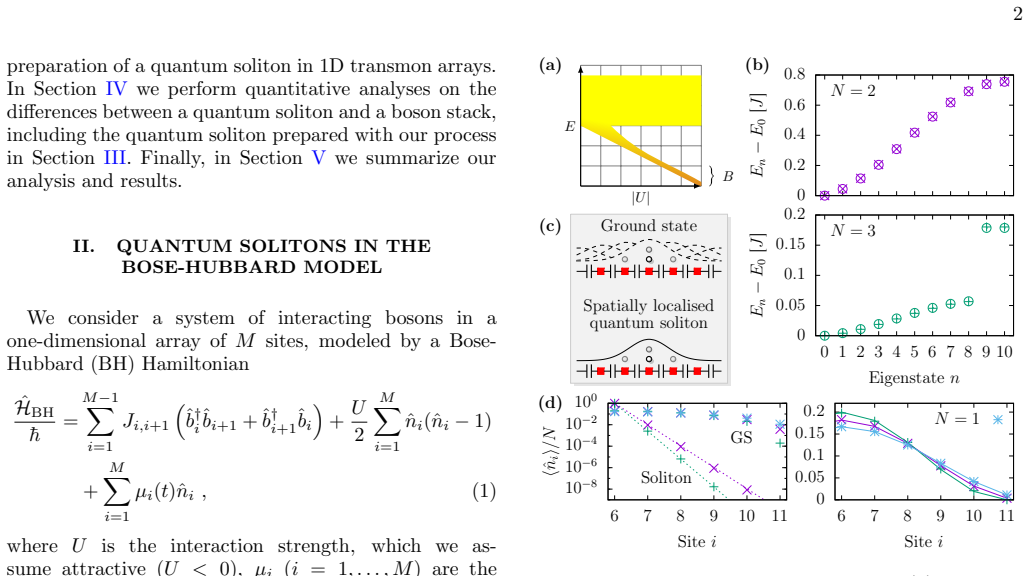
In a linear array of capacitively coupled transmons described by the attractive Bose-Hubbard Hamiltonian, the lowest-energy band consists of spatially localized quantum solitons. Their time evolution produces a quantum-walk interference pattern that reveals their composite nature. Preparation protocols compatible with current tunable-transmon circuits make these states experimentally accessible.
What carries the argument
Spatially localized quantum solitons supported by the attractive Bose-Hubbard Hamiltonian for the transmon array, whose composite character is exposed by their quantum-walk time evolution.
If this is right
- The quantum interference pattern in the time evolution directly confirms the composite nature of the solitons.
- The outlined preparation protocols allow experimental creation of these states with present-day tunable transmons.
- Superconducting circuits thereby become a platform for investigating quantum soliton physics.
Where Pith is reading between the lines
- The same localized states and walks could appear in other circuit-QED architectures with engineered attractive interactions.
- Observing the walks might guide designs that use composite excitations for quantum information tasks.
- Extending the model to driven or disordered arrays could expose additional soliton regimes not examined here.
Load-bearing premise
The capacitively coupled transmon array is accurately described by a Bose-Hubbard Hamiltonian with attractive on-site interactions.
What would settle it
Absence of the predicted quantum interference pattern in the measured time evolution of a prepared localized state would show that the states are not quantum solitons.
Figures
read the original abstract
Superconducting qubits are artificial atoms whose spectra and interactions can be engineered through appropriate circuit design, a versatility that can be exploited for quantum simulation. We theoretically investigate a linear array of capacitively coupled transmons, effectively described by a Bose-Hubbard Hamiltonian with attractive interaction. We revisit the discrete-soliton nature of the lowest-energy band of the spectrum, and identify spatially localized quantum solitons. The solitonic character of these states is revealed through their time evolution, which displays a quantum interference pattern, or quantum walk, highlighting their composite nature. We discuss protocols for preparing spatially localized quantum solitons that are compatible with current state-of-the-art tunable-transmon circuits. Our results demonstrate that superconducting circuits provide a promising and experimentally accessible platform for the investigation of quantum soliton physics.
Editorial analysis
A structured set of objections, weighed in public.
Referee Report
Summary. The manuscript studies a linear array of capacitively coupled transmons, modeled by an attractive Bose-Hubbard Hamiltonian. It revisits the lowest-energy band as discrete solitons, identifies spatially localized quantum solitons, shows that their time evolution exhibits a quantum-interference pattern characteristic of quantum walks, and outlines preparation protocols using tunable-transmon circuits. The central claim is that such circuits form an experimentally accessible platform for quantum soliton physics.
Significance. If the effective attractive Bose-Hubbard mapping and the resulting soliton dynamics hold, the work supplies a concrete, circuit-based route to studying composite quantum objects and their interference. The explicit discussion of state-preparation sequences compatible with existing tunable-transmon hardware is a practical strength that could enable near-term experiments.
major comments (2)
- [§2] §2 (effective model): The mapping from the circuit Lagrangian to the attractive Bose-Hubbard Hamiltonian is asserted without an explicit derivation or a parameter-regime analysis showing that the interaction remains attractive for the quoted values of E_J/E_C and capacitive coupling. Because the sign and magnitude of the on-site interaction are known to depend on these ratios, and because the entire soliton band and its quantum-walk signature rest on this mapping, the derivation (or a clear citation to a prior derivation that applies verbatim) must be supplied.
- [§3] §3 (soliton identification): The claim that the lowest band consists of spatially localized solitons is supported only by numerical diagonalization of small chains; no scaling analysis or comparison against the continuum soliton solution is given to confirm that the localization length remains finite in the thermodynamic limit. This directly affects the interpretation of the subsequent time-evolution results.
minor comments (2)
- [Figure 2] Figure 2 caption: the color scale for the probability density is not labeled with units or normalized range; add this for reproducibility.
- The phrase 'quantum interference pattern, or quantum walk' is used without distinguishing the two concepts; a brief clarification of the distinction in the present context would improve readability.
Simulated Author's Rebuttal
We thank the referee for their careful reading of the manuscript and for the constructive comments. We address each major comment below and outline the revisions we will make.
read point-by-point responses
-
Referee: [§2] §2 (effective model): The mapping from the circuit Lagrangian to the attractive Bose-Hubbard Hamiltonian is asserted without an explicit derivation or a parameter-regime analysis showing that the interaction remains attractive for the quoted values of E_J/E_C and capacitive coupling. Because the sign and magnitude of the on-site interaction are known to depend on these ratios, and because the entire soliton band and its quantum-walk signature rest on this mapping, the derivation (or a clear citation to a prior derivation that applies verbatim) must be supplied.
Authors: We agree that the effective-model derivation was presented too briefly. In the revised manuscript we will add a concise derivation of the circuit-to-Hamiltonian mapping, explicitly showing the regime of E_J/E_C and capacitive coupling in which the on-site interaction is attractive (U < 0) for the parameter values used in the paper. revision: yes
-
Referee: [§3] §3 (soliton identification): The claim that the lowest band consists of spatially localized solitons is supported only by numerical diagonalization of small chains; no scaling analysis or comparison against the continuum soliton solution is given to confirm that the localization length remains finite in the thermodynamic limit. This directly affects the interpretation of the subsequent time-evolution results.
Authors: We acknowledge that the manuscript relies on numerical results for finite chains without an explicit finite-size scaling analysis. In the revision we will include a scaling study of the localization length with system size and, where appropriate, a comparison with the continuum limit of the attractive Bose-Hubbard model to confirm that the solitons remain localized in the thermodynamic limit. revision: yes
Circularity Check
No significant circularity; effective model is input, soliton analysis follows independently.
full rationale
The paper takes the capacitively coupled transmon array as effectively described by an attractive Bose-Hubbard Hamiltonian (abstract and introduction) as its starting model from prior literature. All subsequent results on discrete solitons, quantum walks, and preparation protocols are derived as consequences within that model. No equations reduce a prediction to a fitted input by construction, no self-citation chain justifies the central premise, and no ansatz or uniqueness theorem is smuggled in. The derivation chain is self-contained once the effective Hamiltonian is granted; the reader's score of 2 reflects only a possible minor citation, not load-bearing circularity.
Axiom & Free-Parameter Ledger
axioms (1)
- domain assumption The capacitively coupled transmon array is effectively described by a Bose-Hubbard Hamiltonian with attractive interaction.
Reference graph
Works this paper leans on
-
[1]
expansion velocity
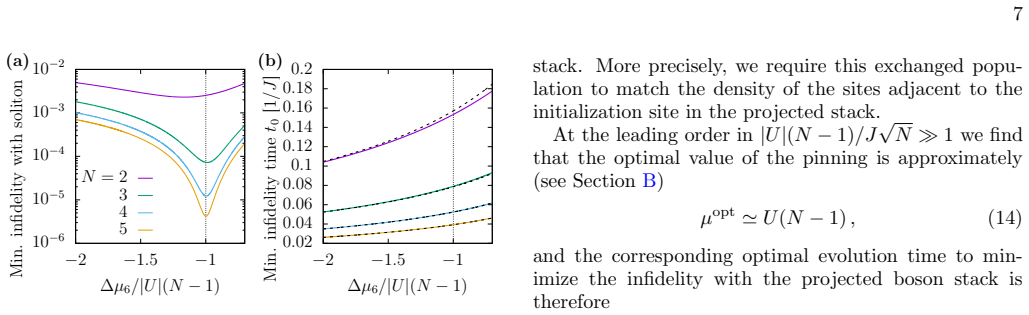
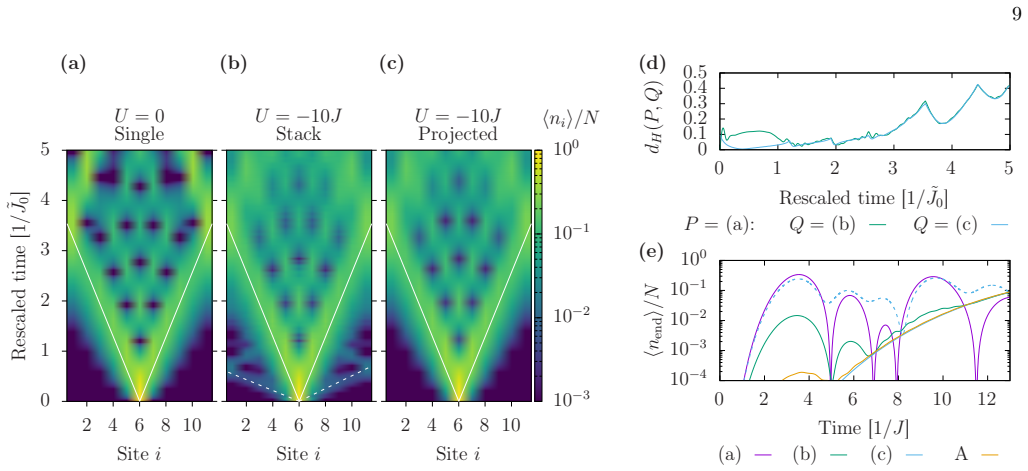
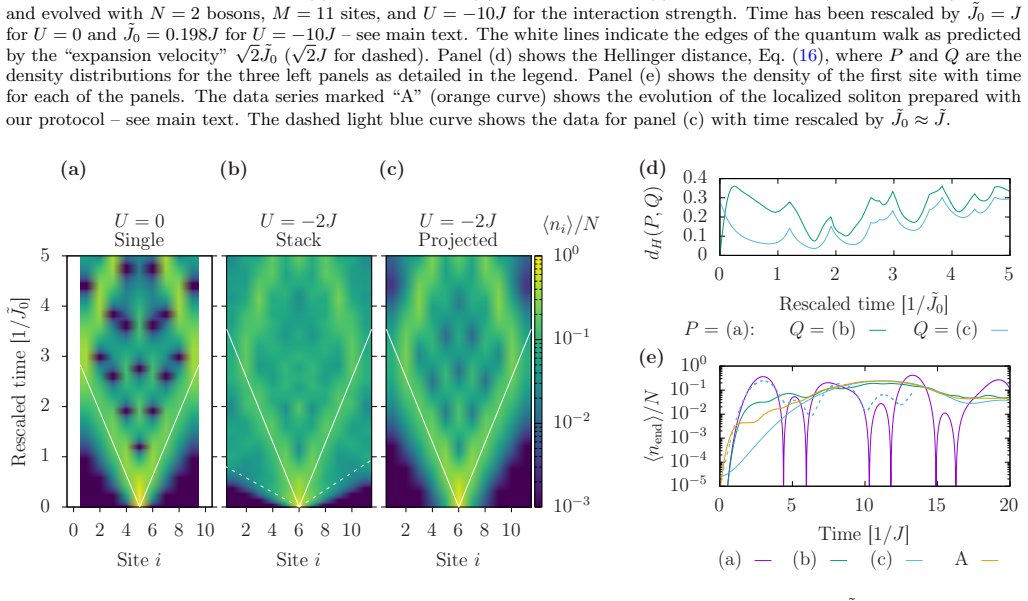
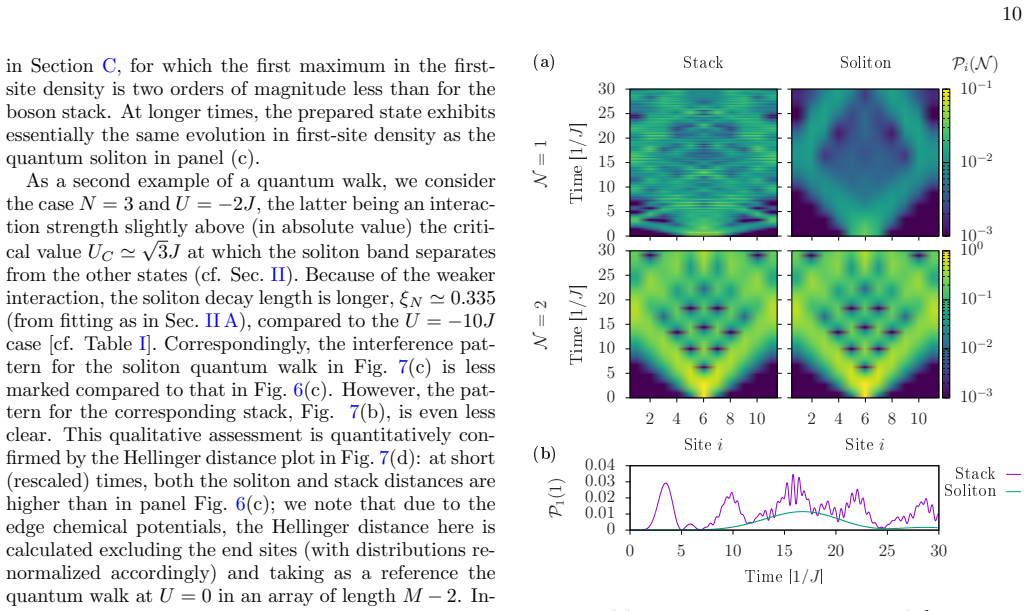
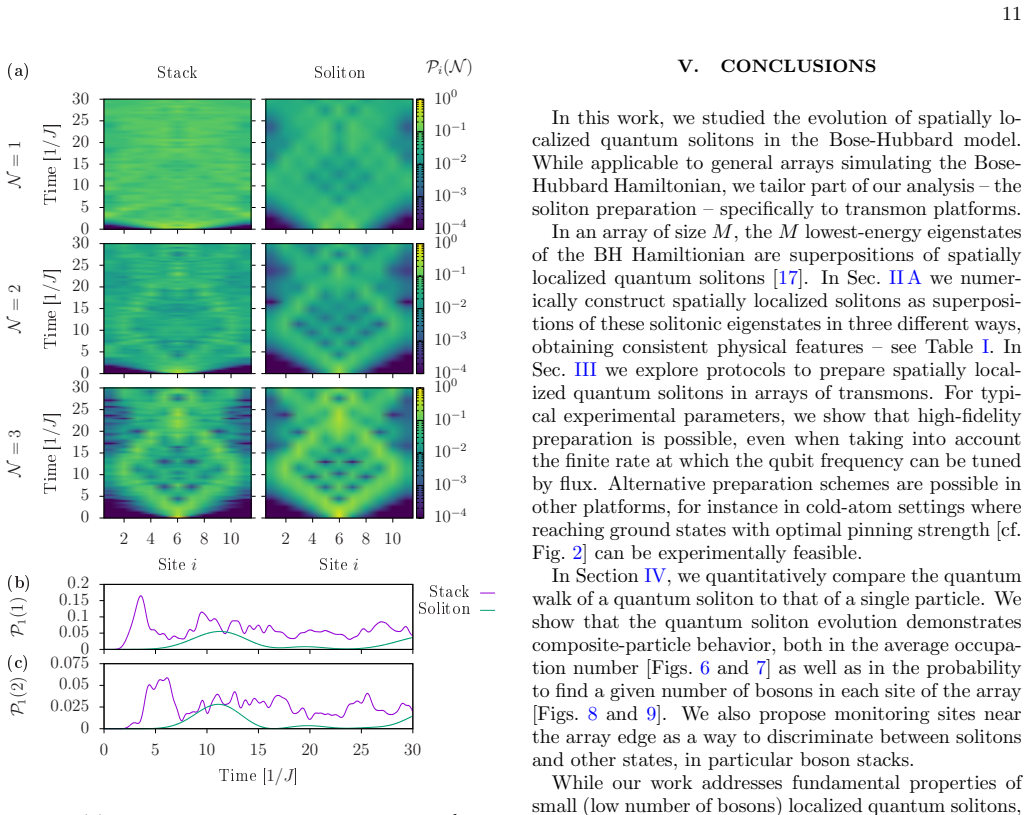
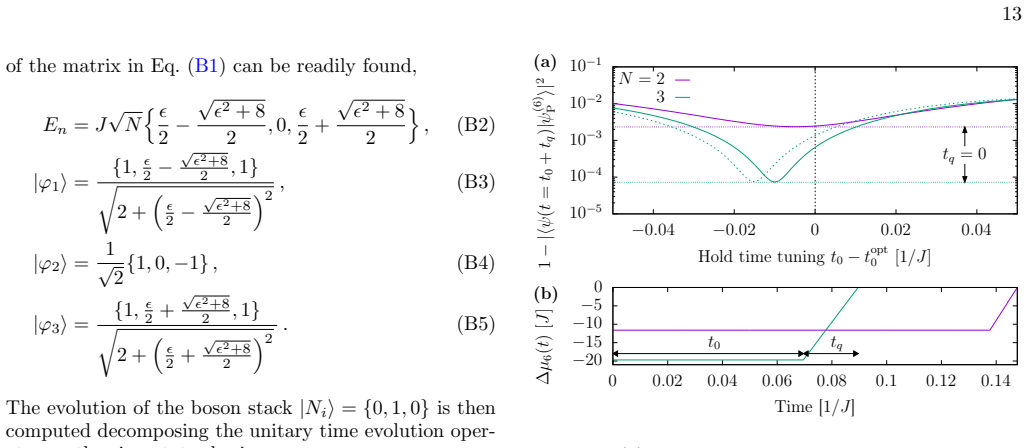
2 − 2 − 1. 5 − 1 (b) N = 2 3 4 5 Min. infidelity with soliton∆ µ6/ |U|(N − 1) Min. infidelity time t0 [1/J ] ∆ µ6/ |U|(N − 1) FIG. 5. Finding the parameters for the constant pinning protocol.(a)Plot of the minimum infidelity with a quantum soliton in the uniform system for a boson stack evolved in the time range 0. . .1/Jin a system with constant pinning ∆µ...
-
[2]
Buluta and F
I. Buluta and F. Nori, Quantum Simulators, Science326, 108 (2009)
2009
-
[3]
I. M. Georgescu, S. Ashhab, and F. Nori, Quantum sim- ulation, Rev. Mod. Phys.86, 153 (2014)
2014
-
[4]
Altman, K
E. Altman, K. R. Brown, G. Carleo, L. D. Carr, E. Dem- ler, C. Chin, B. DeMarco, S. E. Economou, M. A. Eriks- son, K.-M. C. Fu, M. Greiner, K. R. Hazzard, R. G. Hulet, A. J. Koll´ ar, B. L. Lev, M. D. Lukin, R. Ma, X. Mi, S. Misra, C. Monroe, K. Murch, Z. Nazario, K.-K. Ni, A. C. Potter, P. Roushan, M. Saffman, M. Schleier- Smith, I. Siddiqi, R. Simmonds,...
2021
-
[5]
Fauseweh, Quantum many-body simulations on digi- tal quantum computers: State-of-the-art and future chal- lenges, Nat Commun15, 2123 (2024)
B. Fauseweh, Quantum many-body simulations on digi- tal quantum computers: State-of-the-art and future chal- lenges, Nat Commun15, 2123 (2024)
2024
-
[6]
A. A. Houck, H. E. T¨ ureci, and J. Koch, On-chip quan- tum simulation with superconducting circuits, Nat. Phys. 8, 292 (2012)
2012
-
[7]
Blais, A
A. Blais, A. L. Grimsmo, S. Girvin, and A. Wallraff, Circuit quantum electrodynamics, Rev. Mod. Phys.93, 025005 (2021)
2021
-
[8]
N. Goss, A. Morvan, B. Marinelli, B. K. Mitchell, L. B. Nguyen, R. K. Naik, L. Chen, C. J¨ unger, J. M. Kreike- baum, D. I. Santiago, J. J. Wallman, and I. Siddiqi, High- fidelity qutrit entangling gates for superconducting cir- cuits, Nat Commun13, 7481 (2022)
2022
-
[9]
Hacohen-Gourgy, V
S. Hacohen-Gourgy, V. V. Ramasesh, C. De Grandi, I. Siddiqi, and S. M. Girvin, Cooling and autonomous feedback in a Bose-Hubbard chain with attractive inter- actions, Phys. Rev. Lett.115, 240501 (2015)
2015
-
[10]
G. P. Fedorov, S. V. Remizov, D. S. Shapiro, W. V. Pogosov, E. Egorova, I. Tsitsilin, M. Andronik, A. A. Dobronosova, I. A. Rodionov, O. V. Astafiev, and A. V. Ustinov, Photon transport in a Bose-Hubbard chain of superconducting artificial atoms, Phys. Rev. Lett.126, 180503 (2021)
2021
-
[11]
Mansikkam¨ aki, S
O. Mansikkam¨ aki, S. Laine, and M. Silveri, The phases of the disordered Bose-Hubbard model with attractive interactions, Phys. Rev. B103, L220202 (2021)
2021
-
[12]
Mansikkam¨ aki, S
O. Mansikkam¨ aki, S. Laine, A. Piltonen, and M. Sil- veri, Beyond hard-core bosons in transmon arrays, PRX Quantum3, 040314 (2022)
2022
-
[13]
Berke, E
C. Berke, E. Varvelis, S. Trebst, A. Altland, and D. P. DiVincenzo, Transmon platform for quantum comput- ing challenged by chaotic fluctuations, Nat Commun13, 2495 (2022)
2022
-
[14]
Blain, G
B. Blain, G. Marchegiani, J. Polo, G. Catelani, and L. Amico, Soliton versus single-photon quantum dynam- ics in arrays of superconducting qubits, Phys. Rev. Re- search5, 033130 (2023)
2023
-
[15]
Chirolli, J
L. Chirolli, J. Polo, G. Catelani, and L. Amico, Synthetic fractional flux quanta in a ring of superconducting qubits, Phys. Rev. Res.7, 043098 (2025)
2025
-
[16]
Aaronson and A
S. Aaronson and A. Arkhipov, The Computational Com- plexity of Linear Optics, Theory Comput.9, 143 (2013)
2013
-
[17]
B. T. Gard, J. P. Olson, R. M. Cross, M. B. Kim, H. Lee, and J. P. Dowling, Inefficiency of classically simulating linear optical quantum computing with Fock-state in- puts, Phys. Rev. A89, 022328 (2014)
2014
-
[18]
Naldesi, J
P. Naldesi, J. P. Gomez, B. Malomed, M. Olshanii, A. Minguzzi, and L. Amico, Rise and fall of a bright soli- ton in an optical lattice, Phys. Rev. Lett.122, 053001 (2019)
2019
-
[19]
Lahini, M
Y. Lahini, M. Verbin, S. D. Huber, Y. Bromberg, R. Pu- gatch, and Y. Silberberg, Quantum walk of two interact- ing bosons, Phys. Rev. A86, 011603 (2012)
2012
-
[20]
P. M. Preiss, R. Ma, M. E. Tai, A. Lukin, M. Rispoli, P. Zupancic, Y. Lahini, R. Islam, and M. Greiner, Strongly correlated quantum walks in optical lattices, Science347, 1229 (2015)
2015
-
[21]
X. Cai, H. Yang, H.-L. Shi, C. Lee, N. Andrei, and X.-W. Guan, Multiparticle quantum walks and Fisher informa- tion in one-dimensional lattices, Phys. Rev. Lett.127, 100406 (2021)
2021
-
[22]
Oliveira, M
M. Oliveira, M. Santos, M. B. Coˆ elho, F. De Moura, and W. Dias, Cooperative bound states in quantum walks of interacting particles, Physica A Stat. Mech. Appl.640, 129697 (2024)
2024
-
[23]
A. M. Childs and J. Goldstone, Spatial search by quan- tum walk, Phys. Rev. A70, 022314 (2004)
2004
-
[24]
A. M. Childs, D. Gosset, and Z. Webb, Universal compu- tation by multiparticle quantum walk, Science339, 791 (2013)
2013
-
[25]
Qiang, S
X. Qiang, S. Ma, and H. Song, Quantum Walk Com- puting: Theory, Implementation, and Application, Intell. Comput.3, 0097 (2024)
2024
-
[26]
Compagno, L
E. Compagno, L. Banchi, C. Gross, and S. Bose, NOON states via a quantum walk of bound particles, Phys. Rev. A95, 012307 (2017)
2017
-
[27]
C. D. E. Boschi, E. Ercolessi, L. Ferrari, P. Naldesi, F. Ortolani, and L. Taddia, Bound states and expansion dynamics of interacting bosons on a one-dimensional lat- 15 tice, Phys. Rev. A90, 043606 (2014)
2014
-
[28]
Valiente and D
M. Valiente and D. Petrosyan, Two-particle states in the Hubbard model, J. Phys. B: At. Mol. Opt. Phys.41, 161002 (2008)
2008
-
[29]
Scott, J
A. Scott, J. Eilbeck, and H. Gilhøj, Quantum lattice soli- tons, Phys. D: Nonlinear Phenom.78, 194 (1994)
1994
-
[30]
Banchi and R
L. Banchi and R. Vaia, Spectral problem for quasi- uniform nearest-neighbor chains, J. Math. Phys.54, 043501 (2013)
2013
-
[31]
Lai and H
Y. Lai and H. A. Haus, Quantum theory of solitons in optical fibers. ii. exact solution, Phys. Rev. A40, 854 (1989)
1989
-
[32]
A. R. Conn, N. I. M. Gould, and P. L. Toint,Trust Region Methods(Society for Industrial and Applied Mathemat- ics, 2000)
2000
-
[33]
Orell, A
T. Orell, A. A. Michailidis, M. Serbyn, and M. Sil- veri, Probing the many-body localization phase transi- tion with superconducting circuits, Phys. Rev. B100, 134504 (2019)
2019
-
[34]
J. Koch, T. M. Yu, J. Gambetta, A. A. Houck, D. I. Schuster, J. Majer, A. Blais, M. H. Devoret, S. M. Girvin, and R. J. Schoelkopf, Charge-insensitive qubit design de- rived from the Cooper pair box, Phys. Rev. A76, 042319 (2007)
2007
-
[35]
Krantz, M
P. Krantz, M. Kjaergaard, F. Yan, T. P. Orlando, S. Gus- tavsson, and W. D. Oliver, A Quantum Engineer’s Guide to Superconducting Qubits, Appl. Phys. Rev.6, 021318 (2019)
2019
-
[36]
This modulation affects, although typically in a reduced way, also the hopping coefficients
-
[37]
M. Riccardi, A. G. Moshe, G. Menichetti, R. Aiudi, C. Cosenza, A. Abedi, R. Menta, H. G. Ahmad, D. N. Orfatti, F. Cioni, D. Massarotti, F. Tafuri, V. Giovan- netti, M. Polini, F. Caravelli, and D. Szombati, Ex- perimental observation of dynamical blockade between transmon qubits via zz interaction engineering (2026), arXiv:2601.11714 [quant-ph]
arXiv 2026
-
[38]
M. J. Peterer, S. J. Bader, X. Jin, F. Yan, A. Kamal, T. J. Gudmundsen, P. J. Leek, T. P. Orlando, W. D. Oliver, and S. Gustavsson, Coherence and decay of higher energy levels of a superconducting transmon qubit, Phys. Rev. Lett.114, 010501 (2015)
2015
-
[39]
Z. T. Wang, S.-Y. Zhou, Y.-H. Shi, K. Huang, Z. H. Yang, J. Zhang, K. Zhao, Y. Xu, H. Li, S. K. Zhao, Y. Feng, G. Xue, Y. Liu, W.-G. Ma, C.-P. Fang, H.- T. Liu, Y.-Y. Wang, K. Xu, H. Yu, H. Fan, and S. P. Zhao, Observing two-particle correlation dynam- ics in tunable superconducting Bose-Hubbard simulators (2025), arXiv:2509.02180 [quant-ph]
arXiv 2025
-
[40]
Marcos, A
D. Marcos, A. Tomadin, S. Diehl, and P. Rabl, Photon condensation in circuit quantum electrodynamics by en- gineered dissipation, New J. Phys.14, 055005 (2012)
2012
-
[41]
R. Ma, B. Saxberg, C. Owens, N. Leung, Y. Lu, J. Si- mon, and D. I. Schuster, A dissipatively stabilized mott insulator of photons, Nature566, 51 (2019)
2019
-
[42]
L. Schamriß, L. Garbe, and P. Rabl, Refrigeration of a 1d gas of microwave photons (2025), arXiv:2512.17530 [quant-ph]
arXiv 2025
-
[43]
Z. Wang, R. W. Parker, E. Champion, and M. S. Blok, High-EJ /EC transmon qudits with up to 12 levels, Phys. Rev. Appl.23, 034046 (2025)
2025
-
[44]
J. S. Russell,Report on waves, made to the meetings of the British Association in 1842-43(1844) pp. 311–390
-
[45]
A. H. Karamlou, J. Braum¨ uller, Y. Yanay, A. Di Paolo, P. M. Harrington, B. Kannan, D. Kim, M. Kjaer- gaard, A. Melville, S. Muschinske, B. M. Niedzielski, A. Veps¨ al¨ ainen, R. Winik, J. L. Yoder, M. Schwartz, C. Tahan, T. P. Orlando, S. Gustavsson, and W. D. Oliver, Quantum transport and localization in 1d and 2d tight-binding lattices, npj Quantum In...
2022
-
[46]
Luo and Q
S. Luo and Q. Zhang, Informational distance on quantum-state space, Phys. Rev. A69, 032106 (2004)
2004
-
[47]
Strobel, W
H. Strobel, W. Muessel, D. Linnemann, T. Zibold, D. B. Hume, L. Pezz` e, A. Smerzi, and M. K. Oberthaler, Fisher information and entanglement of non-Gaussian spin states, Science345, 424 (2014)
2014
-
[48]
Jin and S.-M
Z.-X. Jin and S.-M. Fei, Quantifying quantum coherence and nonclassical correlation based on Hellinger distance, Phys. Rev. A97, 062342 (2018)
2018
-
[49]
Acharya, T
A. Acharya, T. Kypraios, and M. Gut ¸˘ a, A comparative study of estimation methods in quantum tomography, J. Phys. A: Math. Theor.52, 234001 (2019)
2019
-
[50]
Bianchetti, S
R. Bianchetti, S. Filipp, M. Baur, J. M. Fink, C. Lang, L. Steffen, M. Boissonneault, A. Blais, and A. Wallraff, Control and tomography of a three level superconducting artificial atom, Phys. Rev. Lett.105, 223601 (2010)
2010
-
[51]
Chen, H.-X
L. Chen, H.-X. Li, Y. Lu, C. W. Warren, C. J. Kriˇ zan, S. Kosen, M. Rommel, S. Ahmed, A. Os- man, J. Bizn´ arov´ a, A. Fadavi Roudsari, B. Lienhard, M. Caputo, K. Grigoras, L. Gr¨ onberg, J. Govenius, A. Frisk Kockum, P. Delsing, J. Bylander, and G. Tan- credi, Transmon qubit readout fidelity at the threshold for quantum error correction without a quantu...
2023
-
[52]
Amico, M
L. Amico, M. Boshier, G. Birkl, A. Minguzzi, C. Miniatura, L.-C. Kwek, D. Aghamalyan, V. Ahufinger, D. Anderson, N. Andrei, A. S. Arnold, M. Baker, T. A. Bell, T. Bland, J. P. Brantut, D. Cassettari, W. J. Chet- cuti, F. Chevy, R. Citro, S. De Palo, R. Dumke, M. Ed- wards, R. Folman, J. Fortagh, S. A. Gardiner, B. M. Gar- raway, G. Gauthier, A. G¨ unther,...
2021
-
[53]
Buonsante, V
P. Buonsante, V. Penna, and A. Vezzani, Attractive ul- tracold bosons in a necklace optical lattice, Phys. Rev. A 72, 043620 (2005)
2005
-
[54]
A. A. Avtandilyan and W. V. Pogosov, Optimal-order Trotter–Suzuki decomposition for quantum simulation on noisy quantum computers, Quantum Inf Process24, 8 (2024)
2024
-
[55]
M. A. Rol, L. Ciorciaro, F. K. Malinowski, B. M. Tarasin- ski, R. E. Sagastizabal, C. C. Bultink, Y. Salathe, N. Haandbaek, J. Sedivy, and L. DiCarlo, Time-domain characterization and correction of on-chip distortion of control pulses in a quantum processor, Appl. Phys. Lett. 116, 054001 (2020)
2020
discussion (0)
Sign in with ORCID, Apple, or X to comment. Anyone can read and Pith papers without signing in.