REVIEW 4 major objections 5 minor 45 references
Intelligent Assistants for the Semiconductor Failure Analysis with LLM-Based Planning Agents
T0 review · 4 major / 5 minor · reviewed 2026-08-06 · deepseek-v4-flash
Pith's one-line read LLM planning agent answers chip-failure queries, scoring 3.6/5.
desk verdict Solid industrial proof-of-concept; the engineering is real, but the evaluation doesn't carry the 'operational effectiveness' claim. read the letter →
The pith
A machine-rendered reading of the paper's core claim, the machinery that carries it, and where it could break.
The reading
What carries the argument
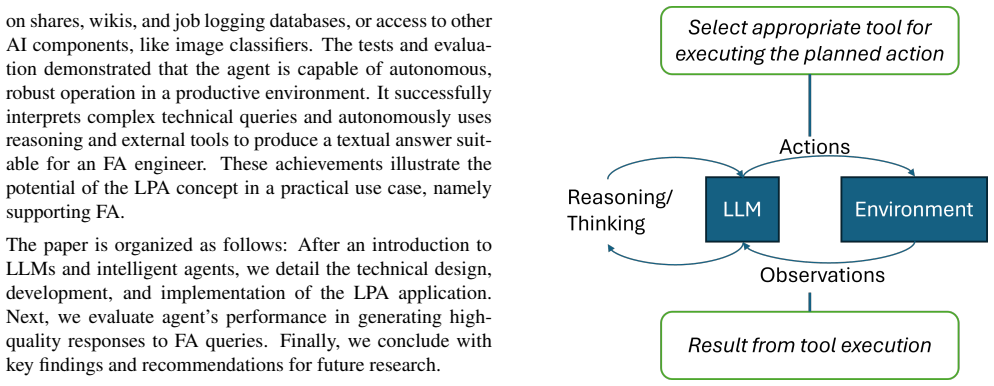
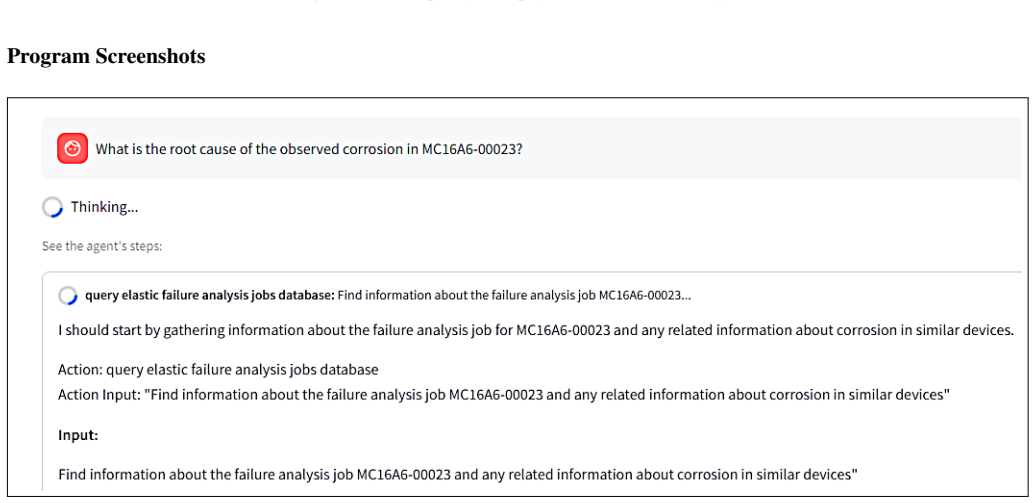
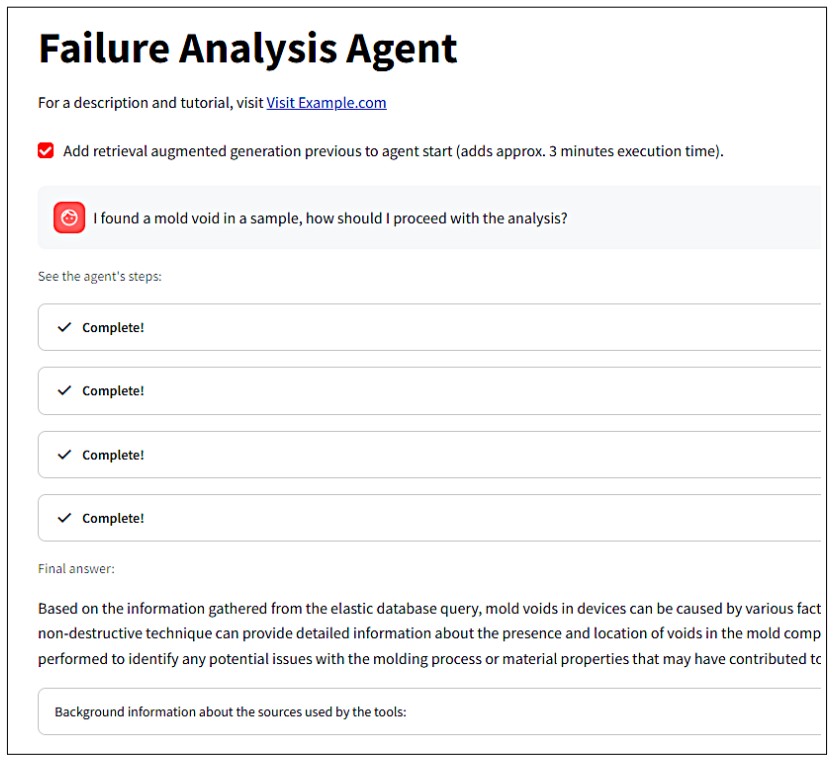
The load-bearing mechanism is the ReAct loop, in which the LLM repeatedly emits a thought about what to do next, an action naming a tool, and an action input, then observes the tool's result, appends it to a scratchpad, and repeats until it decides it has enough information to write a final answer. Around this loop the paper builds a modular system with intent classification to tailor prompts, a short-term memory that stores tool observations, scratchpad trimming to half the context window, and a tool set including structured search over a failure-analysis job database, keyword search over an internal wiki, a retrieval-augmented generation service, an image-analysis tool for mold voids, and prompt-based abductive and practical reasoning tools. A second architecture, online replanning, generates and revises a full step-by-step plan; in the evaluation the ReAct variant was faster and produced higher-quality answers.
What would settle it
Have several failure-analysis engineers independently rate the same 15 agent outputs on the same 1 to 5 scale and compare their scores with the LLM judge's scores; if the two disagree substantially, the reported 3.6/5 result does not establish practical usefulness.
Extended reading notes
Core claim
The paper's central claim is that an LLM-based planning agent can carry out a substantial part of semiconductor failure analysis autonomously. The agent is built as a ReAct loop: the LLM alternates between reasoning about the next step and invoking one of several external services, such as free-text search over historical failure-analysis job records, keyword search over an internal engineering wiki, a retrieval-augmented generation service, an image-analysis tool that detects mold voids in acoustic microscopy scans, and prompted reasoning modules for abductive and practical reasoning. In the best configuration, ReAct with intent classification, simple practical reasoning, and retrieval-augmented generation applied as a preprocessing step, the agent reached a quality score of 3.6 out of 5 on the 15 representative questions, while overall averages were moderate, in the 2 to 3 range. All tested configurations completed runs without unrecoverable failures in the production-like deployment. The paper therefore asserts that the planning-agent concept is operationally feasible and reliable enough for industrial failure-analysis support.
Load-bearing premise
The evaluation assumes that the LLM used as an automatic judge rates answer quality the way a human failure-analysis expert would, so the reported 3.6/5 score is meaningful only if that assumption holds.
Editorial extensions
If this is right
- ReAct-style iterative tool use is the more practical architecture: it finished in about 3.5 minutes per query versus 14 minutes for online replanning, and it scored higher on answer quality.
- Applying retrieval-augmented generation before the agent runs, rather than exposing it as a tool, raised the best score from 3.25 to 3.6 at the cost of roughly three extra minutes.
- Intent classification appeared in every top configuration and improved performance, so it is worth keeping in production deployments.
- Separate abductive-reasoning and short-term-memory modules showed no consistent benefit; the best configuration used only a simple practical-reasoning prompt and no distinct memory module.
- All tested configurations executed reliably in the production-like deployment, producing either an answer or a controlled stop message, which supports the claim of technical robustness.
Reading between the lines
- An immediate next step the paper leaves implicit is to run the same 15 queries past human failure-analysis experts and compare their ratings with the LLM judge's scores; the paper itself calls the automatic evaluation brittle and subjective, so this would settle whether the 3.6/5 result reflects real usefulness.
- The same ReAct-plus-tools orchestration could transfer to other knowledge-intensive industrial domains, such as printed-circuit-board diagnostics or materials testing, wherever internal search and logging services already exist; that transfer is an editorial inference, not a claim in the paper.
- The strong sensitivity of answer quality to prompt wording suggests that prompt engineering, rather than agent architecture alone, accounts for much of the performance gap; a standardized benchmark with varied real failure-analysis questions would allow this to be measured.
Editorial analysis
A structured set of objections, weighed in public.
Referee Report
Summary. The paper describes the design, implementation, and deployment of an LLM-based Planning Agent (LPA) for semiconductor failure analysis. The system combines ReAct-style and online-replanning agents with tools for ElasticSearch retrieval, Confluence wiki search, a RAG pipeline, an ML-based image analysis tool, and explicit abductive/practical reasoning prompts. The authors report ablation studies across 15 FA-related questions and over 2000 logged runs, with answer quality evaluated automatically by a Mixtral 8x7B judge on a 1–5 Likert scale. The best configuration (ReAct, Mixtral 8x7B, intent classification, short-term memory, simple practical reasoning, RAG preprocessing) achieves an average score of 3.6/5. The paper claims operational effectiveness and technical robustness, while also acknowledging moderate answer quality and the need for future user studies and benchmark datasets.
Significance. If the evaluation were externally validated, this would be a useful industrial proof-of-concept: it demonstrates that a planning agent can orchestrate multiple enterprise tools and run reliably in a production-like environment, with transparent reporting of moderate scores and clear engineering lessons. The paper is honest about its limitations, and the architectural details (tool wrappers, prompt templates, context-window trimming, stop-sequence fixes for different LLMs) are valuable for practitioners. However, the central effectiveness claim currently rests on an unvalidated LLM-as-judge that belongs to the same model family as the primary generator, and on a small self-chosen question set without human-expert correlation, baseline comparisons, or significance tests. The contribution is therefore a feasibility demonstration rather than a validated demonstration of effectiveness.
major comments (4)
- [Evaluation, Experiment Setup and Execution] The headline answer-quality scores (e.g., 3.6/5 for the best configuration) are produced by a Mixtral 8x7B model prompted to score outputs against gold-standard answers, and no validation of this judge against human expert ratings is reported. Because the same Mixtral 8x7B model is also the agent's main reasoning model in the best configuration, the judge may systematically favor its own generation style, inflating scores independent of actual FA correctness. The paper itself concedes in the Experiment Discussion that the LLM-based evaluation method 'remains inherently brittle and subjective' and calls for user studies and expert-validated ground truth. This concession is directly at odds with the abstract's claim of 'operational effectiveness and reliability' in supporting FA tasks. The authors should either provide a human–judge correlation study on a subset of outputs or substantially soften the effectiveness claim to feasibility and technical reliability.
- [Evaluation, Experiment Results and Discussion] No baseline comparison to simpler pipelines is included. The ablation studies compare LPA configurations against each other, but there is no comparison to a plain LLM with a single RAG call, to the RAG service alone, or to direct querying of ElasticSearch/Confluence without agent planning. Without such baselines, the claim that the agent's planning and tool orchestration contribute to answer quality is not established; the observed 3.6/5 might be achievable by a simpler retrieval-plus-prompt pipeline. The authors should add at least one non-agent baseline that receives the same gold-standard evaluation.
- [Evaluation, Experiment Setup and Execution] The evaluation uses only 15 self-chosen FA questions, and the reported averages are presented without per-question variance, error bars, or significance tests. Statements such as 'intent classification improved performance and was present in all top configurations' and 'RAG improved answer quality' are therefore not statistically supported. With 15 questions, a 0.2–0.3 difference in average score can easily arise from question difficulty or noise. The authors should report score distributions, per-question results, and appropriate significance tests (e.g., paired bootstrap or Wilcoxon) for the key comparisons, or explicitly label these findings as anecdotal.
- [Evaluation, Experiment Setup and Execution] The description of the run count is unclear and potentially misleading: the paper states that the full combinatorial space would be 1,296 configurations (19,440 runs) but only 'scientifically interesting combinations' were selected, and then reports 'Over 2000 valid runs were performed in total.' It is not stated how many runs per configuration were executed, whether each configuration was run once per question or multiple times, or how invalid runs were handled beyond being rerun. Since all scores are averages over 15 questions, the value of 'over 2000 runs' for supporting the claims is unclear. The authors should clarify the exact number of configurations evaluated, the replication policy, and how many valid runs contributed to each reported average.
minor comments (5)
- [Evaluation, Experiment Setup and Execution] The prompt used for the automatic judge is not shown in the appendix, and the criterion for 'gold standard answers' (who wrote them, how they were checked) is not described. Providing the judge prompt and the gold-answer construction process would increase reproducibility.
- [Technical Design and Implementation, Agent Initialization] The intent classifier is tested on only 20 labeled queries, and no accuracy metric is reported beyond 'performed well overall but showed some ambiguity-related errors.' This is very small for a component that the paper later credits with improving performance; please report exact counts or a confusion matrix.
- [Technical Design and Implementation, Online Replanning Agent Implementation] The paper states that regular-expression parsing of planner outputs 'remains brittle and should be replaced with structured output parsing,' which is an appropriate caveat, but it also means that the online replanning results may understate the potential of that architecture; this should be acknowledged in the conclusion as well.
- [Throughout] There are several typos and heading errors, including 'were were performed in total' in the Evaluation setup, 'Cloud Deplyoment' in the section heading, 'backgoround' in the Future Extensions paragraph, and inconsistent use of 'abdutive' vs. 'abductive' in listing captions. These should be corrected.
- [Conclusion and Future Work] The paper alternates between claiming 'technical feasibility' and implying operational effectiveness (e.g., 'robust enough for deployment, practical use and user-facing evaluation'). The conclusion should explicitly separate the two claims and state that answer-quality effectiveness is not yet validated.
Circularity Check
No significant circularity: the paper is an engineering integration whose evaluation, while subject to a same-family LLM-judge validity caveat, does not reduce to its own inputs by construction.
full rationale
The paper makes no formal derivation or first-principles prediction; it presents an engineering integration of ReAct planning, retrieval tools, and an LLM agent, evaluated by logged runs and a Likert-scale judge. No equation is introduced, so there is no equation-level equivalence of output to input. The only overlapping-author citation is [4], a parallel-thesis RAG service that is integrated as a tool and then independently ablated; the paper's central architectural claims do not rest solely on that citation. The abstract's 'operational effectiveness' claim is supported by execution robustness and by answer-quality scores, but the scores come from a Mixtral 8x7B judge while Mixtral is also the agent LLM in the best configuration. This is a genuine validity threat: the judge may favor its own generation style, and the paper itself concedes in the Experiment Discussion that the evaluation method 'remains inherently brittle and subjective' and calls for user studies and expert-validated ground truth. However, a biased or unvalidated measurement is not the same as circularity under the criteria used here: the judge scores are not identical to the agent outputs by construction, and no parameter was fitted to the target claim. Accordingly, no circular step is exhibited, and the appropriate finding is no significant circularity, with the evaluation caveat recorded as a correctness risk rather than a circularity score.
Assumptions & free parameters
free parameters (5)
- Number of test questions =
15
- Evaluation judge model =
Mixtral 8x7B
- Scoring scale =
1-5 Likert
- Context window trim =
half of context window
- Replanning step limit =
15
assumptions (4)
- domain assumption ReAct planning improves tool use over standalone LLMs.
- domain assumption Mixtral 8x7B as automatic judge produces scores approximating FA engineer judgments.
- domain assumption The 15 selected questions are representative of real FA queries.
- domain assumption The internal ElasticSearch and Confluence data contain information sufficient to answer the test questions.
Cite this review
Pith. "Pith review of Intelligent Assistants for the Semiconductor Failure Analysis with LLM-Based Planning Agents." pith.science (2026). https://pith.science/paper/G7V5LY6J
@misc{pith2026250615567,
  author       = {Pith},
  title        = {Pith review of: Intelligent Assistants for the Semiconductor Failure Analysis with LLM-Based Planning Agents},
  year         = {2026},
  howpublished = {\url{https://pith.science/paper/G7V5LY6J}},
  note         = {Machine review of arXiv:2506.15567}
}
read the original abstract
Failure Analysis (FA) is a highly intricate and knowledge-intensive process. The integration of AI components within the computational infrastructure of FA labs has the potential to automate a variety of tasks, including the detection of non-conformities in images, the retrieval of analogous cases from diverse data sources, and the generation of reports from annotated images. However, as the number of deployed AI models increases, the challenge lies in orchestrating these components into cohesive and efficient workflows that seamlessly integrate with the FA process. This paper investigates the design and implementation of an agentic AI system for semiconductor FA using a Large Language Model (LLM)-based Planning Agent (LPA). The LPA integrates LLMs with advanced planning capabilities and external tool utilization, allowing autonomous processing of complex queries, retrieval of relevant data from external systems, and generation of human-readable responses. The evaluation results demonstrate the agent's operational effectiveness and reliability in supporting FA tasks.
Figures


Figures from the paper (11 more)




Reference graph
Works this paper leans on
-
[1]
Semikong: Curating, training, and evaluating A semiconductor industry-specific large language model,
C. Nguyen, W. Nguyen, A. Suzuki, D. Oku, H. A. Phan, S. Dinh, Z. Nguyen, A. Ha, S. Raghavan, H. V o, T. Nguyen, L. Nguyen, and Y . Hirayama, “Semikong: Curating, training, and evaluating A semiconductor industry-specific large language model,” CoRR, vol. abs/2411.13802, 2024
arXiv 2024
-
[2]
Retrieval- augmented generation for large language models: A sur- vey,
Y . Gao, Y . Xiong, X. Gao, K. Jia, J. Pan, Y . Bi, Y . Dai, J. Sun, Q. Guo, M. Wang, and H. Wang, “Retrieval- augmented generation for large language models: A sur- vey,”CoRR, vol. abs/2312.10997, 2023
arXiv 2023
-
[3]
Prompt Engineering Guide,
E. Saravia, “Prompt Engineering Guide,” https://github.com/dair-ai/Prompt-Engineering-Guide, 12 2022
2022
-
[4]
Towards an fa chatbot with retrieval- augmented language modeling,
M. Fichtenkamm, M. Kofler, K. Schekotihin, and C. Burmer, “Towards an fa chatbot with retrieval- augmented language modeling,” in 2024 IEEE Interna- tional Symposium on the Physical and Failure Analysis of Integrated Circuits (IPFA), pp. 1–8, 2024
work page 2024
-
[5]
React: Synergizing reason- ing and acting in language models,
S. Yao, J. Zhao, D. Yu, N. Du, I. Shafran, K. R. Narasimhan, and Y . Cao, “React: Synergizing reason- ing and acting in language models,” in ICLR, OpenRe- view.net, 2023
work page 2023
-
[6]
A. Vaswani, N. Shazeer, N. Parmar, J. Uszkoreit, L. Jones, A. N. Gomez, L. Kaiser, and I. Polosukhin, “Attention Is All You Need,”Advances in Neural Infor- mation Processing Systems, 2017
work page 2017
-
[7]
BERT: Pre-training of Deep Bidirectional Trans- formers for Language Understanding,
J. Devlin, M.-W. Chang, K. Lee, and K. Toutanova, “BERT: Pre-training of Deep Bidirectional Trans- formers for Language Understanding,” 2019. arXiv:1810.04805 [cs]
arXiv 2019
-
[8]
Explor- ing the limits of transfer learning with a unified text-to- text transformer,
C. Raffel, N. Shazeer, A. Roberts, K. Lee, S. Narang, M. Matena, Y . Zhou, W. Li, and P. J. Liu, “Explor- ing the limits of transfer learning with a unified text-to- text transformer,”Journal of machine learning research, vol. 21, no. 140, pp. 1–67, 2020
work page 2020
Show all 45 references
-
[9]
Language Models are Few-Shot Learners,
T. B. Brown, B. Mann, N. Ryder, M. Subbiah, J. Ka- plan, P. Dhariwal, A. Neelakantan, P. Shyam, G. Sastry, A. Askell, S. Agarwal, A. Herbert-V oss, G. Krueger, T. Henighan, R. Child, A. Ramesh, D. M. Ziegler, J. Wu, C. Winter, C. Hesse, M. Chen, E. Sigler, M. Litwin, S. Gray, ...
2020 arXiv
-
[10]
Fine- Tuning Language Models from Human Preferences,
D. M. Ziegler, N. Stiennon, J. Wu, T. B. Brown, A. Rad- ford, D. Amodei, P. Christiano, and G. Irving, “Fine- Tuning Language Models from Human Preferences,” Jan. 2020. arXiv:1909.08593 [cs, stat]
2020 arXiv
-
[11]
Training language models to follow instructions with human feedback,
L. Ouyang, J. Wu, X. Jiang, D. Almeida, C. L. Wain- wright, P. Mishkin, C. Zhang, S. Agarwal, K. Slama, A. Ray, J. Schulman, J. Hilton, F. Kelton, L. Miller, M. Simens, A. Askell, P. Welinder, P. Christiano, J. Leike, and R. Lowe, “Training language models to follow instructio...
2022 arXiv
-
[12]
Pre-train, Prompt, and Predict: A Systematic Sur- vey of Prompting Methods in Natural Language Pro- cessing,
P. Liu, W. Yuan, J. Fu, Z. Jiang, H. Hayashi, and G. Neu- big, “Pre-train, Prompt, and Predict: A Systematic Sur- vey of Prompting Methods in Natural Language Pro- cessing,” July 2021. arXiv:2107.13586 [cs]
2021 arXiv
-
[13]
Retrieval-augmented genera- tion for knowledge-intensive NLP tasks,
P. Lewis, E. Perez, A. Piktus, F. Petroni, V . Karpukhin, N. Goyal, H. Küttler, M. Lewis, W. Yih, T. Rocktäschel, S. Riedel, and D. Kiela, “Retrieval-augmented genera- tion for knowledge-intensive NLP tasks,” in NeurIPS, 2020
2020
-
[14]
Chain-of- Thought Prompting Elicits Reasoning in Large Lan- guage Models,
J. Wei, X. Wang, D. Schuurmans, M. Bosma, b. ichter, F. Xia, E. Chi, Q. V . Le, and D. Zhou, “Chain-of- Thought Prompting Elicits Reasoning in Large Lan- guage Models,” inAdvances in Neural Information Pro- cessing Systems (S. Koyejo, S. Mohamed, A. Agar- wal, D. Belgrave, K. ...
2022
-
[15]
Large Language Models are Zero-Shot Reason- ers,
T. Kojima, S. S. Gu, M. Reid, Y . Matsuo, and Y . Iwa- sawa, “Large Language Models are Zero-Shot Reason- ers,” Jan. 2023. arXiv:2205.11916 [cs]
2023 arXiv
-
[16]
The Impact of Reasoning Step Length on Large Language Models,
M. Jin, Q. Yu, D. Shu, H. Zhao, W. Hua, Y . Meng, Y . Zhang, and M. Du, “The Impact of Reasoning Step Length on Large Language Models,” Jan. 2024. arXiv:2401.04925 [cs]
2024 arXiv
-
[17]
Intelligent agents: theory and practice,
M. Wooldridge and N. R. Jennings, “Intelligent agents: theory and practice,” The Knowledge Engineering Re- view, vol. 10, pp. 115–152, June 1995
1995
-
[18]
Intelligent agents: The key concepts,
M. J. Wooldridge, “Intelligent agents: The key concepts,” in Multi-Agent-Systems and Applications , vol. 2322 of Lecture Notes in Computer Science, pp. 3– 43, Springer, 2001
2001
-
[19]
Towards large language model-based personal agents in the enterprise: Current trends and open problems,
V . Muthusamy, Y . Rizk, K. Kate, P. Venkateswaran, V . Isahagian, A. Gulati, and P. Dube, “Towards large language model-based personal agents in the enterprise: Current trends and open problems,” in Findings of the Association for Computational Linguistics: EMNLP 2023 (H. Bou...
2023
-
[20]
Augmented Language Models: a Survey,
G. Mialon, R. Dessì, M. Lomeli, C. Nalmpantis, R. Pasunuru, R. Raileanu, B. Rozière, T. Schick, J. Dwivedi-Yu, A. Celikyilmaz, E. Grave, Y . LeCun, and T. Scialom, “Augmented Language Models: a Survey,” Feb. 2023. arXiv:2302.07842 [cs]
2023 arXiv
-
[21]
A survey on large language model based autonomous agents,
L. Wang, C. Ma, X. Feng, Z. Zhang, H. Yang, J. Zhang, Z. Chen, J. Tang, X. Chen, Y . Lin, W. X. Zhao, Z. Wei, and J. Wen, “A survey on large language model based autonomous agents,” Frontiers of Computer Science , vol. 18, p. 186345, Dec. 2024
2024
-
[22]
The Rise and Potential of Large Language Model Based Agents: A Survey,
Z. Xi, W. Chen, X. Guo, W. He, Y . Ding, B. Hong, M. Zhang, J. Wang, S. Jin, E. Zhou, R. Zheng, X. Fan, X. Wang, L. Xiong, Y . Zhou, W. Wang, C. Jiang, Y . Zou, X. Liu, Z. Yin, S. Dou, R. Weng, W. Cheng, Q. Zhang, W. Qin, Y . Zheng, X. Qiu, X. Huang, and T. Gui, “The Rise and ...
2023 arXiv
-
[23]
An In-depth Survey of Large Language Model-based Artificial Intelligence Agents,
P. Zhao, Z. Jin, and N. Cheng, “An In-depth Survey of Large Language Model-based Artificial Intelligence Agents,” Sept. 2023. arXiv:2309.14365 [cs]
2023 arXiv
-
[24]
Hugginggpt: Solving ai tasks with chatgpt and its friends in hugging face,
Y . Shen, K. Song, X. Tan, D. Li, W. Lu, and Y . Zhuang, “Hugginggpt: Solving ai tasks with chatgpt and its friends in hugging face,” Advances in Neural Informa- tion Processing Systems, vol. 36, 2024
2024
-
[25]
Mixtral of experts
M. AI, “Mixtral of experts.” Online, 2023. https:// mistral.ai/news/mixtral-of-experts/
2023
-
[26]
Llama 3: Open foundation and instruction models
M. AI, “Llama 3: Open foundation and instruction models.” Online, 2024. https://ai.meta.com/ blog/meta-llama-3/
2024
-
[27]
Plan-and-execute
“Plan-and-execute.” Online. https:// langchain-ai.github.io/langgraph/ tutorials/plan-and-execute/ plan-and-execute/, accessed 05.09.2024
2024
-
[28]
Hotpotqa: A dataset for diverse, explainable multi-hop question an- swering,
Z. Yang, P. Qi, S. Zhang, Y . Bengio, W. W. Cohen, R. Salakhutdinov, and C. D. Manning, “Hotpotqa: A dataset for diverse, explainable multi-hop question an- swering,” arXiv preprint arXiv:1809.09600, 2018. Appendix Selected Prompt Templates Listing 5: Excerpt from a prompt tem...
2018 arXiv
-
[29]
Observations relate to observations made in ,→ analyses of devices and can be observed failures, measurements and general findings ,→ from analyses
Identify the set of relevant observations. Observations relate to observations made in ,→ analyses of devices and can be observed failures, measurements and general findings ,→ from analyses. Specify only the concrete observations
-
[30]
The hypotheses must ,→ explain why the observations occurred and can be potential root causes or potential ,→ failures
Generate hypotheses that can best explain the set of observations. The hypotheses must ,→ explain why the observations occurred and can be potential root causes or potential ,→ failures. Generate at least 1 and at most 3 hypotheses
-
[31]
For every generated hypothesis, rate how well the hypothesis explains the observations. ,→ Rate by assigning an integer value between 0 and 10 to the hypothesis, where 0 means ,→ the hypothesis is absolutely not likely to explain the observations and 10 means the ,→ hypothesis...
-
[32]
PinShort
"PinShort": The short in the device could be caused by a short circuit between ,→ pins, which may be due to manufacturing defects, contamination, or damage during ,→ assembly
-
[33]
MetallizationPinholes
"MetallizationPinholes": The short could be caused by pinholes in the metallization ,→ layers, which may allow for electrical connections between different layers or ,→ components, leading to a short circuit
-
[34]
ParticleShortingPinsLeads
"ParticleShortingPinsLeads": The short may be caused by particles or foreign ,→ materials that have bridged the gap between pins or leads, creating a short ,→ circuit. This could be due to contamination during manufacturing, handling, or ,→ assembly processes. Listing 14: Exem...
-
[35]
Identify the set of relevant observations: - Short in a device which is not decapsulated yet - Localization of the short in the package - IR-LIT - Magnetic Microscopy
-
[36]
Generate hypotheses that can best explain the set of observations: Hypothesis 1: Solder bridge between pins in the package causing the short Hypothesis 2: Cracked die or wire causing the short
-
[37]
Rate how well the hypothesis explains the observations: Hypothesis 1: Solder bridge between pins in the package causing the short - Explains the ,→ localization of the short in the package - Explains the need for IR-LIT, Magnetic ,→ Microscopy, ... to identify the short - Rate...
-
[38]
Check the given information on hypotheses and previous analyses
-
[39]
You can select actions ,→ from the given failure analysis information or given tasks, but you can also select ,→ actions that are described in previous analyses
Select the best actions (at least 1, at most 5) that can reach the goal of confirming or ,→ rebutting the given hypotheses and align with the analyses. You can select actions ,→ from the given failure analysis information or given tasks, but you can also select ,→ actions that...
-
[40]
Also think about the consequences of the actions you propose and if anything could ,→ negatively affect the goal of further researching the hypotheses, like destruction. These are the hypotheses about the root cause and failures and existing previous analyses ,→ and results: {...
-
[41]
,→ This will help confirm the intermittent behavior and irregularities observed in the ,→ VDDM curve
Electrical Verification: Validate the reported failure by performing electrical testing ,→ on the device, such as Tester Measurement (ATE) and Curve Tracer Measurement (I-V). ,→ This will help confirm the intermittent behavior and irregularities observed in the ,→ VDDM curve
-
[42]
This can provide initial visual evidence to support or refute the hypotheses
Optical Microscopy: Perform external and internal visual inspection using Optical ,→ Microscopy (OM) to look for signs of corrosion, moisture-related issues, or defective ,→ bonding. This can provide initial visual evidence to support or refute the hypotheses
-
[43]
This can help isolate the physical failure fault and provide insights ,→ into the root cause
X-Ray Radiography: Conduct X-ray imaging to examine the bond wires, solder joints, Cu ,→ traces, and lead frames for any visible defects or anomalies that could be related to ,→ the failures. This can help isolate the physical failure fault and provide insights ,→ into the root cause
-
[44]
This will allow for a more detailed examination of the bonding and ,→ potential corrosion or moisture-related issues
Decapsulation: Perform chemical decapsulation to expose the die and bonding area for ,→ further analysis. This will allow for a more detailed examination of the bonding and ,→ potential corrosion or moisture-related issues
-
[45]
This can ,→ provide more detailed information on the root cause of the failures
(Cross-)subsectioning: Perform cross-subsectioning on the bonding area to examine the ,→ bonding quality and look for signs of corrosion or moisture-related issues. This can ,→ provide more detailed information on the root cause of the failures. These actions align with the ge...
Reviewed August 6, 2026 · model on record in the stance chip above.
Discussion (0). Sign in to comment.