REVIEW 3 major objections 6 minor 61 references
Event-based Graph Representation with Spatial and Motion Vectors for Asynchronous Object Detection
T0 review · 3 major / 6 minor · reviewed 2026-08-06 · deepseek-v4-flash
Pith's one-line read Decoupled spatial and temporal event graphs improve graph-based event-camera object detection by over 6% with no added computation.
desk verdict The architecture is new and the ablations are careful, but the headline DAGr gain rests on a baseline the authors themselves flag as not representative. read the letter →
The pith
A machine-rendered reading of the paper's core claim, the machinery that carries it, and where it could break.
The reading
What carries the argument
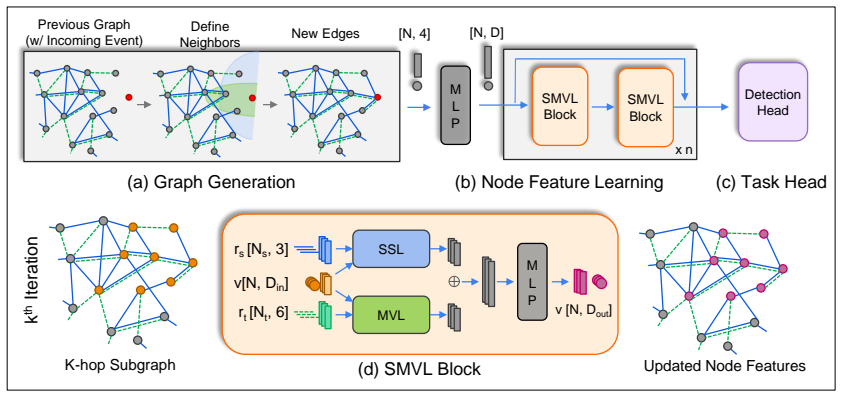
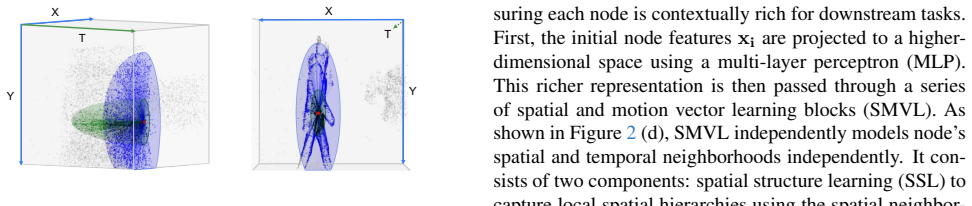
The load-bearing object is the decoupled spatiotemporal multigraph $G = \{V, E_s, R_s, E_t, R_t\}$: each event is a node in $\mathbb{R}^3$ at $(x_i, y_i, t_i)$, with spatial edges defined by an ellipsoid whose semi-major axis lies in the XY-plane (4% of input size, 5 ms temporal radius) and temporal edges by an inverted ellipsoid (1% spatial, 40 ms temporal). The spatial view is learned with an anisotropic B-spline kernel of size $k \times k \times 1$, which is a 2D operation, and the temporal view is learned by GATv2-style multi-head attention over motion-vector edge features. This separation is what lets the network capture both global spatial structure and local motion while keeping all computation in the sparse, asynchronous regime; fusing the two views is deliberately a cheap concatenation plus MLP.
What would settle it
Re-run DAGr, AEGNN, and eGSMV under identical protocols with the same 100 ms windows, same training budget, and same detection head, and publish both mAP and per-event FLOPs; if DAGr under that protocol reaches or exceeds 0.371 mAP on Gen1, the claimed over-6% advantage would not hold.
Extended reading notes
Core claim
The paper's central claim is that an event stream is better modeled as a spatiotemporal multigraph with two independent neighbor structures than as a single spatiotemporal graph or a dense tensor. The spatial subgraph connects nearby events within a tight ellipsoid and is processed by a 2D anisotropic B-spline convolution that captures local structure, while the temporal subgraph connects events that are close in space but separated in time and is processed by multi-head attention over edge features that include displacement, velocity ($\Delta x/\Delta t$, $\Delta y/\Delta t$), and polarity change. Because the two views are decoupled, message passing computes quadratic rather than cubic relations, and 2D kernels replace 3D kernels, cutting per-message-passing cost by up to 87.5%. With an event-level detection head that pools only proximal events before non-maximum suppression, the framework reports 0.371 mAP on Gen1 and 0.431 mAP@50 on eTraM at 4.5 and 26.1 MFLOPs per event, with 5.6M parameters, outperforming AEGNN by 21% and DAGr by over 6% without additional computation.
Load-bearing premise
The headline improvement over DAGr rests on the assumption that the DAGr numbers in Table 1 fairly represent that method under comparable settings, but the table itself footnotes that those values are 'not representative for the above comparison'.
Editorial extensions
If this is right
- Graph-based event detectors can match or narrow the gap to dense transformer-based detectors while using roughly three orders of magnitude fewer FLOPs per event, e.g., 4.5 versus about 2400 on Gen1.
- Because the spatial kernel is 2D and the two graph views are independent, the spatial and temporal learning blocks can run in parallel, giving close-to-constant update time as the graph grows (21.4 ms at 25,000 nodes) and a 5x speedup over AEGNN's cubic kernels.
- Retaining event-level granularity in the detection head matters: coarsening predictions to voxel grids of size 8x8 and above drops mAP from about 0.36 to 0.197 on the Gen1 validation set.
- The design generalizes beyond ego-motion driving scenes to static traffic monitoring, where eGSMV reaches 0.431 mAP@50 on eTraM with a fraction of dense methods' parameters.
Reading between the lines
- A direct test of the paper's central mechanism would swap the 2D spatial kernel for the 3D isotropic kernel at a matched parameter budget; the paper's own ablation shows 3D gains only 0.02 mAP at about six times the parameters, but that ablation is on a validation set with shorter sequences.
- The authors leave open whether the same decoupling helps other event-level tasks; since the temporal edge features are essentially velocity and displacement, optical flow and motion segmentation are natural next targets.
- The claim of no additional computational requirement is relative to graph baselines; comparing against a dense method at equal per-event FLOPs would test whether the sparse representation itself, rather than the efficiency trick, is the source of the accuracy gain.
Editorial analysis
A structured set of objections, weighed in public.
Referee Report
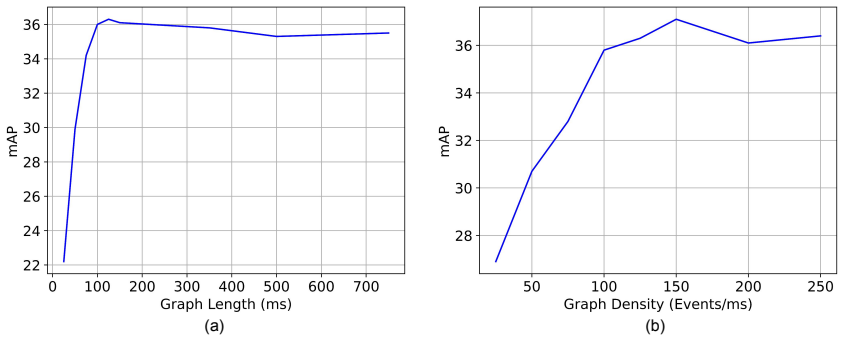
Summary. The manuscript proposes eGSMV, an event-based object detection method that represents an event stream as a spatiotemporal multigraph with separate spatial and temporal edges. Spatial structure is learned with an anisotropic 2D spline convolution; temporal structure is learned with motion-vector features and GATv2 attention on a separate temporal neighborhood. The authors report 0.371 mAP on Gen1 and 0.431 mAP@50 on eTraM, claiming an over-6% accuracy gain over the graph-based DAGr baseline, lower MFLOPs per event than AEGNN and DAGr, and a 5x speedup from quadratic rather than cubic kernels. Ablations examine the SSL/MVL split, detection-head granularity, graph length, and graph density.
Significance. If the baseline comparisons were fully specified and reliable, the contribution would be useful: the decoupled spatial/temporal multigraph is a sensible way to preserve sparsity and asynchronous operation while avoiding cubic kernels, and the ablations (Tables 3, 4, 6, 8; Figure 7) give internal evidence that both modules contribute. The paper also candidly discusses storage and hardware limitations in Section 5. At present, however, the headline accuracy and speed claims rest on baselines that the paper itself disavows or does not measure, so the quantitative contribution is not yet established.
major comments (3)
- [Section 4.2, Table 1] The headline 'over 6%' improvement over DAGr is not supported by the data as presented. Table 1 flags the DAGr row (0.212/0.304 mAP, 6.27/4.58 MFLOPs/ev, 34.6M params) as 'not representative for the above comparison,' and Section 4.2 gives no protocol for either re-run configuration: no graph or time-window length, no early-aggregation details, no training recipe, and no test-split or variance information. Because the DAGr numbers are the comparison target of the central accuracy claim, and the paper also notes DAGr is an event+image fusion technique, the 6% gain cannot be verified or interpreted as a like-for-like graph-based gain. Please provide a complete, reproducible DAGr re-evaluation (or use published numbers with explicit provenance) and restate the claim with the appropriate uncertainty.
- [Section 4.2 and Abstract/Introduction] The reported eTraM improvement over AEGNN is inconsistent. The abstract and introduction state a 25% improvement, while Section 4.2 states mAP 35% higher using a re-run AEGNN benchmark 'under the same evaluation settings as our method,' but Table 1 lists AEGNN at 0.180 mAP@50 and no separate re-run result or protocol is given. With the printed numbers, eGSMV's 0.431 exceeds 0.180 by 0.251 points (139% relative), so neither 25% nor 35% is self-consistent without additional context. Please report the exact AEGNN configuration, the resulting number, and state whether percentages are absolute points or relative gains.
- [Section 4.2, Timing Experiments and Table 2] The abstract's '5x speedup' is not measured. Table 2 compares a 'dense graph update' to the proposed serial and parallel asynchronous updates; it does not compare against AEGNN or DAGr. The claim that 'our quadratic kernels enable more than 5x speedup compared to AEGNN' appears in the text without any AEGNN timing experiment. Please either add direct wall-clock latency measurements against AEGNN (and DAGr) under the same hardware and graph sizes, or revise the speedup claim to a kernel-complexity bound that is explicitly labeled as such.
minor comments (6)
- [Section 1 and Table 1] The statement 'our method achieves a 21% improvement over AEGNN on Gen1' should be qualified: Table 1 gives AEGNN 0.163 and eGSMV 0.371, a 0.208 mAP-point gap (128% relative), so if the intended meaning is 21 percentage points, say so explicitly.
- [Section 8.1, Equations (9) and (12)] The classification and confidence losses use inconsistent notation for predictions and ground truth (y_i vs ŷ_i, and s_i vs ŝ_i); please align with a standard convention.
- [Section 3.1, Equation (2)] It is unclear whether the coordinates in the neighbor condition are raw pixel coordinates, normalized coordinates, or a mix; please define the units and normalization for R_XY, R_t, and the edge features in Equations (5) and (6).
- [Table 1 footnote] Table 1 uses '*' for estimated values and '^' for non-representative values, but the DAGr MFLOPs/ev entries are inside the flagged row; please state explicitly that the efficiency comparison is likewise affected.
- [Section 4.2 and Figure 5] Figure 5 is referenced in the text but not described; consider adding a sentence summarizing what it shows.
- [Section 10.1, Table 8] The text refers to 'Table??' when discussing multi-head attention; please fix the reference.
Circularity Check
No significant circularity: the paper reports measured empirical results, and its graph construction, losses, and ablations do not reduce to their own inputs.
full rationale
This is an empirical computer-vision paper, not a formal derivation, so the circularity burden is low. The core claims are measured detection accuracy (mAP) and efficiency (MFLOPs/ev, parameters, timing) on Gen1 and eTraM. The graph construction in Eq. (2) defines spatial and temporal neighbors via ellipsoidal radii, and Eqs. (5)-(6) define edge features as coordinate differences and velocities; these are definitions of the representation, not hidden uses of the target result. The SMVL architecture combines a 2D anisotropic spline convolution with GATv2-based attention on motion-vector edge features, and the ablations in Tables 3, 4, 6, 7, and 8 compare variants of these components. None of these components is fitted to the reported test metric and then reported as a prediction; hyperparameters such as R_XY, R_t, and neighbor counts are explicitly tuned on validation data (Section 3.1), which is standard practice. The authors do cite their own eTraM dataset paper [53] and their survey [10], but these citations provide an external dataset and background context, and the dataset itself is a public benchmark; this is not load-bearing circularity. The most notable weakness is the reliability of the DAGr baseline in Table 1, which carries a footnote that the values are 'not representative for the above comparison' and is described in Section 4.2 as an event+image fusion technique with only partially specified configurations. That is a correctness or reproducibility concern about the comparison, not a circularity concern: the DAGr numbers are external baselines, not outputs of this paper's own equations. Accordingly, no step in the paper reduces by construction to its inputs, and no self-citation substitutes for an argument. The honest finding is no significant circularity, score 0.
Assumptions & free parameters
free parameters (8)
- R_XY (spatial) =
4% of input dimension
- R_t (spatial) =
5 ms
- R_XY (temporal) =
1% of input dimension
- R_t (temporal) =
40 ms
- Number of spatial neighbors =
16
- Number of temporal neighbors =
12
- Graph length =
100 ms
- Loss weights (alpha, beta, gamma, lambda) =
1, 2, 3, 1.5
assumptions (3)
- domain assumption GNNs trained synchronously can be executed asynchronously at inference with equivalent results
- ad hoc to paper The ellipsoidal neighbor rule in Eq. 2 adequately captures the spatial and temporal structure of events
- domain assumption Spline convolution and GATv2 attention are suitable aggregation mechanisms for event graphs
Cite this review
Pith. "Pith review of Event-based Graph Representation with Spatial and Motion Vectors for Asynchronous Object Detection." pith.science (2026). https://pith.science/paper/GAO5ZDK2
@misc{pith2026250715150,
  author       = {Pith},
  title        = {Pith review of: Event-based Graph Representation with Spatial and Motion Vectors for Asynchronous Object Detection},
  year         = {2026},
  howpublished = {\url{https://pith.science/paper/GAO5ZDK2}},
  note         = {Machine review of arXiv:2507.15150}
}
read the original abstract
Event-based sensors offer high temporal resolution and low latency by generating sparse, asynchronous data. However, converting this irregular data into dense tensors for use in standard neural networks diminishes these inherent advantages, motivating research into graph representations. While such methods preserve sparsity and support asynchronous inference, their performance on downstream tasks remains limited due to suboptimal modeling of spatiotemporal dynamics. In this work, we propose a novel spatiotemporal multigraph representation to better capture spatial structure and temporal changes. Our approach constructs two decoupled graphs: a spatial graph leveraging B-spline basis functions to model global structure, and a temporal graph utilizing motion vector-based attention for local dynamic changes. This design enables the use of efficient 2D kernels in place of computationally expensive 3D kernels. We evaluate our method on the Gen1 automotive and eTraM datasets for event-based object detection, achieving over a 6% improvement in detection accuracy compared to previous graph-based works, with a 5x speedup, reduced parameter count, and no increase in computational cost. These results highlight the effectiveness of structured graph modeling for asynchronous vision. Project page: eventbasedvision.github.io/eGSMV.
Figures

Figures from the paper (6 more)




Reference graph
Works this paper leans on
-
[1]
Manideep Reddy Aliminati, Bharatesh Chakravarthi, Aayush Atul Verma, Arpitsinh Vaghela, Hua Wei, Xuesong Zhou, and Yezhou Yang. Sevd: Synthetic event-based vision dataset for ego and fixed traffic perception.arXiv preprint arXiv:2404.10540, 2024. 1
arXiv 2024
-
[2]
A low power, fully event-based gesture recognition system
Arnon Amir, Brian Taba, David Berg, Timothy Melano, Jef- frey McKinstry, Carmelo Di Nolfo, Tapan Nayak, Alexan- der Andreopoulos, Guillaume Garreau, Marcela Mendoza, Jeff Kusnitz, Michael Debole, Steve Esser, Tobi Delbruck, Myron Flickner, and Dharmendra Modha. A low power, fully event-based gesture recognition system. In2017 IEEE Conference on Computer V...
work page 2017
-
[3]
Monocular event-based vision for obstacle avoidance with a quadrotor
Anish Bhattacharya, Marco Cannici, Nishanth Rao, Yuezhan Tao, Vijay Kumar, Nikolai Matni, and Davide Scaramuzza. Monocular event-based vision for obstacle avoidance with a quadrotor. In8th Annual Conference on Robot Learning. 1
-
[4]
Graph-based object classifica- tion for neuromorphic vision sensing
Yin Bi, Aaron Chadha, Alhabib Abbas, Eirina Bourtsoulatze, and Yiannis Andreopoulos. Graph-based object classifica- tion for neuromorphic vision sensing. InProceedings of the IEEE/CVF international conference on computer vision, pages 491–501, 2019. 3
work page 2019
-
[5]
Yin Bi, Aaron Chadha, Alhabib Abbas, Eirina Bourtsoulatze, and Yiannis Andreopoulos. Graph-based spatio-temporal feature learning for neuromorphic vision sensing.IEEE Transactions on Image Processing, 2020. 3
work page 2020
- [6]
-
[7]
Pedro: An event-based dataset for person detection in robotics
Chiara Boretti, Philippe Bich, Fabio Pareschi, Luciano Prono, Riccardo Rovatti, and Gianluca Setti. Pedro: An event-based dataset for person detection in robotics. InPro- ceedings of the IEEE/CVF Conference on Computer Vision and Pattern Recognition, pages 4064–4069, 2023. 1
work page 2023
-
[8]
How attentive are graph attention networks? InInternational Conference on Learning Representations
Shaked Brody, Uri Alon, and Eran Yahav. How attentive are graph attention networks? InInternational Conference on Learning Representations. 5
Show all 61 references
-
[9]
Asynchronous convolutional networks for object detection in neuromorphic cameras
Marco Cannici, Marco Ciccone, Andrea Romanoni, and Matteo Matteucci. Asynchronous convolutional networks for object detection in neuromorphic cameras. InProceedings of the IEEE/CVF Conference on Computer Vision and Pattern Recognition Workshops, pages 0–0, 2019. 2
2019
-
[10]
Recent event camera innovations: A survey.arXiv preprint arXiv:2408.13627, 2024
Bharatesh Chakravarthi, Aayush Atul Verma, Kostas Dani- ilidis, Cornelia Fermuller, and Yezhou Yang. Recent event camera innovations: A survey.arXiv preprint arXiv:2408.13627, 2024. 1
2024 arXiv
-
[11]
Ob- ject detection with spiking neural networks on automotive event data
Lo ¨ıc Cordone, Benoˆıt Miramond, and Philippe Thierion. Ob- ject detection with spiking neural networks on automotive event data. In2022 International Joint Conference on Neu- ral Networks (IJCNN), 2022. 2
2022
-
[12]
Ob- ject detection with spiking neural networks on automotive event data
Lo ¨ıc Cordone, Benoˆıt Miramond, and Philippe Thierion. Ob- ject detection with spiking neural networks on automotive event data. In2022 International Joint Conference on Neu- ral Networks (IJCNN), pages 1–8. IEEE, 2022. 6
2022
-
[13]
A large scale event-based detec- tion dataset for automotive, 2020
Pierre de Tournemire, Davide Nitti, Etienne Perot, Davide Migliore, and Amos Sironi. A large scale event-based detec- tion dataset for automotive, 2020. 6, 14
2020
-
[14]
A voxel graph cnn for object classification with event cameras
Yongjian Deng, Hao Chen, Hai Liu, and Youfu Li. A voxel graph cnn for object classification with event cameras. In Proceedings of the IEEE/CVF Conference on Computer Vi- sion and Pattern Recognition, pages 1172–1181, 2022. 2, 3
2022
-
[15]
A dynamic gcn with cross-representation distillation for event-based learn- ing.Proceedings of the AAAI Conference on Artificial Intel- ligence, 38(2):1492–1500, 2024
Yongjian Deng, Hao Chen, and Youfu Li. A dynamic gcn with cross-representation distillation for event-based learn- ing.Proceedings of the AAAI Conference on Artificial Intel- ligence, 38(2):1492–1500, 2024. 3
2024
-
[16]
PyTorch Lightning, 2019
William Falcon and The PyTorch Lightning team. PyTorch Lightning, 2019. 6
2019
-
[17]
Matthias Fey and Jan E. Lenssen. Fast graph representa- tion learning with PyTorch Geometric. InICLR Workshop on Representation Learning on Graphs and Manifolds, 2019. 6
2019
-
[18]
Event-based, 6-dof camera tracking from photometric depth maps.IEEE transactions on pattern analysis and machine intelligence, 40(10):2402–2412, 2017
Guillermo Gallego, Jon EA Lund, Elias Mueggler, Henri Re- becq, Tobi Delbruck, and Davide Scaramuzza. Event-based, 6-dof camera tracking from photometric depth maps.IEEE transactions on pattern analysis and machine intelligence, 40(10):2402–2412, 2017. 2
2017
-
[19]
Davison, J¨org Conradt, Kostas Daniilidis, and Da- vide Scaramuzza
Guillermo Gallego, Tobi Delbr ¨uck, Garrick Orchard, Chiara Bartolozzi, Brian Taba, Andrea Censi, Stefan Leutenegger, Andrew J. Davison, J¨org Conradt, Kostas Daniilidis, and Da- vide Scaramuzza. Event-based vision: A survey.CoRR, abs/1904.08405, 2019. 1
1904 arXiv
-
[20]
Yolox: Exceeding yolo series in 2021.arXiv preprint arXiv:2107.08430, 2021
Zheng Ge, Songtao Liu, Feng Wang, Zeming Li, and Jian Sun. Yolox: Exceeding yolo series in 2021.arXiv preprint arXiv:2107.08430, 2021. 5, 10
2021 arXiv
-
[21]
Low-latency auto- motive vision with event cameras.Nature, 629(8014):1034– 1040, 2024
Daniel Gehrig and Davide Scaramuzza. Low-latency auto- motive vision with event cameras.Nature, 629(8014):1034– 1040, 2024. 2, 3, 6, 7
2024
-
[22]
Recurrent vision transformers for object detection with event cameras
Mathias Gehrig and Davide Scaramuzza. Recurrent vision transformers for object detection with event cameras. InPro- ceedings of the IEEE/CVF conference on computer vision and pattern recognition, pages 13884–13893, 2023. 1, 2, 6
2023
-
[23]
Dsec: A stereo event camera dataset for driving scenarios.IEEE Robotics and Automation Letters, 2021
Mathias Gehrig, Willem Aarents, Daniel Gehrig, and Davide Scaramuzza. Dsec: A stereo event camera dataset for driving scenarios.IEEE Robotics and Automation Letters, 2021. 1
2021
-
[24]
Region-based convolutional networks for accurate object detection and segmentation.IEEE transactions on pattern analysis and machine intelligence, 38(1):142–158,
Ross Girshick, Jeff Donahue, Trevor Darrell, and Jitendra Malik. Region-based convolutional networks for accurate object detection and segmentation.IEEE transactions on pattern analysis and machine intelligence, 38(1):142–158,
-
[25]
Hierarchical neural memory network for low latency event processing
Ryuhei Hamaguchi, Yasutaka Furukawa, Masaki Onishi, and Ken Sakurada. Hierarchical neural memory network for low latency event processing. InProceedings of the IEEE/CVF Conference on Computer Vision and Pattern Recognition, pages 22867–22876, 2023. 2
2023
-
[26]
Robust estimation of a location parameter
Peter J Huber. Robust estimation of a location parameter. In Breakthroughs in statistics: Methodology and distribution, pages 492–518. Springer, 1992. 10
1992
-
[27]
Towards event-driven object detection with off-the-shelf deep learning
Massimiliano Iacono, Stefan Weber, Arren Glover, and Chiara Bartolozzi. Towards event-driven object detection with off-the-shelf deep learning. In2018 IEEE/RSJ Interna- tional Conference on Intelligent Robots and Systems (IROS), pages 1–9, 2018. 1
2018
-
[28]
Memory-efficient graph convolutional networks for object classification and detection with event cameras
Kamil Jeziorek, Andrea Pinna, and Tomasz Kryjak. Memory-efficient graph convolutional networks for object classification and detection with event cameras. In2023 Sig- nal Processing: Algorithms, Architectures, Arrangements, and Applications (SPA), pages 160–165, 2023. 3
2023
-
[29]
Chen, Zhenshan Bing, and Alois Knoll
Zhuangyi Jiang, Pengfei Xia, Kai Huang, Walter Stechele, G. Chen, Zhenshan Bing, and Alois Knoll. Mixed frame-/event- driven fast pedestrian detection.2019 International Confer- ence on Robotics and Automation (ICRA), pages 8332–8338,
2019
-
[30]
Mixed frame-/event-driven fast pedestrian detection
Zhuangyi Jiang, Pengfei Xia, Kai Huang, Walter Stechele, Guang Chen, Zhenshan Bing, and Alois Knoll. Mixed frame-/event-driven fast pedestrian detection. In2019 In- ternational Conference on Robotics and Automation (ICRA), pages 8332–8338, 2019. 1, 6
2019
-
[31]
Hanme Kim, Stefan Leutenegger, and Andrew J. Davison. Real-time 3d reconstruction and 6-dof tracking with an event camera. InEuropean Conference on Computer Vision, 2016. 2
2016
-
[32]
Shi, and Ryad B
Xavier Lagorce, Garrick Orchard, Francesco Galluppi, Bertram E. Shi, and Ryad B. Benosman. Hots: A hierarchy of event-based time-surfaces for pattern recognition.IEEE Transactions on Pattern Analysis and Machine Intelligence, 39(7):1346–1359, 2017. 2
2017
-
[33]
Asynchronous spatio-temporal memory net- work for continuous event-based object detection.IEEE Transactions on Image Processing, 2022
Jianing Li, Jia Li, Lin Zhu, Xijie Xiang, Tiejun Huang, and Yonghong Tian. Asynchronous spatio-temporal memory net- work for continuous event-based object detection.IEEE Transactions on Image Processing, 2022. 1, 2, 6
2022
-
[34]
Graph-based asyn- chronous event processing for rapid object recognition
Yijin Li, Han Zhou, Bangbang Yang, Ye Zhang, Zhaopeng Cui, Hujun Bao, and Guofeng Zhang. Graph-based asyn- chronous event processing for rapid object recognition. In Proceedings of the IEEE/CVF International Conference on Computer Vision, pages 934–943, 2021. 2, 3
2021
-
[35]
Graph-based asyn- chronous event processing for rapid object recognition
Yijin Li, Han Zhou, Bangbang Yang, Ye Zhang, Zhaopeng Cui, Hujun Bao, and Guofeng Zhang. Graph-based asyn- chronous event processing for rapid object recognition. In Proceedings of the IEEE/CVF International Conference on Computer Vision, pages 934–943, 2021. 6
2021
-
[36]
A 128×128 120 db 15µs latency asynchronous temporal con- trast vision sensor.IEEE Journal of Solid-State Circuits, 43 (2):566–576, 2008
Patrick Lichtsteiner, Christoph Posch, and Tobi Delbruck. A 128×128 120 db 15µs latency asynchronous temporal con- trast vision sensor.IEEE Journal of Solid-State Circuits, 43 (2):566–576, 2008. 1
2008
-
[37]
Microsoft coco: Common objects in context
Tsung-Yi Lin, Michael Maire, Serge Belongie, James Hays, Pietro Perona, Deva Ramanan, Piotr Doll´ar, and C Lawrence Zitnick. Microsoft coco: Common objects in context. In Computer Vision–ECCV 2014: 13th European Conference, Zurich, Switzerland, September 6-12, 2014, Proceeding...
2014
-
[38]
Event-based asynchronous sparse con- volutional networks
Nico Messikommer, Daniel Gehrig, Antonio Loquercio, and Davide Scaramuzza. Event-based asynchronous sparse con- volutional networks. InComputer Vision–ECCV 2020: 16th European Conference, Glasgow, UK, August 23–28, 2020, Proceedings, Part VIII 16, pages 415–431. Springer, 2020. 6
2020
-
[39]
Event-based asynchronous sparse con- volutional networks
Nico Messikommer, Daniel Gehrig, Antonio Loquercio, and Davide Scaramuzza. Event-based asynchronous sparse con- volutional networks. InComputer Vision–ECCV 2020: 16th European Conference, Glasgow, UK, August 23–28, 2020, Proceedings, Part VIII 16, pages 415–431. Springer, 2020. 3
2020
-
[40]
Learning visual motion segmentation using event surfaces
Anton Mitrokhin, Zhiyuan Hua, Cornelia Ferm ¨uller, and Yiannis Aloimonos. Learning visual motion segmentation using event surfaces. In2020 IEEE/CVF Conference on Computer Vision and Pattern Recognition (CVPR), pages 14402–14411, 2020. 3
2020
-
[41]
Better and faster: Adaptive event conver- sion for event-based object detection
Yansong Peng, Yueyi Zhang, Peilin Xiao, Xiaoyan Sun, and Feng Wu. Better and faster: Adaptive event conver- sion for event-based object detection. InProceedings of the AAAI Conference on Artificial Intelligence, pages 2056– 2064, 2023. 2
2023
-
[42]
Get: Group event transformer for event- based vision
Yansong Peng, Yueyi Zhang, Zhiwei Xiong, Xiaoyan Sun, and Feng Wu. Get: Group event transformer for event- based vision. InInternational Conference on Computer Vi- sion (ICCV), 2023. 1, 2
2023
-
[43]
Scene adaptive sparse transformer for event-based object detection
Yansong Peng, Hebei Li, Yueyi Zhang, Xiaoyan Sun, and Feng Wu. Scene adaptive sparse transformer for event-based object detection. InProceedings of the IEEE/CVF Confer- ence on Computer Vision and Pattern Recognition (CVPR), pages 16794–16804, 2024. 1, 6
2024
-
[44]
Learning to detect objects with a 1 megapixel event camera
Etienne Perot, Pierre de Tournemire, Davide Nitti, Jonathan Masci, and Amos Sironi. Learning to detect objects with a 1 megapixel event camera. InAdvances in Neural Information Processing Systems, pages 16639–16652. Curran Associates, Inc., 2020. 1, 2, 6, 8
2020
-
[45]
High speed and high dynamic range video with an event camera.IEEE transactions on pattern analysis and machine intelligence, 43(6):1964–1980, 2019
Henri Rebecq, Ren ´e Ranftl, Vladlen Koltun, and Davide Scaramuzza. High speed and high dynamic range video with an event camera.IEEE transactions on pattern analysis and machine intelligence, 43(6):1964–1980, 2019. 1
1964
-
[46]
You only look once: Unified, real-time object de- tection
J Redmon. You only look once: Unified, real-time object de- tection. InProceedings of the IEEE conference on computer vision and pattern recognition, 2016. 2
2016
-
[47]
Focal loss for dense ob- ject detection
T-YLPG Ross and GKHP Doll ´ar. Focal loss for dense ob- ject detection. Inproceedings of the IEEE conference on computer vision and pattern recognition, pages 2980–2988,
-
[48]
Temporal graph networks for deep learning on dynamic graphs.arXiv preprint arXiv:2006.10637, 2020
Emanuele Rossi, Ben Chamberlain, Fabrizio Frasca, Davide Eynard, Federico Monti, and Michael Bronstein. Temporal graph networks for deep learning on dynamic graphs.arXiv preprint arXiv:2006.10637, 2020. 3
2006 arXiv
-
[49]
Aegnn: Asynchronous event-based graph neural networks
Simon Schaefer, Daniel Gehrig, and Davide Scaramuzza. Aegnn: Asynchronous event-based graph neural networks. InIEEE Conference on Computer Vision and Pattern Recog- nition, 2022. 2, 3, 6, 7 15
2022
-
[50]
Eventnet: Asynchronous recursive event processing
Yusuke Sekikawa, Kosuke Hara, and Hideo Saito. Eventnet: Asynchronous recursive event processing. InProceedings of the IEEE/CVF conference on computer vision and pattern recognition, pages 3887–3896, 2019. 3
2019
-
[51]
Hats: Histograms of aver- aged time surfaces for robust event-based object classifica- tion
Amos Sironi, Manuele Brambilla, Nicolas Bourdis, Xavier Lagorce, and Ryad Benosman. Hats: Histograms of aver- aged time surfaces for robust event-based object classifica- tion. InProceedings of the IEEE conference on computer vision and pattern recognition, pages 1731–1740, 2018. 1, 2
2018
-
[52]
Deep directly-trained spik- ing neural networks for object detection
Qiaoyi Su, Yuhong Chou, Yifan Hu, Jianing Li, Shijie Mei, Ziyang Zhang, and Guoqi Li. Deep directly-trained spik- ing neural networks for object detection. InProceedings of the IEEE/CVF International Conference on Computer Vi- sion, 2023. 2
2023
-
[53]
etram: Event-based traffic monitoring dataset
Aayush Atul Verma, Bharatesh Chakravarthi, Arpitsinh Vaghela, Hua Wei, and Yezhou Yang. etram: Event-based traffic monitoring dataset. InProceedings of the IEEE/CVF Conference on Computer Vision and Pattern Recognition, pages 22637–22646, 2024. 1, 6, 14
2024
-
[54]
Eas-snn: End-to-end adaptive sampling and representation for event-based detec- tion with recurrent spiking neural networks.arXiv preprint arXiv:2403.12574, 2024
Ziming Wang, Ziling Wang, Huaning Li, Lang Qin, Run- hao Jiang, De Ma, and Huajin Tang. Eas-snn: End-to-end adaptive sampling and representation for event-based detec- tion with recurrent spiking neural networks.arXiv preprint arXiv:2403.12574, 2024. 2, 6
2024 arXiv
-
[55]
Spikingvit: a multi- scale spiking vision transformer model for event-based ob- ject detection.IEEE Transactions on Cognitive and Devel- opmental Systems, 2024
Lixing Yu, Hanqi Chen, Ziming Wang, Shaojie Zhan, Jiankun Shao, Qingjie Liu, and Shu Xu. Spikingvit: a multi- scale spiking vision transformer model for event-based ob- ject detection.IEEE Transactions on Cognitive and Devel- opmental Systems, 2024
2024
-
[56]
Trainable spiking-yolo for low-latency and high-performance object detection
Mengwen Yuan, Chengjun Zhang, Ziming Wang, Huixiang Liu, Gang Pan, and Huajin Tang. Trainable spiking-yolo for low-latency and high-performance object detection. 2024. 2
2024
-
[57]
Deep learning for event-based vision: A comprehensive survey and bench- marks, 2023
Xu Zheng, Yexin Liu, Yunfan Lu, Tongyan Hua, Tianbo Pan, Weiming Zhang, Dacheng Tao, and Lin Wang. Deep learning for event-based vision: A comprehensive survey and bench- marks, 2023. 1
2023
-
[58]
Enhancing ge- ometric factors in model learning and inference for object detection and instance segmentation.IEEE transactions on cybernetics, 52(8):8574–8586, 2021
Zhaohui Zheng, Ping Wang, Dongwei Ren, Wei Liu, Rong- guang Ye, Qinghua Hu, and Wangmeng Zuo. Enhancing ge- ometric factors in model learning and inference for object detection and instance segmentation.IEEE transactions on cybernetics, 52(8):8574–8586, 2021. 10
2021
-
[59]
Event-based motion segmentation with spatio- temporal graph cuts.IEEE Transactions on Neural Networks and Learning Systems, 34(8):4868–4880, 2023
Yi Zhou, Guillermo Gallego, Xiuyuan Lu, Siqi Liu, and Shaojie Shen. Event-based motion segmentation with spatio- temporal graph cuts.IEEE Transactions on Neural Networks and Learning Systems, 34(8):4868–4880, 2023. 3
2023
-
[60]
The multi- vehicle stereo event camera dataset: An event camera dataset for 3d perception.IEEE Robotics and Automation Letters, 3 (3):2032–2039, 2018
Alex Zihao Zhu, Dinesh Thakur, Tolga ¨Ozaslan, Bernd Pfrommer, Vijay Kumar, and Kostas Daniilidis. The multi- vehicle stereo event camera dataset: An event camera dataset for 3d perception.IEEE Robotics and Automation Letters, 3 (3):2032–2039, 2018. 1
2018
-
[61]
State space models for event cameras
Nikola Zubic, Mathias Gehrig, and Davide Scaramuzza. State space models for event cameras. InProceedings of the IEEE/CVF Conference on Computer Vision and Pattern Recognition (CVPR), pages 5819–5828, 2024. 1, 2, 6 16
2024
Reviewed August 6, 2026 · model on record in the stance chip above.
Discussion (0). Sign in to comment.