REVIEW 3 major objections 4 minor 80 references
Fairness Overfitting in Machine Learning: An Information-Theoretic Perspective
T0 review · 3 major / 4 minor · reviewed 2026-08-07 · deepseek-v4-flash
Pith's one-line read This paper argues that the gap between fairness on training data and fairness on unseen data can be bounded by mutual information between the trained model and subsets of features and sensitive attributes, with group imbalance explicitly…
desk verdict The fairness-overfitting question is worth asking and the Efron-Stein idea is sensible, but the central variance-to-sub-Gaussian step is invalid, so all seven theorems rest on a false lemma. read the letter →
The pith
A machine-rendered reading of the paper's core claim, the machinery that carries it, and where it could break.
The reading
What carries the argument
The load-bearing mechanism is a variance lemma (Lemma 2) built on the Efron–Stein inequality: a function of $m$ i.i.d. inputs whose value changes by at most $\beta$ when one input is replaced has variance at most $(m/4)\,\mathbb{E}[\beta^2]$. For demographic parity, Lemma 3 shows the relevant sensitivity is the shifted harmonic group-size term $1/(n_0+2)+1/(n_1+2)$; for equalized odds, Lemma 5 gives the analogous inverse-smallest-subgroup term. Lemma 4 converts this variance control into a log-moment generating function bound, and Donsker–Varadhan's variational representation then turns the mutual information terms into stated generalization guarantees. Theorems 2–5 progressively compress the mutual information target from model weights to predictions to loss pairs to loss differences, each compression justified by the data-processing inequality.
What would settle it
Take $X$ with $\mathbb{P}(X=1)=0.1$ and $\mathbb{P}(X=0)=0.9$; then $X-0.1$ has values in $[0,1]$ and variance $0.09$, but at $\lambda=10$ the moment generating function equals $0.9e^{-1}+0.1e^{9}\approx 810$, which is larger than $e^{10^2\cdot 0.09/2}=e^{4.5}\approx 90$, so the premise fails and the proof's use of it is not justified.
Extended reading notes
Core claim
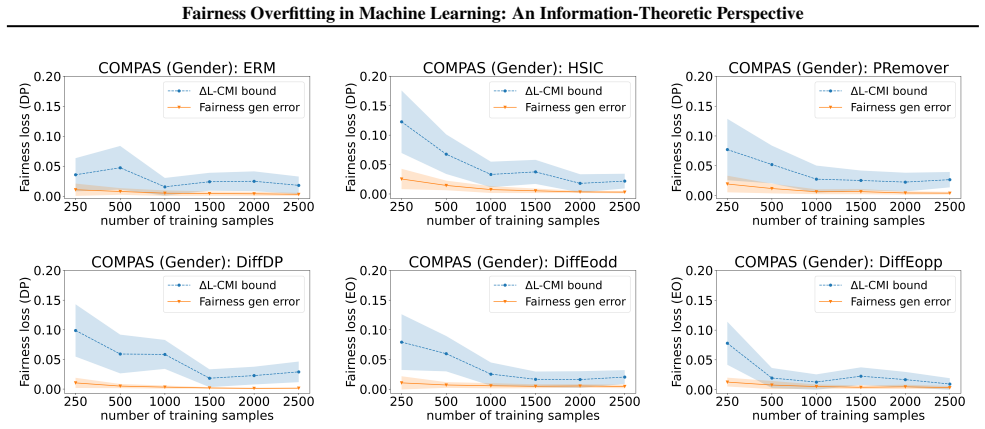
On the paper's own terms, the central discovery is that the expected fairness generalization error can be written as a sum over $m$-sample combinations of terms of the form $\sqrt{(m/2)\,\mathbb{E}[((n_0+2)^{-1}+(n_1+2)^{-1})^2]\,I(W;V_u)}$ for demographic parity, with CMI, f-CMI, e-CMI, and loss-difference CMI analogues, and with the smallest $(T,Y)$-subgroup size replacing the group sizes for equalized odds. The authors claim these are the first fairness-generalization bounds that explicitly encode group imbalance while remaining computable for deep neural networks. They also claim a label-free property for demographic parity: the bound involves mutual information with features and sensitive attributes, but not with labels. The empirical sections are intended to show that the loss-difference CMI bound has a strong linear relationship with the observed fairness generalization error and that balancing training batches reduces demographic parity on test data by up to an order of magnitude.
Load-bearing premise
The load-bearing premise is that a centered random variable taking values in $[0,1]$ with variance at most $\sigma^2$ has moment generating function at most $e^{\lambda^2\sigma^2/2}$, the step that converts Lemma 2's variance bound into the exponential inequalities behind every theorem; this premise is false in general.
Editorial extensions
If this is right
- A learning algorithm's fairness generalization gap becomes an estimable quantity: run the algorithm, estimate $I(W;V_u)$ or the CMI variants, and obtain a bound on the expected fairness gap without test labels.
- Group imbalance directly inflates the bound, so balanced training data should yield better fairness generalization; the paper's batch-balancing experiments support this prediction.
- Because the DP bound is label-free, fairness generalization for demographic parity depends on how strongly the model encodes features and sensitive attributes, not on how it uses labels.
- Choosing $m$ close to $n$ gives a single-term bound that scales like $1/\sqrt{n}$ and is cheap to estimate, while smaller $m$ can tighten the mutual information term at higher estimation cost.
- The same variance machinery extends to equalized odds and to multiclass total-variation fairness losses, so the guidance transfers across fairness metrics.
Reading between the lines
- The label-free form of the DP bound suggests an unlabeled diagnostic: monitoring mutual information between model outputs and sensitive attributes on unlabeled data could flag fairness-overfitting risk before any test labels arrive.
- The group-imbalance factor can be tested directly as an algorithmic recipe: training on artificially balanced subsets while holding accuracy fixed should shrink the fairness gap, independent of the theory's details.
- The same Efron–Stein variance lemma should apply to other subgroup-based losses, such as calibration gaps or worst-group accuracy, where the sensitivity to one-sample changes is again controlled by subgroup sizes.
- A reader wanting to act on the paper's insight should treat the batch-balancing recommendation as the practical takeaway that can be validated separately from the theorem proofs.
Editorial analysis
A structured set of objections, weighed in public.
Referee Report
Summary. The paper studies fairness generalization error, defined as the difference between population-level and empirical fairness risk for demographic parity and equalized odds. It proposes an information-theoretic framework in which a variance bound based on the Efron-Stein inequality is combined with a 'Hoeffding's lemma' step to obtain mutual-information and conditional-mutual-information bounds. Theorems 1 and 6 give MI bounds for DP and EO; Theorems 2-5 give CMI, f-CMI, e-CMI, and delta-L-CMI bounds for DP; Theorem 7 gives a delta-L-CMI bound for EO. The paper also reports experiments on COMPAS and Adult, a bound-versus-error correlation analysis, and a batch-balancing technique for improving test-time fairness.
Significance. The problem addressed is timely, and the empirical demonstration of fairness overfitting on COMPAS and Adult is a useful observation. The high-level idea of using subset-based decompositions and the CMI framework for group-dependent losses is methodologically attractive, and the paper ships a fairly extensive experimental section with many runs. However, the central theoretical claim does not follow from the supplied proofs: all seven theorems depend on an invalid transition from a variance bound to an exponential moment-generating-function bound. If the bounds were valid, they would be a meaningful contribution; as presented, the theoretical core is unsupported, and the empirical results cannot certify the inequalities.
major comments (3)
- [Appendix C.2, Eq. (75)] Equation (75) is the load-bearing step of Theorem 1, and it is not justified by the stated Hoeffding lemma. Lemma 6 requires a range [a,b] and yields E[e^{λX}] ≤ e^{λ²(b−a)²/8}; it does not allow substituting a variance bound. The proof first bounds Var(ℓF_E(w,V_u)) ≤ (m/4)E[(1/(n0+2)+1/(n1+2))²] and then concludes E[e^{λ(ℓ−Eℓ)}] ≤ e^{λ²m/8 E[(...)]}. This is exactly the false claim that a centered bounded variable with variance σ² is σ-sub-Gaussian. A concrete counterexample is X with P(X=1)=ε and P(X=−ε/(1−ε))=1−ε, which has mean zero and variance ε/(1−ε), while at λ=1/ε, log E[e^{λX}] ≈ 1/ε exceeds λ²Var/2 ≈ 1/(2ε). Consequently, inequality (79) and therefore Theorem 1 do not follow from the supplied proof.
- [Appendix C.3, Lemma 4 and its use in Theorems 2–5] Lemma 4 uses the same invalid variance-to-MGF transition: after Eq. (88) bounds Var(ℓF_E(w,S_u)−ℓF_E(w,S̄_u)) ≤ (m/4)E[(...)], Eq. (90) applies 'Hoeffding's lemma' to obtain e^{λ²m/8 E[(...)]}. The correct conditional Hoeffding bound would carry the square of the random range β, and taking expectations gives E[e^{λ²β²/8}], not e^{λ²E[β²]/8}; because exp is convex, E[e^{cβ²}] ≥ e^{cE[β²]}, so the needed inequality has the wrong direction. Since Theorems 2, 3, 4, and 5 are all derived through Lemma 4, all CMI-based bounds are unsupported. The Markov-chain comparisons in Eq. (15) and the empirical correlations in Figure 2 cannot repair this missing proof step.
- [Theorems 6 and 7 and Appendix D] The equalized-odds bounds inherit the same defect. The proof of Theorem 6 in Appendix D.2 bounds Var(ℓFS_E(w,Z_u)) and then uses the same 'Hoeffding' step to obtain the exponential MGF bound that feeds the discriminant argument; Lemma 8 in the same appendix explicitly states a CMI bound using E[e^{λ(ℓFS_E(w,S_u)−ℓFS_E(w,S̄_u))}] ≤ e^{λ²m/8 E[(2/(min(n_{t,y}+2))+2/(min(n̄_{t,y}+2)))²]}, which is the same invalid variance-to-exponential-tail step. Thus the EO results are unsupported even if the bounded-difference estimates in Lemmas 3 and 5 are accepted.
minor comments (4)
- [Remark 6] Remark 6 says 'Theorem 5 introduces m > 1 as a hyperparameter,' but the sentence appears before Theorem 5 is stated and the intended reference is evidently Theorem 1; please correct this.
- [Appendix D.2] Equation (168) contains an undefined notation 'Vaug' and a stray '==' on the same line, which makes the EO proof harder to follow; these should be cleaned up.
- [Figure 2] The caption of Figure 2 does not identify which panels correspond to Theorem 5 and which to Theorem 7; explicit panel-level labels would make the figure easier to match to the stated results.
- [Appendix F.1] No code or data release is mentioned; given the reliance on a specific MI estimator (Ross, 2014) and the 1050 runs per data point, releasing the experimental code would materially aid reproducibility.
Circularity Check
No significant circularity: the fairness generalization bounds are derived from external concentration inequalities and are expressed in terms of mutual informations that are not fitted to the target quantity.
full rationale
The paper's central claims are Theorems 1-7, which bound the fairness generalization error by mutual information terms such as I(W;V_u) and conditional mutual information terms such as I_{Z[2n]}(ΔL_u^{Φ_u}; R_{u_1}). These information quantities are external to the derivation: they depend on the learned model, the data, and the supersample selection process, and they are not constructed from the fairness generalization error itself. The proof chain uses standard external tools: the Efron-Stein inequality (Lemma 7, attributed to Boucheron et al.), Hoeffding's lemma (Lemma 6), and the Donsker-Varadhan variational representation of KL divergence. Lemma 2 is derived from Efron-Stein and the law of total expectation, not from the theorem it supports. Lemma 3 bounds the sensitivity of the group-based fairness loss, and Theorem 1 combines this bound with Lemma 2 and the variational representation. Theorems 2-7 follow the same pattern with conditional mutual information and the loss-difference construction adapted from Dong et al. (2024), an external reference. None of these steps defines the target bound in terms of itself, and none fits a parameter to the data being predicted. The paper does contain a serious mathematical flaw: Eq. (75) and Lemma 4 invoke Hoeffding's lemma using only a variance bound, and a centered bounded variable need not have an MGF bounded by exp(λ²Var/2). This is a derivation gap, not circularity, because the erroneous step is not equivalent to the theorem's input by construction. Self-citations, such as Laakom et al. (2024) and Bu et al. (2020), appear only as context for existing information-theoretic generalization bounds and are not load-bearing in the proofs. Therefore, the circularity score is 0.
Assumptions & free parameters
free parameters (1)
- subset size m =
not reported in main text
assumptions (6)
- domain assumption Predictions f(w,x) in [0,1] for all w and x
- standard math Training samples are i.i.d. from a joint distribution P_Z
- standard math Donsker-Varadhan variational representation of KL divergence
- standard math Hoeffding's lemma
- standard math Efron-Stein inequality
- domain assumption Binary sensitive attribute T in {0,1} and binary label Y in {0,1} for EO
Cite this review
Pith. "Pith review of Fairness Overfitting in Machine Learning: An Information-Theoretic Perspective." pith.science (2026). https://pith.science/paper/GC3TUYHX
@misc{pith2026250607861,
  author       = {Pith},
  title        = {Pith review of: Fairness Overfitting in Machine Learning: An Information-Theoretic Perspective},
  year         = {2026},
  howpublished = {\url{https://pith.science/paper/GC3TUYHX}},
  note         = {Machine review of arXiv:2506.07861}
}
read the original abstract
Despite substantial progress in promoting fairness in high-stake applications using machine learning models, existing methods often modify the training process, such as through regularizers or other interventions, but lack formal guarantees that fairness achieved during training will generalize to unseen data. Although overfitting with respect to prediction performance has been extensively studied, overfitting in terms of fairness loss has received far less attention. This paper proposes a theoretical framework for analyzing fairness generalization error through an information-theoretic lens. Our novel bounding technique is based on Efron-Stein inequality, which allows us to derive tight information-theoretic fairness generalization bounds with both Mutual Information (MI) and Conditional Mutual Information (CMI). Our empirical results validate the tightness and practical relevance of these bounds across diverse fairness-aware learning algorithms. Our framework offers valuable insights to guide the design of algorithms improving fairness generalization.
Figures


Figures from the paper (7 more)


Reference graph
Works this paper leans on
-
[1]
A reductions approach to fair classification
Agarwal, A., Beygelzimer, A., Dud \' k, M., Langford, J., and Wallach, H. A reductions approach to fair classification. In International conference on machine learning, pp.\ 60--69. PMLR, 2018
work page 2018
-
[2]
Towards a unified theory of learning and information
Alabdulmohsin, I. Towards a unified theory of learning and information. Entropy, 22 0 (4): 0 438, 2020
work page 2020
-
[3]
Beyond adult and compas: Fair multi-class prediction via information projection
Alghamdi, W., Hsu, H., Jeong, H., Wang, H., Michalak, P., Asoodeh, S., and Calmon, F. Beyond adult and compas: Fair multi-class prediction via information projection. Advances in Neural Information Processing Systems, 35: 0 38747--38760, 2022
work page 2022
-
[4]
An exact characterization of the generalization error for the gibbs algorithm
Aminian, G., Bu, Y., Toni, L., Rodrigues, M., and Wornell, G. An exact characterization of the generalization error for the gibbs algorithm. Advances in Neural Information Processing Systems, 34: 0 8106--8118, 2021
work page 2021
-
[5]
Baharlouei, S., Nouiehed, M., Beirami, A., and Razaviyayn, M. R 'enyi fair inference. In International Conference on Learning Representations, 2020
work page 2020
-
[6]
Barocas, S., Hardt, M., and Narayanan, A. Fairness and machine learning. fairmlbook. org, 2019
work page 2019
-
[7]
Biswas, A. and Mukherjee, S. Ensuring fairness under prior probability shifts. In Proceedings of the 2021 AAAI/ACM Conference on AI, Ethics, and Society, pp.\ 414--424, 2021
work page 2021
-
[8]
Concentration Inequalities: A Nonasymptotic Theory of Independence
Boucheron, S., Lugosi, G., and Massart, P. Concentration Inequalities: A Nonasymptotic Theory of Independence . Oxford University Press, 2013. doi:10.1093/acprof:oso/9780199535255.001.0001. URL https://doi.org/10.1093/acprof:oso/9780199535255.001.0001
arXiv 2013
Show all 80 references
-
[9]
Bu, Y., Zou, S., and Veeravalli, V. V. Tightening mutual information-based bounds on generalization error. IEEE Journal on Selected Areas in Information Theory, 1 0 (1): 0 121--130, 2020
2020
-
[10]
Calmon, F., Wei, D., Vinzamuri, B., Natesan Ramamurthy, K., and Varshney, K. R. Optimized pre-processing for discrimination prevention. Advances in neural information processing systems, 30, 2017
2017
-
[11]
Generalization bounds for meta-learning: An information-theoretic analysis
Chen, Q., Shui, C., and Marchand, M. Generalization bounds for meta-learning: An information-theoretic analysis. Advances in Neural Information Processing Systems, 34: 0 25878--25890, 2021
2021
-
[12]
Fairness transferability subject to bounded distribution shift
Chen, Y., Raab, R., Wang, J., and Liu, Y. Fairness transferability subject to bounded distribution shift. Advances in neural information processing systems, 35: 0 11266--11278, 2022
2022
-
[13]
Fair prediction with disparate impact: A study of bias in recidivism prediction instruments
Chouldechova, A. Fair prediction with disparate impact: A study of bias in recidivism prediction instruments. Big data, 5 0 (2): 0 153--163, 2017
2017
-
[14]
Algorithmic decision making and the cost of fairness
Corbett-Davies, S., Pierson, E., Feller, A., Goel, S., and Huq, A. Algorithmic decision making and the cost of fairness. In Proceedings of the 23rd acm sigkdd international conference on knowledge discovery and data mining, pp.\ 797--806, 2017
2017
-
[15]
N., Wei, D., Varshney, K
Coston, A., Ramamurthy, K. N., Wei, D., Varshney, K. R., Speakman, S., Mustahsan, Z., and Chakraborty, S. Fair transfer learning with missing protected attributes. In Proceedings of the 2019 AAAI/ACM Conference on AI, Ethics, and Society, pp.\ 91--98, 2019
2019
-
[16]
Darbellay, G. A. and Vajda, I. Estimation of the information by an adaptive partitioning of the observation space. IEEE Transactions on Information Theory, 45 0 (4): 0 1315--1321, 1999
1999
-
[17]
Fairness guarantee in multi-class classification
Denis, C., Elie, R., Hebiri, M., and Hu, F. Fairness guarantee in multi-class classification. arXiv preprint arXiv:2109.13642, 2021
2021 arXiv
-
[18]
Towards generalization beyond pointwise learning: A unified information-theoretic perspective
Dong, Y., Gong, T., Chen, H., He, Z., Li, M., Song, S., and Li, C. Towards generalization beyond pointwise learning: A unified information-theoretic perspective. In Forty-first International Conference on Machine Learning, 2024
2024
-
[19]
Doob, J. L. Regularity properties of certain families of chance variables. Transactions of the American Mathematical Society, 47 0 (3): 0 455--486, 1940
1940
-
[20]
Fairness through awareness
Dwork, C., Hardt, M., Pitassi, T., Reingold, O., and Zemel, R. Fairness through awareness. In Proceedings of the 3rd innovations in theoretical computer science conference, pp.\ 214--226, 2012
2012
-
[21]
Estimating mutual information for discrete-continuous mixtures
Gao, W., Kannan, S., Oh, S., and Viswanath, P. Estimating mutual information for discrete-continuous mixtures. Advances in neural information processing systems, 30, 2017
2017
-
[22]
C., Thomas, P
Giguere, S., Metevier, B., Brun, Y., Da Silva, B. C., Thomas, P. S., and Niekum, S. Fairness guarantees under demographic shift. In Proceedings of the 10th International Conference on Learning Representations (ICLR), 2022
2022
-
[23]
Learning fair representations via distance correlation minimization
Guo, D., Wang, C., Wang, B., and Zha, H. Learning fair representations via distance correlation minimization. IEEE Transactions on Neural Networks and Learning Systems, 35 0 (2): 0 2139--2152, 2022
2022
-
[24]
M., Dilkina, B., and Steeg, G
Gupta, U., Ferber, A. M., Dilkina, B., and Steeg, G. V. Controllable guarantees for fair outcomes via contrastive information estimation, 2021. URL https://arxiv.org/abs/2101.04108
2021 arXiv
-
[25]
Ffb: A fair fairness benchmark for in-processing group fairness methods
Han, X., Chi, J., Chen, Y., Wang, Q., Zhao, H., Zou, N., and Hu, X. Ffb: A fair fairness benchmark for in-processing group fairness methods. In International Conference on Learning Representations, 2024
2024
-
[26]
Equality of opportunity in supervised learning
Hardt, M., Price, E., and Srebro, N. Equality of opportunity in supervised learning. Advances in neural information processing systems, 29, 2016
2016
-
[27]
Information-theoretic generalization bounds for black-box learning algorithms
Harutyunyan, H., Raginsky, M., Ver Steeg, G., and Galstyan, A. Information-theoretic generalization bounds for black-box learning algorithms. Advances in Neural Information Processing Systems, 34: 0 24670--24682, 2021
2021
-
[28]
Nearly-tight vc-dimension bounds for piecewise linear neural networks
Harvey, N., Liaw, C., and Mehrabian, A. Nearly-tight vc-dimension bounds for piecewise linear neural networks. In Conference on learning theory, pp.\ 1064--1068. PMLR, 2017
2017
-
[29]
and Durisi, G
Hellstr \"o m, F. and Durisi, G. A new family of generalization bounds using samplewise evaluated cmi. Advances in Neural Information Processing Systems, 35: 0 10108--10121, 2022
2022
-
[30]
and Liu, H
Huang, R. and Liu, H. Bridging fairness gaps: A (conditional) distance covariance perspective in fairness learning. arXiv preprint arXiv:2412.00720, 2024
2024
-
[31]
Wasserstein fair classification
Jiang, R., Pacchiano, A., Stepleton, T., Jiang, H., and Chiappa, S. Wasserstein fair classification. In Uncertainty in artificial intelligence, pp.\ 862--872. PMLR, 2020
2020
-
[32]
Jose, S. T. and Simeone, O. Information-theoretic generalization bounds for meta-learning and applications. Entropy, 23 0 (1): 0 126, 2021
2021
-
[33]
and Calders, T
Kamiran, F. and Calders, T. Data preprocessing techniques for classification without discrimination. Knowledge and information systems, 33 0 (1): 0 1--33, 2012
2012
-
[34]
Fairness-aware classifier with prejudice remover regularizer
Kamishima, T., Akaho, S., Asoh, H., and Sakuma, J. Fairness-aware classifier with prejudice remover regularizer. In Machine Learning and Knowledge Discovery in Databases: European Conference, ECML PKDD 2012, Bristol, UK, September 24-28, 2012. Proceedings, Part II 23, pp.\ 35-...
2012
-
[35]
Inherent trade-offs in the fair determination of risk scores
Kleinberg, J., Mullainathan, S., and Raghavan, M. Inherent trade-offs in the fair determination of risk scores. arXiv preprint arXiv:1609.05807, 2016
2016 arXiv
-
[36]
and Becker, B
Kohavi, R. and Becker, B. Adult data set. UCI machine learning repository, 5: 0 2093, 1996
1996
-
[37]
Estimating mutual information
Kraskov, A., St \"o gbauer, H., and Grassberger, P. Estimating mutual information. Physical Review E—Statistical, Nonlinear, and Soft Matter Physics, 69 0 (6): 0 066138, 2004
2004
-
[38]
Class-wise generalization error: an information-theoretic analysis
Laakom, F., Bu, Y., and Gabbouj, M. Class-wise generalization error: an information-theoretic analysis. arXiv preprint arXiv:2401.02904, 2024
2024 arXiv
-
[39]
Propublica compas analysis—data and analysis for ‘machine bias.’
Larson, J., Mattu, S., Kirchner, L., and Angwin, J. Propublica compas analysis—data and analysis for ‘machine bias.’. https://github. com/propublica/compas-analysis, 2016
2016
-
[40]
A maximal correlation approach to imposing fairness in machine learning
Lee, J., Bu, Y., Sattigeri, P., Panda, R., Wornell, G., Karlinsky, L., and Feris, R. A maximal correlation approach to imposing fairness in machine learning. In ICASSP 2022-2022 IEEE International Conference on Acoustics, Speech and Signal Processing (ICASSP), pp.\ 3523--3527....
2022
-
[41]
K., Bu, Y., Rajan, D., Sattigeri, P., Panda, R., Das, S., and Wornell, G
Lee, J. K., Bu, Y., Rajan, D., Sattigeri, P., Panda, R., Das, S., and Wornell, G. W. Fair selective classification via sufficiency. In International conference on machine learning, pp.\ 6076--6086. PMLR, 2021
2021
-
[42]
and Liu, H
Li, P. and Liu, H. Achieving fairness at no utility cost via data reweighing with influence. In International Conference on Machine Learning, pp.\ 12917--12930. PMLR, 2022
2022
-
[43]
Kernel dependence regularizers and gaussian processes with applications to algorithmic fairness
Li, Z., P \'e rez-Suay, A., Camps-Valls, G., and Sejdinovic, D. Kernel dependence regularizers and gaussian processes with applications to algorithmic fairness. Pattern Recognition, 132: 0 108922, 2022
2022
-
[44]
Learning adversarially fair and transferable representations, 2018
Madras, D., Creager, E., Pitassi, T., and Zemel, R. Learning adversarially fair and transferable representations, 2018. URL https://arxiv.org/abs/1802.06309
2018 arXiv
-
[45]
A survey on bias and fairness in machine learning
Mehrabi, N., Morstatter, F., Saxena, N., Lerman, K., and Galstyan, A. A survey on bias and fairness in machine learning. ACM computing surveys (CSUR), 54 0 (6): 0 1--35, 2021
2021
-
[46]
and Vishnoi, N
Mehrotra, A. and Vishnoi, N. Fair ranking with noisy protected attributes. Advances in Neural Information Processing Systems, 35: 0 31711--31725, 2022
2022
-
[47]
Modak, E., Asnani, H., and Prabhakaran, V. M. R \'e nyi divergence based bounds on generalization error. In 2021 IEEE Information Theory Workshop (ITW), pp.\ 1--6. IEEE, 2021
2021
-
[48]
Mroueh, Y. et al. Fair mixup: Fairness via interpolation. In International Conference on Learning Representations, 2021
2021
-
[49]
K., Haghifam, M., and Roy, D
Neu, G., Dziugaite, G. K., Haghifam, M., and Roy, D. M. Information-theoretic generalization bounds for stochastic gradient descent. In Conference on Learning Theory, pp.\ 3526--3545. PMLR, 2021
2021
-
[50]
Learning fair and transferable representations with theoretical guarantees
Oneto, L., Donini, M., Pontil, M., and Maurer, A. Learning fair and transferable representations with theoretical guarantees. In 2020 IEEE 7th International Conference on Data Science and Advanced Analytics (DSAA), pp.\ 30--39. IEEE, 2020 a
2020
-
[51]
Randomized learning and generalization of fair and private classifiers: From pac-bayes to stability and differential privacy
Oneto, L., Donini, M., Pontil, M., and Shawe-Taylor, J. Randomized learning and generalization of fair and private classifiers: From pac-bayes to stability and differential privacy. Neurocomputing, 416: 0 231--243, 2020 b
2020
-
[52]
and Shmueli, E
Pessach, D. and Shmueli, E. A review on fairness in machine learning. ACM Computing Surveys (CSUR), 55 0 (3): 0 1--44, 2022
2022
-
[53]
Fairness and accuracy under domain generalization
Pham, T.-H., Zhang, X., and Zhang, P. Fairness and accuracy under domain generalization. ArXiv, 2023
2023
-
[54]
Rezaei, A., Liu, A., Memarrast, O., and Ziebart, B. D. Robust fairness under covariate shift. In Proceedings of the AAAI Conference on Artificial Intelligence, volume 35, pp.\ 9419--9427, 2021
2021
-
[55]
T., Durisi, G., and Simeone, O
Rezazadeh, A., Jose, S. T., Durisi, G., and Simeone, O. Conditional mutual information-based generalization bound for meta learning. In 2021 IEEE International Symposium on Information Theory (ISIT), pp.\ 1176--1181. IEEE, 2021
2021
-
[56]
Tighter expected generalization error bounds via wasserstein distance
Rodr \' guez G \'a lvez, B., Bassi, G., Thobaben, R., and Skoglund, M. Tighter expected generalization error bounds via wasserstein distance. Advances in Neural Information Processing Systems, 34: 0 19109--19121, 2021
2021
-
[57]
Ross, B. C. Mutual information between discrete and continuous data sets. PloS one, 9 0 (2): 0 e87357, 2014
2014
-
[58]
M., Pugnana, A., Turini, F., et al
Ruggieri, S., Alvarez, J. M., Pugnana, A., Turini, F., et al. Can we trust fair-ai? In Proceedings of the AAAI Conference on Artificial Intelligence, volume 37, pp.\ 15421--15430, 2023
2023
-
[59]
Schumann, C., Wang, X., Beutel, A., Chen, J., Qian, H., and Chi, E. H. Transfer of machine learning fairness across domains. arXiv preprint arXiv:1906.09688, 2019
1906 arXiv
-
[60]
K., Das, S., Panda, R., Sattigeri, P., and Wornell, G
Shah, A., Bu, Y., Lee, J. K., Das, S., Panda, R., Sattigeri, P., and Wornell, G. W. Selective regression under fairness criteria. In International Conference on Machine Learning, pp.\ 19598--19615. PMLR, 2022
2022
-
[61]
Average individual fairness: Algorithms, generalization and experiments
Sharifi-Malvajerdi, S., Kearns, M., and Roth, A. Average individual fairness: Algorithms, generalization and experiments. Advances in neural information processing systems, 32, 2019
2019
-
[62]
Beyond h-divergence: Domain adaptation theory with jensen-shannon divergence
Shui, C., Chen, Q., Wen, J., Zhou, F., Gagn \'e , C., and Wang, B. Beyond h-divergence: Domain adaptation theory with jensen-shannon divergence. arXiv preprint arXiv:2007.15567, 6, 2020
2007 arXiv
-
[63]
X., Arbel, T., Wang, B., and Gagn \'e , C
Shui, C., Xu, G., Chen, Q., Li, J., Ling, C. X., Arbel, T., Wang, B., and Gagn \'e , C. On learning fairness and accuracy on multiple subgroups. Advances in Neural Information Processing Systems, 35: 0 34121--34135, 2022
2022
-
[64]
Fairness violations and mitigation under covariate shift
Singh, H., Singh, R., Mhasawade, V., and Chunara, R. Fairness violations and mitigation under covariate shift. In Proceedings of the 2021 ACM Conference on Fairness, Accountability, and Transparency, pp.\ 3--13, 2021
2021
-
[65]
Sontag, E. D. et al. Vc dimension of neural networks. NATO ASI Series F Computer and Systems Sciences, 168: 0 69--96, 1998
1998
-
[66]
and Zakynthinou, L
Steinke, T. and Zakynthinou, L. Reasoning about generalization via conditional mutual information. In Conference on Learning Theory, pp.\ 3437--3452. PMLR, 2020
2020
-
[67]
and Zhang, K
Tang, Z. and Zhang, K. Attainability and optimality: The equalized odds fairness revisited. In Conference on Causal Learning and Reasoning, pp.\ 754--786. PMLR, 2022
2022
-
[68]
Wang, H., Gao, R., and Calmon, F. P. Generalization bounds for noisy iterative algorithms using properties of additive noise channels. J. Mach. Learn. Res., 24: 0 26--1, 2023
2023
-
[69]
and Mao, Y
Wang, Z. and Mao, Y. On the generalization of models trained with sgd: Information-theoretic bounds and implications. arXiv preprint arXiv:2110.03128, 2021
2021 arXiv
-
[70]
and Mao, Y
Wang, Z. and Mao, Y. Tighter information-theoretic generalization bounds from supersamples. arXiv preprint arXiv:2302.02432, 2023
2023 arXiv
-
[71]
I., and Srebro, N
Woodworth, B., Gunasekar, S., Ohannessian, M. I., and Srebro, N. Learning non-discriminatory predictors. In Conference on learning theory, pp.\ 1920--1953. PMLR, 2017
1920
-
[72]
H., Aickelin, U., and Zhu, J
Wu, X., Manton, J. H., Aickelin, U., and Zhu, J. Information-theoretic analysis for transfer learning. In 2020 IEEE International Symposium on Information Theory (ISIT), pp.\ 2819--2824. IEEE, 2020
2020
-
[73]
H., Aickelin, U., and Zhu, J
Wu, X., Manton, J. H., Aickelin, U., and Zhu, J. On the generalization for transfer learning: An information-theoretic analysis. IEEE Transactions on Information Theory, 2024
2024
-
[74]
and Raginsky, M
Xu, A. and Raginsky, M. Information-theoretic analysis of generalization capability of learning algorithms. Advances in Neural Information Processing Systems, 30, 2017
2017
-
[75]
Joint transfer of model knowledge and fairness over domains using wasserstein distance
Yoon, T., Lee, J., and Lee, W. Joint transfer of model knowledge and fairness over domains using wasserstein distance. IEEE Access, 8: 0 123783--123798, 2020
2020
-
[76]
B., Valera, I., Rogriguez, M
Zafar, M. B., Valera, I., Rogriguez, M. G., and Gummadi, K. P. Fairness constraints: Mechanisms for fair classification. In Artificial intelligence and statistics, pp.\ 962--970. PMLR, 2017
2017
-
[77]
Learning fair representations
Zemel, R., Wu, Y., Swersky, K., Pitassi, T., and Dwork, C. Learning fair representations. In International conference on machine learning, pp.\ 325--333. PMLR, 2013
2013
-
[78]
Individually conditional individual mutual information bound on generalization error
Zhou, R., Tian, C., and Liu, T. Individually conditional individual mutual information bound on generalization error. IEEE Transactions on Information Theory, 68 0 (5): 0 3304--3316, 2022
2022
-
[79]
Exactly tight information-theoretic generalization error bound for the quadratic gaussian problem
Zhou, R., Tian, C., and Liu, T. Exactly tight information-theoretic generalization error bound for the quadratic gaussian problem. arXiv preprint arXiv:2305.00876, 2023
2023 arXiv
-
[80]
write newline
" write newline "" before.all 'output.state := FUNCTION n.dashify 't := "" t empty not t #1 #1 substring "-" = t #1 #2 substring "--" = not "--" * t #2 global.max substring 't := t #1 #1 substring "-" = "-" * t #2 global.max substring 't := while if t #1 #1 substring * t #2 gl...
Reviewed August 7, 2026 · model on record in the stance chip above.
Discussion (0). Sign in to comment.