Determining Kerr black hole spin and inclination from a segment of the critical curve in black hole images
Pith reviewed 2026-06-26 11:48 UTC · model grok-4.3
The pith
A segment of the critical curve in a black hole image uniquely determines the Kerr spin parameter a/M and inclination i.
A machine-rendered reading of the paper's core claim, the machinery that carries it, and where it could break.
Core claim
For a non-extremal Kerr black hole, three observables extracted from any standardized segment of the critical curve uniquely determine the spin a/M and inclination i together with the auxiliary location parameter r_nl in the domain considered. The critical curve itself is not observable, but the method relies on the fact that higher-order photon rings accumulate near it, allowing localized portions of the resulting brightness enhancement to serve as identifiable segments.
What carries the argument
Standardized segments of the critical curve together with three observables that characterize their geometry.
If this is right
- The method applies directly to non-extremal Kerr black holes within the domain examined.
- It does not require reconstruction of the entire critical curve.
- The framework extends naturally to more general rotating black-hole spacetimes.
- Localized photon-ring segments become usable data sources for parameter estimation.
Where Pith is reading between the lines
- The same segment-based observables could be tested in ray-traced images from general-relativity magnetohydrodynamic simulations to quantify measurement error.
- If the three observables remain robust under realistic interstellar scattering, the technique could supplement existing shadow-diameter methods for spin inference.
- The auxiliary parameter r_nl might serve as a diagnostic for which part of the photon ring is being observed in a given image.
Load-bearing premise
Localized portions of the brightness enhancement around the critical curve can be reliably identified and measured as standardized segments in realistic noisy images.
What would settle it
Measure the three observables from a candidate segment in an image, compute the implied a/M and i, and check whether those values are consistent with independent constraints on the same black hole obtained from other observables such as the full shadow shape or orbital dynamics.
Figures
read the original abstract
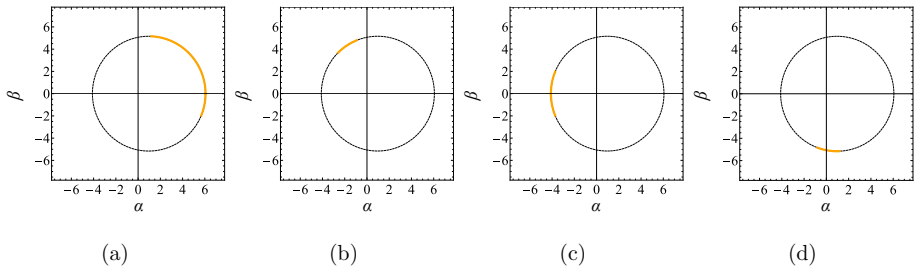
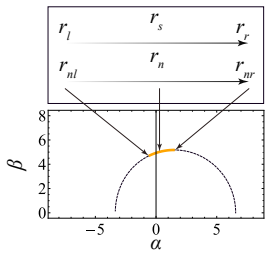
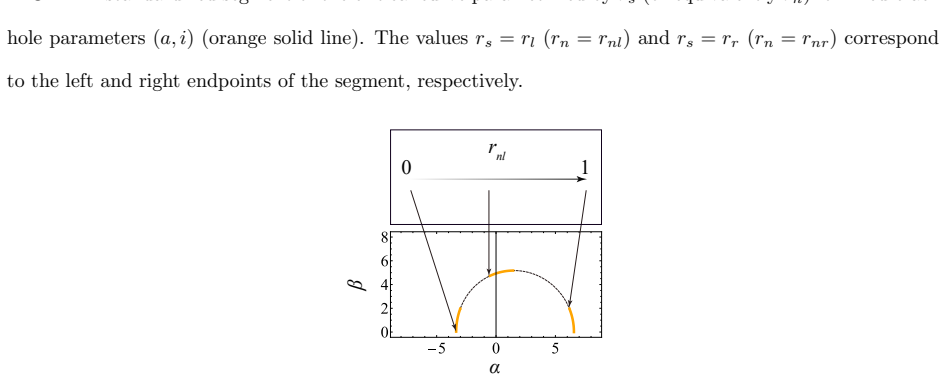
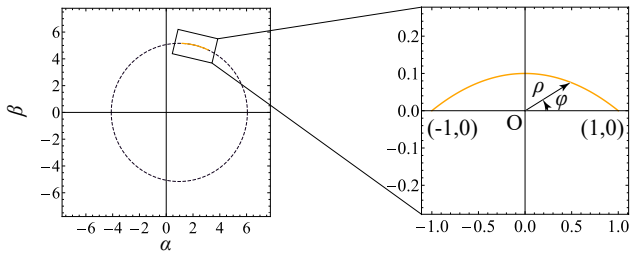
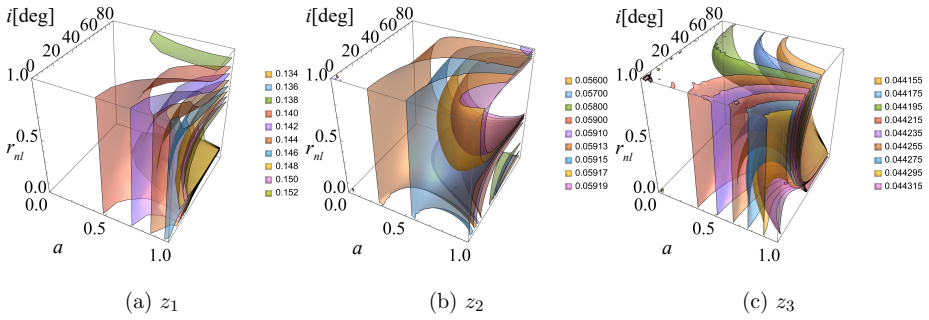
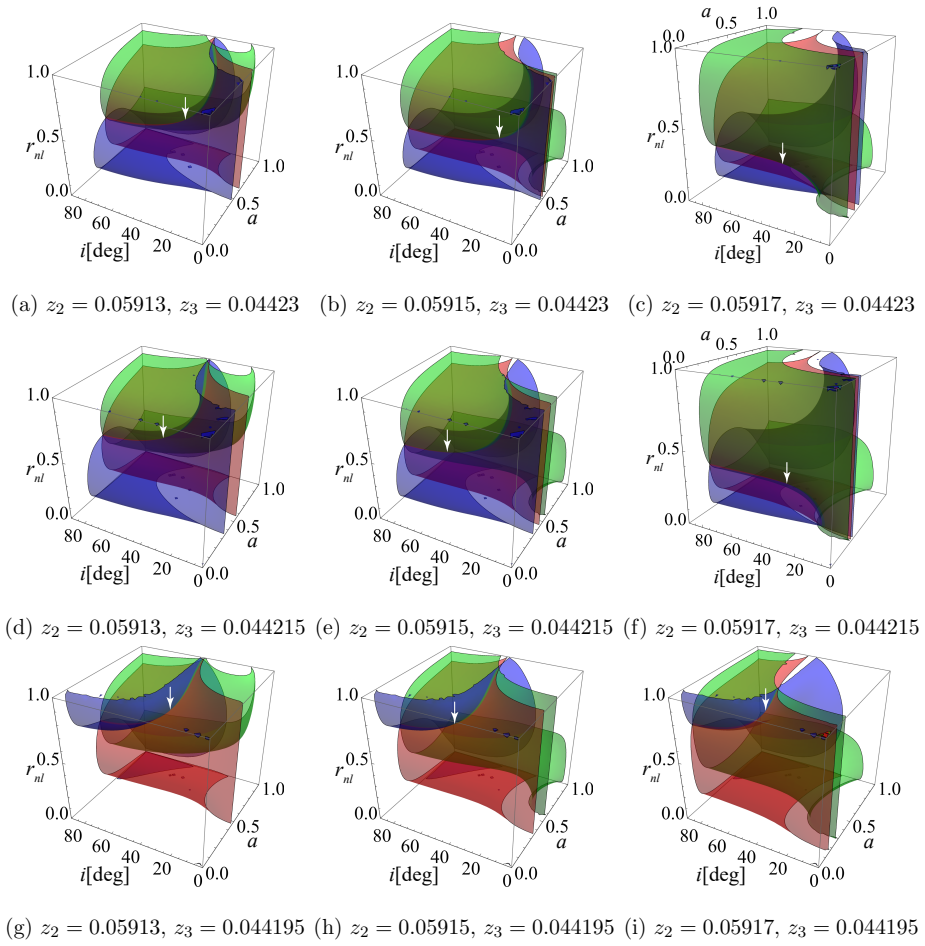
We present a method for determining the spin parameter $a/M$ and inclination angle $i$ of a non-extremal Kerr black hole from segments of the critical curve identified in black hole images. Although the critical curve itself is not directly observable, higher-order photon rings accumulate near it, and in realistic observations localized portions of the resulting brightness enhancement may be available for identifying segments of the critical curve. We introduce standardized segments of the critical curve and define three observables that characterize their geometry. We show that these observables uniquely determine $(a/M,i)$, together with an auxiliary parameter $r_{nl}\in[0,1]$ specifying the location of the identified segment along the critical curve, within the domain considered. Thus, even a segment of the critical curve contains sufficient geometric information to constrain the black hole spin and inclination without reconstructing the full critical curve. The framework is naturally suited to realistic observations and may be extended to more general rotating black hole spacetimes.
Editorial analysis
A structured set of objections, weighed in public.
Referee Report
Summary. The paper introduces standardized segments of the Kerr critical curve and defines three geometric observables on them. It claims these observables uniquely determine the spin a/M, inclination i, and auxiliary parameter r_nl ∈ [0,1] within the domain considered, allowing extraction of black hole parameters from localized segments of the photon-ring brightness enhancement without reconstructing the full critical curve.
Significance. If the uniqueness result holds over a well-specified domain, the method would enable parameter constraints from partial observations in realistic, noisy images, which is relevant for Event Horizon Telescope analyses and extensions to other rotating spacetimes.
major comments (2)
- [Abstract] Abstract: the central uniqueness claim (that the three observables determine (a/M, i, r_nl)) is asserted without derivation steps, explicit injectivity proof, or error analysis; the domain boundaries are unspecified, leaving open the possibility of local degeneracies or non-injective regions outside numerically sampled areas as flagged by the stress-test.
- [Abstract] Abstract (paragraph on realistic observations): the assumption that localized brightness enhancements can be reliably identified and measured as standardized segments is load-bearing for applicability but lacks quantification of identification errors, noise robustness, or domain of validity.
minor comments (1)
- [Abstract] The auxiliary parameter r_nl is introduced without a clear definition or range justification in the abstract; a brief equation or figure reference would improve clarity.
Simulated Author's Rebuttal
We thank the referee for their constructive comments on our manuscript. We address the two major comments point by point below, with proposed revisions to improve clarity on the uniqueness result and its observational context.
read point-by-point responses
-
Referee: [Abstract] Abstract: the central uniqueness claim (that the three observables determine (a/M, i, r_nl)) is asserted without derivation steps, explicit injectivity proof, or error analysis; the domain boundaries are unspecified, leaving open the possibility of local degeneracies or non-injective regions outside numerically sampled areas as flagged by the stress-test.
Authors: The uniqueness result is established numerically via dense sampling of the observable-to-parameter map and a dedicated stress-test (Section 4) that confirms injectivity throughout the domain explored. An analytic injectivity proof is not provided because the Kerr critical-curve equations are transcendental. We will revise the abstract to (i) state that the result is demonstrated numerically, (ii) give explicit domain boundaries (0 ≤ a/M ≤ 0.99, 0 ≤ i ≤ π/2, r_nl ∈ [0,1]), and (iii) summarize the stress-test findings on the absence of degeneracies inside this domain. A short error-propagation analysis based on the same stress-test will be added to the main text. revision: partial
-
Referee: [Abstract] Abstract (paragraph on realistic observations): the assumption that localized brightness enhancements can be reliably identified and measured as standardized segments is load-bearing for applicability but lacks quantification of identification errors, noise robustness, or domain of validity.
Authors: The abstract paragraph is motivational; the core contribution is the geometric uniqueness result under idealized segment identification. We will revise the abstract to qualify the observational applicability and add a concise discussion paragraph (new subsection in Section 5) that outlines the main sources of identification error, states the assumed domain of validity, and notes that quantitative noise-robustness studies lie beyond the present geometric analysis. This keeps the manuscript focused while acknowledging the referee’s concern. revision: partial
Circularity Check
No significant circularity; uniqueness follows from independent geometric mapping
full rationale
The abstract and provided text define three observables characterizing standardized segments of the Kerr critical curve and assert that these determine (a/M, i, r_nl) uniquely within the considered domain. No quoted equations or steps reduce the claimed prediction to a fitted input by construction, nor does any load-bearing step rely on self-citation chains or ansatzes smuggled from prior work. The derivation is presented as a forward geometric map whose injectivity is asserted after analysis, with no evidence that observables are defined in terms of the target parameters. This is the expected non-finding for a paper whose central claim rests on explicit coordinate geometry rather than reparameterization of its own inputs.
Axiom & Free-Parameter Ledger
free parameters (1)
- r_nl
axioms (1)
- domain assumption The critical curve of a Kerr black hole is fully determined by a/M and i.
Reference graph
Works this paper leans on
-
[1]
The RMSE and MAE are computed by comparing these values with the true parameter values
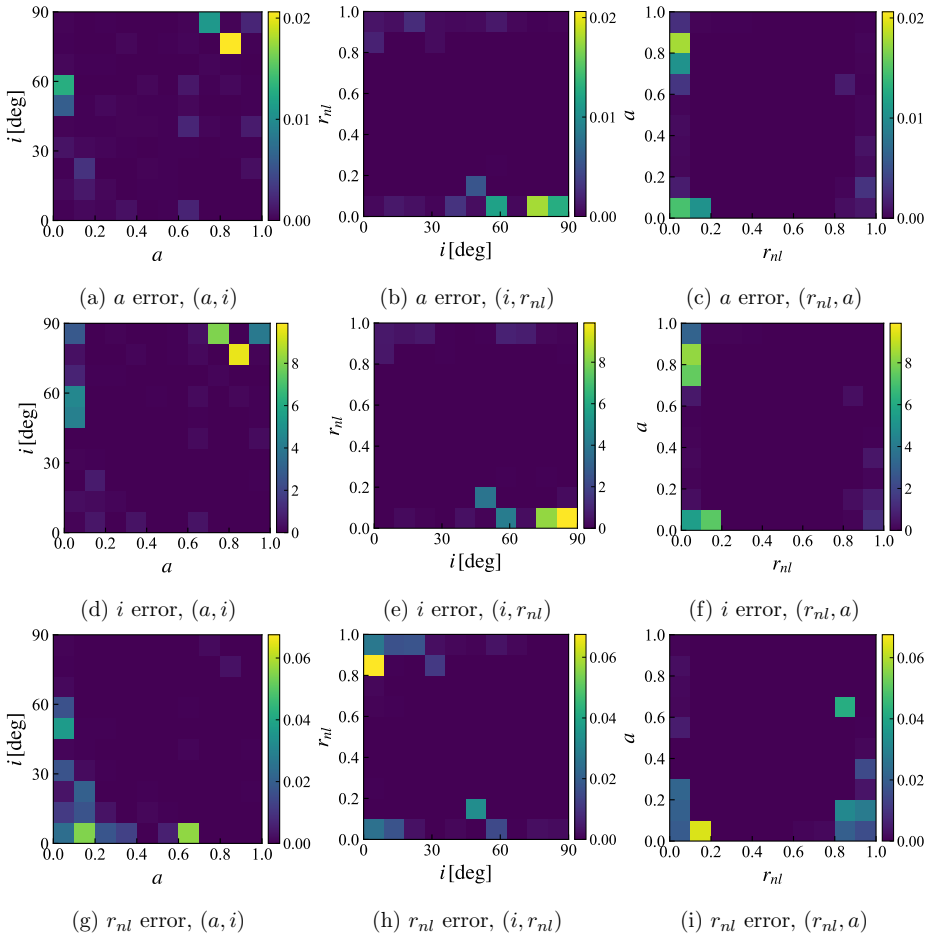
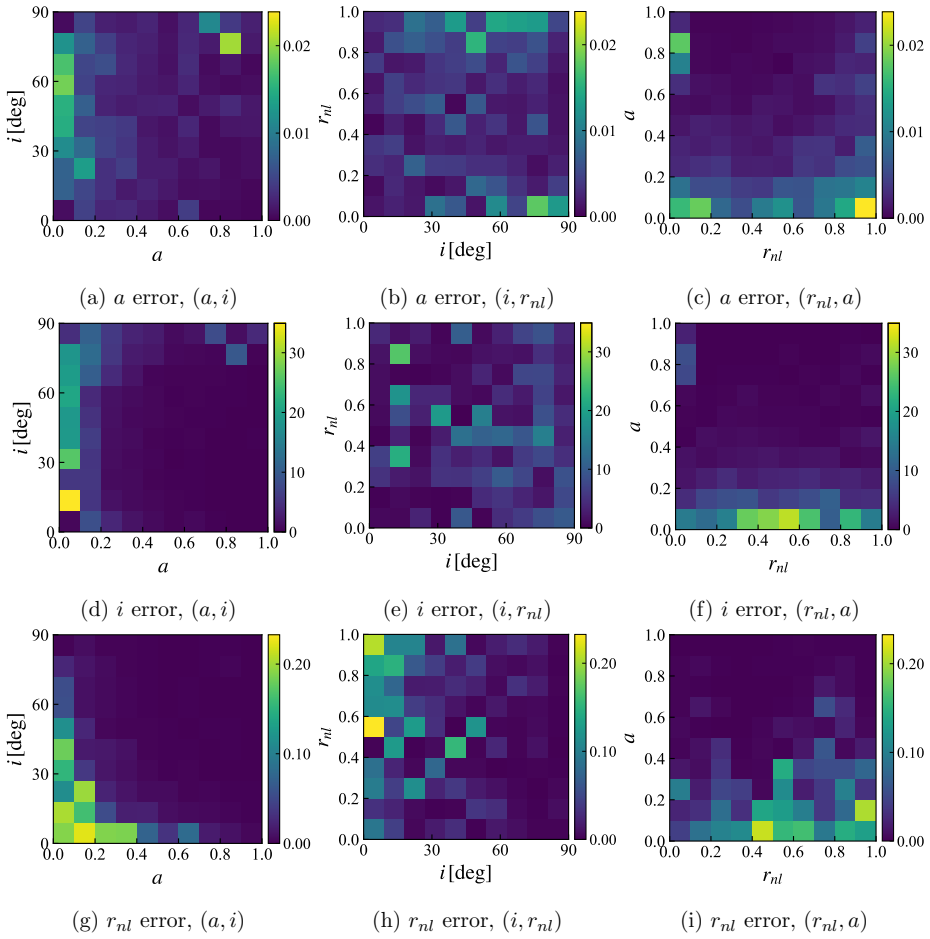
and obtain the corresponding parameter values. The RMSE and MAE are computed by comparing these values with the true parameter values. In this way, we assess the sensitivity of the method to uncertainties in the observables derived from the identified segments. Since the relation between actual observational uncertainties and the standard deviation ofz j ...
-
[2]
First M87 Event Horizon Telescope Results. I. The Shadow of the Supermassive Black Hole
K. Akiyamaet al.[Event Horizon Telescope], Astrophys. J. Lett.875, L1 (2019) doi:10.3847/2041-8213/ab0ec7 [arXiv:1906.11238 [astro-ph.GA]]
work page internal anchor Pith review Pith/arXiv arXiv doi:10.3847/2041-8213/ab0ec7 2019
-
[3]
K. Akiyamaet al.[Event Horizon Telescope], Astrophys. J. Lett.930, no.2, L12 (2022) doi:10.3847/2041-8213/ac6674 [arXiv:2311.08680 [astro-ph.HE]]
work page internal anchor Pith review Pith/arXiv arXiv doi:10.3847/2041-8213/ac6674 2022
-
[4]
Black Holes,
J. M. Bardeen, in “Black Holes,” ed. C. DeWitt and B. DeWitt, New York, Gordon & Breach (1973)
1973
-
[5]
The mathematical theory of black holes
S. Chandrasekhar, “The mathematical theory of black holes”, Oxford Univ. Press (1992)
1992
-
[6]
Hidden symmetries, null geodesics, and photon capture in the Sen black hole
K. Hioki and U. Miyamoto, Phys. Rev. D78, 044007 (2008) doi:10.1103/PhysRevD.78.044007 [arXiv:0805.3146 [gr-qc]]
work page internal anchor Pith review Pith/arXiv arXiv doi:10.1103/physrevd.78.044007 2008
-
[7]
Measurement of the Kerr Spin Parameter by Observation of a Compact Object's Shadow
K. Hioki and K. i. Maeda, Phys. Rev. D80, 024042 (2009) doi:10.1103/PhysRevD.80.024042 [arXiv:0904.3575 [astro-ph.HE]]
work page internal anchor Pith review Pith/arXiv arXiv doi:10.1103/physrevd.80.024042 2009
-
[8]
Constraining the spin and the deformation parameters from the black hole shadow
N. Tsukamoto, Z. Li and C. Bambi, JCAP06, 043 (2014) doi:10.1088/1475-7516/2014/06/043 [arXiv:1403.0371 [gr-qc]]
work page internal anchor Pith review Pith/arXiv arXiv doi:10.1088/1475-7516/2014/06/043 2014
-
[9]
A. A. Abdujabbarov, L. Rezzolla and B. J. Ahmedov, Mon. Not. Roy. Astron. Soc.454, no.3, 2423-2435 (2015) doi:10.1093/mnras/stv2079 [arXiv:1503.09054 [gr-qc]]
work page internal anchor Pith review Pith/arXiv arXiv doi:10.1093/mnras/stv2079 2015
-
[10]
P. Kocherlakotaet al.[Event Horizon Telescope], Phys. Rev. D103, no.10, 104047 (2021) doi:10.1103/PhysRevD.103.104047 [arXiv:2105.09343 [gr-qc]]. 32
-
[11]
K. Hioki and U. Miyamoto, Phys. Rev. D107, no.4, 044042 (2023) doi:10.1103/PhysRevD.107.044042 [arXiv:2210.02164 [gr-qc]]
-
[12]
K. Hioki and U. Miyamoto, Phys. Rev. D109, no.4, 044030 (2024) doi:10.1103/PhysRevD.109.044030 [arXiv:2311.16802 [gr-qc]]
-
[13]
K. Hioki and U. Miyamoto, Class. Quant. Grav.42, no.12, 125009 (2025) doi:10.1088/1361- 6382/ade047 [arXiv:2411.08486 [gr-qc]]
-
[14]
First M87 Event Horizon Telescope Results. IV. Imaging the Central Supermassive Black Hole
K. Akiyamaet al.[Event Horizon Telescope], Astrophys. J. Lett.875, no.1, L4 (2019) doi:10.3847/2041-8213/ab0e85 [arXiv:1906.11241 [astro-ph.GA]]
work page internal anchor Pith review Pith/arXiv arXiv doi:10.3847/2041-8213/ab0e85 2019
-
[15]
S. E. Gralla, D. E. Holz and R. M. Wald, Phys. Rev. D100, no.2, 024018 (2019) doi:10.1103/PhysRevD.100.024018 [arXiv:1906.00873 [astro-ph.HE]]
work page internal anchor Pith review Pith/arXiv arXiv doi:10.1103/physrevd.100.024018 2019
-
[16]
First M87 Event Horizon Telescope Results. V. Physical Origin of the Asymmetric Ring
K. Akiyamaet al.[Event Horizon Telescope], Astrophys. J. Lett.875, no.1, L5 (2019) doi:10.3847/2041-8213/ab0f43 [arXiv:1906.11242 [astro-ph.GA]]
work page internal anchor Pith review Pith/arXiv arXiv doi:10.3847/2041-8213/ab0f43 2019
-
[17]
Advection-dominated Accretion: A Self-similar Solution.Astrophys
R. Narayan and I. s. Yi, Astrophys. J. Lett.428, L13 (1994) doi:10.1086/187381 [arXiv:astro- ph/9403052 [astro-ph]]
-
[18]
2014, ARA&A, 52, 529, doi: 10.1146/annurev-astro-082812-141003
F. Yuan and R. Narayan, Ann. Rev. Astron. Astrophys.52, 529-588 (2014) doi:10.1146/annurev-astro-082812-141003 [arXiv:1401.0586 [astro-ph.HE]]
work page internal anchor Pith review Pith/arXiv arXiv doi:10.1146/annurev-astro-082812-141003 2014
-
[19]
A public code for general relativistic, polarised radiative transfer around spinning black holes
J. Dexter, Mon. Not. Roy. Astron. Soc.462, no.1, 115-136 (2016) doi:10.1093/mnras/stw1526 [arXiv:1602.03184 [astro-ph.HE]]
work page internal anchor Pith review Pith/arXiv arXiv doi:10.1093/mnras/stw1526 2016
-
[20]
M. D. Johnson, A. Lupsasca, A. Strominger, G. N. Wong, S. Hadar, D. Kapec, R. Narayan, A. Chael, C. F. Gammie and P. Galison,et al.Sci. Adv.6, no.12, eaaz1310 (2020) doi:10.1126/sciadv.aaz1310 [arXiv:1907.04329 [astro-ph.IM]]
-
[21]
K. Akiyama, K. Niinuma, K. Hada, A. Doi, Y. Hagiwara, A. E. Higuchi, M. Honma, T. Kawashima, D. Kolev and S. Koyama,et al.Proc. SPIE Int. Soc. Opt. Eng.13092, 130922E (2024) doi:10.1117/12.3019968 [arXiv:2406.09516 [astro-ph.IM]]
-
[22]
M. D. Johnson, K. Akiyama, R. Baturin, B. Bilyeu, L. Blackburn, D. Boroson, A. Cardenas- Avendano, A. Chael, C. k. Chan and D. Chang,et al.Proc. SPIE Int. Soc. Opt. Eng.13092, 130922D (2024) doi:10.1117/12.3019835 [arXiv:2406.12917 [astro-ph.IM]]
-
[23]
A. Lupsasca, A. C´ ardenas-Avenda˜ no, D. C. M. Palumbo, M. D. Johnson, S. E. Gralla, D. P. Marrone, P. Galison, P. Tiede and L. Keeble, Proc. SPIE Int. Soc. Opt. Eng.13092, 130926Q (2024) doi:10.1117/12.3019437 [arXiv:2406.09498 [gr-qc]]
-
[24]
R. P. Kerr, Phys. Rev. Lett.11, 237 (1963). 33
1963
-
[25]
Carter,Global structure of the Kerr family of gravitational fields,Phys
B. Carter, Phys. Rev.174, 1559-1571 (1968) doi:10.1103/PhysRev.174.1559
-
[26]
Z. Chang and Q. H. Zhu, Phys. Rev. D102, no.4, 044012 (2020) doi:10.1103/PhysRevD.102.044012 [arXiv:2006.00685 [gr-qc]]
-
[27]
A. de Vries, Class. Quant. Grav.17, no.1, 123-144 (1999) doi:10.1088/0264-9381/17/1/309
-
[28]
J. L. Synge, Mon. Not. Roy. Astron. Soc.131, no.3, 463-466 (1966) doi:10.1093/mnras/131.3.463
-
[29]
S. E. Gralla, A. Lupsasca and A. Strominger, Mon. Not. Roy. Astron. Soc.475, no.3, 3829- 3853 (2018) doi:10.1093/mnras/sty039 [arXiv:1710.11112 [astro-ph.HE]]
work page internal anchor Pith review Pith/arXiv arXiv doi:10.1093/mnras/sty039 2018
-
[30]
C. F. Paganini and M. A. Oancea, Class. Quant. Grav.35, no.6, 067001 (2018) doi:10.1088/1361-6382/aaaa5b [arXiv:1710.02403 [gr-qc]]
-
[31]
Principal component analysis: a review and recent devel- opments,
Jolliffe, Ian T and Cadima, Jorge, “Principal component analysis: a review and recent devel- opments,” Phil. Trans. R. Soc. A.374, 20150202 (2016)
2016
-
[32]
See the Supplemental Material for table data on the transformation matrixA
-
[33]
See the Supplemental Material for table data on the dimensionless parameters, their corre- sponding Fourier coefficients, and principal components. 34
discussion (0)
Sign in with ORCID, Apple, or X to comment. Anyone can read and Pith papers without signing in.