REVIEW 5 major objections 6 minor 37 references
A transformer's reasoning depth can be made to grow with input length by routing each token's deepest hidden state into the next token's early layers, and this added depth lifts Parity accuracy to 100%.
Reviewed by Pith at T0; open to challenge. T0 means a machine referee read the full paper against a public rubric. the ladder, T0–T4 →
T0 review · deepseek-v4-flash
2026-08-02 22:02 UTC pith:GCQFQFXO
load-bearing objection A genuinely new cross-token backward-connection architecture with surprisingly strong parity results, but the depth explanation is still a hypothesis in need of controlled ablation. the 5 major comments →
Turbo Connection: Reasoning as Information Flow from Higher to Lower Layers
The pith
A machine-rendered reading of the paper's core claim, the machinery that carries it, and where it could break.
Core claim
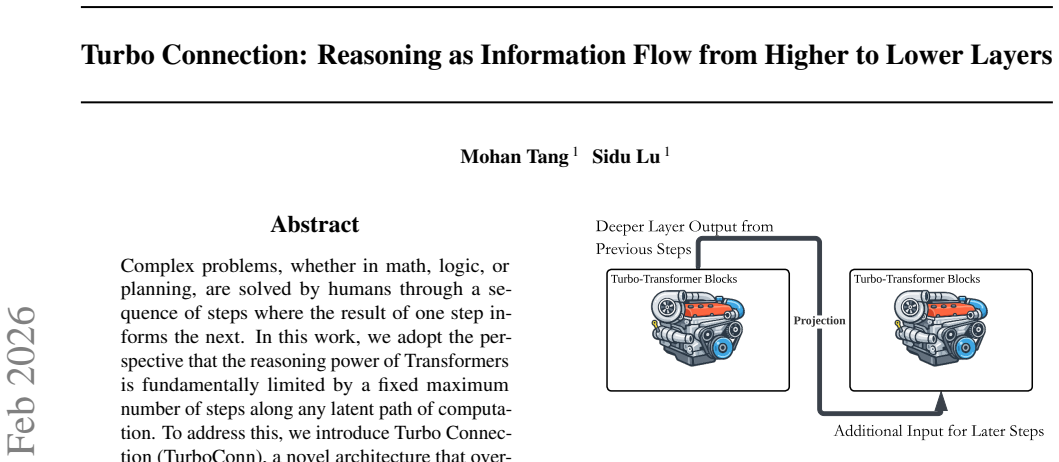
Turbo Connection (TurboConn) adds residual connections that route the higher-layer hidden state of token t into the lower layers of token t+1 through a learnable projection initialized to zero. Because decoding is causal, this introduces no circular dependency: past-token computations can feed future-token early layers. The paper claims this extends the maximum computational-path length from a constant L to kL, where k is sequence length, making reasoning depth scale linearly with input length. Empirically, fine-tuning pretrained Llama and Qwen models with TurboConn improves accuracy on GSM8K, multi-step arithmetic, and Parity by 0.9 to over 10 points, lifting Qwen-3-1.7B from 53.78% to 100%
What carries the argument
The central object is the Turbo Connection: a set of hand-selected residual 'backward' edges (e.g., layer 14 → layer 0 for Llama 1B) that carry the hidden state of token t at a higher layer into a lower layer of token t+1. Each connection is a learnable low-rank linear projection, initialized to zero and scaled by a multiplier α (default 100), and a grouping mechanism (group size g) lets batches of g tokens be processed in parallel, trading depth (kL/g) for training speed. The work it does is to create explicit multi-token, multi-layer information paths, effectively unrolling the transformer into a deeper network along the sequence dimension while keeping total FLOPs nearly constant.
Load-bearing premise
The central claim rests on the assumption that the trained model actually uses the hand-picked connections as a long multi-token, multi-layer information chain, rather than simply benefiting from extra parameters or a changed optimization landscape; the paper offers no direct probe of the internal paths.
What would settle it
Ablate the most important connection (e.g., layer 14 → layer 0 for Llama 1B) after fine-tuning and measure the drop on Parity; if accuracy is barely affected, the model is not relying on the depth-scaling chain and the central claim is falsified. A control with the same number of additional low-rank parameters but no token-to-token dependency (e.g., connections that feed a token's own layers or skip tokens) would isolate whether the gains come from the depth mechanism or from extra capacity.
If this is right
- Effective reasoning depth rises from a fixed layer count L to kL, where k is the sequence length, so the maximum number of sequential computational steps a model can use grows with the input rather than staying constant.
- Dense multi-layer downward connections outperform a single 'soft-token' feedback: on Parity, one-vector feedback reaches 96.51% while TurboConn reaches 100%, showing the benefit comes from dense cross-layer information flow.
- TurboConn can be fine-tuned onto existing pretrained LLMs with no loss-function change, no extra inference-time latency, and a comparable trainable-parameter count, lifting a plateaued Qwen-3-1.7B from 53.78% to 100% on Parity.
- Models trained with TurboConn generalize better to longer inputs (perfect Parity accuracy at length 30 when trained only on length ≤10) and exhibit 'discriminative filtering'—eliminating more wrong answer candidates than larger baseline models.
- TurboConn is compatible with explicit chain-of-thought: given the same CoT, models with the modification reach the correct conclusion more often (e.g., 30.96% to 33.98% on NuminaMath-CoT), suggesting latent depth helps verify or correct explicit reasoning steps.
Where Pith is reading between the lines
- If the depth-scaling account is right, the standard fully parallel training paradigm—where every token is processed with the same fixed depth—is itself a bottleneck for reasoning; sequential or hybrid training that lets information cascade across tokens could be a general route to stronger LLMs, independent of parameter scale.
- The hand-selected connection graphs suggest a direct ablation experiment: block individual connections after fine-tuning and measure the accuracy drop; a model that truly relies on the long chain should degrade sharply, whereas a model that merely benefits from extra parameters would not.
- Because the projections are initialized to zero, the fine-tuned model starts identical to the base LLM; this means the measured gains reflect what the new paths enable during training, not added capacity at initialization—so the result is evidence about the optimization trajectory as much as about expressivity.
- The same token-to-token routing idea may extend beyond next-token generation to any causally ordered computation, such as iterative refinement in encoder-decoder models or multi-pass decoding, since the safety of the connection depends only on the causal order.
Editorial analysis
A structured set of objections, weighed in public.
Referee Report
Summary. The paper introduces TurboConn, an architectural modification for transformer decoders that adds learnable downward residual connections from higher-layer hidden states of token t to lower layers of token t+1, optionally grouped. The authors argue that this creates a recurrent cross-token pathway whose effective computational depth grows linearly with sequence length (kL/g), overcoming the fixed-depth limitation of standard transformers. They fine-tune Llama 3.2 1B, Llama 3.1 8B, and Qwen3 1.7B on GSM8K (no CoT), Parity, and multi-step arithmetic, reporting consistent accuracy gains that range from 0.9 to over 10 percentage points. Additional experiments address group-size efficiency, comparison with a soft-token feedback baseline, length generalization on Parity, output-distribution discriminative filtering, and synergy with explicit chain-of-thought. The paper concludes that depth of latent computation is a key factor in reasoning and that TurboConn offers a practical way to enhance LLM reasoning without inference latency overhead.
Significance. If the empirical claims hold, TurboConn would be a noteworthy architectural idea with practical appeal: it inserts a simple, parameter-efficient residual pathway that improves reasoning on several tasks and exhibits promising length generalization, all without affecting autoregressive decoding latency. The paper has several strengths: consistent gains across three pretrained model families, a parameter-matched LoRA implementation (with a useful parameter calculation in Appendix A.5), zero-init connection projections that preserve the pretrained model at initialization, and an interesting length-generalization experiment on Parity. However, the evidence as presented is not yet sufficient to support the paper's central depth-based explanation. The main results lack uncertainty quantification, the hand-selected connection graphs are not ablated or validated, and the sparse-vs-dense comparison is not controlled. These gaps leave open alternative explanations for the reported gains, such as optimization effects, extra trainable parameters, or any cross-token state propagation.
major comments (5)
- [§4.3, Tables 1 and 2] All reported accuracies are from single runs, with no standard errors, confidence intervals, or multiple seeds. Several headline gains are small (e.g., GSM8K: 7.20→8.32 for Llama 1B, 23.92→24.82 for Llama 8B), and could be within run-to-run noise. The Parity '100%' result is striking but the test-set size and evaluation protocol are not reported. Please provide variance across at least 3–5 seeds, or otherwise justify statistical significance, and state the number of evaluation examples and decoding settings for each table entry.
- [§3.2.1, §4.5, Appendix A.4] The central claim that the gains arise from increased effective depth (linear in k) relies on the trained model actually using the hand-selected top-to-bottom connection chains (e.g., 14→0 in Llama 1B). The paper provides no probing, causal intervention, or ablation of the connection graph. The length generalization result on Parity (Figure 4) is consistent with carrying any low-dimensional state across tokens through any cross-token connection, not necessarily through long multi-layer chains. A control with the same number of connections arranged randomly or with shallow source layers, and/or an intervention study, is needed to distinguish depth from generic feedback/optimization effects. The connection graphs in Appendix A.4 also appear hand-picked with no separate validation procedure, and hyperparameters (α=100, group size 4) were selected on the same task distributions, so the 'pred
- [§4.5, Table 3] The comparison against the 'single soft-token' baseline does not support the conclusion that architectural density is the key factor. The soft-token baseline passes no hidden state, uses only a single interpolation of the token distribution into the embedding with λ=0.1, has no learnable projection, and has far fewer added parameters than the dense TurboConn. This is not a controlled sparse ablation. A fair 'sparse TurboConn' would use the same D projections and the same number of connections but with a single source/destination pair, or a constant hidden-state feedback path. Without such a control, the 'density is critical' claim is not established.
- [§4.4, Table 2] The group-size experiments conflate several variables: effective depth, the token lag (i−g vs i−1), connection strength α, and training stability. For α=100, group sizes 8 and 16 collapse on Parity (51.42% and 51.40%), a non-monotonicity that the depth narrative does not explain. For α=1, differences across group sizes are small and may be noise. The paper explains the collapse by 'over-reliance' and 'destabilization', but these are post hoc and not quantified. A proper test of the depth hypothesis would hold α and the connection graph fixed while varying only the group size, and would report the variance of each configuration.
- [§3.3, Table 2] The framing that TurboConn adds computation 'with negligible impact on total floating-point operations' is misleading in terms of wall-clock training cost. Table 2 reports training-time overheads of 4.42–4.87× at group size 4, which is substantial. Since the baseline trains in roughly 1.0× the time, it is unclear how much of the reported gain would survive an equal-compute comparison. Please state clearly that the negligible-latency claim applies only to autoregressive inference, and discuss the training-time trade-off explicitly in the abstract/contributions.
minor comments (6)
- [§4.3] Typo: 'alls model sizes' should be 'all model sizes'.
- [§2.1] Typo: 'Continous' should be 'Continuous'.
- [§4.8] Typo: 'agains' should be 'against'.
- [Appendix A.5.3] Inconsistent arithmetic: Pconn is calculated as 10,367,448, but the final expression uses 17,772,768 in the Pours formula. The correct total appears to be 141,111,768 with 10,367,448. Please fix.
- [§4.6 / Figure 4] Figure 4 is referenced but does not appear in the supplied text; if included, it should show axis labels, the exact lengths tested, and the number of evaluation sequences. As written, the reader cannot verify the length-generalization claim.
- [§3.2] The projection operator D(·) is described as 'specific to each connection' but is not indexed in the equations. Using D_{s→l} would clarify that each (source,destination) pair has its own linear map. Also, the choice α=100 is said not to affect 'theoretical representational power'; this is true only asymptotically and should be clarified as an optimization-scale choice.
Circularity Check
No circular derivation: central results are measured on external benchmarks; depth claims are explicit graph-path consequences.
full rationale
The paper's architecture introduces cross-token residual connections of the form h_l^{(i)} = LayerBlock(...) + α·D(h_s^{(i-1)}), and Section 3.2.1's claim that a top-to-bottom connection extends maximum path length to kL is a direct graph-theoretic consequence of that construction, not a fitted quantity renamed as a prediction. The accuracy gains (Table 1), group-size comparisons (Table 2), length generalization (Figure 4), and discriminative-filtering counts (Table 4) are empirical measurements on external datasets (GSM8K, Parity, multi-step arithmetic) with a parameter-matched LoRA baseline (Appendix A.5); no parameter is fitted to a subset of data and then reported as a prediction. The density ablation in Section 4.5 may be weak as a control because the soft-token baseline differs in parameter count and topology, but that is an experimental-design limitation rather than circularity. There are no load-bearing self-citations and no imported uniqueness theorems. The reader's concerns about hand-selected connection graphs and lack of direct probing are about evidence strength and causal attribution, not about the derivation reducing to its inputs. Hence no circular step meets the quoted-reduction bar.
Axiom & Free-Parameter Ledger
free parameters (4)
- connection multiplier α =
100 (default), 1 in ablations
- group size g =
4 for main results; 1,6,8,16 tested
- connection graph (source->destination pairs) =
15 connections for Llama 1B, 45 for 8B, 21 for Qwen 1.7B
- soft-token feedback weight λ =
0.1
axioms (3)
- domain assumption Standard autoregressive transformers have a fixed computational depth (number of layers) independent of sequence length.
- standard math Merrill & Sabharwal (2023) result that finite-depth log-precision transformers are in uniform TC0.
- domain assumption The performance gains observed are caused by increased effective latent depth rather than by added parameters or training dynamics.
invented entities (1)
-
Turbo Connection (downward residual connection)
no independent evidence
read the original abstract
Complex problems, whether in math, logic, or planning, are solved by humans through a sequence of steps where the result of one step informs the next. In this work, we adopt the perspective that the reasoning power of Transformers is fundamentally limited by a fixed maximum number of steps along any latent path of computation. To address this, we introduce Turbo Connection (TurboConn), a novel architecture that overcomes the fixed-depth constraint by routing multiple residual connections from the higher-layer hidden states of each token $t$ to the lower layers of token $t+1$. Fine-tuning pre-trained LLMs with our method not only yields accuracy gains of 0.9% to over 10% on benchmarks like GSM8K, Parity, and multi-step arithmetic, but also demonstrates that the density of these backward connections is critical; our dense interaction significantly outperforms "sparse" alternatives that only pass a single hidden state or vector. Notably, TurboConn can be integrated into pre-trained LLMs to overcome task-specific plateaus: while a fine-tuned Qwen-3-1.7B achieves only 53.78% on Parity, adding our architectural modification enables the model to reach 100% accuracy, all without the necessity to retrain the full model from scratch or sophisticated curriculum learning. Our results provide strong empirical evidence that the depth of the computational path is a key factor in reasoning ability, also offering a new mechanism to enhance LLMs without significantly affecting generation latency.
Figures


Reference graph
Works this paper leans on
-
[5]
URL https://arxiv. org/abs/2110.14168. DeepSeek-AI, Guo, D., Yang, D., Zhang, H., Song, J., Zhang, R., Xu, R., Zhu, Q., Ma, S., Wang, P., Bi, X., Zhang, X., Yu, X., Wu, Y ., Wu, Z. F., Gou, Z., Shao, Z., Li, Z., Gao, Z., Liu, A., Xue, B., Wang, B., Wu, B., Feng, B., Lu, C., Zhao, C., Deng, C., Zhang, C., Ruan, C., Dai, D., Chen, D., Ji, D., Li, E., Lin, F...
-
[6]
Dehghani, M., Gouws, S., Vinyals, O., Uszkoreit, J., and Łukasz Kaiser
URL https://arxiv.org/abs/2501.12948. Dehghani, M., Gouws, S., Vinyals, O., Uszkoreit, J., and Łukasz Kaiser. Universal transformers,
-
[9]
URL https://dl.acm.org/doi/ 10.5555/3666122.3669222
Curran Associates Inc. URL https://dl.acm.org/doi/ 10.5555/3666122.3669222. Geiping, J., McLeish, S., Jain, N., Kirchenbauer, J., Singh, S., Bartoldson, B. R., Kailkhura, B., Bhatele, A., and Goldstein, T. Scaling up test-time compute with latent reasoning: A recurrent depth approach,
-
[10]
Giannou, A., Rajput, S., Sohn, J.-y., Lee, K., Lee, J
URL https://arxiv.org/abs/2502.05171. Giannou, A., Rajput, S., Sohn, J.-y., Lee, K., Lee, J. D., and Papailiopoulos, D. Looped transformers as pro- grammable computers. InProceedings of the 40th In- ternational Conference on Machine Learning, ICML’23. JMLR.org,
-
[11]
URL https://dl.acm.org/ doi/10.5555/3618408.3618866. 9 Turbo Connection: Reasoning as Information Flow from Higher to Lower Layers Grattafiori, A., Dubey, A., Jauhri, A., Pandey, A., Kadian, A., Al-Dahle, A., Letman, A., Mathur, A., Schelten, A., Vaughan, A., Yang, A., Fan, A., Goyal, A., Hartshorn, A., Yang, A., Mitra, A., Sravankumar, A., Korenev, A., H...
-
[12]
URL https://arxiv.org/abs/2407.21783. Graves, A. Adaptive computation time for recurrent neural networks,
-
[14]
URL https:// arxiv.org/abs/2412.06769. Kojima, T., Gu, S. S., Reid, M., Matsuo, Y ., and Iwa- sawa, Y . Large language models are zero-shot reason- ers. InProceedings of the 36th International Confer- ence on Neural Information Processing Systems, NIPS ’22, Red Hook, NY , USA,
-
[16]
Liu, Z., Chen, Y ., Shoeybi, M., Catanzaro, B., and Ping, W
URL https://arxiv.org/abs/ 2402.12875. Liu, Z., Chen, Y ., Shoeybi, M., Catanzaro, B., and Ping, W. Acemath: Advancing frontier math reasoning with post-training and reward modeling, 2025a. URL https: //arxiv.org/abs/2412.15084. Liu, Z., Yang, Z., Chen, Y ., Lee, C., Shoeybi, M., Catan- zaro, B., and Ping, W. Acereason-nemotron 1.1: Ad- vancing math and c...
-
[17]
URL https: //arxiv.org/abs/1608.03983. Merrill, W. and Sabharwal, A. The parallelism tradeoff: Limitations of log-precision transformers.Transactions of the Association for Computational Linguistics, 11:531– 545,
-
[18]
URL https: //aclanthology.org/2023.tacl-1.31/
doi: 10.1162/tacl_a_00562. URL https: //aclanthology.org/2023.tacl-1.31/. Merrill, W. and Sabharwal, A. The expressive power of transformers with chain of thought,
-
[19]
URL https: //arxiv.org/abs/2310.07923. OpenAI, Jaech, A., Kalai, A., Lerer, A., Richardson, A., El-Kishky, A., Low, A., Helyar, A., Madry, A., Beu- tel, A., Carney, A., Iftimie, A., Karpenko, A., Passos, A. T., Neitz, A., Prokofiev, A., Wei, A., Tam, A., Bennett, A., Kumar, A., Saraiva, A., Vallone, A., Duberstein, A., Kondrich, A., Mishchenko, A., Appleb...
-
[20]
Saunshi, N., Dikkala, N., Li, Z., Kumar, S., and Reddi, S
URL https://arxiv.org/abs/2412.16720. Saunshi, N., Dikkala, N., Li, Z., Kumar, S., and Reddi, S. J. Reasoning with latent thoughts: On the power of looped transformers,
-
[21]
URL https://arxiv. org/abs/2502.17416. Singh, A., Co-Reyes, J. D., Agarwal, R., Anand, A., Patil, P., Garcia, X., Liu, P. J., Harrison, J., Lee, J., Xu, K., Parisi, A., Kumar, A., Alemi, A., Rizkowsky, A., Nova, A., Adlam, B., Bohnet, B., Elsayed, G., Sedghi, H., Mordatch, I., Simpson, I., Gur, I., Snoek, J., Penning- ton, J., Hron, J., Kenealy, K., Swers...
-
[22]
Srivastava, A., Rastogi, A., Rao, A., Shoeb, A
URL https://arxiv.org/abs/2312.06585. Srivastava, A., Rastogi, A., Rao, A., Shoeb, A. A. M., Abid, A., Fisch, A., Brown, A. R., Santoro, A., Gupta, A., Garriga-Alonso, A., Kluska, A., Lewkowycz, A., Agar- wal, A., Power, A., Ray, A., Warstadt, A., Kocurek, A. W., Safaya, A., Tazarv, A., Xiang, A., Parrish, A., Nie, A., Hussain, A., Askell, A., Dsouza, A.,...
-
[23]
URLhttps://arxiv.org/abs/2206.04615. Team, K., Du, A., Gao, B., Xing, B., Jiang, C., Chen, C., Li, C., Xiao, C., Du, C., Liao, C., Tang, C., Wang, C., Zhang, D., Yuan, E., Lu, E., Tang, F., Sung, F., Wei, G., Lai, G., Guo, H., Zhu, H., Ding, H., Hu, H., Yang, H., Zhang, H., Yao, H., Zhao, H., Lu, H., Li, H., Yu, H., Gao, H., Zheng, H., Yuan, H., Chen, J.,...
-
[24]
Wang, B., Yue, X., Su, Y ., and Sun, H
URL https://arxiv.org/abs/2501.12599. Wang, B., Yue, X., Su, Y ., and Sun, H. Grokking of implicit reasoning in transformers: a mechanistic journey to the edge of generalization. InProceedings of the 38th Interna- tional Conference on Neural Information Processing Sys- tems, NIPS ’24, Red Hook, NY , USA,
-
[25]
Curran Asso- ciates Inc. ISBN 9798331314385. URLhttps://dl. acm.org/doi/10.5555/3737916.3740933. Wei, J., Wang, X., Schuurmans, D., Bosma, M., ichter, b., Xia, F., Chi, E., Le, Q. V ., and Zhou, D. Chain-of-thought prompting elicits reasoning in large language models. In Koyejo, S., Mohamed, S., Agarwal, A., Belgrave, D., Cho, K., and Oh, A. (eds.),Advanc...
-
[26]
acm.org/doi/10.5555/3600270.3602070
URL https://dl. acm.org/doi/10.5555/3600270.3602070. Yang, A., Li, A., Yang, B., Zhang, B., Hui, B., Zheng, B., Yu, B., Gao, C., Huang, C., Lv, C., Zheng, C., Liu, D., Zhou, F., Huang, F., Hu, F., Ge, H., Wei, H., Lin, H., Tang, J., Yang, J., Tu, J., Zhang, J., Yang, J., Yang, J., Zhou, J., Zhou, J., Lin, J., Dang, K., Bao, K., Yang, K., Yu, L., Deng, L.,...
-
[27]
Yue, X., Qu, X., Zhang, G., Fu, Y ., Huang, W., Sun, H., Su, Y ., and Chen, W
URL https: //arxiv.org/abs/2505.09388. Yue, X., Qu, X., Zhang, G., Fu, Y ., Huang, W., Sun, H., Su, Y ., and Chen, W. Mammoth: Building math generalist models through hybrid instruction tuning,
-
[28]
Zelikman, E., Wu, Y ., Mu, J., and Goodman, N
URL https://arxiv.org/abs/2309.05653. Zelikman, E., Wu, Y ., Mu, J., and Goodman, N. D. Star: self-taught reasoner bootstrapping reasoning with reason- ing. InProceedings of the 36th International Confer- ence on Neural Information Processing Systems, NIPS ’22, Red Hook, NY , USA,
-
[29]
Curran Associates Inc. ISBN 9781713871088. URL https://dl.acm. org/doi/10.5555/3600270.3601396. Zelikman, E., Harik, G., Shao, Y ., Jayasiri, V ., Haber, N., and Goodman, N. D. Quiet-star: Language models can teach themselves to think before speaking,
-
[30]
Zeng, B., Song, S., Huang, S., Wang, Y ., Li, H., He, Z., Wang, X., Li, Z., and Lin, Z
URL https://arxiv.org/abs/2403.09629. Zeng, B., Song, S., Huang, S., Wang, Y ., Li, H., He, Z., Wang, X., Li, Z., and Lin, Z. Pretraining language models to ponder in continuous space,
-
[31]
Zhu, X., Wang, J., Zhang, L., Zhang, Y ., Huang, Y ., Gan, R., Zhang, J., and Yang, Y
URL https:// arxiv.org/abs/2505.20674. Zhu, X., Wang, J., Zhang, L., Zhang, Y ., Huang, Y ., Gan, R., Zhang, J., and Yang, Y . Solving math word problems via cooperative reasoning induced language models. In Rogers, A., Boyd-Graber, J., and Okazaki, N. (eds.),Proceedings of the 61st Annual Meeting of the Association for Computational Linguistics (Volume 1...
-
[32]
doi: 10.18653/v1/2023.acl-long.245
Association for Computational Linguistics. doi: 10.18653/v1/2023.acl-long.245. URL https: //aclanthology.org/2023.acl-long.245/. 13 Turbo Connection: Reasoning as Information Flow from Higher to Lower Layers A. More Training Details A.1. Hyperparameters We set the learning rate for Llama 3 models to1.92×10 −5. This was determined by scaling a base learnin...
-
[33]
GSM8K Prompt: Question: Answer the math question
Input: (-(3 + -(1)) * 4 * (8 + 2 + 9)) = Answer: Completion: 8 A.3.3. GSM8K Prompt: Question: Answer the math question. Input: John cuts his grass to 2 inches. It grows .5 inches per month. When it gets to 4 inches he cuts it back down to 2 inches. It cost $100 to get his grass cut. How much does he pay per year? Answer: Completion: 300 A.4. Connection Co...
2048
-
[781]
emnlp-main.781/
URL https://aclanthology.org/2024. emnlp-main.781/. Cobbe, K., Kosaraju, V ., Bavarian, M., Chen, M., Jun, H., Kaiser, L., Plappert, M., Tworek, J., Hilton, J., Nakano, R., Hesse, C., and Schulman, J. Training verifiers to solve math word problems,
2024
-
[2017]
Hao, S., Sukhbaatar, S., Su, D., Li, X., Hu, Z., Weston, J., and Tian, Y
URL https://arxiv.org/abs/ 1603.08983. Hao, S., Sukhbaatar, S., Su, D., Li, X., Hu, Z., Weston, J., and Tian, Y . Training large language models to reason in a continuous latent space,
-
[2019]
Deng, Y ., Prasad, K., Fernandez, R., Smolensky, P., Chaud- hary, V ., and Shieber, S
URL https://arxiv.org/abs/1807.03819. Deng, Y ., Prasad, K., Fernandez, R., Smolensky, P., Chaud- hary, V ., and Shieber, S. Implicit chain of thought rea- soning via knowledge distillation,
-
[2021]
Biran, E., Gottesman, D., Yang, S., Geva, M., and Glober- son, A
URL https://arxiv.org/ abs/2107.05407. Biran, E., Gottesman, D., Yang, S., Geva, M., and Glober- son, A. Hopping too late: Exploring the limitations of large language models on multi-hop queries. In Al- Onaizan, Y ., Bansal, M., and Chen, Y .-N. (eds.),Proceed- ings of the 2024 Conference on Empirical Methods in Natural Language Processing, pp. 14113–1413...
Pith/arXiv arXiv 2024
-
[2022]
Curran Associates Inc. ISBN 9781713871088. URL https://dl.acm. org/doi/10.5555/3600270.3601883. LI, J., Beeching, E., Tunstall, L., Lipkin, B., So- letskyi, R., Huang, S. C., Rasul, K., Yu, L., Jiang, A., Shen, Z., Qin, Z., Dong, B., Zhou, L., Fleureau, Y ., Lample, G., and Polu, S. Numina- math. [https://huggingface.co/AI-MO/ NuminaMath-CoT](https://gith...
-
[2023]
Fan, Y ., Du, Y ., Ramchandran, K., and Lee, K
URL https: //arxiv.org/abs/2311.01460. Fan, Y ., Du, Y ., Ramchandran, K., and Lee, K. Looped transformers for length generalization. InThe Thir- teenth International Conference on Learning Representa- tions, 2025a. URL https://doi.org/10.48550/ arXiv.2409.15647. Fan, Y ., Du, Y ., Ramchandran, K., and Lee, K. Looped transformers for length generalization...
-
[2024]
doi: 10.18653/v1/2024.emnlp-main
Association for Compu- tational Linguistics. doi: 10.18653/v1/2024.emnlp-main
-
[2025]
Banino, A., Balaguer, J., and Blundell, C
URL https://arxiv.org/abs/ 2504.01943. Banino, A., Balaguer, J., and Blundell, C. Pondernet: Learn- ing to ponder,
-
[2048]
= 10,367,448 The total number of trainable parameters is therefore: Pours = (28×P block) +Pconn = (28×38912×120) + 17,772,768 =141,111,768 A.6. More Training Details for TurboConn + CoT Experiments Since the original NuminaMath-CoT dataset contains a test set of only 100 problems, we perform a custom re-split of the combined training and test data to ensu...
2023
-
[4096]
= 44,426,520 The total number of trainable parameters is therefore: Pours = (32×P block) +Pconn = (32×81920×120) + 44,426,520 =358,999,320 A.5.3. QWEN3 1.7B For the Qwen 3 1.7B model, the key dimensions are: •d hidden = 2048 •d kv = 1024 •d inter = 6144 The number of trainable LoRA parameters per Transformer block (Pblock), given a rankr, is calculated as...
2048
-
[6144]
= 38912r Baseline Model (r= 140): Ptotal = 28×(38912×140) =152,535,040 Our Method (r= 120): Pconn =N conn ×(2rd hidden +r+d hidden) = 21×(2·120·2048 + 120 +
2048
-
[8192]
= 44032r Baseline Model (r= 140): Ptotal = 16×(44032×140) =98,631,680 Our Method (r= 120): Pconn =N conn ×(2rd hidden +r+d hidden) = 15×(2·120·2048 + 120 +
2048
discussion (0)
Sign in with ORCID, Apple, or X to comment. Anyone can read and Pith papers without signing in.