REVIEW 3 major objections 6 minor 35 references
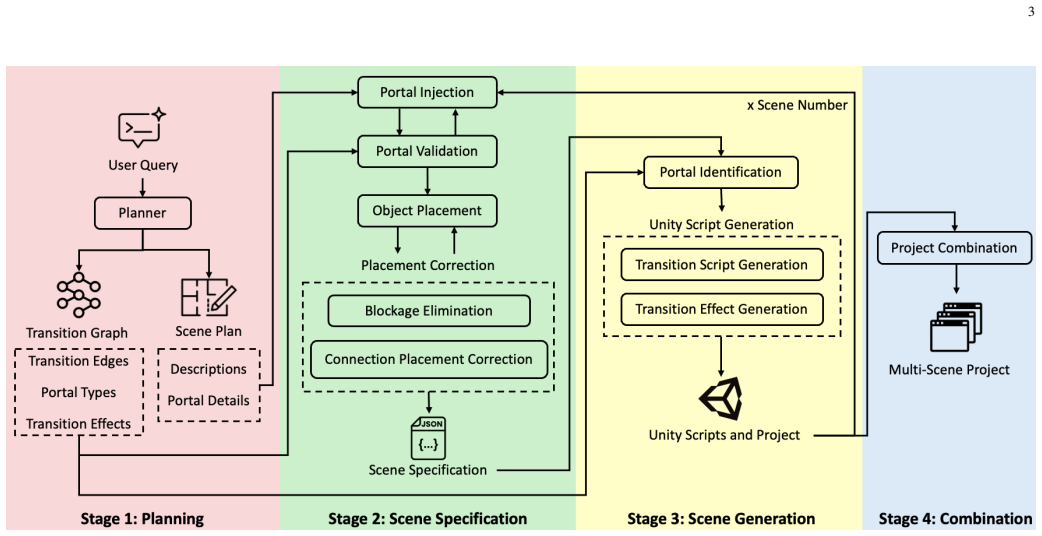
MAGIC turns a single natural-language prompt into a runnable multi-scene 3D game project whose portals are consistent on both sides and actually reachable in play.
Reviewed by Pith at T0; open to challenge. T0 means a machine referee read the full paper against a public rubric. the ladder, T0–T4 →
T0 review · grok-4.5
2026-07-14 04:31 UTC pith:GDTM6VKF
load-bearing objection Solid systems paper that actually ships multi-scene Unity transitions; headline F1 is agent-scored on a thin human check, but the contribution still holds. the 3 major comments →
MAGIC: Transition-Aware Generation of Navigable Multi-Scene Game Worlds with Large Language Models
The pith
A machine-rendered reading of the paper's core claim, the machinery that carries it, and where it could break.
Core claim
The paper claims that a shared transition-aware intermediate representation, combined with a portal-reachability flood-fill during scene specification and an in-play transition evaluation agent, is enough to turn one natural-language prompt into a fully connected, navigable multi-scene Unity project that single-scene generators cannot produce by naive repetition.
What carries the argument
A transition-aware automaton A = (S, P, δ, E) that records scenes, portals, effects, and bidirectional transitions, enforced stage-by-stage; plus a 2D occupancy-grid flood-fill that scores whether every walkable cell is reachable from each portal before the layout is accepted.
Load-bearing premise
That whether a player can actually walk to a portal is adequately decided by a flat 2D floor grid (cell size 0.05) that ignores real 3D clearance and can still return a blocked layout when regeneration retries run out.
What would settle it
Build the same multi-scene prompts with portals that require vertical clearance or non-floor obstacles (stairs, low beams, tall furniture corridors) and measure how often the flood-fill-approved layout still blocks a human or agent path in the packaged Unity project.
If this is right
- A single text prompt can become a multi-scene Unity project with working cross-scene transitions, not just isolated furnished rooms.
- Portal consistency and reachability can be enforced before mesh generation, reducing silent mislinked or blocked doors.
- Transition quality can be scored by executing portals in play (precision, recall, F1, approach rate, portal match) instead of only visual fidelity metrics.
- Stage-by-stage recovery of ground-truth portals and near-complete connectivity (reported ~0.995) is achievable without hand-authored connection graphs.
Where Pith is reading between the lines
- The same shared transition graph and reachability validator could be attached to other single-scene generators that already emit structured layouts, not only the Scenethesis-style path used here.
- If outdoor or multi-level worlds need the same guarantees, the 2D flood-fill would have to be replaced by a true navigation-mesh or 3D clearance check, which the limitations already flag as open work.
- The evaluation agent is engine-portable in principle: any project that exposes colliders and scene loads could reuse the candidate-extract, collide, approach, and MLLM-judge loop.
Editorial analysis
A structured set of objections, weighed in public.
Referee Report
Summary. The paper presents MAGIC, a four-stage prompt-to-Unity pipeline that generates interconnected, navigable multi-scene 3D game worlds from a single natural-language prompt. It introduces a shared transition-aware intermediate representation (automaton A=(S,P,δ,E)) for cross-scene consistency, a flood-fill reachability validator on a 2D occupancy grid for in-scene navigability, template-based LevelLoader script emission, and a project-combination stage. To evaluate transitions (which single-scene metrics ignore), the authors build an in-Unity evaluation agent that collides candidate portals, records destinations, measures approachability from spawn, and applies an MLLM appearance judge. On a new 100-case benchmark derived from MIT Indoor 67 and MMIS (1–5 scenes, looping/branching graphs, mixed portal types), MAGIC reports executable projects for every case and end-to-end transition identification of 0.99 precision / 0.95 recall / 0.96 F1, with stage-wise gains over an LLM baseline and Holodeck on portal recovery and connectivity.
Significance. If the results hold, MAGIC is a concrete advance over single-interior generators (Holodeck, Wonder family, Scenethesis-style pipelines): it is the first system in the comparison table that jointly produces genuine 3D interiors, cross-scene transitions with bound scripts, and a runnable multi-scene Unity project from text alone. The shared IR, flood-fill validator, and transition-focused agent are reusable artifacts; the 100-case multi-scene transition benchmark with ground-truth portals and reachability is, as claimed, a useful community resource; and code is released. These contributions matter for automated game content pipelines and for evaluation methodology beyond visual fidelity. Strengths that should be credited include the fully executable end-to-end artifact, the explicit stage-by-stage ablation against baselines, the human-agreement check of the agent (Table II), and the candid limitations and threats sections.
major comments (3)
- [§IV.E, Table II, Table VI] The headline end-to-end claim (Abstract; §V.B Table VI: 0.9871 P / 0.9481 R / 0.9637 F1, Approach Rate 0.9486) is produced entirely by the author-introduced evaluation agent (§IV.E.1, Fig. 2), not by full-set human labels. Reliability is shown only on a 20-case subset against two annotators (Table II, MeanAbsDiff 0.0299), with no inter-annotator agreement coefficient, no multi-run agent variance, and no human labels on the remaining 80 cases. Because both generator stages and the agent use the same LLM/MLLM family, correlated errors on portal candidates or destinations could systematically inflate F1 relative to true playable transitions. This is load-bearing for contribution 3 and the Abstract numbers; either expand human labeling to a larger stratified sample with IAA, or report agent variance and a clearer bound on how much the 20-case agreement generalizes.
- [§IV.B, §V.A–B, Tables III–VI, §V.D] All reported stage and end-to-end numbers come from a single run per case with temperature 0.7 and no significance testing (§IV.B; Threats to Validity §V.D Internal). Point estimates for portal P/R/F1 (Table IV), connectivity (Table V), and end-to-end F1 may therefore be optimistic, especially given stochastic LLM planning and placement regeneration. For a claim that MAGIC 'recovers more ground-truth portals and yields markedly more navigable layouts' than baselines, at least multi-seed means and standard deviations (or bootstrap intervals) on the main tables are needed; otherwise the comparative ranking is not statistically supported.
- [§III.B, §V.B, §V.C] Navigability (obstacle C2) is enforced and scored by a 2D floor-projection flood-fill with cell size s=0.05 that treats |V|=|walkable cells| as full portal reachability (§III.B). The method ignores true 3D clearance, vertical obstacles, non-floor blockers, and agent embodiment; when the regeneration budget is exhausted it returns the highest-connectivity layout, which may still leave portals blocked (§V.C). Approach Rate 0.9486 is therefore a best-effort residual, not a guarantee of playable transitions. The paper should either (a) validate the 2D proxy against a 3D navigation mesh / human playtest on a subset, or (b) restate the navigability claim more narrowly as '2D occupancy connectivity under the stated projection assumptions' so that C2 is not oversold relative to the implementation.
minor comments (6)
- [§II.A, Table I] Table I comparison is helpful but OpenGame and UniGen citations are thin; a short paragraph clarifying how MAGIC differs from concurrent multi-scene or agentic coding systems would strengthen related-work positioning.
- [§III.A, §IV.D.1, Table III] The transition-aware automaton is defined as A=(S,P,δ,E) with δ symmetric (§III.A), yet the evaluation of graph accuracy weights missing edges more heavily without stating the exact numeric formula used for the 'Average Graph Score' in Table III. Please give the weighted formula explicitly.
- [§I, Fig. 1 / Fig. 3] Figure 1 is referenced as the pipeline overview early on, but the manuscript text also refers to Figure 3 for the same overview and Figure 2 for the agent; numbering and captions should be made consistent so readers can locate the architecture diagram without hunting.
- [§IV.D.2, Table IV] Holodeck is a single-scene system; using it as a Stage-2 baseline is informative for portal count and connectivity, but the paper should state more clearly that Holodeck was not designed for multi-scene portal logic, so low recall is partly expected rather than a pure failure of the method.
- [Appendix A] Appendix A evaluation prompt is useful; consider also releasing the Stage-2/3 and agent prompts or noting their location in the code repository for full reproducibility.
- [§I, §IV] Minor wording: 'na¨ıve' encoding and occasional 'HOLODECK' vs 'Holodeck' capitalization inconsistency; standardize throughout.
Circularity Check
No load-bearing circular derivation; only a mild self-definitional loop on the flood-fill connectivity metric that MAGIC both optimizes and reports.
specific steps
-
self definitional
[§III.B flood-fill validator; §V.A.2 Table V connectivity]
"If the blockage evaluation is not successful, the object placement process will be looped until the maximum number of iterations is reached, and the model will return the placement with the highest connectivity score. ... MAGIC stands out in the average connectivity score among all three methods. The nearly perfect value [0.9952] shows that portals generated by this method can achieve the almost complete reachability across walkable cells"
Navigability is operationally defined as flood-fill Connectivity = |V|/|{walkable cells}| on a 2D occupancy grid. Stage 2 explicitly regenerates placements to maximize that same Connectivity, then Stage-2 evaluation reports MAGIC’s Connectivity as superior to baselines that do not run this loop. For the connectivity sub-claim only, the reported score is partly forced by the generation objective rather than an independent test of navigability.
full rationale
MAGIC is an engineering pipeline paper, not a first-principles derivation. End-to-end transition P/R/F1 are measured against procedurally generated ground-truth scene plans (MIT Indoor 67 + MMIS), not against quantities fitted from MAGIC outputs. Stage-by-stage checks (requirement matching, portal list comparison, script executability) are independent of the generator’s training or fitted constants. The author-built evaluation agent is a measurement instrument validated against human judgment on 20 cases (Table II); that is a reliability concern, not a reduction of a claimed prediction to its inputs. Self-citations to Scenethesis/UniGen supply reusable single-scene components and are not invoked as uniqueness theorems that force the multi-scene claims. The only mild circularity is that Stage 2 regenerates layouts to maximize the same 2D flood-fill connectivity later reported as evidence of navigability—so MAGIC’s near-perfect connectivity score is partly by construction relative to baselines that lack that loop. That does not make the transition-identification F1, executable-project claim, or portal recovery results circular. Score 1.
Axiom & Free-Parameter Ledger
free parameters (4)
- flood-fill grid cell size s =
0.05 units
- LLM decoding temperature =
0.7
- objects per scene expansion (8–12) =
8–12 objects
- placement regeneration max iterations / connectivity selection
axioms (5)
- domain assumption Transitions are bidirectional undirected edges: (si,p,e,sj) ∈ δ ⇔ (sj,p,e,si) ∈ δ.
- ad hoc to paper Doors connected to 'outside' are portals to another scene; windows are portals only if isPortal is true.
- ad hoc to paper 2D floor occupancy flood-fill equality |V| = |walkable cells| is a sufficient proxy for in-scene navigability of portals.
- domain assumption Only FadeInOut and IrisWipe transition effects are supported and chosen by stylistic LLM heuristics when unspecified.
- domain assumption A competent LLM (GPT-4.1 family) plus layered DSL constraints from Scenethesis can produce Unity-ready scene specifications from text.
invented entities (3)
-
Transition-aware automaton / shared intermediate representation A=(S,P,δ,E)
no independent evidence
-
Transition-focused evaluation agent (in-Unity portal candidate testing + MLLM appearance judge)
independent evidence
-
100-case multi-scene transition benchmark (MIT67 + MMIS procedural graphs)
no independent evidence
read the original abstract
Multi-scene navigation (clearing an objective in one bounded space and then crossing a portal into the next) is a defining feature of contemporary 3D games, but authoring it is laborious: every portal must have consistent endpoints on both sides, each interior must remain navigable once it is furnished, and the resulting connectivity must be kept consistent across many files. Recent large language model (LLM) and multimodal LLM (MLLM) scene generators have made single-interior synthesis dramatically cheaper, yet they produce one scene at a time and cannot, by naive repetition, yield a connected multi-scene world. We identify three obstacles that single-scene methods leave unsolved: cross-scene consistency, in-scene navigability, and the evaluation of whether a transition actually works. We present MAGIC, a prompt-to-project system that addresses all three. MAGIC is a four-stage pipeline that turns a single natural-language prompt into a runnable multi-scene game project: it plans a shared transition-aware intermediate representation, specifies each scene while enforcing portal reachability with a flood-fill validator, generates the scenes together with their transition scripts, and combines them into one project. Because existing single-scene fidelity metrics never execute a transition, we further introduce a transition-focused evaluation agent that runs each transition in play. On a new benchmark of 100 multi-scene cases, MAGIC produces an executable project for every case and reaches 0.99 precision, 0.95 recall, and 0.96 F1 on end-to-end transition identification; stage by stage, it recovers more ground-truth portals and yields markedly more navigable layouts than an LLM baseline and Holodeck. Our code is available at https://github.com/sereneee1201/MAGIC/.
Figures


Reference graph
Works this paper leans on
-
[1]
The relative popularity of video game genres in the scientific literature: A bibliographic survey,
J. Swacha, “The relative popularity of video game genres in the scientific literature: A bibliographic survey,”Multimodal Technologies and Interaction, vol. 9, no. 6, 2025,ISSN: 2414-4088.DOI: 10.3390/ mti9060059
2025
-
[2]
Challenges in educational game development,
A. Ghosh, “Challenges in educational game development,”International Journal of Darshan Institute on Engineering Research & Emerging Technology, vol. 11, pp. 54–60, Jul. 2022.DOI: 10.32692/IJDI-ERET/ 11.1.2022.2209
-
[3]
Holodeck: Language guided generation of 3d embodied ai environments,
Y . Yang et al., “Holodeck: Language guided generation of 3d embodied ai environments,” inProceedings of the IEEE/CVF Conference on Computer Vision and Pattern Recognition, 2024, pp. 16 227–16 237
2024
-
[4]
3d software synthesis guided by constraint-expressive intermediate representation,
S. Li, A. Y . Lam, Y . Peng, W. Wang, and M. R. Lyu, “3d software synthesis guided by constraint-expressive intermediate representation,” ArXiv, vol. abs/2507.18625, 2025
arXiv 2025
-
[5]
Game development as human-LLM interaction,
J. Hong, H. Wu, and H. Zhao, “Game development as human-LLM interaction,” inProceedings of the 63rd Annual Meeting of the Associ- ation for Computational Linguistics (Volume 1: Long Papers), W. Che, J. Nabende, E. Shutova, and M. T. Pilehvar, Eds., Vienna, Austria: Association for Computational Linguistics, Jul. 2025, pp. 4333–4354, ISBN: 979-8-89176-251-...
-
[6]
Level generation through large language models,
G. Todd, S. Earle, M. U. Nasir, M. C. Green, and J. Togelius, “Level generation through large language models,” inProceedings of the 18th International Conference on the Foundations of Digital Games, ser. FDG ’23, Lisbon, Portugal: Association for Computing Machinery, 2023, ISBN: 9781450398558.DOI: 10.1145/3582437.3587211
-
[7]
Genie: Generative interactive environments,
J. Bruce et al., “Genie: Generative interactive environments,” inPro- ceedings of the 41st International Conference on Machine Learning, ser. ICML’24, Vienna, Austria: JMLR.org, 2024
2024
-
[8]
Narrative-to-scene generation: An llm-driven pipeline for 2d game environments,
Y .-C. Chen and A. Jhala, “Narrative-to-scene generation: An llm-driven pipeline for 2d game environments,”arXiv preprint, 2025
2025
-
[9]
Image quality assessment: From error visibility to structural similarity,
Z. Wang, A. C. Bovik, H. R. Sheikh, and E. P. Simoncelli, “Image quality assessment: From error visibility to structural similarity,”IEEE Transactions on Image Processing, vol. 13, pp. 600–612, 2004
2004
-
[10]
Learning transferable visual models from natural lan- guage supervision,
A. Radford et al., “Learning transferable visual models from natural lan- guage supervision,” inInternational Conference on Machine Learning, 2021
2021
-
[11]
A. Quattoni and A. Torralba, “Recognizing indoor scenes,” in2009 IEEE Conference on Computer Vision and Pattern Recognition, 2009, pp. 413– 420.DOI: 10.1109/CVPR.2009.5206537
-
[12]
Mmis: Multimodal dataset for interior scene visual generation and recognition,
H. Kassab, A. Mahmoud, M. Bahaa, A. Mohamed, and A. Hamdi, “Mmis: Multimodal dataset for interior scene visual generation and recognition,”2024 Intelligent Methods, Systems, and Applications (IMSA), pp. 172–177, 2024
2024
-
[13]
Unbounded: A generative infinite game of character life simulation,
J. Li et al., “Unbounded: A generative infinite game of character life simulation,” inInternational Conference on Learning Representations, vol. 2025, 2025, pp. 87 465–87 491
2025
-
[14]
Game generation via large language models,
C. Hu, Y . Zhao, and J. Liu, “Game generation via large language models,” in2024 IEEE Conference on Games (CoG), 2024, pp. 1–4. DOI: 10.1109/CoG60054.2024.10645597
-
[15]
Consistent game content creation via function calling for large language models,
R. Gallotta, A. Liapis, and G. Yannakakis, “Consistent game content creation via function calling for large language models,” in2024 IEEE Conference on Games (CoG), 2024, pp. 1–4.DOI: 10.1109/CoG60054. 2024.10645599
-
[16]
Integration of large language models (llm) into the game content creation process,
Y . Yermolaieva, “Integration of large language models (llm) into the game content creation process,”SWorldJournal, vol. 4, no. 30-04, pp. 74–83, Mar. 2025.DOI: 10.30888/2663-5712.2025-30-04-075
-
[17]
Opengame: Open agentic coding for games,
Y . Jiang et al., “Opengame: Open agentic coding for games,”ArXiv,
-
[18]
eprint: 2604.18394 (cs.SE)
-
[19]
90% faster, 100% code-free: Mllm-driven zero-code 3d game development,
R. Yang, Y . Wan, S. Li, and M. R. Lyu, “90% faster, 100% code-free: Mllm-driven zero-code 3d game development,”arXiv, 2025
2025
-
[20]
Wonderturbo: Generating interactive 3d world in 0.72 seconds,
C. Ni et al., “Wonderturbo: Generating interactive 3d world in 0.72 seconds,” inProceedings of the IEEE/CVF International Conference on Computer Vision (ICCV), Oct. 2025, pp. 27 423–27 434
2025
-
[21]
Wonderverse: Extendable 3d scene generation with video generative models,
H. Feng et al., “Wonderverse: Extendable 3d scene generation with video generative models,”arXiv e-prints, 2026. arXiv: 2503.09160[cs.CV]
arXiv 2026
-
[22]
Won- derworld: Interactive 3d scene generation from a single image,
H.-X. Yu, H. Duan, C. Herrmann, W. T. Freeman, and J. Wu, “Won- derworld: Interactive 3d scene generation from a single image,” in Proceedings of the IEEE/CVF Conference on Computer Vision and Pattern Recognition (CVPR), Jun. 2025, pp. 5916–5926
2025
-
[23]
Procedural content generation in games: A survey with insights on emerging llm integration,
M. F. Maleki and R. Zhao, “Procedural content generation in games: A survey with insights on emerging llm integration,” inProceedings of the Twentieth AAAI Conference on Artificial Intelligence and Interactive Digital Entertainment, ser. AIIDE ’24, Lexington: AAAI Press, 2024, ISBN: 1-57735-895-3.DOI: 10.1609/aiide.v20i1.31877
-
[24]
An overview of procedurally generating virtual environments,
Y . Liu, “An overview of procedurally generating virtual environments,” International Journal of Computer Science and Information Technology, 2024
2024
-
[25]
Casagpt: Cuboid arrangement and scene assembly for interior design,
W. Feng, H. Zhou, J. Liao, L. Cheng, and W. Zhou, “Casagpt: Cuboid arrangement and scene assembly for interior design,”2025 IEEE/CVF Conference on Computer Vision and Pattern Recognition (CVPR), pp. 29 173–29 182, 2025
2025
-
[26]
High-resolution image synthesis with latent diffusion models,
R. Rombach, A. Blattmann, D. Lorenz, P. Esser, and B. Ommer, “High-resolution image synthesis with latent diffusion models,”2022 IEEE/CVF Conference on Computer Vision and Pattern Recognition (CVPR), pp. 10 674–10 685, 2021
2022
-
[27]
360-degree image completion by two-stage conditional gans,
N. Akimoto, S. Kasai, M. Hayashi, and Y . Aoki, “360-degree image completion by two-stage conditional gans,”2019 IEEE International Conference on Image Processing (ICIP), pp. 4704–4708, 2019
2019
-
[28]
Guided co-modulated gan for 360° field of view extrapolation,
M. R. K. Dastjerdi, Y . Hold-Geoffroy, J. Eisenmann, S. Khodadadeh, and J.-F. Lalonde, “Guided co-modulated gan for 360° field of view extrapolation,” in2022 International Conference on 3D Vision (3DV), Los Alamitos, CA, USA: IEEE Computer Society, Sep. 2022, pp. 475– 485.DOI: 10.1109/3DV57658.2022.00059
-
[29]
Socratic models: Composing zero-shot multimodal reasoning with language,
A. Zeng et al., “Socratic models: Composing zero-shot multimodal reasoning with language,”ArXiv, vol. abs/2204.00598, 2022
Pith/arXiv arXiv 2022
-
[30]
Language models are few-shot learners,
T. Brown et al., “Language models are few-shot learners,” inAdvances in Neural Information Processing Systems, vol. 33, 2020, pp. 1877–1901
2020
-
[31]
Chain-of-thought prompting elicits reasoning in large language models,
J. Wei et al., “Chain-of-thought prompting elicits reasoning in large language models,”Advances in Neural Information Processing Systems 35, 2022
2022
-
[32]
Controllable procedural generation of landscapes,
J.-H. Liu, S.-K. Zhang, C. Zhang, and S.-H. Zhang, “Controllable procedural generation of landscapes,” inProceedings of the 32nd ACM International Conference on Multimedia, ser. MM ’24, Melbourne VIC, Australia: Association for Computing Machinery, 2024, pp. 6394–6403, ISBN: 9798400706868.DOI: 10.1145/3664647.3681129
-
[33]
An evaluation metric for single image-to-3d models based on object de- tection perspective,
Y . Uchida, R. Togo, K. Maeda, T. Ogawa, and M. Haseyama, “An evaluation metric for single image-to-3d models based on object de- tection perspective,” inSIGGRAPH Asia 2024 Technical Communica- tions, ser. SA ’24, Association for Computing Machinery, 2024,ISBN: 9798400711404.DOI: 10.1145/3681758.3697992 11 APPENDIXA EVALUATIONPROMPT FORSTAGE1OFMAGIC You a...
-
[34]
A dictionary containing the ground truth describing an interior scene
-
[35]
table in the center
A dictionary containing the generated scene description. Your job: - Output a list of scene names **EXACTLY** from the ground truth according to the indices in the generated scene description. - Evaluate how accurately the generated description match the ground truth. **Accuracy Evaluation Rules: ** - Extract from the ground truth: - All key requirements ...
discussion (0)
Sign in with ORCID, Apple, or X to comment. Anyone can read and Pith papers without signing in.