REVIEW 5 major objections 5 minor 1 cited by
CoopTrack: Exploring End-to-End Learning for Efficient Cooperative Sequential Perception
T0 review · 5 major / 5 minor · reviewed 2026-08-15 · deepseek-v4-flash
Pith's one-line read CoopTrack sets a new state of the art on cooperative 3D multi-object tracking, reaching 39.0% mAP and 32.8% AMOTA on V2X-Seq.
desk verdict CoopTrack is a real advance in cooperative tracking, but the learned association's pseudo-label supervision is the key soft spot; it deserves peer review with a request for label-quality analysis. read the letter →
The pith
A machine-rendered reading of the paper's core claim, the machinery that carries it, and where it could break.
The reading
What carries the argument
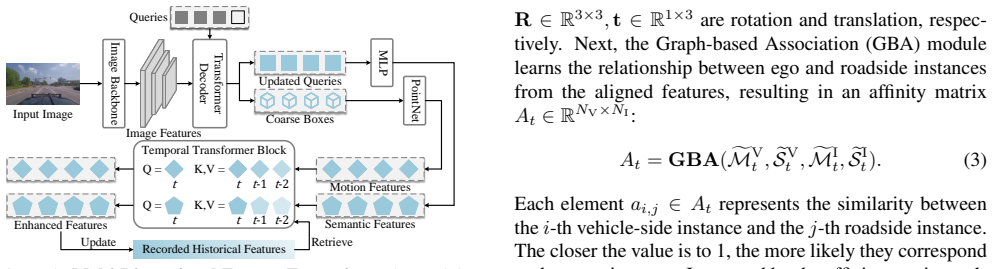
The load-bearing mechanism is the learned cross-agent association built on multi-dimensional instance features. Every candidate object carries a semantic feature vector and a motion feature vector; the motion vector is produced by a shared point-set encoder over the 3D corners of the coarse box, and both vectors are temporally refined by a transformer block over a sliding window of history. Cross-Agent Alignment treats the feature-domain gap between agents as a latent affine transformation, predicting a rotation and translation from the known relative pose. Graph-Based Association then computes a pairwise affinity from projected node features plus edge features derived from reference-point differences, and this affinity matrix drives Hungarian pairing and feature aggregation. The design's role is to make the decision 'which roadside box is the same as this vehicle box' a differentiable part of the end-to-end tracker.
What would settle it
Corrupt the first-stage tracker's predicted boxes with calibrated noise before generating the second-stage association labels and measure CoopTrack's AMOTA; if a small amount of added noise causes a large performance drop, the reported gains depend on clean pseudo-labels rather than on the learned association mechanism itself.
Extended reading notes
Core claim
The central claim is that the bottleneck in cooperative tracking is not communication size but poor association, and that association should be learned from rich instance representations rather than decided by spatial distance. CoopTrack first decodes each agent's image stream into instance queries, then derives a semantic feature and a motion feature for every instance, with the motion feature coming from the 3D corners of the coarse predicted box and both features refined through a short temporal history. Cross-Agent Alignment maps the roadside features into the vehicle's latent space via a learned rotation and translation, and the Graph-Based Association module builds a fully connected graph over the two instance sets, using node features and reference-point differences as edge features to predict an affinity matrix. Aggregation merges matched pairs and keeps unmatched instances, and the result is decoded into cooperative boxes that propagate their tracking queries to the next frame. The paper supports the claim by ablations in which the fusion-after-decoding pipeline, multi-dimensional features, alignment, and graph association each add measurable gains.
Load-bearing premise
The second training stage relies on association labels generated by matching first-stage tracker predictions to ground truth with the Hungarian algorithm; if those predictions are noisy, the learned association module is trained on wrong correspondences, and the paper does not quantify how much label noise is present.
Editorial extensions
If this is right
- Sparse instance-level features are enough for strong cooperative tracking: CoopTrack transmits 5.64e4 bytes per frame on V2X-Seq and still beats dense BEV-feature fusion methods on both mAP and AMOTA.
- A fusion-after-decoding pipeline avoids the ambiguity of merging queries before decoding, yielding a 2.7-point mAP gain over the baseline in the paper's ablation.
- Learnable graph-based association contributes beyond spatial proximity: adding it on top of multi-dimensional features and alignment brings a 1.4-point AMOTA gain in the ablation.
- The method is not limited to vehicle-infrastructure settings: on the Griffin aerial-ground dataset it outperforms the previous end-to-end method by 6.0 mAP and 3.2 AMOTA.
- Performance scales with backbone strength: replacing the default backbone with a newer convolutional backbone raises mAP by 2.3 points and AMOTA by 10.1 points on V2X-Seq.
Reading between the lines
- Because the association module is trained on multi-dimensional features rather than raw reference-point distance, it should tolerate larger pose-estimation errors than the reference-point baselines; this could be tested by measuring ID switches under increasing rotation noise.
- The same latent alignment and graph-association machinery could transfer to other cross-sensor fusion settings (camera-radar, camera-lidar, or agents with different intrinsics), where the domain gap is larger and spatial-only association is known to be fragile.
- Since only sparse instance features are transmitted, per-frame communication cost should scale with the number of detected objects rather than scene size; in dense traffic the cost would rise, and the paper reports only average bytes per frame, so cost scaling is an open question.
- The reliance on Hungarian-generated pseudo-labels could be removed with a soft, differentiable assignment loss trained jointly, which would eliminate the two-stage training loop the paper itself notes is complex.
Signed reviews
Editorial analysis
A structured set of objections, weighed in public.
Referee Report
Summary. The paper proposes CoopTrack, an instance-level end-to-end framework for cooperative 3D multi-object tracking from camera inputs. The method transmits sparse instance-level features from the infrastructure agent to the ego vehicle, aligns cross-agent features with a learned Cross-Agent Alignment module, and associates them with a Graph-Based Association module before decoding cooperative outputs. The framework is trained in two stages; the second stage supervises the association module with labels generated by Hungarian matching between first-stage model predictions and ground truth. Experiments on V2X-Seq report state-of-the-art results (39.0% mAP, 32.8% AMOTA) and a transmission cost lower than UniV2X, while experiments on Griffin show improved tracking over a UniV2X baseline. The paper also provides ablations, robustness studies on latency and pose noise, and a public project page.
Significance. If the central claims hold, CoopTrack is a meaningful advance for cooperative sequential perception: it is among the first fully end-to-end cooperative 3D trackers with a learnable association mechanism, it demonstrates a favorable performance-bandwidth trade-off on V2X-Seq, and it includes practical robustness analyses (communication latency, pose noise, input loss). The paper ships detailed ablations and releases code, which are strengths. However, the evidence that the learnable association module is the source of the improvement is incomplete because the association labels used for training are never validated, and the headline numbers come from single runs without variance reporting.
major comments (5)
- [Section 3.5, Eq. (8)] The second-stage association loss is supervised by labels generated by Hungarian matching between first-stage model predictions and ground truth. The manuscript supports the reliability of these labels only with the sentence in Section 3.5 and a BEV visualization; no precision, recall, F1, per-sequence statistics, or comparison against oracle labels is provided. Because the Graph-Based Association module is the paper's main novelty over UniV2X and the reported gains are attributed to it, the authors should quantify the accuracy of the generated association labels, or provide an ablation that trains with oracle labels instead. Without such evidence, the improvement could be driven by systematic biases of the first-stage model rather than by a better learned association mechanism.
- [Section 4.2, Table 2] In the Griffin experiment, CoopTrack's transmission cost is 1.17e5 bytes, more than double UniV2X's 5.58e4, but the text states that CoopTrack outperforms UniV2X 'with similar transmission costs.' This is internally inconsistent. The authors should either correct the wording or discuss why the higher transmission cost on Griffin is an acceptable trade-off, especially because the abstract and introduction emphasize low transmission costs as a general property of the method.
- [Section 4.2 and Section 4.3, Tables 1-6] All reported results are from single runs with no error bars or multiple seeds. The paper's headline comparisons—9.5 mAP on V2X-Seq in Table 1, 4.6 mAP on the 10Hz ResNet50 setting in Table 3, and the module ablations in Table 4—would be more convincing with at least three seeds and standard deviations. Without this, it is difficult to assess whether the reported margins are statistically reliable. The authors should provide seed variance for the main comparisons and key ablations, or explicitly justify why this is infeasible.
- [Section 4.3, Table 4] The ablation table has no row labels. As printed, it is impossible to determine which configuration each row corresponds to (for example, which two-checkmark row is Pipeline+MDFE versus Pipeline+CAA versus Pipeline+GBA). Please add explicit configuration labels to each row or split the table so that the incremental contributions of the pipeline, MDFE, CAA, and GBA are unambiguous.
- [Section 4.3, Table 5] In the historical-frame ablation, moving from 4 to 5 frames increases mAP from 0.356 to 0.367 but decreases AMOTA from 0.346 to 0.324. The text states that performance 'begins to saturate at 4 frames' and that 4 is chosen for efficiency; the non-monotonic behavior of the tracking metric deserves an explicit comment, since it suggests a possible trade-off between detection and tracking performance rather than simple saturation.
minor comments (5)
- [Section 4.2, Table 1 interpretation] The comparison against V2X-ViT in the text states a 12.2% mAP gain and a 4.1% AMOTA gain; the 12.2% appears to be 0.390 - 0.268, but the AMOTA gain is 0.328 - 0.287 = 0.041. The sentence is internally consistent, but the units (percentage points) should be stated explicitly to avoid confusion.
- [Section 3.4, Eq. (6)] The edge features are defined as an MLP over pairwise differences of reference points, but the text says 'the pair-wise differences D' without specifying whether the difference is absolute value or signed; Eq. (6) then adds edge features to the attention score. Please clarify the exact definition of D and how the edge feature dimension aligns with the node feature dimension.
- [Appendix C.2, Table 7] The runtime table reports total inference time of 121.88 ms for the ResNet50 model and 207.99 ms for ResNet101, but the text says 'nearly real-time performance at approximately 10Hz.' The reported total time of 121.88 ms corresponds to 8.2 Hz, not 10 Hz; please reconcile this statement with the measured runtime.
- [Figure 6 and Section 3.5] The association label generation process is described for the positive case (ground truth matched by both agents) and negative cases, but the exact rule for labels when one agent's prediction is matched to a ground truth and the other agent's prediction is matched to a different ground truth is only stated as 'different IDs.' This is clear in principle, but a pseudocode block or a precise algorithmic description would improve reproducibility.
- [Related Work and References] References [13], [20], [58] are described as providing comparisons on V2X-Seq, but it would be helpful to state more explicitly which of these were re-implemented with BEVFormer rather than using their original backbones, since the evaluation protocol in Section B.2 says all methods except CoCa3D use BEVFormer.
Circularity Check
No significant circularity: the SOTA claim is benchmarked against held-out ground truth, and the pseudo-label training signal does not make the reported metrics equal to its own inputs by construction.
full rationale
CoopTrack is an empirical systems paper. Its central claim, state-of-the-art mAP and AMOTA on V2X-Seq and Griffin, is established by evaluating final outputs against held-out ground truth with standard metrics, not by deriving the reported numbers from its own inputs. The only superficially circular-looking component is the second-stage association supervision (Sec. 3.5, Eq. 8), where association labels are generated by Hungarian matching first-stage predictions to ground truth. This is pseudo-labeling for a training loss, and the final evaluation is independent of those labels, so no equation in the paper makes a predicted quantity equal to the label-generation function by construction. The paper does reference prior work by overlapping authors (UniV2X [71], V2X-Seq [70], Griffin [46], Quest [9]) as baselines, datasets, and for Hungarian-matching details, but these citations are contextual or benchmark comparisons rather than load-bearing justifications of the method's validity; the Hungarian algorithm itself is attributed to the standard external reference [17]. The claimed benefit of the graph-based association module is supported by an ablation study (Table 4), and the concern about unquantified pseudo-label quality is an evidential or correctness risk, not circularity, because the benchmark metrics are computed against ground truth rather than against the training labels. Accordingly, no circular step can be exhibited with the specific reduction required by the review rules.
Assumptions & free parameters
free parameters (3)
- History length tau =
4
- Loss weight lambda_asso =
10.0
- Loss weights lambda_bbx and lambda_cls =
0.25 and 2.0
assumptions (3)
- domain assumption The domain gap between vehicle and infrastructure features can be modeled as a linear latent-space transformation (Eq. 5a).
- domain assumption Constant velocity assumption for propagating track query reference points across frames.
- ad hoc to paper Hungarian matching with L1 cost on predicted attributes produces correct cross-agent association labels.
Cite this review
Pith. "Pith review of CoopTrack: Exploring End-to-End Learning for Efficient Cooperative Sequential Perception." pith.science (2026). https://pith.science/paper/GDYG3B72
@misc{pith2026250719239,
  author       = {Pith},
  title        = {Pith review of: CoopTrack: Exploring End-to-End Learning for Efficient Cooperative Sequential Perception},
  year         = {2026},
  howpublished = {\url{https://pith.science/paper/GDYG3B72}},
  note         = {Machine review of arXiv:2507.19239}
}
read the original abstract
Cooperative perception aims to address the inherent limitations of single-vehicle autonomous driving systems through information exchange among multiple agents. Previous research has primarily focused on single-frame perception tasks. However, the more challenging cooperative sequential perception tasks, such as cooperative 3D multi-object tracking, have not been thoroughly investigated. Therefore, we propose CoopTrack, a fully instance-level end-to-end framework for cooperative tracking, featuring learnable instance association, which fundamentally differs from existing approaches. CoopTrack transmits sparse instance-level features that significantly enhance perception capabilities while maintaining low transmission costs. Furthermore, the framework comprises two key components: Multi-Dimensional Feature Extraction, and Cross-Agent Association and Aggregation, which collectively enable comprehensive instance representation with semantic and motion features, and adaptive cross-agent association and fusion based on a feature graph. Experiments on both the V2X-Seq and Griffin datasets demonstrate that CoopTrack achieves excellent performance. Specifically, it attains state-of-the-art results on V2X-Seq, with 39.0\% mAP and 32.8\% AMOTA. The project is available at https://github.com/zhongjiaru/CoopTrack.
Figures


Figures from the paper (6 more)


Forward citations
Cited by 1 Pith paper
-
Research Challenges and Progress in the End-to-End V2X Cooperative Autonomous Driving Competition
This paper summarizes the CVPR 2025 V2X cooperative driving challenge, its winning solutions, and the open research problems it reveals.
Reference graph
Works this paper leans on
-
[1]
Lang, Sourabh V ora, Venice Erin Liong, Qiang Xu, Anush Krishnan, Yu Pan, Gi- ancarlo Baldan, and Oscar Beijbom
Holger Caesar, Varun Bankiti, Alex H. Lang, Sourabh V ora, Venice Erin Liong, Qiang Xu, Anush Krishnan, Yu Pan, Gi- ancarlo Baldan, and Oscar Beijbom. nuscenes: A multi- modal dataset for autonomous driving. In 2020 IEEE/CVF Conference on Computer Vision and Pattern Recognition (CVPR), pages 11618–11628, 2020. 3, 13
2020
-
[2]
A review of object tracking methods: From general field to autonomous vehi- cles
Jingwei Cao, Hongyu Zhang, Lisheng Jin, Jiawang Lv, Guoyang Hou, and Chengtao Zhang. A review of object tracking methods: From general field to autonomous vehi- cles. Neurocomputing, page 127635, 2024. 3
2024
-
[3]
Ziming Chen, Yifeng Shi, and Jinrang Jia. Transiff: An instance-level feature fusion framework for vehicle- infrastructure cooperative 3d detection with transformers. In Proceedings of the IEEE/CVF International Conference on Computer Vision, pages 18205–18214, 2023. 5
work page 2023
-
[4]
Jdt3d: Addressing the gaps in lidar-based tracking-by-attention
Brian Cheong, Jiachen Zhou, and Steven Waslander. Jdt3d: Addressing the gaps in lidar-based tracking-by-attention. In European Conference on Computer Vision, pages 161–177. Springer, 2024. 3
work page 2024
-
[5]
Hsu-Kuang Chiu, Chien-Yi Wang, Min-Hung Chen, and Stephen F Smith. Probabilistic 3d multi-object coopera- tive tracking for autonomous driving via differentiable multi- sensor kalman filter. In 2024 IEEE International Conference on Robotics and Automation (ICRA) , pages 18458–18464. IEEE, 2024. 1, 2
work page 2024
-
[6]
3dmotformer: Graph trans- former for online 3d multi-object tracking
Shuxiao Ding, Eike Rehder, Lukas Schneider, Marius Cordts, and Juergen Gall. 3dmotformer: Graph trans- former for online 3d multi-object tracking. InProceedings of the IEEE/CVF international conference on computer vision, pages 9784–9794, 2023. 6
work page 2023
-
[7]
Shuxiao Ding, Lukas Schneider, Marius Cordts, and Juergen Gall. Ada-track: End-to-end multi-camera 3d multi-object tracking with alternating detection and association. In Pro- ceedings of the IEEE/CVF Conference on Computer Vision and Pattern Recognition, pages 15184–15194, 2024. 2, 3, 4, 5
work page 2024
-
[8]
Simon Doll, Niklas Hanselmann, Lukas Schneider, Richard Schulz, Markus Enzweiler, and Hendrik PA Lensch. Star- track: Latent motion models for end-to-end 3d object track- ing with adaptive spatio-temporal appearance representa- tions. IEEE Robotics and Automation Letters , 9(2):1326– 1333, 2023. 5
work page 2023
Show all 82 references
-
[9]
Quest: Query stream for practical cooperative percep- tion
Siqi Fan, Haibao Yu, Wenxian Yang, Jirui Yuan, and Zaiqing Nie. Quest: Query stream for practical cooperative percep- tion. In 2024 IEEE International Conference on Robotics and Automation (ICRA) , pages 18436–18442. IEEE, 2024. 4, 5, 6
2024
-
[10]
Rcooper: A real-world large-scale dataset for roadside cooperative perception
Ruiyang Hao, Siqi Fan, Yingru Dai, Zhenlin Zhang, Chenxi Li, Yuntian Wang, Haibao Yu, Wenxian Yang, Jirui Yuan, and Zaiqing Nie. Rcooper: A real-world large-scale dataset for roadside cooperative perception. In Proceedings of the IEEE/CVF Conference on Computer Vision and Patt...
2024
-
[11]
Styledrive: Towards driving-style aware benchmark- ing of end-to-end autonomous driving
Ruiyang Hao, Bowen Jing, Haibao Yu, and Zaiqing Nie. Styledrive: Towards driving-style aware benchmark- ing of end-to-end autonomous driving. arXiv preprint arXiv:2506.23982, 2025. 1
2025
-
[12]
Deep residual learning for image recognition
Kaiming He, Xiangyu Zhang, Shaoqing Ren, and Jian Sun. Deep residual learning for image recognition. In Proceed- ings of the IEEE conference on computer vision and pattern recognition, pages 770–778, 2016. 7, 14
2016
-
[13]
Where2comm: Communication-efficient collab- orative perception via spatial confidence maps
Yue Hu, Shaoheng Fang, Zixing Lei, Yiqi Zhong, and Si- heng Chen. Where2comm: Communication-efficient collab- orative perception via spatial confidence maps. Advances in neural information processing systems , 35:4874–4886,
-
[14]
Collaboration helps camera overtake li- dar in 3d detection
Yue Hu, Yifan Lu, Runsheng Xu, Weidi Xie, Siheng Chen, and Yanfeng Wang. Collaboration helps camera overtake li- dar in 3d detection. In Proceedings of the IEEE/CVF Con- ference on Computer Vision and Pattern Recognition, pages 9243–9252, 2023. 6, 13
2023
-
[15]
Pragmatic com- munication in multi-agent collaborative perception
Yue Hu, Xianghe Pang, Xiaoqi Qin, Yonina C Eldar, Siheng Chen, Ping Zhang, and Wenjun Zhang. Pragmatic com- munication in multi-agent collaborative perception. arXiv preprint arXiv:2401.12694, 2024. 2
2024 arXiv
-
[16]
Communication-efficient collaborative percep- tion via information filling with codebook
Yue Hu, Juntong Peng, Sifei Liu, Junhao Ge, Si Liu, and Si- heng Chen. Communication-efficient collaborative percep- tion via information filling with codebook. In Proceedings of the IEEE/CVF Conference on Computer Vision and Pat- tern Recognition, pages 15481–15490, 2024. 2
2024
-
[17]
The hungarian method for the assignment problem
Harold W Kuhn. The hungarian method for the assignment problem. Naval research logistics quarterly , 2(1-2):83–97,
-
[18]
Delving into the secrets of bev 3d object detection in autonomous driving: A comprehensive survey
Haoyu Li, Yueran Zhao, Jiaru Zhong, Bo Wang, Chao Sun, and Fengchun Sun. Delving into the secrets of bev 3d object detection in autonomous driving: A comprehensive survey. Authorea Preprints, 2024. 2
2024
-
[19]
Time3d: End-to-end joint monocu- lar 3d object detection and tracking for autonomous driving
Peixuan Li and Jieyu Jin. Time3d: End-to-end joint monocu- lar 3d object detection and tracking for autonomous driving. In Proceedings of the IEEE/CVF conference on computer vi- sion and pattern recognition, pages 3885–3894, 2022. 3, 5
2022
-
[20]
Learning distilled collaboration graph for multi-agent perception
Yiming Li, Shunli Ren, Pengxiang Wu, Siheng Chen, Chen Feng, and Wenjun Zhang. Learning distilled collaboration graph for multi-agent perception. Advances in Neural Infor- mation Processing Systems, 34:29541–29552, 2021. 6, 13
2021
-
[21]
V2x-sim: Multi-agent col- laborative perception dataset and benchmark for autonomous driving
Yiming Li, Dekun Ma, Ziyan An, Zixun Wang, Yiqi Zhong, Siheng Chen, and Chen Feng. V2x-sim: Multi-agent col- laborative perception dataset and benchmark for autonomous driving. IEEE Robotics and Automation Letters, 7(4):10914– 10921, 2022. 1, 2
2022
-
[22]
End-to-end 3d tracking with decoupled queries
Yanwei Li, Zhiding Yu, Jonah Philion, Anima Anandku- mar, Sanja Fidler, Jiaya Jia, and Jose Alvarez. End-to-end 3d tracking with decoupled queries. In Proceedings of the IEEE/CVF International Conference on Computer Vision , pages 18302–18311, 2023. 3
2023
-
[23]
Bevformer: 9 learning bird’s-eye-view representation from lidar-camera via spatiotemporal transformers
Zhiqi Li, Wenhai Wang, Hongyang Li, Enze Xie, Chong- hao Sima, Tong Lu, Qiao Yu, and Jifeng Dai. Bevformer: 9 learning bird’s-eye-view representation from lidar-camera via spatiotemporal transformers. IEEE Transactions on Pat- tern Analysis and Machine Intelligence, 2024. 4, 6, 7, 13
2024
-
[24]
V2vformer: Vehicle-to- vehicle cooperative perception with spatial-channel trans- former
Chunmian Lin, Daxin Tian, Xuting Duan, Jianshan Zhou, Dezong Zhao, and Dongpu Cao. V2vformer: Vehicle-to- vehicle cooperative perception with spatial-channel trans- former. IEEE Transactions on Intelligent Vehicles , 9(2): 3384–3395, 2024. 2
2024
-
[25]
Sparse4d v3: Advancing end-to-end 3d detec- tion and tracking
Xuewu Lin, Zixiang Pei, Tianwei Lin, Lichao Huang, and Zhizhong Su. Sparse4d v3: Advancing end-to-end 3d detec- tion and tracking. arXiv preprint arXiv:2311.11722 , 2023. 3
2023 arXiv
-
[26]
Bevmamba: Time se- quence dense bird’s-eye-view perception modeling with state space model
Xiao Liu, Jiaru Zhong, and Chao Sun. Bevmamba: Time se- quence dense bird’s-eye-view perception modeling with state space model. IEEE Transactions on Intelligent Transporta- tion Systems, 2025. 1
2025
-
[27]
A convnet for the 2020s
Zhuang Liu, Hanzi Mao, Chao-Yuan Wu, Christoph Feicht- enhofer, Trevor Darrell, and Saining Xie. A convnet for the 2020s. In Proceedings of the IEEE/CVF conference on com- puter vision and pattern recognition , pages 11976–11986,
-
[28]
Robust collabora- tive 3d object detection in presence of pose errors
Yifan Lu, Quanhao Li, Baoan Liu, Mehrdad Dianati, Chen Feng, Siheng Chen, and Yanfeng Wang. Robust collabora- tive 3d object detection in presence of pose errors. In 2023 IEEE International Conference on Robotics and Automation (ICRA), pages 4812–4818. IEEE, 2023. 6, 13
2023
-
[29]
Track to reconstruct and reconstruct to track
Jonathon Luiten, Tobias Fischer, and Bastian Leibe. Track to reconstruct and reconstruct to track. IEEE Robotics and Automation Letters, 5(2):1803–1810, 2020. 3
2020
-
[30]
Holovic: Large-scale dataset and benchmark for multi-sensor holo- graphic intersection and vehicle-infrastructure cooperative
Cong Ma, Lei Qiao, Chengkai Zhu, Kai Liu, Zelong Kong, Qing Li, Xueqi Zhou, Yuheng Kan, and Wei Wu. Holovic: Large-scale dataset and benchmark for multi-sensor holo- graphic intersection and vehicle-infrastructure cooperative. In Proceedings of the IEEE/CVF Conference on Compu...
2024
-
[31]
Dolphins: Dataset for collabora- tive perception enabled harmonious and interconnected self- driving
Ruiqing Mao, Jingyu Guo, Yukuan Jia, Yuxuan Sun, Sheng Zhou, and Zhisheng Niu. Dolphins: Dataset for collabora- tive perception enabled harmonious and interconnected self- driving. In Proceedings of the Asian Conference on Com- puter Vision, pages 4361–4377, 2022. 2
2022
-
[32]
Triplettrack: 3d object tracking using triplet embeddings and lstm
Nicola Marinello, Marc Proesmans, and Luc Van Gool. Triplettrack: 3d object tracking using triplet embeddings and lstm. In Proceedings of the IEEE/CVF conference on computer vision and pattern recognition, pages 4500–4510,
-
[33]
Simpletrack: Understanding and rethinking 3d multi-object tracking
Ziqi Pang, Zhichao Li, and Naiyan Wang. Simpletrack: Understanding and rethinking 3d multi-object tracking. In European conference on computer vision , pages 680–696. Springer, 2022. 3
2022
-
[34]
Standing between past and future: Spatio-temporal modeling for multi-camera 3d multi- object tracking
Ziqi Pang, Jie Li, Pavel Tokmakov, Dian Chen, Sergey Zagoruyko, and Yu-Xiong Wang. Standing between past and future: Spatio-temporal modeling for multi-camera 3d multi- object tracking. In Proceedings of the IEEE/CVF conference on computer vision and pattern recognition , page...
2023
-
[35]
Time will tell: New outlooks and a baseline for temporal multi-view 3d object detection
Jinhyung Park, Chenfeng Xu, Shijia Yang, Kurt Keutzer, Kris Kitani, Masayoshi Tomizuka, and Wei Zhan. Time will tell: New outlooks and a baseline for temporal multi-view 3d object detection. arXiv preprint arXiv:2210.02443, 2022. 13
-
[36]
Pointnet: Deep learning on point sets for 3d classification and segmentation
Charles R Qi, Hao Su, Kaichun Mo, and Leonidas J Guibas. Pointnet: Deep learning on point sets for 3d classification and segmentation. In Proceedings of the IEEE conference on computer vision and pattern recognition, pages 652–660,
-
[37]
Learning cooperative trajectory representations for motion forecasting
Hongzhi Ruan, Haibao Yu, Wenxian Yang, Siqi Fan, and Za- iqing Nie. Learning cooperative trajectory representations for motion forecasting. Advances in Neural Information Pro- cessing Systems, 37:13430–13457, 2025. 2
2025
-
[38]
Transformers for multi-object tracking on point clouds
Felicia Ruppel, Florian Faion, Claudius Gl ¨aser, and Klaus Dietmayer. Transformers for multi-object tracking on point clouds. In 2022 IEEE Intelligent Vehicles Symposium (IV) , pages 852–859. IEEE, 2022. 5
2022
-
[39]
Shasta: Modeling shape and spatio-temporal affinities for 3d multi-object tracking
Tara Sadjadpour, Jie Li, Rares Ambrus, and Jeannette Bohg. Shasta: Modeling shape and spatio-temporal affinities for 3d multi-object tracking. IEEE Robotics and Automation Let- ters, 9(5):4273–4280, 2023. 3
2023
-
[40]
Col- laborative semantic occupancy prediction with hybrid fea- ture fusion in connected automated vehicles
Rui Song, Chenwei Liang, Hu Cao, Zhiran Yan, Walter Zim- mer, Markus Gross, Andreas Festag, and Alois Knoll. Col- laborative semantic occupancy prediction with hybrid fea- ture fusion in connected automated vehicles. In Proceedings of the IEEE/CVF Conference on Computer Vision...
2024
-
[41]
Spot: Spatiotemporal modeling for 3d object track- ing
Colton Stearns, Davis Rempe, Jie Li, Rares ¸ Ambrus ¸, Sergey Zakharov, Vitor Guizilini, Yanchao Yang, and Leonidas J Guibas. Spot: Spatiotemporal modeling for 3d object track- ing. In European Conference on Computer Vision , pages 639–656. Springer, 2022. 3
2022
-
[42]
3d multi- object tracking based on two-stage data association for col- laborative perception scenarios
Hao Su, Shin’Ichi Arakawa, and Masayuki Murata. 3d multi- object tracking based on two-stage data association for col- laborative perception scenarios. In 2023 IEEE Intelligent Ve- hicles Symposium (IV), pages 1–7. IEEE, 2023. 1, 2
2023
-
[43]
Cooper- ative 3d multi-object tracking for connected and automated vehicles with complementary data association
Hao Su, Shin’ichi Arakawa, and Masayuki Murata. Cooper- ative 3d multi-object tracking for connected and automated vehicles with complementary data association. In2024 IEEE Intelligent Vehicles Symposium (IV), pages 285–291. IEEE, 2024
2024
-
[44]
Collaborative multi- object tracking with conformal uncertainty propagation
Sanbao Su, Songyang Han, Yiming Li, Zhili Zhang, Chen Feng, Caiwen Ding, and Fei Miao. Collaborative multi- object tracking with conformal uncertainty propagation. IEEE Robotics and Automation Letters , 9(4):3323–3330,
-
[45]
Attention is all you need
Ashish Vaswani, Noam Shazeer, Niki Parmar, Jakob Uszko- reit, Llion Jones, Aidan N Gomez, Łukasz Kaiser, and Illia Polosukhin. Attention is all you need. Advances in neural information processing systems, 30, 2017. 5
2017
-
[46]
Griffin: Aerial-ground cooperative detection and tracking dataset and benchmark
Jiahao Wang, Xiangyu Cao, Jiaru Zhong, Yuner Zhang, Haibao Yu, Lei He, and Shaobing Xu. Griffin: Aerial-ground cooperative detection and tracking dataset and benchmark. arXiv preprint arXiv:2503.06983, 2025. 2, 7, 14
2025 arXiv
-
[47]
Camo-mot: Combined appearance-motion optimiza- tion for 3d multi-object tracking with camera-lidar fusion
Li Wang, Xinyu Zhang, Wenyuan Qin, Xiaoyu Li, Jinghan Gao, Lei Yang, Zhiwei Li, Jun Li, Lei Zhu, Hong Wang, et al. Camo-mot: Combined appearance-motion optimiza- tion for 3d multi-object tracking with camera-lidar fusion. IEEE Transactions on Intelligent Transportation Systems...
2023
-
[48]
Onetrack: Demystifying the conflict between detection and tracking in end-to-end 3d trackers
Qitai Wang, Jiawei He, Yuntao Chen, and Zhaoxiang Zhang. Onetrack: Demystifying the conflict between detection and tracking in end-to-end 3d trackers. In European Conference on Computer Vision, pages 387–404. Springer, 2024. 2, 3
2024
-
[49]
Exploring object-centric temporal modeling for efficient multi-view 3d object detection
Shihao Wang, Yingfei Liu, Tiancai Wang, Ying Li, and Xi- angyu Zhang. Exploring object-centric temporal modeling for efficient multi-view 3d object detection. In Proceedings of the IEEE/CVF international conference on computer vi- sion, pages 3621–3631, 2023. 13
2023
-
[50]
A multi-modal fusion-based 3d multi-object tracking framework with joint detection
Xiyang Wang, Chunyun Fu, Jiawei He, Mingguang Huang, Ting Meng, Siyu Zhang, Hangning Zhou, Ziyao Xu, and Chi Zhang. A multi-modal fusion-based 3d multi-object tracking framework with joint detection. IEEE Robotics and Automa- tion Letters, 2024. 3
2024
-
[51]
3d multi-object tracking: A baseline and new evaluation met- rics
Xinshuo Weng, Jianren Wang, David Held, and Kris Kitani. 3d multi-object tracking: A baseline and new evaluation met- rics. In 2020 IEEE/RSJ International Conference on Intelli- gent Robots and Systems (IROS), pages 10359–10366. IEEE,
2020
-
[52]
Gnn3dmot: Graph neural network for 3d multi-object tracking with 2d-3d multi-feature learning
Xinshuo Weng, Yongxin Wang, Yunze Man, and Kris M Ki- tani. Gnn3dmot: Graph neural network for 3d multi-object tracking with 2d-3d multi-feature learning. In Proceedings of the IEEE/CVF conference on computer vision and pattern recognition, pages 6499–6508, 2020. 3
2020
-
[53]
V2x-real: a largs-scale dataset for vehicle-to- everything cooperative perception
Hao Xiang, Zhaoliang Zheng, Xin Xia, Runsheng Xu, Letian Gao, Zewei Zhou, Xu Han, Xinkai Ji, Mingxi Li, Zonglin Meng, et al. V2x-real: a largs-scale dataset for vehicle-to- everything cooperative perception. In European Conference on Computer Vision, pages 455–470. Springer, 2024. 2
2024
-
[54]
Deformable model-driven neural rendering for high-fidelity 3d reconstruction of human heads under low- view settings
Baixin Xu, Jiarui Zhang, Kwan-Yee Lin, Chen Qian, and Ying He. Deformable model-driven neural rendering for high-fidelity 3d reconstruction of human heads under low- view settings. In Proceedings of the IEEE/CVF International Conference on Computer Vision, pages 17924–17934, 2023. 3
2023
-
[55]
Parameterization-driven neu- ral surface reconstruction for object-oriented editing in neu- ral rendering
Baixin Xu, Jiangbei Hu, Fei Hou, Kwan-Yee Lin, Wayne Wu, Chen Qian, and Ying He. Parameterization-driven neu- ral surface reconstruction for object-oriented editing in neu- ral rendering. In European Conference on Computer Vision, pages 461–479. Springer, 2024. 3
2024
-
[56]
From component to system: A task-unified planning system with planning-oriented pre- dictor
Jiahui Xu, Wenbo Shao, Weida Wang, Cheng Liu, Chao Yang, Jun Li, and Hong Wang. From component to system: A task-unified planning system with planning-oriented pre- dictor. IEEE Transactions on Vehicular Technology, 74(4): 5335–5348, 2025. 2
2025
-
[57]
Cobevt: Cooperative bird’s eye view semantic segmentation with sparse transformers
Runsheng Xu, Zhengzhong Tu, Hao Xiang, Wei Shao, Bolei Zhou, and Jiaqi Ma. Cobevt: Cooperative bird’s eye view semantic segmentation with sparse transformers. arXiv preprint arXiv:2207.02202, 2022. 2
2022 arXiv
-
[58]
V2x-vit: Vehicle-to-everything cooperative perception with vision transformer
Runsheng Xu, Hao Xiang, Zhengzhong Tu, Xin Xia, Ming- Hsuan Yang, and Jiaqi Ma. V2x-vit: Vehicle-to-everything cooperative perception with vision transformer. InEuropean conference on computer vision , pages 107–124. Springer,
-
[59]
Opv2v: An open benchmark dataset and fusion pipeline for perception with vehicle-to-vehicle communica- tion
Runsheng Xu, Hao Xiang, Xin Xia, Xu Han, Jinlong Li, and Jiaqi Ma. Opv2v: An open benchmark dataset and fusion pipeline for perception with vehicle-to-vehicle communica- tion. In 2022 International Conference on Robotics and Au- tomation (ICRA), pages 2583–2589. IEEE, 2022. 2
2022
-
[60]
V2v4real: A real-world large-scale dataset for vehicle-to-vehicle cooperative perception
Runsheng Xu, Xin Xia, Jinlong Li, Hanzhao Li, Shuo Zhang, Zhengzhong Tu, Zonglin Meng, Hao Xiang, Xiaoyu Dong, Rui Song, et al. V2v4real: A real-world large-scale dataset for vehicle-to-vehicle cooperative perception. In Proceed- ings of the IEEE/CVF Conference on Computer Vis...
2023
-
[61]
Pointssc: A cooperative vehicle-infrastructure point cloud benchmark for semantic scene completion
Yuxiang Yan, Boda Liu, Jianfei Ai, Qinbu Li, Ru Wan, and Jian Pu. Pointssc: A cooperative vehicle-infrastructure point cloud benchmark for semantic scene completion. In 2024 IEEE International Conference on Robotics and Automation (ICRA), pages 17027–17034. IEEE, 2024. 2
2024
-
[62]
Quality matters: Embracing quality clues for robust 3d multi-object tracking
Jinrong Yang, En Yu, Zeming Li, Xiaoping Li, and Wenbing Tao. Quality matters: Embracing quality clues for robust 3d multi-object tracking. arXiv preprint arXiv:2208.10976,
-
[63]
What2comm: Towards communication-efficient collaborative perception via feature decoupling
Kun Yang, Dingkang Yang, Jingyu Zhang, Hanqi Wang, Peng Sun, and Liang Song. What2comm: Towards communication-efficient collaborative perception via feature decoupling. In Proceedings of the 31st ACM international conference on multimedia, pages 7686–7695, 2023. 2
2023
-
[64]
V2x-radar: A multi-modal dataset with 4d radar for cooperative perception
Lei Yang, Xinyu Zhang, Jun Li, Chen Wang, Zhiying Song, Tong Zhao, Ziying Song, Li Wang, Mo Zhou, Yang Shen, et al. V2x-radar: A multi-modal dataset with 4d radar for cooperative perception. arXiv preprint arXiv:2411.10962 ,
-
[65]
Lidar-based end-to-end temporal perception for vehicle-infrastructure cooperation
Zhenwei Yang, Jilei Mao, Wenxian Yang, Yibo Ai, Yu Kong, Haibao Yu, and Weidong Zhang. Lidar-based end-to-end temporal perception for vehicle-infrastructure cooperation. arXiv preprint arXiv:2411.14927, 2024. 2
2024 arXiv
-
[66]
Knowledge-informed multi-agent trajectory prediction at signalized intersections for infrastructure-to- everything
Huilin Yin, Yangwenhui Xu, Jiaxiang Li, Hao Zhang, and Gerhard Rigoll. Knowledge-informed multi-agent trajectory prediction at signalized intersections for infrastructure-to- everything. arXiv preprint arXiv:2501.13461, 2025. 2
2025 arXiv
-
[67]
Center- based 3d object detection and tracking
Tianwei Yin, Xingyi Zhou, and Philipp Krahenbuhl. Center- based 3d object detection and tracking. In Proceedings of the IEEE/CVF conference on computer vision and pattern recognition, pages 11784–11793, 2021. 3
2021
-
[68]
Dair-v2x: A large-scale dataset for vehicle- infrastructure cooperative 3d object detection
Haibao Yu, Yizhen Luo, Mao Shu, Yiyi Huo, Zebang Yang, Yifeng Shi, Zhenglong Guo, Hanyu Li, Xing Hu, Jirui Yuan, et al. Dair-v2x: A large-scale dataset for vehicle- infrastructure cooperative 3d object detection. In Proceed- ings of the IEEE/CVF Conference on Computer Vision a...
2022
-
[69]
Flow-based feature fusion for vehicle- infrastructure cooperative 3d object detection
Haibao Yu, Yingjuan Tang, Enze Xie, Jilei Mao, Ping Luo, and Zaiqing Nie. Flow-based feature fusion for vehicle- infrastructure cooperative 3d object detection. Advances in Neural Information Processing Systems , 36:34493–34503,
-
[70]
V2x-seq: A large-scale sequential dataset for vehicle-infrastructure cooperative perception and forecast- ing
Haibao Yu, Wenxian Yang, Hongzhi Ruan, Zhenwei Yang, Yingjuan Tang, Xu Gao, Xin Hao, Yifeng Shi, Yifeng Pan, Ning Sun, et al. V2x-seq: A large-scale sequential dataset for vehicle-infrastructure cooperative perception and forecast- ing. In Proceedings of the IEEE/CVF Conferenc...
-
[71]
End-to-end autonomous driving through v2x cooperation
Haibao Yu, Wenxian Yang, Jiaru Zhong, Zhenwei Yang, Siqi Fan, Ping Luo, and Zaiqing Nie. End-to-end autonomous driving through v2x cooperation. In The 39th Annual AAAI Conference on Artificial Intelligence, 2025. 1, 2, 3, 5, 6, 7, 8, 13, 14
2025
-
[72]
Development strategy of vehicle-energy-road-cloud collabo- ration in the new technological situation
Chao Yue, Jiaru Zhong, Qili Ning, Xiaohui Chen, Chao Sun, Wenwei Wang, Yubo Lian, Keqiang Li, and Fengchun Sun. Development strategy of vehicle-energy-road-cloud collabo- ration in the new technological situation. Strategic Study of Chinese Academy of Engineering, 26(1):45–58, 2024. 2
2024
-
[73]
Motr: End-to-end multiple- object tracking with transformer
Fangao Zeng, Bin Dong, Yuang Zhang, Tiancai Wang, Xi- angyu Zhang, and Yichen Wei. Motr: End-to-end multiple- object tracking with transformer. In European conference on computer vision, pages 659–675. Springer, 2022. 3
2022
-
[74]
Mutr3d: A multi-camera tracking frame- work via 3d-to-2d queries
Tianyuan Zhang, Xuanyao Chen, Yue Wang, Yilun Wang, and Hang Zhao. Mutr3d: A multi-camera tracking frame- work via 3d-to-2d queries. In Proceedings of the IEEE/CVF Conference on Computer Vision and Pattern Recognition , pages 4537–4546, 2022. 3, 4
2022
-
[75]
Co-mtp: A cooperative trajec- tory prediction framework with multi-temporal fusion for au- tonomous driving
Xinyu Zhang, Zewei Zhou, Zhaoyi Wang, Yangjie Ji, Yan- jun Huang, and Hong Chen. Co-mtp: A cooperative trajec- tory prediction framework with multi-temporal fusion for au- tonomous driving. arXiv preprint arXiv:2502.16589, 2025. 2
2025
-
[76]
Leveraging temporal contexts to enhance vehicle-infrastructure cooperative per- ception
Jiaru Zhong, Haibao Yu, Tianyi Zhu, Jiahui Xu, Wenxian Yang, Zaiqing Nie, and Chao Sun. Leveraging temporal contexts to enhance vehicle-infrastructure cooperative per- ception. In 2024 IEEE 27th International Conference on In- telligent Transportation Systems (ITSC). IEEE, 2024. 5
2024
-
[77]
Ua-track: Uncertainty-aware end-to-end 3d multi- object tracking
Lijun Zhou, Tao Tang, Pengkun Hao, Zihang He, Kalok Ho, Shuo Gu, Wenbo Hou, Zhihui Hao, Haiyang Sun, Kun Zhan, et al. Ua-track: Uncertainty-aware end-to-end 3d multi- object tracking. arXiv preprint arXiv:2406.02147, 2024. 3
2024 arXiv
-
[78]
On the continuity of rotation representations in neural networks
Yi Zhou, Connelly Barnes, Jingwan Lu, Jimei Yang, and Hao Li. On the continuity of rotation representations in neural networks. In Proceedings of the IEEE/CVF conference on computer vision and pattern recognition, pages 5745–5753,
-
[79]
V2xpnp: Vehicle-to-everything spatio-temporal fusion for multi-agent perception and pre- diction
Zewei Zhou, Hao Xiang, Zhaoliang Zheng, Seth Z Zhao, Mingyue Lei, Yun Zhang, Tianhui Cai, Xinyi Liu, Johnson Liu, Maheswari Bajji, et al. V2xpnp: Vehicle-to-everything spatio-temporal fusion for multi-agent perception and pre- diction. arXiv preprint arXiv:2412.01812, 2024. 2
2024 arXiv
-
[80]
Lanemapnet: Lane network recognization and hd map construction using curve region aware temporal bird’s- eye-view perception
Tianyi Zhu, Jianghao Leng, Jiaru Zhong, Zhang Zhang, and Chao Sun. Lanemapnet: Lane network recognization and hd map construction using curve region aware temporal bird’s- eye-view perception. In 2024 IEEE Intelligent Vehicles Sym- posium (IV), pages 2168–2175. IEEE, 2024. 1
2024
-
[81]
Tum- traf v2x cooperative perception dataset
Walter Zimmer, Gerhard Arya Wardana, Suren Sritharan, Xingcheng Zhou, Rui Song, and Alois C Knoll. Tum- traf v2x cooperative perception dataset. In Proceedings of the IEEE/CVF conference on computer vision and pattern recognition, pages 22668–22677, 2024. 2 12 A. Appendix Over...
2024
-
[2023]
1, 2, 3, 6, 7, 14, 15 11
Reviewed August 15, 2026 · model on record in the stance chip above.
Discussion (0). Continue with ORCID to comment.