REVIEW 2 major objections 7 minor 64 references
Optimization of DNN-based HSI Segmentation FPGA-based SoC for ADS: A Practical Approach
T0 review · 2 major / 7 minor · reviewed 2026-08-06 · deepseek-v4-flash
Pith's one-line read Iterative pruning and quantization shrink a hyperspectral U-Net to 1% of its parameters while keeping weighted IoU at 88.37.
desk verdict Useful measured end-to-end HSI segmentation deployment on an FPGA SoC; the main caveat is that accuracy preservation is shown on one fold only. read the letter →
The pith
A machine-rendered reading of the paper's core claim, the machinery that carries it, and where it could break.
The reading
What carries the argument
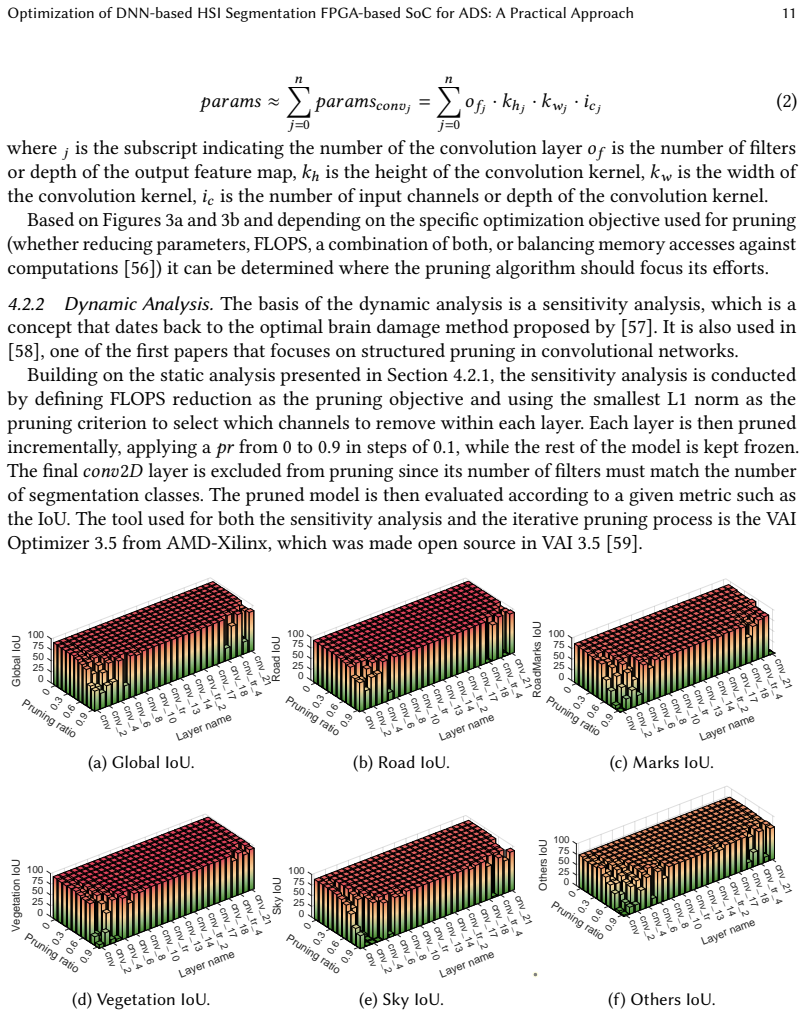
The load-bearing mechanism is the iterative structured pruning procedure. Static analysis identifies the convolution and transposed-convolution layers as essentially the whole computational cost, so the pruning objective is a target FLOPs reduction; dynamic analysis measures, for each convolutional layer, how class-level IoU degrades as that layer's channels are removed by smallest L1 norm while the rest of the network stays frozen. A constrained binary search then distributes the global pruning ratio into layer-specific ratios, locking any layer whose predicted degradation exceeds the user tolerance, and the surviving scheme is fine-tuned before another iteration begins. The same toolchain also performs INT8 quantization with batch-normalization folding, and the final preprocessing normalization is folded into a depthwise convolution so the accelerator can execute it.
What would settle it
Apply the reported two-iteration layer-specific pruning scheme (overall 0.75) to each of the other four stratified folds of HSI-Drive v2.0 and measure weighted IoU; if the mean falls more than about one point below the 88.40 uncompressed baseline, the single-layer sensitivity curves are miscalibrated for joint pruning.
Extended reading notes
Core claim
The central claim is that a U-Net for 25-band hyperspectral driving-scene segmentation can be reduced from 31.10 million parameters and 34.87 GFLOPs to 0.32 million parameters and 8.49 GFLOPs with negligible loss of segmentation quality, and that this reduction is achievable by iterating a post-training, structured channel-pruning procedure that combines a static analysis of per-layer FLOPs and parameter counts with a dynamic per-layer sensitivity analysis. Each convolutional layer is pruned one at a time using the smallest-L1-norm channels as the pruning criterion, and a constrained binary search assigns layer-specific pruning ratios that meet a global FLOPs target while keeping weighted IoU above a threshold. The paper reports that after two pruning iterations (overall ratio 0.75) and fine-tuning, weighted IoU is 88.37 versus 88.40 for the uncompressed INT8 model, and that the pruned model outperforms both one-time pruning at the same global ratio and shallower dense U-Nets trained from scratch.
Load-bearing premise
The pruning ratios come from sensitivity curves measured one layer at a time with the rest of the network frozen, and the method assumes those curves still predict accuracy when many layers are pruned together and then fine-tuned.
Editorial extensions
If this is right
- At an overall pruning ratio of 0.75 achieved in two iterations, the model keeps wIoU within 0.03 points of the uncompressed INT8 U-Net while cutting parameters by about 99% and operations by about 76%.
- Iterative pruning at a global ratio of 0.8 reaches wIoU 84.43, nearly one point higher than one-time pruning at 0.8 (83.51), and produces roughly half the parameters, because previously locked layers can be pruned again in the second iteration.
- Preprocessing, not inference, is the bottleneck: it takes about 2.5x the DPU latency in the single-stage design, and splitting it into two threads reduces the longest task by about 15%.
- Folding the final symmetric normalization into a depthwise convolution moves it onto the accelerator; requantization changes the winning class for only about 2% of pixels, mostly at class boundaries.
- Choosing the right DPU configuration and the two-iteration pruning together produce an 8.18x throughput improvement from worst-case to best-case configuration.
Reading between the lines
- A testable extension is to apply the same iterative scheme to the other four stratified folds of HSI-Drive v2.0; the paper reports fold 5 only, so the layer-specific ratios may be miscalibrated on other splits.
- The sensitivity analysis suggests structural conclusions the paper states only implicitly: layers feeding the skip connections are the least prunable in post-training pruning, which favors asymmetric encoder-heavy, decoder-light architectures.
- Because preprocessing dominates latency even after three-stage pipelining, further gains would likely come from offloading reflectance correction and demosaicing to programmable logic or fusing them into the network, an option the paper identifies but does not implement.
- The authors' comparison with pre-training pruning indicates that post-training iterative pruning is more robust across random initializations; a natural next experiment would be to combine the two, using pre-training to identify prunable architectures and post-training sensitivity to refine ratios.
Editorial analysis
A structured set of objections, weighed in public.
Referee Report
Summary. The paper presents a hardware/software co-design methodology for deploying a U-Net-based HSI segmentation pipeline on an AMD-Xilinx KV260 FPGA-based SoC. The contributions span raw-data preprocessing (cropping, reflectance correction, demosaicing, normalization) with careful memory-format management (BSQ-to-BIP), iterative post-training structured pruning guided by static and dynamic sensitivity analyses, post-training quantization, and a three-stage pipelined deployment. The authors report reducing the baseline U-Net from 31.10 M parameters and 34.87 GFLOPS to 0.32 M parameters and 8.49 GFLOPs (1.02% and 24.34% of the original, respectively) while maintaining a weighted IoU of 88.37 versus 88.40 for the FP32 baseline, and a 2.86x inference speed-up on the B4096 DPU configuration.
Significance. If the claims hold, this is a valuable practical contribution to embedded HSI segmentation for autonomous driving: it demonstrates that aggressive compression (structured pruning plus INT8 quantization) can be combined with a full preprocessing pipeline on a commercially available SoC, and it provides a reproducible algorithm (Algorithm 1) for iterative pruning. The paper is commendable for reporting internally consistent numbers (the abstract matches Table 3), for comparing against a state-of-the-art RGB model (Intern Image), and for including detailed deployment data (power, resource usage, throughput). The main limitation is the use of a single test fold both for pruning-ratio selection and for final evaluation, which weakens the generality of the accuracy-preservation claim.
major comments (2)
- [3.2, 4.2.3, Table 3] The central accuracy claim is not an independent evaluation because the same fold used for selecting pruning decisions is also used for reporting the final accuracy. Section 3.2 states that 'from now on... the results provided will correspond to the fifth fold'; Section 4.2.2 builds sensitivity curves from wIoU measured on that fold (Figures 4 and 5); Section 4.2.3 uses Algorithm 1 with thresholds to select layer-specific pruning ratios; and Table 3 rows are compared on the same fold to choose the 0.75 schedule. Therefore, the reported wIoU of 88.37 is a selection result rather than a hold-out result. For an ADS-oriented claim, the authors should evaluate the final compressed model on the remaining folds (or at least report per-fold results with the same pruning ratios) to substantiate 'no noticeable degradation'.
- [4.2.2-4.2.3] The sensitivity analysis prunes each layer independently while all other layers are frozen, and the constrained binary search in Algorithm 1 uses these independent curves to assign simultaneous layer-specific pruning ratios. This ignores possible interactions between concurrently pruned layers. The paper partially mitigates this concern by recomputing sensitivity on the pruned model (Figure 5b) and by comparing iterative versus one-time pruning at a global 0.8 ratio (Section 4.2.4). However, the final 0.75 schedule is still derived from independent-sensitivity data on the same fold. Providing at least one validation where the selected ratios are applied jointly and the wIoU is measured on a fold not used for selection (or comparing against a joint-sensitivity estimate) would substantially strengthen the method.
minor comments (7)
- [6.4] Section 6.4 contains a typo: 'his created three concurrent threads' should be 'This created three concurrent threads'.
- [4.2.4] Section 4.2.4 contains garbled notation: 'overallprof 0.99' and 'The prof the central area' should read 'overall pr' and 'The pr in the central area', respectively.
- [4.2.3] Section 4.2.3 has a typo: 'For an initialprof 0.5' should be 'For an initial pr of 0.5'.
- [4.2.1, Eq. (1)] Equation (1) includes the factor (1/4)^j on every term, but the text says this factor applies only to transposed conv2d layers. The equation should clarify that the factor is 1 for regular conv layers.
- [Table 3] The row labeled '0b' in Table 3 is ambiguous; the footnote says it corresponds to the depth-4 floating-point model from [53], but the label '0' could be mistaken for a pruning ratio of 0. Use a clearer label such as 'FP32 depth-4 [53]'.
- [1, 7] The paper claims that the optimization reduces inference operations by 'an order of magnitude' (Introduction and Conclusions), but the reported value is 24.34% of the original, i.e., a 4.1x reduction. Please revise the wording to 'roughly 4x' or clarify the basis of the order-of-magnitude claim.
- [4.2.3] The definition of 'locked layers' is confusing: layers with a pruning ratio of 0.9 are described as 'locked', yet the text later suggests they 'could have been further pruned'. Please rephrase to distinguish layers that are excluded from pruning from layers already pruned at the maximum ratio.
Circularity Check
No significant circularity: accuracy and speedup are measured outcomes, not derived from pruning targets; the fold-5 selection caveat is a statistical validity issue rather than a circular derivation.
full rationale
The paper's compression claim is an engineering report rather than a first-principles derivation. The reductions in parameters (to 1.02%) and operations (to 24.34%) are direct consequences of the user-set pruning target of 0.75 and the FLOPs-based pruning objective in Eq. 1, but the paper does not present these reductions as a prediction; it presents them as the achieved configuration. The load-bearing accuracy claim (wIoU 88.37 vs. baseline 88.40) and the 2.86x speedup are measured on the deployed model, not computed from the pruning ratios, so they are not equivalent to the inputs by construction. Self-citations to [17,18] for the public HSI-Drive v2.0 dataset, to [52] for the baseline architecture/training, and to [53] for quantization are independently published, and the paper's own Table 2 re-measures the quantization effect, so these citations are not load-bearing circularity. The one substantive caveat is that pruning ratios, including the second iteration ratio of 0.5, are selected using fold-5 wIoU (Sections 4.2.2-4.2.3, Algorithm 1), while the headline results are also reported for the fifth fold (Section 3.2). This means the 'no noticeable degradation' figure is not cross-fold independent and should be read as a selection-influenced result; however, that is a test-set selection and generalization weakness, not an input-output equivalence, so it does not constitute circularity under the stated rules.
Assumptions & free parameters
free parameters (7)
- Overall pruning ratio pr (first iteration) =
0.5
- Overall pruning ratio pr (second iteration) =
0.5
- wIoU tolerance threshold (ΔwIoU < 1) =
1 IoU point
- Layer wIoU tolerance (layer ΔwIoU < 0.25) =
0.25 IoU points
- Locked layers fraction threshold =
25%
- Finetuning epochs =
60
- Finetuning learning rate =
1e-6
assumptions (5)
- domain assumption The sensitivity analysis prunes each layer independently on a frozen model, and these per-layer curves predict the behavior of the jointly pruned, fine-tuned model.
- domain assumption Equations (1) and (2) approximate total FLOPS and parameters by ignoring non-convolutional layers, stated to be 0.21% and 0.08% of the total.
- domain assumption The VAI Optimizer 3.5 pruning tool implements channel pruning correctly and its FLOPS accounting matches the DPU workload.
- domain assumption The fifth test fold is representative of the dataset, so conclusions from pruning on fold 5 generalize.
- domain assumption The on-board preprocessing pipeline reproduces the training-time preprocessing closely enough that accuracy on HSI-Drive v2.0 images transfers to the DPU.
Cite this review
Pith. "Pith review of Optimization of DNN-based HSI Segmentation FPGA-based SoC for ADS: A Practical Approach." pith.science (2026). https://pith.science/paper/GEMTKCJY
@misc{pith2026250716556,
  author       = {Pith},
  title        = {Pith review of: Optimization of DNN-based HSI Segmentation FPGA-based SoC for ADS: A Practical Approach},
  year         = {2026},
  howpublished = {\url{https://pith.science/paper/GEMTKCJY}},
  note         = {Machine review of arXiv:2507.16556}
}
read the original abstract
The use of HSI for autonomous navigation is a promising research field aimed at improving the accuracy and robustness of detection, tracking, and scene understanding systems based on vision sensors. Combining advanced computer algorithms, such as DNNs, with small-size snapshot HSI cameras enhances the reliability of these systems. HSI overcomes intrinsic limitations of greyscale and RGB imaging in depicting physical properties of targets, particularly regarding spectral reflectance and metamerism. Despite promising results in HSI-based vision developments, safety-critical systems like ADS demand strict constraints on latency, resource consumption, and security, motivating the shift of ML workloads to edge platforms. This involves a thorough software/hardware co-design scheme to distribute and optimize the tasks efficiently among the limited resources of computing platforms. With respect to inference, the over-parameterized nature of DNNs poses significant computational challenges for real-time on-the-edge deployment. In addition, the intensive data preprocessing required by HSI, which is frequently overlooked, must be carefully managed in terms of memory arrangement and inter-task communication to enable an efficient integrated pipeline design on a SoC. This work presents a set of optimization techniques for the practical co-design of a DNN-based HSI segmentation processor deployed on a FPGA-based SoC targeted at ADS, including key optimizations such as functional software/hardware task distribution, hardware-aware preprocessing, ML model compression, and a complete pipelined deployment. Applied compression techniques significantly reduce the complexity of the designed DNN to 24.34% of the original operations and to 1.02% of the original number of parameters, achieving a 2.86x speed-up in the inference task without noticeable degradation of the segmentation accuracy.
Figures


Figures from the paper (12 more)


Reference graph
Works this paper leans on
-
[1]
Fully Convolutional Networks for Semantic Segmentation
Jonathan Long, Evan Shelhamer, and Trevor Darrell. Fully Convolutional Networks for Semantic Segmentation. In Proceedings of the IEEE Conference on Computer Vision and Pattern Recognition (CVPR), pages 3431–3440, 2015. doi: 10.1109/CVPR.2015.7298965
arXiv 2015
-
[2]
Yujian Mo, Yan Wu, Xinneng Yang, Feilin Liu, and Yujun Liao. Review the State-of-the-art Technologies of Semantic Segmentation Based on Deep Learning.Neurocomputing, 493:626–646, 2022. doi: 10.1016/j.neucom.2022.01.005
-
[3]
Deep Learning in Medical Hyperspectral Images: A Review.Sensors, 22(24):9790, 2022
Rong Cui, He Yu, Tingfa Xu, Xiaoxue Xing, Xiaorui Cao, Kang Yan, and Jiexi Chen. Deep Learning in Medical Hyperspectral Images: A Review.Sensors, 22(24):9790, 2022. doi: 10.3390/s22249790
-
[4]
Anton Terentev, Viktor Dolzhenko, Alexander Fedotov, and Danila Eremenko. Current State of Hyperspectral Remote Sensing for Early Plant Disease Detection: A Review.Sensors, 22(3):757, 2022. doi: 10.3390/s22030757
-
[5]
Gözde Özdoğan, Xiaohui Lin, and Da-Wen Sun. Rapid and Noninvasive Sensory Analyses of Food Products by Hyperspectral Imaging: Recent Application Developments.Trends in Food Science & Technology, 111:151–165, 2021. doi: 10.1016/j.tifs.2021.02.044
-
[6]
David H Foster, Kinjiro Amano, Sérgio MC Nascimento, and Michael J Foster. Frequency of Metamerism in Natural Scenes.Journal of the Optical Society of America A, 23(10):2359–2372, 2006. doi: 10.1364/JOSAA.23.002359
-
[7]
Victoria Martínez, Unai Martinez-Corral, Óscar Mata- Carballeira, and Inés del Campo
Jon Gutiérrez-Zaballa, Koldo Basterretxea, Javier Echanobe, M. Victoria Martínez, Unai Martinez-Corral, Óscar Mata- Carballeira, and Inés del Campo. On-chip Hyperspectral Image Segmentation With Fully Convolutional Networks For Scene Understanding in Autonomous Driving.Journal of Systems Architecture, 139:102878, 2023. ISSN 1383-7621. doi: 10.1016/j.sysar...
arXiv 2023
-
[8]
Nathaniel Hanson, Benjamin Pyatski, Samuel Hibbard, Charles DiMarzio, and Taşkın Padır. Hyper-Drive: Visible-Short Wave Infrared Hyperspectral Imaging Datasets for Robots in Unstructured Environments. In2023 13th Workshop on Hyperspectral Imaging and Signal Processing: Evolution in Remote Sensing (WHISPERS), pages 1–5. IEEE, 2023. doi: 10.1109/WHISPERS614...
arXiv 2023
Show all 64 references
-
[9]
Point-Supervised Semantic Segmentation of Natural Scenes via Hyperspectral Imaging
Tianqi Ren, Qiu Shen, Ying Fu, and Shaodi You. Point-Supervised Semantic Segmentation of Natural Scenes via Hyperspectral Imaging. InProceedings of the IEEE/CVF Conference on Computer Vision and Pattern Recognition Workshops (CVPRW), pages 1357–1367, 2024. doi: 10.1109/CVPRW63...
2024
-
[10]
A Tiny VIS-NIR Snapshot Multi- spectral Camera
Bert Geelen, Carolina Blanch, Pilar Gonzalez, Nicolaas Tack, and Andy Lambrechts. A Tiny VIS-NIR Snapshot Multi- spectral Camera. In Georg von Freymann, Winston V. Schoenfeld, Raymond C. Rumpf, and Henry Helvajian, editors, Advanced Fabrication Technologies for Micro/Nano Opti...
2015 doi
-
[11]
Accurate Video-Rate Multi-Spectral Imaging Using IMEC Snapshot Sensors
Kathleen Vunckx and Wouter Charle. Accurate Video-Rate Multi-Spectral Imaging Using IMEC Snapshot Sensors. In 2021 11th Workshop on Hyperspectral Imaging and Signal Processing: Evolution in Remote Sensing (WHISPERS), pages 1–7, 2021. doi: 10.1109/WHISPERS52202.2021.9483975
2021
-
[12]
A Compact Snapshot Multispectral Imager with A Monolithically Integrated Per-pixel Filter Mosaic
Bert Geelen, Nicolaas Tack, and Andy Lambrechts. A Compact Snapshot Multispectral Imager with A Monolithically Integrated Per-pixel Filter Mosaic. In Georg von Freymann, Winston V. Schoenfeld, and Raymond C. Rumpf, editors, Advanced Fabrication Technologies for Micro/Nano Opti...
2014 doi
-
[13]
Kria K26 SOM: The Ideal Platform for Vision AI at the Edge
AMD-Xilinx. Kria K26 SOM: The Ideal Platform for Vision AI at the Edge. https://docs.xilinx.com/v/u/en-US/wp529- som-benchmarks, 2021
2021
-
[14]
Kria K26 SOM Data Sheet (DS987)
AMD-Xilinx. Kria K26 SOM Data Sheet (DS987). https://docs.amd.com/r/en-US/ds987-k26-som/Overview, 2024
2024
-
[15]
Arm Cortex-A53 MPCore Processor Technical Reference Manual
ARM. Arm Cortex-A53 MPCore Processor Technical Reference Manual. https://developer.arm.com/documentation/ ddi0500, 2018. Accessed: 2024-11-08
2018
-
[16]
DPUCZDX8G for Zynq UltraScale+ MPSoCs Product Guide (PG338)
Xilinx. DPUCZDX8G for Zynq UltraScale+ MPSoCs Product Guide (PG338). https://https://docs.xilinx.com/r/en- US/pg338-dpu?tocId=3xsG16y_QFTWvAJKHbisEw, 2024
2024
-
[17]
HSI-Drive v2.0: More Data for New Challenges in Scene Understanding for Autonomous Driving
Jon Gutiérrez-Zaballa, Koldo Basterretxea, Javier Echanobe, M Victoria Martínez, and Unai Martinez-Corral. HSI-Drive v2.0: More Data for New Challenges in Scene Understanding for Autonomous Driving. In2023 IEEE Symposium Series on Computational Intelligence (SSCI), pages 207–2...
2023
-
[18]
Hsi -drive, 2023
Koldo Basterretxea, Jon Gutiérrez -Zaballa, Javier Echanobe, and María Victoria Martínez. Hsi -drive, 2023. URL https://doi.org/10.5281/zenodo.15686957
2023 doi
-
[19]
U-Net: Convolutional Networks for Biomedical Image Segmenta- tion
Olaf Ronneberger, Philipp Fischer, and Thomas Brox. U-Net: Convolutional Networks for Biomedical Image Segmenta- tion. InMedical Image Computing and Computer-assisted Intervention–MICCAI 2015: 18th International Conference, Munich, Germany, October 5-9, 2015, Proceedings, Part...
2015 doi
-
[20]
HyKo: A Spectral Dataset for Scene Understanding
Christian Winkens, Florian Sattler, Veronika Adams, and Dietrich Paulus. HyKo: A Spectral Dataset for Scene Understanding. InProceedings of the IEEE International Conference on Computer Vision Workshops (ICCVW), pages 254–261, 2017. doi: 10.1109/ICCVW.2017.39
2017 doi
-
[21]
HS3-Bench: A Benchmark and Strong Baseline for Hyperspectral Semantic Segmentation in Driving Scenarios
Nick Theisen, Robin Bartsch, Dietrich Paulus, and Peer Neubert. HS3-Bench: A Benchmark and Strong Baseline for Hyperspectral Semantic Segmentation in Driving Scenarios. In2024 IEEE/RSJ International Conference on Intelligent Robots and Systems (IROS), pages 5895–5901. IEEE, 20...
2024
- [22]
-
[23]
HSICityV2: Urban Scene Understanding via Hyper- spectral Images, Jul 2021
Yuxing Huang, Tianqi Ren, Qiu Shen, Ying Fu, and Shaodi You. HSICityV2: Urban Scene Understanding via Hyper- spectral Images, Jul 2021
2021
-
[24]
Hsi Road: A Hyper Spectral Image Dataset for Road Segmentation
Jiarou Lu, Huafeng Liu, Yazhou Yao, Shuyin Tao, Zhenming Tang, and Jianfeng Lu. Hsi Road: A Hyper Spectral Image Dataset for Road Segmentation. In2020 IEEE International Conference on Multimedia and Expo (ICME), pages 1–6. IEEE,
-
[25]
Basterretxea, V
K. Basterretxea, V. Martínez, J. Echanobe, J. Gutiérrez–Zaballa, and I. Del Campo. HSI-Drive: A Dataset for the Research of Hyperspectral Image Processing Applied to Autonomous Driving Systems. In2021 IEEE Intelligent Vehicles Symposium (IV), pages 866–873, 2021. doi: 10.1109/...
2021
-
[26]
The Cityscapes Dataset for Semantic Urban Scene Understanding
Marius Cordts, Mohamed Omran, Sebastian Ramos, Timo Rehfeld, Markus Enzweiler, Rodrigo Benenson, Uwe Franke, Stefan Roth, and Bernt Schiele. The Cityscapes Dataset for Semantic Urban Scene Understanding. InProceedings of the IEEE Conference on Computer Vision and Pattern Recog...
2016 doi
-
[28]
Semantic Object Classes in Video: A High-definition Ground Truth Database.Pattern Recognition Letters, 30(2):88–97, 2009
Gabriel J Brostow, Julien Fauqueur, and Roberto Cipolla. Semantic Object Classes in Video: A High-definition Ground Truth Database.Pattern Recognition Letters, 30(2):88–97, 2009. doi: 10.1016/j.patrec.2008.04.005
2009 doi
-
[29]
The Mapillary Vistas Dataset for Semantic Understanding of Street Scenes
Gerhard Neuhold, Tobias Ollmann, Samuel Rota Bulo, and Peter Kontschieder. The Mapillary Vistas Dataset for Semantic Understanding of Street Scenes. InProceedings of the IEEE International Conference on Computer Vision (ICCV), pages 4990–4999, 2017. doi: 10.1109/ICCV.2017.534
2017 doi
-
[30]
The ApolloScape Dataset for Autonomous Driving
Xinyu Huang, Xinjing Cheng, Qichuan Geng, Binbin Cao, Dingfu Zhou, Peng Wang, Yuanqing Lin, and Ruigang Yang. The ApolloScape Dataset for Autonomous Driving. InProceedings of the IEEE/CVF Conference on Computer Vision and Pattern Recognition (CVPR), pages 954–960, 2018. doi: 1...
2018
-
[32]
Cityscapes Dataset Benchmarks, 2024
Cityscapes Dataset. Cityscapes Dataset Benchmarks, 2024. URL https://www.cityscapes-dataset.com/benchmarks/. Accessed: September 16, 2024
2024
-
[33]
Strong but simple: A Baseline for Domain Generalized Dense Perception by CLIP-based Transfer Learning.arXiv, 2023
Christoph Hümmer, Manuel Schwonberg, Liangwei Zhong, Hu Cao, Alois Knoll, and Hanno Gottschalk. Strong but simple: A Baseline for Domain Generalized Dense Perception by CLIP-based Transfer Learning.arXiv, 2023. doi: 10.48550/arXiv.2312.02021
-
[34]
To Prune, or Not to Prune: Exploring the Efficacy of Pruning for Model Compression
Michael Zhu and Suyog Gupta. To Prune, or Not to Prune: Exploring the Efficacy of Pruning for Model Compression. arXiv, 2017. doi: 10.48550/arXiv.1710.01878. , Vol. 1, No. 1, Article . Publication date: September 2025. 26 Gutiérrez-Zaballa et al
-
[35]
A Dynamic CNN Pruning Method Based on Matrix Similarity.Signal, Image and Video Processing, 15:381–389, 2021
Mingwen Shao, Junhui Dai, Jiandong Kuang, and Deyu Meng. A Dynamic CNN Pruning Method Based on Matrix Similarity.Signal, Image and Video Processing, 15:381–389, 2021. doi: 10.1007/s11760-020-01760-x
2021 doi
-
[36]
Importance Estimation for Neural Network Pruning
Pavlo Molchanov, Arun Mallya, Stephen Tyree, Iuri Frosio, and Jan Kautz. Importance Estimation for Neural Network Pruning. InProceedings of the IEEE/CVF Conference on Computer Vision and Pattern Recognition (CVPR), pages 11264– 11272, 2019. doi: 10.1109/CVPR.2019.01152
2019
-
[37]
Optimal Brain Compression: A Framework for Accurate Post-Training Quantization and Pruning
Elias Frantar and Dan Alistarh. Optimal Brain Compression: A Framework for Accurate Post-Training Quantization and Pruning. In S. Koyejo, S. Mohamed, A. Agarwal, D. Belgrave, K. Cho, and A. Oh, editors,Advances in Neural Information Processing Systems, volume 35, pages 4475–44...
2022
-
[38]
A Fast Post- Training Pruning Framework for Transformers
Woosuk Kwon, Sehoon Kim, Michael W Mahoney, Joseph Hassoun, Kurt Keutzer, and Amir Gholami. A Fast Post- Training Pruning Framework for Transformers. In S. Koyejo, S. Mohamed, A. Agarwal, D. Belgrave, K. Cho, and A. Oh, editors,Advances in Neural Information Processing Systems...
2022
-
[39]
Plug-and-play: An Efficient Post-training Pruning Method for Large Language Models
Yingtao Zhang, Haoli Bai, Haokun Lin, Jialin Zhao, Lu Hou, and Carlo Vittorio Cannistraci. Plug-and-play: An Efficient Post-training Pruning Method for Large Language Models. InThe Twelfth International Conference on Learning Representations, 2024
2024
- [40]
- [41]
-
[42]
Deconstructing Lottery Tickets: Zeros, Signs, and the Supermask.Advances in Neural Information Processing Systems, 32, 2019
Hattie Zhou, Janice Lan, Rosanne Liu, and Jason Yosinski. Deconstructing Lottery Tickets: Zeros, Signs, and the Supermask.Advances in Neural Information Processing Systems, 32, 2019
2019
-
[43]
What’s Hidden in A Randomly Weighted Neural Network? InProceedings of the IEEE/CVF Conference on Computer Vision and Pattern Recognition (CVPR), pages 11893–11902, 2020
Vivek Ramanujan, Mitchell Wortsman, Aniruddha Kembhavi, Ali Farhadi, and Mohammad Rastegari. What’s Hidden in A Randomly Weighted Neural Network? InProceedings of the IEEE/CVF Conference on Computer Vision and Pattern Recognition (CVPR), pages 11893–11902, 2020. doi: 10.1109/C...
2020
-
[44]
Proving the Lottery Ticket Hypothesis: Pruning is All You Need
Eran Malach, Gilad Yehudai, Shai Shalev-Schwartz, and Ohad Shamir. Proving the Lottery Ticket Hypothesis: Pruning is All You Need. InInternational Conference on Machine Learning, pages 6682–6691. PMLR, 2020
2020
-
[45]
A Comprehensive Review of Network Pruning Based on Pruning Granularity and Pruning Time Perspectives.Neurocomputing, page 129382, 2025
Kehan Zhu, Fuyi Hu, Yuanbing Ding, Wei Zhou, and Ruxin Wang. A Comprehensive Review of Network Pruning Based on Pruning Granularity and Pruning Time Perspectives.Neurocomputing, page 129382, 2025. doi: 10.1016/j. neucom.2025.129382
2025
-
[46]
A Survey on Deep Neural Network Pruning: Taxonomy, Comparison, Analysis, and Recommendations.IEEE Transactions on Pattern Analysis and Machine Intelligence, 2024
Hongrong Cheng, Miao Zhang, and Javen Qinfeng Shi. A Survey on Deep Neural Network Pruning: Taxonomy, Comparison, Analysis, and Recommendations.IEEE Transactions on Pattern Analysis and Machine Intelligence, 2024. doi: 10.1109/TPAMI.2024.3447085
2024
-
[47]
Auto-compressing Subset Pruning for Semantic Image Segmentation
Konstantin Ditschuneit and Johannes S Otterbach. Auto-compressing Subset Pruning for Semantic Image Segmentation. InDAGM German Conference on Pattern Recognition, pages 20–35. Springer, 2022. doi: 10.1007/978-3-031-16788-1_2
2022 doi
-
[48]
Finding Lottery Tickets in Vision Models via Data-driven Spectral Foresight Pruning
Leonardo Iurada, Marco Ciccone, and Tatiana Tommasi. Finding Lottery Tickets in Vision Models via Data-driven Spectral Foresight Pruning. InProceedings of the IEEE/CVF Conference on Computer Vision and Pattern Recognition (CVPR), pages 16142–16151, 2024. doi: 10.1109/CVPR52733...
2024
-
[49]
STAMP: Simultaneous Training and Model Pruning for Low Data Regimes in Medical Image Segmentation.Medical Image Analysis, 81:102583, 2022
Nicola K Dinsdale, Mark Jenkinson, and Ana IL Namburete. STAMP: Simultaneous Training and Model Pruning for Low Data Regimes in Medical Image Segmentation.Medical Image Analysis, 81:102583, 2022. doi: 10.1016/j.media.2022. 102583
2022 doi
-
[50]
Dynamically Pruning Segformer for Efficient Semantic Segmentation
Haoli Bai, Hongda Mao, and Dinesh Nair. Dynamically Pruning Segformer for Efficient Semantic Segmentation. In ICASSP 2022-2022 IEEE International Conference on Acoustics, Speech and Signal Processing (ICASSP), pages 3298–3302. IEEE, 2022. doi: 10.1109/ICASSP43922.2022.9747634
2022
-
[51]
Pruning Parameterization with Bi-level Optimization for Efficient Semantic Segmentation on the Edge
Changdi Yang, Pu Zhao, Yanyu Li, Wei Niu, Jiexiong Guan, Hao Tang, Minghai Qin, Bin Ren, Xue Lin, and Yanzhi Wang. Pruning Parameterization with Bi-level Optimization for Efficient Semantic Segmentation on the Edge. In Proceedings of the IEEE/CVF Conference on Computer Vision ...
2023
-
[52]
Evaluating Single Event Upsets in Deep Neural Networks for Semantic Segmentation: An Embedded System Perspective.Journal of Systems Architecture, 154:103242,
Jon Gutiérrez-Zaballa, Koldo Basterretxea, and Javier Echanobe. Evaluating Single Event Upsets in Deep Neural Networks for Semantic Segmentation: An Embedded System Perspective.Journal of Systems Architecture, 154:103242,
-
[53]
Victoria Martínez
Jon Gutiérrez-Zaballa, Koldo Basterretxea, Javier Echanobe, Óscar Mata-Carballeira, and M. Victoria Martínez. Rapid Deployment of Domain-specific Hyperspectral Image Processors with Application to Autonomous Driving. In2023 30th IEEE International Conference on Electronics, Ci...
2023
-
[54]
Learn the Architecture: Introducing Neon
ARM. Learn the Architecture: Introducing Neon. https://developer.arm.com/documentation/102474/0100/?lang=en,
-
[55]
Deep Learning with INT8 Optimization on Xilinx Devices
Yao Fu, Ephrem Wu, Ashish Sirasao, Sedny Attia, Kamran Khan, and Ralph Wittig. Deep Learning with INT8 Optimization on Xilinx Devices. https://docs.xilinx.com/v/u/en-US/wp486-deep-learning-int8, 2016
2016
-
[56]
Shift: A Zero Flop, Zero Parameter Alternative to Spatial Convolutions
Bichen Wu, Alvin Wan, Xiangyu Yue, Peter Jin, Sicheng Zhao, Noah Golmant, Amir Gholaminejad, Joseph Gonzalez, and Kurt Keutzer. Shift: A Zero Flop, Zero Parameter Alternative to Spatial Convolutions. InProceedings of the IEEE/CVF Conference on Computer Vision and Pattern Recog...
2018
-
[57]
Accessed: 2024-11-08. , Vol. 1, No. 1, Article . Publication date: September 2025. Optimization of DNN-based HSI Segmentation FPGA-based SoC for ADS: A Practical Approach 27
2024
-
[58]
Pruning Filters for Efficient ConvNets, 2017
Hao Li, Asim Kadav, Igor Durdanovic, Hanan Samet, and Hans Peter Graf. Pruning Filters for Efficient ConvNets, 2017
2017
-
[59]
Vitis AI User Guide
AMD-Xilinx. Vitis AI User Guide. UG1414 (v3.5) September 28, 2023. https://docs.xilinx.com/r/en-US/ug1414-vitis- ai/Vitis-AI-Overview, 2023
2023
-
[60]
Optimal Brain Damage
Yann LeCun, John Denker, and Sara Solla. Optimal Brain Damage. In D. Touretzky, editor,Advances in Neural Information Processing Systems, volume 2. Morgan-Kaufmann, 1989
1989
-
[61]
Encoder-decoder with Atrous Separable Convolution for Semantic Image Segmentation
Liang-Chieh Chen, Yukun Zhu, George Papandreou, Florian Schroff, and Hartwig Adam. Encoder-decoder with Atrous Separable Convolution for Semantic Image Segmentation. InProceedings of the European Conference on Computer Vision (ECCV), pages 801–818, 2018. doi: 10.1007/978-3-030...
2018 doi
-
[62]
OpenMP: An Industry Standard API for Shared-memory Programming.IEEE Computational Science and Engineering, 5(1):46–55, 1998
Leonardo Dagum and Ramesh Menon. OpenMP: An Industry Standard API for Shared-memory Programming.IEEE Computational Science and Engineering, 5(1):46–55, 1998. doi: 10.1109/99.660313
1998 doi
-
[63]
Real-time Semantic Image Segmentation with Deep Learning for Autonomous Driving: A Survey.Applied Sciences, 11(19):8802, 2021
Ilias Papadeas, Lazaros Tsochatzidis, Angelos Amanatiadis, and Ioannis Pratikakis. Real-time Semantic Image Segmentation with Deep Learning for Autonomous Driving: A Survey.Applied Sciences, 11(19):8802, 2021. doi: 10.3390/app11198802
2021 doi
-
[66]
Addison-Wesley Professional, 1997
David R Butenhof.Programming with POSIX Threads. Addison-Wesley Professional, 1997. , Vol. 1, No. 1, Article . Publication date: September 2025
1997
-
[2020]
doi: 10.1109/ICME46284.2020.9102890
2020
-
[2024]
doi: 10.1016/j.sysarc.2024.103242
2024
Reviewed August 6, 2026 · model on record in the stance chip above.
Discussion (0). Continue with ORCID to comment.