REVIEW 4 major objections 4 minor 56 references
Comparing two scientific PDFs is best done by aligning typed elements first, then diffing each type in its own representation.
Reviewed by Pith at T0; open to challenge. T0 means a machine referee read the full paper against a public rubric. the ladder, T0–T4 →
T0 review · deepseek-v4-flash
2026-08-02 14:34 UTC pith:GFTZSTAP
load-bearing objection Solid alignment-first document-diff framework with honest ablations, but the headline comparison rests on an unspecified baseline-projection step, so the numbers are conditional until the appendix and data ship. the 4 major comments →
Heterogeneous Element-Aware Cross-Version Differencing of Scientific Documents via Layout-Aware Alignment and Structure-Aware Reasoning
The pith
A machine-rendered reading of the paper's core claim, the machinery that carries it, and where it could break.
Core claim
Prior methods fail, the paper argues, because they compare in the wrong space: text diff discards layout and element boundaries, image diff discards semantics. The alternative represents each document as a set of typed elements e=(b,c,s,t) and insists on cross-version alignment before any comparison. Alignment picks, for each element in version A, the element in version B that maximizes a type-specific score of location, content, and structural compatibility; unmatched elements are insertions or deletions. Difference reasoning then runs only over aligned pairs: typography-aware span comparison for text, cell-and-topology comparison for tables, symbolic-or-tree comparison for formulas, region
What carries the argument
The load-bearing object is the typed element representation plus the alignment score that pairs elements across versions. Each element e=(b,c,s,t) carries a spatial bounding box, a content representation, a structure-aware representation (with typography cues for text), and a semantic type. The alignment score Φk combines location compatibility, content similarity, and structural compatibility with type-specific weights λk; the aligned counterpart of an element is the candidate with maximal score, kept only if the score clears a type-specific threshold. This one-to-one mapping is the mechanism that reduces spurious differences from reflow and relocation, and it is also the paper's identified
Load-bearing premise
The reported gains rest on two linked assumptions: that real revisions are mostly one-to-one element correspondences, and that every baseline's output can be projected into the framework's evaluation space without systematically distorting the baseline's native strengths.
What would settle it
Compile a public benchmark of cross-version scientific PDFs that includes paragraph splits/merges, cross-page tables, and table reformatting, and measure detection F1 with ground-truth correspondences. If a many-to-many-aware baseline matches or exceeds the reported 0.85–0.90 F1, the one-to-one alignment premise is the bottleneck; separately, scoring each method with its own native output format (e.g., a table-cell diff's own cell-level output) would reveal whether the framework's metric projection inflates its advantage.
If this is right
- Alignment is the main lever: removing it drops matching F1 from 0.859 to 0.692 and detection F1 from 0.866 to 0.779, so any document-diff system should allocate effort to matching before comparison.
- A single generic representation cannot serve all elements: removing type-specific representations drops detection F1 to 0.811, and tables and formulas specifically need structural compatibility terms for reliable matching.
- Structure-aware reasoning changes the output from 'changed or not' to 'what kind of change': structure similarity for tables rises from 0.716 to 0.833 and structure consistency for formulas from 0.797 to 0.877 over the strongest baselines.
- Typography cues are real revision signals: font, size, bold/italic, and superscript/subscript changes are captured, and dropping them lowers structure consistency by about 0.03.
- A single pipeline can report detection, localization, structure awareness, and alignment quality across text, tables, formulas, and figures because all outputs are projected into one evaluation space.
Where Pith is reading between the lines
- Beyond the paper's claims: if one-to-one alignment were replaced with many-to-many or graph-based matching, the single largest error class (27.4%) could be substantially reduced; the paper already names this as future work.
- An independent benchmark that scores each method by its own native output — rather than by projection into the proposed framework's evaluation space — would clarify how much of the reported gain is genuine differencing ability and how much comes from the metric mapping.
- The architecture is built from interchangeable components (layout detector, table parser, formula parser, visual features), so the same alignment-first recipe should transfer to other structured formats such as Word, HTML, XML, or LaTeX source with minimal redesign.
- If the recipe transfers, it could also apply to non-scientific documents with typed elements — legal contracts, patents, regulatory filings — where layout reflow currently produces many false positives in text-only diff tools.
Editorial analysis
A structured set of objections, weighed in public.
Referee Report
Summary. The paper proposes a three-stage framework for cross-version differencing of scientific PDFs: layout-aware decomposition into typed elements (text, table, formula, figure), alignment-first correspondence modeling via a weighted combination of location/content/structure compatibility, and type-aware difference reasoning that outputs change detection, localization, structure-awareness, and alignment/matching quality. The authors evaluate on a proprietary dataset drawn from journal production proofreading workflows, comparing against element-specific baselines and reporting improvements on all four element types across the four evaluation dimensions. The paper also includes module-level ablations, alignment ablations, parameter sensitivity analyses, and an error-pattern analysis. The central claim is that a heterogeneous, element-aware, alignment-first pipeline consistently outperforms existing text-based, image-based, and element-specific baselines in realistic editorial production scenarios.
Significance. If the empirical claim holds, the framework is a practical and interpretable solution for an important real-world task, and the unified evaluation protocol is a useful contribution. Strengths of the paper include the internal consistency of the reported numbers: the per-type F1 scores in Table 2 macro-average exactly to the full-model values in Table 5, and the ablation directions are credible. The use of real production proofreading data is a positive. However, the comparative claim is entirely empirical, and its validity depends on details that are not present in the submitted manuscript: the baseline-output projection protocol, the dataset construction and annotation protocol, and the metric definitions are all deferred to appendices that are absent. The one-to-one alignment assumption is acknowledged by the authors as the largest error source, which tempers the generality of the claim. The significance should be judged after the missing evaluation details are supplied.
major comments (4)
- [§5.1, Table 2] The central comparative claim relies on the assertion that 'all baseline outputs are projected into the same evaluation space through deterministic post-processing based on their predicted matches, changed units, and recovered element attributes.' This mapping is defined only in Appendix C, which is absent. Many baselines (e.g., TextDiff edit scripts, ImageDiff pixel differences, SSIMDiff) do not natively emit element-level structure or alignment attributes, so the post-processing must reconstruct information the baselines never produce. If that reconstruction is lossy or implicitly implements the proposed framework's logic, the reported margins (e.g., text Det-F1 0.903 vs. 0.829; table Str-Sim 0.833 vs. 0.716) could be artifacts of the metric mapping rather than genuine differencing superiority. The appendix must be supplied, with formal definitions and examples showing how each baselin
- [§5.1, Appendix A/B] The dataset is central to the empirical claim but is described only as real-world data from 'our enterprise system'; the detailed construction procedure, statistics, discipline distribution, annotation protocol, and split details are in absent Appendix A. Similarly, the implementation settings in Table 1 are useful, but full software versions, detector fine-tuning details, and hyperparameter settings are deferred to absent Appendix B. No code or data is released. This makes the central comparative result impossible to reproduce or independently audit. At minimum, the appendices must be included in the submission, and the data-sharing situation should be stated explicitly.
- [§4.3, Eq. (5), Fig. 3] The alignment Eq. (5) independently selects the arg-max target for each source element without a global injectivity constraint, so the claimed 'one-to-one correspondence' is not guaranteed by the formulation; many-to-one assignments can occur. The paper's own error analysis identifies many-to-many correspondence as the largest error source (27.4%, Fig. 3). The evaluation protocol (Appendix C) does not clarify how many-to-many ground-truth cases are handled or how alignment accuracy and matching F1 are computed for split/merged elements. This is a limitation the authors acknowledge in the Discussion, but it affects the interpretation of the alignment-quality numbers and the robustness claim for production scenarios. Please specify the exact scope of the current evaluation and, if possible, provide subset results for one-to-one versus many-to-many cases.
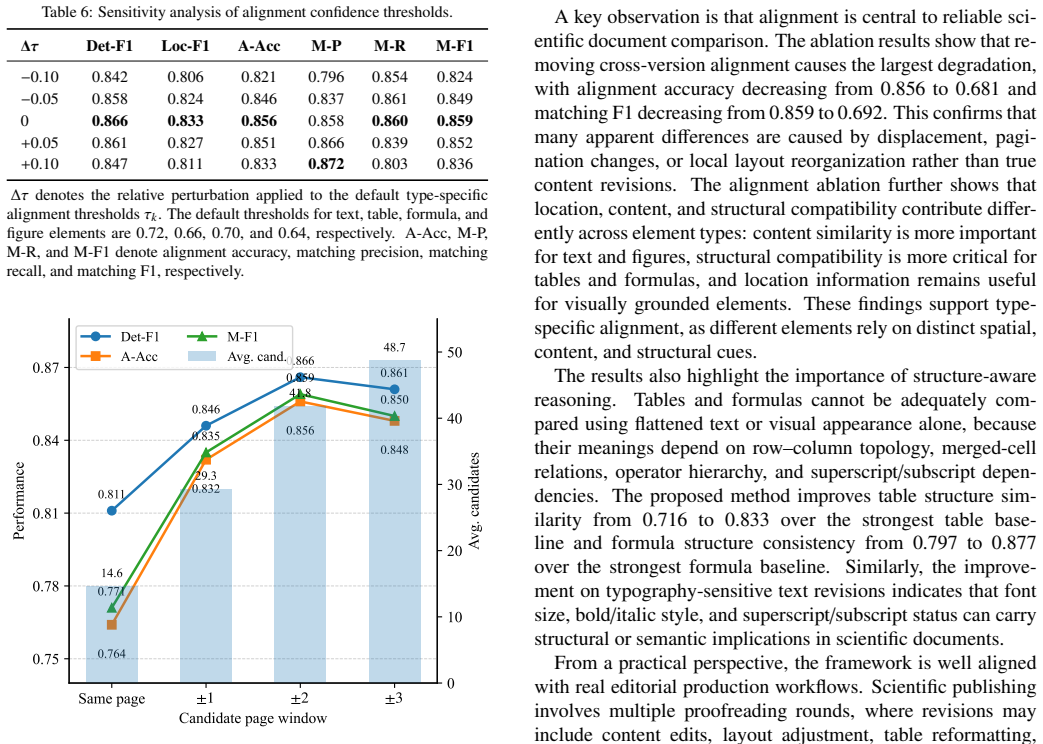
- [§5.1, §5.4, Table 6] The type-specific alignment weights and confidence thresholds are selected on the validation set, and the default setting is shown to be the best in the sensitivity analysis. However, the validation set composition and size are not described, and there is no indication of whether the baselines received a comparable hyperparameter search on the same validation set. Unequal tuning is a known source of bias in comparative evaluations. Please report the validation-set characteristics and describe the tuning procedure used for the baselines so that the comparison is demonstrably fair.
minor comments (4)
- [Figures 3–6] The figure labels and legends appear corrupted in the submission, with many entries shown as '/uni00000013/...' glyph sequences. The captions state what the figures should show, but the actual labels are unreadable, making figures 3–6 not interpretable. Please regenerate the figures with proper text rendering.
- [Throughout] There are frequent spacing artifacts in words such as 'di fferencing,' 'e ffective,' and 'V ol.' These may be PDF-extraction artifacts, but the manuscript text should be cleaned before final submission.
- [§5.1, Table 2] The note under Table 2 explains N/A entries, but it would help to state explicitly which metrics are excluded from the macro-averaging in Table 5 and whether the macro-average is over all four element types or only those with non-N/A values for each metric.
- [§6] The Discussion lists limitations that are also identified in the error analysis; it would be helpful to quantify the proportion of test elements affected by each limitation and to state whether the reported metrics are computed only on one-to-one cases or on all cases.
Circularity Check
No circular derivation: the system is an evaluated pipeline, not a prediction derived from its own fitted inputs.
full rationale
The paper's claims are empirical and comparative. The proposed framework is a three-stage pipeline (decomposition, alignment, reasoning), with compatibility weights and thresholds selected on a validation set and fixed on a held-out test set; detection, localization, structure-awareness, and alignment metrics are computed against annotated ground truth (Sec. 5.1). There is no equation in which an output quantity is defined in terms of the quantity it is said to predict, and no fitted parameter is renamed as a prediction. Ablations (Table 5, Fig. 4) and sensitivity analyses (Fig. 5, Table 6, Fig. 6) quantify the contribution of each component against the same external test data, which is independent evidence rather than circular support. The only load-bearing risk is evaluation fairness: baseline outputs are 'projected into the same evaluation space through deterministic post-processing based on their predicted matches, changed units, and recovered element attributes' (Sec. 5.1), and the mapping is deferred to an absent Appendix C. That is a reproducibility/fairness caveat, not a circular reduction, because no baseline or proposed-method score is constructed from its own target. The one self-citation ([13], used alongside external PubLayNet [12] to motivate structure-preserving table representations in Sec. 1) is incidental and not load-bearing. No uniqueness theorem, ansatz-by-citation, or definitional equivalence is invoked. Score 0.
Axiom & Free-Parameter Ledger
free parameters (4)
- Type-specific alignment weights λ_k (location/content/structure) =
text (0.20,0.60,0.20); table (0.15,0.35,0.50); formula (0.10,0.35,0.55); figure (0.25,0.60,0.15)
- Type-specific alignment confidence thresholds τ_k =
text 0.72; table 0.66; formula 0.70; figure 0.64
- Candidate page window and top-K retrieval =
±2 pages; K=50
- Layout detector operating points =
input 1280×1280; confidence 0.25; max 300 proposals/page
axioms (4)
- domain assumption Scientific documents decompose cleanly into four semantic element types (text, table, formula, figure) with detectable boundaries.
- domain assumption A one-to-one mapping A_k exists for most cross-version element pairs.
- domain assumption Ground-truth annotations derived from production proofreading workflows are correct and complete.
- ad hoc to paper Baseline outputs can be faithfully mapped into the proposed four-dimensional evaluation space without systematic bias.
read the original abstract
Cross-version differencing of scientific documents is essential in scholarly publishing and technical documentation, but remains challenging because scientific documents are page-structured artifacts containing heterogeneous elements such as text, tables, formulas, figures, and layout cues. Existing text-sequence-based methods often lose layout and structural information, while image-based methods lack semantic interpretability and are sensitive to rendering variation. To address these limitations, this paper proposes a layout-aware heterogeneous element-aware framework for scientific document differencing. The framework decomposes document versions into semantically typed elements, establishes cross-version correspondence through an alignment-first mechanism that jointly models spatial, content, and structural compatibility, and performs type-aware difference reasoning over aligned element pairs. It supports unified change detection, localization, structure-awareness analysis, and alignment/matching evaluation across text, tables, formulas, and figures. Experiments on real-world scientific PDF data from journal production proofreading workflows show that the proposed framework consistently outperforms element-specific baselines. It achieves detection F1 scores of 0.903, 0.855, 0.862, and 0.845 for text, tables, formulas, and figures, respectively, with further improvements in localization, structure awareness, and matching quality. Ablation and sensitivity analyses confirm the effectiveness of cross-version alignment, type-specific representations, structure-aware reasoning, and compatibility-weight design. These results demonstrate that heterogeneous element-aware differencing provides a robust and interpretable solution for scientific document comparison in realistic editorial production scenarios.
Figures


Reference graph
Works this paper leans on
-
[1]
A. K. Pun, M. Javed, D. S. Doermann, A survey on change detection techniques in document images, arXiv preprint arXiv:2307.07691 (2023). doi:10.48550/arXiv.2307.07691
work page internal anchor Pith review Pith/arXiv arXiv doi:10.48550/arxiv.2307.07691 2023
-
[2]
R. Xia, S. Mao, X. Yan, H. Zhou, B. Zhang, H. Peng, J. Pi, D. Fu, W. Wu, H. Ye, et al., Docgenome: An open large-scale scientific docu- ment benchmark for training and testing multi-modal large language mod- els, arXiv preprint arXiv:2406.11633 (2024). doi:10.48550/arXiv. 2406.11633
-
[3]
P.-F. Hsu, C. Wei, Neural graph matching for modification sim- ilarity applied to electronic document comparison, arXiv preprint arXiv:2204.05486 (2022). doi:10.48550/arXiv.2204.05486
work page internal anchor Pith review Pith/arXiv arXiv doi:10.48550/arxiv.2204.05486 2022
-
[4]
N. Chen, A. L. HuiKai, J. Wu, J. Hou, Z. Zhang, Q. Wang, X. Wang, B. He, Xtragpt: Context-aware and controllable academic paper revision, arXiv preprint arXiv:2505.11336 (2025).doi:10.48550/arXiv.2505. 11336
-
[5]
Y . Morikawa, Y . Kashiwa, K. Fujiwara, H. Iida, Revtoken: A token- level review recommendation: How far are we?, in: 2024 IEEE Inter- national Conference on Software Maintenance and Evolution (ICSME), IEEE, 2024, pp. 654–659. doi:10.1109/ICSME58944.2024.00068
arXiv 2024
-
[6]
Santosh, N
T. Santosh, N. Modani, A. Saxena, A tale of two revisions: Summarizing changes across document versions, in: Findings of the Association for Computational Linguistics: ACL 2024, 2024, pp. 3195–3211. doi:10. 18653/v1/2024.findings-acl.190
2024
-
[7]
D. Park, N. R. Yarram, S. Kim, M. Kim, S. Joe, T. Lee, Text change detec- tion in multilingual documents using image comparison, in: Proceedings of the Winter Conference on Applications of Computer Vision, 2025, pp. 5218–5227. doi:10.48550/arXiv.2412.04137
work page internal anchor Pith review Pith/arXiv arXiv doi:10.48550/arxiv.2412.04137 2025
-
[8]
D. Li, W. Jia, Q. Yu, Z. Hu, Document image verification based on para- graph alignment and subtle change detection, Applied Sciences 15 (23) (2025) 12430. doi:10.3390/app152312430
-
[9]
H. Feng, S. Wei, X. Fei, W. Shi, Y . Han, L. Liao, J. Lu, B. Wu, Q. Liu, C. Lin, et al., Dolphin: Document image parsing via heterogeneous anchor prompting, in: Findings of the Association for Computational Linguistics: ACL 2025, 2025, pp. 21919–21936. doi:10.18653/v1/ 2025.findings-acl.1130
doi:10.18653/v1/ 2025
-
[10]
L. Ouyang, Y . Qu, H. Zhou, J. Zhu, R. Zhang, Q. Lin, B. Wang, Z. Zhao, M. Jiang, X. Zhao, et al., Omnidocbench: Benchmarking diverse pdf document parsing with comprehensive annotations, in: Proceedings of the IEEE/CVF Conference on Computer Vision and Pattern Recognition, 2025, pp. 24838–24848. doi:10.48550/arXiv.2412.07626
-
[11]
T. Sun, C. Cui, Y . Du, Y . Liu, Pp-doclayout: A unified document layout detection model to accelerate large-scale data construction, arXiv preprint arXiv:2503.17213 (2025). doi:10.48550/arXiv.2503.17213
- [12]
-
[13]
Z. Yin, S. Wang, Enhancing scientific table understanding with type- guided chain-of-thought, Information Processing & Management 62 (4) (2025) 104159. doi:10.1016/j.ipm.2025.104159
arXiv 2025
-
[14]
Z. Wang, M. Zhang, R. G. Baraniuk, A. S. Lan, Scientific formula re- trieval via tree embeddings, in: 2021 IEEE International Conference on Big Data (Big Data), IEEE, 2021, pp. 1493–1503. doi:10.1109/ BigData52589.2021.9671942
arXiv 2021
-
[15]
Z. Ding, X. Wang, Y . Wu, G. Cao, L. Chen, Tagging knowledge con- cepts for math problems based on multi-label text classification, Expert Systems with Applications 267 (2025) 126232. doi:10.1016/j.eswa. 2024.126232
arXiv 2025
-
[16]
G. M. Binmakhashen, S. A. Mahmoud, Document layout analysis: a com- prehensive survey, ACM Computing Surveys (CSUR) 52 (6) (2019) 1–36. doi:10.1145/3355610
-
[17]
F. Shi, L. Chen, M. Zhou, Y . Zhao, Y . Zheng, A stepwise intelligence generative method for structured maintenance guidance documents based on knowledge graph augmented llm, Advanced engineering informatics 67 (2025) 103523. doi:10.1016/j.aei.2025.103523
arXiv 2025
-
[18]
W. Ma, M. Cao, J. Ma, Z. Dong, C. Yang, Z. Li, Mamba-yolo: Multi- level adaptive rectangular convolution for document layout analysis, Pat- tern Recognition 170 (2026) 112031. doi:10.1016/j.patcog.2025. 112031
-
[19]
J. Wang, K. Hu, Q. Huo, Unihdsa: A unified relation prediction ap- proach for hierarchical document structure analysis, Pattern Recognition 165 (2025) 111617. doi:10.1016/j.patcog.2025.111617
arXiv 2025
-
[20]
H. Qi, X. Meng, Z. Du, Yolo-dla: A yolo-based unified framework for multi-scale document layout analysis, Expert Systems with Applications (2025) 129981doi:10.1016/j.eswa.2025.129981
arXiv 2025
-
[21]
R. Shannon, A. Quigley, P. Nixon, Deep di ffs: visually exploring the history of a document, in: Proceedings of the International Conference on Advanced Visual Interfaces, 2010, pp. 361–364. doi:10.1145/ 1842993.1843063
arXiv 2010
-
[22]
D. Yang, A. Halfaker, R. Kraut, E. Hovy, Identifying semantic edit inten- tions from revisions in wikipedia, in: Proceedings of the 2017 Conference on Empirical Methods in Natural Language Processing, 2017, pp. 2000–
2017
-
[23]
I. Kuznetsov, J. Buchmann, M. Eichler, I. Gurevych, Revise and resubmit: An intertextual model of text-based collaboration in peer review, Com- putational Linguistics 48 (4) (2022) 949–986. doi:10.1162/coli_a_ 00455
doi:10.1162/coli_a_ 2022
-
[24]
Q. Ruan, I. Kuznetsov, I. Gurevych, Re3: A holistic framework and dataset for modeling collaborative document revision, in: Proceedings of the 62nd Annual Meeting of the Association for Computational Linguis- tics (V olume 1: Long Papers), 2024, pp. 4635–4655. doi:10.18653/ v1/2024.acl-long.255
2024
-
[25]
M. D’Arcy, A. Ross, E. Bransom, B. Kuehl, J. Bragg, T. Hope, D. Downey, Aries: A corpus of scientific paper edits made in response to peer reviews, in: Proceedings of the 62nd Annual Meeting of the As- sociation for Computational Linguistics (V olume 1: Long Papers), 2024, pp. 6985–7001. doi:10.18653/v1/2024.acl-long.377
-
[26]
L. Jourdan, F. Boudin, N. Hernandez, R. Dufour, Casimir: A corpus of scientific articles enhanced with multiple author-integrated revisions, in: Proceedings of the 2024 Joint International Conference on Computa- tional Linguistics, Language Resources and Evaluation (LREC-COLING 2024), 2024, pp. 2883–2892. doi:10.48550/arXiv.2403.00241
-
[27]
Similar Document Template Matching Algorithm
H. Yenigalla, B. R. S. Reddy, B. V . Rahul, N. H. Raju, Similar document template matching algorithm, arXiv preprint arXiv:2311.12663 (2023). 13 doi:10.48550/arXiv.2311.12663
work page internal anchor Pith review Pith/arXiv arXiv doi:10.48550/arxiv.2311.12663 2023
-
[28]
J. Zhang, W. Yang, S. Lai, Z. Xie, L. Jin, Dockylin: A large multimodal model for visual document understanding with e fficient visual slim- ming, in: Proceedings of the AAAI Conference on Artificial Intelligence, V ol. 39, 2025, pp. 9923–9932.doi:10.1609/aaai.v39i9.33076
-
[30]
P. Xie, D. Wang, L. Sun, X. Zhang, Y . Xie, S. Qian, C. Sun, B. Liu, Vip-doc: Visual prompts guide fine-grained document understanding for reader friendly vllm, Expert Systems with Applications (2026) 131508doi:10.1016/j.eswa.2026.131508
arXiv 2026
-
[31]
B. Pfitzmann, C. Auer, M. Dolfi, A. S. Nassar, P. Staar, Doclaynet: A large human-annotated dataset for document-layout segmentation, in: Proceed- ings of the 28th ACM SIGKDD conference on knowledge discovery and data mining, 2022, pp. 3743–3751. doi:10.1145/3534678.3539043
arXiv 2022
-
[32]
C. Yu, W. Li, W. Li, Z. Zhu, R. Liu, B. Hou, L. Jiao, A survey for table recognition based on deep learning, Neurocomputing 600 (2024) 128154. doi:10.1016/j.neucom.2024.128154
arXiv 2024
-
[34]
H.-Y . Guo, C. Wang, F. Yin, X.-H. Li, C.-L. Liu, Vision–language pre-training for graph-based handwritten mathematical expression recog- nition, Pattern Recognition 162 (2025) 111346. doi:10.1016/j. patcog.2025.111346
arXiv 2025
-
[35]
A. Hu, H. Xu, L. Zhang, J. Ye, M. Yan, J. Zhang, Q. Jin, F. Huang, J. Zhou, mplug-docowl2: High-resolution compressing for ocr-free multi- page document understanding, in: Proceedings of the 63rd Annual Meet- ing of the Association for Computational Linguistics (V olume 1: Long Papers), 2025, pp. 5817–5834. doi:10.18653/v1/2025.acl-long. 291
-
[36]
J. Luo, Z. Zhang, F. Qi, Y . Zhang, Hainougat: An academic docu- ment parser that preserves formulas and tables for high-energy physics, Engineering Applications of Artificial Intelligence 166 (2026) 113504. doi:10.1016/j.engappai.2025.113504
arXiv 2026
-
[37]
A. Pe ˜na, A. Morales, J. Fierrez, J. Ortega-Garcia, I. Puente, J. Cordova, G. Cordova, Continuous document layout analysis: Human-in-the-loop ai-based data curation, database, and evaluation in the domain of pub- lic affairs, Information Fusion 108 (2024) 102398. doi:10.1016/j. inffus.2024.102398
arXiv 2024
-
[38]
T. Shehzadi, I. Ifza, D. Stricker, M. Z. Afzal, Docsemi: E fficient document layout analysis with guided queries, in: Proceedings of the IEEE/CVF International Conference on Computer Vision, 2025, pp. 7536–7546. doi:10.1109/ICCVW69036.2025.00781
arXiv 2025
-
[39]
Y . Wang, I. T. Phillips, R. M. Haralick, Table structure understanding and its performance evaluation, Pattern recognition 37 (7) (2004) 1479–1497. doi:10.1016/j.patcog.2004.01.012
-
[40]
X. Kang, Z. Wang, X. Zi, X. Jin, K. Huang, F. Yin, Q. Wang, A bench- mark and method for photographed table reasoning, Pattern Recognition (2026) 113355doi:10.1016/j.patcog.2026.113355
arXiv 2026
-
[41]
E. E. Kostalia, E. G. Petrakis, N. Bourbakis, Evaluating methods for the parsing and understanding of mathematical formulas in technical docu- ments, in: 2020 IEEE 32nd International Conference on Tools with Ar- tificial Intelligence (ICTAI), IEEE, 2020, pp. 407–412. doi:10.1109/ ICTAI50040.2020.00070
arXiv 2020
-
[42]
R. Aggarwal, S. Pandey, A. K. Tiwari, G. Harit, Survey of structural analysis in mathematical expression recognition, IETE Technical Review 41 (4) (2024) 486–497. doi:10.1080/02564602.2023.2265864
arXiv 2024
-
[43]
C. Wang, J. Tao, Graphs in scientific visualization: A survey, in: Com- puter Graphics Forum, V ol. 36, Wiley Online Library, 2017, pp. 263–287. doi:10.1111/cgf.12800
-
[44]
R. Das, M. Soylu, A key review on graph data science: The power of graphs in scientific studies, Chemometrics and Intelligent Labora- tory Systems 240 (2023) 104896. doi:10.1016/j.chemolab.2023. 104896
-
[45]
F. Lan, A. Aljebreen, E. Dragut, Unit: One document, many revisions, too many edit intention taxonomies, in: Findings of the Association for Computational Linguistics: ACL 2025, 2025, pp. 23005–23024. doi: 10.18653/v1/2025.findings-acl.1180
-
[46]
W. Shi, Y . Song, D. Zhang, J. Liu, X. Zou, Fonts: Text rendering with typography and style controls, in: Proceedings of the IEEE /CVF In- ternational Conference on Computer Vision, 2025, pp. 18463–18474. doi:10.48550/arXiv.2412.00136
-
[47]
G. Nunes, V . Rolla, D. Pereira, V . Alves, A. Carreiro, M. Baptista, Bench- marking table extraction: Multimodal llms vs traditional ocr, in: Proceed- ings of the 1st Joint Workshop on Large Language Models and Structure Modeling (XLLM 2025), 2025, pp. 8–15. doi:10.18653/v1/2025. xllm-1.2
doi:10.18653/v1/2025 2025
-
[48]
D. Kudale, B. V . Kasuba, V . Subramanian, P. Chaudhuri, G. Ramakrish- nan, Sprint: Script-agnostic structure recognition in tables, in: Interna- tional conference on document analysis and recognition, Springer, 2024, pp. 350–367. doi:10.1007/978-3-031-70549-6_21
-
[49]
H. Yang, A. D. Hellicar, M. Rybinski, S. Karimi, Enhanced table struc- ture recognition with multi-modal approach, in: Proceedings of the Third Workshop for Artificial Intelligence for Scientific Publications, 2025, pp. 201–207. doi:10.18653/v1/2025.wasp-main.23
-
[50]
P. Horn, J. Keuper, Benchmarking document parsers on mathematical formula extraction from pdfs, arXiv preprint arXiv:2512.09874 (2025). doi:10.48550/arXiv.2512.09874
work page internal anchor Pith review Pith/arXiv arXiv doi:10.48550/arxiv.2512.09874 2025
-
[51]
F. Wieckowiak, V . Eglin, T. Bonnet, S. Bres, L. Rousseau, A multi- modal evaluation pipeline for mathematical expression recognition: Com- parisons of datasets, metrics, and models, in: International Conference on Document Analysis and Recognition, Springer, 2025, pp. 120–136. doi:10.1007/978-3-032-04627-7_7
-
[52]
J. Zhu, W. Zhao, Y . Li, X. Hu, L. Gao, Tamer: tree-aware transformer for handwritten mathematical expression recognition, in: Proceedings of the AAAI Conference on Artificial Intelligence, V ol. 39, 2025, pp. 10950– 10958. doi:10.1609/aaai.v39i10.33190
-
[53]
R. Jain, D. Doermann, Visualdi ff: Document image verification and change detection, in: 2013 12th International Conference on Document Analysis and Recognition, IEEE, 2013, pp. 40–44. doi:10.1109/ ICDAR.2013.17
2013
-
[54]
Z. Wang, A. C. Bovik, H. R. Sheikh, E. P. Simoncelli, Image quality as- sessment: from error visibility to structural similarity, IEEE transactions on image processing 13 (4) (2004) 600–612. doi:10.1109/TIP.2003. 819861
doi:10.1109/tip.2003 2004
-
[55]
C. Wickrema, S. Leary, S. Sarkar, M. Giglio, E. Bianchi, E. Mace, M. Twardowski, Benchmarking image similarity metrics for novel view synthesis applications, arXiv preprint arXiv:2506.12563 (2025). doi: 10.48550/arXiv.2506.12563
- [56]
-
[57]
D. Zhang, J. Lyu, Z. Shen, Y . Zhou, Class-agnostic region-of-interest matching in document images, in: International Conference on Docu- ment Analysis and Recognition, Springer, 2025, pp. 446–464. doi: 10.1007/978-3-032-04627-7_26 . 14
-
[2010]
doi:10.18653/v1/D17-1213
discussion (0)
Sign in with ORCID, Apple, or X to comment. Anyone can read and Pith papers without signing in.