REVIEW 2 major objections 4 minor 48 references
HyperNSD treats hypergraph representations as incidence-coupled stochastic diffusion paths, so uncertainty is read from trajectory variability rather than final confidence scores.
Reviewed by Pith at T0; open to challenge. T0 means a machine referee read the full paper against a public rubric. the ladder, T0–T4 →
T0 review · grok-4.5
2026-07-10 19:24 UTC pith:GG5OKPLQ
load-bearing objection Solid incidence-domain SDE for hypergraph uncertainty: real technical step beyond GNSD/HND, careful theory, consistent OOD gains; free parameters and unreleased code keep it conditional, not flashy. the 2 major comments →
Hypergraph Neural Stochastic Diffusion: An SDE Framework for Uncertainty Estimation
The pith
A machine-rendered reading of the paper's core claim, the machinery that carries it, and where it could break.
Core claim
HyperNSD shows that predictive uncertainty on hypergraphs can be obtained intrinsically by evolving node states under the incidence-coupled SDE dX = −G⊤Aθ(X)GX dt + G⊤Bϕ(X)G dW and reading the variability of the resulting stochastic trajectories, rather than by post-hoc confidence scores or expensive ensembles.
What carries the argument
The HyperNSD SDE: both the neural drift Aθ and the neural diffusion Bϕ are diagonal modulators defined on incidence pairs and are composed with the fixed hypergraph gradient G, so every stochastic path is forced to respect the same higher-order geometry that carries the deterministic message-passing.
Load-bearing premise
The claim rests on the idea that routing both the deterministic flow and the noise through one fixed incidence gradient, then scaling each incidence with two independent softmax networks, is expressive enough to capture the main sources of structural and representation uncertainty.
What would settle it
If, under the same degree-preserving rewiring protocol used in the paper, HyperNSD’s trajectory-variability scores fail to separate rewired OOD nodes from in-distribution nodes better than a strong pairwise graph SDE baseline or a deterministic hypergraph diffusion model, the incidence-coupled construction would be falsified.
Editorial analysis
A structured set of objections, weighed in public.
Referee Report
Summary. The paper proposes HyperNSD, an SDE framework for uncertainty estimation on hypergraphs. Node representations evolve as dX = −G⊤ A_θ(X) G X dt + G⊤ B_ϕ(X) G dW over the node–hyperedge incidence domain, with learnable softmax-normalized modulators for drift and stochastic forcing. Uncertainty is read from the variability of sampled terminal trajectories. The authors prove local Lipschitz/linear-growth of the coefficients, global well-posedness and energy identities, stopped stability under initial and structural perturbations, null-space conservation and structure-constrained modes, permutation equivariance, and Euler–Maruyama convergence. Experiments on six hypergraph benchmarks under label leave-out, feature interpolation, and structure-manipulation OOD shifts, plus misclassification detection, show HyperNSD competitive or best on most AUROC settings while preserving ID accuracy; ablations and expansion comparisons support incidence-aware stochastic forcing.
Significance. If the claims hold, HyperNSD supplies a principled continuous-time stochastic model for higher-order uncertainty that goes beyond post-hoc logits or pairwise graph expansions. The detailed appendices (well-posedness, energy balance, structural stability, equivariance, numerical convergence) and the multi-shift empirical protocol (Tables II–III, Figs. 2–5) are genuine strengths. The incidence-coupled construction is a natural and non-trivial extension of graph SDE methods (GNSD/LGNSDE) and of the authors’ deterministic HND backbone. The work is of clear interest to the hypergraph learning and trustworthy ML communities, even if the particular A_θ/B_ϕ factorization is not claimed to be universal.
major comments (2)
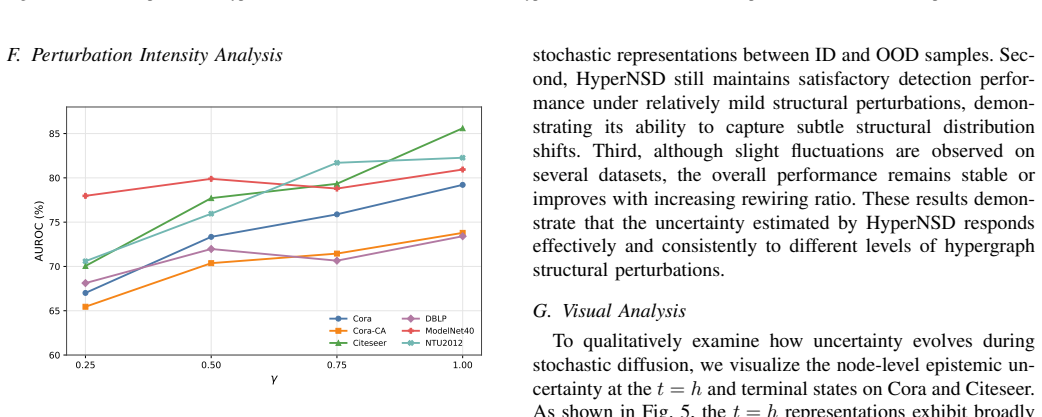
- §V-A and Tables II–III: the strongest empirical claim (best AUROC in 16/18 OOD settings; gains under structure manipulation) rests on synthetic OOD constructions (label leave-out, feature interpolation, degree-preserving rewiring with fixed γ=0.5). These are reasonable but leave open whether the same ranking holds under natural distribution shifts or on larger/heterogeneous hypergraphs. A short discussion of external validity, or one additional real-shift experiment if available, would strengthen the central claim without changing the method.
- §IV-D and Appendix H: epistemic uncertainty is described as trajectory-induced variance of X(T) while detection uses path-conditioned predictive entropy / aleatoric scores. The mapping from representation-level variability to the concrete detection scores used in Tables II–III is only sketched. Clarifying the exact score (and whether M samples are used at test time for every baseline comparison) is load-bearing for reproducibility of the reported gains.
minor comments (4)
- Code is promised at a GitHub URL but not yet released; for a methods paper with free parameters (T, h/L, M, hidden dim, γ) this should be supplied or the hyperparameter protocol made fully self-contained.
- Fig. 1 and the complexity paragraph: runtime is reported only for Cora (Appendix I). A brief note on scaling with N = |I| for the larger DBLP/ModelNet40 instances would help readers assess practicality.
- Notation: G is used both for the hypergraph and for the incidence gradient matrix; a short clarifying sentence in §III would avoid confusion.
- Related work: the distinction from HyperGOOD and from pairwise SDE methods is clear, but a one-sentence comparison of computational cost versus deep ensembles would round out the positioning.
Circularity Check
No significant circularity: HyperNSD is a modular SDE construction evaluated on external benchmarks; self-citations supply the deterministic backbone but do not force the OOD claims by definition.
specific steps
-
self citation load bearing
[Sec. IV-A.2 / Eq. (11); Related Work citing [8]]
"We employ the deterministic hypergraph neural diffusion equation [8] introduced in Section III as the drift component of the proposed stochastic dynamics. Specifically, the drift field F_θ(X(t)) is defined as F_θ(X(t)) = -G^⊤ A_θ(X(t)) G X(t)"
The deterministic drift is taken wholesale from the authors’ own prior preprint HND [8]. This is a modular self-citation that supplies the backbone operator, not a uniqueness theorem that forces the OOD results. The stochastic forcing B_ϕ, the trajectory-variability uncertainty estimator, and the reported detection gains are independent of that citation and are evaluated externally; hence the step is minor and non-load-bearing for the central claim.
full rationale
The paper defines HyperNSD as the incidence-coupled SDE dX = -G^T A_θ(X) G X dt + G^T B_ϕ(X) G dW (Eq. 19), with A_θ and B_ϕ independent softmax-normalized neural modulators. Well-posedness, energy identity, structure-constrained modes (ker Σ_ϕ = ker G), permutation equivariance, and Euler–Maruyama convergence (Thm. 1–3, Prop. 2–4) follow from standard SDE arguments under the local-Lipschitz/linear-growth conditions that the softmax construction itself supplies; they are not tautological restatements of the empirical claim. Uncertainty is estimated from the variability of sampled terminal trajectories after training with a path-conditioned cross-entropy loss; this is not equal by construction to the training objective or to any fitted constant later presented as a prediction. Empirical gains (best AUROC in 16/18 OOD settings, Tables II–III) are measured against public hypergraph benchmarks and independent baselines (MSP, ODIN, GNSD, HyperGOOD, etc.). The only self-citations of note are to the authors’ own HND/HNDiffN preprints, which supply the deterministic drift operator used as a modular component; they are not invoked as uniqueness theorems that forbid alternatives, nor do they redefine the OOD detection scores. Ablations (Fig. 3) and expansion comparisons (Fig. 2) further show that the claimed gains depend on the incidence-aware stochastic term rather than on a circular re-labeling of the deterministic backbone. Score 1.5 reflects one minor, non-load-bearing self-citation chain for the drift module; the central derivation and experimental claims remain independent of that chain.
Axiom & Free-Parameter Ledger
free parameters (5)
- diffusion horizon T
- Euler-Maruyama step size h / number of layers L
- number of training trajectories M
- hidden dimension and learning rate
- rewiring ratio γ for structural OOD
axioms (4)
- standard math Existence/uniqueness theory for finite-dimensional SDEs under local Lipschitz + linear growth (standard Itô theory).
- domain assumption Hypergraph gradient and divergence operators of HND (Zhou et al., arXiv:2604.10955) correctly encode higher-order diffusion.
- ad hoc to paper Softmax-normalized neural modulators remain positive and sum to one, guaranteeing bounded diffusion coefficients.
- domain assumption Trajectory variability of the terminal measure is a faithful proxy for both aleatoric and epistemic uncertainty on hypergraphs.
invented entities (2)
-
Hypergraph Neural Stochastic Diffusion (HyperNSD) SDE
no independent evidence
-
Incidence-space Q-Wiener process Z = G W
no independent evidence
read the original abstract
Hypergraph neural networks have shown powerful capability in modeling higher-order relations, yet their predictive uncertainty remains underexplored. Unlike pairwise graphs, uncertainty in hypergraphs arises not only from noisy attributes and ambiguous labels, but also from variations in node-hyperedge incidence structures and complex higher-order dependencies. Existing approaches mainly estimate uncertainty from final predictions or rely on computationally expensive ensembles and Bayesian inference, limiting their ability to capture uncertainty evolution during representation learning. In this paper, we propose Hypergraph Neural Stochastic Diffusion(HyperNSD), a stochastic differential equation framework for uncertainty estimation on hypergraphs. HyperNSD models hypergraph representations as stochastic processes evolving over node-hyperedge incidence structures. A learnable drift function captures deterministic higher-order diffusion dynamics, while a learnable stochastic forcing function characterizes structural ambiguity and representation noise. Predictive uncertainty is directly quantified through the variability of stochastic representation trajectories, providing an intrinsic uncertainty measure beyond post-hoc confidence scores. We formulate HyperNSD with neural drift and diffusion networks, enabling joint learning of prediction and uncertainty propagation. Theoretical analyses establish well posedness, perturbation stability,permutation equivariance, and numerical convergence of the proposed stochastic dynamics. Experiments on multiple hypergraph benchmarks demonstrate that HyperNSD achieves reliable uncertainty estimation for out-of-distribution and misclassification detection while preserving competitive prediction accuracy. These results provide a principled stochastic-dynamical framework for trustworthy higher-order representation learning.
Figures



Reference graph
Works this paper leans on
-
[1]
A. Bretto, “Hypergraph theory,”An introduction. Mathematical Engi- neering. Cham: Springer, vol. 1, pp. 209–216, 2013
work page 2013
-
[2]
A survey on hypergraph neural networks: An in-depth and step-by-step guide,
S. Kim, S. Y . Lee, Y . Gao, A. Antelmi, M. Polato, and K. Shin, “A survey on hypergraph neural networks: An in-depth and step-by-step guide,” inProceedings of the 30th ACM SIGKDD Conference on Knowledge Discovery and Data Mining, 2024, pp. 6534–6544
work page 2024
-
[3]
A hypergraph-based model for pre- dicting potential drug combinations in cancer therapy,
Q. Wang, Z. Zhou, and G. Yan, “A hypergraph-based model for pre- dicting potential drug combinations in cancer therapy,”Interdisciplinary Sciences: Computational Life Sciences, pp. 1–11, 2025
work page 2025
-
[4]
Q. Wang, B. Wu, M. Xu, X. Liu, Y . Mao, Z. Zhou, and G. Yan, “Hypersynergyx: Synergistic drug combination prediction via hyper- graph modeling and knowledge graph-enhanced retrieval-augmented generation,”IEEE Journal of Biomedical and Health Informatics, 2026
work page 2026
-
[5]
Y . Feng, H. You, Z. Zhang, R. Ji, and Y . Gao, “Hypergraph neural net- works,” inProceedings of the AAAI conference on artificial intelligence, vol. 33, no. 01, 2019, pp. 3558–3565
work page 2019
-
[6]
You are AllSet: A Multiset Function Framework for Hypergraph Neural Networks
E. Chien, C. Pan, J. Peng, and O. Milenkovic, “You are allset: A multiset function framework for hypergraph neural networks,”arXiv preprint arXiv:2106.13264, 2021
work page internal anchor Pith review Pith/arXiv arXiv 2021
-
[7]
Hgnn+: General hypergraph neural networks,
Y . Gao, Y . Feng, S. Ji, and R. Ji, “Hgnn+: General hypergraph neural networks,”IEEE Transactions on Pattern Analysis and Machine Intelli- gence, vol. 45, no. 3, pp. 3181–3199, 2022
work page 2022
-
[8]
Hypergraph Neural Diffusion: A PDE-Inspired Framework for Hypergraph Message Passing
Z. Zhou, M. Zhou, X. Lin, X. Qi, and G. Yan, “Hypergraph neural diffusion: A pde-inspired framework for hypergraph message passing,” arXiv preprint arXiv:2604.10955, 2026
work page internal anchor Pith review Pith/arXiv arXiv 2026
-
[9]
Tackling over-smoothing on hypergraphs: A ricci flow-guided neural diffusion approach,
M. Zhou, Z. Zhou, X. Han, X. Qi, G. Wang, and G. Yan, “Tackling over-smoothing on hypergraphs: A ricci flow-guided neural diffusion approach,”arXiv preprint arXiv:2603.15696, 2026
-
[10]
On calibration of modern neural networks,
C. Guo, G. Pleiss, Y . Sun, and K. Q. Weinberger, “On calibration of modern neural networks,” inInternational conference on machine learning. PMLR, 2017, pp. 1321–1330
work page 2017
-
[11]
Simple and scalable predictive uncertainty estimation using deep ensembles,
B. Lakshminarayanan, A. Pritzel, and C. Blundell, “Simple and scalable predictive uncertainty estimation using deep ensembles,”Advances in neural information processing systems, vol. 30, 2017
work page 2017
-
[12]
Energy-based Out-of-Distribution Detection for Graph Neural Networks
Q. Wu, Y . Chen, C. Yang, and J. Yan, “Energy-based out-of-distribution detection for graph neural networks,”arXiv preprint arXiv:2302.02914, 2023
work page internal anchor Pith review Pith/arXiv arXiv 2023
-
[13]
Graph neural stochastic diffusion for estimating uncertainty in node classification,
X. Lin, W. Zhang, F. Shi, C. Zhou, L. Zou, X. Zhao, D. Yin, S. Pan, and Y . Cao, “Graph neural stochastic diffusion for estimating uncertainty in node classification,” inForty-first international conference on machine learning, 2024
work page 2024
-
[14]
Energy-based epistemic uncertainty for graph neural networks,
D. Fuchsgruber, T. Wollschl ¨ager, and S. G ¨unnemann, “Energy-based epistemic uncertainty for graph neural networks,”Advances in Neural Information Processing Systems, vol. 37, pp. 34 378–34 428, 2024. JOURNAL OF LATEX CLASS FILES, VOL. 18, NO. 9, SEPTEMBER 2020 13
work page 2024
-
[15]
Uncertainty estimation on graphs with structure informed stochastic partial differential equations,
F. Xu and T. Markovich, “Uncertainty estimation on graphs with structure informed stochastic partial differential equations,”Advances in Neural Information Processing Systems, vol. 38, pp. 61 432–61 463, 2026
work page 2026
-
[16]
Weight uncertainty in neural network,
C. Blundell, J. Cornebise, K. Kavukcuoglu, and D. Wierstra, “Weight uncertainty in neural network,” inInternational conference on machine learning. PMLR, 2015, pp. 1613–1622
work page 2015
-
[17]
Graph posterior network: Bayesian predictive uncertainty for node classification,
M. Stadler, B. Charpentier, S. Geisler, D. Z ¨ugner, and S. G ¨unnemann, “Graph posterior network: Bayesian predictive uncertainty for node classification,”Advances in Neural Information Processing Systems, vol. 34, pp. 18 033–18 048, 2021
work page 2021
-
[18]
Uncertainty modeling in graph neural networks via stochastic differential equations,
R. Bergna, S. Calvo Ordo ˜nez, F. Opolka, P. Li`o, and J. M. Hern´andez Lo- bato, “Uncertainty modeling in graph neural networks via stochastic differential equations,” inInternational Conference on Learning Repre- sentations, vol. 2025, 2025, pp. 39 627–39 643
work page 2025
-
[19]
GOLD: Graph Out-of-Distribution Detection via Implicit Adversarial Latent Generation
D. Wang, R. Qiu, G. Bai, and Z. Huang, “Gold: Graph out-of-distribution detection via implicit adversarial latent generation,”arXiv preprint arXiv:2502.05780, 2025
work page internal anchor Pith review Pith/arXiv arXiv 2025
-
[20]
Hypergcn: A new method for training graph convolutional networks on hypergraphs,
N. Yadati, M. Nimishakavi, P. Yadav, V . Nitin, A. Louis, and P. Talukdar, “Hypergcn: A new method for training graph convolutional networks on hypergraphs,”Advances in neural information processing systems, vol. 32, 2019
work page 2019
-
[21]
HNHN: Hypergraph Networks with Hyperedge Neurons
Y . Dong, W. Sawin, and Y . Bengio, “Hnhn: Hypergraph networks with hyperedge neurons,”arXiv preprint arXiv:2006.12278, 2020
work page internal anchor Pith review Pith/arXiv arXiv 2006
-
[22]
A Hypergraph Neural Network Framework for Learning Hyperedge-Dependent Node Embeddings
R. Aponte, R. A. Rossi, S. Guo, J. Hoffswell, N. Lipka, C. Xiao, G. Chan, E. Koh, and N. Ahmed, “A hypergraph neural network framework for learning hyperedge-dependent node embeddings,”arXiv preprint arXiv:2212.14077, 2022
work page internal anchor Pith review Pith/arXiv arXiv 2022
-
[23]
UniGNN: a Unified Framework for Graph and Hypergraph Neural Networks
J. Huang and J. Yang, “Unignn: a unified framework for graph and hypergraph neural networks,”arXiv preprint arXiv:2105.00956, 2021
work page internal anchor Pith review Pith/arXiv arXiv 2021
-
[24]
Equivariant hypergraph neural networks,
J. Kim, S. Oh, S. Cho, and S. Hong, “Equivariant hypergraph neural networks,” inEuropean Conference on Computer Vision. Springer, 2022, pp. 86–103
work page 2022
-
[25]
Equivariant Hypergraph Diffusion Neural Operators
P. Wang, S. Yang, Y . Liu, Z. Wang, and P. Li, “Equivariant hypergraph diffusion neural operators,”arXiv preprint arXiv:2207.06680, 2022
work page internal anchor Pith review Pith/arXiv arXiv 2022
-
[26]
From hypergraph energy functions to hypergraph neural networks,
Y . Wang, Q. Gan, X. Qiu, X. Huang, and D. Wipf, “From hypergraph energy functions to hypergraph neural networks,” inInternational Con- ference on Machine Learning. PMLR, 2023, pp. 35 605–35 623
work page 2023
-
[27]
L. Telyatnikov, M. S. Bucarelli, G. Bernardez, O. Zaghen, S. Scardapane, and P. Li ´o, “Hypergraph neural networks through the lens of message passing: A common perspective to homophily and architecture design,” arXiv preprint arXiv:2310.07684, 2023
work page internal anchor Pith review Pith/arXiv arXiv 2023
-
[28]
Transferable hypergraph neural networks via spectral similarity,
M. Hayhoe, H. M. Riess, M. M. Zavlanos, V . Preciado, and A. Ribeiro, “Transferable hypergraph neural networks via spectral similarity,” in Learning on Graphs Conference. PMLR, 2024, pp. 18–1
work page 2024
-
[29]
Oversquashing in hypergraph neural networks,
N. Yadati, “Oversquashing in hypergraph neural networks,” inThe Third Learning on Graphs Conference, 2025
work page 2025
-
[30]
Hypergraph neural diffusion networks,
F. Lu, M. Ng, and A. Yip, “Hypergraph neural diffusion networks,” Neural Networks, p. 108271, 2025
work page 2025
-
[31]
Dropout as a bayesian approximation: Representing model uncertainty in deep learning,
Y . Gal and Z. Ghahramani, “Dropout as a bayesian approximation: Representing model uncertainty in deep learning,” ininternational conference on machine learning. PMLR, 2016, pp. 1050–1059
work page 2016
-
[32]
A Baseline for Detecting Misclassified and Out-of-Distribution Examples in Neural Networks
D. Hendrycks and K. Gimpel, “A baseline for detecting misclassified and out-of-distribution examples in neural networks,”arXiv preprint arXiv:1610.02136, 2016
work page internal anchor Pith review Pith/arXiv arXiv 2016
-
[33]
Enhancing The Reliability of Out-of-distribution Image Detection in Neural Networks
S. Liang, Y . Li, and R. Srikant, “Enhancing the reliability of out- of-distribution image detection in neural networks,”arXiv preprint arXiv:1706.02690, 2017
work page internal anchor Pith review Pith/arXiv arXiv 2017
-
[34]
A simple unified framework for detecting out-of-distribution samples and adversarial attacks,
K. Lee, K. Lee, H. Lee, and J. Shin, “A simple unified framework for detecting out-of-distribution samples and adversarial attacks,”Advances in neural information processing systems, vol. 31, 2018
work page 2018
-
[35]
Energy-based out-of-distribution detection,
W. Liu, X. Wang, J. Owens, and Y . Li, “Energy-based out-of-distribution detection,”Advances in neural information processing systems, vol. 33, pp. 21 464–21 475, 2020
work page 2020
-
[36]
What uncertainties do we need in bayesian deep learning for computer vision?
A. Kendall and Y . Gal, “What uncertainties do we need in bayesian deep learning for computer vision?”Advances in neural information processing systems, vol. 30, 2017
work page 2017
-
[37]
A review of uncertainty quantification in deep learning: Techniques, applications and challenges,
M. Abdar, F. Pourpanah, S. Hussain, D. Rezazadegan, L. Liu, M. Ghavamzadeh, P. Fieguth, X. Cao, A. Khosravi, U. R. Acharyaet al., “A review of uncertainty quantification in deep learning: Techniques, applications and challenges,”Information fusion, vol. 76, pp. 243–297, 2021
work page 2021
-
[38]
Decomposition of uncertainty in bayesian deep learning for efficient and risk-sensitive learning,
S. Depeweg, J.-M. Hernandez-Lobato, F. Doshi-Velez, and S. Udluft, “Decomposition of uncertainty in bayesian deep learning for efficient and risk-sensitive learning,” inInternational Conference on Machine Learning. PMLR, 2018, pp. 1184–1193
work page 2018
-
[39]
Uncertainty aware semi- supervised learning on graph data,
X. Zhao, F. Chen, S. Hu, and J.-H. Cho, “Uncertainty aware semi- supervised learning on graph data,”Advances in Neural Information Processing Systems, vol. 33, pp. 12 827–12 836, 2020
work page 2020
-
[40]
G. J. Lord, C. E. Powell, and T. Shardlow,An introduction to compu- tational stochastic PDEs. Cambridge University Press, 2014, vol. 50
work page 2014
-
[41]
An introduction to numerical methods for stochastic differ- ential equations,
E. Platen, “An introduction to numerical methods for stochastic differ- ential equations,”Acta numerica, vol. 8, pp. 197–246, 1999
work page 1999
-
[42]
Uncertainty on asyn- chronous time event prediction,
M. Bilo ˇs, B. Charpentier, and S. G ¨unnemann, “Uncertainty on asyn- chronous time event prediction,”Advances in Neural Information Pro- cessing Systems, vol. 32, 2019
work page 2019
-
[43]
SDE-Net: Equipping Deep Neural Networks with Uncertainty Estimates
L. Kong, J. Sun, and C. Zhang, “Sde-net: Equipping deep neural networks with uncertainty estimates,”arXiv preprint arXiv:2008.10546, 2020
work page internal anchor Pith review Pith/arXiv arXiv 2008
-
[44]
Collective classification in network data,
P. Sen, G. Namata, M. Bilgic, L. Getoor, B. Galligher, and T. Eliassi- Rad, “Collective classification in network data,”AI magazine, vol. 29, no. 3, pp. 93–93, 2008
work page 2008
-
[45]
3d shapenets: A deep representation for volumetric shapes,
Z. Wu, S. Song, A. Khosla, F. Yu, L. Zhang, X. Tang, and J. Xiao, “3d shapenets: A deep representation for volumetric shapes,” inProceedings of the IEEE conference on computer vision and pattern recognition, 2015, pp. 1912–1920
work page 2015
-
[46]
On visual similarity based 3d model retrieval,
D.-Y . Chen, X.-P. Tian, Y .-T. Shen, and M. Ouhyoung, “On visual similarity based 3d model retrieval,” inComputer graphics forum, vol. 22, no. 3. Wiley Online Library, 2003, pp. 223–232
work page 2003
-
[47]
Hypergood: Towards out-of-distribution detection in hypergraphs,
T. Cai, Y . Jiang, M. Li, C. Huang, Y . Fang, C. Gao, and Z. Zheng, “Hypergood: Towards out-of-distribution detection in hypergraphs,” in Proceedings of the AAAI Conference on Artificial Intelligence, vol. 40, no. 24, 2026, pp. 19 817–19 825. Zhiheng Zhoureceived the Ph.D. degree from the Academy of Mathematics and Systems Science, Chinese Academy of Scie...
work page 2026
-
[48]
(134) SinceB ϕ(X)1/2 is invertible, this impliesGz= 0.Thus, z∈kerG, and consequently, kerΣ ϕ(X) = kerG.(135) SinceΣ ϕ(X)∈R n×n andG∈R N×n have the same null space inR n, the rank–nullity theorem gives rankΣ ϕ(X) =n−dim kerΣ ϕ(X) =n−dim kerG= rankG. (136) Finally, suppose that the hypergraph is connected and that kerG= span{D v 1/21n}.Letq=D v 1/21n.Thenq∈...
work page 2020
discussion (0)
Sign in with ORCID, Apple, or X to comment. Anyone can read and Pith papers without signing in.