REVIEW 3 major objections 6 minor 50 references
Prompt inversion alone cannot reverse-engineer text-to-image models; you also need the latent noise that carries structure.
Reviewed by Pith at T0; open to challenge. T0 means a machine referee read the full paper against a public rubric. the ladder, T0–T4 →
Joint hard-prompt inversion (VLM+CLIP+LLM) and unconditional DDIM noise inversion reconstructs target images with higher fidelity than prompt-only methods and supports prompt-only editing.
T0 review reviewed 2026-07-30 challenge →
load-bearing objection Useful dual pipeline, but the SOTA fidelity numbers are mostly noise inversion doing the work—and the baselines never got that noise. the 3 major comments →
Dual Inversion for Text-to-Image Diffusion Models: From Both Prompt and Noise Perspectives
The pith
A machine-rendered reading of the paper's core claim, the machinery that carries it, and where it could break.
The reading
Core claim
High-fidelity reverse engineering of text-to-image diffusion models is not achieved by prompt inversion alone. Jointly recovering a faithful hard prompt and the latent noise of the target image is necessary; the inverted noise supplies structural information that the prompt cannot, and unconditional DDIM inversion yields a noise that is independent of the prompt and therefore supports controllable editing without re-optimization.
What carries the argument
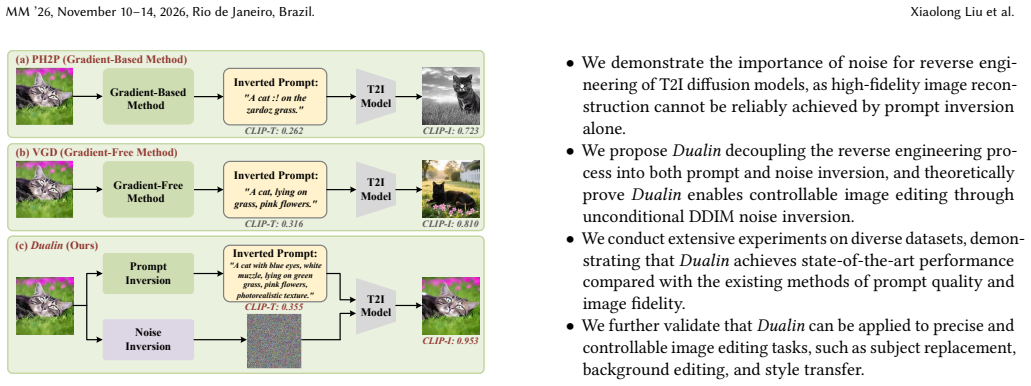
Dualin: a two-stage dual inversion. Stage I builds a hard prompt by fusing VLM scene content with CLIP-retrieved aesthetic tags via an LLM and selecting by CLIP score. Stage II runs unconditional DDIM inversion to recover latent noise x*_T. Theorem 4.1 (Decoupling Property) states that this noise is independent of the prompt and that generation from it decomposes into the original latent plus unconditional residual plus a prompt-dependent offset, which Corollary 4.2 turns into editability by fixing the noise and only changing the prompt.
Load-bearing premise
Unconditional DDIM inversion is assumed to recover essentially exact structural noise of the target, with residuals small enough that fixing that noise and only editing the prompt preserves layout at the claimed fidelity.
What would settle it
On held-out target images, compare reconstruction and edit fidelity when using Dualin’s unconditional DDIM noise versus the same inverted prompt with random or DDPM-inverted noise: if CLIP-I/SSIM and layout-preserving edits do not collapse without the Dualin noise, the central claim fails.
If this is right
- Readable inverted prompts plus inverted noise can reconstruct targets at substantially higher image–image similarity than prompt-only methods.
- Fixing the unconditionally inverted noise and editing only prompt tokens supports subject replacement, background change, and style transfer without reinversion.
- Prompt-only reverse engineering is systematically underpowered for structural fidelity; noise recovery becomes a required companion step.
- The same dual pair can serve as a substrate for downstream tasks such as semantic editing and model auditing that need both interpretability and pixel-level control.
Where Pith is reading between the lines
- If noise truly carries structure independent of prompt, other conditioning channels (ControlNet maps, IP-Adapter embeddings) might be invertible the same way and composed with Dualin-style prompts.
- Accumulated DDIM inversion error over long trajectories may set a practical ceiling on edit fidelity; shorter or corrected inversion schedules could be a direct follow-on test.
- Safety and provenance tools could treat the recovered (prompt, noise) pair as a fingerprint of a generated image rather than the prompt alone.
Editorial analysis
A structured set of objections, weighed in public.
Referee Report
Summary. The paper argues that prompt inversion alone is insufficient for high-fidelity reverse engineering of text-to-image diffusion models because latent noise encodes structural information. It proposes Dualin, a two-stage method: (I) gradient-free hard-prompt inversion via VLM scene extraction, CLIP-based retrieval from a fixed aesthetic Concept Bank, and LLM fusion/selection; (II) unconditional DDIM inversion to recover a latent noise x*_T from the target image. Theorem 4.1 states a decoupling property (noise independent of prompt; generation decomposes into unconditional residual plus conditional offset), and Corollary 4.2 claims editable generation by fixing x*_T and editing the prompt without reinversion. Experiments on MS COCO, LAION, and DiffusionDB with SD-V1.5, SDXL, and PixArt-α report SOTA CLIP-T/CLIP-I, LPIPS, SSIM, and LLM-judge scores versus PEZ, PH2P, BLIP, and VGD, plus qualitative subject/background/style edits.
Significance. If the joint-recovery claim holds under fair controls, the work usefully reframes T2I reverse engineering as dual (prompt + noise) rather than prompt-only, and the Stage-I recipe (VLM+CLIP bank+LLM) is a practical, readable alternative to gradient-based hard prompts. The empirical suite is a genuine strength: three datasets, three generators, standard metrics plus external LLM judges, and ablations on stages, modules, candidate-set size, and inversion steps. The editing demos illustrate a usable pipeline. However, the headline fidelity gains and the “exact noise / guaranteeing consistency” framing largely rest on giving Dualin an inverted latent that baselines never receive, and Theorem 4.1 largely restates known properties of unconditional DDIM inversion rather than a Dualin-specific guarantee. Significance is therefore conditional on fairer controls and tighter positioning against null-text / P2P-style inversion-editing priors.
major comments (3)
- [§5.3 Table 1; §5.4 Table 4] Table 1 vs Table 4 (and §5.3–5.4): the SOTA image-fidelity claim is confounded. All named baselines (PEZ, PH2P, BLIP, VGD) are prompt-only; only Dualin is evaluated with the unconditionally DDIM-inverted x*_T (Eq. 13). Table 4 shows Stage I alone already reaches CLIP-I 0.807 (on par with VGD’s ~0.80–0.81 in Table 1), while full Dualin jumps to 0.928—i.e., nearly the entire reported fidelity lift is Stage II. Without a control that freezes the same unconditional inversion and pairs it with VGD/BLIP/PH2P (and Dualin) prompts, the experiments do not establish that Dualin’s prompt stage is load-bearing for the fidelity numbers, nor that “joint” recovery beats “any decent prompt + noise inversion.” This control is necessary for the central claim.
- [Abstract; §4.2 Eq. (13); Theorem 4.1; Corollary 4.2] Abstract, §4.2, and Theorem 4.1: the language “reconstructs the exact latent noise” / “guaranteeing the consistency at the structural information level” overstates what approximate DDIM inversion delivers. Empirically SSIM is only ~0.62–0.66 (Table 1) and the paper’s own step/DDPM ablations (Table 4, Fig. 7) show substantial degradation—consistent with known accumulation of inversion error. Theorem 4.1’s decomposition (x0(P)=x*_0+Δ_uncond+Δ_cond(P)) is a standard consequence of running unconditional inversion then conditional sampling; it is not Dualin-specific and does not by itself prove small Δ_uncond or pixel-level fidelity. The claim should be restated as approximate structural anchoring, with quantitative bounds or at least explicit acknowledgment of residual error, and related more carefully to null-text inversion / Prompt-to-Prompt-style priors.
- [§2 Related Work; §4.3; §5.5; Corollary 4.2] §2 and §4.3 / §5.5: the editing application (fix x*_T, edit tokens in P*) is presented as enabled by Dualin’s theory, but the manuscript under-engages the substantial inversion-for-editing literature (e.g., null-text inversion, P2P, and related DDIM inversion editing pipelines) that already uses (approximately) the same unconditional or lightly optimized inversion + prompt edit pattern. Without that positioning, Corollary 4.2 reads as a restatement of prior practice rather than a new guarantee. A related-work and discussion revision should clarify what is new (the Stage-I hard prompt + the specific dual pipeline) versus what is inherited.
minor comments (6)
- [§4.1 Eq. (12); §5.1 Evaluation Metrics] CLIP is used both to select the final prompt (Eq. 12) and as the primary prompt/image metrics (CLIP-T, CLIP-I). LPIPS/SSIM and GPT-4o/Gemini judges partially mitigate this, but the paper should note the coupling and, if possible, report an alternate text–image scorer for CLIP-T.
- [Figure 1; Figure 4] Figure 1 and Figure 4 captions/layout repeat blocks of text in the manuscript source; clean duplication and ensure inverted prompts are fully legible in the camera-ready figures.
- [§5.4 Table 4] Table 4 row “w/o Stage I” reports CLIP-I 0.739 in the table body but the surrounding text says 0.263; reconcile the numbers and the prose.
- [§5.4; §5.1] Typo: “Dulian” for Dualin in the DDPM inversion paragraph of §5.4; also “employe” → “employ” in §5.1.
- [§4.1 Zero-Shot Concept Retrieval; §5.1] Concept Bank construction (categories, vocabulary size, top-k) is only sketched; a short appendix listing sources/size of C and sensitivity to bank contents would aid reproducibility.
- [Table 3] Inversion time in Table 3 (Dualin 18.73s) is useful; please specify hardware and whether VLM/LLM calls are included or cached, and report variance over images.
Circularity Check
Mild definitional restatement in Theorem 4.1 and CLIP used both to select and score prompts; central fidelity claims are empirical, not circular.
specific steps
-
self definitional
[§4.2 Theorem 4.1 (Decoupling Property) and Corollary 4.2]
"The value of x*_T is independent of P, i.e., x*_T = I_ϕ(x*_0), ∂x*_T/∂P = 0, where I_ϕ is the mapping of the unconditional inversion; ... x0(P)=x*_0+Δ_uncond+Δ_cond(P), where Δ_uncond = G^ϕ_0:T(x*_T)−x*_0 denotes the unconditional reconstruction error independent of P, whereas Δ_cond(P)=G_0:T(x*_T,P)−G^ϕ_0:T(x*_T) represents the offset introduced by the conditional prompt P. ... Corollary 4.2 (Editable Property). Perform an unconditional inversion on the original image to obtain x*_T, then fix it and generate various edited results using different modified prompts P ... without requiring reinv"
Independence of x*_T from P is true by construction once inversion is defined as unconditional (I_ϕ with ϕ). The decomposition into Δ_uncond and Δ_cond(P) is an algebraic identity from writing conditional generation relative to the unconditional path, not an independent derivation. The 'editable without re-optimization' corollary follows immediately from that definition. The paper presents these as theoretical proofs enabling Dualin, but they restate the setup of unconditional DDIM inversion.
-
fitted input called prediction
[§4.1 Eqs. (9)–(12); evaluation CLIP-T in §5.1/Table 1]
"We compute the CLIP similarity score S(I,P_i) for each candidate prompt P_i against the target image I. We select the highest one as the final output prompt P* as follows: P* = argmax_{P_i ∈ P}(S(I,P_i)). ... For prompt fidelity, we measure the cosine similarity between the CLIP embeddings of the inverted prompts and the target images, denoted as CLIP-T."
Stage I explicitly maximizes CLIP image–text similarity to choose P*; CLIP-T is the same cosine similarity reported as a fidelity metric. Elevated CLIP-T is therefore partly guaranteed by the selection objective rather than an out-of-sample prediction. This coupling is limited to CLIP-T (CLIP-I/LPIPS/SSIM and LLM judges remain independent) and does not force the joint-inversion fidelity claims.
full rationale
The paper's load-bearing empirical claims (SOTA CLIP-I/LPIPS/SSIM vs PEZ/PH2P/BLIP/VGD on MS COCO, LAION, DiffusionDB; editing demos) are comparisons on held-out images with independent metrics (LPIPS, SSIM, external LLM judges) and are not forced by construction. Two mild circularities exist but are not central: (1) Theorem 4.1's 'proof' that x*_T is independent of P and that generation decomposes into Δ_uncond + Δ_cond(P) restates the definition of unconditional DDIM inversion rather than deriving a non-tautological constraint; Corollary 4.2 likewise restates a standard property of fixing inverted noise. (2) Stage I selects P* by argmax of CLIP similarity S(I,P_i) and then reports CLIP-T as that same similarity, so the CLIP-T gains are partly selection-optimized. Neither reduces the image-fidelity or editing results to a fit or self-citation chain. No load-bearing self-citation, uniqueness import, or ansatz-smuggling was found. Score 2 reflects these minor issues only.
Axiom & Free-Parameter Ledger
free parameters (3)
- candidate_prompt_set_size_N =
~30 (saturation)
- noise_inversion_steps =
35–50
- concept_bank_top_k_per_category =
top-k (unspecified exact k in text)
axioms (4)
- domain assumption DDIM reverse/forward maps are sufficiently deterministic that unconditional inversion yields a reusable structural latent x*_T independent of prompt P.
- domain assumption CLIP cosine similarity is an adequate objective and metric for prompt–image and image–image fidelity (CLIP-T, CLIP-I).
- ad hoc to paper VLM scene captions plus a fixed aesthetic Concept Bank plus LLM fusion can produce hard prompts that are both human-readable and generative-model-effective.
- standard math Standard latent diffusion forward/reverse equations (Eqs. 1–6) and VAE encode/decode hold for the evaluated models.
invented entities (2)
-
Dualin two-stage dual inversion procedure
no independent evidence
-
Concept Bank C = {medium, style, lighting, quality} tag sets
no independent evidence
Cite this review
Pith. "Pith review of Dual Inversion for Text-to-Image Diffusion Models: From Both Prompt and Noise Perspectives." pith.science (2026). https://pith.science/paper/GLGLMQQX
@misc{pith2026260726735,
  author       = {Pith},
  title        = {Pith review of: Dual Inversion for Text-to-Image Diffusion Models: From Both Prompt and Noise Perspectives},
  year         = {2026},
  howpublished = {\url{https://pith.science/paper/GLGLMQQX}},
  note         = {Machine review of arXiv:2607.26735}
}
read the original abstract
Prompt inversion, as a typical reverse engineering technique, enables text-to-image (T2I) diffusion models to generate the desired target images without extensive prompt engineering. However, existing prompt inversion methods suffer from significant limitations: (1) gradient-based methods are unstable and uninterpretable, often resulting in generated images with severe artifacts; (2) gradient-free methods yield human-readable prompts but still fail to preserve visual fidelity due to the lack of fine-grained detail alignment. We contend that the limitations stem from treating prompt inversion as a sufficient condition for reverse engineering, ignoring the critical role of the latent noise that encodes structural information. Consequently, we propose Dualin (Dual inversion), a two-stage method that jointly recovers both the semantic prompt and latent noise of the target image. In the first stage, we integrate vision-language model, CLIP and large language model to invert a faithful, human-interpretable hard prompt. In the second stage, unconditional DDIM inversion reconstructs the exact latent noise of the target image, guaranteeing the consistency at the structural information level. Theoretically, we prove that the inverted noise enables flexible image editing without re-optimization. Extensive experiments on diverse datasets demonstrate that Dualin simultaneously generates high-quality inverted prompts and achieves state-of-the-art image fidelity. Additionally, Dualin can establish a robust foundation for the precise and controllable image editing.
Figures


Reference graph
Works this paper leans on
-
[1]
Josh Achiam, Steven Adler, Sandhini Agarwal, Lama Ahmad, Ilge Akkaya, Floren- cia Leoni Aleman, Diogo Almeida, Janko Altenschmidt, Sam Altman, Shyamal Anadkat, et al. 2023. GPT-4 technical report.arXiv preprint arXiv:2303.08774 (2023)
Pith/arXiv arXiv 2023
-
[2]
Lorenzo Agnolucci, Alberto Baldrati, Alberto Del Bimbo, and Marco Bertini. 2025. iSEARLE: Improving textual inversion for zero-shot composed image retrieval. IEEE Transactions on Pattern Analysis and Machine Intelligence47, 11 (2025), 10801–10817
2025
-
[3]
Shuai Bai, Yuxuan Cai, Ruizhe Chen, Keqin Chen, Xionghui Chen, Zesen Cheng, Lianghao Deng, Wei Ding, Chang Gao, Chunjiang Ge, et al . 2025. Qwen3-VL technical report.arXiv preprint arXiv:2511.21631(2025)
Pith/arXiv arXiv 2025
-
[4]
Junsong Chen, Jincheng Yu, Chongjian Ge, Lewei Yao, Enze Xie, Zhongdao Wang, James Kwok, Ping Luo, Huchuan Lu, and Zhenguo Li. 2024. PixArt- 𝛼: Fast Training of Diffusion Transformer for Photorealistic Text-to-Image Synthesis. In Proceedings of the Twelfth International Conference on Learning Representations
2024
-
[5]
Yiyi Chen, Heather Lent, and Johannes Bjerva. 2024. Text embedding inversion security for multilingual language models. InProceedings of the 62nd Annual Meeting of the Association for Computational Linguistics. 7808–7827
2024
-
[6]
Abhimanyu Dubey, Abhinav Jauhri, Abhinav Pandey, Abhishek Kadian, Ahmad Al-Dahle, Aiesha Letman, Akhil Mathur, Alan Schelten, Amy Yang, Angela Fan, et al. 2024. The LLaMA 3 Herd of Models.arXiv preprint arXiv:2407.21783(2024)
Pith/arXiv arXiv 2024
-
[7]
Luca Eyring, Shyamgopal Karthik, Karsten Roth, Alexey Dosovitskiy, and Zeynep Akata. 2024. Reno: Enhancing one-step text-to-image models through reward- based noise optimization.Advances in Neural Information Processing Systems37 (2024), 125487–125519
2024
-
[8]
Rinon Gal, Yuval Alaluf, Yuval Atzmon, Or Patashnik, Amit Haim Bermano, Gal Chechik, and Daniel Cohen-Or. 2023. An Image is Worth One Word: Personalizing Text-to-Image Generation using Textual Inversion. InProceedings of the Eleventh International Conference on Learning Representations
2023
-
[9]
Donghoon Kim, Minji Bae, Kyuhong Shim, and Byonghyo Shim. 2025. Visu- ally Guided Decoding: Gradient-Free Hard Prompt Inversion with Language Models. InProceedings of the Thirteenth International Conference on Learning Representations
2025
-
[10]
Nupur Kumari, Bingliang Zhang, Sheng-Yu Wang, Eli Shechtman, Richard Zhang, and Jun-Yan Zhu. 2023. Ablating concepts in text-to-image diffusion models. In Proceedings of the IEEE/CVF International Conference on Computer Vision. 22691– 22702
2023
-
[11]
Nupur Kumari, Bingliang Zhang, Richard Zhang, Eli Shechtman, and Jun-Yan Zhu
-
[12]
Junnan Li, Dongxu Li, Silvio Savarese, and Steven Hoi. 2023. BLIP-2: Bootstrap- ping language-image pre-training with frozen image encoders and large language models. InProceedings of the 40th International Conference on Machine Learning. 19730–19742
2023
-
[13]
Mingzhe Li, Gehao Zhang, Zhenting Wang, Shiqing Ma, Siqi Pan, Richard Cartwright, and Juan Zhai. 2025. EDITOR: Effective and Interpretable Prompt Inversion for Text-to-Image Diffusion Models.arXiv preprint arXiv:2506.03067 (2025)
arXiv 2025
-
[14]
Ruibin Li, Ruihuang Li, Song Guo, and Lei Zhang. 2024. Source prompt disentan- gled inversion for boosting image editability with diffusion models. InEuropean Conference on Computer Vision. 404–421
2024
-
[15]
Xiang Lisa Li and Percy Liang. 2021. Prefix-Tuning: Optimizing Continuous Prompts for Generation. InProceedings of the 59th Annual Meeting of the Associa- tion for Computational Linguistics and the 11th International Joint Conference on Natural Language Processing. 4582–4597
2021
-
[16]
Jiayi Lin, Jiabo Huang, Jian Hu, and Shaogang Gong. 2025. InvSeg: Test-Time Prompt Inversion for Semantic Segmentation. InProceedings of the AAAI Confer- ence on Artificial Intelligence, Vol. 39. 5245–5253
2025
-
[17]
Tsung-Yi Lin, Michael Maire, Serge Belongie, James Hays, Pietro Perona, Deva Ramanan, Piotr Dollár, and C Lawrence Zitnick. 2014. Microsoft COCO: Common objects in context. InEuropean Conference on Computer Vision. 740–755
2014
-
[18]
Zhihua Liu, Amrutha Saseendran, Lei Tong, Xilin He, Fariba Yousefi, Nikolay Burlutskiy, Dino Oglic, Tom Diethe, Philip Alexander Teare, Huiyu Zhou, et al
-
[19]
Zhe Ma, Qingming Li, Xuhong Zhang, Tianyu Du, Ruixiao Lin, Zonghui Wang, Shouling Ji, and Wenzhi Chen. 2025. An Inversion-based Measure of Memoriza- tion for Diffusion Models. InProceedings of the IEEE/CVF International Conference on Computer Vision. 16959–16969
2025
-
[20]
Shweta Mahajan, Tanzila Rahman, Kwang Moo Yi, and Leonid Sigal. 2024. Prompt- ing hard or hardly prompting: Prompt inversion for text-to-image diffusion mod- els. InProceedings of the IEEE/CVF Conference on Computer Vision and Pattern Recognition. 6808–6817
2024
-
[21]
John Xavier Morris, Wenting Zhao, Justin T Chiu, Vitaly Shmatikov, and Alexan- der M Rush. 2024. Language Model Inversion. InProceedings of the Twelfth International Conference on Learning Representations
2024
-
[22]
Dustin Podell, Zion English, Kyle Lacey, Andreas Blattmann, Tim Dockhorn, Jonas Müller, Joe Penna, and Robin Rombach. 2024. SDXL: Improving Latent Diffusion Models for High-Resolution Image Synthesis. InProceedings of the Twelfth International Conference on Learning Representations
2024
-
[23]
Wenjie Qu, Yuguang Zhou, Yongji Wu, Tingsong Xiao, Binhang Yuan, Yiming Li, and Jiaheng Zhang. 2025. Prompt inversion attack against collaborative inference of large language models. InProceedings of the IEEE Symposium on Security and Privacy. 1695–1712
2025
-
[24]
Alec Radford, Jong Wook Kim, Chris Hallacy, Aditya Ramesh, Gabriel Goh, Sandhini Agarwal, Girish Sastry, Amanda Askell, Pamela Mishkin, Jack Clark, et al. 2021. Learning transferable visual models from natural language supervision. InProceedings of the 38th International Conference on Machine Learning. 8748– 8763
2021
-
[25]
Zhiyao Ren, Yibing Zhan, Baosheng Yu, and Dacheng Tao. 2025. Reverse Prompt: Cracking the Recipe Inside Text-to-Image Generation.arXiv preprint arXiv:2503.19937(2025)
Pith/arXiv arXiv 2025
-
[26]
Robin Rombach, Andreas Blattmann, Dominik Lorenz, Patrick Esser, and Björn Ommer. 2022. High-resolution image synthesis with latent diffusion models. In Proceedings of the IEEE/CVF Conference on Computer Vision and Pattern Recognition. 10684–10695
2022
-
[27]
Danila Rukhovich, Elona Dupont, Dimitrios Mallis, Kseniya Cherenkova, Anis Kacem, and Djamila Aouada. 2025. Cad-recode: Reverse engineering cad code from point clouds. InProceedings of the IEEE/CVF International Conference on Computer Vision. 9801–9811
2025
-
[28]
Christoph Schuhmann, Romain Beaumont, Richard Vencu, Cade Gordon, Ross Wightman, Mehdi Cherti, Theo Coombes, Aarush Katta, Clayton Mullis, Mitchell Wortsman, et al. 2022. LAION-5B: An open large-scale dataset for training next generation image-text models.Advances in Neural Information Processing Systems 35 (2022), 25278–25294
2022
-
[29]
Jeremy Styborski, Mingzhi Lyu, Jiayou Lu, Nupur Kapur, and Adams Wai-Kin Kong. 2025. When and Where do Data Poisons Attack Textual Inversion?. In Proceedings of the IEEE/CVF International Conference on Computer Vision. 19439– 19449
2025
-
[30]
Gemini Team, Rohan Anil, Sebastian Borgeaud, Jean-Baptiste Alayrac, Jiahui Yu, Radu Soricut, Johan Schalkwyk, Andrew M Dai, Anja Hauth, Katie Millican, et al
-
[31]
Xinpeng Ti, Wentao Ye, Zhifang Zhang, Junbo Zhao, Chang Yao, Lei Feng, and Haobo Wang. 2025. Towards Reverse Engineering of Language Models: A Survey. InProceedings of the Findings of the Association for Computational Linguistics: EMNLP 2025. 7483–7502
2025
-
[32]
Corban Villa, Shujaat Mirza, and Christina Pöpper. 2025. Exposing the Guardrails: Reverse-Engineering and Jailbreaking Safety Filters in DALL·E Text-to-Image Pipelines. InProceedings of the 34th USENIX Security Symposium. 897–916
2025
-
[33]
Gemini: A family of highly capable multimodal models.arXiv preprint arXiv:2312.11805(2023)
Pith/arXiv arXiv 2023
-
[34]
Ruoyu Wang, Huayang Huang, Ye Zhu, Olga Russakovsky, and Yu Wu. 2025. The silent assistant: Noisequery as implicit guidance for goal-driven image generation. InProceedings of the IEEE/CVF International Conference on Computer Vision. 17618– 17628
2025
-
[35]
Zilan Wang, Junfeng Guo, Jiacheng Zhu, Yiming Li, Heng Huang, Muhao Chen, and Zhengzhong Tu. 2025. Sleepermark: Towards robust watermark against fine-tuning text-to-image diffusion models. InProceedings of the Computer Vision and Pattern Recognition Conference. 8213–8224
2025
-
[36]
Kai Wang, Fei Yang, Bogdan Raducanu, and Joost van de Weijer. 2025. Multi-class textual-inversion secretly yields a semantic-agnostic classifier. InProceedings of the IEEE/CVF Winter Conference on Applications of Computer Vision. 4400–4409
2025
-
[37]
Yuxin Wen, Neel Jain, John Kirchenbauer, Micah Goldblum, Jonas Geiping, and Tom Goldstein. 2023. Hard prompts made easy: Gradient-based discrete optimiza- tion for prompt tuning and discovery.Advances in Neural Information Processing Systems36 (2023), 51008–51025
2023
-
[38]
Enze Xie, Junsong Chen, Junyu Chen, Han Cai, Haotian Tang, Yujun Lin, Zhekai Zhang, Muyang Li, Ligeng Zhu, Yao Lu, et al . 2025. SANA: Efficient high- resolution text-to-image synthesis with linear diffusion transformers. InPro- ceedings of the Thirteenth International Conference on Learning Representations
2025
-
[39]
Wang, Evan Montoya, David Munechika, Haoyang Yang, Benjamin Hoover, and Duen Horng Chau
Zijie J. Wang, Evan Montoya, David Munechika, Haoyang Yang, Benjamin Hoover, and Duen Horng Chau. 2023. DiffusionDB: A Large-scale Prompt Gallery Dataset for Text-to-Image Generative Models. InProceedings of the 61st Annual Meeting of the Association for Computational Linguistics. 893–911
2023
-
[40]
Ling Yang, Zhaochen Yu, Chenlin Meng, Minkai Xu, Stefano Ermon, and Bin Cui
-
[41]
Dayong Ye, Tianqing Zhu, Feng He, Bo Liu, Minhui Xue, and Wanlei Zhou. 2025. Cross-Modal Prompt Inversion: Unifying Threats to Text and Image Generative AI Models. InProceedings of the 34th USENIX Security Symposium. 2303–2322
2025
-
[42]
Bing Xiong, Yue Peng, RanRan Zhang, Fuqiang Chen, JiaYe He, and Wenjian Qin. 2025. Unpaired multi-domain histopathology virtual staining using dual path prompted inversion. InProceedings of the AAAI Conference on Artificial Intelligence, Vol. 39. 8780–8787. MM ’26, November 10–14, 2026, Rio de Janeiro, Brazil. Xiaolong Liu et al
2025
-
[43]
Lvmin Zhang, Anyi Rao, and Maneesh Agrawala. 2023. Adding conditional control to text-to-image diffusion models. InProceedings of Proceedings of the IEEE/CVF International Conference on Computer Vision. 3836–3847
2023
-
[44]
Richard Zhang, Phillip Isola, Alexei A Efros, Eli Shechtman, and Oliver Wang
-
[45]
Zikai Zhou, Shitong Shao, Lichen Bai, Shufei Zhang, Zhiqiang Xu, Bo Han, and Zeke Xie. 2025. Golden noise for diffusion models: A learning framework. In Proceedings of the IEEE/CVF International Conference on Computer Vision. 17688– 17697
2025
-
[46]
Collin Zhang, John Xavier Morris, and Vitaly Shmatikov. 2024. Extracting prompts by inverting LLM outputs. InProceedings of the 2024 Conference on Empirical Methods in Natural Language Processing. 14753–14777
2024
-
[2018]
In Proceedings of the IEEE/CVF Conference on Computer Vision and Pattern Recognition
The unreasonable effectiveness of deep features as a perceptual metric. In Proceedings of the IEEE/CVF Conference on Computer Vision and Pattern Recognition. 586–595
-
[2023]
InProceedings of the IEEE/CVF Conference on Computer Vision and Pattern Recognition
Multi-concept customization of text-to-image diffusion. InProceedings of the IEEE/CVF Conference on Computer Vision and Pattern Recognition. 1931–1941
1931
-
[2024]
InProceedings of the 41st International Conference on Machine Learning
Mastering text-to-image diffusion: Recaptioning, planning, and generating with multimodal LLMs. InProceedings of the 41st International Conference on Machine Learning. 56704–56721
-
[2025]
InProceedings of the 42nd International Conference on Machine Learning
Segment anyword: Mask prompt inversion for open-set grounded segmen- tation. InProceedings of the 42nd International Conference on Machine Learning. 39420–39454
This paper was first reviewed by grok-4.5 on July 30, 2026.
discussion (0)
Sign in with ORCID, Apple, or X to comment. Anyone can read and Pith papers without signing in.