REVIEW 3 major objections 3 minor 52 references
The evaluation metric itself can be the evolving object in a self-improving agent loop, and a metric evolved from ten labeled examples beats the bare LLM judge it contains on code generation.
Reviewed by Pith at T0; open to challenge. T0 means a machine referee read the full paper against a public rubric. the ladder, T0–T4 →
T0 review · deepseek-v4-flash
2026-08-02 06:20 UTC pith:GNX4TTMF
load-bearing objection The metric-evolution result is solid, but the 'task score cannot certify a grader' claim is built on a confounded ablation that needs to be redone. the 3 major comments →
Who Grades the Grader? Co-Evolving Evaluation Metrics and Skills for Self-Improving LLM Agents
The pith
A machine-rendered reading of the paper's core claim, the machinery that carries it, and where it could break.
Core claim
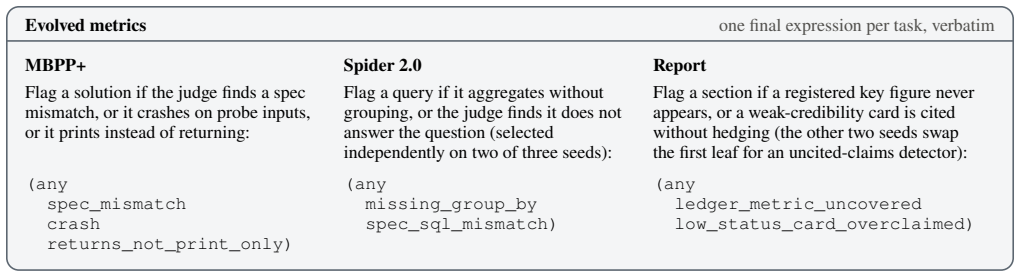
The paper's load-bearing claim is that a grading function can be treated as a first-class evolving object in the sparse-anchor regime: no existing evaluator, only ten dev items with golden references and a locked test set that selection never touches. What evolves is an expression tree over typed drawback detectors — each detector checks one failure class (crash, print-instead-of-return, missing group-by, unhedged weak claim) — selected for recall-weighted agreement with the ten-item anchor and regularized by reliability-weighted consensus over unlabeled outputs. The measured result is that the evolved composition is valid: on MBPP+ it reaches 0.625 peak agreement with hidden unit tests vers
What carries the argument
The central object is a metric expression: a tree over atomic 'drawback detectors' (typed checks that each flag one failure class and otherwise abstain), composed with disjunction, conjunction, negation, and weighted votes. The machinery that carries the argument is the selection objective S(e) = A_dev(e) · A_train(e)^w − λC(e): recall-weighted agreement with the ten-item dev anchor (a missed drawback costs twice a false alarm) multiplied by reliability-weighted consensus over unlabeled train outputs (anchor-proven ops lead), minus a complexity penalty, behind a fail-closed gate that rejects candidates with no usable dev opinion and a validity gate that drops all-pass/all-fail/all-abstain ca
Load-bearing premise
The ten hand-picked dev items, soft-labeled by a same-family LLM teacher under a hand-designed protocol, are sufficient and unbiased enough that selection order by anchor agreement orders candidates by true validity — with teacher quality held fixed and anchor-robustness replayed only on the report task, a biased or noisy anchor would silently misdirect the search.
What would settle it
Run the metric loop on MBPP+ with a deliberately corrupted anchor — say, flipping fail/clean soft labels on three of the ten dev items — and check whether held-out agreement on the locked set still rises by +0.21 over the bare judge. If a corrupted anchor still yields the same gain, the anchor discipline is not doing the claimed safety work; if the gain vanishes, the method's dependence on ten golden labels is confirmed and its fragility to label noise is exposed.
If this is right
- A self-improving agent loop can bootstrap its own grader from ten labeled examples; the sparse-anchor regime is sufficient when selection is fail-closed and consensus-regularized.
- Anchor discipline, not the detector lifecycle, is load-bearing for evaluator safety: the naive ablation collapses into a vacuous always-pass metric, the no-lifecycle ablation does not.
- Downstream task score cannot validate a self-evolved evaluator: a worthlessly permissive metric trains skills just as well as the working one, so evaluator validity must be checked against a locked reference that metric selection never reads.
- An evolved metric suffices inside a skill loop: Double Ratchet retains 88–110% of the lift that ground truth or a hand-written rubric buys, and solves held-out problems that the frozen solver never solves.
- Inspectable metrics enable targeted repair: the rubric-gaming failure was fixed by one vocabulary-aware detector plus hints, with no loss of task score.
Where Pith is reading between the lines
- Inference: the detectability spectrum implies metric evolution is a moving target — each solver improvement retires mechanically checkable failures and leaves semantic ones, so the value of an evolved metric shifts from agreement toward legibility; triage and repair would remain valuable even where the metric barely beats chance.
- Inference: because teacher quality is held fixed and anchor-robustness was replayed only on report generation, a direct test of how anchor quality degrades with a weaker teacher — or with the same subsampling replay on MBPP+ and Spider — would determine whether ten golden examples remain sufficient across the whole spectrum.
- Inference: the Figure-3 dissociation is a proof-of-concept caution for any co-evolved judge or learned reward: if a degenerate reward trains a policy as well as the correct one, downstream performance alone cannot detect reward hacking; the field would need held-out references the judge never reads.
Editorial analysis
A structured set of objections, weighed in public.
Referee Report
Summary. The paper proposes Double Ratchet, a system that co-evolves an evaluation metric with a self-improving skill loop. The metric is an expression tree over typed drawback detectors, selected by agreement with a ten-item anchored reference set and regularized by consensus on unlabeled outputs; the locked test set is never read by metric selection. The authors report a +0.21 gain in agreement with hidden ground truth on MBPP+, robustness of the gain to a paired test, and ablation results claiming that anchor guards, rather than detector lifecycle, carry the safety load, so that downstream task score cannot certify a self-evolved evaluator. In co-evolution, the evolved metric allegedly retains 88–110% of the lift of ground-truth or rubric-based grading across MBPP+, Spider 2.0-Snow, and report generation.
Significance. If the central claims hold, this is a valuable mechanism study: it demonstrates that an inspectable, composed metric can be evolved from ten labeled examples, with a genuine locked-set validity measurement, and it articulates a measurable dissociation between metric validity and downstream task score. The paper is unusually disciplined: metric selection never reads the locked set, all selection constants are listed in Appendix C, the code is released, item-level verdict counts are reported, and paired tests are given at both peak and final-round columns. The within-task Spider detectability contrast is a strong controlled design. However, the headline negative claim—that task score cannot certify a self-evolved evaluator—is currently confounded by the definition of the naive arm, and the paired significance test is not statistically valid as run. These issues are load-bearing and require revision.
major comments (3)
- [§Co-Evolution with the Skill Loop; §Problem Setup] The naive arm is defined as disabling 'fail-closed anchoring, the validity gate, and skill-loop rollback,' yet Problem Setup states that task scores 'remain comparable across arms because every arm rolls back identically against the same set.' These statements are inconsistent. Tables 3–4 and Figure 3 use the co naive arm's equal or higher task scores (e.g., MBPP+ peak 0.742 vs 0.717; Report 0.841 vs 0.812) to support the claim that downstream task score cannot validate an evaluator. That conclusion is not isolated: the naive arm's score could reflect the absence of rollback (retaining regressive skills) rather than the vacuous metric. Please rerun the naive arm with rollback enabled while disabling only the metric-level guards, or alternatively disable rollback in all arms, and report rollback counts for the naive arm.
- [§Results, 'The lift survives a paired test'] The exact McNemar test pools three seeds over a single 40-item locked set, so the 120 matched verdicts are not independent observations: the same 40 items appear under all three seeds. The reported p=0.014 is therefore anti-conservative and cannot support the claim that the +0.21 gain is 'beyond seed noise' in a task-level sense. The point estimate is not in question, but the significance claim is load-bearing. Reanalyze with items as clusters (clustered McNemar, item-stratified bootstrap, or a mixed model with item random effects), or state that the paired test only demonstrates within-set grader differences conditional on the chosen 40 items.
- [§Roles and models; §Limitations] The dev soft labels are produced by Claude Opus 4.7, the same model family used for the judge ops inside the metric, and for the report task the entire anchor depends on that teacher under a closed taxonomy. The manuscript acknowledges that teacher quality is held fixed and untested. Since the report task is the deployment-like case where no golden metric exists, the paper's 'anchor discipline' safety claim is not yet robust to teacher bias or label noise. Please add a teacher-strength or teacher-family sweep, or an explicit label-noise analysis showing that selection does not silently follow teacher errors. The MBPP+ execution-based validity result is unaffected by this concern.
minor comments (3)
- [Abstract] The phrase '+0.21 agreement with hidden ground truth' is ambiguous: the text in §Results shows this is the gain over the round-0 hand-authored seed metric (0.417 to 0.625), not the absolute agreement. State this explicitly.
- [Figure 3] The 'hatched bar' is referenced in the caption but is not directly labeled in the figure panel (b). Label the bars or add a legend so the reader can identify the co naive arm without rereading the caption.
- [Throughout] The spelling of 'naive' vs. 'naïve' is inconsistent (e.g., 'co naive' in tables and 'naive arm' in text). Use a single spelling consistently.
Circularity Check
No significant circularity: metric validity is measured against references selection never reads; the main caveat is a confound, not circularity.
full rationale
The load-bearing validity claim is genuinely out-of-sample. Problem Setup defines dev as 'the only supervised signal any loop reads' and test as 'locked against the metric... no part of metric evolution reads it', and Algorithm 1's Audit step is 'measurement only, never a training signal'. Selection (Eq. 2) uses only dev agreement and train consensus, so the MBPP+ +0.21 / p=0.014 and the Spider/report held-out agreements are measured against hidden unit tests, official execution comparison, or a locked reference that metric search never reads. The self-citations to Ratchet are declared component adoptions ('that published loop is adopted unchanged here as the skill-side component') and the skill loop is actually executed as the reference loop in the paper, so the self-citation is not load-bearing. The paper also flags its main anchor-quality limitations itself ('Teacher quality is held fixed, so how anchor quality degrades with a weaker teacher is untested'). The one serious problem is not circularity: the naive arm is defined in Co-Evolution as disabling 'fail-closed anchoring, the validity gate, and skill-loop rollback', while Problem Setup asserts 'every arm rolls back identically against the same set'; this confounds the task-score-dissociation evidence for 'task score cannot validate a self-evolved evaluator.' That is an experimental-control contradiction, not a prediction that reduces by construction to its inputs, so it does not raise the circularity score.
Axiom & Free-Parameter Ledger
free parameters (8)
- dev recall weights w_f=2, w_p=1 =
w_f=2, w_p=1
- reliability scale κ=10 =
10
- consensus exponent w =
1.0 (MBPP+, Spider); 0.25 (report)
- complexity penalty =
0.001 per op beyond 3-leaf floor; +0.002 per LLM-calling op
- birth gate thresholds =
fire on ≥1/2 of cluster; clean on known-good outputs
- report anchor pass threshold =
pass iff ≤1 miss class under seven-class taxonomy
- ten dev items, five clear failures + five clean positives =
10 items (5/5)
- co-evolution curriculum =
metric phases 15/8/5/2 rounds between four 25-round skill phases
axioms (7)
- domain assumption Ten-item dev anchor with teacher soft labels is a sufficient, unbiased selection signal for metric validity on the broad distribution.
- domain assumption Drawback-detector stance: 'given an output we can usually find drawbacks, so a clean verdict means no known drawback was found, not certified correctness.'
- domain assumption Mostly-deterministic typed detectors 'fail differently from the LLM being graded' and thereby resist shared-blind-spot collusion.
- domain assumption Same-family teacher (Claude Opus 4.7) comparing outputs to golden dev references is not a circular self-grader.
- domain assumption The skill loop adopted from Ratchet (Zhang et al. 2026b) behaves as published and is identical across arms.
- domain assumption The independent final judge (Claude Opus 4.8) reliably audits quality, and the audit can be fixed when it misreads the format contract.
- domain assumption Paired McNemar over 3 seeds × 40 locked items (120 seed-item verdicts) licenses a claim about graders, not tasks.
invented entities (3)
-
typed drawback detector ops (static/execution/judge cost tiers) with shadow vs active tiers
independent evidence
-
metric expression grammar over ops (Eq. 1)
independent evidence
-
Double Ratchet co-evolution loop
independent evidence
read the original abstract
Self-evolving agent systems create, revise, and retire their own skills, but every such loop assumes a reliable evaluation metric already exists. In many real applications none does. We show the metric itself can be the evolving object: our loop searches compositions of small typed drawback detectors under a full evolutionary lifecycle, selecting for agreement with a ten-item anchored reference set and regularizing by consensus over unlabeled outputs. What evolves is the function that grades one output, never the fixed task sets it is scored on, and what comes out is an inspectable expression rather than an opaque judge. It is also valid: on code generation it gains 0.21 agreement with hidden ground truth on a locked set that metric selection never reads (paired $p=0.014$), beating the bare LLM judge it contains. Validity is where safety lives: removing the anchor guards collapses the metric into a vacuous always-pass detector while removing the detector lifecycle does not, inverting the lesson from skill evolution. That collapse warns this line of work that downstream task score cannot validate a self-evolved evaluator, since the collapsed metric trains skills just as well. Task score answers only sufficiency, and an evolved metric suffices: \emph{Double Ratchet}, co-evolving the metric with a lifecycle-managed skill loop, retains 88--110\% of the lift ground truth or a hand-written rubric buys, across MBPP+, Spider~2.0-Snow, and report generation. When evolved skills gamed the report rubric, an independent judge caught it and one added detector repaired it.
Figures




Reference graph
Works this paper leans on
-
[1]
Amodei, D.; Olah, C.; Steinhardt, J.; Christiano, P.; Schulman, J.; and Man \'e , D. 2016. Concrete Problems in AI Safety. arXiv preprint arXiv:1606.06565
Pith/arXiv arXiv 2016
-
[2]
Anthropic . 2026. New in Claude Managed Agents: Dreaming, Outcomes, and Multiagent Orchestration. https://claude.com/blog/new-in-claude-managed-agents. Product announcement, May 19, 2026
2026
-
[3]
Austin, J.; Odena, A.; Nye, M.; Bosma, M.; Michalewski, H.; Dohan, D.; Jiang, E.; Cai, C.; Terry, M.; Le, Q.; and Sutton, C. 2021. Program Synthesis with Large Language Models. arXiv preprint arXiv:2108.07732
Pith/arXiv arXiv 2021
-
[4]
Bai, Y.; Kadavath, S.; Kundu, S.; Askell, A.; Kernion, J.; Jones, A.; Chen, A.; Goldie, A.; Mirhoseini, A.; McKinnon, C.; et al. 2022. Constitutional AI : Harmlessness from AI Feedback. arXiv preprint arXiv:2212.08073
Pith/arXiv arXiv 2022
-
[5]
H.; Chen, S.; Liu, Z.; Jiang, F.; and Wang, B
Chen, G. H.; Chen, S.; Liu, Z.; Jiang, F.; and Wang, B. 2024 a . Humans or LLMs as the Judge? A Study on Judgement Bias. In Proceedings of the 2024 Conference on Empirical Methods in Natural Language Processing (EMNLP)
2024
-
[6]
Chen, M.; Li, Y.; Yang, Y.; Yu, S.; Lin, B.; and He, X. 2024 b . AutoManual : Generating Instruction Manuals by LLM Agents via Interactive Environmental Learning. In Advances in Neural Information Processing Systems, volume 37
2024
-
[7]
Chen, M.; Tworek, J.; Jun, H.; Yuan, Q.; Pinto, H. P. d. O.; Kaplan, J.; Edwards, H.; Burda, Y.; Joseph, N.; Brockman, G.; et al. 2021. Evaluating Large Language Models Trained on Code. arXiv preprint arXiv:2107.03374
Pith/arXiv arXiv 2021
-
[8]
Y.; Cheung, S
Chen, T. Y.; Cheung, S. C.; and Yiu, S. M. 1998. Metamorphic Testing: A New Approach for Generating Next Test Cases. Technical Report HKUST-CS98-01, Hong Kong University of Science and Technology
1998
-
[9]
Deng, M.; Ramachandran, A.; Xu, C.; Hu, L.; Yao, Z.; Datta, A.; and Zhang, H. 2025. ReFoRCE : A Text-to- SQL Agent with Self-Refinement, Consensus Enforcement, and Column Exploration. arXiv preprint arXiv:2502.00675
Pith/arXiv arXiv 2025
-
[10]
Dong, P.; Li, L.; Tang, Z.; Liu, X.; Pan, X.; Wang, Q.; and Chu, X. 2024 a . Pruner-Zero: Evolving Symbolic Pruning Metric from Scratch for Large Language Models. In Proceedings of the 41st International Conference on Machine Learning (ICML)
2024
-
[11]
Dong, Y.; Ding, J.; Jiang, X.; Li, G.; Li, Z.; and Jin, Z. 2024 b . CodeScore : Evaluating Code Generation by Learning Code Execution. ACM Transactions on Software Engineering and Methodology
2024
-
[12]
Dubois, Y.; Li, X.; Taori, R.; Zhang, T.; Gulrajani, I.; Ba, J.; Guestrin, C.; Liang, P.; and Hashimoto, T. B. 2023. AlpacaFarm : A Simulation Framework for Methods that Learn from Human Feedback. Advances in Neural Information Processing Systems, 36
2023
-
[13]
H.; and Hutter, F
Elsken, T.; Metzen, J. H.; and Hutter, F. 2019. Neural Architecture Search: A Survey. Journal of Machine Learning Research, 20(55): 1--21
2019
-
[14]
Fernando, C.; Banarse, D.; Michalewski, H.; Osindero, S.; and Rockt \"a schel, T. 2024. Promptbreeder: Self-Referential Self-Improvement via Prompt Evolution. In Proceedings of the 41st International Conference on Machine Learning (ICML)
2024
-
[15]
Gao, L.; Schulman, J.; and Hilton, J. 2023. Scaling Laws for Reward Model Overoptimization. In Proceedings of the 40th International Conference on Machine Learning (ICML), 10835--10866
2023
-
[16]
Goodhart, C. A. E. 1984. Problems of Monetary Management: The UK Experience. Monetary Theory and Practice: The UK Experience, 91--121
1984
-
[17]
Gu, J.; Jiang, X.; Shi, Z.; Tan, H.; Zhai, X.; Xu, C.; Li, W.; Shen, Y.; Ma, S.; Liu, H.; Wang, S.; Zhang, K.; Wang, Y.; Gao, W.; Ni, L.; and Guo, J. 2024. A Survey on LLM -as-a-Judge. arXiv preprint arXiv:2411.15594
Pith/arXiv arXiv 2024
-
[18]
Hu, S.; Lu, C.; and Clune, J. 2025. Automated Design of Agentic Systems. In International Conference on Learning Representations (ICLR)
2025
-
[19]
T.; Moazam, H.; Miller, H.; Zaharia, M.; and Potts, C
Khattab, O.; Singhvi, A.; Maheshwari, P.; Zhang, Z.; Santhanam, K.; Vardhamanan, S.; Haq, S.; Sharma, A.; Joshi, T. T.; Moazam, H.; Miller, H.; Zaharia, M.; and Potts, C. 2024. DSPy : Compiling Declarative Language Model Calls into Self-Improving Pipelines. In International Conference on Learning Representations (ICLR)
2024
-
[20]
Lei, F.; Chen, J.; Ye, Y.; Cao, R.; Shin, D.; Su, H.; Suo, Z.; Gao, H.; Hu, W.; Yin, P.; Zhong, V.; Xiong, C.; Sun, R.; Liu, Q.; Wang, S.; and Yu, T. 2025. Spider 2.0: Evaluating Language Models on Real-World Enterprise Text-to- SQL Workflows. In International Conference on Learning Representations (ICLR)
2025
-
[21]
Li, X.; Chen, W.; Liu, Y.; Zheng, S.; Chen, X.; He, Y.; Li, Y.; You, B.; Shen, H.; Sun, J.; et al. 2026. SkillsBench : Benchmarking how well agent skills work across diverse tasks. arXiv preprint arXiv:2602.12670
Pith/arXiv arXiv 2026
-
[22]
S.; Wang, Y.; and Zhang, L
Liu, J.; Xia, C. S.; Wang, Y.; and Zhang, L. 2023. Is Your Code Generated by ChatGPT Really Correct? Rigorous Evaluation of Large Language Models for Code Generation. In Advances in Neural Information Processing Systems, volume 36
2023
-
[23]
Liu, P.; Zhang, G.; Wang, B.; Xu, H.; Liang, X.; Jiang, Y.; and Li, Z. 2021. Loss Function Discovery for Object Detection via Convergence-Simulation Driven Search. In International Conference on Learning Representations (ICLR)
2021
-
[24]
Madaan, A.; Tandon, N.; Gupta, P.; Hallinan, S.; Gao, L.; Wiegreffe, S.; Alon, U.; Dziri, N.; Prabhumoye, S.; Yang, Y.; et al. 2023. Self-Refine: Iterative Refinement with Self-Feedback. Advances in Neural Information Processing Systems, 36
2023
-
[25]
Y.; Harada, D.; and Russell, S
Ng, A. Y.; Harada, D.; and Russell, S. 1999. Policy Invariance Under Reward Transformations: Theory and Application to Reward Shaping. In Proceedings of the 16th International Conference on Machine Learning (ICML)
1999
-
[26]
Ni, J.; Liu, Y.; Liu, X.; Sun, Y.; Zhou, M.; Cheng, P.; Wang, D.; Jiang, X.; and Jiang, G. 2026. Trace2Skill : Parallel Inductive Skill Distillation for LLM Agents. arXiv preprint arXiv:2603.25158
Pith/arXiv arXiv 2026
-
[27]
Z.; Shirobokov, S.; Kozlovskii, B.; Ruiz, F
Novikov, A.; V \ u , N.; Eisenberger, M.; Dupont, E.; Huang, P.-S.; Wagner, A. Z.; Shirobokov, S.; Kozlovskii, B.; Ruiz, F. J. R.; Mehrabian, A.; Kumar, M. P.; See, A.; Chaudhuri, S.; Holland, G.; Davies, A.; Nowozin, S.; Kohli, P.; and Balog, M. 2025. AlphaEvolve : A Coding Agent for Scientific and Algorithmic Discovery. arXiv preprint arXiv:2506.13131
Pith/arXiv arXiv 2025
-
[28]
OpenAI . 2026. Codex: Record & Replay. https://developers.openai.com/codex/record-and-replay. Developer documentation
2026
-
[29]
Ouyang, L.; Wu, J.; Jiang, X.; Almeida, D.; Wainwright, C.; Mishkin, P.; Zhang, C.; Agarwal, S.; Slama, K.; Ray, A.; Schulman, J.; Hilton, J.; Kelton, F.; Miller, L.; Simens, M.; Askell, A.; Welinder, P.; Christiano, P.; Leike, J.; and Lowe, R. 2022. Training Language Models to Follow Instructions with Human Feedback. Advances in Neural Information Proces...
2022
-
[30]
Pan, A.; Bhatia, K.; and Steinhardt, J. 2022. The Effects of Reward Misspecification: Mapping and Mitigating Misaligned Models. In International Conference on Learning Representations (ICLR)
2022
-
[31]
S.; O'Brien, J
Park, J. S.; O'Brien, J. C.; Cai, C. J.; Morris, M. R.; Liang, P.; and Bernstein, M. S. 2023. Generative Agents: Interactive Simulacra of Human Behavior. In Proceedings of the 36th Annual ACM Symposium on User Interface Software and Technology
2023
-
[32]
Real, E.; Liang, C.; So, D.; and Le, Q. 2020. AutoML-Zero : Evolving Machine Learning Algorithms From Scratch. In Proceedings of the 37th International Conference on Machine Learning (ICML), 8007--8019
2020
-
[33]
Shinn, N.; Cassano, F.; Gopinath, A.; Narasimhan, K.; and Yao, S. 2023. Reflexion: Language Agents with Verbal Reinforcement Learning. In Advances in Neural Information Processing Systems, volume 36
2023
-
[34]
Skalse, J.; Howe, N.; Krasheninnikov, D.; and Krueger, D. 2022. Defining and Characterizing Reward Gaming. Advances in Neural Information Processing Systems, 35: 9460--9471
2022
-
[35]
Wang, G.; Xie, Y.; Jiang, Y.; Mandlekar, A.; Xiao, C.; Zhu, Y.; Fan, L.; and Anandkumar, A. 2024 a . Voyager: An Open-Ended Embodied Agent with Large Language Models. Transactions on Machine Learning Research
2024
-
[36]
Wang, J.; Ren, Y.; and Zhang, H. 2026. From Procedural Skills to Strategy Genes: Towards Experience-Driven Test-Time Evolution. arXiv preprint arXiv:2604.15097
Pith/arXiv arXiv 2026
-
[37]
X.; Wei, Z.; and Wen, J
Wang, L.; Ma, C.; Feng, X.; Zhang, Z.; Yang, H.; Zhang, J.; Chen, Z.; Tang, J.; Chen, X.; Lin, Y.; Zhao, W. X.; Wei, Z.; and Wen, J. 2024 b . A Comprehensive Survey of LLM -Based Autonomous Agents. Frontiers of Computer Science, 18(6)
2024
-
[38]
Z.; Mao, J.; Fried, D.; and Neubig, G
Wang, Z. Z.; Mao, J.; Fried, D.; and Neubig, G. 2024 c . Agent Workflow Memory. arXiv preprint arXiv:2409.07429
Pith/arXiv arXiv 2024
-
[39]
Wu, R.; Wang, X.; Mei, J.; Cai, P.; Fu, D.; Yang, C.; Wen, L.; Yang, X.; Shen, Y.; Wang, Y.; et al. 2025. Self-Evolving LLM Agents through an Experience-Driven Lifecycle. arXiv preprint arXiv:2510.16079
Pith/arXiv arXiv 2025
-
[40]
Xia, P.; Chen, J.; Wang, H.; Liu, J.; Zeng, K.; Wang, Y.; Han, S.; Zhou, Y.; Zhao, X.; Chen, H.; et al. 2026. SkillRL : Evolving Agents via Recursive Skill-Augmented Reinforcement Learning. arXiv preprint arXiv:2602.08234
Pith/arXiv arXiv 2026
-
[41]
Yang, B.; Xia, Y.; Sun, W.; and Liu, Y. 2025. Hallucination Detection for LLM -based Text-to- SQL Generation via Two-Stage Metamorphic Testing. arXiv preprint arXiv:2512.22250
arXiv 2025
-
[42]
V.; Zhou, D.; and Chen, X
Yang, C.; Wang, X.; Lu, Y.; Liu, H.; Le, Q. V.; Zhou, D.; and Chen, X. 2024. Large Language Models as Optimizers. In International Conference on Learning Representations
2024
-
[43]
Yang, Y.; Li, J.; Pan, Q.; Zhan, B.; Cai, Y.; Du, L.; Zhou, J.; Chen, K.; Chen, Q.; Li, X.; et al. 2026. AutoSkill : Experience-Driven Lifelong Learning via Skill Self-Evolution. arXiv preprint arXiv:2603.01145
arXiv 2026
-
[44]
Y.; Cho, K.; Li, X.; Sukhbaatar, S.; Xu, J.; and Weston, J
Yuan, W.; Pang, R. Y.; Cho, K.; Li, X.; Sukhbaatar, S.; Xu, J.; and Weston, J. 2024. Self-Rewarding Language Models. In Proceedings of the 41st International Conference on Machine Learning (ICML)
2024
-
[45]
Yuksekgonul, M.; Bianchi, F.; Boen, J.; Liu, S.; Huang, Z.; Guestrin, C.; and Zou, J. 2024. TextGrad : Automatic ``Differentiation'' via Text. arXiv preprint arXiv:2406.07496
Pith/arXiv arXiv 2024
-
[46]
Zhang, J.; Qu, C.; Fang, J.; et al. 2025. A Survey of Self-Evolving Agents: On Path to Artificial Super Intelligence. arXiv preprint arXiv:2507.21046
Pith/arXiv arXiv 2025
-
[47]
Zhang, X.; Cui, Y.; Wang, G.; Li, Z.; Qiu, W.; Zhu, B.; and He, P. 2026 a . Library Drift: Diagnosing and Fixing a Silent Failure Mode in Self-Evolving LLM Skill Libraries. In ICML 2026 Workshop on Failure Modes in Agentic AI
2026
-
[48]
Zhang, X.; Cui, Y.; Wang, G.; Li, Z.; Qiu, W.; Zhu, B.; and He, P. 2026 b . Ratchet: A Minimal Hygiene Recipe for Self-Evolving LLM Agents. arXiv preprint arXiv:2605.22148
Pith/arXiv arXiv 2026
-
[49]
Zhang, X.; Wang, G.; Cui, Y.; Qiu, W.; Li, Z.; Zhu, B.; and He, P. 2026 c . Experience Compression Spectrum: Unifying Memory, Skills, and Rules in LLM Agents. arXiv preprint arXiv:2604.15877
Pith/arXiv arXiv 2026
-
[50]
Zhao, A.; Huang, D.; Xu, Q.; Lin, M.; Liu, Y.-J.; and Huang, G. 2024. ExpeL : LLM Agents Are Experiential Learners. In Proceedings of the AAAI Conference on Artificial Intelligence
2024
-
[51]
P.; Zhang, H.; Gonzalez, J
Zheng, L.; Chiang, W.-L.; Sheng, Y.; Zhuang, S.; Wu, Z.; Zhuang, Y.; Lin, Z.; Li, Z.; Li, D.; Xing, E. P.; Zhang, H.; Gonzalez, J. E.; and Stoica, I. 2023. Judging LLM -as-a-Judge with MT -Bench and Chatbot Arena. Advances in Neural Information Processing Systems, 36
2023
-
[52]
Zhuge, M.; Zhao, C.; Ashley, D.; Wang, W.; Khizbullin, D.; Xiong, Y.; Liu, Z.; Chang, E.; Krishnamoorthi, R.; Tian, Y.; Shi, Y.; Chandra, V.; and Schmidhuber, J. 2024. Agent-as-a-Judge: Evaluate Agents with Agents. arXiv preprint arXiv:2410.10934
Pith/arXiv arXiv 2024
discussion (0)
Sign in with ORCID, Apple, or X to comment. Anyone can read and Pith papers without signing in.