REVIEW 3 major objections 4 minor 14 references
How to Improve Functionals in Density Functional Theory? ---Formalism and Benchmark Calculation---
T0 review · 3 major / 4 minor · reviewed 2026-08-14 · deepseek-v4-flash
Pith's one-line read A two-system fit using exact densities restores the LDA exchange functional from the Hartree baseline.
desk verdict A narrow, clean benchmark of a previously proposed functional-improvement scheme; the reported gains are in-sample and the power-law ansatz matches the target exactly, so the broader claim of general improvement is not supported. read the letter →
The pith
A machine-rendered reading of the paper's core claim, the machinery that carries it, and where it could break.
The reading
What carries the argument
The load-bearing object is the functional equation for the first-order correction. By comparing two first-order expressions for the exact ground-state energy, the paper obtains an equation whose right-hand side, $C[\rho^{\mathrm{exact}}_{\mathrm{gs}}]$, depends only on known quantities: the inverse Kohn-Sham orbital energies, the known functional $\tilde{E}_{\mathrm{Hxc}}$, and the exact density. The ansatz $E^{(1)}_{\mathrm{Hxc}}[\rho] = A\int\rho(\mathbf{r})^{\alpha}\,d\mathbf{r}$ converts that functional equation into two algebraic equations for $\lambda A$ and $\alpha$ using two calibrating systems. The improved functional is then $E_{\mathrm{Hxc}}[\rho] = \tilde{E}_{\mathrm{Hxc}}[\rho] + \lambda E^{(1)}_{\mathrm{Hxc}}[\rho]$.
What would settle it
Apply the same two-system fitting to a target functional that is not a single power law, for example Hartree plus LDA exchange plus LDA correlation; because Equation (10) cannot then be satisfied exactly, the residual error in the reproduced energy density across a wide density range would show whether the power-law ansatz is adequate.
Extended reading notes
Core claim
The central claim is that the first-order correction functional $E^{(1)}_{\mathrm{Hxc}}[\rho]$ can be extracted without solving the full many-body problem. Equating two first-order expressions for the exact ground-state energy gives a functional equation whose right-hand side, $C[\rho^{\mathrm{exact}}_{\mathrm{gs}}]$, is computable from the known functional, the exact density, and inverse Kohn-Sham orbital energies. With the ansatz $E^{(1)}_{\mathrm{Hxc}}[\rho] = A\int \rho(\mathbf{r})^{\alpha}\,d\mathbf{r}$, two systems fix the constants $\lambda A$ and $\alpha$. In the benchmark where the base functional is Hartree and the target is Hartree plus LDA exchange, the Ar-Kr pair yields $\alpha = 1.3290958$ against a target of $1.3333333$, and $\lambda A$ within 3.7 percent; across all noble-gas pairs $\alpha$ is within about 1 percent and $\lambda A$ within about 5 percent, with heavier pairs giving more accurate coefficients. The resulting functional improves ground-state energies by two to three orders of magnitude and densities by one to two orders of magnitude.
Load-bearing premise
The correction $E^{(1)}_{\mathrm{Hxc}}[\rho]$ is exactly $A\int \rho(\mathbf{r})^{\alpha}\,d\mathbf{r}$, with $A$ and $\alpha$ fixed by two systems; if the true correction is not of this exact power-law form, the two fitted numbers cannot represent it.
Editorial extensions
If this is right
- If the exact density of any two systems is known, the IKS-DFPT1 procedure yields the two constants in the corrected functional, so no direct minimization over functional space is needed.
- For noble-gas benchmarks, the improved Hartree-based functional reproduces the LDA exchange target with the exponent within about 1 percent and the prefactor within a few percent, with heavier atoms giving more accurate fits.
- The improved functional yields ground-state energies two to three orders of magnitude closer to the target and densities one to two orders closer than the original Hartree functional.
- Because the improved functional is constructed to be system independent, the pair-specific calibration is meant to transfer to other electron systems.
- The authors identify nuclear energy density functionals as a promising application of the same correction scheme.
Reading between the lines
- Because the benchmark target, LDA exchange, has exactly the same power-law form as the ansatz, the benchmark verifies the coefficient-extraction machinery rather than the generality of the ansatz; a target with different density dependence would be a harder test.
- The persistent few-percent error in the prefactor across pairs suggests that two densities do not fully determine the correction; adding a third calibrating system or matching energy-density moments could tighten the fit.
- In practical use, the exact density must come from experiment or high-accuracy methods, so the method's reliability will depend on the quality and range of that input density.
Signed reviews
Editorial analysis
A structured set of objections, weighed in public.
Referee Report
Summary. This proceedings paper presents the IKS-DFPT method for improving approximate energy density functionals. The idea is to combine the inverse Kohn-Sham method with first-order density functional perturbation theory: given a known approximate functional and an exact ground-state density, the first-order correction to the Hartree-exchange-correlation functional is determined from a functional equation, Eq. (7). To make the equation tractable, the correction is assumed to have the power-law form E_Hxc^(1)[ρ] = A ∫ ρ^α dr in Eq. (9), and the two parameters λA and α are fixed using two noble-gas atoms. The benchmark uses the Hartree functional as the approximate starting point and the Hartree plus LDA exchange functional as the target, and reports that the fitted coefficients and ground-state energies are close to the target for Ar and Kr.
Significance. If the method is validated, it would offer a systematic route to improving approximate functionals from exact densities, and the extension to nuclear DFT mentioned in the conclusion could be of interest. The paper is honest about the central assumption in Eq. (9), and the derivation of Eq. (7) is explicit and internally consistent. However, the benchmark as presented is not an out-of-sample validation: the correction ansatz has exactly the same functional form as the target exchange term, and the fitted parameters are evaluated on the same systems used for the fit. The reported two-to-three-order improvements in energy are therefore an in-sample consistency check rather than evidence that the method improves conventional functionals in general. The strength of the formal idea is real, but the central claim of the paper currently rests on a benchmark that is partly guaranteed by construction.
major comments (3)
- [Sec. 2, Eq. (9) and Sec. 3, Eq. (11)] The benchmark cannot distinguish the method from a two-parameter fit because the assumed correction in Eq. (9) has exactly the same power-law form as the target exchange correction in Eq. (11). The target differs from the starting Hartree functional by -C∫ρ^{4/3}dr, and the ansatz is A∫ρ^αdr; for α=4/3 and λA=-C, the target is inside the ansatz class by construction. A meaningful test would use a target functional that is not of this form, for example a gradient-dependent functional or a functional with a different density dependence, and quantify how well the two-parameter ansatz can represent it. Without such a test, the statement that the method is promising for improving conventional functionals remains unsupported.
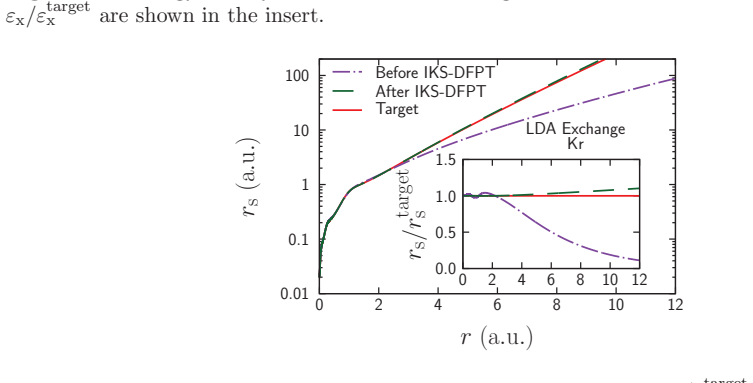
- [Sec. 3, Tables 1-2 and Fig. 2] The parameters λA and α are determined from the same atoms on which the energy and density improvements are then reported: Table 1 reports Ar and Kr after fitting to Ar and Kr, and Table 2 reports each pair after fitting to that same pair. The quoted improvement by two to three orders of magnitude in ground-state energies is therefore an in-sample residual of the inversion, not a predictive result. Please provide out-of-sample tests, such as fitting on Ar and Kr and then reporting errors for Ne, Xe, or another atom, including density errors before and after improvement. This is necessary to support the transferability claim in Sec. 4.
- [Sec. 4, conclusion] The conclusion states that the accuracy of ground-state energies is improved by two to three orders of magnitude and that the IKS-DFPT is promising to improve conventional functionals. This overstates what the benchmark shows: Table 2 reports errors in α of about 0.2–1.0% and errors in λA of about 2.3–7.6%, and these are errors in recovering a functional that lies exactly inside the assumed ansatz. The two-to-three-order improvement in energies is a consequence of using the same target-derived quantities in the fit and in the evaluation. The conclusion should be limited to the statement that the inversion works when the correction has the assumed form, and the open question of transferability to other functional forms should be stated explicitly.
minor comments (4)
- [Table 2 caption] The phrase 'their errors with respect to the target valued are shown' contains a typo; it should be 'target values'.
- [Sec. 2, Eq. (2)] The mass m in the Kohn-Sham equation is not specified; since the benchmark uses Hartree atomic units, the notation would be clearer if m is explicitly set to the electron mass or the atomic-unit convention is stated.
- [Sec. 2, after Eq. (7)] The sentence 'the KS potential V_KS(r) is unique concerning the system' is imprecise; the Kohn-Sham potential is unique up to an additive constant for a given density, and the statement could be clarified to refer to the Hohenberg-Kohn and Kohn-Sham uniqueness theorems.
- [Fig. 2] The inset in Fig. 2 is very small and the ratio rs/r_s^target is hard to read; a separate panel or larger inset would improve readability.
Circularity Check
The benchmark is partially circular: the ansatz Eq. (9) has exactly the single-power-law form of the target functional Eq. (11), and the parameters fitted to each atom pair are then evaluated on those same atoms, so the reported improvements are in-sample consistency checks rather than out-of-sample validation.
-
fitted input called prediction
[Section 3, Eqs. (9)-(11)]
"Because Eq. (8) is a functional equation, it is difficult to be solved directly. In this work, we assume E(1)_Hxc[ρ] = A ∫ [ρ(r)]^α dr, with the values of A and α to be determined... The Hartree and the Hartree plus LDA exchange functional (Hartree-Fock-Slater approximation) [13] are used for Ẽ_Hxc[ρ] and E_target_Hxc[ρ], respectively, as a benchmark: ... E_target_Hxc[ρ] = Ẽ_Hxc[ρ] − 3/4 (3/π)^{1/3} ∫ [ρ(r)]^{4/3} dr."
The assumed correction E^(1)_Hxc is a single power-law A∫ρ^α dr, and the target correction is exactly the same form with α = 4/3 and λA = −(3/4)(3/π)^{1/3}. Because the target lies inside the ansatz family, fitting A and α to the target's exact densities and energies must return near-target values; the benchmark therefore verifies the inversion of Eq. (10) for a functional that the ansatz can represent, not the validity of the power-law assumption for an arbitrary unknown functional.
-
fitted input called prediction
[Section 3, Tables 1-2 and Fig. 2; Section 4]
"To determine A and α, two systems, Systems 1 and 2, are required... All the pairs of the isolated noble-gas atoms (He, Ne, Ar, Kr, Xe, and Rn) are used as Systems 1 and 2. ... In Table 1, the coefficients α and λA and the ground-state energies Egs calculated in the IKS-DFPT are shown for the pair of atoms Ar-Kr."
For the Ar-Kr pair, the coefficients λA and α are determined from the exact densities and energies of Ar and Kr, and the improved ground-state energies for Ar and Kr are then reported in the same table and their densities in Fig. 2 as the IKS-DFPT result. No atom is held out from the fit, so the claimed 2-3 order-of-magnitude improvement in energies and 1-2 order improvement in densities is an in-sample consistency check. Table 2 shows that A and α vary with the chosen pair, so a system-independent functional is not actually extracted and tested on unseen systems.
full rationale
The theoretical part is not circular: Eq. (7) derives a linear functional equation for E^(1)_Hxc from first-order DFPT and the IKS representation of the exact energy, and this step does not presuppose the form of the correction. The circularity enters only in the benchmark. Eq. (9) is introduced as an explicit ansatz, which is legitimate in an inverse-problem test; however, the target chosen in Eq. (11) is the Hartree energy plus a Dirac exchange term, which has exactly the same single-power-law form as the ansatz. Consequently, when A and α are fitted to two atoms, the recovered coefficients must be close to the target values provided the inversion is stable, and the subsequent tables and figures showing improved energies/densities for those same atoms are a measure of how well the fitted parameters reproduce the data used to obtain them. The conclusion extrapolates from this in-sample reproduction to the general statement that IKS-DFPT improves conventional functionals; that extrapolation is not supported by an out-of-sample test, because all reported benchmarks use at least one of the fitting atoms as the evaluation system, and the ansatz is not justified for functionals with a different density dependence. There is no load-bearing self-citation here: Ref. [5] is the previous paper proposing the method, but the present paper re-derives the working equation and the circularity does not come from citing that work. Score 6 reflects that the central demonstration reduces to an in-sample fit of a power-law ansatz whose target has the same power-law form, while the foundational derivation itself retains independent content.
Assumptions & free parameters
free parameters (2)
- α (exponent in correction ansatz) =
1.3290958 for Ar-Kr pair; target 4/3
- λA (amplitude of correction) =
-0.7658732 for Ar-Kr pair; target -0.7385588
assumptions (4)
- domain assumption Exact ground-state density is available and the Kohn-Sham potential is unique.
- domain assumption The difference between the base functional and the exact functional is small enough for first-order perturbation theory.
- ad hoc to paper The correction functional has the exact power-law form E^(1)_Hxc[ρ] = A ∫ ρ^α dr.
- domain assumption The external field is unchanged by the perturbation, V_exact_ext = V_tilde_ext.
Cite this review
Pith. "Pith review of How to Improve Functionals in Density Functional Theory? ---Formalism and Benchmark Calculation---." pith.science (2026). https://pith.science/paper/GOAPW3M4
@misc{pith2026190809063,
  author       = {Pith},
  title        = {Pith review of: How to Improve Functionals in Density Functional Theory? ---Formalism and Benchmark Calculation---},
  year         = {2026},
  howpublished = {\url{https://pith.science/paper/GOAPW3M4}},
  note         = {Machine review of arXiv:1908.09063}
}
abstract
We proposed in Ref. [arXiv:1812.09285v2] a way to improve energy density functionals in the density functional theory based on the combination of the inverse Kohn-Sham method and the density functional perturbation theory. In this proceeding, we mainly focus on the results for the $ \mathrm{Ar} $ and $ \mathrm{Kr} $ atoms.
Figures

Reference graph
Works this paper leans on
-
[5]
Naito T, Ohashi D and Liang H 2018 Improvement of Function als in Density Functional Theory by the Inverse Kohn-Sham Method and Density Functional Perturbation Theo ry ( Preprint arXiv:1812.09285v2)
work page Pith review arXiv 2018
-
[1]
Hohenberg P and Kohn W 1964 Phys. Rev. 136 B864
work page 1964
-
[2]
Kohn W and Sham L J 1965 Phys. Rev. 140 A1133
1965
-
[3]
Bender M, Heenen P H and Reinhard P G 2003 Rev. Mod. Phys. 75 121
work page 2003
-
[4]
Nakatsukasa T, Matsuyanagi K, Matsuo M and Yabana K 2016 Rev. Mod. Phys. 88 045004
work page 2016
-
[6]
Wang Y and Parr R G 1993 Phys. Rev. A 47 R1591
work page 1993
-
[7]
Zhao Q and Parr R G 1993 J. Chem. Phys. 98 543
work page 1993
-
[8]
Baroni S, Giannozzi P and Testa A 1987 Phys. Rev. Lett. 58 1861
work page 1987
Show all 14 references
-
[9]
Gonze X 1995 Phys. Rev. A 52 1096
1995
-
[10]
Gonze X and Vigneron J P 1989 Phys. Rev. B 39 13120
1989
-
[11]
Baroni S, de Gironcoli S, Dal Corso A and Giannozzi P 2001 Rev. Mod. Phys. 73 515
2001
-
[12]
Feynman R P 1939 Phys. Rev. 56 340
1939
-
[13]
Dirac P A M 1930 Proc. Camb. Phil. Soc. 26 376
1930
-
[14]
Kohn W 1999 Rev. Mod. Phys. 71 1253
1999
Reviewed August 14, 2026 · model on record in the stance chip above.
Discussion (0). Continue with ORCID to comment.