REVIEW 2 major objections 4 minor 52 references
Neutrino-less double beta decay in the $\nu$ Standard Model
T0 review · 2 major / 4 minor · reviewed 2026-08-15 · deepseek-v4-flash
Pith's one-line read In the minimal 3+3 Type-I seesaw model, current and next-generation neutrinoless double beta decay searches can discover the model in either mass ordering.
desk verdict Comprehensive νSM global scan with a credible central claim about 0νββ reach, though the numeric boundaries depend on unpropagated nuclear uncertainties and the results are not yet independently reproducible. read the letter →
The pith
A machine-rendered reading of the paper's core claim, the machinery that carries it, and where it could break.
The reading
What carries the argument
The central object is the mass-dependent amplitude $A_\nu(m_i)$ in Eq. (10), which splits the contribution of each neutrino mass eigenstate into three momentum regimes: for $m_i<100$ MeV, potential, hard, and ultrasoft pieces; for $100$ MeV $\le m_i < 2$ GeV, potential and hard pieces; and for $m_i\ge 2$ GeV, a dimension-nine operator controlled by the short-range low-energy constant $g_{\rm NN}^{\nu}$. The inverse half-life in Eq. (9) is proportional to the square of the weighted sum of these six amplitudes, so cancellations between active and sterile contributions can suppress the rate while individual sterile contributions can greatly enhance it. The paper also defines the effective Majorana mass $|m_{\rm eff}^{\beta\beta}|$ in Eq. (11), which reduces to $m_{\beta\beta}$ in the high-scale seesaw limit; the deviation of this quantity from the light-exchange-only band is the signature that sterile neutrinos participate in the decay. The statistical machinery is a frequentist profile likelihood over the full parameter space, which converts the scan into confidence regions for $|m_{\rm eff}^{\beta\beta}|$ and $T_{1/2}^{0\nu}$.
What would settle it
Compute the $0\nu\beta\beta$ nuclear matrix elements for $^{136}$Xe and $^{76}$Ge and the short-range four-nucleon constant $g_{\rm NN}^{\nu}$ with controlled uncertainties; if, for example, the $^{136}$Xe matrix element turned out to be 1.0 rather than 2.7, the predicted half-lives in the sterile-dominated region would lengthen by roughly a factor of seven, pushing the 95% C.L. discovery boundary beyond next-generation ton-scale sensitivity. On the experimental side, a $0\nu\beta\beta$ signal with $|m_{\rm eff}^{\beta\beta}|$ above the maximum allowed by light-neutrino exchange in the relevant ordering would confirm that sterile neutrinos contribute.
Extended reading notes
Core claim
The paper's central claim is that in the 3+3 Type-I seesaw model (the $\nu$SM), the neutrinoless double $\beta$ decay rate is not governed by the light-neutrino-only effective mass $|m_{\beta\beta}|$ once sterile neutrinos are light enough to participate. The full amplitude sums contributions from all six Majorana neutrino mass eigenstates, with the sterile contribution entering through mass-dependent momentum regions: potential, hard, and ultrasoft. As a result, the allowed values of the effective Majorana mass $|m_{\rm eff}^{\beta\beta}|$ and the half-life $T_{1/2}^{0\nu}$ spread over many orders of magnitude, extending well beyond the high-scale seesaw band. The profile likelihoods, built from an 18-dimensional scan subject to a broad set of low- and high-energy constraints, show 68% and 95% confidence regions reaching half-lives that current and next-generation experiments can test, in both normal and inverted ordering. This is what the authors call the model's broad discovery potential.
Load-bearing premise
The quantitative boundaries of the claimed discovery reach assume the nuclear matrix elements $M_\nu^{(3)}=2.7$ for $^{136}$Xe and $3.4$ for $^{76}$Ge, together with the short-range constant $g_{\rm NN}^{\nu}$, and these inputs are used without propagating their uncertainties; if they differ substantially from the true values, the predicted half-lives shift by the square of that difference and the claimed reach moves with them.
Editorial extensions
If this is right
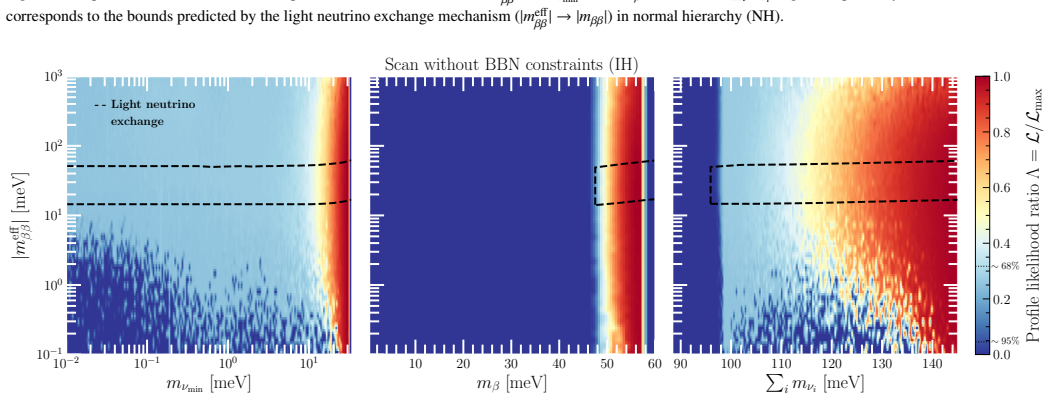
- In the $\nu$SM, the 95% C.L. region for $|m_{\rm eff}^{\beta\beta}|$ extends well beyond the band allowed by light-neutrino exchange alone, in both mass orderings and with or without big-bang nucleosynthesis constraints.
- Current experiments sensitive to half-lives near $10^{26}$ years and next-generation ton-scale searches near $10^{28}$ years already overlap a substantial part of the high-likelihood region, so a discovery is possible in either ordering.
- A signal with $|m_{\rm eff}^{\beta\beta}|$ above the maximum allowed by light-neutrino exchange would indicate sterile-neutrino contributions, and the correlation with the lightest sterile mass $M_1$ could help identify the mass scale responsible.
- Imposing big-bang nucleosynthesis constraints narrows the allowed parameter space, especially for light sterile neutrinos, and shifts the profile likelihood toward longer half-lives, making the discovery potential more conservative but still present.
- The same framework predicts that long half-lives above $10^{28}$ years remain allowed, so a null result at ton-scale sensitivity would not rule the model out but would erode the discovery-potential claim.
Reading between the lines
- If the model is right, a future neutrinoless double beta decay signal cannot be unambiguously interpreted as pure light-Majorana-neutrino exchange: any value of $|m_{\rm eff}^{\beta\beta}|$ above the light-exchange ceiling would be direct evidence for sterile neutrinos, while a value inside the light band would still allow a sterile component hidden by destructive interference.
- The quantitative reach boundaries are conditional on the assumed nuclear matrix elements and the short-range low-energy constant; because the half-life scales as the inverse square of these inputs, improved nuclear-structure calculations could move the 95% C.L. edges by a factor of several, so the reach statements should be revisited as those uncertainties shrink.
- If future cosmology closes the entropy-production or axion-like-particle escape routes that avoid big-bang nucleosynthesis bounds, the no-BBN scenarios that open up the light-sterile and short-half-life region would be disfavored, concentrating the discovery potential in the heavier sterile mass range.
Signed reviews
Editorial analysis
A structured set of objections, weighed in public.
Referee Report
Summary. The paper studies the 3+3 Type-I seesaw extension of the Standard Model ('nuSM') with three right-handed neutrinos whose masses range from keV to 10 TeV. It performs an 18-dimensional parameter scan using the GAMBIT framework, incorporates updated constraints from neutrino oscillation data, electroweak precision observables, CKM unitarity, rare decays, cosmology (DESI 2024), direct sterile-neutrino searches, and BBN (with and without), and computes the neutrinoless double beta decay (0νββ) half-life using the EFT formalism of Ref. [26]. Results are presented as profile-likelihood plots for |meff_ββ| and T1/2 for 76Ge and 136Xe, and the central claim is that current and next-generation 0νββ experiments have broad discovery potential in both normal and inverted neutrino mass orderings.
Significance. If the central claim holds, this would be a useful and fairly comprehensive phenomenological map of the seesaw parameter space relevant to 0νββ, updating earlier N=2 and restricted N=3 studies. The paper's strengths include the use of a public, well-tested scanning framework (GAMBIT), a validated parametrization of the seesaw mixing matrix, an up-to-date set of experimental constraints, and a state-of-the-art EFT treatment of 0νββ from Ref. [26]. The predicted half-life profiles are falsifiable and directly relevant to current and next-generation experiments. The main weakness is that the quantitative reach claim is conditional on fixed nuclear matrix elements and a short-range low-energy constant whose uncertainties are not propagated.
major comments (2)
- [Sec. 4, Eqs. (9)–(11); Figs. 5–6] The half-life and |meff_ββ| profiles are computed with central values only for the nuclear matrix elements M_ν^(3) = 2.7 (136Xe) and 3.4 (76Ge) and for the short-range LEC gNN_ν(m_i) from Ref. [29]. Because T1/2 scales as the inverse square of the total 0νββ amplitude, a factor-of-2 to 3 uncertainty in the NME translates into a factor-of-4 to 9 (roughly an order of magnitude) shift in the T1/2 profile. The location of the 95% C.L. boundary in Fig. 5 directly controls the overlap with the 10^26–10^28 yr experimental window, so the claim of broad current and next-generation discovery potential is conditional on these unpropagated inputs. The authors should propagate these uncertainties or, at minimum, show how the boundaries in Figs. 5 and 6 move under a conservative variation of M_ν^(3) and gNN_ν.
- [Sec. 5, Fig. 5] The 1D profile likelihood for T1/2 appears flat at Λ = 1 over many orders of magnitude (e.g., from about 10^20 to 10^40 yr in the no-BBN cases), and this flat region is the basis for describing the discovery potential as 'broad'. Because the scan is a random differential-evolution run in an 18-dimensional parameter space, the apparent plateau could in principle reflect incomplete coverage rather than a genuine likelihood maximum. Please provide convergence diagnostics (for example, reproducibility of L_max across independent runs or comparison with a second scanning method) or otherwise justify that the flat profile is physical. If the plateau is robust, the central claim is strengthened; if it is a sampling artifact, the discovery-potential statement would need to be qualified.
minor comments (4)
- [Table 1] The sign convention for Δm²_3ℓ is only specified in the table caption ('with '+' and ℓ=1 ... and '−' and ℓ=2'). It would be clearer to state the NH/IH assignment explicitly in the table itself or in a dedicated footnote.
- [Sec. 4, Eq. (11)] Eq. (11) defines |meff_ββ| using the light-neutrino NME M_ν^(3), while the actual half-life in Eq. (9) receives sterile-neutrino contributions through A_ν(m_i). The text should state more explicitly that |meff_ββ| is a convenient rescaling of T1/2 for presentation purposes and not the physical amplitude, to avoid confusion for readers who identify |meff| with the standard light-neutrino effective mass.
- [Captions of Figs. 1–4] The phrase 'bounds predicted by the light neutrino exchange mechanism' is slightly misleading, since the dashed lines are envelopes of the light-neutrino-only region rather than sharp bounds. Consider replacing 'bounds' with 'allowed region' or 'envelope'.
- [Reproducibility] The paper should state the GAMBIT version used and provide or link the scanner configuration files (including likelihood definitions and parameter ranges) so that the 18-dimensional profile likelihood can be reproduced by independent groups.
Circularity Check
No significant circularity: model parameters are constrained externally and 0νββ half-lives are computed from them; prior EFT inputs are cited, not fitted to the target.
full rationale
The paper's derivation chain is self-contained in the relevant sense: the 18-dimensional Type-I seesaw parameters are sampled with GAMBIT and constrained by oscillation data, electroweak precision, direct searches, CKM inputs, LHCb/CMS flavor data, and DESI cosmology (Sec. 3). The 0νββ half-life is then computed from Eq. (9) as a function of these parameters, and the profile likelihoods in Figs. 1-5 are obtained by projecting scans; no 0νββ observable is used to fit the model, so the plotted T1/2 is a genuine model prediction rather than a fit renamed as a prediction. Eq. (11) merely defines a plotting variable |meff_ββ| in terms of the computed half-life, and its reduction to mββ in the high-scale limit is stated as a property, not used to define the model. The amplitude formula and the numerical inputs M_ν^(3)=2.7(3.4) and gNNν(mi) are adopted from Refs. [26,29,30], which include overlapping authors; this is a real dependence of the numerical reach on prior theory inputs. However, those inputs are external published EFT calculations with stated assumptions, they do not contain the present target result (the discovery potential of current/next-generation experiments), and their uncertainty is a robustness/correctness issue, not a circular one. No step reduces, by construction, to an input fitted from the target data, and no load-bearing uniqueness claim is imported from the authors' prior work. Therefore no circular step is present.
Assumptions & free parameters
free parameters (5)
- a1, a2, a3 (R-matrix real rotation parameters) =
scanned uniformly in [-10, 10]
- φ1, φ2, φ3 (R-matrix imaginary rotation parameters) =
scanned uniformly in [-10, 10]
- M1, ΔM21, ΔM32 (sterile mass scale and splittings) =
M1 log-uniform in [10^-6, 10^4] GeV; ΔM log-uniform in [10^-7, 10^4] GeV
- m_νmin (lightest active neutrino mass) =
log-uniform in [10^-5, 0.05] eV
- Nuclear matrix element M_ν^(3) and short-range LEC gNN_ν(m_i) =
M_ν^(3) = 2.7 (136Xe), 3.4 (76Ge); gNN_ν from Ref. [29] (fixed values)
assumptions (5)
- domain assumption The 3+3 Type-I seesaw Lagrangian (Eq. 1) with only dimension-≤4 operators is the complete source of neutrino mass and lepton-number violation; no other LNV operators contribute to 0νββ.
- domain assumption The 0νββ amplitude decomposition of Eq. (10) from Ref. [26], including the hard, potential, and ultrasoft contributions and the matching onto dimension-9 operators for m_i ≥ 2 GeV, is correct and complete.
- domain assumption The active neutrino parameters sampled within the NuFIT 3σ ranges and the DESI 2024 bound on Σ m_νi correctly describe the light neutrino sector.
- domain assumption When BBN constraints are imposed, standard cosmology is assumed; when they are omitted, non-standard cosmological mechanisms (e.g., entropy production [24] or axion-like particle decays [25]) are implicitly required for consistency.
- standard math Profile likelihood ratios are interpreted as confidence intervals via Wilks' theorem (Eq. 12), which requires the likelihood to be regular and the Diver scan to have converged over the 18-dimensional space.
Cite this review
Pith. "Pith review of Neutrino-less double beta decay in the $\nu$ Standard Model." pith.science (2026). https://pith.science/paper/GPHADMFG
@misc{pith2026250509679,
  author       = {Pith},
  title        = {Pith review of: Neutrino-less double beta decay in the $\nu$ Standard Model},
  year         = {2026},
  howpublished = {\url{https://pith.science/paper/GPHADMFG}},
  note         = {Machine review of arXiv:2505.09679}
}
abstract
We perform a comprehensive study of the $3+3$ Type-I seesaw model for a broad range of right-handed mass scales (from keV to 10 TeV). We take into account and, in some cases, update the constraints from a large number of high- and low-energy experiments and study the implications on neutrino-less double beta ($0\nu\beta\beta$) decay experiments. We illustrate our findings through profile likelihood plots for the half-life $T_{1/2}^{0\nu}$ and two-dimensional plots correlating $T_{1/2}^{0\nu}$ to neutrino masses. We find that in this simple class of models for Majorana neutrino masses, current and next-generation $0\nu\beta\beta$ decay experiments have a broad discovery potential in both the normal and inverted orderings of the spectrum of light active neutrinos.
Figures


Figures from the paper (3 more)


Reference graph
Works this paper leans on
- [26]
-
[29]
V . Cirigliano, W. Dekens, and S. Urrutia Quiroga, JHEP 04, 181 (2025), arXiv:2412.10497 [hep-ph]
arXiv 2025
-
[1]
A. M. Abdullahi et al., J. Phys. G 50, 020501 (2023), arXiv:2203.08039 [hep-ph]
arXiv 2023
-
[2]
T. Asaka and M. Shaposhnikov, Phys. Lett. B 620, 17 (2005), arXiv:hep- ph/0505013
-
[3]
L. Canetti, M. Drewes, T. Frossard, and M. Shaposhnikov, Phys. Rev. D 87, 093006 (2013), arXiv:1208.4607 [hep-ph]
arXiv 2013
-
[4]
Minkowski, Phys
P. Minkowski, Phys. Lett. B 67, 421 (1977)
1977
-
[5]
M. Gell-Mann, P. Ramond, and R. Slansky, Conf. Proc. C 790927, 315 (1979), arXiv:1306.4669 [hep-th]
arXiv 1979
-
[6]
Yanagida, Conf
T. Yanagida, Conf. Proc. C 7902131, 95 (1979)
1979
Show all 52 references
-
[7]
S. L. Glashow, NATO Sci. Ser. B 61, 687 (1980)
1980
-
[8]
R. N. Mohapatra and G. Senjanovic, Phys. Rev. Lett. 44, 912 (1980)
1980
-
[9]
Donini, P
A. Donini, P. Hernandez, J. Lopez-Pavon, M. Maltoni, and T. Schwetz, JHEP 07, 161 (2012), arXiv:1205.5230 [hep-ph]
2012 arXiv
-
[10]
J. A. Casas and A. Ibarra, Nucl. Phys. B 618, 171 (2001), arXiv:hep- ph/0103065
2001
-
[11]
Esteban, M
I. Esteban, M. C. Gonzalez-Garcia, M. Maltoni, I. Martinez-Soler, and T. Schwetz, JHEP 01, 087 (2017), arXiv:1611.01514 [hep-ph]
2017 arXiv
-
[12]
Chrzaszcz, M
M. Chrzaszcz, M. Drewes, T. E. Gonzalo, J. Harz, S. Krishnamurthy, and C. Weniger, Eur. Phys. J. C80, 569 (2020), arXiv:1908.02302 [hep-ph]
2020 arXiv
-
[13]
Athron et al
P. Athron et al. (GAMBIT), Eur. Phys. J. C 77, 784 (2017), [Addendum: Eur.Phys.J.C 78, 98 (2018)], arXiv:1705.07908 [hep-ph] . 5 10□2 10□1 100 101 mνmin [meV] 10□1 100 101 102 103 |meff ββ|[meV] - - Light neutrino exchange 10 20 30 mβ [meV] Scan with BBN constraints (NH) 60 70 ...
2017 arXiv
-
[14]
G. D. Martinez, J. McKay, B. Farmer, P. Scott, E. Roebber, A. Putze, and J. Conrad (GAMBIT), Eur. Phys. J. C 77, 761 (2017), arXiv:1705.07959 [hep-ph]
2017 arXiv
-
[15]
P. D. Bolton, F. F. Deppisch, and P. S. B. Dev, in 56th Rencontres de Moriond on Electroweak Interactions and Unified Theories (2022) arXiv:2206.01140 [hep-ph]
2022 arXiv
-
[16]
Cirigliano, A
V . Cirigliano, A. Crivellin, M. Hoferichter, and M. Moulson, Phys. Lett. B 838, 137748 (2023), arXiv:2208.11707 [hep-ph]
2023 arXiv
-
[17]
Bazavov et al
A. Bazavov et al. (Fermilab Lattice, MILC), Phys. Rev. D 99, 114509 (2019), arXiv:1809.02827 [hep-lat]
2019 arXiv
-
[18]
Aoki et al
Y . Aoki et al. (Flavour Lattice Averaging Group (FLAG)), (2024), arXiv:2411.04268 [hep-lat]
2024 arXiv
-
[19]
J. C. Hardy and I. S. Towner, Phys. Rev. C 102, 045501 (2020)
2020
-
[20]
A. G. Adame et al. (DESI), (2024), arXiv:2404.03002 [astro-ph.CO]
2024 arXiv
-
[21]
Aaij et al
R. Aaij et al. (LHCb), Phys. Rev. D 108, 032002 (2023), arXiv:2212.09153 [hep-ex]
2023
-
[22]
Tumasyan et al
A. Tumasyan et al. (CMS), Phys. Rev. D 105, 072008 (2022), arXiv:2201.07861 [hep-ex]
2022 arXiv
-
[23]
A. D. Dolgov and F. L. Villante, Nucl. Phys. B 679, 261 (2004), arXiv:hep-ph/0308083
2004 arXiv
-
[24]
G. M. Fuller, C. T. Kishimoto, and A. Kusenko, (2011), arXiv:1110.6479 [astro-ph.CO]
2011 arXiv
-
[25]
F. F. Deppisch, T. E. Gonzalo, C. Majumdar, and Z. Zhang, (2024), arXiv:2410.06970 [hep-ph]
2024 arXiv
-
[27]
Navas et al
S. Navas et al. (Particle Data Group), Phys. Rev. D 110, 030001 (2024)
2024
- [28]
-
[30]
Cirigliano, W
V . Cirigliano, W. Dekens, J. de Vries, M. L. Graesser, and E. Mereghetti, JHEP 12, 097 (2018), arXiv:1806.02780 [hep-ph]
2018 arXiv
-
[31]
James, Statistical methods in experimental physics (2006)
F. James, Statistical methods in experimental physics (2006)
2006
-
[32]
S. S. Wilks, Annals Math. Statist. 9, 60 (1938)
1938
-
[33]
A. A. Esfahani et al. (Project 8), in Snowmass 2021 (2022) arXiv:2203.07349 [nucl-ex]
2022 arXiv
-
[34]
Aker et al
M. Aker et al. (KATRIN), J. Phys. G 49, 100501 (2022), arXiv:2203.08059 [nucl-ex]
2022 arXiv
-
[35]
Esteban, M
I. Esteban, M. C. Gonzalez-Garcia, M. Maltoni, I. Martinez-Soler, J. a. P. Pinheiro, and T. Schwetz, JHEP 12, 216 (2024), arXiv:2410.05380 [hep- ph]
2024 arXiv
-
[36]
Drewes and B
M. Drewes and B. Garbrecht, Nucl. Phys. B 921, 250 (2017), arXiv:1502.00477 [hep-ph]
2017 arXiv
-
[37]
F. F. Deppisch, P. S. Bhupal Dev, and A. Pilaftsis, New J. Phys. 17, 075019 (2015), arXiv:1502.06541 [hep-ph]
2015 arXiv
-
[38]
Agostini, G
M. Agostini, G. Benato, and J. Detwiler, Phys. Rev. D 96, 053001 (2017), arXiv:1705.02996 [hep-ex]
2017 arXiv
-
[39]
Antel et al., Eur
C. Antel et al., Eur. Phys. J. C 83, 1122 (2023), arXiv:2305.01715 [hep- ph]
2023 arXiv
-
[40]
de Vries, M
J. de Vries, M. Drewes, Y . Georis, J. Klari ´c, and V . Plakkot, (2024), arXiv:2407.10560 [hep-ph]
2024 arXiv
-
[41]
Abada, G
A. Abada, G. Arcadi, V . Domcke, M. Drewes, J. Klaric, and M. Lucente, 6 10 16 10 20 10 24 10 28 10 32 10 36 10 40 10 44 T 0ν 1/2 [yr] 0.0 0.2 0.4 0.6 0.8 1.0 Profile likelihood ratio Λ = L/Lmax NH ∼ 68% ∼ 95% 10 16 10 20 10 24 10 28 10 32 10 36 10 40 10 44 T 0ν 1/2 [yr] 0.0 0....
2019 arXiv
-
[42]
Agostini et al
M. Agostini et al. (GERDA), Phys. Rev. Lett. 125, 252502 (2020), arXiv:2009.06079 [nucl-ex]
2020 arXiv
-
[43]
Abe et al
S. Abe et al. (KamLAND-Zen), Phys. Rev. Lett. 130, 051801 (2023), arXiv:2203.02139 [hep-ex]
2023
-
[44]
J. J. Gomez-Cadenas (2019) pp. 201–206, arXiv:1906.01743 [hep-ex]
2019 arXiv
-
[45]
Abgrall et al
N. Abgrall et al. (LEGEND), AIP Conf. Proc. 1894, 020027 (2017), arXiv:1709.01980 [physics.ins-det]
2017 arXiv
-
[46]
J. B. Albert et al. (nEXO), Phys. Rev. C 97, 065503 (2018), arXiv:1710.05075 [nucl-ex]
2018 arXiv
-
[47]
Han (PandaX-III), J
K. Han (PandaX-III), J. Phys. Conf. Ser. 1342, 012095 (2020), arXiv:1710.08908 [physics.ins-det]
2020 arXiv
-
[48]
Armengaud et al., Eur
E. Armengaud et al., Eur. Phys. J. C 80, 44 (2020), arXiv:1909.02994 [physics.ins-det]
2020 arXiv
-
[49]
Paton (SNO +), in Prospects in Neutrino Physics (2019) arXiv:1904.01418 [hep-ex]
J. Paton (SNO +), in Prospects in Neutrino Physics (2019) arXiv:1904.01418 [hep-ex]
2019 arXiv
-
[50]
Aker et al
M. Aker et al. (KATRIN), Science 388, adq9592 (2025), arXiv:2406.13516 [nucl-ex]
2025
-
[51]
Abed Abud et al
A. Abed Abud et al. (DUNE), (2025), arXiv:2503.23291 [hep-ex]
2025
-
[52]
Albanese et al
R. Albanese et al. (SHiP, HI-ECN3 Project Team), (2025), arXiv:2504.06692 [hep-ex] . 7
2025 arXiv
Reviewed August 15, 2026 · model on record in the stance chip above.
Discussion (0). Continue with ORCID to comment.