REVIEW 4 major objections 6 minor 1 cited by
TouchThinker scales tactile commonsense to open-world settings by pairing a million-frame multi-sensor dataset with action-aware touch representations.
Reviewed by Pith at T0; open to challenge. T0 means a machine referee read the full paper against a public rubric. the ladder, T0–T4 →
T0 review · grok-4.5
2026-07-14 18:04 UTC pith:GQQSKLQB
load-bearing objection Solid multi-source tactile-language systems paper: real data scale-up + action-aware encoder with clean gains; open-world claim is a bit ahead of the supervision story. the 4 major comments →
TouchThinker: Scaling Tactile Commonsense Reasoning to the Open World with Large-scale Data and Action-aware Representation
The pith
A machine-rendered reading of the paper's core claim, the machinery that carries it, and where it could break.
Core claim
TouchThinker claims that open-world tactile commonsense becomes attainable when large multi-source visuotactile data is combined with representations that exploit the redundancy and action-specificity of touch: question-guided token fusion plus Gaussian temporal MoE experts localize the informative contact segments, and a two-stage tactile–language training pipeline aligns those representations with LLM reasoning, producing higher accuracy and stronger cross-sensor generalization than prior tactile-language models.
What carries the argument
Action-aware modeling: question-guided cross-attention over frame tokens, then a router that soft-combines Gaussian temporal experts whose windows focus on the query-relevant press/slide/rotate segments so only informative contact dynamics reach the language model.
Load-bearing premise
That four unified tactile attributes plus language-model-written chain-of-thought and open answers, after manual filtering, give enough causal supervision for transferable open-world tactile commonsense rather than sensor- or template-specific correlations.
What would settle it
Hold out objects and sensors whose behavior requires properties outside the four-attribute schema (for example time-dependent stickiness, thermal cues, or long-horizon malleability) and re-run the same train–test protocol; a large drop relative to in-schema tasks would falsify the claim that the current data-and-representation package already yields open-world tactile commonsense.
If this is right
- Multi-sensor, multi-object tactile corpora can teach sensor-invariant physical properties instead of imaging quirks.
- Explicitly linking question semantics to contact actions improves attribute prediction and multi-step tactile reasoning.
- Open-ended tactile answers become more evidence-grounded when training includes chain-of-thought and free-form formats built from diverse sources.
- Language-instructed robots can better choose materials and interaction strategies from touch alone.
- Unseen-sensor evaluation becomes a practical test of whether true tactile semantics, not gel appearance, have been learned.
Where Pith is reading between the lines
- The same sparse, question-driven temporal focusing may transfer to other event-like streams such as force–torque or event cameras where most frames carry little task signal.
- Expanding beyond the four-attribute schema is the natural next stress test of whether hardness/friction-style labels suffice for everyday physical planning.
- Because the data are mostly 6–8 second clips, long-horizon contact histories are likely the next bottleneck for manipulation policies that must reason over extended touch.
- Distilling the action-aware encoder for on-robot compute may matter more for deployment than further scaling only the language backbone.
Editorial analysis
A structured set of objections, weighed in public.
Referee Report
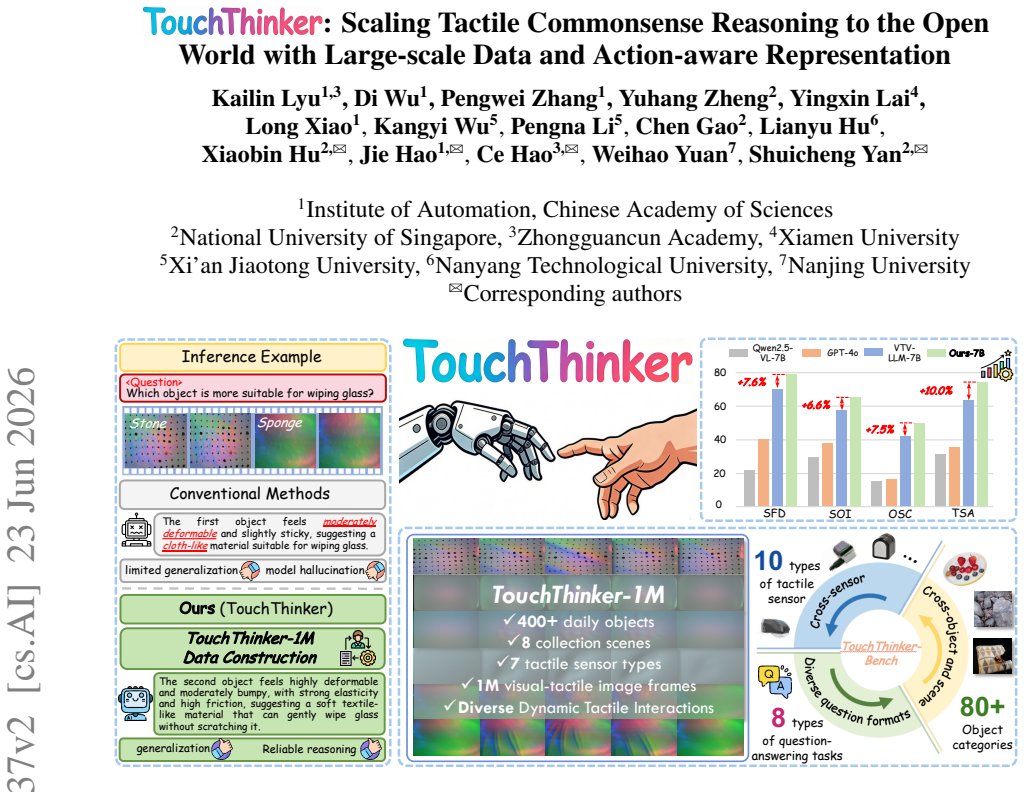
Summary. TouchThinker addresses open-world tactile commonsense reasoning by combining a large multi-source visuotactile corpus (TouchThinker-1M: ~1M frames, 415 objects, 7 sensor types, 8 scenarios) with an action-aware tactile encoder and a two-stage tactile–language training pipeline. The representation module first fuses frame tokens under question guidance, then routes them through a Gaussian temporal MoE that soft-selects action-specific intervals (Eqs. 1–3). Supervision is expanded beyond templated attribute QA to chain-of-thought and open-ended formats. The authors also release TouchThinker-Bench for unseen-object and unseen-sensor evaluation. Empirically, TouchThinker-7B improves average accuracy on the VTV-150K protocol from 60.4% (VTV-LLM-7B) to 67.4% (Table 1), remains stronger under held-out sensors/objects (Table 3), and scores higher on open-ended METEOR/LLM-judge metrics (Table 2). Ablations remove action-aware modeling and each training stage (Tables 4, 6).
Significance. If the results hold under tighter scrutiny of the synthetic supervision and open-ended evaluation, the paper is a useful step for embodied multimodal reasoning: it scales tactile–language data across sensors and interaction types, and it makes the action-specific, redundant nature of tactile streams an explicit modeling target rather than a uniform video encoding problem. The multi-source corpus and the planned public release of code/data are concrete community assets. The fair-protocol gains on VTV-150K and the cross-sensor property-prediction results are the most transferable empirical contributions; the action-aware Gaussian MoE is a clear, ablatable design choice that other tactile MLLMs can adopt or refute.
major comments (4)
- [§3, A.1.2; Figs. 7–8] The open-world / causal-commonsense claim rests on CoT and open-ended instruction data that are synthesized from object class plus the four unified attributes (hardness, protrusion, elasticity, friction) and text templates, without the generator observing visuotactile frames (A.1.2 Stages 2–4; Figs. 7–8). Manual filtering only removes blatant inconsistencies. Under this construction, Stage-II SFT can improve by (i) predicting the four attributes from the encoder and (ii) emitting the corresponding language prior, without requiring the Gaussian temporal windows to surface unannotated physical evidence. This is load-bearing for Adv.2 and for the narrative that TouchThinker-1M supplies “reasoning from tactile observations to physical commonsense.” Please either (a) re-generate or re-annotate a non-trivial subset with frame-conditioned human or multi-annotator rationales, (b) report controll
- [§6.1, Table 2, A.3.2] Open-ended quality is scored with METEOR plus GPT-5 and DeepSeek-V4 multi-dimensional judges (Table 2; §6.1; A.3.2), while the instruction targets themselves were produced by DeepSeek-V4 (A.1.2). Same-family automatic judges on model-generated references risk rewarding stylistic and prior alignment rather than tactile grounding. For a claim of “accurate and coherent open-ended response generation,” the paper needs at least a human preference / correctness study on a fixed sample (with inter-annotator agreement) or an independent judge family, and should report failure modes where fluent answers contradict the tactile evidence (as partially illustrated in Fig. 4).
- [§4, Table 3, A.2.1] TouchThinker-Bench is partly an object-level 6:1 hold-out from the same multi-source pool used for training, with additional unseen-sensor streams (DuraGel, commercial GelSight Mini, GelSight Var. 3) (§4; A.2.1). Table 3’s robustness claim is therefore strongest on the three truly unseen sensors and weaker on “unseen objects” that share acquisition pipelines, materials, and attribute ontology with training. Please report sensor-stratified and source-stratified breakdowns (seen-sensor/unseen-object vs. unseen-sensor) and state explicitly which test objects/sensors never appear in any form in TouchThinker-1M, so that open-world generalization is not overstated.
- [§5.1 Eqs. (2)–(3); Tables 4, 6] The action-aware module is central, yet key design choices are underspecified for reproducibility and for interpreting the ablations: the number of Gaussian experts K, how μ_k/σ_k are initialized and constrained, and whether experts specialize by action type (press/slide/rotate) or only by temporal location. Table 4 and Table 6 show average drops when the module is removed, but do not show that the MoE improves reasoning beyond better four-attribute classification. A minimal load-bearing addition is an attribute-only vs. full-reasoning breakdown with/without MoE, plus the missing hyperparameter values (or a sensitivity plot over K).
minor comments (6)
- [Abstract, Fig. 1, §4, A.2.1] Abstract and Fig. 1 claim “415 objects, 8 scenarios, 7 sensor types” while the Bench text later mentions “10 tactile sensors” and “80+ object categories” / “200 object categories” in different places (§4 vs. A.2.1). Harmonize counts and define “scenario” vs. “scene category” once.
- [§5.1 Eq. (1)] Eq. (1) writes SelfAttn(CrossAttn(F, Q̃_w, Q̃_w)) without stating residual connections, layer norms, or whether Fqa replaces or augments F; a one-line architectural note would help implementers.
- [Table 1] Table 1 caption says “average over multiple runs” but no variance or number of seeds is reported; add mean±std or at least the seed count.
- [A.1.2, §4, Fig. 1] Several typos and wording glitches: “Tactilc Instruction” (A.1.2), “It designed for” (§4), “highlydeformable” / missing spaces in Fig. 1 caption text, “var.1” vs “var.2” sensor naming inconsistency across sources.
- [§9 Limitations] Limitations correctly notes missing attributes (malleability, prickliness) and short clips (6–8 s); consider elevating a short version of this into the main discussion so readers do not over-read the open-world claim.
- [§2, Fig. 2] Related work cites Octopi, VTV-LLM, UniTouch, T3, etc., appropriately; a brief comparison table of prior tactile–language datasets (sensors, #objects, QA formats) would make the “largest to date” claim easier to audit without reading A.1.1.
Circularity Check
Empirical ML paper with no derivation that collapses into its inputs; mild non-load-bearing concern only around LLM-synthesized open-ended targets sharing family with judges.
specific steps
-
other
[A.1.2 Stages 2-4 / Figs. 7-8; Sec. 6.1 evaluation]
"Using predefined prompt templates, we guide a large language model (DeepSeek-AI, 2026) to generate reasoning traces... This pipeline builds on object-level tactile data, object identifiers, and manually annotated tactile attribute descriptions, and uses DeepSeek-V4... we report METEOR... and further employ GPT-5 and DeepSeek-V4 as automatic judges"
Open-ended targets are synthesized from the same four attributes + class labels that the model is also trained to predict, then scored by models from the same LLM family. Free-form metrics can therefore reward attribute-to-language style match rather than novel tactile evidence extraction. This is not a mathematical reduction of a claimed prediction to its inputs, nor load-bearing for the exact-match VTV-150K results, so it is only a minor non-central concern.
full rationale
TouchThinker is an empirical systems paper: it curates multi-source data under a unified four-attribute schema, defines an action-aware encoder (question-guided fusion + Gaussian temporal MoE), trains a two-stage tactile-language model, and reports accuracy/METEOR/LLM-judge numbers on VTV-150K (external protocol, exact-match attribute and templated tasks) plus a held-out-object / unseen-sensor bench. No equation, uniqueness theorem, or fitted constant is presented as a first-principles prediction that is algebraically or statistically forced by construction. Ablations (Table 4, Table 6) remove components and measure drops; gains versus VTV-LLM and Octopi are measured, not derived. The only mild circularity-adjacent issue is that open-ended CoT/QA targets (A.1.2) are LLM-generated from object class + the four attributes (generator never sees frames) and later scored by GPT-5/DeepSeek-V4; this can inflate free-form scores by stylistic match, but it is not load-bearing for the central accuracy claims on VTV-150K or attribute prediction, nor does it reduce any claimed result to an input by definition. Standard object-level train/test split and external-sensor data supply independent grounding. Score 1 reflects only that non-central synthesis/judge overlap; the derivation chain itself is non-circular.
Axiom & Free-Parameter Ledger
free parameters (4)
- LoRA rank and scaling (r=128, alpha=256)
- Number of Gaussian temporal experts K and window parameters (μ_k, σ_k)
- Learning rate 2e-4, batch size 16, max steps 10k, warmup 0.1
- Unified four-attribute label mapping and manual adjudication rules
axioms (5)
- domain assumption Tactile video streams are highly redundant; task-relevant evidence is concentrated in a few action-specific segments (press→hardness, slide→friction, rotate→texture).
- ad hoc to paper A four-dimensional attribute space (hardness, protrusion, elasticity, friction) is a sufficient unified ontology for multi-source tactile commonsense supervision.
- domain assumption Frozen ViFi-CLIP-initialized tactile backbone plus a learned projector can align gel-deformation videos into an LLM token space well enough for reasoning.
- ad hoc to paper METEOR and multi-dimensional scores from GPT-5 / DeepSeek-V4 are valid proxies for open-ended tactile answer quality.
- standard math Softmax cross-entropy under teacher forcing is an appropriate objective for both alignment and CoT/open-ended SFT stages.
invented entities (3)
-
Action-aware Gaussian Temporal MoE (question-routed continuous temporal experts)
no independent evidence
-
TouchThinker-1M multi-source tactile reasoning corpus
no independent evidence
-
TouchThinker-Bench (unseen-object + unseen-sensor open-ended suite)
no independent evidence
read the original abstract
Touch is a key modality for embodied agents to understand the physical world. Although recent work has incorporated tactile signals into language systems for tactile commonsense reasoning, scaling such systems to realistic open-world settings remains challenging due to two key bottlenecks: (1) current tactile reasoning datasets remain limited in format and scale, providing insufficient supervision for reasoning from tactile observations to physical commonsense and hindering the learning of transferable tactile commonsense; (2) Tactile signals are inherently redundant and action-specific, yet existing methods often overlook these properties, resulting in inefficient representations with limited semantic expressiveness. To address these limitations, we propose TouchThinker, a tactile-language framework that scales tactile commonsense reasoning to the open world from both data and representation perspectives. First, we construct TouchThinker-1M, a million-scale, multi-source tactile reasoning dataset covering \textbf{415} objects, \textbf{8} scenarios, and \textbf{7} sensor types, providing a solid data foundation for open-world generalization. We further introduce TouchThinker-Bench, an open-world benchmark with more realistic and diverse tasks. Then, we propose action-aware modeling mechanism to improve tactile representation efficiency and enable efficient reasoning. Experimental results demonstrate that TouchThinker achieves competitive performance against state-of-the-art models across multiple datasets. Our code and dataset will be made available at: https://github.com/lvkailin0118/TouchThinker.
Figures


Forward citations
Cited by 1 Pith paper
-
TacReasoner: A Dynamic Tactile-Language Framework for Interactive Reasoning in Real-World Scenarios
A dynamic-aware tactile encoder plus TouchCoT-10k chain-of-thought data lets a 7B model outperform larger tactile-language baselines on physical-property and real-world reasoning tasks.
Reference graph
Works this paper leans on
-
[1]
Patrick Esser, Robin Rombach, and Bjorn Ommer
A survey of vision-language pre-trained mod- els.arXiv preprint arXiv:2202.10936. Patrick Esser, Robin Rombach, and Bjorn Ommer. 2021. Taming transformers for high-resolution image syn- thesis. InProceedings of the IEEE/CVF conference on computer vision and pattern recognition, pages 12873–12883. Ruoxuan Feng, Jiangyu Hu, Wenke Xia, Tianci Gao, Ao Shen, Y...
Pith/arXiv arXiv 2021
-
[2]
The objectfolder benchmark: Multisensory learning with neural and real objects. InProceedings of the IEEE/CVF Conference on Computer Vision and Pattern Recognition, pages 17276–17286. Carolina Higuera, Akash Sharma, Chaithanya Krishna Bodduluri, Taosha Fan, Patrick Lancaster, Mri- nal Kalakrishnan, Michael Kaess, Byron Boots, Mike Lambeta, Tingfan Wu, and...
Pith/arXiv arXiv 2024
-
[3]
Universal visuo-tactile video understanding for embodied interaction.Advances in Neural Infor- mation Processing Systems, 38:127864–127883. Zhengtong Xu, Raghava Uppuluri, Xinwei Zhang, Cael Fitch, Philip Glen Crandall, Wan Shou, Dongyi Wang, and Yu She. 2025. Unit: Data efficient tactile representation with generalization to unseen objects. IEEE Robotics...
Pith/arXiv arXiv 2025
discussion (0)
Sign in with ORCID, Apple, or X to comment. Anyone can read and Pith papers without signing in.