REVIEW 3 major objections 5 minor 1 cited by
Coordinated strategy tuples beat independent sampling for code pass@K under a fixed attempt budget.
Reviewed by Pith at T0; open to challenge. T0 means a machine referee read the full paper against a public rubric. the ladder, T0–T4 →
T0 review · grok-4.5
2026-07-12 15:55 UTC pith:GQY37BAE
load-bearing objection Solid fixed-budget pass@K recipe that actually coordinates strategies; fix the abstract number and ship the code. the 3 major comments →
Cast a Wider Net: Coordinated Pass@K Policy Optimization for Code Reasoning
The pith
A machine-rendered reading of the paper's core claim, the machinery that carries it, and where it could break.
Core claim
Under a fixed K=4 solver-attempt budget and the same verifier, a joint planner–solver policy that emits a coordinated K-tuple of high-level strategies and receives validity-gated pass@K credit improves pass@4 over independent sampling, planning baselines, planner-only SFT, and pass@K-oriented RL on competitive-programming benchmarks, with significant gains on six of nine model–benchmark cells.
What carries the argument
Coordinated Pass@K Policy Optimization (CPPO): an autoregressive strategy-tuple planner q(S|x) whose multiplicative reward R_plan = J_ψ · R_out is nonzero only for valid tuples that yield at least one verifier-confirmed solver success, trained with split-region GRPO advantages for planner and solver tokens.
Load-bearing premise
The problems of interest admit multiple genuinely distinct algorithmic strategies, so that allocating attempts across a coordinated strategy tuple can beat independent draws from a single answer distribution.
What would settle it
On the same held-out competitive-programming sets, under matched K=4 solver budget and verifier, a coordinated CPPO policy fails to beat the strongest independent-sampling or pass@K RL baseline once training seed and problem resampling are accounted for, or the same pipeline yields no gain once problems are restricted to those with a single canonical solution path.
Editorial analysis
A structured set of objections, weighed in public.
Referee Report
Summary. The paper proposes Coordinated Pass@K Policy Optimization (CPPO), which replaces independent answer sampling for pass@K code generation with a joint planner–solver policy: an autoregressive planner emits a K=4 tuple of high-level algorithmic strategies, and a shared solver produces one attempt per strategy. Planner credit uses a multiplicative reward R_plan = J_ψ · R_out that is nonzero only for validity-gated tuples that also yield at least one verifier-confirmed success; solver tokens receive within-tuple outcome advantages under GRPO. Under a matched K=4 solver-attempt budget, CPPO reports higher pass@4 than direct sampling, planning baselines, planner-only SFT, and pass@K-oriented RL (including PKPO and UpSkill) on APPS, CodeContests, and LiveCodeBench-v6 for Qwen3.5-{2B,4B,9B}, with hierarchical bootstrap significance on six of nine cells, plus supporting ablations, diversity metrics, maj@4 checks, and a Gemma-4 transfer experiment.
Significance. If the fixed-budget gains hold under independent replication, the work is a clear contribution to test-time compute allocation for code reasoning: it reframes pass@K from independent draws of one answer distribution into coordinated multi-strategy exploration, with a concrete RLVR training recipe. Strengths include multi-benchmark, multi-size evaluation; stage and reward-component ablations (Tables 5–6); joint-vs-iid inference decomposition (Appendix I); algorithmic-diversity measurement with classifier reliability checks (Appendix H); token-normalized accounting; maj@4 consistency on single-answer subtasks; hierarchical bootstrap over problems and seeds; and explicit scope limits for single-path math. The multiplicative validity gate and split-region GRPO design are well motivated and empirically isolated. The result is practically relevant for competitive-programming-style settings where any one correct attempt suffices.
major comments (3)
- [Abstract; Table 1; §1] Abstract vs. body inconsistency on the flagship result: the abstract claims Qwen3.5-9B LiveCodeBench-v6 improves from PKPO 0.588 to 0.748 (+0.16; “paired bootstrap”), while §1, Table 1, Appendix A, and Table 9 report 0.728 (+0.14) under hierarchical bootstrap. This is the paper’s own strongest advertised number and must be reconciled (and the bootstrap procedure named consistently) before acceptance; the directional claim is unaffected, but the abstract currently overstates the point estimate.
- [Figure 2; Appendix P; Table 22] For K_solve > 4, Figure 2 and Table 22 pool independent K_tuple=4 rollouts rather than training or sampling a single larger coordinated tuple. The manuscript states this correctly in Appendix P, but the main-text pass@K curves and the claim that “gains persist at larger attempt budgets” can still be read as if coordination scales with K. Please state the pooling protocol in the main text near Figure 2 and avoid language that implies a single K-way joint plan for K>4.
- [Table 1; Appendix B; §4.3] Statistical support rests on three training seeds. The hierarchical bootstrap and per-seed CIs in Appendix B are appropriately conservative, and six cells exclude zero, but three unmarked cells (2B APPS, 4B LCBv6, 9B APPS) have intervals that include zero despite positive means. The abstract’s “six of nine” phrasing is accurate; ensure the main claim does not over-generalize to uniform significance, and consider whether additional seeds or a pre-registered primary cell would strengthen the headline transfer result.
minor comments (5)
- [Abstract; §4.3] Abstract and early prose sometimes say “paired bootstrap” while §4.3 defines hierarchical problem-and-seed bootstrap; align terminology throughout.
- [Table 4; Appendix M] Table 4 / Appendix M: planner–solver token split is missing for some LCBv6 rows (dashed cells). Either recover the split or note why only aggregate decoded length is available so token-normalized comparisons remain interpretable.
- [Limitations] Limitations correctly flag single-path math; a short qualitative failure case (or a small MATH/AIME pilot) would make the scope boundary more concrete for readers outside competitive programming.
- [Ethics Statement / Code and artifact release] Code, RM checkpoints, and judge prompts are promised only upon acceptance. For reproducibility review, a minimal public artifact (sandbox config, evaluation harness, seed logs) would help even before full release.
- [Appendix C; table captions] Minor polish: ensure consistent reporting of ±std vs. bootstrap CIs in captions; check that Example strategy tuples in Appendix C are clearly labeled as post-hoc illustration only (already mostly done).
Circularity Check
No significant circularity: pass@K gains are measured by external sandboxed verification on decontaminated held-out benchmarks, not forced by the training objective or self-citation.
full rationale
CPPO is an empirical RLVR method, not a first-principles derivation. The load-bearing claim is that a joint planner–solver policy trained with R_plan = J_ψ · R_out improves pass@4 under a fixed K=4 solver-attempt budget. That claim is tested against independent baselines on APPS, CodeContests valid, and LiveCodeBench-v6 with decontamination, hierarchical bootstrap over problems and seeds, and ablations that remove the validity gate, outcome credit, across-tuple normalization, and joint (vs iid) inference. J_ψ is a frozen validity filter trained on LLM-judge labels for parseability/non-duplication/no-leakage; the paper itself reports that it matches those labels (AUC 0.971) but only weakly predicts solver success (AUC 0.572), so planner credit is not the evaluation target by construction—R_out and final pass@K come from sandboxed execution of official tests. There is no fitted parameter renamed as a prediction, no uniqueness theorem imported from the authors, and no self-citation chain that forces the result. The abstract/body mismatch on the headline LCBv6 number (0.748 vs 0.728) is a presentation inconsistency, not circular reduction of the claim to its inputs. Score 0 is the honest finding.
Axiom & Free-Parameter Ledger
free parameters (4)
- planner tuple size K_tuple =
4
- validity-gate threshold τ =
0.17
- across-tuple sample count M =
8
- AdamW learning rate and GRPO clip/KL =
lr=5e-7, ε=0.2, β_KL=0.01
axioms (4)
- domain assumption Binary execution verifier V(x,y)∈{0,1} is a sufficient reward for correctness in competitive programming.
- domain assumption Many competitive-programming problems admit multiple distinct algorithmic strategies such that covering strategies improves pass@K more than resampling one mode.
- standard math GRPO with group-normalized advantages and clipped KL-regularized updates is a valid policy optimizer for the split planner/solver token regions.
- ad hoc to paper A small generative plan-validity model trained on LLM-as-judge labels can gate malformed/duplicate/leaky plans without needing to score task quality.
invented entities (3)
-
Coordinated strategy-tuple policy π_Θ(τ|x)=q_Θ(S|x)∏p_Θ(y_i|x,s_i)
independent evidence
-
Multiplicative planner reward R_plan=J_ψ·R_out
independent evidence
-
Plan-validity gate J_ψ
no independent evidence
read the original abstract
Repeated sampling with a verifier is the standard way to allocate test-time compute for code generation, with pass@$K$ as the canonical metric. Yet the standard policy class draws $K$ independent samples from a single answer distribution, so attempts often collapse onto near-duplicate reasoning paths and waste the budget on redundant rollouts. This failure is costly in competitive programming, where many problems admit multiple distinct algorithmic strategies and pass@$K$ requires only one correct attempt. We propose Coordinated Pass@$K$ Policy Optimization (CPPO), which turns pass@$K$ generation into joint exploration over strategies: a planner emits a tuple of $K{=}4$ alternative high-level methods, and a shared solver attempts one solution per method. CPPO trains this joint policy with a multiplicative planner reward, $R_{\mathrm{plan}} = J_\psi \cdot R_{\mathrm{out}}$, assigning credit only to valid strategy tuples that lead to verifier-confirmed pass@$K$ success. Across APPS, CodeContests, and LiveCodeBench-v6, CPPO improves pass@$4$ over direct sampling, planning baselines, planner-only SFT, and pass@$K$-oriented RL under the same $K{=}4$ solver-attempt budget, with statistically significant gains on six of nine model--benchmark cells. The largest single gain is $+0.16$ on Qwen3.5-9B LiveCodeBench-v6 over the strongest baseline, PKPO ($0.588 \rightarrow 0.748$; paired bootstrap, $p < 0.05$).
Figures


Forward citations
Cited by 1 Pith paper
-
Rank-Conditioned Sample Reuse for the Plackett--Luce Best-of-$K$ Objective
Rank-conditioned Horvitz–Thompson reuses all C(n,K) subsets of one Gumbel-Top-n pool for unbiased Plackett–Luce best-of-K value and score-function gradient, with an exact Max-specific DP collapse to a 1-D integral.
Reference graph
Works this paper leans on
-
[1]
Training verifiers to solve math word prob- lems.arXiv preprint arXiv:2110.14168. Google DeepMind. 2026. Gemma 4: Open lightweight models. Official model cards, https://ai. google.dev/gemma. Gemma 4 E2B and E4B. LiveCodeBench-v6 pass@4 values used in this paper (44.0% for E2B, 52.0% for E4B) reproduced from the official model-card evaluation tables. Acces...
Pith/arXiv arXiv 2026
-
[2]
DeepSeek-R1: Incentivizing reasoning capa- bility in LLMs via reinforcement learning.Nature, 645:633–638. Dan Hendrycks, Steven Basart, Saurav Kadavath, Man- tas Mazeika, Akul Arora, Ethan Guo, Collin Burns, Samir Puranik, Horace He, Dawn Song, and Jacob Steinhardt. 2021. Measuring coding challenge com- petence with APPS. InAdvances in Neural Infor- matio...
Pith/arXiv arXiv 2021
-
[3]
The same base-model solver is given a prompt that asks it to first write a solution plan and then write the code
-
[4]
For each problem we sample K full solution attempts under that prompt
-
[5]
Each attempt passes through the same code extraction, sandboxed execution, and verifier pipeline
-
[6]
This comparison isolates the effect of adding a planning prompt before code generation
Pass@K is the fraction of problems on which at least one of theKattempts passes the tests. This comparison isolates the effect of adding a planning prompt before code generation. PlanSearch (Wang et al., 2024) as a planning baseline.We follow the released implementation, using eight candidate plans per problem and the same solver/verifier pipeline as the ...
2024
-
[7]
The base model first generates multiple candi- date plans per problem; we use8candidates
-
[8]
The candidates are selected and organized into plans usable for solving
-
[9]
The same frozen base-model solver then gener- ates code conditioned on each selected plan
-
[10]
This comparison isolates inference-time multi-plan search without planner training
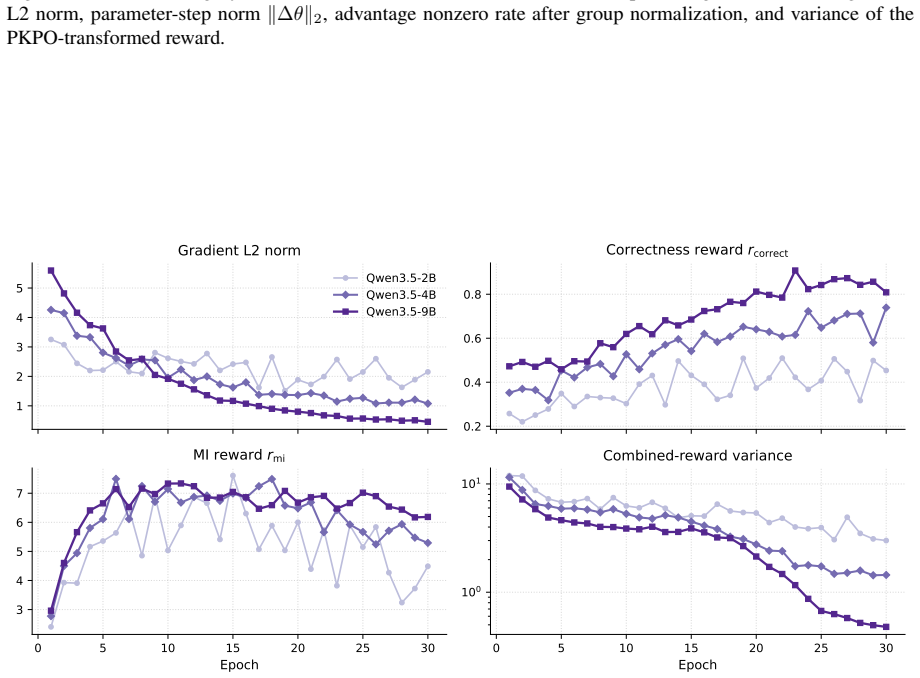
Each problem is evaluated under a budget of K solver attempts, with the same verifier and pass@Kdefinition as above. This comparison isolates inference-time multi-plan search without planner training. PKPO (Walder and Karkhanis, 2025) as a pass@K RL baseline.PKPO transforms the per- sample reward vector r∈ {0,1} n over n≥k samples of the same problem into...
2025
discussion (0)
Sign in with ORCID, Apple, or X to comment. Anyone can read and Pith papers without signing in.