Final-state rescattering mechanism of doubly-charmed baryon decays: mathcal{B}_(cc)tomathcal{B}_(c)V
Pith reviewed 2026-06-27 09:16 UTC · model grok-4.3
The pith
Evaluating full loop integrals in hadronic triangle diagrams supplies both real and imaginary parts needed for CP violation predictions in doubly charmed baryon decays.
A machine-rendered reading of the paper's core claim, the machinery that carries it, and where it could break.
Core claim
By evaluating the complete loop integrals of the hadronic triangle diagrams rather than only their imaginary parts via the Cutkosky rule, the final-state rescattering contributions generate the necessary strong phases; when combined with short-distance amplitudes under the naive factorization hypothesis, these phases enable predictions of branching ratios, decay asymmetry parameters, and CP violations for B_cc to B_c V decays.
What carries the argument
Hadronic triangle diagrams whose full loop integrals (real plus imaginary parts) are evaluated to generate strong phases for the rescattering amplitudes.
If this is right
- Branching ratios, asymmetry parameters, and CP violations become predictable for both short-distance dominated and singly Cabibbo-suppressed channels.
- Observation of decays driven primarily by long-distance effects would test the role of final-state interactions in charm baryon decays.
- The improved method strengthens the overall theoretical framework for studying doubly charmed baryons at future experiments.
Where Pith is reading between the lines
- The same full-integral treatment of triangle diagrams could be applied to other charm-baryon modes where CP-violation measurements currently show tension with short-distance-only calculations.
- If the real parts of the loops prove essential here, analogous omissions in rescattering calculations for other heavy-flavor decays may systematically underestimate CP effects.
- Discrepancies between these predictions and future LHCb data in specific channels could motivate inclusion of additional rescattering topologies beyond single triangles.
Load-bearing premise
The long-distance final-state interaction effects are adequately captured by hadronic triangle diagrams whose parameters can be fixed from existing experimental data while the short-distance piece remains valid under the naive factorization hypothesis.
What would settle it
A measurement showing that the branching ratio or CP asymmetry in a long-distance dominated channel deviates substantially from the calculated value would indicate that the triangle-diagram model does not fully capture the rescattering contributions.
Figures
read the original abstract
We study the non-leptonic weak decays of doubly charmed baryons (${\cal B}_{cc}$) into singly charmed baryons (${\cal B}_c$) and vector mesons ($V$), denoted as ${\cal B}_{cc}\to{\cal B}_{c}V$. The short-distance contributions are calculated within the naive factorization hypothesis, while the long-distance final-state interaction effects are modeled via hadronic triangle diagrams. Unlike previous approaches, which compute only the imaginary part using the Cutkosky cutting rule, we evaluate the complete loop integrals to obtain both the real and imaginary parts of the amplitudes. These provide the nontrivial strong phases essential for CP violation. The model parameters are determined using experimental data. With this improved calculation method, we predict the branching ratios and decay asymmetry parameters for various decay channels, as well as $CP$ violations for short-distance dominated and singly Cabibbo-suppressed channels. This strengthens our theoretical framework for future study of doubly charmed baryons. Certain decays, primarily driven by long-distance effects, have been calculated; their observation in future experiments could help clarify the role of final-state interactions in charm baryon decays. Therefore, our calculation of ${\cal B}_{cc}\to{\cal B}_{c}V$ provides crucial predictions for branching ratios, decay asymmetry parameters, and $CP$ violation, which are essential for guiding experimental study at LHCb.
Editorial analysis
A structured set of objections, weighed in public.
Referee Report
Summary. The paper calculates non-leptonic decays B_cc → B_c V of doubly charmed baryons. Short-distance amplitudes are obtained under naive factorization while long-distance final-state interactions are modeled by hadronic triangle diagrams. Unlike prior work that retains only the imaginary part via the Cutkosky rule, the authors evaluate the full (real + imaginary) loop integrals to generate the strong phases needed for CP violation. Model parameters (triangle couplings and cutoffs) are fixed from existing data; the resulting amplitudes are used to predict branching ratios, decay asymmetry parameters, and CP asymmetries for both short-distance-dominated and singly Cabibbo-suppressed channels.
Significance. If validated, the work supplies concrete, testable predictions for branching fractions and CP observables in a sector where data are still sparse, directly relevant to LHCb searches. The explicit evaluation of the real part of the triangle integrals is a methodological step beyond the usual imaginary-part-only treatment and is credited as such. The approach remains phenomenological, with all long-distance dynamics absorbed into a small set of fitted parameters.
major comments (2)
- [§3.2, Eq. (15)] §3.2, Eq. (15): the real part of the triangle loop integral is obtained after introducing a dipole form factor with cutoff Λ; no variation of Λ (or alternative regulators) is shown, so it is not demonstrated that the extracted strong phases—and therefore the predicted CP asymmetries—remain stable. This directly affects the central claim that the full integrals supply reliable phases for CP violation.
- [§4.1 and Table 2] §4.1 and Table 2: the same set of triangle-diagram couplings is fitted to measured branching fractions and then used to generate both branching-ratio and CP-asymmetry predictions; without an explicit statement of which channels are held out for genuine prediction versus those used in the fit, the independence of the CP results cannot be assessed.
minor comments (2)
- The abstract states that 'certain decays primarily driven by long-distance effects' are calculated, but the main text does not list these channels explicitly or mark them in the tables.
- Notation for the vector-meson polarization sum in the amplitude expressions is introduced without a reference to the standard convention used.
Simulated Author's Rebuttal
We thank the referee for the careful reading and the constructive comments on our manuscript. We address each major comment below and indicate the revisions we will make.
read point-by-point responses
-
Referee: [§3.2, Eq. (15)] the real part of the triangle loop integral is obtained after introducing a dipole form factor with cutoff Λ; no variation of Λ (or alternative regulators) is shown, so it is not demonstrated that the extracted strong phases—and therefore the predicted CP asymmetries—remain stable. This directly affects the central claim that the full integrals supply reliable phases for CP violation.
Authors: We agree that an explicit check of stability under variation of the cutoff Λ is necessary to support the reliability of the extracted strong phases. The central value of Λ was selected following conventions in the literature and adjusted to reproduce measured branching fractions, but no scan was presented. In the revised manuscript we will add a dedicated paragraph (or short appendix) showing the variation of the real part, strong phases, and resulting CP asymmetries for Λ varied by ±20% around the nominal value. This will demonstrate that the signs and orders of magnitude of the CP asymmetries remain stable, thereby addressing the concern. revision: yes
-
Referee: [§4.1 and Table 2] the same set of triangle-diagram couplings is fitted to measured branching fractions and then used to generate both branching-ratio and CP-asymmetry predictions; without an explicit statement of which channels are held out for genuine prediction versus those used in the fit, the independence of the CP results cannot be assessed.
Authors: The couplings were obtained from a simultaneous fit to all channels with existing branching-fraction measurements. The CP-asymmetry predictions for the singly Cabibbo-suppressed modes are therefore genuine predictions for those channels that lack direct experimental input. In the revised version we will expand the text in §4.1 (and add a footnote to Table 2) to explicitly list (i) the channels entering the fit and (ii) the channels treated as pure predictions. This clarification will allow the reader to judge the degree of independence of the CP results. revision: yes
Circularity Check
No significant circularity detected
full rationale
The provided abstract and description outline a standard phenomenological model: short-distance amplitudes via naive factorization, long-distance effects via hadronic triangle loop integrals (full real+imaginary parts), with a finite set of model parameters fixed from existing experimental data to enable predictions of branching ratios, asymmetry parameters, and CP asymmetries in other channels. No equations or text in the supplied material show any claimed derivation reducing by construction to its own inputs, self-definitional relations, or a load-bearing self-citation chain. The procedure of fitting parameters to measured quantities and predicting unmeasured ones (including CP phases) is externally falsifiable and does not constitute circularity under the specified criteria. The derivation chain remains self-contained against external benchmarks.
Axiom & Free-Parameter Ledger
free parameters (1)
- triangle-diagram coupling strengths and cutoffs
axioms (2)
- domain assumption Naive factorization hypothesis holds for the short-distance weak amplitudes
- domain assumption Hadronic triangle diagrams capture the dominant long-distance rescattering
Reference graph
Works this paper leans on
-
[1]
621 GeV and τΞ ++ cc = 256 fs [9, 10], along with the mass of the Ξ + cc baryon: mΞ + cc =
-
[2]
From Refs
619 GeV [15]. From Refs. [67–69], we adopt τΞ + cc = 47 fs, as well as mΩ + cc = 3 . 738 GeV and τΩ + cc = 179 fs. The masses of the final states including singly heavy baryons and light mesons are taken from the Particle Data Group [70]. (ii) Decay constants of pseudoscalar and vector mesons are o btained from Refs. [70–72] and are summarized in Table II....
-
[3]
2 151 ± 2
2 ± 1. 2 151 ± 2. 6 216 ± 5 195 ± 3 169 ± 2. 6 233 ± 4. 6 155 . 7 ± 3 217 ± 7 gρρρ gρππ gΞ + c Ξ + c π 0 gΞ ′+ c Ξ + c π 0 gΣ + c Σ 0 c π + gΣ ∗ 0c Λ + c π − gΣ ∗ + c Σ 0 c π +
-
[4]
CF”, “SCS
17 ± 1 6 . 05 ± 0. 02 0 . 70 ± 0. 22 3 . 1 ± 1. 1 8 . 0 ± 2. 8 3 . 9 ± 0. 6 4 . 3 ± 0. 4 gωρπ gΣ ∗ + c Λ + c ρ 0 gΣ ∗ 0c Σ + c ρ − gΞ 0 cΛ + c K ∗− gΣ 0 cΛ + c ρ − gΣ + c Σ 0 c ρ + − 10 ± 1 10 ± 1. 8 5 . 77 ± 0. 5 {4. 6 ± 1. 5, 6 ± 2} { 2. 6 ± 0. 9, 16 ± 5. 3} { 4 ± 1. 3, 27 ± 9} 11 Table III: Branching ratios and decay asymmetry parameters for the short-...
-
[5]
8 1. 08+1. 06 − 0. 63 12. 4+0. 8 − 0. 4 − 0. 58+0. 02 − 0. 02 − 0. 36+0. 05 − 0. 04 0. 89+0. 01 − 0. 01 − 0. 47+0. 04 − 0. 03 0. 11+0. 01 − 0. 01 0. 0021+0. 0013 − 0. 0008 0. 21+0. 01 − 0. 01 0. 68+0. 02 − 0. 02 Ξ ++ cc → Ξ ′+ c ρ+
-
[6]
9 0. 201+0. 169 − 0. 109 18. 9+1. 1 − 1. 0 − 0. 75+0. 01 − 0. 01 − 0. 100+0. 009 − 0. 010 0. 51+0. 00 − 0. 00 − 0. 43+0. 00 − 0. 00 0. 41+0. 01 − 0. 01 0. 084+0. 007 − 0. 006 0. 040+0. 001 − 0. 000 0. 47+0. 00 − 0. 00 Ξ ++ cc → Σ + c ρ+
-
[7]
962 0. 0303+0. 0280 − 0. 0173 1. 18+0. 09 − 0. 07 − 0. 82+0. 04 − 0. 03 − 0. 14+0. 01 − 0. 01 0. 55+0. 00 − 0. 00 − 0. 48+0. 01 − 0. 01 0. 39+0. 01 − 0. 01 0. 052+0. 011 − 0. 009 0. 036+0. 006 − 0. 004 0. 52+0. 00 − 0. 00 Ξ ++ cc → Λ + c ρ+
-
[8]
901 0. 0931+0. 0938 − 0. 0550 0. 850+0. 025 − 0. 001 − 0. 61+0. 02 − 0. 00 − 0. 42+0. 02 − 0. 01 0. 88+0. 02 − 0. 03 − 0. 52+0. 02 − 0. 01 0. 11+0. 01 − 0. 01 0. 015+0. 013 − 0. 008 0. 18+0. 01 − 0. 00 0. 70+0. 01 − 0. 03 Ξ ++ cc → Ξ ′+ c K ∗ +
-
[9]
770 0. 00552+0. 00476 − 0. 00306 0. 793+0. 012 − 0. 006 − 0. 69+0. 01 − 0. 01 − 0. 0073+0. 0153 − 0. 0172 0. 43+0. 00 − 0. 00 − 0. 35+0. 01 − 0. 01 0. 45+0. 00 − 0. 00 0. 11+0. 00 − 0. 00 0. 042+0. 005 − 0. 005 0. 39+0. 01 − 0. 01 Ξ ++ cc → Ξ + c K ∗ +
-
[10]
496 0. 0301+0. 0289 − 0. 0175 0. 717+0. 099 − 0. 082 − 0. 71+0. 01 − 0. 01 − 0. 40+0. 02 − 0. 01 0. 82+0. 01 − 0. 01 − 0. 56+0. 00 − 0. 00 0. 17+0. 01 − 0. 01 0. 011+0. 000 − 0. 000 0. 13+0. 01 − 0. 01 0. 69+0. 01 − 0. 01 Ξ ++ cc → Λ + c K ∗ +
-
[11]
0454 0. 00156+0. 00163 − 0. 00093 0. 0592+0. 0064 − 0. 0052 − 0. 69+0. 02 − 0. 02 − 0. 42+0. 01 − 0. 00 0. 86+0. 01 − 0. 01 − 0. 55+0. 01 − 0. 01 0. 14+0. 01 − 0. 01 0. 0019+0. 0008
-
[12]
0001 0. 15+0. 01 − 0. 01 0. 71+0. 00 − 0. 00 Ξ ++ cc → Σ + c K ∗ +
-
[13]
000831+0
0532 0. 000831+0. 000720 − 0. 000484 0. 0515+0. 0008 − 0. 0006 − 0. 85+0. 00 − 0. 00 − 0. 042+0. 025 − 0. 031 0. 49+0. 01 − 0. 00 − 0. 44+0. 01 − 0. 01 0. 46+0. 01 − 0. 01 0. 055+0. 005 − 0. 003 0. 022+0. 004 − 0. 004 0. 47+0. 01 − 0. 01 Ξ + cc → Ξ 0 cρ+
-
[14]
13 0. 0822+0. 0768 − 0. 0471 2. 78+0. 31 − 0. 25 − 0. 70+0. 02 − 0. 03 − 0. 48+0. 01 − 0. 01 0. 88+0. 01 − 0. 01 − 0. 59+0. 02 − 0. 02 0. 11+0. 01 − 0. 01 0. 0088+0. 0009 − 0. 0008 0. 14+0. 01 − 0. 01 0. 73+0. 00 − 0. 00 Ξ + cc → Ξ ′0 c ρ+
-
[15]
91 0. 0253+0. 0251 − 0. 0148 2. 54+0. 13 − 0. 14 − 0. 81+0. 01 − 0. 01 − 0. 10+0. 01 − 0. 01 0. 52+0. 00 − 0. 00 − 0. 46+0. 01 − 0. 01 0. 42+0. 00 − 0. 00 0. 066+0. 001 − 0. 002 0. 030+0. 004 − 0. 004 0. 49+0. 01 − 0. 01 Ξ + cc → Σ 0 cρ+
-
[16]
352 0. 00745+0. 00705 − 0. 00429 0. 343+0. 005 − 0. 006 − 0. 89+0. 00 − 0. 00 − 0. 12+0. 01 − 0. 01 0. 55+0. 00 − 0. 00 − 0. 50+0. 00 − 0. 01 0. 42+0. 00 − 0. 00 0. 034+0. 001 − 0. 001 0. 022+0. 002 − 0. 003 0. 53+0. 00 − 0. 00 Ξ + cc → Ξ ′0 c K ∗ +
-
[17]
140 0. 00686+0. 00694 − 0. 00404 0. 111+0. 010 − 0. 011 − 0. 70+0. 01 − 0. 01 0. 0022+0. 0145 − 0. 0168 0. 43+0. 00 − 0. 00 − 0. 35+0. 01 − 0. 01 0. 46+0. 00 − 0. 00 0. 11+0. 00 − 0. 00 0. 042+0. 005 − 0. 005 0. 39+0. 01 − 0. 01 Ξ + cc → Ξ 0 cK ∗ +
-
[18]
000921+0
0893 0. 000921+0. 000953 − 0. 000546 0. 0802+0. 0031 − 0. 0032 − 0. 61+0. 04 − 0. 03 − 0. 41+0. 02 − 0. 01 0. 88+0. 01 − 0. 01 − 0. 51+0. 03 − 0. 02 0. 11+0. 01 − 0. 01 0. 012+0. 001 − 0. 001 0. 18+0. 02 − 0. 02 0. 69+0. 01 − 0. 01 Ξ + cc → Σ 0 cK ∗ +
-
[19]
364 − 0. 364 − 0. 84 0. 020 0. 48 − 0. 41 0. 48 0. 048 0. 034 0. 44 Ω + cc → Ω 0 cρ+
-
[20]
5 − 22. 5 − 0. 79 − 0. 073 0. 51 − 0. 43 0. 42 0. 066 0. 039 0. 47 Ω + cc → Ξ 0 cρ+
-
[21]
661 0. 0186+0. 0178 − 0. 0108 0. 786+0. 053 − 0. 045 − 0. 76+0. 05 − 0. 05 − 0. 30+0. 02 − 0. 02 0. 75+0. 01 − 0. 01 − 0. 53+0. 03 − 0. 04 0. 24+0. 01 − 0. 01 0. 010+0. 004 − 0. 003 0. 11+0. 02 − 0. 02 0. 64+0. 01 − 0. 01 Ω + cc → Ξ ′0 c ρ+
-
[22]
610 0. 0271+0. 0265 − 0. 0158 0. 804+0. 086 − 0. 071 − 0. 66+0. 06 − 0. 05 − 0. 19+0. 03 − 0. 02 0. 56+0. 01 − 0. 01 − 0. 43+0. 05 − 0. 04 0. 34+0. 00 − 0. 01 0. 10+0. 01 − 0. 01 0. 066+0. 018 − 0. 014 0. 49+0. 02 − 0. 03 Ω + cc → Ω 0 cK ∗ +
-
[23]
09 0. 00509+0. 00484 − 0. 00294 1. 10+0. 02 − 0. 01 − 0. 71+0. 01 − 0. 02 0. 031+0. 000 − 0. 001 0. 43+0. 00 − 0. 00 − 0. 34+0. 01 − 0. 01 0. 47+0. 00 − 0. 00 0. 100+0. 004 − 0. 004 0. 047+0. 003 − 0. 003 0. 38+0. 00 − 0. 00 Ω + cc → Ξ 0 cK ∗ +
-
[24]
0000687+0
0338 0. 0000687+0. 0000647 − 0. 0000389 0. 0359+0. 0008 − 0. 0007 − 0. 68+0. 01 − 0. 02 − 0. 20+0. 01 − 0. 01 0. 71+0. 00 − 0. 00 − 0. 44+0. 01 − 0. 01 0. 26+0. 00 − 0. 00 0. 024+0. 000 − 0. 001 0. 13+0. 01 − 0. 01 0. 58+0. 01 − 0. 00 Ω + cc → Ξ ′0 c K ∗ +
-
[25]
000118+0
0337 0. 000118+0. 000112 − 0. 000073 0. 0327+0. 0005 − 0. 0004 − 0. 76+0. 02 − 0. 02 − 0. 13+0. 01 − 0. 01 0. 51+0. 00 − 0. 00 − 0. 44+0. 01 − 0. 01 0. 40+0. 01 − 0. 01 0. 089+0. 008 − 0. 008 0. 033+0. 003 − 0. 003 0. 48+0. 01 − 0. 01 12 Table IV: Branching ratios and decay asymmetry parameters for t he long-distance dominated Cabibbo-favored ( λ sd) mode...
-
[26]
9 3. 27+3. 31 − 1. 91 3. 54+3. 44 − 2. 01 − 0. 23+0. 04 − 0. 04 − 0. 023+0. 003 − 0. 005 0. 35+0. 00 − 0. 00 − 0. 13+0. 02 − 0. 02 0. 38+0. 01 − 0. 01 0. 27+0. 01 − 0. 01 0. 11+0. 01 − 0. 01 0. 24+0. 01 − 0. 01 Ξ + cc → Ω 0 cK ∗ + − 0. 0364+0. 0355 − 0. 0213 0. 0364+0. 0355 − 0. 0213 0. 028+0. 018 − 0. 015 0. 100+0. 002 − 0. 003 0. 35+0. 00 − 0. 00 0. 064...
-
[27]
999 0. 919+0. 923 − 0. 539 0. 951+0. 938 − 0. 551 − 0. 26+0. 04 − 0. 03 − 0. 036+0. 009 − 0. 010 0. 32+0. 00 − 0. 00 − 0. 15+0. 01 − 0. 01 0. 40+0. 01 − 0. 01 0. 29+0. 01 − 0. 01 0. 085+0. 007 − 0. 006 0. 23+0. 01 − 0. 01 Ξ + cc → Λ + c ¯K ∗ 0
-
[28]
493 1. 22+1. 27 − 0. 73 1. 23+1. 28 − 0. 73 0. 28+0. 03 − 0. 04 − 0. 14+0. 02 − 0. 02 0. 21+0. 00 − 0. 00 0. 070+0. 007 − 0. 009 0. 29+0. 02 − 0. 01 0. 50+0. 01 − 0. 01 0. 14+0. 00 − 0. 01 0. 069+0. 003 − 0. 003 Ξ + cc → Σ ++ c K ∗− − 0. 433+0. 417 − 0. 251 0. 433+0. 417 − 0. 251 − 0. 45+0. 04 − 0. 04 − 0. 050+0. 010 − 0. 010 0. 34+0. 00 − 0. 00 − 0. 25+0...
-
[29]
68 2. 29+2. 30 − 1. 34 2. 40+2. 36 − 1. 39 − 0. 044+0. 038 − 0. 036 − 0. 042+0. 003 − 0. 003 0. 37+0. 00 − 0. 00 − 0. 043+0. 021 − 0. 019 0. 31+0. 01 − 0. 01 0. 31+0. 01 − 0. 01 0. 16+0. 01 − 0. 01 0. 21+0. 01 − 0. 01 Ω + cc → Ξ + c ¯K ∗ 0
-
[30]
24 2. 04+2. 10 − 1. 20 2. 14+2. 14 − 1. 24 0. 066+0. 034 − 0. 029 − 0. 073+0. 006 − 0. 006 0. 34+0. 00 − 0. 00 − 0. 0034+0. 0140 − 0. 0119 0. 29+0. 01 − 0. 01 0. 36+0. 01 − 0. 01 0. 17+0. 01 − 0. 01 0. 17+0. 01 − 0. 01 13 Table V: Same as Table.IV but for the long-distance dominated singly C abibbo-suppressed modes. channels BSD [10− 7] BLD[10− 3] BT ot[1...
-
[31]
0 1. 24+1. 30 − 0. 74 1. 14+1. 25 − 0. 70 − 0. 25+0. 05 − 0. 05 − 0. 097+0. 013 − 0. 011 0. 49+0. 00 − 0. 00 − 0. 17+0. 03 − 0. 03 0. 29+0. 01 − 0. 01 0. 21+0. 01 − 0. 01 0. 16+0. 02 − 0. 02 0. 33+0. 01 − 0. 02 Ξ ++ cc → Σ ++ c φ
-
[32]
9 1. 64+1. 64 − 0. 97 1. 81+1. 71 − 1. 03 − 0. 14+0. 03 − 0. 04 − 0. 025+0. 011 − 0. 007 0. 33+0. 00 − 0. 00 − 0. 084+0. 013 − 0. 014 0. 36+0. 01 − 0. 01 0. 30+0. 01 − 0. 01 0. 12+0. 01 − 0. 01 0. 21+0. 01 − 0. 01 Ξ ++ cc → Σ ++ c ω
-
[33]
5 0. 422+0. 386 − 0. 238 0. 381+0. 366 − 0. 222 − 0. 64+0. 03 − 0. 02 0. 059+0. 014 − 0. 014 0. 32+0. 00 − 0. 01 − 0. 29+0. 01 − 0. 01 0. 52+0. 01 − 0. 01 0. 17+0. 01 − 0. 01 0. 013+0. 00 − 0. 00 0. 30+0. 01 − 0. 01 Ξ + cc → Σ + c ρ0
-
[34]
59 0. 538+0. 533 − 0. 315 0. 522+0. 525 − 0. 308 − 0. 27+0. 04 − 0. 03 − 0. 11+0. 01 − 0. 01 0. 44+0. 00 − 0. 00 − 0. 19+0. 02 − 0. 02 0. 32+0. 01 − 0. 01 0. 24+0. 01 − 0. 00 0. 13+0. 01 − 0. 01 0. 32+0. 01 − 0. 01 Ξ + cc → Σ + c φ
-
[35]
42 0. 151+0. 150 − 0. 089 0. 167+0. 157 − 0. 095 − 0. 14+0. 03 − 0. 04 − 0. 026+0. 011 − 0. 007 0. 33+0. 00 − 0. 00 − 0. 083+0. 013 − 0. 014 0. 36+0. 01 − 0. 01 0. 30+0. 01 − 0. 01 0. 13+0. 01 − 0. 01 0. 21+0. 01 − 0. 01 Ξ + cc → Σ + c ω
-
[36]
63 0. 294+0. 279 − 0. 169 0. 289+0. 276 − 0. 167 − 0. 41+0. 03 − 0. 03 − 0. 11+0. 00 − 0. 00 0. 39+0. 00 − 0. 00 − 0. 26+0. 01 − 0. 02 0. 38+0. 01 − 0. 01 0. 23+0. 01 − 0. 01 0. 063+0. 007 − 0. 008 0. 32+0. 01 − 0. 01 Ξ + cc → Λ + c ρ0
-
[37]
59 0. 468+0. 488 − 0. 279 0. 464+0. 486 − 0. 278 0. 50+0. 02 − 0. 02 − 0. 045+0. 015 − 0. 011 0. 31+0. 00 − 0. 00 0. 23+0. 00 − 0. 00 0. 21+0. 01 − 0. 01 0. 48+0. 01 − 0. 01 0. 27+0. 00 − 0. 00 0. 044+0. 001 − 0. 001 Ξ + cc → Λ + c φ
-
[38]
98 0. 239+0. 252 − 0. 144 0. 244+0. 254 − 0. 145 0. 23+0. 03 − 0. 04 − 0. 033+0. 016 − 0. 015 0. 28+0. 00 − 0. 00 0. 096+0. 006 − 0. 010 0. 30+0. 01 − 0. 01 0. 42+0. 01 − 0. 01 0. 19+0. 00 − 0. 01 0. 092+0. 003 − 0. 001 Ξ + cc → Λ + c ω
-
[39]
59 0. 211+0. 216 − 0. 125 0. 204+0. 212 − 0. 122 0. 14+0. 02 − 0. 02 − 0. 56+0. 01 − 0. 01 0. 28+0. 00 − 0. 00 − 0. 21+0. 01 − 0. 00 0. 18+0. 01 − 0. 01 0. 54+0. 01 − 0. 01 0. 034+0. 002 − 0. 001 0. 24+0. 00 − 0. 00 Ξ + cc → Σ ++ c ρ− − 0. 251+0. 244 − 0. 146 0. 251+0. 244 − 0. 146 − 0. 40+0. 02 − 0. 02 − 0. 13+0. 01 − 0. 01 0. 35+0. 00 − 0. 00 − 0. 26+0....
-
[40]
0 7. 14+7. 37 − 4. 06 7. 85+7. 67 − 4. 30 − 0. 43+0. 06 − 0. 03 0. 011+0. 005 − 0. 023 0. 39+0. 00 − 0. 00 − 0. 21+0. 02 − 0. 01 0. 42+0. 01 − 0. 02 0. 20+0. 02 − 0. 01 0. 089+0. 007 − 0. 007 0. 30+0. 01 − 0. 01 Ξ + cc → Σ + c K ∗ 0
-
[41]
84 1. 68+1. 68 − 0. 96 1. 76+1. 71 − 0. 99 − 0. 23+0. 05 − 0. 03 0. 017+0. 000 − 0. 018 0. 41+0. 00 − 0. 00 − 0. 11+0. 01 − 0. 01 0. 36+0. 01 − 0. 02 0. 23+0. 02 − 0. 01 0. 15+0. 01 − 0. 01 0. 26+0. 01 − 0. 01 Ξ + cc → Λ + c K ∗ 0
-
[42]
40 1. 56+1. 61 − 0. 91 1. 60+1. 63 − 0. 92 − 0. 060+0. 052 − 0. 025 − 0. 036+0. 012 − 0. 016 0. 35+0. 00 − 0. 00 − 0. 048+0. 018 − 0. 019 0. 33+0. 00 − 0. 02 0. 32+0. 02 − 0. 00 0. 15+0. 01 − 0. 01 0. 20+0. 01 − 0. 01 Ω + cc → Σ + c ρ0 − 0. 939+0. 921 − 0. 549 0. 939+0. 921 − 0. 549 − 0. 37+0. 02 − 0. 02 − 0. 30+0. 01 − 0. 01 0. 50+0. 00 − 0. 00 − 0. 33+0...
-
[43]
5 8. 17+8. 33 − 4. 72 8. 53+8. 50 − 4. 85 − 0. 24+0. 04 − 0. 03 − 0. 14+0. 01 − 0. 02 0. 35+0. 00 − 0. 00 − 0. 19+0. 01 − 0. 01 0. 35+0. 01 − 0. 01 0. 30+0. 02 − 0. 01 0. 080+0. 005 − 0. 004 0. 27+0. 00 − 0. 01 Ω + cc → Ξ + c K ∗ 0
-
[44]
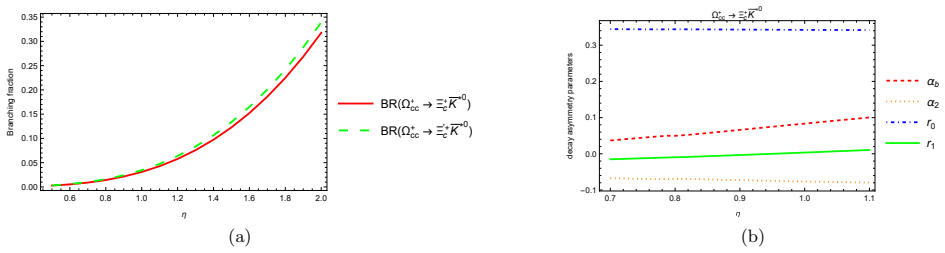
37 11. 9+12. 6 − 7. 1 12. 2+12. 7 − 7. 2 0. 59+0. 01 − 0. 01 − 0. 41+0. 01 − 0. 02 0. 21+0. 00 − 0. 00 0. 093+0. 002 − 0. 002 0. 14+0. 01 − 0. 01 0. 65+0. 01 − 0. 01 0. 15+0. 00 − 0. 00 0. 059+0. 000 − 0. 000 15 0.6 0.8 1.0 1.2 1.4 1.6 1.8 2.0 0.00 0.05 0.10 0.15 0.20 0.25 0.30 0.35 η Branching fraction BR( Ωcc + Ξ c + K *0 ) BR(Ωcc + Ξ c '+K *0 ) (a)...
-
[45]
91+0. 23 − 0. 27 0. 86+0. 69 − 0. 42 − 2. 1+0. 6 − 0. 2 − 0. 31+0. 10
-
[46]
10 0. 29+0. 26 − 0. 15 Ξ ++ cc → Λ + c ρ+
-
[47]
1+0. 8 − 0. 7 − 2. 2+0. 9 − 1. 2 − 1. 1+0. 3 − 0. 3 0. 35+0. 25 − 0. 16 − 1. 7+0. 7 − 0. 8 Ξ ++ cc → Ξ ′+ c K ∗+ − 0. 14+0. 07 − 0. 09 − 0. 39+0. 17 − 0. 22 26+14 − 40
-
[48]
18+0. 06 − 0. 09 − 0. 11+0. 06 − 0. 07 Ξ ++ cc → Ξ + c K ∗+ − 1. 1+0. 3 − 0. 3 1. 00+0. 32 − 0. 31 0. 60+0. 07 − 0. 32 − 0. 44+0. 15 − 0. 32 0. 85+0. 24 − 0. 25 Ξ + cc → Σ 0 cρ+ − 0. 68+0. 26 − 0. 34 0. 24+0. 08 − 0. 08 − 1. 4+0. 4 − 0. 3 − 0. 16+0. 06 − 0. 34 0. 043+0. 022 − 0. 015 Ξ + cc → Ξ ′0 c K ∗+
-
[49]
38+0. 13 − 0. 14 − 0. 017+0. 027 − 0. 007 64+59 − 59 − 0. 17+0. 07 − 0. 07 − 0. 22+0. 07 − 0. 04 Ξ + cc → Ξ 0 c K ∗+ − 0. 30+0. 10 − 0. 11 − 0. 57+0. 22 − 0. 31 − 0. 42+0. 17 − 0. 11 0. 23+0. 09 − 0. 11 − 0. 51+0. 20 − 0. 29 Ω + cc → Ξ 0 cρ+
-
[50]
0153 − 0
0094+0. 0153 − 0. 0115 − 0. 80+0. 18 − 0. 13 − 0. 82+0. 21 − 0. 02 − 0. 0077+0. 0100
-
[51]
0100 − 0. 81+0. 19 − 0. 13 Ω + cc → Ξ ′0 c ρ+ − 1. 1+0. 3 − 0. 3 0. 51+0. 03 − 0. 09 − 0. 16+0. 13 − 0. 29 0. 071+0. 001 − 0. 291 0. 36+0. 04 − 0. 07 Ω + cc → Ω 0 cK ∗+
-
[52]
80+0. 24 − 0. 25 − 0. 060+0. 048 − 0. 079 − 3. 1+1. 3 − 0. 2 0. 12+0. 05 − 0. 04 0. 080+0. 008 − 0. 010 In this work, the value of lifetime of Ω cc is taken as 176fs [69]. In Ref [47], the decay widths of these decays of Ω cc have been calculated, in order to compared with them, we calc ulate the decay width of them, and list them in Tab. IX. For the first...
-
[53]
8% [70], Br(Λ → pπ − ) = 63 . 9% [70], Br(ρ+ → π +π 0) = 100% [70], combined with detection efficiencies for final states ǫp,K ± ,π ± = 90 ∼ 95% [88, 89], ǫπ 0 = 20 ∼ 25% [90] and ǫγ ∼ 1% [91] the 17 Table VIII: CP violations for singly Cabibbo-suppressed modes. channels Adir CP [10− 4] α bCP [10− 4] α 2CP [10− 4] r0CP [10− 4] r1CP [10− 4] Ξ ++ cc → Σ ++ c ρ0
-
[54]
46+0. 05 − 0. 04 1. 6+0. 5 − 0. 3 − 0. 26+0. 01 − 0. 04 − 0. 038+0. 009 − 0. 039 1. 1+0. 3 − 0. 2 Ξ ++ cc → Σ ++ c ω − 1. 1+0. 0 − 0. 1 − 0. 41+0. 07 − 0. 07 − 1. 2+0. 7 − 0. 0 − 0. 36+0. 00 − 0. 01 − 0. 33+0. 00 − 0. 00 Ξ + cc → Σ + c ρ0
-
[55]
040+0. 006 − 0. 004 − 0. 072+0. 013 − 0. 015 0. 24+0. 04 − 0. 04 − 0. 0080+0. 0005 − 0. 0041 0. 0098+0. 0020 − 0. 0025 Ξ + cc → Σ + c ω − 0. 30+0. 02 − 0. 03 − 0. 40+0. 06 − 0. 07 0. 25+0. 02 − 0. 02 − 0. 017+0. 009 − 0. 009 − 0. 26+0. 04 − 0. 04 Ξ + cc → Λ + c ρ0 − 0. 0032+0. 0002 − 0. 0015 − 0. 29+0. 04 − 0. 04 1. 2+0. 1 − 0. 0 − 0. 037+0. 001 − 0. 002 ...
-
[56]
068+0. 007 − 0. 015 − 1. 3+0. 1 − 0. 1 0. 25+0. 01
-
[57]
01 0. 19+0. 00 − 0. 00 0. 78+0. 05 − 0. 04 Ξ + cc → Σ ++ c ρ− − 0. 066+0. 005 − 0. 006 − 0. 37+0. 05 − 0. 05 0. 61+0. 00 − 0. 00 0. 012+0. 001 − 0. 001 − 0. 13+0. 02 − 0. 02 Ξ + cc → Ξ ′+ c K ∗0 − 0. 13+0. 02 − 0. 02 − 8. 4+1. 7 − 1. 4 − 2. 7+0. 4 − 0. 0 − 0. 26+0. 03
-
[58]
02 4. 3+3. 7 − 1. 1 Ξ + cc → Ξ + c K ∗0 − 0. 41+0. 04 − 0. 06 − 4. 1+1. 8 − 2. 4 1. 2+0. 1 − 0. 0 − 0. 29+0. 06
-
[59]
04 − 0. 93+0. 19 − 0. 16 Ω + cc → Σ + c ¯K ∗0 − 0. 068+0. 001 − 0. 001 − 0. 31+0. 02 − 0. 02 − 0. 12+0. 00 − 0. 00 0. 047+0. 001 − 0. 001 − 6. 0+2. 6 − 16. 1 Ω + cc → Λ + c ¯K ∗0 − 0. 00085+0. 00422 − 0. 00412 − 0. 54+0. 10 − 0. 14 − 0. 11+0. 01 − 0. 01 0. 038+0. 004 − 0. 004 0. 089+0. 012 − 0. 011 Ω + cc → Σ ++ c K ∗− − 0. 28+0. 03 − 0. 04 2. 7+4. 7 − 0....
-
[60]
13+0. 01 − 0. 01 0. 57+0. 28 − 0. 14 − 0. 81+0. 08 − 0. 01 − 0. 0084+0. 0003 − 0. 0102 0. 30+0. 15 − 0. 08 Ω + cc → Ξ ′+ c φ
-
[61]
10+0. 01 − 0. 01 − 1. 3+0. 4 − 1. 0 − 0. 037+0. 007 − 0. 008 0. 0087+0. 0009 − 0. 0075 0. 78+0. 29 − 0. 17 Ω + cc → Ξ ′+ c ω − 1. 5+0. 0 − 0. 0 − 0. 73+0. 17 − 0. 20 0. 83+0. 01 − 0. 01 0. 17+0. 04 − 0. 04 − 9. 6+4. 8 − 67. 7 Ω + cc → Ξ + c ρ0
-
[62]
096+0. 007 − 0. 006 − 0. 23+0. 02 − 0. 02 − 0. 043+0. 016 − 0. 020 − 0. 0015+0. 0023 − 0. 0064 − 0. 33+0. 02 − 0. 02 Ω + cc → Ξ + c φ
-
[63]
0005 − 0
0028+0. 0005 − 0. 0003 0. 24+0. 03 − 0. 02 − 0. 17+0. 00 − 0. 01 0. 0037+0. 0008 − 0. 0007 − 40+50 − 33 Ω + cc → Ξ + c ω − 0. 45+0. 01 − 0. 01 13+8 − 41
-
[64]
36+0. 04 − 0. 01 − 0. 18+0. 02 − 0. 01 − 0. 50+0. 07 − 0. 06 Table IX: Comparison of decay widths for three decays Bcc → B cV (Γ T ot[10− 14]) channels This work Ref. [47] Ω + cc → Ω 0 cρ+
-
[65]
5 Ω + cc → Ξ ′+ c ¯K ∗0
8 87. 5 Ω + cc → Ξ ′+ c ¯K ∗0
-
[66]
82+8. 66 − 5. 09 26. 4+27. 2 − 17. 9 Ω + cc → Ξ + c ¯K ∗0
-
[67]
86+7. 88 − 4. 57 13. 8+14. 9 − 9. 5 expected signal events N s for three decay channel can be estimated as follows, N s = N p(Ω cc)Br(Ω + cc → Ω 0 cρ+)Br(Ω 0 c → Ω − π +)Br(ρ+ → π +π 0) × Br(Ω − → Λ K − )Br(Λ → pπ − )(90%)5(25%) ∼ (7. 2 × 10⁴ − 4. 7 × 10⁶), (40) N s = N p(Ω cc)Br(Ω + cc → Ξ ′+ c ¯K ∗0)Br(Ξ ′+ c → Ξ + c γ)Br(Ξ + c → pK − π +) Br( ¯K ∗0 → K...
2025
-
[68]
Appendix C: Strong couplings In general, meson-baryon and meson-meson strong couplings can be obtained from the SU(3)- invariant strong Hamiltonian
(B14) εαβρτ is the Levi-Civita tensor. Appendix C: Strong couplings In general, meson-baryon and meson-meson strong couplings can be obtained from the SU(3)- invariant strong Hamiltonian. In the present work, we use th e SU(3) flavor symmetry to analysis the vector-vector-pseudoscalar (VVP), vector-pseudosca lar-pseudoscalar (VPP), baryon-baryon- pseudosca...
-
[69]
First Observation of the Doubly Charmed Baryon Xi_cc^+
M. Mattson et al. [SELEX], Phys. Rev. Lett. 89, 112001 (2002) doi:10.1103/PhysRevLett.89.112001 [arXiv:hep-ex/0208014 [hep-ex]]. 27 Table X: The strong coupling constants between the vector meson s and two pseudoscalar mesons gV P P can be obtained by using the coupling gρππ = 6. 05 = − gV P P√ 2 [55] and SU(3) relations. Vertex g Vertex g Vertex g Vertex...
work page internal anchor Pith review Pith/arXiv arXiv doi:10.1103/physrevlett.89.112001 2002
-
[70]
Confirmation of the Double Charm Baryon Xi_cc+ via its Decay to p D+ K-
A. Ocherashvili et al. [SELEX], Phys. Lett. B 628, 18-24 (2005) doi:10.1016/j.physletb.2005.09.043 [arXiv:hep-ex/0406033 [hep-ex]]
work page internal anchor Pith review Pith/arXiv arXiv doi:10.1016/j.physletb.2005.09.043 2005
-
[71]
S. P. Ratti, Nucl. Phys. B Proc. Suppl. 115, 33-36 (2003) doi:10.1016/S0920-5632(02)01948-5
-
[72]
B. Aubert et al. [BaBar], Phys. Rev. D 74, 011103 (2006) doi:10.1103/PhysRevD.74.011103 [arXiv:hep- 28 Table XII: The strong coupling constants between three vector m esons gV V V can be obtained by using the coupling gρρρ = 4. 17 = − gV V V√ 2 [77] and SU(3) relations. Vertex g Vertex g Vertex g Vertex g ρ0ρ0ω gV V V√ 2 ρ0ωρ 0 gV V V√ 2 ρ0ρ+ρ− − gV V V√ ...
-
[73]
1 = gP BB2 2 and Σ + c Σ 0 c π + = 8
7 = gP BB1 √ 2 , gΞ ′+ c Ξ + c π 0 = 3 . 1 = gP BB2 2 and Σ + c Σ 0 c π + = 8 . 0 = gP BB3 √ 2 [58], respectively. Since the matrix forms of the spin-3/2 singly charmed baryon ground state B∗ 6 and the 1/2 sextet B6 under symmetry are similar, the derived relations are identical. Then the couplings B∗ 6B¯ 3P and B∗ 6B6P can be get from gΣ ∗ 0c Λ + c π − =...
-
[74]
R. Chistov et al. [Belle], Phys. Rev. Lett. 97, 162001 (2006) doi:10.1103/PhysRevLett.97.162001 [arXiv:hep-ex/0606051 [hep-ex]]
-
[75]
Search for the doubly charmed baryon Xi_cc^+
R. Aaij et al. [LHCb], JHEP 12, 090 (2013) doi:10.1007/JHEP12(2013)090 [arXiv:1310.2538 [hep-e x]]
work page internal anchor Pith review Pith/arXiv arXiv doi:10.1007/jhep12(2013)090 2013
-
[76]
Observation of the doubly charmed baryon $\Xi_{cc}^{++}$
R. Aaij et al. [LHCb], Phys. Rev. Lett. 119, no.11, 112001 (2017) doi:10.1103/PhysRevLett.119.112001 [arXiv:1707.01621 [hep-ex]]
work page internal anchor Pith review Pith/arXiv arXiv doi:10.1103/physrevlett.119.112001 2017
-
[77]
First observation of the doubly charmed baryon decay $\Xi_{cc}^{++}\rightarrow \Xi_{c}^{+}\pi^{+}$
R. Aaij et al. [LHCb], Phys. Rev. Lett. 121, no.16, 162002 (2018) doi:10.1103/PhysRevLett.121.162002 [arXiv:1807.01919 [hep-ex]]
work page internal anchor Pith review Pith/arXiv arXiv doi:10.1103/physrevlett.121.162002 2018
-
[78]
Measurement of the lifetime of the doubly charmed baryon $\Xi_{cc}^{++}$
R. Aaij et al. [LHCb], Phys. Rev. Lett. 121, no.5, 052002 (2018) doi:10.1103/PhysRevLett.121.052002 [arXiv:1806.02744 [hep-ex]]
work page internal anchor Pith review Pith/arXiv arXiv doi:10.1103/physrevlett.121.052002 2018
-
[79]
R. Aaij et al. [LHCb], Chin. Phys. C 44, no.2, 022001 (2020) doi:10.1088/1674-1137/44/2/022001 [arXiv:1910.11316 [hep-ex]]
-
[80]
R. Aaij et al. [LHCb], JHEP 05, 038 (2022) doi:10.1007/JHEP05(2022)038 [arXiv:2202.05648 [hep- ex]]
discussion (0)
Sign in with ORCID, Apple, or X to comment. Anyone can read and Pith papers without signing in.