REVIEW 2 major objections 5 minor 85 references
Sierpiński-triangle ZX-diagram states are exact quantum many-body scars of a local chaotic Hamiltonian, with the parent Hamiltonian, annihilators, and scar-preserving deformation all expressed in ZX-calculus.
Reviewed by Pith at T0; open to challenge. T0 means a machine referee read the full paper against a public rubric. the ladder, T0–T4 →
T0 review · deepseek-v4-flash
2026-08-01 04:32 UTC pith:GTDWTSJ3
load-bearing objection Real new method—ZX inverse design for scars—but the exactness proof is a set of asserted diagrams, so the referee should check those identities before signing off. the 2 major comments →
Fractal quantum many-body scars and Hamiltonian inverse design from ZX-calculus
The pith
A machine-rendered reading of the paper's core claim, the machinery that carries it, and where it could break.
Core claim
The central claim is that a Sierpiński-triangle ZX-diagram defines a many-body state that is an exact zero-energy eigenstate of a frustration-free local Hamiltonian, Hpar, whose terms are simple ZX diagrams built from parity projectors, a singlet projector, and phase-cancelling operators. The annihilation is certified locally by ZX identities: inserting a Hamiltonian term into the boundary of the fractal diagram and applying rewrite rules yields exactly zero, exposing the phase-cancellation mechanism. Adding a local deformation V = −Σ H^b_i, also written as a ZX diagram, preserves the exact eigenstate but destroys positivity, pushes the state into the bulk of the spectrum, and produces chaot
What carries the argument
The central object is the fractal ZX-diagram: a graph-like ZX diagram (Z-spiders joined by Hadamard edges) laid out as a Sierpiński triangle or carpet, with generation-dependent phases and open legs defining the qubits of the state. The carrying mechanism for the Hamiltonian construction is a set of local annihilators, H^a_i(k), H^b_i(k), and H^c_i(k), formed by sandwiching a phase-cancelling rank-one operator Ξ_i(k) between parity and singlet projectors, together with the local ZX identities (Eqs. 15-17, 19) showing each term annihilates the fractal state after diagrammatic rewriting. The same language then supplies the scar-preserving deformation: subtracting H^b terms swaps the outer wire
Load-bearing premise
The construction collapses if the local ZX annihilation identities, the equalities-to-zero that certify H^a_i|ψ⟩ = H^b_i|ψ⟩ = H^c_i|ψ⟩ = 0, are not valid for every generation and phase assignment, or if the small-system null-space search picked annihilator supports that do not generalize.
What would settle it
Verify by exact diagonalization on the next computed generation (L = 33 or L = 65) that the fractal ZX state has zero energy under Hpar and under Hpar + V, and that each local identity (15)-(17), (19) reduces to exact zero when simplified symbolically; a single nonzero norm or a non-GUE level statistic after symmetry resolution would falsify the scar claim. A simpler check is to contract identity (15) for a single site with the phase assignment of generation 5 and confirm that the resulting diagram vanishes exactly.
If this is right
- For the triangle family, the parent Hamiltonian is frustration-free, positive semidefinite, and expressed entirely as ZX diagrams; the fractal state is an exact zero-energy ground state, yielding a diagrammatically certified local Hamiltonian with a highly atypical eigenstate.
- The annihilation identities depend only on local phase cancellation, so the same Hamiltonian forms work for arbitrary generation-dependent phase functions, not just the numerically studied π(1−1/g) family.
- The deformed Hamiltonian Hpar + λV has GUE level statistics ⟨r⟩ = 0.601(4) in the resolved symmetry sector, placing the area-law fractal state in the bulk of a chaotic spectrum as an exact quantum many-body scar.
- The Sierpiński-carpet states show approximately logarithmic entanglement and self-similar profiles, but need annihilators with larger support, making them less immediately suited to the same Hamiltonian engineering.
- All steps, from state preparation to local constraints to chaotic embedding, are representable in ZX-calculus, establishing it as a Hamiltonian inverse-design framework.
Where Pith is reading between the lines
- If the diagrammatic certification holds beyond the computed sizes, it provides an exact, phase-independent proof of scarred eigenstates at system sizes far beyond exact diagonalization, since the identities are local and symbolic rather than numeric.
- The triangle/carpet contrast suggests a tunable hierarchy: by choosing other self-similar graphs or phase assignments, one may interpolate between area-law and logarithmic or power-law entanglement, giving a testable family of fractal scar candidates.
- Combining this construction with a graphical calculus that handles linear combinations, such as ZXW, could yield one-parameter families of scar-preserving deformations with arbitrary real coefficients, and potentially diagrammatic scar towers through spectrum-generating algebras.
- Because the resulting terms are three- and five-site local interactions with compact diagrammatic forms, the construction is a plausible starting point for compiling scar Hamiltonians onto programmable quantum simulators, where native multibody interactions are becoming available.
Editorial analysis
A structured set of objections, weighed in public.
Referee Report
Summary. This paper introduces two families of many-body quantum states obtained by promoting Sierpiński-triangle and Sierpiński-carpet graphs to ZX-diagrams. For the triangle family, MPS calculations show area-law entanglement with self-similar spatial profiles of local observables; for the carpet family, the entanglement grows approximately logarithmically over accessible sizes, far below the min-cut upper bound. For the triangle states, the author constructs a local frustration-free parent Hamiltonian from null spaces of reduced density matrices, expresses the local terms as compact ZX-diagrams, and asserts diagrammatic identities (Eqs. (15)–(17) and (19)) certifying exact annihilation. A local deformation H_par + λV is then introduced that preserves the exact eigenstate and, for λ=1, produces level statistics consistent with GUE, leading to the claim that the fractal ZX state is a quantum many-body scar of a chaotic Hamiltonian.
Significance. If the asserted identities are proved, the result is significant: it demonstrates that ZX-calculus can act as a design language in which the target state, its local annihilators, the parent Hamiltonian, and a scar-preserving chaotic deformation are all represented diagrammatically. The construction is phase-generic and gives compact local Hamiltonian terms that would be dense in a standard tensor-network parent construction. The numerical work is carefully parameterized (χ_max=1024, ε=10^-20, symmetry-resolved spectral statistics), and the explicit embedding of a zero-energy area-law state in a GUE-spectrum model is an instructive example. The MPS results and min-cut bounds are reproducible from the described procedure. The main gap is the absence of derivations or machine-checked certificates for the exact annihilation identities, on which the central claim rests.
major comments (2)
- [Sec. IV A, Eqs. (15)–(17) and (19)] The exact-scar construction hinges on the local annihilation identities (15)–(17) and (19). The paper presents these as final diagram equalities to zero with no step-by-step derivation, algebraic expansion, or machine-checked certificate. Since these identities are the only support for the claims H_a_i(k)|ψ⟩=0, H_b_i(k)|ψ⟩=0, H_c_i(k)|ψ⟩=0, and the subsequent deformation property, they are load-bearing. A single miscopied phase or an incorrect Hadamard edge would invalidate the parent Hamiltonian. I request a supplementary derivation (e.g., a sequence of ZX rewrites, or an explicit Pauli-algebra expansion for each identity) or a reproducible PyZX/ZXLive script that verifies them. This is necessary before the exactness of the scar construction can be accepted.
- [Sec. IV A, paragraph 'Next, we will assume...' and Eq. (14)] The construction relies on the assumption that 'other sites can be annihilated by phase-independent annihilators composed of Pauli operators.' This assumption is not made precise, and the paper does not verify that the compact terms (14a)–(14c) annihilate the fractal state for every position in the periodic pattern {a,b,a,c,...} and for every generation g. The identities (15)–(17) contain generic phases α,β,γ,δ, but no argument is given that the boundary phase pattern of the Sierpiński triangle always matches one of these configurations. Please supply a systematic enumeration of the local boundary subdiagrams (or an induction on g) showing that each term position is covered. Without this, the parent Hamiltonian may contain terms that do not annihilate the target state.
minor comments (5)
- [Sec. II A, Eq. (4)] The rewrite rules in Eq. (4) are terse; for readers not familiar with ZX-calculus, a pointer to the complete rule set with illustrative diagrams would help. In particular, the bialgebra rule (b) in Eq. (4a) is easy to confuse with the spider fusion (f).
- [Sec. III B, Fig. 3] The color map for generations is hard to distinguish, especially for generations 6–9. Using line styles or markers would improve readability.
- [Sec. III C] The MPS convergence checks are described as 'stable on the scale of the plotted data' but no quantitative data are given. Please report the discarded weight or fidelity for the largest system sizes, or an example of convergence.
- [Sec. IV A, after Eq. (18)] The periodic pattern {a,b,a,c,...} is shown for g=4; please give the rule for arbitrary g. It seems to follow the boundary recursion of the Sierpiński triangle, but the formal definition would help.
- [Sec. IV B, Eq. (21)] The diagram for H_a'^i(k) is described as 'swapping the outer wires' of H_a^i(k). This is only obvious for λ=1; for general λ the diagram is not given. The text already mentions the need for ZX-related calculi for real coefficients, but a brief explanation of why λ=1 is special would be useful.
Circularity Check
No circularity: inverse design is explicit and diagnostics are independent
full rationale
The paper's central maneuver is self-avowed inverse design: a fractal ZX-diagram state is chosen first, and local annihilators, a parent Hamiltonian, and a scar-preserving deformation are constructed so that the state is an exact zero-energy eigenstate. This is not a hidden fit or a renamed prediction; it is the stated goal ("Hamiltonian inverse design" in the title and abstract). The level statistics and the entanglement-vs-energy plot are independent diagnostics of the constructed Hamiltonian: ⟨r⟩=0.601(4) is an emergent numerical property of H_par+λV, not an input used to set λ. The exactness of the eigenstate under the deformation is by construction from annihilation identities, but the paper does not present this as a prediction. The ZX identities in Eqs. (15)-(17) and (19) are the load-bearing mathematical core and are asserted as final equalities rather than derived step-by-step or machine-certified; this is an evidence-strength / omitted-proof concern, not circularity, because the identities are checkable by the cited sound and complete rewrite rules and are independent of the fitted numerical null-space search. The numerical search constrains the operator supports, but the final identities are stated for arbitrary phase functions, so they are not merely a refit of the small-g data. Self-citations [33,77,78] are peripheral remarks about scar degeneracies and are not load-bearing for the derivation. No exhibited equation reduces a claimed output to an input by construction in a way the paper conceals.
Axiom & Free-Parameter Ledger
free parameters (4)
- spider phase family φ_g =
π/g; π/2^{g-1}; π(1−1/g); π(1−1/2^{g-1})
- deformation strength λ =
λ=1 (positive and negative values also tested)
- MPS bond dimension χmax / truncation ϵ =
χmax=1024, ϵSVD=10^-20
- local term range k =
3 and 5 site terms
axioms (4)
- standard math ZX-calculus rewrite rules are sound and complete
- domain assumption Parent Hamiltonian from kernels of reduced density matrices is frustration-free and has the target as a zero-energy eigenstate
- standard math Min-cut of the tensor-network graph bounds the entanglement entropy
- ad hoc to paper Non-central sites of the fractal state can be annihilated by phase-independent Pauli operators
read the original abstract
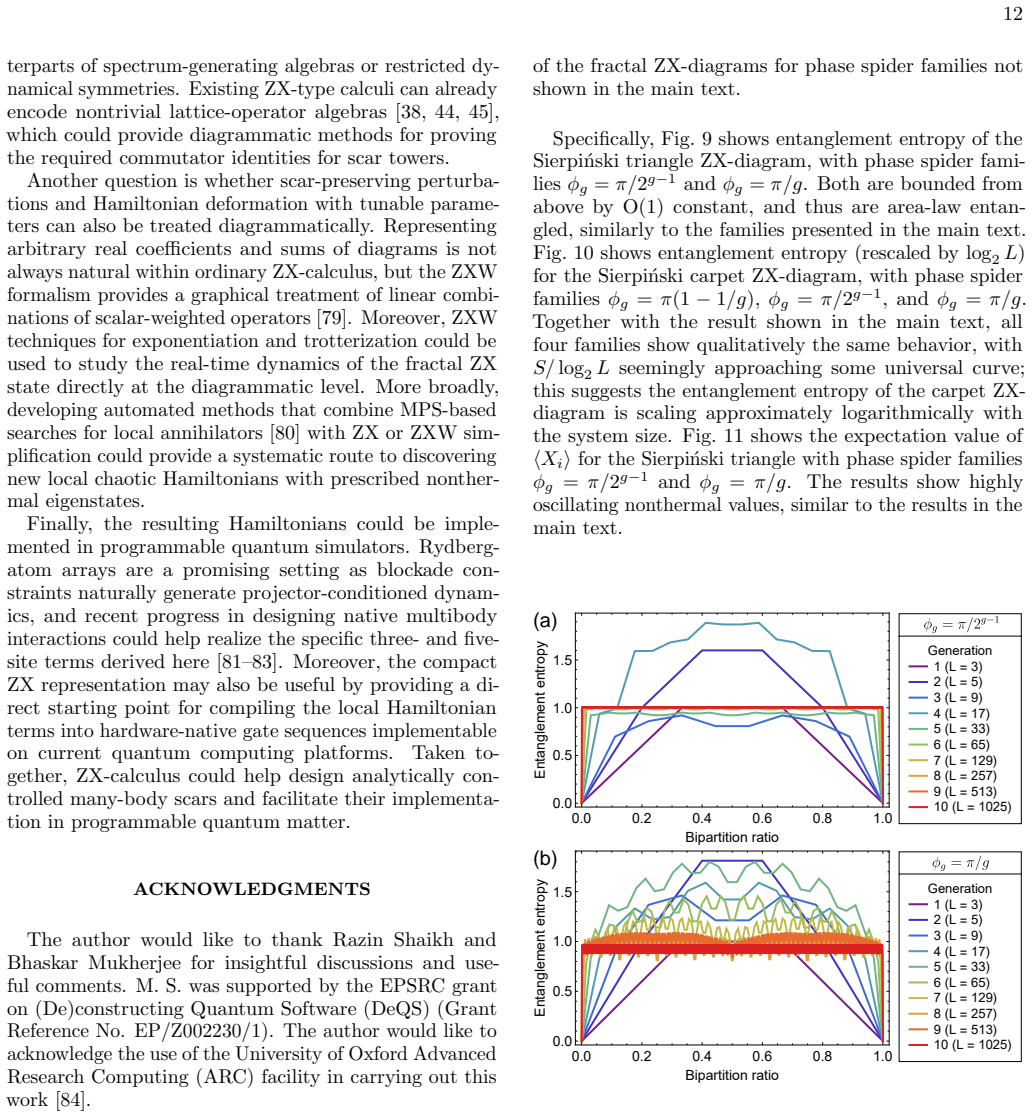
Diagrammatic languages such as ZX-calculus provide compact and intuitive descriptions of quantum processes and have become established tools for circuit simplification, verification, and compilation. However, their potential as a framework for constructing many-body states and the Hamiltonians that host them remains largely unexplored. Here, we introduce families of fractal many-body states obtained from ZX-diagrams based on the Sierpi\'nski triangle and Sierpi\'nski carpet. By construction, the underlying graph connectivity imposes atypical subvolume-law minimum-cut upper bounds on the entanglement, while the actual states are parametrically less entangled still: the triangle family obeys an area law, whereas the carpet family displays approximately logarithmic scaling across the available system sizes. Additionally, their local observables retain fractal-like spatial structure, identifying these states as natural candidates for atypical eigenstates in otherwise thermalizing systems. For the triangle family, we combine parent-Hamiltonian methods, insights from ZX-calculus, and local ZX identities that certify exact annihilation of the target state, producing frustration-free Hamiltonians whose terms admit simple representations in the same diagrammatic language as the states themselves. We then construct a local deformation that produces chaotic level statistics while embedding the fractal ZX state in the bulk of the energy spectrum as an exact quantum many-body scar. Our results demonstrate, through this explicit construction, that ZX-calculus can serve as a framework for Hamiltonian inverse design, in which quantum many-body scars, their local annihilators, and the chaotic Hamiltonians embedding them can be constructed and related through a set of graphical identities.
Figures




Reference graph
Works this paper leans on
-
[1]
J. M. Deutsch, Quantum statistical mechanics in a closed system, Phys. Rev. A43, 2046 (1991)
2046
-
[2]
Thus, all three operators are positive semidefinite, although the latter two are not normalized to be idempotent. The local parent-Hamiltonian terms can then be con- 9 structed as, H a i (k) = ΠZ i−1,i+1 Ξi(k) = −ϕk π ϕk ,(14a) H b i (k) = ΠXY Z i−1,i+1 Ξi(k) = π π −ϕk ϕk π π ,(14b) H c i (k) = ΠXY Z i−1,i+1ΠZ i−2,i+2 Ξi(k) (14c) = π π −ϕk π ϕk π π . The ...
-
[3]
Srednicki, Chaos and quantum thermalization, Phys
M. Srednicki, Chaos and quantum thermalization, Phys. 13 0.0 0.2 0.4 0.6 0.8 1.0 0.0 0.2 0.4 0.6 0.8 Bipartition ratio Entanglement entropy / log 2 L Generation 1 ( L = 3 ) 2 ( L = 9 ) 3 ( L = 27 ) 4 ( L = 81 ) 0.0 0.2 0.4 0.6 0.8 1.0 0.0 0.2 0.4 0.6 0.8 Bipartition ratio Entanglement entropy / log 2 L Generation 1 ( L = 3 ) 2 ( L = 9 ) 3 ( L = 27 ) 4 ( L...
1994
-
[4]
Rigol, V
M. Rigol, V. Dunjko, and M. Olshanii, Thermalization and its mechanism for generic isolated quantum systems, Nature452, 854 (2008)
2008
-
[5]
D’Alessio, Y
L. D’Alessio, Y. Kafri, A. Polkovnikov, and M. Rigol, From quantum chaos and eigenstate thermalization to statistical mechanics and thermodynamics, Adv. Phys. 65, 239 (2016)
2016
-
[6]
Bohigas, M
O. Bohigas, M. J. Giannoni, and C. Schmit, Characteri- zation of Chaotic Quantum Spectra and Universality of Level Fluctuation Laws, Phys. Rev. Lett.52, 1 (1984)
1984
-
[7]
E. J. Heller, Bound-State Eigenfunctions of Classically Chaotic Hamiltonian Systems: Scars of Periodic Orbits, Phys. Rev. Lett.53, 1515 (1984)
1984
-
[8]
M. V. Berry, Regular and irregular semiclassical wave- functions, J. Phys. A: Math. Gen.10, 2083 (1977)
2083
-
[9]
Polkovnikov, K
A. Polkovnikov, K. Sengupta, A. Silva, and M. Vengalat- tore, Colloquium: Nonequilibrium dynamics of closed interacting quantum systems, Rev. Mod. Phys.83, 863 (2011). 0.0 0.2 0.4 0.6 0.8 1.0 - 0.4 - 0.2 0.0 0.2 Generation 1 ( L = 3 ) 2 ( L = 5 ) 3 ( L = 9 ) 4 ( L = 17 ) 5 ( L = 33 ) 6 ( L = 65 ) 7 ( L = 129 ) 8 ( L = 257 ) 0.0 0.2 0.4 0.6 0.8 1.0 - 0.4 -...
2011
-
[10]
Nandkishore and D
R. Nandkishore and D. A. Huse, Many-Body Localization and Thermalization in Quantum Statistical Mechanics, Annu. Rev. Condens. Matter Phys.6, 15 (2015)
2015
-
[11]
D. A. Abanin, E. Altman, I. Bloch, and M. Serbyn, Col- loquium: Many-body localization, thermalization, and entanglement, Rev. Mod. Phys.91, 021001 (2019)
2019
-
[12]
Khemani, M
V. Khemani, M. Hermele, and R. Nandkishore, Local- ization from Hilbert space shattering: From theory to physical realizations, Phys. Rev. B101, 174204 (2020)
2020
-
[13]
C. J. Turner, A. A. Michailidis, D. A. Abanin, M. Serbyn, and Z. Papi´ c, Weak ergodicity breaking from quantum many-body scars, Nat. Phys.14, 745 (2018)
2018
-
[14]
C. J. Turner, A. A. Michailidis, D. A. Abanin, M. Serbyn, and Z. Papi´ c, Quantum scarred eigenstates in a Rydberg atom chain: Entanglement, breakdown of thermalization, and stability to perturbations, Phys. Rev. B98, 155134 (2018)
2018
-
[15]
Serbyn, D
M. Serbyn, D. A. Abanin, and Z. Papi´ c, Quantum many- body scars and weak breaking of ergodicity, Nat. Phys. 17, 675 (2021)
2021
-
[16]
Chandran, T
A. Chandran, T. Iadecola, V. Khemani, and R. Moessner, Quantum Many-Body Scars: A Quasiparticle Perspective, Annu. Rev. Condens. Matter Phys.14, 443 (2023)
2023
-
[17]
Moudgalya, B
S. Moudgalya, B. A. Bernevig, and N. Regnault, Quan- tum many-body scars and Hilbert space fragmentation: a review of exact results, Rep. Prog. Phys.85, 086501 (2022)
2022
-
[18]
Bernien, S
H. Bernien, S. Schwartz, A. Keesling, H. Levine, A. Om- ran, H. Pichler, S. Choi, A. S. Zibrov, M. Endres, M. Greiner,et al., Probing many-body dynamics on a 51-atom quantum simulator, Nature551, 579 (2017)
2017
-
[19]
Shiraishi and T
N. Shiraishi and T. Mori, Systematic Construction of Counterexamples to the Eigenstate Thermalization Hy- pothesis, Phys. Rev. Lett.119, 030601 (2017). 14
2017
-
[20]
S. Choi, C. J. Turner, H. Pichler, W. W. Ho, A. A. Michailidis, Z. Papi´ c, M. Serbyn, M. D. Lukin, and D. A. Abanin, Emergent SU(2) Dynamics and Perfect Quantum Many-Body Scars, Phys. Rev. Lett.122, 220603 (2019)
2019
-
[21]
K. Bull, I. Martin, and Z. Papi´ c, Systematic Construction of Scarred Many-Body Dynamics in 1D Lattice Models, Phys. Rev. Lett.123, 030601 (2019)
2019
-
[22]
W. W. Ho, S. Choi, H. Pichler, and M. D. Lukin, Periodic Orbits, Entanglement, and Quantum Many-Body Scars in Constrained Models: Matrix Product State Approach, Phys. Rev. Lett.122, 040603 (2019)
2019
-
[23]
Iadecola and M
T. Iadecola and M. Schecter, Quantum many-body scar states with emergent kinetic constraints and finite- entanglement revivals, Phys. Rev. B101, 024306 (2020)
2020
-
[24]
Lin and O
C.-J. Lin and O. I. Motrunich, Exact Quantum Many- Body Scar States in the Rydberg-Blockaded Atom Chain, Phys. Rev. Lett.122, 173401 (2019)
2019
-
[25]
Moudgalya, N
S. Moudgalya, N. Regnault, and B. A. Bernevig, Entan- glement of exact excited states of Affleck-Kennedy-Lieb- Tasaki models: Exact results, many-body scars, and vio- lation of the strong eigenstate thermalization hypothesis, Phys. Rev. B98, 235156 (2018)
2018
-
[26]
Moudgalya, S
S. Moudgalya, S. Rachel, B. A. Bernevig, and N. Regnault, Exact excited states of nonintegrable models, Phys. Rev. B98, 235155 (2018)
2018
-
[27]
Moudgalya, E
S. Moudgalya, E. O’Brien, B. A. Bernevig, P. Fendley, and N. Regnault, Large classes of quantum scarred Hamil- tonians from matrix product states, Phys. Rev. B102, 085120 (2020)
2020
-
[28]
Chattopadhyay, H
S. Chattopadhyay, H. Pichler, M. D. Lukin, and W. W. Ho, Quantum many-body scars from virtual entangled pairs, Phys. Rev. B101, 174308 (2020)
2020
-
[29]
Schecter and T
M. Schecter and T. Iadecola, Weak Ergodicity Breaking and Quantum Many-Body Scars in Spin-1 XY Magnets, Phys. Rev. Lett.123, 147201 (2019)
2019
-
[30]
Moudgalya, N
S. Moudgalya, N. Regnault, and B. A. Bernevig, η-pairing in Hubbard models: From spectrum generating algebras to quantum many-body scars, Phys. Rev. B102, 085140 (2020)
2020
-
[31]
Pakrouski, P
K. Pakrouski, P. N. Pallegar, F. K. Popov, and I. R. Klebanov, Many-Body Scars as a Group Invariant Sector of Hilbert Space, Phys. Rev. Lett.125, 230602 (2020)
2020
-
[32]
Moudgalya and O
S. Moudgalya and O. I. Motrunich, Exhaustive Character- ization of Quantum Many-Body Scars Using Commutant Algebras, Phys. Rev. X14, 041069 (2024)
2024
-
[33]
C. M. Langlett, Z.-C. Yang, J. Wildeboer, A. V. Gorshkov, T. Iadecola, and S. Xu, Rainbow scars: From area to volume law, Phys. Rev. B105, L060301 (2022)
2022
-
[34]
Mukherjee, C
B. Mukherjee, C. J. Turner, M. Szyniszewski, and A. Pal, Symmetric Tensor Scars with Tunable Entanglement from Volume to Area Law, Phys. Rev. Lett.136, 090401 (2026)
2026
-
[35]
Dooley, Parent Hamiltonians for Stabilizer Quantum Many-Body Scars, Phys
S. Dooley, Parent Hamiltonians for Stabilizer Quantum Many-Body Scars, Phys. Rev. Lett.136, 240402 (2026)
2026
-
[36]
Shibata, N
N. Shibata, N. Yoshioka, and H. Katsura, Onsager’s Scars in Disordered Spin Chains, Phys. Rev. Lett.124, 180604 (2020)
2020
-
[37]
O’Dea, F
N. O’Dea, F. Burnell, A. Chandran, and V. Khemani, From tunnels to towers: Quantum scars from Lie algebras and q-deformed Lie algebras, Phys. Rev. Res.2, 043305 (2020)
2020
-
[38]
Zhang, D
S.-Y. Zhang, D. Yuan, T. Iadecola, S. Xu, and D.-L. Deng, Extracting Quantum Many-Body Scarred Eigenstates with Matrix Product States, Phys. Rev. Lett.131, 020402 (2023)
2023
-
[39]
Coecke and R
B. Coecke and R. Duncan, Interacting quantum observ- ables: categorical algebra and diagrammatics, New J. Phys.13, 043016 (2011)
2011
-
[40]
Duncan, A
R. Duncan, A. Kissinger, S. Perdrix, and J. van de Weter- ing, Graph-theoretic Simplification of Quantum Circuits with the ZX-calculus, Quantum4, 279 (2020)
2020
-
[41]
van de Wetering, ZX-calculus for the working quantum computer scientist, arXiv:2012.13966 (2020)
J. van de Wetering, ZX-calculus for the working quantum computer scientist, arXiv:2012.13966 (2020)
Pith/arXiv arXiv 2012
-
[42]
Coecke and A
B. Coecke and A. Kissinger,Picturing Quantum Processes: A First Course in Quantum Theory and Diagrammatic Reasoning(Cambridge University Press, Cambridge, Eng- land, UK, 2017)
2017
-
[43]
Kissinger and J
A. Kissinger and J. van de Wetering,Picturing Quan- tum Software: An Introduction to the ZX-Calculus and Quantum Compilation(Preprint, 2024)
2024
-
[44]
R. D. P. East, J. van de Wetering, N. Chancellor, and A. G. Grushin, AKLT-States as ZX-Diagrams: Diagrammatic Reasoning for Quantum States, PRX Quantum3, 010302 (2022)
2022
-
[45]
Q. Wang, R. D. P. East, R. A. Shaikh, L. Yeh, B. Po´ or, and B. Coecke, Beyond Penrose tensor diagrams with the ZX calculus: Applications to quantum computing, quantum machine learning, condensed matter physics, and quantum gravity, arXiv:2511.06012 (2025)
arXiv 2025
-
[46]
R. D. P. East, P. Martin-Dussaud, and J. Van de Weter- ing, Spin-networks in the ZX-calculus, arXiv:2111.03114 (2021)
Pith/arXiv arXiv 2021
-
[47]
Buznach Ahituv, D
E. Buznach Ahituv, D. Chowdhury, and J. Ruhman, Un- veiling a Hidden Percolation Transition in Monitored Clifford Circuits: Inroads from ZX Calculus, Phys. Rev. Lett.135, 050402 (2025)
2025
-
[48]
H. Ha, D. A. Huse, and G. M. Sommers, Roughening Transition in Quantum Circuits, Phys. Rev. Lett.135, 160603 (2025)
2025
-
[49]
S. Mas-Mendoza, R. D. P. East, M. Filippone, and A. G. Grushin, A graphical diagnostic of topological order using ZX calculus, arXiv:2509.12355 (2025)
arXiv 2025
-
[50]
D.-C. Lu, F. Xu, and Y.-Z. You, Strange correlator and string order parameter for non-invertible symmetry protected topological phases in 1+1d, arXiv:2505.00673 (2025)
Pith/arXiv arXiv 2025
-
[51]
Gorantla, S.-H
P. Gorantla, S.-H. Shao, and N. Tantivasadakarn, Tensor Networks for Noninvertible Symmetries in 3 + 1D and Beyond, Phys. Rev. X15, 041006 (2025)
2025
-
[52]
G. Wong, R. A. Shaikh, and W. Donnelly, A ribbon ZX calculus for gauge theory, arXiv:2606.13551 (2026)
Pith/arXiv arXiv 2026
-
[53]
Priestley, Finite-Dimensional ZX-Calculus for Loop Quantum Gravity, arXiv:2511.15966 (2025)
B. Priestley, Finite-Dimensional ZX-Calculus for Loop Quantum Gravity, arXiv:2511.15966 (2025)
arXiv 2025
-
[54]
Voigt, J
A. Voigt, J. Richter, and P. Tomczak, The quantum Heisenberg antiferromagnet on the Sierpi´ nski gasket: an exact diagonalization study, Physica A299, 461 (2001)
2001
-
[55]
M´ elin, B
R. M´ elin, B. Dou¸ cot, and F. Igl´ oi, Strong-disorder renormalization-group method on fractal lattices: Heisen- berg models and magnetoresistive effects in tight-binding models, Phys. Rev. B72, 024205 (2005)
2005
-
[56]
Cheng and J.-B
J.-Q. Cheng and J.-B. Xu, Multipartite entanglement, quantum coherence, and quantum criticality in triangular and Sierpi´ nski fractal lattices, Phys. Rev. E97, 062134 (2018)
2018
-
[57]
Zhou and P
Y. Zhou and P. Ye, Entanglement fractalization, Phys. Rev. Res.6, 043145 (2024)
2024
-
[58]
Vilmart, A near-minimal axiomatisation of zx-calculus for pure qubit quantum mechanics, in2019 34th Annual ACM/IEEE Symposium on Logic in Computer Science 15 (LICS)(2019) pp
R. Vilmart, A near-minimal axiomatisation of zx-calculus for pure qubit quantum mechanics, in2019 34th Annual ACM/IEEE Symposium on Logic in Computer Science 15 (LICS)(2019) pp. 1–10
2019
-
[59]
K. F. Ng and Q. Wang, A universal completion of the ZX-calculus, arXiv:1706.09877 (2017)
Pith/arXiv arXiv 2017
-
[60]
Jeandel, S
E. Jeandel, S. Perdrix, and R. Vilmart, Diagrammatic reasoning beyond clifford+t quantum mechanics, inPro- ceedings of the 33rd Annual ACM/IEEE Symposium on Logic in Computer Science, LICS ’18 (Association for Computing Machinery, New York, NY, USA, 2018) pp. 569–578
2018
-
[61]
Backens, The ZX-calculus is complete for stabilizer quantum mechanics, New J
M. Backens, The ZX-calculus is complete for stabilizer quantum mechanics, New J. Phys.16, 093021 (2014)
2014
-
[62]
Backens, The ZX-calculus is complete for the single- qubit Clifford+T group, Electronic Proceedings in Theo- retical Computer Science172, 293 (2014)
M. Backens, The ZX-calculus is complete for the single- qubit Clifford+T group, Electronic Proceedings in Theo- retical Computer Science172, 293 (2014)
2014
-
[63]
ZXLive (2026), https://github.com/zxcalc/zxlive, [Online]
2026
-
[64]
Kissinger and J
A. Kissinger and J. van de Wetering, PyZX: Large scale automated diagrammatic reasoning, Electronic Proceed- ings in Theoretical Computer Science318, 229 (2020)
2020
-
[65]
Schollw¨ ock, The density-matrix renormalization group in the age of matrix product states, Ann
U. Schollw¨ ock, The density-matrix renormalization group in the age of matrix product states, Ann. Phys.326, 96 (2011)
2011
-
[66]
Verstraete, V
F. Verstraete, V. Murg, and J. I. Cirac, Matrix product states, projected entangled pair states, and variational renormalization group methods for quantum spin systems, Adv. Phys.57, 143 (2008)
2008
-
[67]
Vidal, Efficient Simulation of One-Dimensional Quan- tum Many-Body Systems, Phys
G. Vidal, Efficient Simulation of One-Dimensional Quan- tum Many-Body Systems, Phys. Rev. Lett.93, 040502 (2004)
2004
-
[68]
J. I. Cirac, D. P´ erez-Garc ´ ıa, N. Schuch, and F. Verstraete, Matrix product states and projected entangled pair states: Concepts, symmetries, theorems, Rev. Mod. Phys.93, 045003 (2021)
2021
-
[69]
Backens, H
M. Backens, H. Miller-Bakewell, G. de Felice, L. Lobski, and J. van de Wetering, There and back again: A circuit extraction tale, Quantum5, 421 (2021)
2021
-
[70]
Gray, quimb: A python package for quantum informa- tion and many-body calculations, J
J. Gray, quimb: A python package for quantum informa- tion and many-body calculations, J. Open Source Softw. 3, 819 (2018)
2018
-
[71]
Affleck, T
I. Affleck, T. Kennedy, E. H. Lieb, and H. Tasaki, Rigorous results on valence-bond ground states in antiferromagnets, Phys. Rev. Lett.59, 799 (1987)
1987
-
[72]
Fannes, B
M. Fannes, B. Nachtergaele, and R. F. Werner, Finitely correlated states on quantum spin chains, Commun. Math. Phys.144, 443 (1992)
1992
-
[73]
Perez-Garcia, F
D. Perez-Garcia, F. Verstraete, M. M. Wolf, and J. I. Cirac, Matrix product state representations, Quantum Inf. Comput.7, 401 (2007)
2007
-
[74]
M. V. Berry and M. Tabor, Level clustering in the regular spectrum, Proc. R. Soc. A.356, 375 (1977)
1977
-
[75]
Oganesyan and D
V. Oganesyan and D. A. Huse, Localization of interacting fermions at high temperature, Phys. Rev. B75, 155111 (2007)
2007
-
[76]
Y. Y. Atas, E. Bogomolny, O. Giraud, and G. Roux, Distribution of the Ratio of Consecutive Level Spacings in Random Matrix Ensembles, Phys. Rev. Lett.110, 084101 (2013)
2013
-
[77]
V. B. Bulchandani, S. Gopalakrishnan, and E. Ilievski, Superdiffusion in spin chains, J. Stat. Mech.: Theory Exp. 2021(8), 084001
2021
-
[78]
C. J. Turner, M. Szyniszewski, B. Mukherjee, R. Me- lendrez, H. J. Changlani, and A. Pal, Stable infinite- temperature eigenstates in SU(2)-symmetric noninte- grable models, Phys. Rev. Res.8, L022064 (2026)
2026
-
[79]
R. Melendrez, B. Mukherjee, M. Szyniszewski, C. J. Turner, A. Pal, and H. J. Changlani, Exact generalized Bethe eigenstates of the non-integrable alternating Heisen- berg chain, arXiv:2501.14017 (2025)
Pith/arXiv arXiv 2025
-
[80]
R. A. Shaikh, Q. Wang, and R. Yeung, How to sum and exponentiate hamiltonians in zxw calculus, Electronic Proceedings in Theoretical Computer Science394, 236 (2023)
2023
discussion (0)
Sign in with ORCID, Apple, or X to comment. Anyone can read and Pith papers without signing in.