REVIEW 4 major objections 6 minor 51 references
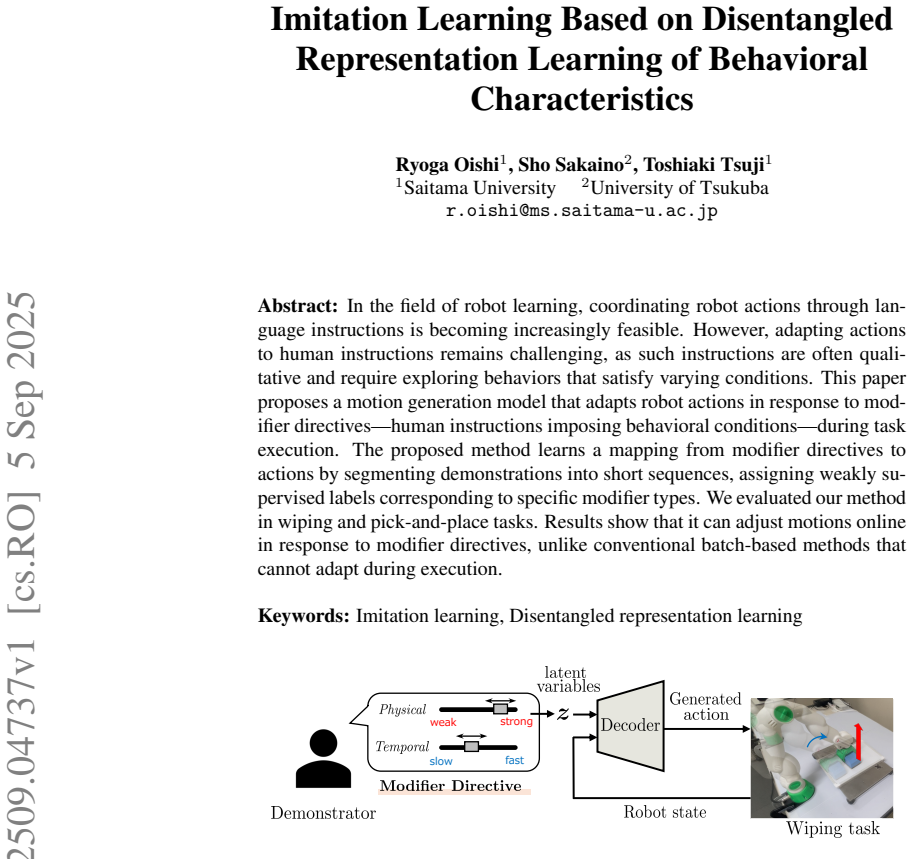
The paper claims that qualitative mid-task directives can be encoded as independent latent dials in a conditional variational autoencoder, letting a robot adjust speed and force while it works.
Reviewed by Pith at T0; open to challenge. T0 means a machine referee read the full paper against a public rubric. the ladder, T0–T4 →
A weakly-supervised CVAE with action chunking lets a robot change wiping speed online from instruction labels, but the same mechanism fails to disentangle wiping force and fails on spatial pick-and-place directives.
T0 review reviewed 2026-08-05 challenge →
load-bearing objection The paper's central 'online' claim is untested: every trial uses a fixed latent directive, so the method may be a batch CVAE with chunking; the disentanglement results are partial and the evaluation is thin, but the idea is worth a serious referee. the 4 major comments →
Imitation Learning Based on Disentangled Representation Learning of Behavioral Characteristics
The pith
A machine-rendered reading of the paper's core claim, the machinery that carries it, and where it could break.
The reading
Core claim
The central claim is that weak supervision on individual latent dimensions of a conditional variational autoencoder is enough to make those dimensions act as online command channels for motion modifiers. Each constrained latent dimension is trained, through a binary-cross-entropy loss, to predict the labeled intensity of the corresponding modifier applied to a short action segment. At inference, the user sets only the constrained coordinates to the desired directive intensity, fixes the unconstrained coordinates to zero, and the decoder emits a chunk of future states whose overlapping predictions are combined with weights w_i = 1/log(i+1). In the wiping task, the temporal axis reaches a modi
What carries the argument
The central object is the constrained-latent CVAE: a conditional variational autoencoder whose latent code is partitioned into constrained dimensions, one per modifier type, and unconstrained dimensions. Each constrained dimension feeds a small MLP trained to predict the weak label of the modifier (0.0, 0.5, or 1.0) with binary cross-entropy; the total loss is a weighted sum of reconstruction, KL, and modifier-prediction terms. This forces the decoder's output to vary along the behavioral axis named by the label. During online inference, the user places the command in the constrained coordinates and the decoder's overlapping action chunks are averaged with weights w_i = 1/log(i+1), which smo
Load-bearing premise
The load-bearing premise is that training a label-predicting MLP on each constrained latent dimension transfers into independent, monotone control of the decoded motion along that dimension, so that one z changes exactly one behavioral quality—a premise the paper's physical-channel and spatial-directive results only partially satisfy.
What would settle it
Command only the temporal latent dimension through its five levels and measure both the cycle-time feature and the force feature. If the temporal dial changes the force feature as much as it changes the cycle-time feature, the dials are not independent; the claim would be confirmed only if off-axis modifier-directive errors can be driven close to zero for every constrained dimension.
If this is right
- A robot operator could change force or speed mid-task by adjusting one latent coordinate, without stopping the motion or retraining the policy.
- The constraint loss is architecture-agnostic: it improves both LSTM-based and transformer-based sequence generators, suggesting it can be added to other imitation-learning backbones.
- Smoothing of chunked predictions is not optional; without temporal averaging, online switching of the latent command produces oscillations and zero task success.
- If the disentanglement holds across more directive axes, the method scales to continuous adjustment of several behavioral qualities simultaneously.
Where Pith is reading between the lines
- A natural extension is to combine these continuous latent dials with a discrete selection mechanism, such as gating, so symbolic directives (e.g., placement left/center/right) can be handled alongside continuous ones; the paper itself points to gating as a possible remedy.
- Because the evaluation metric fits a line across five commanded values, the method implies a monotone intensity axis; a user study could test whether commanded increments are perceptibly and repeatably ordered across trials.
- The unconstrained latent dimensions are fixed to zero at inference without an ablation, so their role as a reservoir for task variability remains untested; varying them could affect robustness.
- The framework is most likely to succeed in contact tasks where force and torque signals carry directive information; extending to visual or auditory directives would require adding sensory modalities.
Editorial analysis
A structured set of objections, weighed in public.
Referee Report
Summary. The paper proposes an imitation-learning method based on a conditional variational autoencoder whose latent space is partially constrained by weakly supervised labels for 'modifier directives' (e.g., slow/fast, weak/strong). At inference, the user sets the constrained latent dimensions to command values, fixes the unconstrained dimension to zero, and the decoder outputs action chunks that are combined with the weighting rule of Eq. (7). The method is evaluated on wiping and pick-and-place tasks with two base architectures (ACT and CVAE-LSTM) plus proposed variants, using task success rate (TSR) and a modifier-directive error (MDE) metric. The central claim is that motions can be adjusted online in response to mid-execution modifier directives, unlike batch methods.
Significance. If the online-modification claim were substantiated, the work would target a real gap: typical language-conditioned imitation learning selects skills or tasks rather than continuously modulating motion parameters. The paper is commendably transparent: Appendix B.2 provides the MDE reference-line construction from real teleoperation data, Appendix B.3 gives full hyperparameters, and Appendix A candidly reports failures on spatial directives and pick-and-place. The strongest supported result is a temporal-axis modulation in the wiping task with CVAE-LSTM (Proposed), where the temporal MDE reaches 0.22. However, the current evidence does not support the headline 'online' claim, and the physical directive is not disentangled in either proposed architecture. The significance is therefore conditional on additional experiments and a more carefully scoped claim.
major comments (4)
- [§3.4, §5.1, §5.2] The paper's stated differentiator is 'online' adaptation, and Eq. (7) is motivated as mitigating abrupt transitions 'when z_cmd is modified during online motion generation.' Yet no experiment changes z_cmd during a trial. §5.1 uses one z_cmd per episode (9 or 13 constant settings, including neutral), and Table 3 varies only the weighting function, never the latent command. All reported results are therefore compatible with a batch model that receives the directive at trial start. Please add an experiment that switches z_cmd mid-trial (e.g., slow→fast, weak→strong) and report trajectory smoothness, TSR, and MDE after the switch; without this, the central contribution is unsupported.
- [Table 2, §5.1] The physical directive is not disentangled. For CVAE-LSTM (Proposed), the physical MDE is 0.63 on both z1 and z2, identical on the constrained and unconstrained axes, and above the 0.50 threshold; the temporal MDE on z1 is also 0.69. Only the temporal MDE on z2 (0.22) supports the claim. ACT (Proposed) achieves a temporal MDE of 0.43 on z1 but physical MDEs of 1.47/1.95, with the intended z1/z2 assignment not recovered. Please either provide evidence for physical-axis control (or for the other architecture) or explicitly limit the claim to temporal directives in this task.
- [§3.4, §5.1] The inference-time rule z^u_n = 0 for the unconstrained latent is never ablated. Since the latent space has only three dimensions (S=2, N=1), fixing the unconstrained dimension to zero can be tested directly. Without this ablation, the reader cannot tell whether the model relies on the unconstrained channel for behavioral content, which would undermine the claimed mapping between z^c and modifier directives. Please add an ablation with z^u set to nonzero values (e.g., values from the prior or from the learned posteriors) and report TSR/MDE.
- [Appendix B.2, Eq. (8)] The MDE metric rewards the linear label-feature relationship by construction: the same z_cmd values are scaled to x ∈ {0,0.25,0.5,0.75,1.0} on the same 0–1 grid used for the weak labels, and the relative error in slope/intercept penalizes any nonlinearity. This makes MDE a reasonable alignment metric but not a direct measure of user controllability or independence. Please report the raw feature values at each command level (e.g., cycle time vs. z_cmd) and, for the physical axis, the actual torque feature per condition, so that readers can see the effect size and monotonicity that the slope/intercept summary may hide.
minor comments (6)
- [Abstract, §1] The manuscript describes 'language instructions' and 'modifier directives' as if they were language inputs, but the experiments use manually specified latent command values. Please clarify the status of the language interface.
- [Table 2] The column headers 'z1(phys) z2(temp) temp phys' are very hard to parse. Use separate, explicit columns for the intended directive and the measured directive (e.g., 'z1 measured as physical', 'z1 measured as temporal').
- [§5.1] The text describes the physical MDE of 0.63 as a positive result ('dropping to 0.63'), but 0.63 is above the stated 0.50 compatibility threshold. Please hedge or reinterpret.
- [Table 3] Only 5 trials are reported per cell. Given the 0% vs 100% differences, please report the number of trials and, if possible, confidence intervals or a simple statistical test.
- [Appendix B.2] The MDE definition divides by the intercept b, which is close to zero for the physical directive in the wiping task (b = -1.017). This can inflate the MDE and make cross-directive comparisons misleading; consider a scale-invariant variant or report absolute errors.
- [§5.2] The sentence 'To demonstrate the effectiveness of Action Chunking in our method, where zcmd is supplied during online motion generation' states exactly the claim that is not tested, because zcmd is never changed mid-trial in this section. Please rephrase to describe what is actually varied.
Circularity Check
No circularity: latent supervision and MDE benchmark are distinct; main gap is an untested online switch, not a definitional reduction.
full rationale
Walked the full derivation chain. The model is trained with a composite loss (Eq. 6): reconstruction, KL, and label-prediction BCE on constrained latents (Eqs. 3-5). The evaluation metric MDE (Eq. 8) is defined against reference lines fitted from independently collected teleoperation trials (Appendix B.2, Tables 5-6); it is not a function of the training loss or of the fitted model parameters. The generated line is fitted from actual executed motions at five scaled z_cmd values, so the benchmark is external to the training objective. The special role of Eq. (7) smoothing is evaluated empirically in Table 3; no parameter is fitted to TSR and then reported as a prediction. Self-citations (bilateral-control data collection [41-43], prior IL [45-46]) are background and not load-bearing for the modifier-directive/disentanglement claim. Appendix A's admission that spatial directives fail and loss weights are hand-tuned is a stated limitation, not a circular reduction. The main weakness—no experiment changes z_cmd mid-trial, so the 'online' claim is not directly exercised—is a missing test, not an equation-level circularity. Therefore no step satisfies the hard rule requiring an exhibited reduction to inputs.
Axiom & Free-Parameter Ledger
free parameters (5)
- Loss weights alpha, beta, gamma =
Wiping ACT(Prop): (1.0,1.0,0.5); CVAE-LSTM(Prop): (1.0,0.3,2.5); Pick-and-Place ACT(Prop): (1.0,2.0,5.0); CVAE-LSTM(Prop
- Exponential smoothing weight m in w_i = exp(-m*i) =
not reported
- Latent command scale =
z in {-2,-1,0,1,2} mapped to x in {0.0,0.25,0.5,0.75,1.0}
- Latent dimension split (S=2 constrained, N=1 unconstrained) =
3-dimensional latent total
- MDE compatibility threshold =
0.50
axioms (6)
- domain assumption Demonstrator-assigned weak labels (0.0, 0.5, 1.0) are an ordinal, consistent encoding of qualitative modifier directives
- domain assumption Every W=50-step window within a demonstration inherits the demonstration's single modifier label; within-window variation is ignorable
- ad hoc to paper The unconstrained latent z^u_n can be fixed to 0 at inference without losing behaviorally relevant information
- ad hoc to paper Each constrained latent dimension z^c_s is independently controllable and monotone in the decoded feature, so manual z values in [-2,2] produce feature levels spanning the demonstrated range
- domain assumption A single scalar feature per directive (cycle time, minimum torque tau4, final joint angle q2) is a sufficient statistic for directive alignment, and the reference MDE lines (a,b) with a != 0 and b != 0 are valid ground truth
- standard math Standard VAE/CVAE machinery: diagonal Gaussian prior p(z) = N(0, I), reparameterization, KL objective
invented entities (1)
-
Constrained latent modifier axes z^c_s (z^c_1 physical, z^c_2 temporal in the Wiping setup)
no independent evidence
Cite this review
Pith. "Pith review of Imitation Learning Based on Disentangled Representation Learning of Behavioral Characteristics." pith.science (2026). https://pith.science/paper/GTEZNGTR
@misc{pith2026250904737,
  author       = {Pith},
  title        = {Pith review of: Imitation Learning Based on Disentangled Representation Learning of Behavioral Characteristics},
  year         = {2026},
  howpublished = {\url{https://pith.science/paper/GTEZNGTR}},
  note         = {Machine review of arXiv:2509.04737}
}
read the original abstract
In the field of robot learning, coordinating robot actions through language instructions is becoming increasingly feasible. However, adapting actions to human instructions remains challenging, as such instructions are often qualitative and require exploring behaviors that satisfy varying conditions. This paper proposes a motion generation model that adapts robot actions in response to modifier directives human instructions imposing behavioral conditions during task execution. The proposed method learns a mapping from modifier directives to actions by segmenting demonstrations into short sequences, assigning weakly supervised labels corresponding to specific modifier types. We evaluated our method in wiping and pick and place tasks. Results show that it can adjust motions online in response to modifier directives, unlike conventional batch-based methods that cannot adapt during execution.
Figures


Reference graph
Works this paper leans on
-
[1]
T. Osa, J. Pajarinen, G. Neumann, J. A. Bagnell, P. Abbeel, and J. Peters. An algorith- mic perspective on imitation learning. F oundations and Trends® in Robotics, 7(1-2):1–179,
- [2]
-
[3]
Y . Wang, C. C. Beltran-Hernandez, W. Wan, and K. Harada. Robotic imitation of hu- man assembly skills using hybrid trajectory and force learning. In 2021 IEEE Interna- tional Conference on Robotics and Automation (ICRA) , pages 11278–11284, 2021. doi: 10.1109/ICRA48506.2021.9561619
arXiv 2021
-
[4]
K. Takeuchi, S. Sakaino, and T. Tsuji. Motion generation based on contact state estimation using two-stage clustering. IEEJ Journal of Industry Applications , 12(5):1000–1007, 2023. doi:10.1541/ieejjia.22012635
-
[5]
K. Kutsuzawa and M. Hayashibe. Imitation learning with time-varying synergy for compact representation of spatiotemporal structures. IEEE Access , 11:34150–34162, 2023. doi:10. 1109/ACCESS.2023.3264213
arXiv 2023
-
[6]
E. Bıyık, D. P. Losey, M. Palan, N. C. Landolfi, G. Shevchuk, and D. Sadigh. Learning reward functions from diverse sources of human feedback: Optimally integrating demonstrations and preferences. The International Journal of Robotics Research, 41(1):45–67, 2022. doi:10.1177/ 02783649211041652. URL https://doi.org/10.1177/02783649211041652
-
[7]
S. Ross, G. J. Gordon, and J. A. Bagnell. A reduction of imitation learning and structured prediction to no-regret online learning, 2011. URL https://arxiv.org/abs/1011.0686
Pith/arXiv arXiv 2011
-
[8]
A. Mandlekar, D. Xu, R. Mart ´ın-Mart´ın, Y . Zhu, L. Fei-Fei, and S. Savarese. Human-in-the- loop imitation learning using remote teleoperation, 2020. URL https://arxiv.org/abs/ 2012.06733
Pith/arXiv arXiv 2020
- [9]
-
[10]
M. Shridhar, L. Manuelli, and D. Fox. Cliport: What and where pathways for robotic manipu- lation, 2021. URL https://arxiv.org/abs/2109.12098
Pith/arXiv arXiv 2021
-
[11]
S. Stepputtis, J. Campbell, M. Phielipp, S. Lee, C. Baral, and H. B. Amor. Language- conditioned imitation learning for robot manipulation tasks, 2020. URL https://arxiv. org/abs/2010.12083
Pith/arXiv arXiv 2020
-
[12]
E. Jang, A. Irpan, M. Khansari, D. Kappler, F. Ebert, C. Lynch, S. Levine, and C. Finn. Bc-z: Zero-shot task generalization with robotic imitation learning, 2022. URL https://arxiv. org/abs/2202.02005
Pith/arXiv arXiv 2022
-
[13]
T. Kobayashi, M. Kobayashi, T. Buamanee, and Y . Uranishi. Bi-lat: Bilateral control-based imitation learning via natural language and action chunking with transformers, 2025. URL https://arxiv.org/abs/2504.01301. 9
Pith/arXiv arXiv 2025
-
[14]
M. Ahn, A. Brohan, N. Brown, Y . Chebotar, O. Cortes, B. David, C. Finn, C. Fu, K. Gopalakr- ishnan, K. Hausman, A. Herzog, D. Ho, J. Hsu, J. Ibarz, B. Ichter, A. Irpan, E. Jang, R. J. Ruano, K. Jeffrey, S. Jesmonth, N. J. Joshi, R. Julian, D. Kalashnikov, Y . Kuang, K.-H. Lee, S. Levine, Y . Lu, L. Luu, C. Parada, P. Pastor, J. Quiambao, K. Rao, J. Retti...
-
[15]
A. Brohan, N. Brown, J. Carbajal, Y . Chebotar, X. Chen, K. Choromanski, T. Ding, D. Driess, A. Dubey, C. Finn, P. Florence, C. Fu, M. G. Arenas, K. Gopalakrishnan, K. Han, K. Hausman, A. Herzog, J. Hsu, B. Ichter, A. Irpan, N. Joshi, R. Julian, D. Kalashnikov, Y . Kuang, I. Leal, L. Lee, T.-W. E. Lee, S. Levine, Y . Lu, H. Michalewski, I. Mordatch, K. Pe...
Pith/arXiv arXiv 2023
-
[16]
S. Karnik, Z.-W. Hong, N. Abhangi, Y .-C. Lin, T.-H. Wang, C. Dupuy, R. Gupta, and P. Agrawal. Embodied red teaming for auditing robotic foundation models, 2025. URL https://arxiv.org/abs/2411.18676
Pith/arXiv arXiv 2025
-
[17]
K. Kawaharazuka, Y . Kawamura, K. Okada, and M. Inaba. Imitation learning with additional constraints on motion style using parametric bias. IEEE Robotics and Automation Letters , 6 (3):5897–5904, 2021. doi:10.1109/LRA.2021.3087423
-
[18]
Y . Bengio, A. Courville, and P. Vincent. Representation learning: A review and new perspec- tives, 2014. URL https://arxiv.org/abs/1206.5538
Pith/arXiv arXiv 2014
-
[19]
F. Locatello, S. Bauer, M. Lucic, S. Gelly, B. Sch ¨olkopf, and O. Bachem. Challenging common assumptions in the unsupervised learning of disentangled representations. CoRR, abs/1811.12359, 2018. URL http://arxiv.org/abs/1811.12359
Pith/arXiv arXiv 2018
-
[20]
X. Wang, H. Chen, S. Tang, Z. Wu, and W. Zhu. Disentangled representation learning, 2024. URL https://arxiv.org/abs/2211.11695
Pith/arXiv arXiv 2024
-
[21]
I. Higgins, L. Matthey, A. Pal, C. Burgess, X. Glorot, M. Botvinick, S. Mohamed, and A. Ler- chner. beta-V AE: Learning basic visual concepts with a constrained variational framework. In International Conference on Learning Representations , 2017. URL https://openreview. net/forum?id=Sy2fzU9gl
work page 2017
-
[22]
M. J. V owels, N. C. Camgoz, and R. Bowden. Gated variational autoencoders: Incorporat- ing weak supervision to encourage disentanglement, 2019. URL https://arxiv.org/abs/ 1911.06443
work page internal anchor Pith review Pith/arXiv arXiv 2019
-
[23]
J. Hu, Z. Wang, P. Stone, and R. Mart ´ın-Mart´ın. Disentangled unsupervised skill discovery for efficient hierarchical reinforcement learning. In The Thirty-eighth Annual Conference on Neural Information Processing Systems , 2024. URL https://openreview.net/forum? id=ePOBcWfNFC
work page 2024
-
[24]
Y . Hristov and S. Ramamoorthy. Learning from demonstration with weakly supervised disentanglement. In International Conference on Learning Representations , 2021. URL https://openreview.net/forum?id=Ldau9eHU-qO
work page 2021
-
[25]
W. Song, S. Jeon, H. Choi, K. Sohn, and D. Min. Learning disentangled skills for hierar- chical reinforcement learning through trajectory autoencoder with weak labels. Expert Sys- tems with Applications , 230:120625, 2023. ISSN 0957-4174. doi:https://doi.org/10.1016/ j.eswa.2023.120625. URL https://www.sciencedirect.com/science/article/pii/ S0957417423011272. 10
-
[26]
J. L. Elman. Finding structure in time. Cognitive Science , 14(2):179–211, 1990. ISSN 0364-0213. doi:https://doi.org/10.1016/0364-0213(90)90002-E. URL https://www. sciencedirect.com/science/article/pii/036402139090002E
arXiv 1990
-
[27]
S. Hochreiter and J. Schmidhuber. Long short-term memory. Neural Computation, 9(8):1735– 1780, 1997. doi:10.1162/neco.1997.9.8.1735
-
[28]
A. Vaswani, N. M. Shazeer, N. Parmar, J. Uszkoreit, L. Jones, A. N. Gomez, L. Kaiser, and I. Polosukhin. Attention is all you need. In Neural Information Processing Systems , 2017. URL https://api.semanticscholar.org/CorpusID:13756489
work page 2017
-
[29]
T. Z. Zhao, V . Kumar, S. Levine, and C. Finn. Learning fine-grained bimanual manipulation with low-cost hardware, 2023. URL https://arxiv.org/abs/2304.13705
Pith/arXiv arXiv 2023
-
[30]
H. Bharadhwaj, J. Vakil, M. Sharma, A. Gupta, S. Tulsiani, and V . Kumar. Roboagent: Gener- alization and efficiency in robot manipulation via semantic augmentations and action chunking,
-
[31]
K. Hausman, J. T. Springenberg, Z. Wang, N. Heess, and M. Riedmiller. Learning an embed- ding space for transferable robot skills. In International Conference on Learning Representa- tions, 2018. URL https://openreview.net/forum?id=rk07ZXZRb
work page 2018
-
[32]
C. Lynch, M. Khansari, T. Xiao, V . Kumar, J. Tompson, S. Levine, and P. Sermanet. Learning latent plans from play, 2019. URL https://arxiv.org/abs/1903.01973
Pith/arXiv arXiv 2019
-
[33]
D. P. Kingma and M. Welling. Auto-encoding variational bayes. CoRR, abs/1312.6114, 2013. URL https://api.semanticscholar.org/CorpusID:216078090
Pith/arXiv arXiv 2013
-
[34]
K. Sohn, H. Lee, and X. Yan. Learning structured output representation using deep conditional generative models. In Neural Information Processing Systems , 2015. URL https://api. semanticscholar.org/CorpusID:13936837
work page 2015
-
[35]
K. Kutsuzawa, S. Sakaino, and T. Tsuji. Sequence-to-sequence model for trajectory planning of nonprehensile manipulation including contact model. IEEE Robotics and Automation Letters , 3(4):3606–3613, 2018. doi:10.1109/LRA.2018.2854958
-
[36]
R. Okumura, N. Nishio, and T. Taniguchi. Tactile-sensitive newtonianvae for high-accuracy in- dustrial connector insertion. In 2022 IEEE/RSJ International Conference on Intelligent Robots and Systems (IROS), pages 4625–4631, 2022. doi:10.1109/IROS47612.2022.9981610
arXiv 2022
-
[37]
M. Noseworthy, R. Paul, S. Roy, D. Park, and N. Roy. Task-conditioned variational autoen- coders for learning movement primitives. In Conference on Robot Learning , 2019. URL https://api.semanticscholar.org/CorpusID:210178479
work page 2019
-
[38]
T. Osa and S. Ikemoto. Goal-conditioned variational autoencoder trajectory primitives with continuous and discrete latent codes. SN Computer Science , 1(5), Sept. 2020. ISSN 2661-8907. doi:10.1007/s42979-020-00324-7. URL http://dx.doi.org/10.1007/ s42979-020-00324-7
-
[39]
D. Tanneberg, K. Ploeger, E. Rueckert, and J. Peters. Skid raw: Skill discovery from raw trajectories. IEEE Robotics and Automation Letters , 6(3):4696–4703, 2021. doi:10.1109/ LRA.2021.3068891
-
[40]
PECAN: Personalizing Robot Behaviors through a Learned Canonical Space
H. Nemlekar, R. R. Sanchez, and D. P. Losey. Pecan: Personalizing robot behaviors through a learned canonical space, 2024. URL https://arxiv.org/abs/2407.16081
work page internal anchor Pith review Pith/arXiv arXiv 2024
-
[41]
Y . Saigusa, S. Sakaino, and T. Tsuji. Imitation learning for nonprehensile manipulation through self-supervised learning considering motion speed. IEEE Access, 10:68291–68306, 2022. doi: 10.1109/ACCESS.2022.3185651. 11
-
[42]
S. Sakaino, T. Sato, and K. Ohnishi. Multi-dof micro-macro bilateral controller using oblique coordinate control. IEEE Transactions on Industrial Informatics , 7(3):446–454, 2011. doi: 10.1109/TII.2011.2158837
-
[43]
A. Sasagawa, K. Fujimoto, S. Sakaino, and T. Tsuji. Imitation learning based on bilat- eral control for human–robot cooperation. IEEE Robotics and Automation Letters , 5(4): 6169–6176, Oct. 2020. ISSN 2377-3774. doi:10.1109/lra.2020.3011353. URL http: //dx.doi.org/10.1109/LRA.2020.3011353
-
[44]
M. Kobayashi, T. Buamanee, and T. Kobayashi. Alpha- α and bi-act are all you need: Im- portance of position and force information/ control for imitation learning of unimanual and bimanual robotic manipulation with low-cost system. IEEE Access, 13:29886–29899, 2025. doi:10.1109/ACCESS.2025.3541200
arXiv 2025
- [45]
- [46]
-
[47]
D. P. Kingma and J. Ba. Adam: A method for stochastic optimization. CoRR, abs/1412.6980,
-
[2014]
URL https://api.semanticscholar.org/CorpusID:6628106. 12 A LIMITATION Although the proposed method enables motion generation that can respond to online modifier di- rectives, there remain several limitations. First, while our method demonstrates successful disen- tanglement between latent variables and modifier directives in certain tasks, this property d...
-
[2018]
ISSN 1935-8253. doi:10.1561/2300000053. URL http://dx.doi.org/10.1561/ 2300000053
-
[2022]
URL https://arxiv.org/abs/2204.01691
-
[2023]
URL https://arxiv.org/abs/2309.01918
This paper was first reviewed by deepseek-v4-flash on August 5, 2026.
discussion (0)
Sign in with ORCID, Apple, or X to comment. Anyone can read and Pith papers without signing in.