REVIEW 4 major objections 5 minor 42 references
Microstructure-Conditioned Surrogate Models for Graded Multiscale Optimization of Mycelium Composites
T0 review · 4 major / 5 minor · reviewed 2026-08-02 · deepseek-v4-flash
Pith's one-line read A microstructure-conditioned surrogate for mycelium composites makes graded multiscale optimization tractable, cutting simulation time from about 5900 seconds to about 2 seconds while matching a full two-scale finite-element simulation.
desk verdict HyPRNN works and is honestly evaluated, but the optimized-design claims outrun the evidence; send to review with requests for FE2 re-validation and error bars. read the letter →
The pith
A machine-rendered reading of the paper's core claim, the machinery that carries it, and where it could break.
The reading
What carries the argument
The HyPRNN—a Physically Recurrent Neural Network (a surrogate that embeds the actual constitutive model, compressible neo-Hookean material points, between a learned encoder and decoder) whose weights are generated by a hypernetwork, a second network that outputs the first network's weights. The physics inside the network lets material parameters such as the mycelium shear modulus be varied without retraining; the hypernetwork supplies a continuous map from geometric microstructure variables to encoder/decoder weights; and a pre- and post-rotation accounts for chip orientation. Two encoder variants carry the geometric nonlinearity: a linear encoder with a Cholesky-parametrized positive-defini
What would settle it
Run the same disk and compression optimizations with the surrogate replaced by actual RVE solves (or fabricate and test the optimized graded composite) and compare the resulting peak stress and bulge. If the 42% stress reduction or the near-zero bulge does not survive the check—or if the optimized designs lie outside the surrogate's training range in volume fraction, aspect ratio, pellet fraction, or orientation—the central claim is falsified. A cheaper computational falsification: evaluate surrogate and FE² on out-of-distribution microstructure combinations (e.g., high volume fraction with hi
Extended reading notes
Core claim
The central discovery is the HyPRNN: a physically recurrent neural network in which the encoder and decoder weights are predicted by a hypernetwork conditioned on microstructural variables. The network's fictitious material points use the same compressible neo-Hookean model as the microscale RVEs, so the mycelium shear modulus enters directly as a material parameter; geometric parameters (volume fraction, chip aspect ratio) enter through the hypernetwork; and chip orientation is handled by rotating the input deformation and output stress. Two encoders are introduced—a linear encoder with a Cholesky-parametrized, eigenvalue-bounded weight matrix and a nonlinear encoder with a zero-shifted, Ch
Load-bearing premise
The load-bearing premise is that the parametrization used to train the surrogate—2D random packings of equi-oriented ellipses, and 2D slices of an uncalibrated discrete-element deposition—is representative of the microstructures the optimizer will select and of the real mycelium–woodchip composite; the paper itself flags that the deposition variables are not calibrated and that the slice 'somewhat disconnects' the manufacturing variable from the microstructure.
Editorial extensions
If this is right
- Graded multiscale simulation becomes cheap enough to embed in an optimizer: the surrogate reduces a 5900 s FE² bending-beam run to roughly 2 s, turning material-grading design from one-off analysis into an iterative loop.
- A surrogate trained on a small dataset of random ellipse-packing RVEs reproduces the full FE² response of a graded beam closely enough that the best linear HyPRNN is nearly indistinguishable from the reference solution.
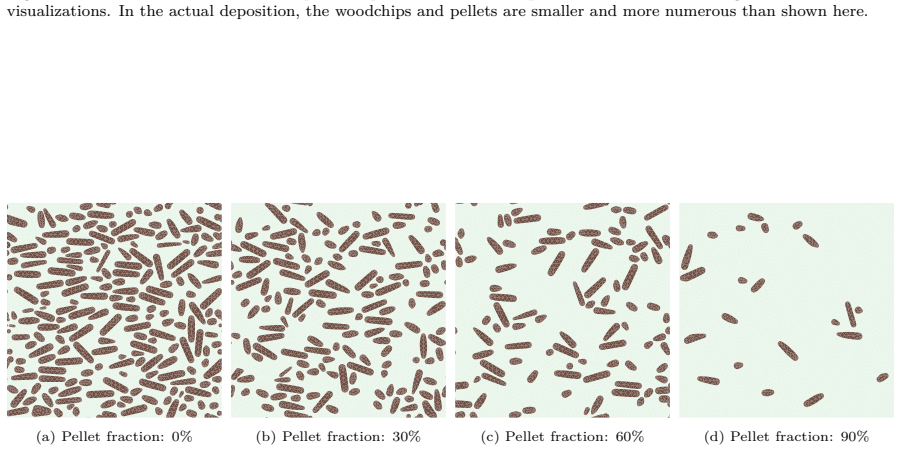
- Conditioning on manufacturing variables—pellet fraction and initial chip orientation from a deposition simulation—lets the optimizer find non-obvious spatial patterns that change deformation qualitatively, reducing hole bulging from 1.48 to about 0.00001.
- The physics-based bias pays off most in the low-data regime: the linear encoder achieves low loss with tens of training samples, whereas a plain neural network needs an order of magnitude more data; this matters because RVE data generation is the dominant offline cost.
- The same architecture supports both material-parameter conditioning (directly in the embedded material model) and geometric conditioning (through the hypernetwork), so functionally graded nonlinear composites are no longer restricted to fixed-microstructure surrogates.
Reading between the lines
- The surrogate is differentiable, so the obvious next step is replacing the derivative-free optimizer with gradient-based grading optimization; a gradient-based loop could converge in a fraction of the roughly 1000 simulations reported.
- The manufacturing-conditioned demonstration is explicitly a proof-of-concept: the deposition simulation is not calibrated against experiments and the 3D geometry is reduced to a 2D slice, so the near-zero bulge is a statement about a simulated proxy. Conditioning a surrogate directly on 3D deposition data or measured manufacturing parameters would test whether the optimization transfers to a real
- Because orientation is handled by rigid rotation of aligned ellipses, the current method does not cover orientation dispersion or multi-directional chips; a richer conditioning variable (e.g., an orientation distribution parameter) would be needed for real deposited woodchips, whose alignment is partial.
- The claim that small datasets suffice is relative to the RVE cost and the chosen parameter range; a scaling-law study that varies the training-set size and the width of the microstructure range would show where the hypernetwork conditioning starts to break down, especially under distribution shift toward extreme volume fractions or aspect ratios.
Signed reviews
Editorial analysis
A structured set of objections, weighed in public.
Referee Report
Summary. The paper proposes the HyPRNN, a physically recurrent neural network whose encoder and decoder weights are generated by a hypernetwork conditioned on microstructural variables. The architecture is intended for finite-strain hyperelastic composites and is demonstrated on a mycelium-woodchip composite model. The authors compare linear and nonlinear encoders against a plain neural network on three datasets with varying material and geometric parameters, validate surrogate-based graded FE² beam simulations against full RVE-based FE² results, and use the surrogate in gradient-free optimization of a graded disk and of a compression specimen. The paper also conditions the surrogate on manufacturing variables from an uncalibrated discrete-element deposition simulation. The authors report large wall-clock savings (from ~5900 s to ~2 s) and optimized designs that reduce peak stress by 42% or nearly eliminate hole bulging, and they make code available on GitHub.
Significance. If the claims hold, this is a useful contribution to data-driven multiscale mechanics: conditioning a physics-based surrogate through a hypernetwork addresses the data bottleneck for varying microstructures, and the zero-stress-at-undeformed-state inductive bias gives the surrogate a qualitative advantage over generic neural networks. The paper ships reproducible code and a full FE² validation, which are clear strengths. The wall-time comparison is meaningful, and the idea of conditioning directly on manufacturing variables is practically attractive. However, the material-specific conclusions are currently supported only by simulations of idealized 2D proxies, and the optimization results are not rechecked against the reference solver; these issues limit the strength of the central claims until addressed.
major comments (4)
- [§5.4 and §6.2] The optimized disk and the optimized compression specimen are evaluated only with the surrogate constitutive model, never re-run with the RVE-based FE² reference. The claims of a 42% peak-stress reduction (Fig. 10) and a bulge reduction to 0.00001 (Fig. 15b) are therefore predictions about the surrogate, not verified predictions about the simulated material. Because an optimizer can exploit regions where the surrogate is inaccurate, the paper should re-evaluate at least the reported optima with the ground-truth micromodel. This is load-bearing for the central claim that HyPRNN makes graded multiscale optimization tractable.
- [§6.1 and §7] The manufacturing-conditioning demonstration rests on an explicitly uncalibrated DEM simulation ('we make the pragmatic choice of not calibrating against experiments') and on a 2D slice that the authors state 'does somewhat disconnect the manufacturing variable from the generated microstructure.' Consequently, the optimized pellet-fraction/orientation patterns are predictions for a simulated proxy, not for the real mycelium-woodchip composite. The abstract's final sentence ('a practical route to engineer the microscale') and the corresponding conclusion should be qualified to make this limitation explicit.
- [§4.1.1, Eqns. (8)–(14)] The linear-encoder admissibility proof needs clarification. The encoder computes Ĉ = 2 EΩ W + I. Even when EΩ and W are symmetric, their product is not symmetric in general, so Ĉ is not guaranteed to be a symmetric Cauchy-Green tensor; det(Ĉ)>0 alone is not equivalent to positive definiteness for a non-symmetric matrix. Equation (11) also uses a spectral bound for a generally non-symmetric product. If the implementation uses Voigt/vector notation rather than 2×2 matrix multiplication, or if an implicit symmetrization is applied, this should be stated explicitly. This is load-bearing for the claim that the encoder always produces admissible deformations.
- [§5.2, Figure 5] The low-data claim relies on learning curves that show only the average over 10 runs, without error bars, confidence bands, or per-run spread. The text states that 'the differences between the types of models are significant' and that within-type variations are 'smaller,' but no statistical measure is provided. Adding variance information or at least min-max envelopes would quantitatively support the central claim that the HyPRNN performs well on small datasets.
minor comments (5)
- [§5.3, Figure 8] The 'near-perfect match' of the linear HyPRNN (512) is supported only visually. Reporting a quantitative displacement or energy error norm against the RVE-based FE² solution would make the validation more convincing.
- [Table 2] The online simulation timings are reported as averages over three runs but no spread is given. A standard deviation or range would help assess the variability of the wall-time comparison.
- [§5.2, Dmat] The text says a PRNN with linear encoder can extrapolate material parameters after training with only one value, citing [17], but the Dmat experiment trains on a range of µ. This experiment therefore does not directly demonstrate extrapolation; the claim should be attributed to the cited prior work or separated from the present results.
- [Reference [2]] The reference metadata for the review article contains duplicated journal/page strings; please clean up the bibliographic entries.
- [§5.1.1] The RVE dataset uses 2D random packings of equal-orientation ellipses. Since the paper's title and abstract refer to a mycelium-woodchip composite, it would be helpful to state explicitly that this is an idealized model material and that the FE² validation demonstrates numerical consistency with the same model rather than experimental fidelity.
Circularity Check
No significant circularity: HyPRNN predictions are benchmarked against an independent FE² simulation; the embedded neo-Hookean model is a sourced physics bias, not a fitted input, and the self-citation cluster (refs 8, 16, 17, 31) is non-load-bearing.
full rationale
Derivation-chain walk: (i) RVE training data are generated in-paper (Sec. 5.1.1) across (Vf, r, mu) using a compressible neo-Hookean model with parameters taken from external literature (Islam et al., refs 28-30); (ii) the HyPRNN is trained on a train/validation/test split (Sec. 5.1.2), with learning curves measured on held-out samples (Fig. 5); (iii) the central claim of 'accurate predictions from small datasets' is supported further by the FE² 3-point-bending validation (Sec. 5.3) against a full concurrent RVE-based simulation whose macroscale equilibrium and tangent accumulation are external to the surrogate's fitted weights. No fitted quantity is re-labeled as a prediction: the hypernetwork's output (PRNN weights) and the stress predictions are trained on and tested against distinct samples, and the FE² benchmark is a coupled BVP, not a training target. The embedded material model (Sec. 4.1: 'These material models are the same ones also used as constitutive equations in the R VE for data generation, in this case neo-Hookean') is a stated physics bias with literature-sourced stiffness values, not a parameter fitted to the prediction target; the sample-dependent learning curves show the learned encoder/decoder carry the homogenization content, ruling out 'forced by construction'. Self-citations [8,16,17,31] form the PRNN/FFE² lineage but are non-load-bearing: the single-mu extrapolation claim of [17] is explicitly set aside ('In contrast to that study... the material parameter is varied in the training data here'), and the encoder validity constraints (Eqs. 8-16) are re-derived in-text rather than imported. Per the reviewing rule, flagged limitations are weighed but belong to correctness risk, not circularity: Sec. 6.1's uncalibrated DEM ('we make the pragmatic choice of not calibrating against experiments'; the 2D slice 'does somewhat disconnect the manufacturing variable from the generated microstructure'), and the fact that the optimized designs (42% stress reduction, bulge 0.00001) are evaluated with the surrogate only, without a confirming RVE-based FE² re-simulation. These are validation gaps, not reductions of an output to an input. Verdict: no exhibited circular step; score 1 reflects a minor non-load-bearing self-citation cluster with otherwise independent central content.
Assumptions & free parameters
free parameters (4)
- wmax (linear encoder scaling bound) =
1.25
- Model hyperparameters (M, hidden sizes, activations) =
e.g., M=2-24; hidden (8), (8,8,8); sigmoid
- Optimization penalty coefficient for deformation constraint =
not reported
- DEM slicing / pellet geometry choices =
pellet radius 1.5x sphere radius; slice height 4x sphere radius
assumptions (6)
- domain assumption Compressible neo-Hookean law (Eqs. 4-5) with mycelium Lame parameters (lambda=0.62, mu=0.51 MPa) and beech wood properties models both constituents.
- domain assumption Homogenized macroscale stress equals volume average over a periodic RVE (Eq. 6); separation of scales holds.
- domain assumption Microstructure is adequately parametrized by (Vf, r, mu) or by (pellet fraction, orientation); in each RVE all ellipses share one shape and orientation.
- ad hoc to paper A 2D slice of the 3D DEM deposition is a valid proxy for the manufactured microstructure.
- domain assumption Material response is path-independent; monotonic random-direction loading up to ||F-I||=0.5 covers the strain space needed by FE2 simulations.
- standard math Eigenvalue inequalities in Section 4.1.1 (lambda_min(E_F) > -1/2 for det F > 0, and scaling by lambda_max) guarantee positive-definite C-hat.
invented entities (1)
-
Fictitious material points (M) inside the PRNN
Cite this review
Pith. "Pith review of Microstructure-Conditioned Surrogate Models for Graded Multiscale Optimization of Mycelium Composites." pith.science (2026). https://pith.science/paper/GTKFZPFT
@misc{pith2026260713688,
  author       = {Pith},
  title        = {Pith review of: Microstructure-Conditioned Surrogate Models for Graded Multiscale Optimization of Mycelium Composites},
  year         = {2026},
  howpublished = {\url{https://pith.science/paper/GTKFZPFT}},
  note         = {Machine review of arXiv:2607.13688}
}
read the original abstract
Emerging sustainable materials increasingly rely on engineered hierarchy and microstructure to achieve control of their properties and mechanical behavior. Optimizing these materials with controllable microstructures requires efficient multiscale simulations. Data-driven surrogate models for the microscale can accelerate multiscale simulations, but require large amounts of data even for a fixed microstructure. When a range of microstructures is considered, as is the case in multiscale optimization, even more data is needed to train a surrogate. To overcome this challenge, we condition a hybrid physics-data surrogate on microstructural variables using a hypernetwork. This approach enables accurate predictions of multiscale mechanical behavior for a mycelium-woodchip composite material, even when trained on small datasets. The conditioned surrogate makes multiscale simulations of functionally graded structures tractable, and we validate it against a full FE^2 simulation. We optimize a graded multiscale disk, and reduce the peak stress by 42% compared to one with a random microstructure. Then, we go one step further, conditioning the network directly on manufacturing variables that can have a complex influence on the microstructure. This is a practical route to engineer the microscale for desired macroscale behavior. This contribution highlights the benefits of microarchitectured structures and demonstrates how conditioned surrogate models enable their multiscale optimization, which will accelerate the development and design of future sustainable materials and structures.
Figures


Figures from the paper (12 more)




Reference graph
Works this paper leans on
-
[1]
Kaysser, B
Yoshinari, W. Kaysser, B. Rabin, A. Kawasaki, R. G. M. Ford, Functionally Graded Materials: Design, Processing and Applications, Vol. 5, Springer Science & Business Media, 2013
2013
-
[2]
J. N. Fuhg, G. A. Padmanabha, N. Bouklas, B. Bahmani, W. C. Sun, N. N. Vlassis, M. Flaschel, P. Carrara, L. D. Lorenzis, A review on data-driven constitutive laws for solids , Archives of Computational Methods in Engineering 2024 32:3 32 (2024) 1841–1883. doi:10.1007/S11831-024-10196-2 . URL https://link.springer.com/article/10.1007/s11831-024-10196-2
- [3]
-
[4]
C. Kim, J. Lee, J. Yoo, Machine learning-combined topology optimization for functionary graded composite structure design, Computer Methods in Applied Mechanics and Engineering 387 (2021) 114158. doi:10.1016/J.CMA.2021. 114158
-
[5]
A. Chandrasekhar, S. Sridhara, K. Suresh, Graded multiscale topology optimization using neural networks, Advances in Engineering Software 175 (2023) 103359. doi:10.1016/J.ADVENGSOFT.2022.103359
arXiv 2023
-
[6]
C. Rao, Y. Liu, Three-dimensional convolutional neural network (3d-cnn) for heterogeneous material homogeniza- tion, Computational Materials Science 184 (2020) 109850. doi:10.1016/J.COMMATSCI.2020.109850
arXiv 2020
-
[7]
E. Pitz, K. Pochiraju, A neural network transformer model for composite microstructure homogenization, Engineer- ing Applications of Artificial Intelligence 134 (2024) 108622. doi:10.1016/J.ENGAPPAI.2024.108622
arXiv 2024
- [8]
Show all 42 references
-
[9]
Black, A
N. Black, A. R. Najafi, Deep neural networks for parameterized homogenization in concurrent multiscale structural optimization, Structural and Multidisciplinary Optimization 66 (2023) 1–25. doi:10.1007/S00158-022-03471-Y/ FIGURES/26. URL https://link.springer.com/article/10.10...
2023 doi
-
[10]
Mozaffar, R
M. Mozaffar, R. Bostanabad, W. Chen, K. Ehmann, J. Cao, M. A. Bessa, Deep learning predicts path-dependent plasticity, Proceedings of the National Academy of Sciences of the United States of America 116 (2019) 26414–26420. doi:10.1073/PNAS.1911815116/-/DCSUPPLEMENTAL.Y. URL ht...
2019 doi
-
[11]
Jailin, E
C. Jailin, E. Baranger, Material-embedding physics-augmented neural networks: A first application to constitutive law parameterization, Computer Methods in Applied Mechanics and Engineering 445 (2025) 118188. doi:10.1016/ J.CMA.2025.118188
2025
-
[12]
Caruana, Learning many related tasks at the same time with backpropagation, Advances in Neural Information Processing Systems 7 (1994)
R. Caruana, Learning many related tasks at the same time with backpropagation, Advances in Neural Information Processing Systems 7 (1994)
1994
-
[13]
C. Finn, P. Abbeel, S. Levine, Model-agnostic meta-learning for fast adaptation of deep networks (7 2017). URL https://proceedings.mlr.press/v70/finn17a.html 21
2017
-
[14]
J. N. Heidenreich, C. Bonatti, D. Mohr, Transfer learning of recurrent neural network-based plasticity models , International Journal for Numerical Methods in Engineering 125 (2024) e7357. doi:10.1002/NME.7357. URL https://onlinelibrary.wiley.com/doi/full/10.1002/nme.7357https...
2024 doi
-
[15]
Ghane, M
E. Ghane, M. Fagerström, M. Mirkhalaf, Recurrent neural networks and transfer learning for predicting elasto- plasticity in woven composites, European Journal of Mechanics - A/Solids 107 (2024) 105378. doi:10.1016/J. EUROMECHSOL.2024.105378
2024
-
[16]
M. A. Maia, I. B. Rocha, P. Kerfriden, F. P. van der Meer, Physically recurrent neural networks for path-dependent heterogeneous materials: Embedding constitutive models in a data-driven surrogate, Computer Methods in Applied Mechanics and Engineering 407 (2023) 115934. doi:10...
2023
-
[17]
Kovács, I
N. Kovács, I. B. C. M. Rocha, F. P. van der Meer, C. Furtado, P. P. Camanho, Uncertainty quantification in multiscale modeling of polymer composite materials using physically recurrent neural networks (2025). URL http://arxiv.org/abs/2504.11625
2025 arXiv
-
[18]
Z. Liu, C. T. Wu, M. Koishi, A deep material network for multiscale topology learning and accelerated nonlinear modeling of heterogeneous materials, Computer Methods in Applied Mechanics and Engineering 345 (2019) 1138–
2019
-
[19]
T. Li, Micromechanics-informed parametric deep material network for physics behavior prediction of heterogeneous materials with a varying morphology, Computer Methods in Applied Mechanics and Engineering 419 (2024) 116687. doi:10.1016/J.CMA.2023.116687
2024
-
[20]
Wei, W.-N
T.-J. Wei, W.-N. Wan, C.-S. Chen, Deep material network: Overview, applications and current directions (4 2025). URL http://arxiv.org/abs/2504.12159
2025
-
[21]
Zheng, D
L. Zheng, D. M. Kochmann, S. Kumar, Hypercan: Hypernetwork-driven deep parameterized constitutive models for metamaterials, Extreme Mechanics Letters 72 (11 2024). doi:10.1016/j.eml.2024.102243
2024
-
[22]
H. Wang, J. Tao, Z. Wu, K. Weiland, Z. Wang, K. Masania, B. Wang, Fabrication of living entangled network composites enabled by mycelium, Advanced Science 11 (6 2024). doi:10.1002/ADVS.202309370
2024 doi
-
[23]
Gantenbein, E
S. Gantenbein, E. Colucci, J. Käch, E. Trachsel, F. B. Coulter, P. A. Rühs, K. Masania, A. R. Studart, Three- dimensional printing of mycelium hydrogels into living complex materials , Nature Materials 2022 22:1 22 (2022) 128–134. doi:10.1038/s41563-022-01429-5 . URL https://w...
2022 doi
-
[24]
Schyck, M
S. Schyck, M. Ablonczy, S. Patranabish, K. Masania, Shaping of biohybrid functional living materials , Advanced Functional Materials 36 (2026) e30836. doi:10.1002/ADFM.202530836. URL https://onlinelibrary.wiley.com/doi/full/10.1002/adfm.202530836https://onlinelibrary.wiley.com...
2026 doi
-
[25]
R. M. McBee, M. Lucht, N. Mukhitov, M. Richardson, T. Srinivasan, D. Meng, H. Chen, A. Kaufman, M. Reitman, C. Munck, D. Schaak, C. Voigt, H. H. Wang, Engineering living and regenerative fungal–bacterial biocomposite structures, Nature Materials 2021 21:4 21 (2021) 471–478. do...
2021 doi
-
[26]
I. H. Nettersheim, N. S. Sotelo, J. C. Verdonk, K. Masania, Engineered living composite materials, Composites Science and Technology 256 (2024) 110758. doi:10.1016/J.COMPSCITECH.2024.110758
2024
-
[27]
Zhang, Z
M. Zhang, Z. Zhang, R. Zhang, Y. Peng, M. Wang, J. Cao, Lightweight, thermal insulation, hydrophobic mycelium composites with hierarchical porous structure: Design, manufacture and applications, Composites Part B: Engi- neering 266 (2023) 111003. doi:10.1016/J.COMPOSITESB.2023.111003
2023
-
[28]
M. R. Islam, G. Tudryn, R. Bucinell, L. Schadler, R. C. Picu, Morphology and mechanics of fungal mycelium , Scientific Reports 2017 7:1 7 (2017) 13070–. doi:10.1038/s41598-017-13295-2 . URL https://www.nature.com/articles/s41598-017-13295-2
2017 doi
-
[29]
M. R. Islam, G. Tudryn, R. Bucinell, L. Schadler, R. C. Picu, Mechanical behavior of mycelium-based particulate composites, Journal of Materials Science 53 (2018) 16371–16382. doi:10.1007/s10853-018-2797-z
2018 doi
-
[30]
M. R. Islam, G. Tudryn, R. Bucinell, L. Schadler, R. C. Picu, Stochastic continuum model for mycelium-based bio-foam, Materials & Design 160 (2018) 549–556. doi:10.1016/J.MATDES.2018.09.046
2018 doi
-
[31]
M. Maia, I. Rocha, D. Kovačević, F. P. van der Meer, Physically recurrent neural network for rate and path- dependent heterogeneous materials in a finite strain framework, Mechanics of Materials 198 (2024) 105145. doi: 10.1016/J.MECHMAT.2024.105145
2024
-
[32]
Geuzaine, J
C. Geuzaine, J. F. Remacle, Gmsh: A 3-d finite element mesh generator with built-in pre- and post-processing facilities, International Journal for Numerical Methods in Engineering 79 (2009) 1309–1331. doi:10.1002/NME.2579. URL https://onlinelibrary.wiley.com/doi/full/10.1002/n...
2009 doi
-
[33]
I. A. Baratta, J. P. Dean, J. S. Dokken, M. U. of Luxembourg; Rafinex Sarl HABERA, T. Jack; University of Luxembourg > Faculty of Science, M. F. . D. of Engineering (DoE) HALE, C. N. Richardson, M. E. Rognes, M. W. Scroggs, N. Sime, G. N. Wells, Dolfinx: The next generation fe...
2025 doi
-
[34]
Bradbury, R
J. Bradbury, R. Frostig, P. Hawkins, M. J. Johnson, Y. Katariya, C. Leary, D. Maclaurin, G. Necula, A. Paszke, J. VanderPlas, S. Wanderman-Milne, Q. Zhang, Jax: composable transformations of python+numpy programs (2018). URL http://github.com/jax-ml/jax
2018
-
[35]
D. P. Kingma, J. L. Ba, Adam: A method for stochastic optimization , 3rd International Conference on Learning Representations, ICLR 2015 - Conference Track Proceedings (12 2014). URL https://arxiv.org/abs/1412.6980v9
2015 arXiv
-
[36]
Bleyer, dolfinx_materials: A python package for advanced material modelling (10 2024)
J. Bleyer, dolfinx_materials: A python package for advanced material modelling (10 2024). doi:10.5281/zenodo. 13882183. URL https://doi.org/10.5281/zenodo.13882183
2024 doi
-
[37]
J. F. Durodola, O. Attia, Deformation and stresses in functionally graded rotating disks, Composites Science and Technology 60 (2000) 987–995. doi:10.1016/S0266-3538(99)00197-9
2000 doi
-
[38]
Bayat, M
M. Bayat, M. Saleem, B. B. Sahari, A. M. Hamouda, E. Mahdi, Analysis of functionally graded rotating disks with variable thickness, Mechanics Research Communications 35 (2008) 283–309. doi:10.1016/J.MECHRESCOM.2008.02. 007
2008 doi
-
[39]
H. M. A. Abdalla, D. Casagrande, L. Moro, Thermo-mechanical analysis and optimization of functionally graded ro- tating disks, Journal of Strain Analysis for Engineering Design 55 (2020) 159–171. doi:10.1177/0309324720904793/ ASSET/9D49D730-B9F7-4A4A-8CD7-9F591A582618/ASSETS/I...
2020 doi
-
[40]
Hansen, A
N. Hansen, A. Ostermeier, Completely derandomized self-adaptation in evolution strategies., Evolutionary compu- tation 9 (2001) 159–195. doi:10.1162/106365601750190398
2001 doi
-
[41]
Smilauer, V
V. Smilauer, V. Angelidakis, E. Catalano, R. Caulk, B. Chareyre, W. Chevremont, S. Dorofeenko, J. Duriez, N. Dyck, J. Elias, et al., Yade documentation, arXiv preprint arXiv:2301.00611 (2023). Appendix A. Hyperparameter configurations In Table A.3 we present the hyperparameter...
2023 arXiv
-
[1168]
doi:10.1016/j.cma.2018.09.020
2018 doi
Reviewed August 2, 2026 · model on record in the stance chip above.
Discussion (0). Continue with ORCID to comment.