REVIEW 4 major objections 4 minor 1 cited by
POSS: Position Specialist Generates Better Draft for Speculative Decoding
T0 review · 4 major / 4 minor · reviewed 2026-08-07 · deepseek-v4-flash
Pith's one-line read Position specialists boost LLM draft acceptance and speed
desk verdict Useful pos-acc diagnostic and a plausible specialization idea, but the missing matched-capacity baseline keeps the mechanism claim unproven and the empirical reporting is a bit cherry-picked. read the letter →
The pith
A machine-rendered reading of the paper's core claim, the machinery that carries it, and where it could break.
The reading
What carries the argument
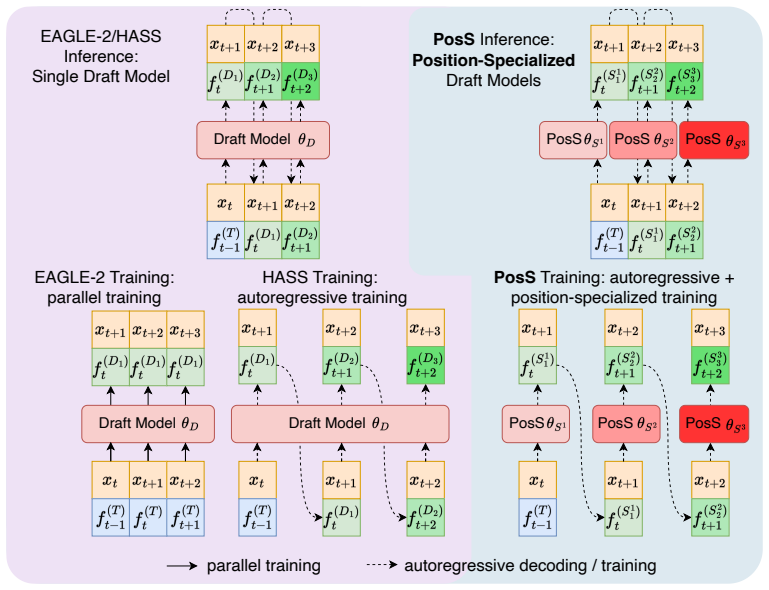
The central object is the position-specialized draft layer together with the position-wise acceptance rate (pos-acc) chain rule. In POSS-$n$, each specialist layer handles $n$ consecutive draft positions and is trained on the feature output of the preceding specialist, so it sees only the noise level typical of its own position; training combines token-level cross-entropy, Smooth L1 feature matching, and Top-K distillation losses. The chain rule $\mathrm{pos\text{-}acc}_i = P(A_i)/P(A_{i-1})$ shows that the probability of accepting $k$ draft tokens equals $P(A_1)$ times the product of the conditional acceptance rates, which explains why a drop at any one position is multiplied across the whole draft and why keeping late-position accuracy high is the lever for longer acceptance length.
What would settle it
Train a single HASS-style draft model with total parameter count and training epochs matched to those of the full POSS setup, then compare average acceptance length and pos-acc on the same six datasets. If the single model matches or beats POSS, the claim that position specialization itself is what helps would be falsified.
Extended reading notes
Core claim
The paper's central claim is that the degradation of draft-token quality at later positions in speculative decoding is caused by accumulated feature deviation, and that this can be addressed by assigning each draft position (or small group of positions) to its own 'position specialist' layer rather than asking one layer to cover all positions. Each specialist is trained autoregressively on features produced by the preceding specialist, so it learns to handle the narrow, expected amount of noise at its own position. The introduced metric, position-wise acceptance rate (pos-acc), is the conditional probability of accepting the i-th draft token given the previous token was accepted; because overall acceptance length factors into a product of these conditional probabilities, a drop at any position multiplies into the whole draft. The experiments show POSS variants keep pos-acc relatively flat at deep positions where EAGLE-2 and HASS fall off, and this translates into higher average acceptance length and speed-up ratio.
Load-bearing premise
The paper's central claim rests on the assumption that the measured gains come from position specialization rather than from simply having more draft-model parameters or more training, a control that the experiments do not include.
Editorial extensions
If this is right
- Higher position-wise acceptance rates at later positions directly raise average acceptance length per drafting round.
- Fewer drafting rounds are needed to finish a generation, which is the mechanism behind the measured speed-up ratio.
- The improvements hold across six datasets and two target model sizes, Llama-3-8B-Instruct and Llama-2-13B-chat.
- POSS-3, which adds the fewest specialist layers, still outperforms HASS, showing that even a small number of specialists shifts the trade-off.
Reading between the lines
- An untested alternative is that a single draft model with the same total parameter count and training budget would match POSS; the paper's experiments do not include this control, so the specialization mechanism is not yet isolated from added capacity.
- Equal-width position blocks (POSS-n) may not be optimal; allocating more specialists to the deepest positions, where feature deviation accumulates fastest, could give larger acceptance gains.
- The pos-acc chain-rule view suggests that other late-position fixes, such as feature alignment or position-conditioned adapters, could be combined with specialists to push acceptance length further.
Editorial analysis
A structured set of objections, weighed in public.
Referee Report
Summary. The paper proposes POSS, a speculative decoding draft model composed of position-specialized Transformer layers, where each specialist is trained to predict tokens at one or several fixed draft positions. It introduces position-wise acceptance rate (pos-acc) as a diagnostic and argues that a single draft layer's accuracy decays at later positions because of accumulated feature deviation, while specialists can focus on a narrower band of deviation. Experiments on Llama-3-8B-Instruct and Llama-2-13B-Chat across six datasets report higher average acceptance length and speed-up ratio over EAGLE-2 and HASS, supported by analyses of pos-acc, computational overhead, and draft depth. The code is released.
Significance. The pos-acc metric is a clean and useful diagnostic for speculative decoding, and the idea of decomposing drafting by position is intuitive and could be practically valuable. The paper reports consistent, though modest, acceptance-length gains over strong baselines, and the efficiency analysis in Figure 5 attempts to quantify the overhead of additional specialists. Releasing the code is a strength. However, the experiments do not isolate the specialization mechanism from added model capacity and additional training, so the central claim that position specialization itself drives the gains is not yet established.
major comments (4)
- [§3.2, §3.3, §4.1, Table 1] The main claim that position specialization improves later-position acceptance is not isolated experimentally. In the 8B target setting the draft depth is 6 (Section 4.1), so POSS-1, POSS-2, and POSS-3 deploy 6, 3, and 2 Transformer layers respectively (Section 3.3), whereas EAGLE-2 and HASS use a single layer. The higher pos-acc of POSS in Figures 2 and 4 and the higher acceptance lengths in Table 1 could therefore result simply from a larger, more expressive draft model. A matched-capacity control is missing: for example, a single HASS-style draft model with 2, 3, or 6 layers, trained with the same initialization and the same total number of update steps, should be compared against POSS-n. Without such a control, the mechanism story illustrated in Figure 3 is unsupported.
- [§4.1, Table 2] The speed-up ratio, one of the two headline metrics, is computed after selecting the fastest of three runs per method: the paper states 'We repeat all experiments 3 times and select the fastest one among each method for speed-up ratio calculation.' This selection rule can systematically favor methods with higher run-to-run variance, and no standard deviation or significance test is reported. The reported speed-up advantages over HASS are often small (0.01x to 0.09x on average in Table 2), so this reporting choice is load-bearing for the claim that POSS 'consistently outperforms' baselines. The authors should report mean and variance over the three runs, or provide a clear justification for the fastest-run selection.
- [Appendix B] The training budgets are not matched. HASS is trained for 40 epochs from scratch, while POSS is initialized from the reproduced EAGLE-2 checkpoint and trained for an additional 20 epochs. This gives POSS a warm start from EAGLE-2 training in addition to its own 20 epochs, whereas HASS must learn the same mapping from scratch. The statement in Appendix B that this 'fairly compares' with HASS is therefore difficult to maintain. The authors should either train all methods from the same initialization for the same number of update steps or show that the comparison is insensitive to the initialization and training schedule.
- [Abstract, Table 1, Table 2] The abstract reports improvements of 'up to 4.5%' for acceptance length and 'up to 5.7%' for speed-up ratio, but these are per-dataset maxima rather than average gains. The average improvements over HASS are smaller, and in some settings negligible (e.g., Llama-2-13B at temperature 0: HASS 3.33x vs POSS-3 3.34x in Table 2). The authors should report average relative improvements and indicate where differences are within run-to-run noise.
minor comments (4)
- [Figure 4] The legend uses 'PosS' while the main text and other figures use 'POSS'; please use a single consistent notation.
- [Tables 1 and 2] The shorthand 'L3 8B' and 'L2 13B' is not defined in the captions; please spell out the model names at least once in each caption.
- [Appendix A] The limitations section mentions only memory and KV-cache overhead; it does not acknowledge the capacity and training-budget confound discussed above, which should be listed as a limitation or addressed experimentally.
- [Appendix D] The phrase 'EAGLE-2 and HASS... are de facto POSS-∞' is imprecise, since EAGLE-2 and HASS share one layer across all positions rather than using infinitely many specialists; please rephrase.
Circularity Check
No significant circularity: pos-acc is a chain-rule decomposition and the POSS gains are externally measured, not fitted or self-cited into existence.
full rationale
The paper's derivation chain is self-contained. The pos-acc decomposition (Eqs. 3-4) is a direct application of conditional probability with the nesting A_i ⊂ A_{i-1}, not an assumption that encodes the conclusion. The POSS training losses (Eqs. 5-10) are standard token/feature cross-entropy and Smooth L1 objectives whose targets are target-model features and tokens, independently of the reported acceptance-length and speed-up metrics. The empirical pos-acc curves in Figures 2 and 4 are measurements, not quantities fitted to the headline Tables 1-2. No parameter is fitted to the evaluation metric, no uniqueness theorem is imported, and the few self-citations (Refs. 35-36) appear only in related work and are not load-bearing. The absence of a matched-capacity single-draft-model baseline is a possible confound for the mechanism claim but is not circularity, since the comparison is externally measured rather than true by construction. Score 0.
Assumptions & free parameters
free parameters (7)
- number of positions per specialist n =
1, 2, 3
- draft tree depth =
6 for Llama-3-8B, 7 for Llama-2-13B
- draft tree width =
10
- total draft tokens per round =
60
- token-level loss weight w =
0.1
- Top-K distillation K =
10
- training epochs for POSS =
20 additional epochs from the EAGLE-2 checkpoint
assumptions (6)
- standard math Standard chain rule of probability applies to acceptance events because accepted tokens are nested (A_i subset A_{i-1}).
- domain assumption Target model hidden states are extractable and usable as features for draft prediction at inference time.
- ad hoc to paper Feature deviation between draft-generated and target features increases monotonically with draft position.
- domain assumption Training on ShareGPT and its distilled version transfers to the six evaluation datasets.
- ad hoc to paper Each position specialist's assigned feature-deviation band is narrow enough that a single Transformer layer can learn it.
- domain assumption Speculative decoding verification preserves the target distribution.
Cite this review
Pith. "Pith review of POSS: Position Specialist Generates Better Draft for Speculative Decoding." pith.science (2026). https://pith.science/paper/GUSABTS5
@misc{pith2026250603566,
  author       = {Pith},
  title        = {Pith review of: POSS: Position Specialist Generates Better Draft for Speculative Decoding},
  year         = {2026},
  howpublished = {\url{https://pith.science/paper/GUSABTS5}},
  note         = {Machine review of arXiv:2506.03566}
}
read the original abstract
Speculative decoding accelerates Large Language Model (LLM) inference by using a small draft model to predict multiple tokens, and a large target model to verify these tokens in parallel. Recent studies leverage the hidden state of the target model to enhance draft model prediction accuracy. However, existing methods suffer from the degrading quality of draft token predictions at later positions, due to error accumulation in draft model generated features. In this paper, we propose Position Specialists (PosS), which consist of multiple position-specialized draft layers to generate tokens at assigned position(s). Position specialists greatly improve token acceptance rate at later positions per drafting round, as each specialist only needs to focus on handling a certain level of draft model feature deviation. Experiment results on Llama-3-8B-Instruct and Llama-2-13B-chat across six datasets demonstrate that PosS effectively improves over baselines on average acceptance length and speed-up ratio. Our codebase is available at https://github.com/shrango/PosS.
Figures


Figures from the paper (4 more)


Forward citations
Cited by 1 Pith paper
-
PreScience: A Dataset and Benchmark for Scientific Forecasting
A new benchmark tests whether AI can forecast future scientific papers; frontier LLMs score ~5.6/10 on matching real abstracts, and simulated corpora are measurably less diverse and novel than human science.
Reference graph
Works this paper leans on
-
[1]
Fast inference from transformers via speculative decoding
Yaniv Leviathan, Matan Kalman, and Yossi Matias. Fast inference from transformers via speculative decoding. InInternational Conference on Machine Learning, 2022
work page 2022
-
[2]
Charlie Chen, Sebastian Borgeaud, Geoffrey Irving, Jean-Baptiste Lespiau, L. Sifre, and John M. Jumper. Accelerating large language model decoding with speculative sampling.ArXiv, abs/2302.01318, 2023
arXiv 2023
-
[3]
Medusa: Simple llm inference acceleration framework with multiple decoding heads
Tianle Cai, Yuhong Li, Zhengyang Geng, Hongwu Peng, Jason D Lee, Deming Chen, and Tri Dao. Medusa: Simple llm inference acceleration framework with multiple decoding heads. arXiv preprint arXiv:2401.10774, 2024
arXiv 2024
-
[4]
EAGLE: Speculative sampling requires rethinking feature uncertainty
Yuhui Li, Fangyun Wei, Chao Zhang, and Hongyang Zhang. EAGLE: Speculative sampling requires rethinking feature uncertainty. InInternational Conference on Machine Learning, 2024
2024
-
[5]
EAGLE-2: Faster inference of language models with dynamic draft trees
Yuhui Li, Fangyun Wei, Chao Zhang, and Hongyang Zhang. EAGLE-2: Faster inference of language models with dynamic draft trees. InEmpirical Methods in Natural Language Processing, 2024
2024
-
[6]
Learning harmonized represen- tations for speculative sampling.arXiv preprint arXiv:2408.15766, 2024
Lefan Zhang, Xiaodan Wang, Yanhua Huang, and Ruiwen Xu. Learning harmonized represen- tations for speculative sampling.arXiv preprint arXiv:2408.15766, 2024
arXiv 2024
-
[7]
H. T. Kung and John T. Robinson. On optimistic methods for concurrency control. InTODS, 1979. 10
work page 1979
-
[8]
Xing, Hao Zhang, Joseph E
Lianmin Zheng, Wei-Lin Chiang, Ying Sheng, Siyuan Zhuang, Zhanghao Wu, Yonghao Zhuang, Zi Lin, Zhuohan Li, Dacheng Li, Eric P. Xing, Hao Zhang, Joseph E. Gonzalez, and Ion Stoica. Judging llm-as-a-judge with mt-bench and chatbot arena, 2023
2023
Show all 39 references
-
[9]
Hashimoto
Rohan Taori, Ishaan Gulrajani, Tianyi Zhang, Yann Dubois, Xuechen Li, Carlos Guestrin, Percy Liang, and Tatsunori B. Hashimoto. Stanford alpaca: An instruction-following llama model. https://github.com/tatsu-lab/stanford_alpaca, 2023
2023
-
[10]
Training verifiers to solve math word problems, 2021
Karl Cobbe, Vineet Kosaraju, Mohammad Bavarian, Mark Chen, Heewoo Jun, Lukasz Kaiser, Matthias Plappert, Jerry Tworek, Jacob Hilton, Reiichiro Nakano, Christopher Hesse, and John Schulman. Training verifiers to solve math word problems, 2021
2021
-
[11]
Dai, Jakob Uszkoreit, Quoc Le, and Slav Petrov
Tom Kwiatkowski, Jennimaria Palomaki, Olivia Redfield, Michael Collins, Ankur Parikh, Chris Alberti, Danielle Epstein, Illia Polosukhin, Jacob Devlin, Kenton Lee, Kristina Toutanova, Llion Jones, Matthew Kelcey, Ming-Wei Chang, Andrew M. Dai, Jakob Uszkoreit, Quoc Le, and Slav...
2019
-
[12]
Abstractive text summarization using sequence-to-sequence rnns and beyond, 2016
Ramesh Nallapati, Bowen Zhou, Cicero Nogueira dos santos, Caglar Gulcehre, and Bing Xiang. Abstractive text summarization using sequence-to-sequence rnns and beyond, 2016
2016
-
[13]
Mark Chen, Jerry Tworek, Heewoo Jun, Qiming Yuan, Henrique Ponde de Oliveira Pinto, Jared Kaplan, Harri Edwards, Yuri Burda, Nicholas Joseph, Greg Brockman, Alex Ray, Raul Puri, Gretchen Krueger, Michael Petrov, Heidy Khlaaf, Girish Sastry, Pamela Mishkin, Brooke Chan, Scott G...
2021
-
[14]
Sequoia: Scalable, robust, and hardware-aware speculative decoding.arXiv preprint arXiv:2402.12374, 2024
Zhuoming Chen, Avner May, Ruslan Svirschevski, Yuhsun Huang, Max Ryabinin, Zhihao Jia, and Beidi Chen. Sequoia: Scalable, robust, and hardware-aware speculative decoding.arXiv preprint arXiv:2402.12374, 2024
2024 arXiv
-
[15]
Speculative decoding: Exploiting speculative execution for accelerating seq2seq generation.arXiv preprint arXiv:2203.16487, 2022
Heming Xia, Tao Ge, Peiyi Wang, Si-Qing Chen, Furu Wei, and Zhifang Sui. Speculative decoding: Exploiting speculative execution for accelerating seq2seq generation.arXiv preprint arXiv:2203.16487, 2022
2022 arXiv
-
[16]
Token-driven gammatune: Adaptive calibration for enchanced speculative decoding.arXiv preprint arXiv:2504.00030, 2025
Aayush Gautam, Susav Shrestha, and Narasimha Annapareddy. Token-driven gammatune: Adaptive calibration for enchanced speculative decoding.arXiv preprint arXiv:2504.00030, 2025
2025 arXiv
-
[17]
Specdec++: Boosting speculative decoding via adaptive candidate lengths.arXiv preprint arXiv:2405.19715, 2024
Kaixuan Huang, Xudong Guo, and Mengdi Wang. Specdec++: Boosting speculative decoding via adaptive candidate lengths.arXiv preprint arXiv:2405.19715, 2024
2024 arXiv
-
[18]
Magicdec: Breaking the latency- throughput tradeoff for long context generation with speculative decoding.arXiv preprint arXiv:2408.11049, 2024
Ranajoy Sadhukhan, Jian Chen, Zhuoming Chen, Vashisth Tiwari, Ruihang Lai, Jinyuan Shi, Ian En-Hsu Yen, Avner May, Tianqi Chen, and Beidi Chen. Magicdec: Breaking the latency- throughput tradeoff for long context generation with speculative decoding.arXiv preprint arXiv:2408.1...
2024 arXiv
-
[19]
Better & faster large language models via multi-token prediction.arXiv preprint arXiv:2404.19737, 2024
Fabian Gloeckle, Badr Youbi Idrissi, Baptiste Rozière, David Lopez-Paz, and Gabriel Syn- naeve. Better & faster large language models via multi-token prediction.arXiv preprint arXiv:2404.19737, 2024
2024 arXiv
-
[20]
Ems-sd: Efficient multi-sample speculative decoding for accelerating large language models.arXiv preprint arXiv:2405.07542, 2024
Yunsheng Ni, Chuanjian Liu, Yehui Tang, Kai Han, and Yunhe Wang. Ems-sd: Efficient multi-sample speculative decoding for accelerating large language models.arXiv preprint arXiv:2405.07542, 2024
2024 arXiv
-
[21]
Turning trash into treasure: Accelerating inference of large language models with token recycling.arXiv preprint arXiv:2408.08696, 2024
Xianzhen Luo, Yixuan Wang, Qingfu Zhu, Zhiming Zhang, Xuanyu Zhang, Qing Yang, Dongliang Xu, and Wanxiang Che. Turning trash into treasure: Accelerating inference of large language models with token recycling.arXiv preprint arXiv:2408.08696, 2024. 11
2024 arXiv
-
[22]
Lossless acceleration of large language model via adaptive n-gram parallel decoding.arXiv preprint arXiv:2404.08698, 2024
Jie Ou, Yueming Chen, and Wenhong Tian. Lossless acceleration of large language model via adaptive n-gram parallel decoding.arXiv preprint arXiv:2404.08698, 2024
2024 arXiv
-
[23]
Parallel decoding via hidden transfer for lossless large language model acceleration.arXiv preprint arXiv:2404.12022, 2024
Pengfei Wu, Jiahao Liu, Zhuocheng Gong, Qifan Wang, Jinpeng Li, Jingang Wang, Xunliang Cai, and Dongyan Zhao. Parallel decoding via hidden transfer for lossless large language model acceleration.arXiv preprint arXiv:2404.12022, 2024
2024 arXiv
-
[24]
Parallel speculative decoding with adaptive draft length.arXiv preprint arXiv:2408.11850, 2024
Tianyu Liu, Yun Li, Qitan Lv, Kai Liu, Jianchen Zhu, and Winston Hu. Parallel speculative decoding with adaptive draft length.arXiv preprint arXiv:2408.11850, 2024
2024 arXiv
-
[25]
Fast and accurate language model decoding via parallel token processing
Zhepei Wei, Wei-Lin Chen, Xinyu Zhu, and Yu Meng. Fast and accurate language model decoding via parallel token processing. InAdaptive Foundation Models: Evolving AI for Personalized and Efficient Learning, 2024
2024
-
[26]
Griffin: Effective token alignment for faster speculative decoding.arXiv preprint arXiv:2502.11018, 2025
Shijing Hu, Jingyang Li, Xingyu Xie, Zhihui Lu, Kim-Chuan Toh, and Pan Zhou. Griffin: Effective token alignment for faster speculative decoding.arXiv preprint arXiv:2502.11018, 2025
2025
-
[27]
Specinfer: Accelerating large language model serving with tree-based speculative inference and verification
Xupeng Miao, Gabriele Oliaro, Zhihao Zhang, Xinhao Cheng, Zeyu Wang, Zhengxin Zhang, Rae Ying Yee Wong, Alan Zhu, Lijie Yang, Xiaoxiang Shi, et al. Specinfer: Accelerating large language model serving with tree-based speculative inference and verification. InProceedings of the...
2024
-
[28]
Propd: Dynamic token tree pruning and generation for llm parallel decoding
Shuzhang Zhong, Zebin Yang, Ruihao Gong, Runsheng Wang, Ru Huang, and Meng Li. Propd: Dynamic token tree pruning and generation for llm parallel decoding. InProceedings of the 43rd IEEE/ACM International Conference on Computer-Aided Design, pages 1–8, 2024
2024
-
[29]
Layerskip: Enabling early exit inference and self-speculative decoding.arXiv preprint arXiv:2404.16710, 2024
Mostafa Elhoushi, Akshat Shrivastava, Diana Liskovich, Basil Hosmer, Bram Wasti, Liangzhen Lai, Anas Mahmoud, Bilge Acun, Saurabh Agarwal, Ahmed Roman, et al. Layerskip: Enabling early exit inference and self-speculative decoding.arXiv preprint arXiv:2404.16710, 2024
2024 arXiv
-
[30]
Triforce: Lossless acceleration of long sequence generation with hierarchical speculative decoding.arXiv preprint arXiv:2404.11912, 2024
Hanshi Sun, Zhuoming Chen, Xinyu Yang, Yuandong Tian, and Beidi Chen. Triforce: Lossless acceleration of long sequence generation with hierarchical speculative decoding.arXiv preprint arXiv:2404.11912, 2024
2024 arXiv
-
[31]
Judge decoding: Faster speculative sampling requires going beyond model alignment.arXiv preprint arXiv:2501.19309, 2025
Gregor Bachmann, Sotiris Anagnostidis, Albert Pumarola, Markos Georgopoulos, Artsiom Sanakoyeu, Yuming Du, Edgar Schönfeld, Ali Thabet, and Jonas Kohler. Judge decoding: Faster speculative sampling requires going beyond model alignment.arXiv preprint arXiv:2501.19309, 2025
2025 arXiv
-
[32]
Specrea- son: Fast and accurate inference-time compute via speculative reasoning.arXiv preprint arXiv:2504.07891, 2025
Rui Pan, Yinwei Dai, Zhihao Zhang, Gabriele Oliaro, Zhihao Jia, and Ravi Netravali. Specrea- son: Fast and accurate inference-time compute via speculative reasoning.arXiv preprint arXiv:2504.07891, 2025
2025 arXiv
-
[33]
Speculative thinking: En- hancing small-model reasoning with large model guidance at inference time.arXiv preprint arXiv:2504.12329, 2025
Wang Yang, Xiang Yue, Vipin Chaudhary, and Xiaotian Han. Speculative thinking: En- hancing small-model reasoning with large model guidance at inference time.arXiv preprint arXiv:2504.12329, 2025
2025 arXiv
-
[34]
Efficient reasoning for llms through speculative chain-of-thought.arXiv preprint arXiv:2504.19095, 2025
Jikai Wang, Juntao Li, Lijun Wu, and Min Zhang. Efficient reasoning for llms through speculative chain-of-thought.arXiv preprint arXiv:2504.19095, 2025
2025 arXiv
-
[35]
Efficient test-time scaling via self-calibration.arXiv preprint arXiv:2503.00031, 2025
Chengsong Huang, Langlin Huang, Jixuan Leng, Jiacheng Liu, and Jiaxin Huang. Efficient test-time scaling via self-calibration.arXiv preprint arXiv:2503.00031, 2025
2025 arXiv
-
[36]
Divide, reweight, and conquer: A logit arithmetic approach for in-context learning.arXiv preprint arXiv:2410.10074, 2024
Chengsong Huang, Langlin Huang, and Jiaxin Huang. Divide, reweight, and conquer: A logit arithmetic approach for in-context learning.arXiv preprint arXiv:2410.10074, 2024
2024 arXiv
-
[37]
Non-myopic generation of language models for reasoning and planning.arXiv preprint arXiv:2410.17195, 2024
Chang Ma, Haiteng Zhao, Junlei Zhang, Junxian He, and Lingpeng Kong. Non-myopic generation of language models for reasoning and planning.arXiv preprint arXiv:2410.17195, 2024
2024 arXiv
-
[38]
Toward effective retrieval augmented generative services in 6g networks.IEEE Network, 38(6):459–467, 2024
Xi Huang, Yinxu Tang, Junling Li, Ning Zhang, and Xuemin Shen. Toward effective retrieval augmented generative services in 6g networks.IEEE Network, 38(6):459–467, 2024. 12
2024
-
[39]
OPT-tree: Speculative decoding with adaptive draft tree structure.Transactions of the Association for Computational Linguistics, 13:188–199, 2025
Jikai Wang, Yi Su, Juntao Li, Qingrong Xia, Zi Ye, Xinyu Duan, Zhefeng Wang, and Min Zhang. OPT-tree: Speculative decoding with adaptive draft tree structure.Transactions of the Association for Computational Linguistics, 13:188–199, 2025. 13 A Limitations POSSrequires slightly...
2025
Reviewed August 7, 2026 · model on record in the stance chip above.
Discussion (0). Sign in to comment.