Quantum Correlations in the Decay of B⁰ meson and Entanglement Entropy
Pith reviewed 2026-06-29 03:50 UTC · model grok-4.3
The pith
Entanglement entropy in B0 decays into vector meson pairs depends strongly on relative phases of polarization amplitudes.
A machine-rendered reading of the paper's core claim, the machinery that carries it, and where it could break.
Core claim
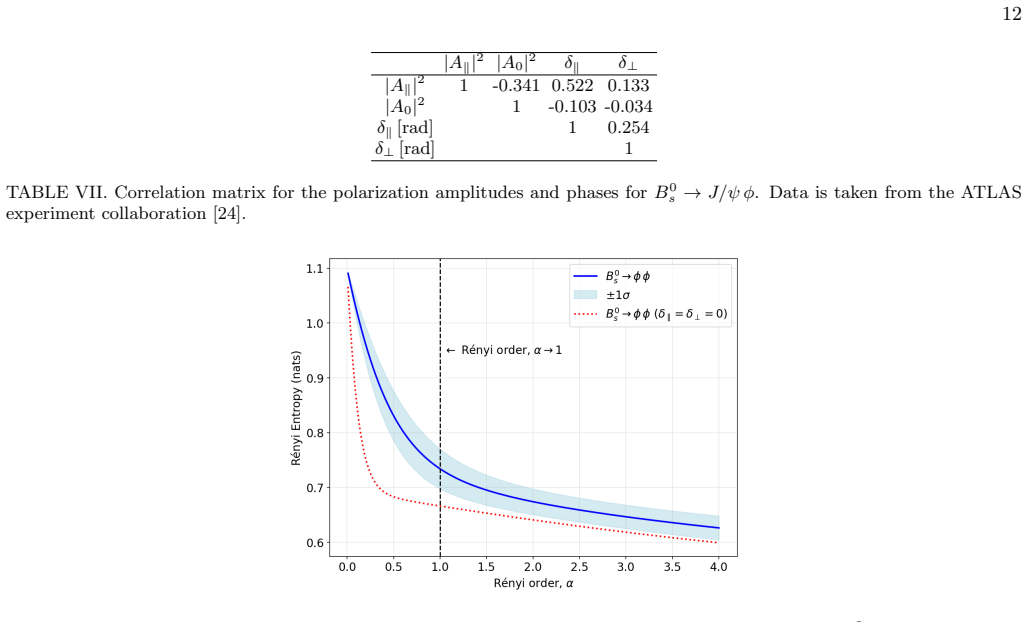
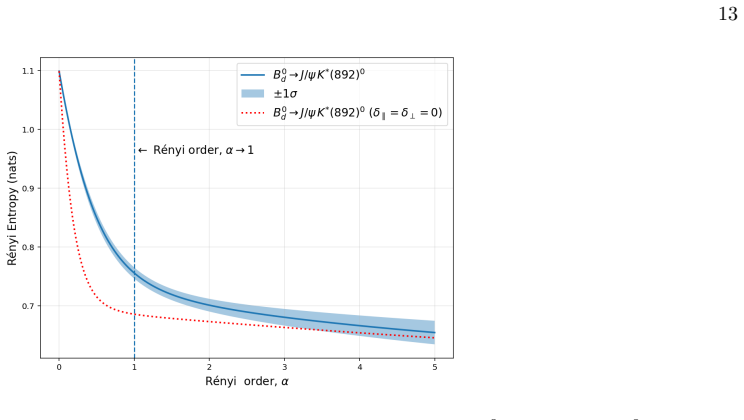
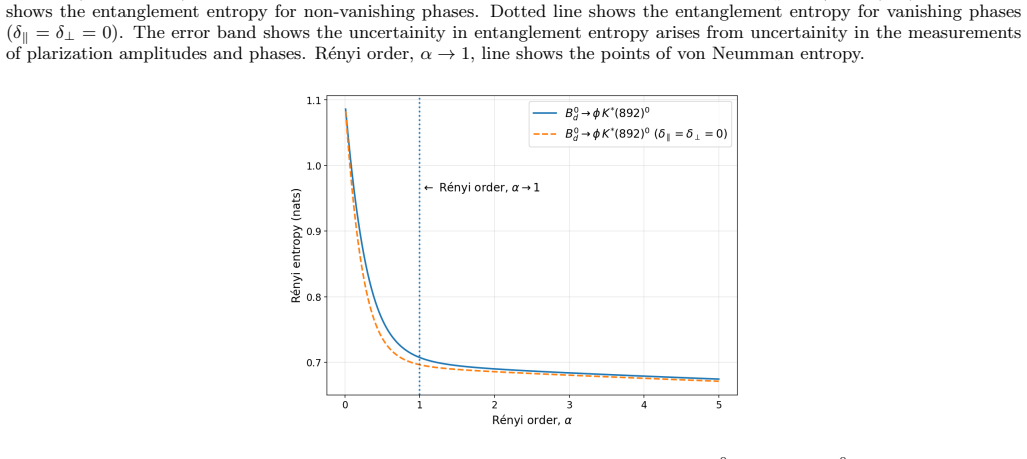
The final state of B0 to two-vector-meson decays forms a two-qutrit system whose density matrix is fixed by measured complex polarization amplitudes and relative phases; the Rényi entropies of this state, together with von Neumann, collision, and min-entropies, exhibit strong phase dependence and correlate with branching fractions, indicating the role of the underlying interactions in producing the observed quantum correlations.
What carries the argument
Rényi entropy of order alpha applied to the two-qutrit density matrix reconstructed from polarization amplitudes and relative phases.
If this is right
- The von Neumann entropy tracks the branching fraction, connecting entanglement to the strength of weak and strong interactions.
- Entropy values rise or fall sharply once nonzero relative phases are included.
- Different decay channels produce measurably different entanglement levels.
- Additional quantifiers such as negativity and I-concurrence give consistent diagnostics of the same correlations.
Where Pith is reading between the lines
- The phase sensitivity could be checked against independent amplitude analyses from multiple experiments for internal consistency.
- If the phases carry CP-violating information, the entropy might serve as an indirect probe of those phases.
- Time-dependent versions of the same calculation could track how entanglement evolves inside the B meson before decay.
Load-bearing premise
The two-meson final state is a pure bipartite system whose quantum state is completely determined by the measured polarization amplitudes and relative phases.
What would settle it
A direct experimental extraction of Rényi entropy (or von Neumann entropy) from one of the four decay channels that deviates from the numerical value computed from the published amplitudes and phases.
Figures
read the original abstract
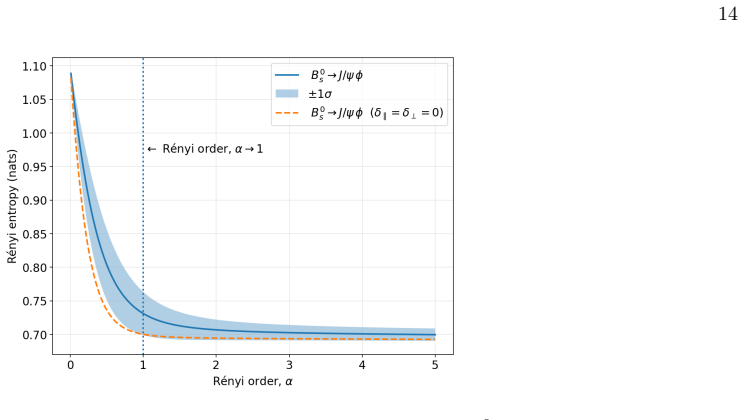
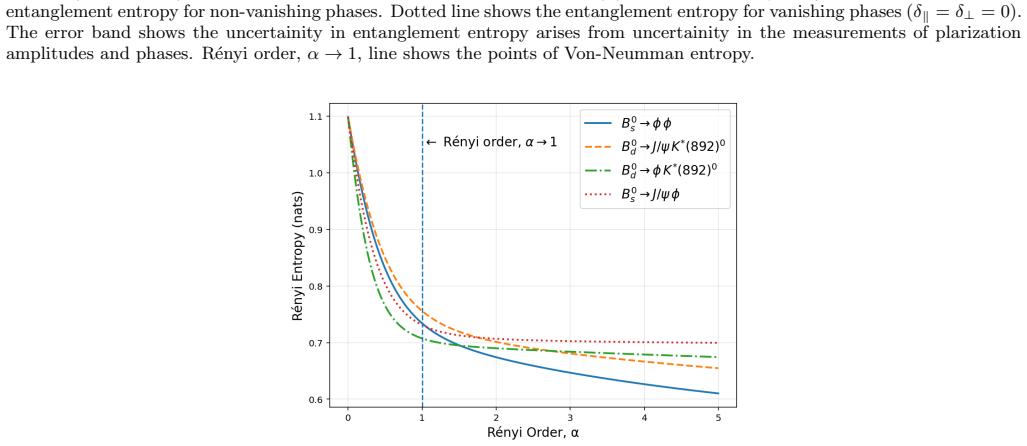
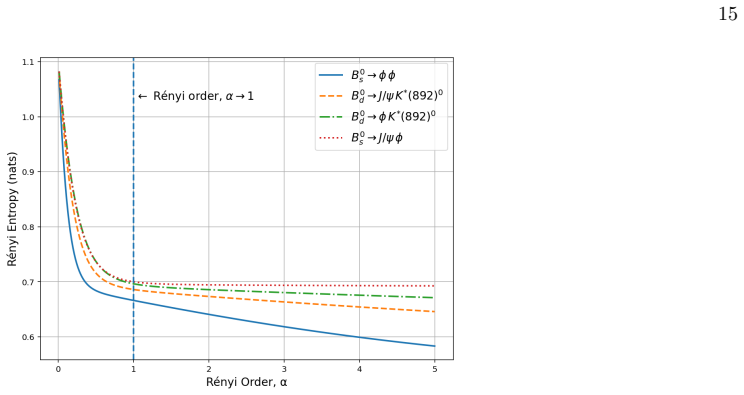
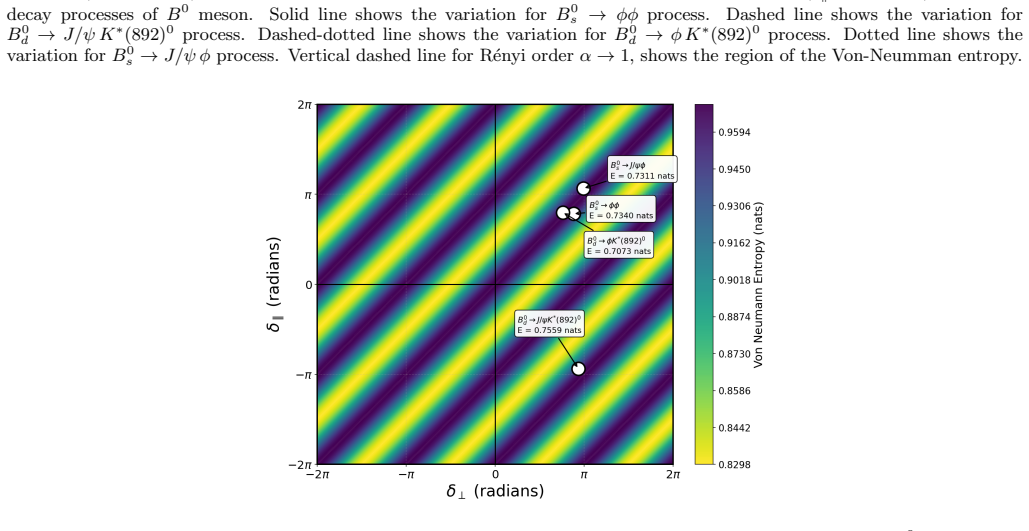
We present a phenomenological study of quantum correlations in the decay of $B^0$ mesons into a system of two vector mesons. The decay of the $B^0$ meson into two vector mesons constitutes a bipartite system of two qutrits. The entanglement entropy is used as a measure of quantum correlations in the system of decaying particles. We study the variation of the R\'enyi entropy with R\'enyi order ($\alpha$) for the decay channels $B_s^0 \rightarrow \phi\, \phi$, $B_d^0 \rightarrow J/\psi\, K^{*}(892)^0$, $B_d^0 \rightarrow \phi\, K^{*}(892)^0$ and $B_s^0 \rightarrow J/\psi\, \phi$ and discuss the significance of entanglement entropy at different R\'enyi order regimes. The LHCb, ATLAS and Belle collaborations experimental measurements of complex polarization amplitudes and relative phases are used as input for our analysis. A comparison of entanglement entropy for all the $B^0$ meson decay processes, with both vanishing and non-vanishing phases, reveals a strong phase dependence of the entropy. We further present the results of Hartley entropy (Max-Entropy), von Neumann entropy, collision entropy, and min-entropy, each corresponding to different values and limits of the R\'enyi order. The comparison between the branching fractions of the decay processes and the von Neumann entropy shows a connection between entanglement and decay dynamics, indicating the role of weak and strong interaction in generating quantum entanglement. In addition, we evaluate several other entanglement measures, including linear entropy, I-concurrence, tangle, negativity, logarithmic negativity, Schmidt coefficients, and Schmidt rank for different $B^0$ meson decay processes. Our study demonstrates that entanglement measures provide useful insights into the underlying decay dynamics and may serve as important tools for understanding quantum correlations in high-energy particle physics processes.
Editorial analysis
A structured set of objections, weighed in public.
Referee Report
Summary. The manuscript performs a phenomenological study of quantum correlations in four B^0 (and Bs^0) decay channels to two vector mesons, treating each as a pure two-qutrit state constructed from measured helicity amplitudes and relative phases reported by LHCb, ATLAS, and Belle. Rényi entropies are evaluated as functions of the order α, with limits yielding Hartley, von Neumann, collision, and min-entropies; additional monotones (linear entropy, I-concurrence, tangle, negativity, logarithmic negativity, Schmidt coefficients, and Schmidt rank) are computed. Results are presented for both vanishing and non-vanishing phases, and von Neumann entropy values are compared with branching fractions to argue for a link between entanglement and the roles of weak and strong interactions in the decays.
Significance. The work supplies concrete numerical values of standard entanglement measures for experimentally accessible two-vector-meson final states. Because the two-qutrit state is fixed by the helicity amplitudes, the reported entropies are direct functions of published data; the phase-dependence plots and branching-fraction comparisons therefore constitute a re-expression of existing measurements rather than new dynamical predictions. The approach is technically sound within the helicity formalism but does not yet demonstrate that the entanglement quantities yield independent physical insight beyond what is already contained in the amplitude magnitudes and phases.
minor comments (3)
- [numerical results section] §3 (or wherever the numerical tables appear): the manuscript should tabulate the input amplitudes, phases, and their experimental uncertainties together with the resulting entropy values so that readers can reproduce the quoted numbers and assess error propagation.
- [discussion of branching fractions] The abstract and §4 claim a 'connection between entanglement and decay dynamics' on the basis of the branching-fraction comparison; this comparison is a direct numerical consequence of the amplitude normalizations and should be presented with the explicit functional relation rather than as an interpretive conclusion.
- [figures] Figure captions and axis labels for the Rényi-entropy plots should state the precise values of α used and whether the curves include experimental uncertainties.
Simulated Author's Rebuttal
We thank the referee for their careful reading of the manuscript, the accurate summary, and the recommendation for minor revision. We address the principal concern expressed in the significance assessment below.
read point-by-point responses
-
Referee: Because the two-qutrit state is fixed by the helicity amplitudes, the reported entropies are direct functions of published data; the phase-dependence plots and branching-fraction comparisons therefore constitute a re-expression of existing measurements rather than new dynamical predictions. The approach is technically sound within the helicity formalism but does not yet demonstrate that the entanglement quantities yield independent physical insight beyond what is already contained in the amplitude magnitudes and phases.
Authors: We agree that the numerical values are obtained directly from published helicity amplitudes and phases. Nevertheless, the manuscript's contribution consists in the systematic computation of a suite of entanglement monotones (including the full Rényi family and its limits) and in the explicit demonstration that these quantities exhibit strong sensitivity to the relative phases and a clear correlation with measured branching fractions. This correlation is interpreted as reflecting the interplay between weak and strong dynamics in generating the observed interference. Such a quantum-information re-analysis is not present in the original experimental publications and supplies a new interpretive framework for the same data. To make this point more explicit we will add a short clarifying paragraph in the conclusions. revision: partial
Circularity Check
No significant circularity detected
full rationale
The paper constructs the two-qutrit state |ψ⟩ directly from external experimental helicity amplitudes and phases (LHCb/ATLAS/Belle data) and computes all listed entropies and monotones from the resulting reduced density matrix via standard definitions. No parameters are fitted to the target quantities, no predictions are made that reduce to the inputs by construction, and no load-bearing steps rely on self-citations or imported uniqueness theorems. The derivation is self-contained against external benchmarks.
Axiom & Free-Parameter Ledger
axioms (1)
- domain assumption The decay of the B0 meson into two vector mesons constitutes a bipartite system of two qutrits.
Reference graph
Works this paper leans on
-
[1]
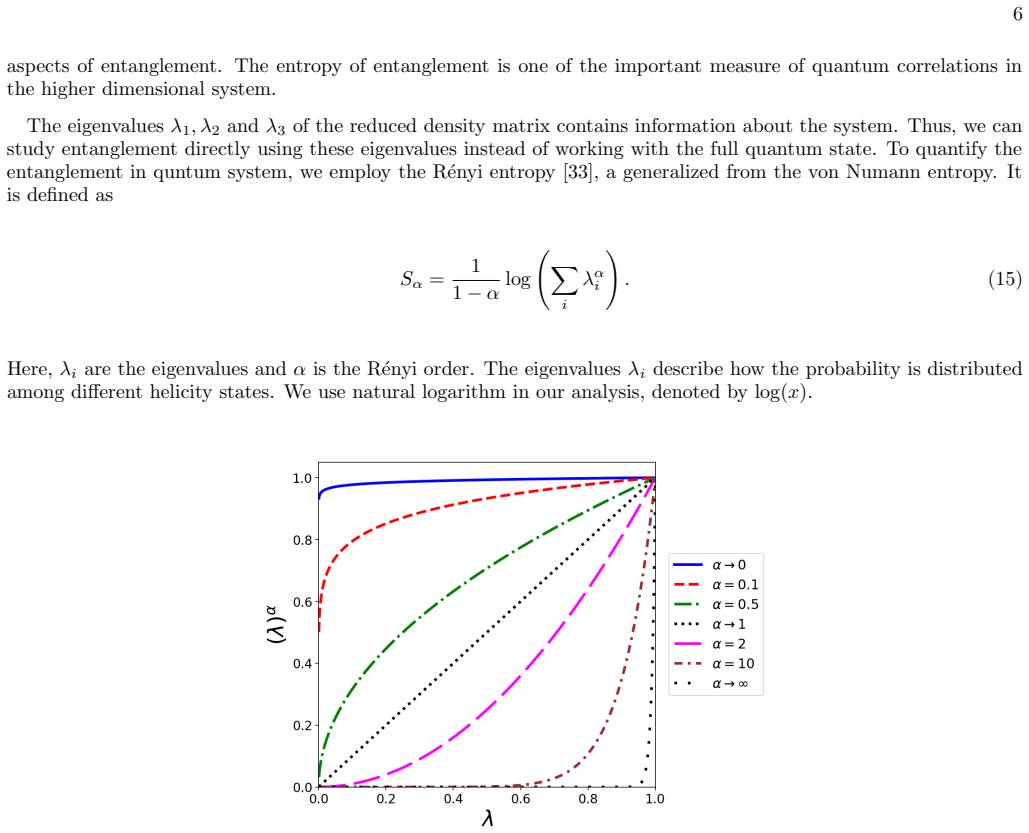
Von Neumann Entropy (α→1) The expression for R´ enyi entropy is undefined atα= 1 and must be evaluated using the limitα→1. In this limit, it reduces to the von Neumann entropy [33], given by S1 =− X i λi logλ i.(16) The von Neumann entropy serves as a standard measure of entanglement in quantum mechanics. It describes how evenly the decay is shared among ...
-
[2]
In this limit, the R´ enyi entropy reduces to the Hartley entropy [33], also called the max-entropy
Max-entropy, Hartley Entropy (α→0) Now we consider the limitα→0 in the R´ enyi entropy. In this limit, the R´ enyi entropy reduces to the Hartley entropy [33], also called the max-entropy. In the limitα→0, the expression becomes S0 = log(rank(ρA)) = log Ω,(17) where Ω is the number of non-zero eigenvalues. The Hartley entropy does not depend on the actual...
-
[3]
In this case, the expression for entropy is given by S2 =−log X i λ2 i ! .(18) The quantity P i λ2 i is known as the purity of the reduced density matrix [34]
Collision Entropy (α= 2) Now we consider the caseα= 2 in the R´ enyi entropy. In this case, the expression for entropy is given by S2 =−log X i λ2 i ! .(18) The quantity P i λ2 i is known as the purity of the reduced density matrix [34]. It measures the degree to which the subsystem approximates a pure state. Because the eigenvalues appear squared, larger...
-
[4]
In this limit, the expression for entropy is given by S∞ =−log(λ max),(19) whereλ max is the largest eigenvalue
Min-Entropy (α→ ∞) We now consider the limit of the R´ enyi entropy whenα→ ∞, which defines the min-entropy [33]. In this limit, the expression for entropy is given by S∞ =−log(λ max),(19) whereλ max is the largest eigenvalue. The min-entropy depends only on a single quantity, which is the largest eigenvalue. In this limit, only the most probable helicity...
-
[5]
Einstein, B
A. Einstein, B. Podolsky, and N. Rosen, Can quantum-mechanical description of physical reality be considered complete?, Physical review47, 777 (1935)
1935
-
[6]
Schr¨ odinger, Probability relations between separated systems, Math
E. Schr¨ odinger, Probability relations between separated systems, Math. Proc. Cambridge Phil. Soc.32, 446 (2008)
2008
-
[7]
J. S. Bell, On the einstein podolsky rosen paradox, Physics Physique Fizika1, 195 (1964)
1964
-
[8]
J. F. Clauser, M. A. Horne, A. Shimony, and R. A. Holt, Proposed experiment to test local hidden-variable theories, Physical review letters23, 880 (1969)
1969
-
[9]
Aspect, J
A. Aspect, J. Dalibard, and G. Roger, Experimental test of bell’s inequalities using time-varying analyzers, Physical review letters49, 1804 (1982)
1982
-
[10]
C. H. Bennett, G. Brassard, C. Cr´ epeau, R. Jozsa, A. Peres, and W. K. Wootters, Teleporting an unknown quantum state via dual classical and einstein-podolsky-rosen channels, Phys. Rev. Lett.70, 1895 (1993)
1993
-
[11]
C. H. Bennett, H. J. Bernstein, S. Popescu, and B. Schumacher, Concentrating partial entanglement by local operations, Phys. Rev. A53, 2046 (1996)
2046
-
[12]
Vogel, Quantum computation and quantum information, by m.a
M. Vogel, Quantum computation and quantum information, by m.a. nielsen and i.l. chuang, Contemporary Physics52, 604 (2011)
2011
-
[13]
Horodecki, P
R. Horodecki, P. Horodecki, M. Horodecki, and K. Horodecki, Quantum entanglement, Rev. Mod. Phys.81, 865 (2009)
2009
-
[14]
P. Calabrese and J. L. Cardy, Entanglement entropy and quantum field theory, J. Stat. Mech.0406, P06002 (2004), arXiv:hep-th/0405152
Pith/arXiv arXiv 2004
-
[15]
A. J. Barr, M. Fabbrichesi, R. Floreanini, E. Gabrielli, and L. Marzola, Quantum entanglement and Bell inequality violation at colliders, Prog. Part. Nucl. Phys.139, 104134 (2024), arXiv:2402.07972 [hep-ph]. 18
arXiv 2024
-
[16]
Y. Afik, F. Fabbri, M. Low, L. Marzola, J. A. Aguilar-Saavedra, M. M. Altakach, N. A. Asbah, Y. Bai, H. Banks, A. J. Barr,et al., Quantum information meets high-energy physics: input to the update of the european strategy for particle physics, The European Physical Journal Plus140, 855 (2025)
2025
-
[17]
G. Aadet al.(ATLAS), Observation of quantum entanglement with top quarks at the ATLAS detector, Nature633, 542 (2024), arXiv:2311.07288 [hep-ex]
arXiv 2024
-
[18]
A. Hayrapetyanet al.(CMS), Observation of quantum entanglement in top quark pair production in proton–proton collisions at √s= 13 TeV, Rept. Prog. Phys.87, 117801 (2024), arXiv:2406.03976 [hep-ex]
arXiv 2024
-
[19]
M. Fabbrichesi, R. Floreanini, and G. Panizzo, Testing Bell Inequalities at the LHC with Top-Quark Pairs, Phys. Rev. Lett.127, 161801 (2021), arXiv:2102.11883 [hep-ph]
arXiv 2021
-
[20]
W. Gong, G. Parida, Z. Tu, and R. Venugopalan, Measurement of Bell-type inequalities and quantum entanglement from Λ-hyperon spin correlations at high energy colliders, Phys. Rev. D106, L031501 (2022), arXiv:2107.13007 [hep-ph]
arXiv 2022
-
[21]
M. Fabbrichesi, R. Floreanini, E. Gabrielli, and L. Marzola, Bell inequality is violated in charmonium decays, Phys. Rev. D110, 053008 (2024), arXiv:2406.17772 [hep-ph]
arXiv 2024
-
[22]
K. Ehat¨ aht, M. Fabbrichesi, L. Marzola, and C. Veelken, Probing entanglement and testing Bell inequality violation with e+e-→τ+τ- at Belle II, Phys. Rev. D109, 032005 (2024), arXiv:2311.17555 [hep-ph]
arXiv 2024
-
[23]
A. J. Barr, Testing Bell inequalities in Higgs boson decays, Phys. Lett. B825, 136866 (2022), arXiv:2106.01377 [hep-ph]
arXiv 2022
-
[24]
J. A. Aguilar-Saavedra, A. Bernal, J. A. Casas, and J. M. Moreno, Testing entanglement and Bell inequalities in H→ZZ, Phys. Rev. D107, 016012 (2023), arXiv:2209.13441 [hep-ph]
arXiv 2023
-
[25]
E. Gabrielli and L. Marzola, Quantum entanglement and bell nonlocality at future lepton colliders, Eur. Phys. J. Plus 141, 331 (2026), arXiv:2602.03960 [hep-ph]
arXiv 2026
-
[26]
Aaijet al.(LHCb), Measurement of the polarization amplitudes inB 0 d →J/ψ K ∗(892)0, Phys
R. Aaijet al.(LHCb), Measurement of the polarization amplitudes inB 0 d →J/ψ K ∗(892)0, Phys. Rev. D88, 052002 (2013), arXiv:1307.2782 [hep-ex]
Pith/arXiv arXiv 2013
-
[27]
K. F. Chenet al.(Belle), Measurement of polarization and triple-product correlations inB 0 d →ϕ K ∗(892)0, Phys. Rev. Lett.94, 221804 (2005), arXiv:hep-ex/0503013
arXiv 2005
-
[28]
G. Aadet al.(ATLAS), Measurement of theCP-violating phaseϕ s inB 0 s →J/ψϕdecays in ATLAS at 13 TeV, Eur. Phys. J. C81, 342 (2021), arXiv:2001.07115 [hep-ex]
arXiv 2021
-
[29]
M. Fabbrichesi, R. Floreanini, E. Gabrielli, and L. Marzola, Measuring cp violation using quantum state tomography, arXiv preprint arXiv:2512.07939 (2025)
arXiv 2025
-
[30]
C. M. Caves and G. J. Milburn, Qutrit entanglement1, Optics Communications179, 439 (2000)
2000
-
[31]
Sent´ ıs, C
G. Sent´ ıs, C. Eltschka, and J. Siewert, Quantitative bound entanglement in two-qutrit states, Phys. Rev. A94, 020302(R) (2016)
2016
- [32]
-
[33]
M. Fabbrichesi, R. Floreanini, E. Gabrielli, and L. Marzola, Bell inequality is violated in B0→J/ψK*(892)0 decays, Phys. Rev. D109, L031104 (2024), arXiv:2305.04982 [hep-ph]
arXiv 2024
-
[34]
Blum,Density matrix theory and applications, Vol
K. Blum,Density matrix theory and applications, Vol. 64 (Springer Science & Business Media, 2012)
2012
-
[35]
Fabbrichesi, R
M. Fabbrichesi, R. Floreanini, E. Gabrielli, and L. Marzola, Bell inequalities and quantum entanglement in weak gauge boson production at the lhc and future colliders, The European Physical Journal C83, 823 (2023)
2023
-
[36]
E. Gabrielli and L. Marzola, Entanglement and Bell Inequality Violation in B→ϕϕDecays, Symmetry16, 1036 (2024), arXiv:2408.05010 [hep-ph]
arXiv 2024
-
[37]
Ozawa and N
M. Ozawa and N. Javerzat, Perspective on physical interpretations of r´ enyi entropy in statistical mechanics, Europhysics Letters147, 11001 (2024)
2024
-
[38]
G. M. Bosyk, M. Portesi, and A. Plastino, Collision entropy and optimal uncertainty, Phys. Rev. A85, 012108 (2012), arXiv:1112.5903 [quant-ph]
Pith/arXiv arXiv 2012
-
[39]
Rungta and C
P. Rungta and C. M. Caves, Concurrence-based entanglement measures for isotropic states, Physical Review A67, 012307 (2003)
2003
- [40]
-
[41]
Takahashiet al.(Particle Data Group), Review of Particle Physics, Int
F. Takahashiet al.(Particle Data Group), Review of Particle Physics, Int. J. Mod. Phys. A41, 2630011 (2026)
2026
-
[42]
Gabrielli and L
E. Gabrielli and L. Marzola, Entanglement and bell inequality violation in b→ϕϕdecays, Symmetry16, 1036 (2024)
2024
-
[43]
Fabbrichesi, R
M. Fabbrichesi, R. Floreanini, E. Gabrielli, and L. Marzola, Bell inequality is violated in b 0→j/ψk*(892) 0 decays, Physical Review D109, L031104 (2024)
2024
-
[44]
Aaij and et al., Precision measurement of cp violation in the penguin-mediated decayb 0 s →ϕϕ, Physical Review Letters 131, 171802 (2023)
R. Aaij and et al., Precision measurement of cp violation in the penguin-mediated decayb 0 s →ϕϕ, Physical Review Letters 131, 171802 (2023)
2023
-
[45]
Severi, C
C. Severi, C. D. E. Boschi, F. Maltoni, and M. Sioli, Quantum tops at the lhc: from entanglement to bell inequalities, The European Physical Journal C82, 285 (2022)
2022
discussion (0)
Sign in with ORCID, Apple, or X to comment. Anyone can read and Pith papers without signing in.