REVIEW 5 major objections 6 minor 23 references
Thermal Breaking of the I-Love Universality for Hot White Dwarfs
T0 review · 5 major / 6 minor · reviewed 2026-07-31 · deepseek-v4-flash
Pith's one-line read For hot white dwarfs, heat breaks the universal I-Love relation, and the paper identifies the mechanism as a loss of self-similarity in the star's constant-density layers.
desk verdict Worth a serious look: it adds a quantitative eccentricity-gradient diagnostic to the known thermal breaking of I-Love in white dwarfs, but the causal story outruns the evidence. read the letter →
The pith
A machine-rendered reading of the paper's core claim, the machinery that carries it, and where it could break.
The reading
What carries the argument
The central tool is the Clairaut-Radau equation, which gives the radial variation of the oblateness of a slowly, uniformly rotating star's internal constant-density surfaces; the paper expresses this as the eccentricity ratio e_s/e_c between the surface and the center, with values near 1 indicating self-similar isodensity surfaces. The second ingredient is the 'connection radius', the boundary where the Fermi temperature drops below the local temperature; it separates a degenerate core from a thermally supported outer envelope. The argument runs through these two objects: a hot young white dwarf has its connection radius deep inside, the outer non-degenerate shell deforms more strongly under
What would settle it
Solve the tidal perturbation equations for the same density profiles and compare the radial gradient of the tidal deformation of constant-density surfaces with the Clairaut-Radau rotational eccentricity ratio; a hot model in which the two measures diverge would falsify the claimed mechanism. Alternatively, a hot carbon-oxygen white dwarf whose measured tidal deformability matches the zero-temperature baseline within a few percent would contradict the predicted >10% deviation.
Extended reading notes
Core claim
At a central temperature near 10^8 K, a 0.6 solar-mass carbon-oxygen white dwarf's dimensionless moment of inertia and tidal Love number fall on an I-Love curve that departs more than 10% from the zero-temperature electron-degenerate baseline; the same model shows an isodensity-surface eccentricity ratio e_s/e_c of 5.8. After the star cools below 10^7 K, e_s/e_c relaxes to 1.6 and the I-Love curve returns to the baseline. For the 0.15 solar-mass helium-core white dwarf, which never becomes as hot and remains strongly degenerate, the eccentricity ratio stays below 3.2 and the I-Love residual below 2%. The paper interprets these results as confirming that temperature-induced violations of the
Load-bearing premise
The paper assumes that the rotational eccentricity ratio computed from the Clairaut-Radau equation for slowly rotating models also controls the deformation geometry of effectively non-rotating tidally deformed stars; if that identification fails, the claimed causal mechanism does not follow.
Editorial extensions
If this is right
- A 0.6 solar-mass carbon-oxygen white dwarf at central temperature near 10^8 K shows I-Love deviations above 10% relative to the zero-temperature baseline, so gravitational-wave or tidal inferences that assume a cold white-dwarf relation could be biased for young, hot white dwarfs.
- Cooling below 10^7 K brings the I-Love curve back to the zero-temperature model, so the thermal breaking is reversible and confined to the early, hot phase of a white dwarf's life.
- Helium-core white dwarfs stay within 2% of the zero-temperature relation at all modeled ages, because their interiors remain highly degenerate even when young.
- The fraction of the star's radius where the Fermi temperature exceeds the local temperature (the degeneracy boundary) tracks the I-Love residual almost one-to-one, identifying degeneracy rather than absolute temperature as the controlling parameter.
- A simple equation-of-state test with varying stiffness profiles reproduces the same correlation between eccentricity variation and I-Love residual (correlation coefficient 0.993), indicating the link is generic and not an artifact of the thermal modeling.
Reading between the lines
- If the geometric criterion is right, then any physical process that moves the degeneracy boundary inward—rapid accretion heating, residual hydrogen burning, or a different composition—should also break I-Love universality even at lower temperatures; this is a testable prediction.
- The same machinery could be applied to hot neutron stars or quark stars with finite-temperature envelopes, where absolute temperatures are far below the Fermi temperature, so the effect should be negligible; a comparison would sharpen the boundary of the universality.
- One could directly verify the proposed mechanism by solving the tidal perturbation equations for the same stellar profiles and comparing the radial deformation of constant-density surfaces under tidal forcing to the rotational eccentricity ratio used here; if they disagree, the causal chain needs revision.
Editorial analysis
A structured set of objections, weighed in public.
Referee Report
Summary. The paper investigates thermal breaking of the I-Love universal relations for white dwarfs using MESA models of a 0.15 Msun helium-core and a 0.6 Msun carbon-oxygen-core white dwarf at various central temperatures. From these static, spherical profiles it computes the dimensionless moment of inertia and tidal deformability, compares the resulting I-Love curves with a zero-temperature Chandrasekhar baseline taken from the literature, and uses the Clairaut-Radau equation to extract the radial eccentricity ratio e_s/e_c as a measure of isodensity-surface self-similarity. The central numerical claim is that for the 0.6 Msun CO-core model at Tc ~ 1e8 K the I-Love curve deviates by more than 10% from the zero-temperature baseline with e_s/e_c = 5.8, and that after cooling below 1e7 K the curve returns to the baseline with e_s/e_c = 1.6. The paper interprets this as confirmation that the temperature-induced violation of the universal relations is fundamentally driven by loss of self-similarity in isodensity surfaces, a mechanism hypothesized by Yagi et al. [5].
Significance. If established, the paper would provide a concrete, realistic-model test of a proposed geometric mechanism behind the I-Love-Q universality, and would clarify when thermal effects invalidate this universality for low-mass white dwarfs. The use of MESA to construct evolutionary white-dwarf models is a strength, as is the explicit computation of eccentricity profiles from realistic density distributions. The paper also makes a falsifiable quantitative prediction about the size of the thermal I-Love residual. However, the causal interpretation currently exceeds the evidence: the MESA models are not used to directly correlate the eccentricity ratio with the I-Love residual, the supporting toy-model EOS contains an algebraic inconsistency, and the zero-temperature baseline is not computed with the same pipeline. These issues are fixable in revision, but they are load-bearing for the paper's main claim.
major comments (5)
- [Section 4.3.1, Eqs. (23)-(24)] The two displayed forms of the composite-polytrope EOS are not equivalent: P(q) = (1 + K q^{-10/3} + K q^{-8/3})^{1/2} is not the same function as sqrt(1+K q^{5/3}) / sqrt(1+K q^{2/3}). The limiting behaviors claimed in Eqs. (25)-(28) also do not follow from Eq. (24): for q → ∞, Eq. (24) gives P ∝ q^{1/2}, not P ∝ q^{4/3}. Since Section 4.3 is the paper's controlled test of the eccentricity-variation criterion, the correlation reported in Fig. 3 (r = 0.993) is not established. The EOS should be corrected, the test repeated, and the quoted correlation re-verified.
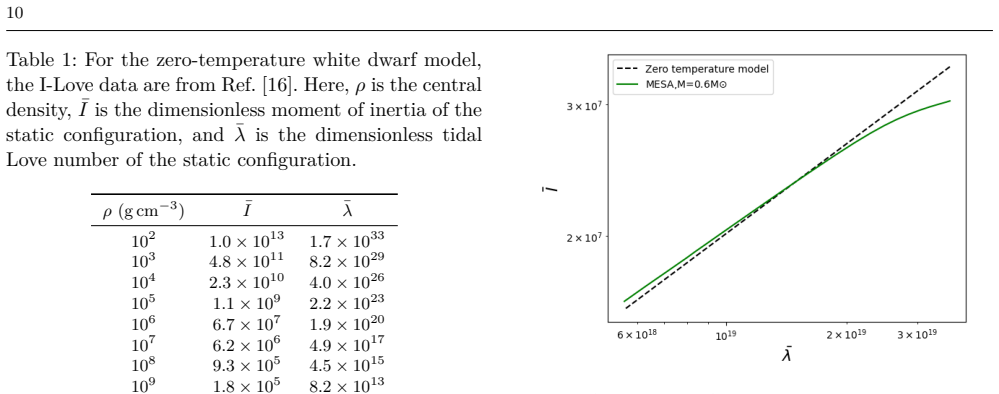
- [Section 5.4, Figs. 9-10] The zero-temperature baseline is imported from Ref. [16] (Table 1) rather than computed with the same MESA pipeline. The >10% residual claim depends entirely on this external curve. Please compute a zero-temperature Chandrasekhar baseline with the same code and definitions, or validate that the imported curve reproduces the MESA low-temperature limit to within the quoted residual. In addition, the comparison protocol is unspecified: is the residual evaluated at fixed \bar{λ}, fixed mass, or along the MESA cooling track? If the mass differs between the MESA model and the baseline at the comparison point, part of the 'thermal' residual could be a mass effect.
- [Section 5.2 and 5.4 (causal claim)] The central claim that I-Love residuals are 'fundamentally driven by loss of self-similarity' is not directly supported for the MESA models. The quantity e_s/e_c is extracted from the rotational Clairaut-Radau equation, while the I-Love residual is computed from static, spherical MESA profiles. The paper never plots the residual against e_s/e_c for the same MESA models; Figs. 6 and 11 show separate correlations of these two quantities with degeneracy. A common dependence on temperature/degeneracy is a plausible confounder. A direct residual-vs-e_s/e_c plot for the MESA models, and a justification that the rotational eccentricity ratio controls the static tidally induced deformation, are needed before the causal claim can be sustained.
- [Section 5.3, Fig. 6] A third 0.77 Msun CO-core model appears in the text — '0.15Msun He-core red line, 0.6Msun CO-core black line, and 0.77Msun CO-core blue line' — but its construction is never described in Section 5.1. The claim that e_s/e_c is controlled by the degree of degeneracy rather than by mass or temperature relies on this model. Please describe the model's evolutionary origin, composition, and how it was added to the MESA analysis.
- [Section 3.3, Eqs. (19)-(22)] The numerical solution of the y-equation for the tidal Love number is not specified: no details are given for how dρ/dp is evaluated from MESA output, how the interior solution is matched to the surface boundary condition, how y_R is extracted, or what convergence/error tests were performed. Since \bar{λ} and all I-Love residuals depend on y_R, this omission prevents reproducibility. Add a paragraph describing the discretization, boundary conditions, and validation against known polytropic solutions.
minor comments (6)
- [Section 5.1 vs. Section 6] The maximum central temperature for the helium-core WD is stated as approximately 10^7 K in Section 5.1 but as Tc ~ 2.5×10^7 K in the Conclusions. Please make these values consistent.
- [Fig. 4 and Fig. 5 captions] The captions do not specify the axis labels or units. Please state what is plotted (age, central temperature, surface temperature) and the units.
- [Section 5.3, Fig. 6] The 'degree of degeneracy' is quantified by r_con/r_surf, but this is not defined in the figure caption or axis label. Define the connection radius and explain why this dimensionless radius is an appropriate proxy for degeneracy.
- [Eq. (36)] The piecewise pressure expression has a discontinuity at r_con. Use '≈' and clarify that P_th is the ideal-gas thermal pressure term.
- [Table 1] The table reproduces I-Love data from Ref. [16] but does not state the EOS, mass range, or computational method used there. Please add these details so readers can assess the comparison.
- [Eq. (34)] The function η(a) is defined as (a/e) dϵ/da, but the symbol e is not defined in that equation. Define the eccentricity and oblateness variables explicitly and state how they are related to the rotationally deformed isodensity surfaces.
Circularity Check
No significant circularity: I-Love residuals and eccentricity ratios are independent numerical outputs against an externally tabulated zero-temperature baseline.
full rationale
The derivation chain is not circular. The I-Love residuals for MESA models are computed from static spherical profiles (Eqs. 13, 20-22) and compared with the zero-temperature Chandrasekhar baseline taken from Boshkayev et al. [16] (Table 1), an external reference. The eccentricity ratio e_s/e_c is obtained independently from the Clairaut-Radau equation (Eq. 33) applied to the same MESA density profile. No fitted parameter is used to force the residual-versus-eccentricity or residual-versus-degeneracy trends; they are numerical outputs. The composite-polytrope test in Section 4.3 defines the residual relative to K=0.684732, so the reference point is zero by definition, but the authors explicitly report that excluding it leaves r=0.993. The paper adopts the Yagi et al. [5,6] self-similarity hypothesis as a proposed mechanism and then tests it on MESA models rather than assuming the conclusion. The main weaknesses are causal overreach—the rotational Clairaut-Radau eccentricity is used as a proxy for tidal isodensity self-similarity without a direct MESA plot of residual versus e_s/e_c—and an internal inconsistency between Eqs. (23) and (24). These are correctness/evidence concerns, not circularity. No self-citation chain is load-bearing.
Assumptions & free parameters
free parameters (2)
- Composite-polytrope EOS parameter K =
K=0.684732 reference; varied upward
- MESA initial progenitor masses =
1.5 Msun (He) and 3.1 Msun (CO)
assumptions (5)
- domain assumption Newtonian hydrostatic equilibrium is sufficient for white-dwarf structure
- domain assumption Clairaut-Radau equation describes the eccentricity profile of slowly, uniformly rotating stars
- domain assumption Approximate self-similarity of isodensity surfaces is the cause of I-Love-Q universality
- domain assumption Zero-temperature Chandrasekhar I-Love table from literature is an appropriate baseline
- domain assumption MESA stripping and relaxation yields a realistic He-core WD structure
Cite this review
Pith. "Pith review of Thermal Breaking of the I-Love Universality for Hot White Dwarfs." pith.science (2026). https://pith.science/paper/GX5R6JWG
@misc{pith2026260727873,
  author       = {Pith},
  title        = {Pith review of: Thermal Breaking of the I-Love Universality for Hot White Dwarfs},
  year         = {2026},
  howpublished = {\url{https://pith.science/paper/GX5R6JWG}},
  note         = {Machine review of arXiv:2607.27873}
}
abstract
The universal I-Love-Q relations for compact stars have significant applications in gravitational-wave astronomy, but thermal effects can break these relations in low-mass white dwarfs. In this work, we employ the stellar evolution code MESA to construct realistic models of $0.15 \, M_{\odot}$ helium-core and $0.6 \, M_{\odot}$ carbon-oxygen core white dwarfs at various temperatures. By utilizing the Clairaut-Radau equation, we quantitatively extract the radial variation of the eccentricity of internal isodensity surfaces. Our numerical results demonstrate that higher central temperatures amplify the eccentricity variation, causing the I-Love relations to deviate from the zero-temperature Chandrasekhar model, whereas subsequent cooling restores them. This confirms that the temperature-induced violation of the universal relations is fundamentally driven by the loss of self-similarity in isodensity surfaces, providing key insights into the applicability conditions of I-Love-Q relations in compact objects.
Figures


Figures from the paper (6 more)



Reference graph
Works this paper leans on
-
[5]
Why i-love-q: Explaining why universality emerges in compact objects.Physical Review D, 90(6):063010, 2014
Kent Yagi, Leo C Stein, George Pappas, Nicolás Yunes, and Theocharis A Apostolatos. Why i-love-q: Explaining why universality emerges in compact objects.Physical Review D, 90(6):063010, 2014
2014
-
[16]
Non-validity of i–love–q relations for hot white dwarf stars.Monthly No- tices of the Royal Astronomical Society, 478(2):1893–1899, 2018
Kuantay Boshkayev and Hernando Quevedo. Non-validity of i–love–q relations for hot white dwarf stars.Monthly No- tices of the Royal Astronomical Society, 478(2):1893–1899, 2018
2018
-
[1]
I-love-q relations in neutron stars and their applications to astro- physics,gravitational waves, and fundamental physics
Kent Yagi and Nicolas Yunes. I-love-q relations in neutron stars and their applications to astro- physics,gravitational waves, and fundamental physics. Physical Review D—Particles, Fields, Gravitation, and Cosmology, 88(2):023009, 2013
2013
-
[2]
I-love-q: Unexpected uni- versal relations for neutron stars and quark stars.Science, 341(6144):365–368, 2013
Kent Yagi and Nicolas Yunes. I-love-q: Unexpected uni- versal relations for neutron stars and quark stars.Science, 341(6144):365–368, 2013
2013
-
[3]
I-love-q relations for white dwarf stars.Monthly Notices of the Royal Astro- nomical Society, 464(4):4349–4359, 2016
K Boshkayev, H Quevedo, and B Zhami. I-love-q relations for white dwarf stars.Monthly Notices of the Royal Astro- nomical Society, 464(4):4349–4359, 2016
2016
-
[4]
I–love–q relations for realistic white dwarfs.Monthly Notices of the Royal Astronomical Society, 492(1):978–992, 2020
Andrew J Taylor, Kent Yagi, and Phil L Arras. I–love–q relations for realistic white dwarfs.Monthly Notices of the Royal Astronomical Society, 492(1):978–992, 2020
2020
-
[6]
Three-hair relations for rotating stars: nonrelativistic limit.The As- trophysical Journal, 788(1):15, 2014
Leo C Stein, Kent Yagi, and Nicolás Yunes. Three-hair relations for rotating stars: nonrelativistic limit.The As- trophysical Journal, 788(1):15, 2014
2014
-
[7]
Static spherically-symmetric stellar struc- ture in general relativity.TAPIR, California Institute of Technology, 2013
Christian D Ott. Static spherically-symmetric stellar struc- ture in general relativity.TAPIR, California Institute of Technology, 2013
2013
Show all 23 references
-
[8]
The maximum mass of ideal white dwarfs.Astrophysical Journal, vol
Subrahmanyan Chandrasekhar. The maximum mass of ideal white dwarfs.Astrophysical Journal, vol. 74, p. 81, 74:81, 1931
1931
-
[9]
Uni- versity of Chicago Press, 1989
Subrahmanyan Chandrasekhar.Selected Papers, Volume 1: Stellar Structure and Stellar Atmospheres, volume 1. Uni- versity of Chicago Press, 1989
1989
-
[10]
Slowly rotating relativistic stars
James B Hartle. Slowly rotating relativistic stars. i. equa- tions of structure.Astrophysical Journal, vol. 150, p. 1005, 150:1005, 1967
1967
-
[11]
Slowly rotating rela- tivistic stars
James B Hartle and Kip S Thorne. Slowly rotating rela- tivistic stars. ii. models for neutron stars and supermassive stars.Astrophysical Journal, vol. 153, p. 807,153:807,1968
1968
-
[12]
Tidal love numbers of neutron stars.The Astrophysical Journal, 677(2):1216–1220, 2008
Tanja Hinderer. Tidal love numbers of neutron stars.The Astrophysical Journal, 677(2):1216–1220, 2008
2008
-
[13]
Lat- timer
Sergey Postnikov, Madappa Prakash, and James M. Lat- timer. Tidal love numbers of neutron and self-bound quark stars.Physical Review D, 82(2), 2010
2010
-
[14]
Robert A Van Gorder and Petra A Fisher. Spatial eigen- value problems for stars in hydrostatic equilibrium: Gen- eralized lane–emden equations as boundary value prob- lems.Monthly Notices of the Royal Astronomical Society, 523(2):2059–2073, 2023
-
[15]
Common envelope binaries
B Paczynski. Common envelope binaries. InSymposium- international astronomical union, volume 73, pages 75–80. Cambridge University Press, 1976. 12
1976
-
[17]
Evolution of helium white dwarfs of low and intermediate masses.The Astrophysical Journal, 477(1):313–334, 1997
LG Althaus and OG Benvenuto. Evolution of helium white dwarfs of low and intermediate masses.The Astrophysical Journal, 477(1):313–334, 1997
1997
-
[18]
The evolution of helium white dwarfs: I
T Driebe, F Herwig, et al. The evolution of helium white dwarfs: I. the companion of the millisecond pulsar psr j1012+ 5307.arXiv preprint astro-ph/9809079, 1998
1998 arXiv
-
[19]
Reconstructing the evolution of double helium white dwarfs: envelope loss without spiral- in.arXiv preprint astro-ph/0006216, 2000
Gijs Nelemans, Frank Verbunt, Lev R Yungelson, and Si- mon F Portegies Zwart. Reconstructing the evolution of double helium white dwarfs: envelope loss without spiral- in.arXiv preprint astro-ph/0006216, 2000
2000 arXiv
-
[20]
The evolution of ultra-massive carbon–oxygen white dwarfs.Monthly Notices of the Royal Astronomical Society, 511(4):5198–5206, 2022
María E Camisassa, Leandro G Althaus, Detlev Koester, Santiago Torres, Pilar Gil Pons, and Alejandro H Cór- sico. The evolution of ultra-massive carbon–oxygen white dwarfs.Monthly Notices of the Royal Astronomical Society, 511(4):5198–5206, 2022
2022
-
[21]
Freezing of a carbon-oxygen white dwarf
R Mochkovitch. Freezing of a carbon-oxygen white dwarf. Astronomy and Astrophysics (ISSN 0004-6361), vol. 122, no. 1-2, June 1983, p. 212-218., 122:212–218, 1983
1983
-
[22]
Princeton University Press, 2015
Jean-Louis Tassoul.Theory of Rotating Stars.(PSA-1), Volume 1. Princeton University Press, 2015
2015
-
[23]
Cooling of white dwarfs.IN: Annual review of astronomy and astrophysics
Francesca D’Antona and Italo Mazzitelli. Cooling of white dwarfs.IN: Annual review of astronomy and astrophysics. Vol. 28 (A91-28201 10-90). Palo Alto, CA, Annual Re- views, Inc., 1990, p. 139-181., 28:139–181, 1990
1990
Reviewed July 31, 2026 · model on record in the stance chip above.
Discussion (0). Sign in to comment.