REVIEW 4 major objections 4 minor 9 cited by
VERA: Explainable Video Anomaly Detection via Verbalized Learning of Vision-Language Models
T0 review · 4 major / 4 minor · reviewed 2026-08-12 · deepseek-v4-flash
Pith's one-line read VERA claims that a frozen vision-language model can perform explainable video anomaly detection by learning a small set of natural-language guiding questions through a verbal learner–optimizer loop, using only coarse video-level labels…
desk verdict VERA applies verbalized learning to VAD with a genuinely novel idea, but the SOTA claim rests on unfair baselines and single-run evidence. read the letter →
The pith
A machine-rendered reading of the paper's core claim, the machinery that carries it, and where it could break.
The reading
What carries the argument
The central object is the learned guiding-question set $Q$, treated as language-based learnable parameters. A learner agent, the frozen VLM prompted with $Q$, makes a binary video-level prediction on uniformly sampled frames; an optimizer agent, the same frozen VLM given a different prompt plus batched frames, predictions, and ground-truth labels, rewrites $Q$. At inference, the best $Q^*$ is inserted into the prompt to score 10-second segments, and those scores are refined by ensembling with scene-similar segments using cosine similarity and ImageBind features, then by Gaussian smoothing and position weighting to yield frame-level scores. The questions carry the argument: they operationalize "anomaly" into patterns the VLM can verify.
What would settle it
Run VERA on UCF-Crime with the optimizer replaced by a non-learning prompt shuffler that paraphrases the current questions without seeing frames or labels; if the paraphrased prompts reach the same 86.55% AUC, the learner–optimizer verbal loop is not what carries the result, and if they fall well short, the data-driven optimization is load-bearing.
Extended reading notes
Core claim
The paper's central claim is that the bottleneck for frozen VLMs in video anomaly detection is the prompt, not the model. With questions that describe concrete abnormal patterns, a frozen InternVL2-8B reaches 86.55% AUC on UCF-Crime and 88.26% on XD-Violence, reported as the best among explainable methods in a fair comparison, while still being able to answer open-ended follow-up questions. The paper argues that the complex reasoning VAD seems to require can be decomposed into verbal reflections that are learnable, transferable across datasets and models, and sufficient to replace both instruction tuning and external LLM reasoning modules.
Load-bearing premise
The load-bearing premise, stated in the paper's limitations, is that the frozen VLM's visual encoder perceives the fine-grained details needed to distinguish anomaly from normal; if the encoder misses those cues, the learned questions and the frame-level scores inherit the same blind spots.
Editorial extensions
If this is right
- Explainable VAD can run end-to-end with a frozen VLM, so deployment needs no GPU fine-tuning and keeps the model's general question-answering ability intact.
- The learned questions transfer across model sizes, architectures, and datasets, so anomaly-detection knowledge can be shipped as text rather than as weights.
- Coarse video-level labels are sufficient for training, avoiding the frame-level instruction-tuning datasets used by prior explainable pipelines.
- Anomaly scoring can be made context-aware in three cheap steps, segment prompting, scene-similarity ensembling, and temporal smoothing, each of which adds measurable AUC.
- Because the backbone stays frozen, VERA can be upgraded simply by swapping in a newer frozen VLM and reusing or re-learning the questions.
Reading between the lines
- Beyond the paper, the learner–optimizer verbal loop is a general recipe: any video-understanding task with coarse labels and a checkable visual predicate could be recast as learning a small set of guiding questions, not just anomaly detection.
- Beyond the paper, the reported transfer asymmetry, in which questions from the smaller model help the larger one but not vice versa, suggests question complexity should be matched to VLM reasoning ability; one could test this by measuring AUC against the syntactic complexity of learned questions.
- Beyond the paper, a stress test follows from the authors' stated limitation: evaluate VERA on anomalies that CLIP-style encoders are known to miss, such as small-object or fine-grained manipulation anomalies; failure there would confirm the perception bottleneck rather than the question-optimization component.
- Beyond the paper, the framing suggests a cheap ablation: re-derive the questions with a stronger visual encoder while keeping the same language model, which would localize how much of VERA's lift comes from perception versus verbal prompting.
Signed reviews
Editorial analysis
A structured set of objections, weighed in public.
Referee Report
Summary. The paper proposes VERA, a verbalized-learning framework that adapts a frozen vision-language model to weakly supervised video anomaly detection. The method treats a small set of natural-language "guiding questions" as learnable parameters, refining them through a learner-optimizer loop in which both agents are implemented with the same frozen VLM. At inference, the learned questions are inserted into the prompt, segment-level anomaly scores are generated, and these scores are refined by scene-context retrieval (ImageBind) and temporal Gaussian/position weighting. Experiments on UCF-Crime and XD-Violence report frame-level AUC of 86.55 and 88.26, respectively, together with ablations, transfer experiments, and qualitative examples of explainable predictions.
Significance. If the empirical claims hold, VERA is a meaningful contribution: it demonstrates that a frozen VLM can be adapted to VAD without parameter updates, instruction tuning, or an external reasoning LLM, using only coarse video-level labels, while also providing textual explanations. The training algorithm is described transparently in Algorithm 1, and the ablation study in Section 4.3 gives useful evidence about which components matter (question learning, scene retrieval, temporal refinement). The transfer tables (Tables 7-9) and the sensitivity analysis in Appendix B.4 are informative and suggest the method is not brittle in every hyperparameter. However, the headline state-of-the-art claim is currently underdetermined by the baseline comparison used and by the absence of repeated-run statistics.
major comments (4)
- [Section 4.2, Table 2] The claim that VERA achieves the highest AUC among explainable VAD methods on UCF-Crime rests on comparing against Holmes-VAD and VADor "without IT, as reported in their papers." The published versions of these methods are instruction-tuned systems, and their instruction-tuned variants report higher AUC in their own papers. This comparison conflates the proposed architecture with the absence of instruction tuning. The headline claim should be supported either by evaluating the published instruction-tuned checkpoints under the same protocol, or by explicitly softening the claim to "best among explainable methods that do not use instruction tuning or full-frame training."
- [Tables 3 and 10] The XD-Violence evaluation is incomplete with respect to the same state-of-the-art claim. Holmes-VAD is omitted from the AUC table (Table 3), while in the AP table (Table 10) Holmes-VAD outperforms VERA by a large margin (84.96 vs 70.54). The AP gap is attributed to full-frame training, but then the "fair comparison" in Table 2 should also apply to the XD-Violence AUC, where the missing Holmes-VAD row makes the claim untestable. Report Holmes-VAD AUC on XD-Violence under both its published and no-IT configurations, with a clear statement of which training frames each configuration uses.
- [Section 4 and Appendix B] All experiments are single-run: no seeds, standard deviations, or significance tests are reported for any table. Because training involves random batch sampling and stochastic VLM decoding, the point differences supporting the main claim (e.g., 86.55 vs 85.90 for VADor on UCF-Crime) may lie within run-to-run noise. Please report results over multiple seeds for the main tables, or otherwise provide a statistical significance analysis, and state how Q* and the inference hyperparameters are selected without test-set feedback.
- [Appendix B.4] Several inference hyperparameters (K, tau, omega, sigma_1, sigma_2) are set per dataset, and the sensitivity analysis is performed only on UCF-Crime. The final AUC is visibly sensitive to some of these choices (Table 13 shows 85.21 without retrieval and 86.61 at K=0.15h). It is therefore important to specify how these values are chosen for XD-Violence and for future datasets. If any of these choices are made by looking at test-set performance, the reported numbers are optimistic; if not, the validation protocol should be described explicitly.
minor comments (4)
- [Table 10 caption] The caption says "No IT is used for Holmes-VAD" but the superscript dagger is only explained after the table; please clarify in the caption which methods use full training frames and which use no instruction tuning, since this distinction is central to the paper's claims.
- [Section 4.3, Table 7] There is a grammatical error in the sentence "Additionally, We also evaluate the transferability of Q across different scales and and observe an interesting phenomenon": the doubled "and" should be removed.
- [Section 5] The concluding sentence claims VERA works "without additional computation overhead," but inference uses an ImageBind feature extractor and convolutional smoothing on top of the VLM forward passes. Please rephrase to "without additional reasoning modules or parameter updates" to avoid overstating the computational claim.
- [Abstract and Introduction] The phrase "state-of-the-art explainable VAD performance" appears in the abstract and contributions before the limitations of the comparison are acknowledged; please qualify it in the abstract to match the actual experimental setup.
Circularity Check
No significant circularity: VERA's central claim is an empirical benchmark result, and the only notable self-citation (VML) is non-load-bearing.
full rationale
VERA's load-bearing claim is the UCF-Crime AUC in Table 2 (86.55) and the corresponding explainable-VAD comparison. This is an empirical outcome computed on held-out test frames: the learnable guiding questions Q are optimized on coarse video-level training labels via the learner/optimizer loop (Eqs. 1-2), the best Q* is selected on a 10% validation split, and the reported AUC is measured on test videos. No equation in the paper defines the test AUC as a function of the training objective or of Q*; Step 2 and Step 3 are deterministic post-processing (cosine retrieval, softmax ensembling, Gaussian smoothing, position weighting), not fitted parameters that encode the evaluation labels. Hyperparameters K, tau, omega, sigma_1, and sigma_2 are tuned with sensitivity experiments, which is benchmark tuning rather than a construction-level reduction. The only notable self-citation is VML [45], jointly authored by W. Liu: Section 2 states 'The designed VL framework is inspired by a recent technique called verbalized machine learning (VML) [45]' and Section 3.2 says VERA 'inherits the idea of VML [45] in training.' This is a real prior technique, cited as inspiration rather than as a proof of VERA's effectiveness; the transfer to video VAD is implemented and tested independently, so the citation is not load-bearing in the circularity sense. The paper also honestly flags in Limitations C that performance 'relies heavily on the visual perception capabilities of VLMs'; that is a dependency on the backbone's perception, not a circular reduction of the method's outputs to its inputs. The fairness qualifier in Section 4.2 ('without IT, as reported in their papers') and the AP gap in Table 10 are correctness and benchmarking concerns, not circularity.
Assumptions & free parameters
free parameters (10)
- Learned guiding questions Q* =
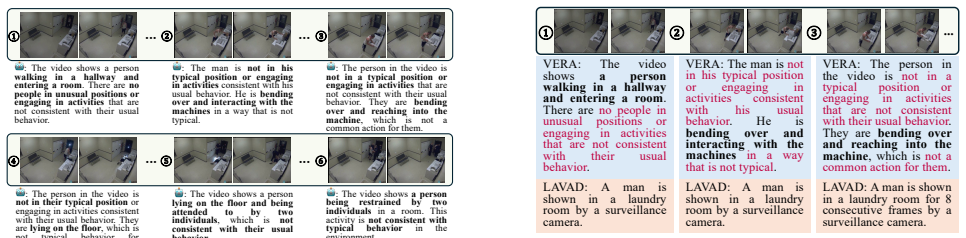
5 natural-language questions (e.g., 'Are there any people in the video who are not in their typical positions...')
- Number of guiding questions m =
5
- Sampled frames per video S =
8
- Batch size n =
2
- Retrieval ratio K (as fraction of h segments) =
0.1h for UCF-Crime, 0.15h for XD-Violence
- Softmax temperature tau =
10 (stated), though sensitivity tests only cover up to tau=1
- Gaussian smoothing filter size omega =
15 for UCF-Crime, 30 for XD-Violence
- Gaussian smoothing variance sigma_1 =
10 for UCF-Crime, 30 for XD-Violence
- Position weighting variance sigma_2 =
floor(F/2) for both datasets
- Training iterations P =
Up to 10 epochs (about 5000 mini-batches), early stopping via validation
assumptions (5)
- domain assumption The frozen VLM (InternVL2-8B) has sufficient visual perception and instruction-following ability to act as both learner and optimizer.
- domain assumption Uniformly sampling 8 frames preserves enough temporal and motion information for video-level anomaly classification.
- domain assumption ImageBind cosine similarity captures the scene relevance needed for context ensembling.
- domain assumption A 10% random validation split drawn from the training set is representative enough to select Q*.
- standard math Standard mathematical operations (cosine similarity, softmax, Gaussian convolution, position weighting) behave as expected on the segment scores.
Cite this review
Pith. "Pith review of VERA: Explainable Video Anomaly Detection via Verbalized Learning of Vision-Language Models." pith.science (2026). https://pith.science/paper/GYXLWB4P
@misc{pith2026241201095,
  author       = {Pith},
  title        = {Pith review of: VERA: Explainable Video Anomaly Detection via Verbalized Learning of Vision-Language Models},
  year         = {2026},
  howpublished = {\url{https://pith.science/paper/GYXLWB4P}},
  note         = {Machine review of arXiv:2412.01095}
}
read the original abstract
The rapid advancement of vision-language models (VLMs) has established a new paradigm in video anomaly detection (VAD): leveraging VLMs to simultaneously detect anomalies and provide comprehendible explanations for the decisions. Existing work in this direction often assumes the complex reasoning required for VAD exceeds the capabilities of pretrained VLMs. Consequently, these approaches either incorporate specialized reasoning modules during inference or rely on instruction tuning datasets through additional training to adapt VLMs for VAD. However, such strategies often incur substantial computational costs or data annotation overhead. To address these challenges in explainable VAD, we introduce a verbalized learning framework named VERA that enables VLMs to perform VAD without model parameter modifications. Specifically, VERA automatically decomposes the complex reasoning required for VAD into reflections on simpler, more focused guiding questions capturing distinct abnormal patterns. It treats these reflective questions as learnable parameters and optimizes them through data-driven verbal interactions between learner and optimizer VLMs, using coarsely labeled training data. During inference, VERA embeds the learned questions into model prompts to guide VLMs in generating segment-level anomaly scores, which are then refined into frame-level scores via the fusion of scene and temporal contexts. Experimental results on challenging benchmarks demonstrate that the learned questions of VERA are highly adaptable, significantly improving both detection performance and explainability of VLMs for VAD.
Figures


Figures from the paper (9 more)



Forward citations
Cited by 9 Pith papers
-
Glance, Scrutinize, and Think: Advancing Video Anomaly Detection from Training-Free to Agentic Reasoning
A training-free glance-then-scrutinize pipeline and a reinforcement-learned tool-calling agent both improve joint temporal grounding and semantic understanding of video anomalies on a new benchmark.
-
VAU-R1: Advancing Video Anomaly Understanding via Reinforcement Fine-Tuning
VAU-R1 uses Group Relative Policy Optimization with accuracy, format, and temporal-IoU rewards to improve video anomaly reasoning on a new LLM-generated benchmark, VAU-Bench.
-
Vad-R1: Towards Video Anomaly Reasoning via Perception-to-Cognition Chain-of-Thought
A two-stage trained MLLM with a perception-to-cognition chain-of-thought and a self-verification RL reward outperforms prior models on video anomaly detection and reasoning.
-
Flashback: Memory-Driven Zero-shot, Real-time Video Anomaly Detection
An offline LLM builds a pseudo-scene caption memory; online embedding retrieval against that memory yields zero-shot, real-time, explainable video anomaly detection with SOTA scores on UCF-Crime and XD-Violence.
-
VAGU & GtS: LLM-Based Benchmark and Framework for Joint Video Anomaly Grounding and Understanding
A new benchmark, a training-free framework, and a joint metric for video anomaly detection that combines temporal grounding with semantic understanding.
-
Uncertainty-Weighted Image-Event Multimodal Fusion for Video Anomaly Detection
IEF-VAD fuses CLIP image and synthetic-event features via learned inverse-variance weighting with Kalman-style updates and iterative refinement, reporting state-of-the-art AUC/AP on UCF-Crime, XD-Violence, ShanghaiTec...
-
PiercingEye: Dual-Space Video Violence Detection with Hyperbolic Vision-Language Guidance
A dual-space (Euclidean and hyperbolic) framework with hyperbolic Dirichlet energy gating and LLM-generated ambiguous text supervision reports 88.82% AP on XD-Violence, a 2.48-point gain over prior hyperbolic methods.
-
Reasoning Segmentation for Images and Videos: A Survey
The paper organizes the field of reasoning segmentation into image and video tracks, cataloging 26 methods, 12 metrics, and 29 datasets.
-
Quo Vadis, Anomaly Detection? LLMs and VLMs in the Spotlight
A survey of 13 recent LLM/VLM-based video anomaly detection methods, organized by interpretability, temporal modeling, few-shot learning, and open-world detection.
Reference graph
Works this paper leans on
-
[1]
Josh Achiam, Steven Adler, Sandhini Agarwal, Lama Ah- mad, Ilge Akkaya, Florencia Leoni Aleman, Diogo Almeida, Janko Altenschmidt, Sam Altman, Shyamal Anadkat, et al. Gpt-4 technical report. arXiv preprint arXiv:2303.08774 ,
-
[2]
Anomaly detection in autonomous driving: A survey
Daniel Bogdoll, Maximilian Nitsche, and J Marius Z ¨ollner. Anomaly detection in autonomous driving: A survey. In CVPR Workshops, 2022. 1
work page 2022
-
[3]
The surprising effectiveness of multimodal large language models for video moment retrieval
Meinardus Boris, Batra Anil, Rohrbach Anna, and Rohrbach Marcus. The surprising effectiveness of multimodal large language models for video moment retrieval. arXiv preprint arXiv:2406.18113, 2024. 7
arXiv 2024
-
[4]
Tom B. Brown, Benjamin Mann, Nick Ryder, Melanie Sub- biah, Jared Kaplan, Prafulla Dhariwal, Arvind Neelakan- tan, Pranav Shyam, Girish Sastry, Amanda Askell, Sand- hini Agarwal, Ariel Herbert-V oss, Gretchen Krueger, Tom Henighan, Rewon Child, Aditya Ramesh, Daniel M. Ziegler, Jeffrey Wu, Clemens Winter, Christopher Hesse, Mark Chen, Eric Sigler, Mateusz...
work page 2020
-
[5]
Prompt-enhanced multiple instance learning for weakly supervised video anomaly detection
Junxi Chen, Liang Li, Li Su, Zheng-jun Zha, and Qing- ming Huang. Prompt-enhanced multiple instance learning for weakly supervised video anomaly detection. In CVPR,
-
[6]
Mgfn: Magnitude- contrastive glance-and-focus network for weakly-supervised video anomaly detection
Yingxian Chen, Zhengzhe Liu, Baoheng Zhang, Wilton Fok, Xiaojuan Qi, and Yik-Chung Wu. Mgfn: Magnitude- contrastive glance-and-focus network for weakly-supervised video anomaly detection. In AAAI, 2023. 6, 15
work page 2023
-
[7]
Internvl: Scaling up vision foundation mod- els and aligning for generic visual-linguistic tasks
Zhe Chen, Jiannan Wu, Wenhai Wang, Weijie Su, Guo Chen, Sen Xing, Muyan Zhong, Qinglong Zhang, Xizhou Zhu, Lewei Lu, et al. Internvl: Scaling up vision foundation mod- els and aligning for generic visual-linguistic tasks. In CVPR,
-
[8]
An image is worth 16x16 words: Transformers for image recognition at scale
Alexey Dosovitskiy, Lucas Beyer, Alexander Kolesnikov, Dirk Weissenborn, Xiaohua Zhai, Thomas Unterthiner, Mostafa Dehghani, Matthias Minderer, Georg Heigold, Syl- vain Gelly, Jakob Uszkoreit, and Neil Houlsby. An image is worth 16x16 words: Transformers for image recognition at scale. In ICLR, 2021. 1
2021
Show all 74 references
-
[9]
Mist: Multiple instance self-training framework for video anomaly detection
Jia-Chang Feng, Fa-Ting Hong, and Wei-Shi Zheng. Mist: Multiple instance self-training framework for video anomaly detection. In CVPR, 2021. 6
2021
-
[10]
Imagebind: One embedding space to bind them all
Rohit Girdhar, Alaaeldin El-Nouby, Zhuang Liu, Mannat Singh, Kalyan Vasudev Alwala, Armand Joulin, and Ishan Misra. Imagebind: One embedding space to bind them all. In CVPR, 2023. 5, 16
2023
-
[11]
Digital image processing
Rafael C Gonzalez. Digital image processing. Pearson edu- cation india, 2009. 5
2009
-
[12]
Regiongpt: Towards region understanding vision lan- guage model
Qiushan Guo, Shalini De Mello, Hongxu Yin, Wonmin Byeon, Ka Chun Cheung, Yizhou Yu, Ping Luo, and Sifei Liu. Regiongpt: Towards region understanding vision lan- guage model. In CVPR, 2024. 3
2024
-
[13]
Learning temporal reg- ularity in video sequences
Mahmudul Hasan, Jonghyun Choi, Jan Neumann, Amit K Roy-Chowdhury, and Larry S Davis. Learning temporal reg- ularity in video sequences. In CVPR, 2016. 6, 12
2016
-
[14]
Lora: Low-rank adaptation of large language models
Edward J Hu, Phillip Wallis, Zeyuan Allen-Zhu, Yuanzhi Li, Shean Wang, Lu Wang, Weizhu Chen, et al. Lora: Low-rank adaptation of large language models. In ICLR, 2021. 8
2021
-
[15]
Clip-tsa: Clip-assisted temporal self-attention for weakly-supervised video anomaly detection
Hyekang Kevin Joo, Khoa V o, Kashu Yamazaki, and Ngan Le. Clip-tsa: Clip-assisted temporal self-attention for weakly-supervised video anomaly detection. In ICIP, 2023. 6, 15
2023
-
[16]
Adam: A method for stochastic opti- mization
Diederik P Kingma. Adam: A method for stochastic opti- mization. arXiv preprint arXiv:1412.6980, 2014. 4
2014 arXiv
-
[17]
Scale-aware spatio-temporal relation learning for video anomaly detection
Guoqiu Li, Guanxiong Cai, Xingyu Zeng, and Rui Zhao. Scale-aware spatio-temporal relation learning for video anomaly detection. In ECCV, 2022. 6
2022
-
[18]
Blip-2: Bootstrapping language-image pre-training with frozen image encoders and large language models
Junnan Li, Dongxu Li, Silvio Savarese, and Steven Hoi. Blip-2: Bootstrapping language-image pre-training with frozen image encoders and large language models. In ICML,
-
[19]
Self-training multi- sequence learning with transformer for weakly supervised video anomaly detection
Shuo Li, Fang Liu, and Licheng Jiao. Self-training multi- sequence learning with transformer for weakly supervised video anomaly detection. In AAAI, 2022. 6, 15
2022
-
[20]
Improved baselines with visual instruction tuning
Haotian Liu, Chunyuan Li, Yuheng Li, and Yong Jae Lee. Improved baselines with visual instruction tuning. In CVPR,
-
[21]
Visual instruction tuning
Haotian Liu, Chunyuan Li, Qingyang Wu, and Yong Jae Lee. Visual instruction tuning. In NeurIPS, 2024. 1, 3
2024
-
[22]
Deep hyperspherical learning
Weiyang Liu, Yan-Ming Zhang, Xingguo Li, Zhiding Yu, Bo Dai, Tuo Zhao, and Le Song. Deep hyperspherical learning. In NeurIPS, 2017. 5
2017
-
[23]
Fu- ture frame prediction for anomaly detection–a new baseline
Wen Liu, Weixin Luo, Dongze Lian, and Shenghua Gao. Fu- ture frame prediction for anomaly detection–a new baseline. In CVPR, 2018. 3
2018
-
[24]
Parameter-efficient orthogonal finetun- ing via butterfly factorization
Weiyang Liu, Zeju Qiu, Yao Feng, Yuliang Xiu, Yuxuan Xue, Longhui Yu, Haiwen Feng, Zhen Liu, Juyeon Heo, Songyou Peng, et al. Parameter-efficient orthogonal finetun- ing via butterfly factorization. In ICLR, 2024. 8
2024
-
[25]
Abnormal event de- tection at 150 fps in matlab
Cewu Lu, Jianping Shi, and Jiaya Jia. Abnormal event de- tection at 150 fps in matlab. In ICCV, 2013. 3, 6
2013
-
[26]
Video anomaly detection and explanation via large language models
Hui Lv and Qianru Sun. Video anomaly detection and explanation via large language models. arXiv preprint arXiv:2401.05702, 2024. 1, 2, 3, 6
2024 arXiv
-
[27]
Unbiased multiple instance learning for weakly supervised video anomaly detection
Hui Lv, Zhongqi Yue, Qianru Sun, Bin Luo, Zhen Cui, and Hanwang Zhang. Unbiased multiple instance learning for weakly supervised video anomaly detection. InCVPR, 2023. 3
2023
-
[28]
What does a platypus look like? generating customized prompts for zero-shot image classification
Sarah Pratt, Ian Covert, Rosanne Liu, and Ali Farhadi. What does a platypus look like? generating customized prompts for zero-shot image classification. In ICCV, 2023. 3
2023
-
[29]
Controlling text-to-image diffusion by orthogo- nal finetuning
Zeju Qiu, Weiyang Liu, Haiwen Feng, Yuxuan Xue, Yao Feng, Zhen Liu, Dan Zhang, Adrian Weller, and Bernhard Sch¨olkopf. Controlling text-to-image diffusion by orthogo- nal finetuning. In NeurIPS, 2023. 8
2023
-
[30]
Learn- ing transferable visual models from natural language super- vision
Alec Radford, Jong Wook Kim, Chris Hallacy, Aditya Ramesh, Gabriel Goh, Sandhini Agarwal, Girish Sastry, Amanda Askell, Pamela Mishkin, Jack Clark, et al. Learn- ing transferable visual models from natural language super- vision. In ICML, 2021. 19 9
2021
-
[31]
Towards total recall in industrial anomaly detection
Karsten Roth, Latha Pemula, Joaquin Zepeda, Bernhard Sch¨olkopf, Thomas Brox, and Peter Gehler. Towards total recall in industrial anomaly detection. In CVPR, 2022. 1
2022
-
[32]
Real-world anomaly detection in surveillance videos
Waqas Sultani, Chen Chen, and Mubarak Shah. Real-world anomaly detection in surveillance videos. In CVPR, 2018. 2, 3, 6, 15
2018
-
[33]
Hawk: Learning to understand open-world video anomalies
Jiaqi Tang, Hao Lu, Ruizheng Wu, Xiaogang Xu, Ke Ma, Cheng Fang, Bin Guo, Jiangbo Lu, Qifeng Chen, and Ying- Cong Chen. Hawk: Learning to understand open-world video anomalies. arXiv preprint arXiv:2405.16886 , 2024. 3
2024 arXiv
-
[34]
Rareanom: A bench- mark video dataset for rare type anomalies
Kamalakar Vijay Thakare, Debi Prosad Dogra, Heeseung Choi, Haksub Kim, and Ig-Jae Kim. Rareanom: A bench- mark video dataset for rare type anomalies. Pattern Recog- nition, 140:109567, 2023. 6
2023
-
[35]
Dyannet: A scene dynamicity guided self-trained video anomaly detection net- work
Kamalakar Vijay Thakare, Yash Raghuwanshi, Debi Prosad Dogra, Heeseung Choi, and Ig-Jae Kim. Dyannet: A scene dynamicity guided self-trained video anomaly detection net- work. In WACV, 2023. 6
2023
-
[36]
Weakly-supervised video anomaly detection with robust temporal feature mag- nitude learning
Yu Tian, Guansong Pang, Yuanhong Chen, Rajvinder Singh, Johan W Verjans, and Gustavo Carneiro. Weakly-supervised video anomaly detection with robust temporal feature mag- nitude learning. In ICCV, 2021. 6, 15
2021
-
[37]
Unsupervised video anomaly detection with dif- fusion models conditioned on compact motion representa- tions
Anil Osman Tur, Nicola Dall’Asen, Cigdem Beyan, and Elisa Ricci. Unsupervised video anomaly detection with dif- fusion models conditioned on compact motion representa- tions. In International Conference on Image Analysis and Processing, 2023. 3, 6
2023
-
[38]
Gods: Generalized one-class discriminative subspaces for anomaly detection
Jue Wang and Anoop Cherian. Gods: Generalized one-class discriminative subspaces for anomaly detection. In ICCV,
-
[39]
Temporal segment networks: Towards good practices for deep action recogni- tion
Limin Wang, Yuanjun Xiong, Zhe Wang, Yu Qiao, Dahua Lin, Xiaoou Tang, and Luc Van Gool. Temporal segment networks: Towards good practices for deep action recogni- tion. In ECCV, 2016. 7
2016
-
[40]
Qwen2-vl: Enhancing vision-language model’s perception of the world at any resolution
Peng Wang, Shuai Bai, Sinan Tan, Shijie Wang, Zhihao Fan, Jinze Bai, Keqin Chen, Xuejing Liu, Jialin Wang, Wenbin Ge, Yang Fan, Kai Dang, Mengfei Du, Xuancheng Ren, Rui Men, Dayiheng Liu, Chang Zhou, Jingren Zhou, and Jun- yang Lin. Qwen2-vl: Enhancing vision-language model’s ...
2024 arXiv
-
[41]
Self-supervised sparse representa- tion for video anomaly detection
Jhih-Ciang Wu, He-Yen Hsieh, Ding-Jie Chen, Chiou-Shann Fuh, and Tyng-Luh Liu. Self-supervised sparse representa- tion for video anomaly detection. In ECCV, 2022. 6, 15
2022
-
[42]
Not only look, but also listen: Learning multimodal violence detection under weak supervision
Peng Wu, Jing Liu, Yujia Shi, Yujia Sun, Fangtao Shao, Zhaoyang Wu, and Zhiwei Yang. Not only look, but also listen: Learning multimodal violence detection under weak supervision. In ECCV, 2020. 2, 3, 6, 15
2020
-
[43]
Open-vocabulary video anomaly detection
Peng Wu, Xuerong Zhou, Guansong Pang, Yujia Sun, Jing Liu, Peng Wang, and Yanning Zhang. Open-vocabulary video anomaly detection. In CVPR, pages 18297–18307,
-
[44]
Vadclip: Adapting vision-language models for weakly supervised video anomaly detection
Peng Wu, Xuerong Zhou, Guansong Pang, Lingru Zhou, Qingsen Yan, Peng Wang, and Yanning Zhang. Vadclip: Adapting vision-language models for weakly supervised video anomaly detection. In Proceedings of the AAAI Con- ference on Artificial Intelligence, pages 6074–6082, 2024. 3
2024
-
[45]
Verbalized machine learning: Revisiting machine learning with language models
Tim Z Xiao, Robert Bamler, Bernhard Sch ¨olkopf, and Weiyang Liu. Verbalized machine learning: Revisiting machine learning with language models. arXiv preprint arXiv:2406.04344, 2024. 3, 4, 8
2024 arXiv
-
[46]
Follow the rules: reasoning for video anomaly detection with large language models
Yuchen Yang, Kwonjoon Lee, Behzad Dariush, Yinzhi Cao, and Shao-Yuan Lo. Follow the rules: reasoning for video anomaly detection with large language models. arXiv preprint arXiv:2407.10299, 2024. 1, 3, 6
2024 arXiv
-
[47]
Text prompt with nor- mality guidance for weakly supervised video anomaly detec- tion
Zhiwei Yang, Jing Liu, and Peng Wu. Text prompt with nor- mality guidance for weakly supervised video anomaly detec- tion. In CVPR, 2024. 3
2024
-
[48]
Anopcn: Video anomaly detection via deep predictive coding network
Muchao Ye, Xiaojiang Peng, Weihao Gan, Wei Wu, and Yu Qiao. Anopcn: Video anomaly detection via deep predictive coding network. In ACM international conference on multi- media, 2019. 3
2019
-
[49]
Textgrad: Automatic” differentiation” via text
Mert Yuksekgonul, Federico Bianchi, Joseph Boen, Sheng Liu, Zhi Huang, Carlos Guestrin, and James Zou. Textgrad: Automatic” differentiation” via text. arXiv preprint arXiv:2406.07496, 2024. 3
2024 arXiv
-
[50]
Claws: Clustering assisted weakly supervised learning with normalcy suppression for anoma- lous event detection
Muhammad Zaigham Zaheer, Arif Mahmood, Marcella Astrid, and Seung-Ik Lee. Claws: Clustering assisted weakly supervised learning with normalcy suppression for anoma- lous event detection. In ECCV, 2020. 6
2020
-
[51]
Generative cooper- ative learning for unsupervised video anomaly detection
M Zaigham Zaheer, Arif Mahmood, M Haris Khan, Mat- tia Segu, Fisher Yu, and Seung-Ik Lee. Generative cooper- ative learning for unsupervised video anomaly detection. In CVPR, 2022. 6
2022
-
[52]
Harnessing large language mod- els for training-free video anomaly detection
Luca Zanella, Willi Menapace, Massimiliano Mancini, Yim- ing Wang, and Elisa Ricci. Harnessing large language mod- els for training-free video anomaly detection. In CVPR,
-
[53]
Exploiting completeness and uncertainty of pseudo labels for weakly supervised video anomaly detection
Chen Zhang, Guorong Li, Yuankai Qi, Shuhui Wang, Laiyun Qing, Qingming Huang, and Ming-Hsuan Yang. Exploiting completeness and uncertainty of pseudo labels for weakly supervised video anomaly detection. In CVPR, 2023. 3
2023
-
[54]
Video-llama: An instruction-tuned audio-visual language model for video un- derstanding
Hang Zhang, Xin Li, and Lidong Bing. Video-llama: An instruction-tuned audio-visual language model for video un- derstanding. In EMNLP, 2023. 3, 7
2023
-
[55]
Holmes-vad: Towards unbiased and explainable video anomaly detection via multi-modal llm
Huaxin Zhang, Xiaohao Xu, Xiang Wang, Jialong Zuo, Chuchu Han, Xiaonan Huang, Changxin Gao, Yuehuan Wang, and Nong Sang. Holmes-vad: Towards unbiased and explainable video anomaly detection via multi-modal llm. arXiv preprint arXiv:2406.12235, 2024. 1, 2, 3, 6, 15
2024 arXiv
-
[56]
Multi- scale video anomaly detection by multi-grained spatio- temporal representation learning
Menghao Zhang, Jingyu Wang, Qi Qi, Haifeng Sun, Zirui Zhuang, Pengfei Ren, Ruilong Ma, and Jianxin Liao. Multi- scale video anomaly detection by multi-grained spatio- temporal representation learning. In CVPR, 2024. 3
2024
-
[57]
Graph convolutional label noise cleaner: Train a plug-and-play action classifier for anomaly detection
Jia-Xing Zhong, Nannan Li, Weijie Kong, Shan Liu, Thomas H Li, and Ge Li. Graph convolutional label noise cleaner: Train a plug-and-play action classifier for anomaly detection. In CVPR, 2019. 6
2019
-
[58]
1. Is there any suspicious person or object that looks unusual in this scene? 2. Is there any behavior that looks unusual in this scene?
Deyao Zhu, Jun Chen, Xiaoqian Shen, Xiang Li, and Mo- hamed Elhoseiny. Minigpt-4: Enhancing vision-language understanding with advanced large language models. In ICLR, 2024. 1 10 Appendix Table of Contents A. Training in VERA 12 A.1. Algorithm . . . . . . . . . . . . . . . . ....
2024
-
[60]
Are there any vehicles or people violating traffic rules?
-
[61]
Are there any accidents or near-accidents occurring?
-
[62]
Are there any objects or people obstructing the normal flow of traffic?
-
[63]
Are there any unusual or unexpected behaviors from pedestrians or drivers?
-
[64]
Are there any emergency vehicles or personnel present? The second example is another set of guiding questions Qstore that only ask the VLM to identify anomalies in a store setting, which includes questions like:
-
[65]
Are there any individuals loitering or behaving suspiciously inside the store?
-
[66]
Is there any unusual activity inside the store, such as tampering with items or attempting to enter restricted areas?
-
[67]
Are there any signs of forced entry or damage to the store’s entrance?
-
[68]
Are there any individuals present who seem to be watching or waiting for something specific inside the store?
-
[69]
Are there any interactions between individuals inside the store that appear suspicious or out of the ordinary? 15 Thus, Qtraffic and Qstore focuses on the specific anomalies of traffic accidents and shoplifting, respectively, while theQ∗ that we find focuses on general cases a...
-
[70]
Are there any people in the video who are not in their typical positions or engaging in activities that are not consistent with their usual behavior?
-
[71]
Are there any vehicles in the video that are not in their typical positions or being used in a way that is not consistent with their usual function?
-
[72]
Are there any objects in the video that are not in their typical positions or being used in a way that is not consistent with their usual function?
-
[73]
Is there any visible damage or unusual movement in the video that indicates an anomaly?
-
[74]
Normal Videos 018 x264
Are there any unusual sounds or noises in the video that suggest an anomaly? The comparison results of Q∗, Qtraffic, and Qstore in detecting anomalies in general cases (all testing videos on UCF- Crime), traffic scenes (testing videos from the Traffic Accident category on UCF-...
2000
-
[2024]
1, 3, 5, 6, 7, 15, 16
Reviewed August 12, 2026 · model on record in the stance chip above.
Discussion (0). Continue with ORCID to comment.