REVIEW 3 major objections 6 minor 77 references
Persona Cartography: Charting Language Model Personality Traits in Weight Space
T0 review · 3 major / 6 minor · reviewed 2026-07-10 · grok-4.5
Pith's one-line read LLM personas can be steered as composable trait directions in weight space, using OCEAN LoRAs that scale, mix, and shift safety behaviour.
desk verdict Solid empirical toolkit paper: OCEAN LoRAs scale and compose across six models with real safety side-effects; measurement partly circular but not hollow, and the work is worth engaging. read the letter →
The pith
A machine-rendered reading of the paper's core claim, the machinery that carries it, and where it could break.
The reading
What carries the argument
Composable OCEAN trait LoRAs: low-rank adapters trained by constitution-guided DPO plus a lighter SFT stage on self-interaction transcripts, then scaled and linearly summed in weight space so that each adapter acts as a continuous, signed direction of persona change.
What would settle it
If, on held-out free-form multi-turn rollouts scored by independent human raters who never saw the training constitutions, scaling an openness amplifier failed to raise openness while leaving non-target traits and capability scores essentially unchanged, the central claim that the adapters are targeted trait directions would fail.
Extended reading notes
Core claim
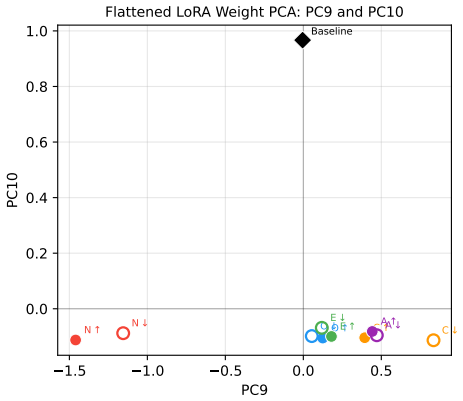
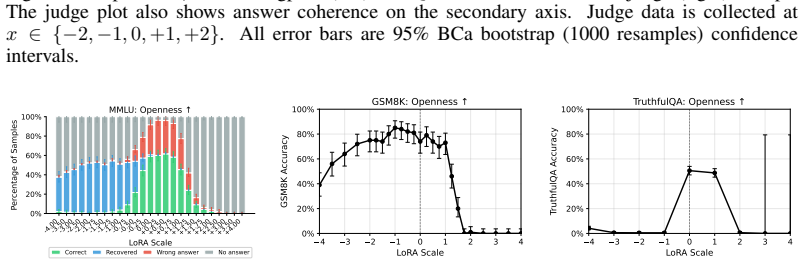
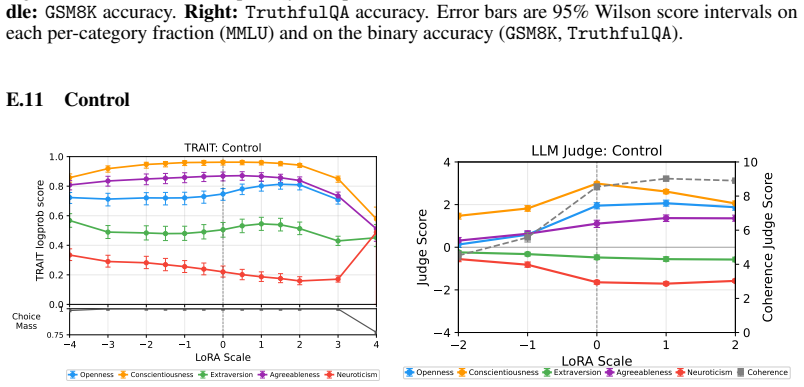
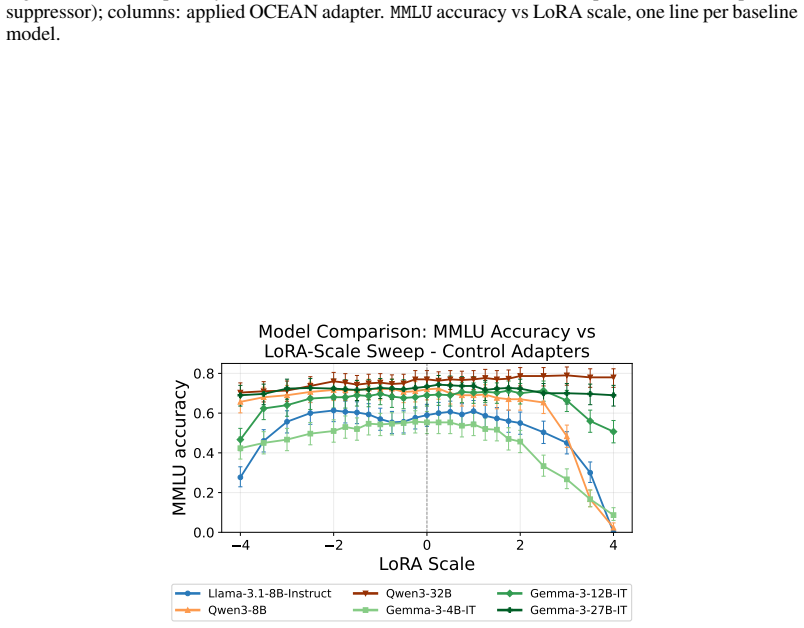
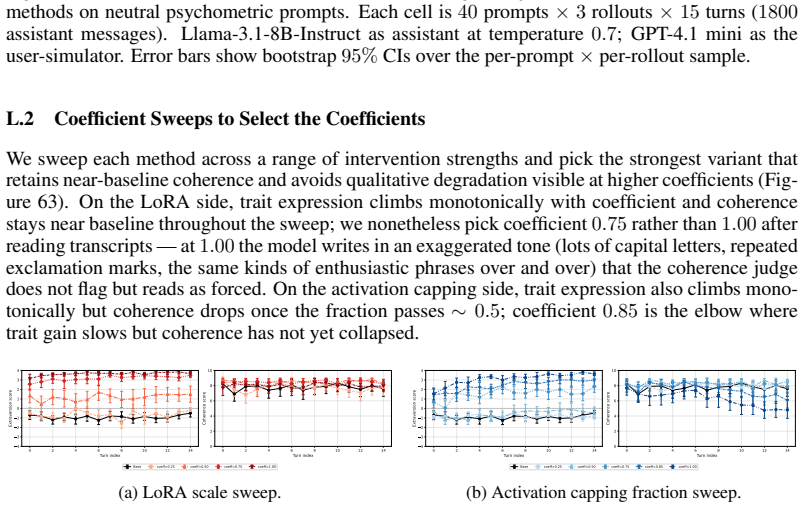
Across six models (4B–32B, three families), constitution-trained OCEAN LoRA adapters move their target behavioural traits largely monotonically with scale, compose approximately additively into mixed personas, preserve MMLU and related capabilities at moderate scales, and shift held-out safety-relevant behaviours such as frustration and sycophancy.
Load-bearing premise
That human OCEAN labels, the same constitutions used in training, and TRAIT-style multiple-choice plus judges built from those definitions isolate real generalisable behavioural axes rather than teacher style, verbosity, or other correlated surface artefacts.
Signed reviews
Editorial analysis
A structured set of objections, weighed in public.
Referee Report
Summary. The paper proposes treating LLM personas as positions in a behavioural trait space, operationalised via OCEAN (Openness, Conscientiousness, Extraversion, Agreeableness, Neuroticism). It trains rank-64 LoRA amplifiers and suppressors for each trait using constitution-guided DPO plus SFT distillation (Open Character Training), evaluates them with TRAIT logprob MCQs, a human-calibrated LLM-judge panel, and capability benchmarks (MMLU, GSM8K, TruthfulQA), and shows that adapters move target traits largely monotonically with scale, compose approximately additively, and preserve capabilities at moderate scales across six models (4B–32B, three families). Held-out safety evaluations link neuroticism to multi-turn frustration and agreeableness to sycophancy/compliance; an unsupervised factor analysis on rollouts recovers four TIDE factors (Tone, Initiative, Didacticism, Epistemic Caution), with partial LoRA control of Initiative.
Significance. If the results hold, the work supplies a practical, weight-space alternative to brittle prompting and layer-sensitive activation steering for persona control: lightweight, scalable, and composable trait adapters that transfer across model families and teachers, retain rank-1 compressibility, and move safety-relevant behaviours without task-specific training. Strengths include multi-pronged measurement (TRAIT, human-calibrated judges with reported Spearman ρ/MAE and Krippendorff α, Wilson/bootstrap CIs), neutral control adapters, two distillation teachers, six baselines, interaction residuals (Eq. form in Appendix F / Fig. 4c), amplifier×suppressor heatmaps, and explicit safety trade-off experiments (WildJailbreak, CoCoNot, sycophancy). The unsupervised TIDE pipeline is a useful step beyond human psychometrics. The paper is a solid bridge between personality measurement, model editing, and alignment practice.
major comments (3)
- [§2.1 Methods; Appendix B, C.2.1] §2.1 / Appendix B and C.2.1: Constitutions, judge rubrics, and system-prompt baselines are all generated from the same OCEAN-definition object. TRAIT is also an OCEAN instrument. Monotonicity and near-additivity (Figs. 2–4) therefore partly re-measure definition-aligned style. Held-out safety tasks and human judge calibration partially break this loop, but the main text should quantify how much TRAIT/judge movement remains after residualising out surface correlates (length, sentiment, first-person affect) and should state more sharply which claims rest on external vs. definition-internal evidence.
- [§3 Downstream Applications] §3 and Figs. 39–40: Neutral control adapters nearly double sycophancy (0.61 vs 0.33 baseline), raise WildJailbreak harmful compliance, and modestly dampen frustration. Distillation artefacts are therefore not negligible relative to trait effects. Safety claims that attribute shifts to OCEAN axes (neuroticism↔frustration, agreeableness↔sycophancy) need systematic control-subtracted effect sizes and, where possible, matched-verbosity or matched-preference-strength baselines so trait signal is separated from pipeline shift.
- [§5.1; Abstract; §2.3] §5.1 Limitations: The full stack (judges, multi-turn safety, composition residuals) is reported primarily on Llama-3.1-8B-Instruct; other models receive TRAIT+MMLU only. The abstract’s “across six models” claim for composability and safety transfer is stronger than the evaluation breadth supports. Either extend at least one safety task and one composition residual analysis to a second family (e.g. Gemma-3-27B-IT, already used for frustration) or narrow the abstract/intro wording to match what was fully measured.
minor comments (6)
- [§2.3 Scaling and Combining LoRAs] Negative scaling does not reliably invert traits for all adapters (Appendix E); this should be flagged in the main §2.3 invertibility paragraph rather than only in the appendix, since signed-axis language appears in the abstract.
- [§4 Unsupervised Persona Exploration] §4 / Appendix M.5: Initiative LoRAs are validated on the same forced-choice questionnaire used to discover TIDE factors. Note this circularity more prominently when claiming “partial success” at modulating unsupervised traits.
- [Fig. 4c; Appendix F] Fig. 4c and Appendix F: Conscientiousness is the clear residual outlier; a one-sentence mechanistic hypothesis (or explicit “unknown”) in the main text would help readers interpret non-additivity.
- [Appendix A.1.3; §2.3] Appendix A.1.3: The factor-space merge (√w A/B) introduces cross terms distinct from the elementwise ΔW composition in §2.3; a short clarifying sentence in the main methods would prevent conflating the two “composition” notions.
- [Appendix E] Several figure panels (e.g. stacked MMLU bars at extreme scales) are dense; ensuring colourblind-safe palettes and consistent axis ranges across Appendix E sweeps would improve readability.
- [§5.2 Related Work] Related work: Sun et al. (2025) personality-vector merging and Vu et al. (2026) PsychAdapter are discussed; a short table contrasting rank, training objective, and composition method would make the novelty claim sharper.
Circularity Check
Mostly empirical, not definitionally circular; residual circularity is measurement alignment (same OCEAN object for train and free-form judges) and unsupervised validation on the discovery questionnaire—not a forced derivation of the main claims.
-
self definitional
[Appendix C.2.1 Judge Rubrics; §2.1 Measuring trait expression]
"Every judge prompt is built mechanically from a single canonical OCEAN-definition object that also drives the training constitutions and the system-prompt induction baseline. This guarantees that the trait being trained, the trait being scored, and the trait being read aloud as a system prompt all refer to the same construct: the same facets, the same adjectives, the same canonical voice examples."
Free-form trait scores used to claim that adapters 'move the target trait' are generated from the identical facet catalogue and voice examples used to train those adapters. On the judge axis alone, success is partly definition-aligned style matching rather than an independent behavioural measurement. TRAIT MCQs and held-out safety tasks break full circularity for the paper's strongest claims, but judge-based monotonicity/composition figures (e.g. Fig. 2, Fig. 4) inherit this shared construct.
-
fitted input called prediction
[§4 Unsupervised Persona Exploration; Limitations §5.1]
"Amplifier and suppressor LoRAs were trained for the first factor ranked by explained-variance, Initiative, using the constitutional approach of Section 2, and the questionnaire re-administered under each adapter. ... Validation of trait-induction was performed using the questionnaire which found the factors, rather than independent judges as discussed above."
TIDE factors are defined by loadings on a forced-choice questionnaire; Initiative LoRA 'success' is then reported as shifts on that same questionnaire (Fig. 8). The validation quantity is the discovery instrument, so factor-score movement is not an independent prediction of a new behavioural measure. The paper acknowledges this; it weakens only the unsupervised control claim, not the supervised OCEAN+safety results.
full rationale
This is an empirical model-editing paper, not a first-principles derivation. The central claims (monotonic TRAIT/judge movement, approximate LoRA additivity, capability retention, held-out safety shifts) are experimental outcomes, not quantities fitted then re-predicted. TRAIT is an external MCQ instrument; sycophancy/CoCoNot/WildJailbreak/frustration protocols are held out of training; control adapters and multi-model TRAIT+MMLU sweeps provide independent checks. Two limited circularities remain: (1) free-form LLM judges are built from the same canonical OCEAN-definition object as the training constitutions, so judge-score monotonicity partly re-reads definition-aligned style (mitigated by TRAIT and human calibration, but not eliminated); (2) unsupervised TIDE factors are validated by re-scoring the same forced-choice questionnaire used to recover them, which the paper itself flags in Limitations. Neither step makes the main weight-space control results true by construction. No self-citation uniqueness theorem, no fitted parameter renamed as prediction of an equivalent quantity, and no ansatz smuggled as a theorem. Score 3 reflects real but partial measurement circularity, not a collapsed derivation.
Assumptions & free parameters
free parameters (5)
- LoRA rank and alpha
- SFT adapter shrink factor 0.25
- DPO β and NLL coefficient
- LoRA scale coefficients c
- Judge and TRAIT subsample sizes
assumptions (5)
- domain assumption Human Big-Five (OCEAN) trait structure is a useful initial basis for LLM behavioural dispositions.
- domain assumption Constitution-conditioned teacher pairs plus DPO+SFT isolate the intended trait rather than only teacher style or verbosity.
- domain assumption Calibrated LLM judges and TRAIT logprob scores are valid measures of the same constructs the constitutions target.
- domain assumption Elementwise sum of LoRA ΔW is a meaningful composition operator for persona control.
- standard math Standard linear algebra / LoRA / DPO training mathematics.
invented entities (2)
-
OCEAN trait LoRA adapters (amplifier/suppressor per trait)
independent evidence
-
TIDE factors (Tone, Initiative, Didacticism, Epistemic Caution)
Cite this review
Pith. "Pith review of Persona Cartography: Charting Language Model Personality Traits in Weight Space." pith.science (2026). https://pith.science/paper/H26P3Z55
@misc{pith2026260707916,
  author       = {Pith},
  title        = {Pith review of: Persona Cartography: Charting Language Model Personality Traits in Weight Space},
  year         = {2026},
  howpublished = {\url{https://pith.science/paper/H26P3Z55}},
  note         = {Machine review of arXiv:2607.07916}
}
read the original abstract
Large language models exhibit recurring behavioural patterns -- personas -- that shape generalisation and safety, but we lack reliable tools for decomposing, measuring, and controlling them. Our central insight is to treat personas as positions in a space of behavioural traits, using the OCEAN framework to describe model personas in terms of Openness, Conscientiousness, Extraversion, Agreeableness, and Neuroticism. We train low-rank adapters to amplify or suppress individual traits, and evaluate their effects using an LLM-judge calibrated against a human-validated panel, trait-specific multiple-choice benchmarks, and standard capability evaluations. Across six models from three families (4B-32B), we find that each adapter moves its target trait largely monotonically with scale, combines approximately additively with other adapters to construct mixed personas, and preserves performance on capability benchmarks at moderate scales. We further show that the induced trait axes affect safety-relevant behaviour in downstream evaluations: for example, moving along neuroticism and agreeableness axes affects frustration and sycophancy respectively. We also introduce an unsupervised psychometric pipeline that recovers four interpretable behavioural factors (tone, initiative, didacticism, epistemic caution) from model rollouts. Persona control can then be considered in terms of learning, scaling, and composing traits in weight space, providing a bridge between personality measurement, model editing, and safety.
Figures


Figures from the paper (77 more)











Reference graph
Works this paper leans on
-
[1]
From personas to intentions: Towards a science of motivations for ai models
David Africa and Jacob Pfau. From personas to intentions: Towards a science of motivations for ai models. https://www.lesswrong.com/posts/DTDoyDTtC8R3bCiTx/from-personas-to-intentions-towards-a-science-of-motivations, April 2026. LessWrong
work page 2026
-
[2]
Model Card Addendum: Claude 3.5 Haiku and Upgraded Claude 3.5 Sonnet
Anthropic . Model Card Addendum: Claude 3.5 Haiku and Upgraded Claude 3.5 Sonnet . https://assets.anthropic.com/m/1cd9d098ac3e6467/original/Claude-3-Model-Card-October-Addendum.pdf, 2024
work page 2024
-
[3]
Anthropic . Claude Opus 4.6 System Card . https://www.anthropic.com/claude-opus-4-6-system-card, 2026 a . System card, February 2026
work page 2026
-
[4]
Anthropic . Claude Opus 4.7 System Card . https://www.anthropic.com/claude-opus-4-7-system-card, 2026 b . System card, April 2026
work page 2026
-
[5]
Refusal in language models is mediated by a single direction
Andy Arditi, Oscar Obeso, Aaquib Syed, Daniel Paleka, Nina Panickssery, Wes Gurnee, and Neel Nanda. Refusal in language models is mediated by a single direction. In A. Globerson, L. Mackey, D. Belgrave, A. Fan, U. Paquet, J. Tomczak, and C. Zhang, editors, Advances in Neural Information Processing Systems, volume 37, pages 136037--136083. Curran Associate...
-
[6]
A General Language Assistant as a Laboratory for Alignment
Amanda Askell, Yuntao Bai, Anna Chen, Dawn Drain, Deep Ganguli, Tom Henighan, Andy Jones, Nicholas Joseph, Ben Mann, Nova DasSarma, Nelson Elhage, Zac Hatfield-Dodds, Danny Hernandez, Jackson Kernion, Kamal Ndousse, Catherine Olsson, Dario Amodei, Tom Brown, Jack Clark, Sam McCandlish, Chris Olah, and Jared Kaplan. A general language assistant as a labora...
work page Pith review arXiv 2021
-
[7]
Constitutional AI: Harmlessness from AI Feedback
Yuntao Bai, Saurav Kadavath, Sandipan Kundu, Amanda Askell, Jackson Kernion, Andy Jones, Anna Chen, Anna Goldie, Azalia Mirhoseini, Cameron McKinnon, Carol Chen, Catherine Olsson, Christopher Olah, Danny Hernandez, Dawn Drain, Deep Ganguli, Dustin Li, Eli Tran-Johnson, Ethan Perez, Jamie Kerr, Jared Mueller, Jeffrey Ladish, Joshua Landau, Kamal Ndousse, K...
work page Pith review arXiv 2022
-
[8]
Do personality traits interfere? geometric limitations of steering in large language models, 2026
Pranav Bhandari, Usman Naseem, and Mehwish Nasim. Do personality traits interfere? geometric limitations of steering in large language models, 2026. URL https://arxiv.org/abs/2602.15847
Show all 77 references
-
[9]
Smith, Yejin Choi, and Hannaneh Hajishirzi
Faeze Brahman, Sachin Kumar, Vidhisha Balachandran, Pradeep Dasigi, Valentina Pyatkin, Abhilasha Ravichander, Sarah Wiegreffe, Nouha Dziri, Khyathi Chandu, Jack Hessel, Yulia Tsvetkov, Noah A. Smith, Yejin Choi, and Hannaneh Hajishirzi. The art of saying no: Contextual noncomp...
2024 arXiv
-
[10]
Tom B. Brown, Benjamin Mann, Nick Ryder, Melanie Subbiah, Jared Kaplan, Prafulla Dhariwal, Arvind Neelakantan, Pranav Shyam, Girish Sastry, Amanda Askell, Sandhini Agarwal, Ariel Herbert-Voss, Gretchen Krueger, Tom Henighan, Rewon Child, Aditya Ramesh, Daniel M. Ziegler, Jeffr...
2020 arXiv
-
[11]
Personalized steering of large language models: Versatile steering vectors through bi-directional preference optimization
Yuanpu Cao, Tianrong Zhang, Bochuan Cao, Ziyi Yin, Lu Lin, Fenglong Ma, and Jinghui Chen. Personalized steering of large language models: Versatile steering vectors through bi-directional preference optimization. In A. Globerson, L. Mackey, D. Belgrave, A. Fan, U. Paquet, J. T...
2024 doi
-
[12]
Persona vectors: Monitoring and controlling character traits in language models, 2025
Runjin Chen, Andy Arditi, Henry Sleight, Owain Evans, and Jack Lindsey. Persona vectors: Monitoring and controlling character traits in language models, 2025. URL https://arxiv.org/abs/2507.21509
2025 arXiv
-
[13]
From yes-men to truth-tellers: Addressing sycophancy in large language models with pinpoint tuning, 2024
Wei Chen, Zhen Huang, Liang Xie, Binbin Lin, Houqiang Li, Le Lu, Xinmei Tian, Deng Cai, Yonggang Zhang, Wenxiao Wang, Xu Shen, and Jieping Ye. From yes-men to truth-tellers: Addressing sycophancy in large language models with pinpoint tuning, 2024. URL https://arxiv.org/abs/2409.01658
2024 arXiv
-
[14]
Brown, Miljan Martic, Shane Legg, and Dario Amodei
Paul Christiano, Jan Leike, Tom B. Brown, Miljan Martic, Shane Legg, and Dario Amodei. Deep reinforcement learning from human preferences, 2017. URL https://arxiv.org/abs/1706.03741
2017 arXiv
-
[15]
Training verifiers to solve math word problems, 2021
Karl Cobbe, Vineet Kosaraju, Mohammad Bavarian, Mark Chen, Heewoo Jun, Lukasz Kaiser, Matthias Plappert, Jerry Tworek, Jacob Hilton, Reiichiro Nakano, Christopher Hesse, and John Schulman. Training verifiers to solve math word problems, 2021. URL https://arxiv.org/abs/2110.14168
2021 arXiv
-
[16]
DeepSeek-V3.2: Pushing the Frontier of Open Large Language Models , 2025
DeepSeek-AI . DeepSeek-V3.2: Pushing the Frontier of Open Large Language Models , 2025. URL https://arxiv.org/abs/2512.02556
2025 arXiv
-
[17]
Zhang, Han Bao, Hanwei Xu, Haocheng Wang, Haowei Zhang, Honghui Ding, Huajian Xin, Huazuo Gao, Hui Li, Hui Qu, J
DeepSeek-AI, Aixin Liu, Bei Feng, Bing Xue, Bingxuan Wang, Bochao Wu, Chengda Lu, Chenggang Zhao, Chengqi Deng, Chenyu Zhang, Chong Ruan, Damai Dai, Daya Guo, Dejian Yang, Deli Chen, Dongjie Ji, Erhang Li, Fangyun Lin, Fucong Dai, Fuli Luo, Guangbo Hao, Guanting Chen, Guowei L...
2025 arXiv
-
[18]
Toxicity in chatgpt: Analyzing persona-assigned language models
Ameet Deshpande, Vishvak Murahari, Tanmay Rajpurohit, Ashwin Kalyan, and Karthik Narasimhan. Toxicity in chatgpt: Analyzing persona-assigned language models. In Houda Bouamor, Juan Pino, and Kalika Bali, editors, Findings of the Association for Computational Linguistics: EMNLP...
2023 doi
-
[19]
John M. Digman. Personality structure: Emergence of the five-factor model. Annual Review of Psychology, 41: 0 417--440, 1990. URL https://doi.org/10.1146/annurev.ps.41.020190.002221
1990 doi
-
[20]
Higher-order factors of the big five
John M Digman. Higher-order factors of the big five. Journal of personality and social psychology, 73 0 (6): 0 1246, 1997. URL https://doi.org/10.1037/0022-3514.73.6.1246
1997 doi
-
[21]
PERSONA : Dynamic and compositional inference-time personality control via activation vector algebra
Xiachong Feng, Liang Zhao, Weihong Zhong, Yichong Huang, Yuxuan Gu, Lingpeng Kong, Xiaocheng Feng, and Bing Qin. PERSONA : Dynamic and compositional inference-time personality control via activation vector algebra. In The Fourteenth International Conference on Learning Represe...
2026
-
[22]
Gemma, 2024
Gemma Team , Thomas Mesnard, Cassidy Hardin, Robert Dadashi, Surya Bhupatiraju, Laurent Sifre, Morgane Rivière, Mihir Sanjay Kale, Juliette Love, Pouya Tafti, Léonard Hussenot, et al. Gemma, 2024. URL https://www.kaggle.com/m/3301
2024
-
[23]
Gemma Team , Aishwarya Kamath, Johan Ferret, Shreya Pathak, Nino Vieillard, Ramona Merhej, Sarah Perrin, Tatiana Matejovicova, Alexandre Ramé, Morgane Rivière, Louis Rouillard, Thomas Mesnard, Geoffrey Cideron, Jean bastien Grill, Sabela Ramos, Edouard Yvinec, Michelle Casbon,...
2025 arXiv
-
[24]
Glm-4.5: Agentic, reasoning, and coding (arc) foundation models, 2025
GLM-4.5 Team , Aohan Zeng, Xin Lv, Qinkai Zheng, Zhenyu Hou, Bin Chen, Chengxing Xie, Cunxiang Wang, Da Yin, Hao Zeng, Jiajie Zhang, Kedong Wang, Lucen Zhong, Mingdao Liu, Rui Lu, Shulin Cao, Xiaohan Zhang, Xuancheng Huang, Yao Wei, Yean Cheng, Yifan An, Yilin Niu, Yuanhao Wen...
2025 arXiv
-
[25]
Gemini 2.0 Flash Model Card
Google DeepMind . Gemini 2.0 Flash Model Card . https://storage.googleapis.com/deepmind-media/Model-Cards/Gemini-2-0-Flash-Model-Card.pdf, 2025
2025
-
[26]
Gemma 4 Model Card
Google DeepMind . Gemma 4 Model Card . https://ai.google.dev/gemma/docs/core/model_card_4, 2026
2026
-
[27]
Aaron Grattafiori, Abhimanyu Dubey, Abhinav Jauhri, Abhinav Pandey, Abhishek Kadian, Ahmad Al-Dahle, Aiesha Letman, Akhil Mathur, Alan Schelten, Alex Vaughan, Amy Yang, Angela Fan, Anirudh Goyal, Anthony Hartshorn, Aobo Yang, Archi Mitra, Archie Sravankumar, Artem Korenev, Art...
2024 arXiv
-
[28]
Measuring massive multitask language understanding
Dan Hendrycks, Collin Burns, Steven Basart, Andy Zou, Mantas Mazeika, Dawn Song, and Jacob Steinhardt. Measuring massive multitask language understanding. In International Conference on Learning Representations, 2021. URL https://openreview.net/forum?id=d7KBjmI3GmQ
2021
-
[29]
Hu, Yelong Shen, Phillip Wallis, Zeyuan Allen-Zhu, Yuanzhi Li, Shean Wang, Lu Wang, and Weizhu Chen
Edward J. Hu, Yelong Shen, Phillip Wallis, Zeyuan Allen-Zhu, Yuanzhi Li, Shean Wang, Lu Wang, and Weizhu Chen. Lora: Low-rank adaptation of large language models, 2021. URL https://arxiv.org/abs/2106.09685
2021 arXiv
-
[30]
Values in the wild: Discovering and analyzing values in real-world language model interactions, 2025
Saffron Huang, Esin Durmus, Miles McCain, Kunal Handa, Alex Tamkin, Jerry Hong, Michael Stern, Arushi Somani, Xiuruo Zhang, and Deep Ganguli. Values in the wild: Discovering and analyzing values in real-world language model interactions, 2025. URL https://arxiv.org/abs/2504.15236
2025 arXiv
-
[31]
Chat vector: A simple approach to equip llms with instruction following and model alignment in new languages, 2024
Shih-Cheng Huang, Pin-Zu Li, Yu-Chi Hsu, Kuang-Ming Chen, Yu Tung Lin, Shih-Kai Hsiao, Richard Tzong-Han Tsai, and Hung yi Lee. Chat vector: A simple approach to equip llms with instruction following and model alignment in new languages, 2024. URL https://arxiv.org/abs/2310.04799
2024 arXiv
-
[32]
Training language models to be warm can reduce accuracy and increase sycophancy
Lujain Ibrahim, Franziska Sofia Hafner, and Luc Rocher. Training language models to be warm can reduce accuracy and increase sycophancy. Nature, 652: 0 1159--1165, 2026. doi:10.1038/s41586-026-10410-0. URL https://doi.org/10.1038/s41586-026-10410-0
2026 doi
-
[33]
Editing models with task arithmetic
Gabriel Ilharco, Marco Tulio Ribeiro, Mitchell Wortsman, Ludwig Schmidt, Hannaneh Hajishirzi, and Ali Farhadi. Editing models with task arithmetic. In The Eleventh International Conference on Learning Representations, 2023. URL https://openreview.net/forum?id=6t0Kwf8-jrj
2023
-
[34]
Wildteaming at scale: From in-the-wild jailbreaks to (adversarially) safer language models, 2024
Liwei Jiang, Kavel Rao, Seungju Han, Allyson Ettinger, Faeze Brahman, Sachin Kumar, Niloofar Mireshghallah, Ximing Lu, Maarten Sap, Yejin Choi, and Nouha Dziri. Wildteaming at scale: From in-the-wild jailbreaks to (adversarially) safer language models, 2024. URL https://arxiv....
2024 arXiv
-
[35]
Kimi Team , Yifan Bai, Yiping Bao, Y. Charles, Cheng Chen, Guanduo Chen, Haiting Chen, Huarong Chen, Jiahao Chen, Ningxin Chen, Ruijue Chen, Yanru Chen, Yuankun Chen, Yutian Chen, Zhuofu Chen, Jialei Cui, Hao Ding, Mengnan Dong, Angang Du, Chenzhuang Du, Dikang Du, Yulun Du, Y...
2026 arXiv
-
[36]
Do llms have distinct and consistent personality? trait: Personality testset designed for llms with psychometrics, 2025
Seungbeen Lee, Seungwon Lim, Seungju Han, Giyeong Oh, Hyungjoo Chae, Jiwan Chung, Minju Kim, Beong woo Kwak, Yeonsoo Lee, Dongha Lee, Jinyoung Yeo, and Youngjae Yu. Do llms have distinct and consistent personality? trait: Personality testset designed for llms with psychometric...
2025 arXiv
-
[37]
Model spec midtraining: Improving how alignment training generalizes, 2026
Chloe Li, Nevan Wichers, Sara Price, Samuel Marks, and Jon Kutasov. Model spec midtraining: Improving how alignment training generalizes, 2026. URL https://arxiv.org/abs/2605.02087
2026 arXiv
-
[38]
Diab, and Maarten Sap
Wenkai Li, Jiarui Liu, Andy Liu, Xuhui Zhou, Mona T. Diab, and Maarten Sap. BIG 5- CHAT : Shaping LLM personalities through training on human-grounded data. In Wanxiang Che, Joyce Nabende, Ekaterina Shutova, and Mohammad Taher Pilehvar, editors, Proceedings of the 63rd Annual ...
2025 doi
-
[39]
T ruthful QA : Measuring how models mimic human falsehoods
Stephanie Lin, Jacob Hilton, and Owain Evans. T ruthful QA : Measuring how models mimic human falsehoods. In Smaranda Muresan, Preslav Nakov, and Aline Villavicencio, editors, Proceedings of the 60th Annual Meeting of the Association for Computational Linguistics (Volume 1: Lo...
2022 doi
-
[40]
The assistant axis: Situating and stabilizing the default persona of language models, 2026
Christina Lu, Jack Gallagher, Jonathan Michala, Kyle Fish, and Jack Lindsey. The assistant axis: Situating and stabilizing the default persona of language models, 2026. URL https://arxiv.org/abs/2601.10387
2026
-
[41]
The importance of ai character
William MacAskill and Tom Davidson. The importance of ai character. https://www.forethought.org/research/the-importance-of-ai-character, March 2026. Forethought Research
2026
-
[42]
Open character training: Shaping the persona of ai assistants through constitutional ai, 2025
Sharan Maiya, Henning Bartsch, Nathan Lambert, and Evan Hubinger. Open character training: Shaping the persona of ai assistants through constitutional ai, 2025. URL https://arxiv.org/abs/2511.01689
2025
-
[43]
The persona selection model: Why ai assistants might behave like humans, 2026
Sam Marks, Jack Lindsey, and Christopher Olah. The persona selection model: Why ai assistants might behave like humans, 2026. URL https://alignment.anthropic.com/2026/psm/. Alignment Science Blog, 23 February 2026
2026
-
[44]
A new look at the big five factor structure through exploratory structural equation modeling
Herbert W Marsh, Oliver L \"u dtke, Bengt Muth \'e n, Tihomir Asparouhov, Alexandre JS Morin, Ulrich Trautwein, and Benjamin Nagengast. A new look at the big five factor structure through exploratory structural equation modeling. Psychological assessment, 22 0 (3): 0 471--491,...
2010 doi
-
[45]
McCrae and Oliver P
Robert R. McCrae and Oliver P. John. An introduction to the five-factor model and its applications. Journal of Personality, 60 0 (2): 0 175--215, 1992. URL https://onlinelibrary.wiley.com/doi/10.1111/j.1467-6494.1992.tb00970.x
1992 doi
-
[46]
Llama 3.3 model card
Meta AI . Llama 3.3 model card . https://github.com/meta-llama/llama-models/blob/main/models/llama3_3/MODEL_CARD.md, 2024
2024
-
[47]
Llama 4 Scout
Meta AI . Llama 4 Scout . https://huggingface.co/meta-llama/Llama-4-Scout-17B-16E, 2025
2025
-
[48]
Mistral Small 3.2
Mistral AI . Mistral Small 3.2 . https://docs.mistral.ai/models/mistral-small-3-2-25-06, 2025
2025
-
[49]
GPT-3.5 Turbo
OpenAI . GPT-3.5 Turbo . https://platform.openai.com/docs/models/gpt-3.5-turbo, 2023. OpenAI API model card
2023
-
[50]
GPT-4.1 model family
OpenAI . GPT-4.1 model family . https://platform.openai.com/docs/models/gpt-4.1, 2025. OpenAI API model card; accessed 2026-05-07
2025
-
[51]
GPT-5.4 nano model
OpenAI . GPT-5.4 nano model . https://developers.openai.com/api/docs/models/gpt-5.4-nano, 2026. OpenAI API model card
2026
-
[52]
Long Ouyang, Jeff Wu, Xu Jiang, Diogo Almeida, Carroll L. Wainwright, Pamela Mishkin, Chong Zhang, Sandhini Agarwal, Katarina Slama, Alex Ray, John Schulman, Jacob Hilton, Fraser Kelton, Luke Miller, Maddie Simens, Amanda Askell, Peter Welinder, Paul Christiano, Jan Leike, and...
2022 arXiv
-
[53]
Bernstein
Joon Sung Park, Joseph O'Brien, Carrie Jun Cai, Meredith Ringel Morris, Percy Liang, and Michael S. Bernstein. Generative agents: Interactive simulacra of human behavior. In Proceedings of the 36th Annual ACM Symposium on User Interface Software and Technology, UIST '23, New Y...
2023 doi
-
[54]
Qwen2.5 technical report, 2025
Qwen Team , An Yang, Baosong Yang, Beichen Zhang, Binyuan Hui, Bo Zheng, Bowen Yu, Chengyuan Li, Dayiheng Liu, Fei Huang, Haoran Wei, Huan Lin, Jian Yang, Jianhong Tu, Jianwei Zhang, Jianxin Yang, Jiaxi Yang, Jingren Zhou, Junyang Lin, Kai Dang, Keming Lu, Keqin Bao, Kexin Yan...
2025 arXiv
-
[55]
Direct preference optimization: Your language model is secretly a reward model
Rafael Rafailov, Archit Sharma, Eric Mitchell, Christopher D Manning, Stefano Ermon, and Chelsea Finn. Direct preference optimization: Your language model is secretly a reward model. In A. Oh, T. Naumann, A. Globerson, K. Saenko, M. Hardt, and S. Levine, editors, Advances in N...
2023
-
[56]
Steering llama 2 via contrastive activation addition
Nina Rimsky, Nick Gabrieli, Julian Schulz, Meg Tong, Evan Hubinger, and Alexander Turner. Steering llama 2 via contrastive activation addition. In Lun-Wei Ku, Andre Martins, and Vivek Srikumar, editors, Proceedings of the 62nd Annual Meeting of the Association for Computationa...
2024 doi
-
[57]
The cross-cultural generalizability of the five-factor model of personality
Jean-Pierre Rolland. The cross-cultural generalizability of the five-factor model of personality. In The five-factor model of personality across cultures, pages 7--28. Springer, 2002. URL https://doi.org/10.1007/978-1-4615-0763-5_2
2002 doi
-
[58]
Hierarchical subcomponents of the big five personality factors: a cross-language replication
Gerard Saucier and Fritz Ostendorf. Hierarchical subcomponents of the big five personality factors: a cross-language replication. Journal of personality and social psychology, 76 0 (4): 0 613, 1999. URL https://doi.org/10.1037/0022-3514.76.4.613
1999 doi
-
[59]
Role play with large language models
Murray Shanahan, Kyle McDonell, and Laria Reynolds. Role play with large language models. Nature, 623 0 (7987): 0 493--498, 2023. URL https://doi.org/10.1038/s41586-023-06647-8
2023 doi
-
[60]
Bowman, Newton Cheng, Esin Durmus, Zac Hatfield-Dodds, Scott R
Mrinank Sharma, Meg Tong, Tomasz Korbak, David Duvenaud, Amanda Askell, Samuel R. Bowman, Newton Cheng, Esin Durmus, Zac Hatfield-Dodds, Scott R. Johnston, Shauna Kravec, Timothy Maxwell, Sam McCandlish, Kamal Ndousse, Oliver Rausch, Nicholas Schiefer, Da Yan, Miranda Zhang, a...
2023 arXiv
-
[61]
Aaditya Singh, Adam Fry, Adam Perelman, Adam Tart, Adi Ganesh, Ahmed El-Kishky, Aidan McLaughlin, Aiden Low, AJ Ostrow, Akhila Ananthram, Akshay Nathan, Alan Luo, Alec Helyar, Aleksander Madry, Aleksandr Efremov, Aleksandra Spyra, Alex Baker-Whitcomb, Alex Beutel, Alex Karpenk...
2026 arXiv
-
[62]
When do llm preferences predict downstream behavior?, 2026
Katarina Slama, Alexandra Souly, Dishank Bansal, Henry Davidson, Christopher Summerfield, and Lennart Luettgau. When do llm preferences predict downstream behavior?, 2026. URL https://arxiv.org/abs/2602.18971
2026
-
[63]
Emotion concepts and their function in a large language model
Nicholas Sofroniew, Isaac Kauvar, William Saunders, Runjin Chen, Tom Henighan, Sasha Hydrie, Craig Citro, Adam Pearce, Julius Tarng, Wes Gurnee, Joshua Batson, Sam Zimmerman, Kelley Rivoire, Kyle Fish, Chris Olah, and Jack Lindsey. Emotion concepts and their function in a larg...
2026
-
[64]
Gemma needs help: Investigating and mitigating emotional instability in llms, 2026
Anna Soligo, Vladimir Mikulik, and William Saunders. Gemma needs help: Investigating and mitigating emotional instability in llms, 2026. URL https://arxiv.org/abs/2603.10011
2026
-
[65]
Building better ai agents: A provocation on the utilisation of persona in llm-based conversational agents
Guangzhi Sun, Xiao Zhan, and Jose Such. Building better ai agents: A provocation on the utilisation of persona in llm-based conversational agents. In Proceedings of the 6th ACM Conference on Conversational User Interfaces, CUI '24, New York, NY, USA, 2024. Association for Comp...
2024 doi
-
[66]
Personality vector: Modulating personality of large language models by model merging, 2025
Seungjong Sun, Seo Yeon Baek, and Jang Hyun Kim. Personality vector: Modulating personality of large language models by model merging, 2025. URL https://arxiv.org/abs/2509.19727
2025
-
[67]
Analysing the generalisation and reliability of steering vectors
Daniel Tan, David Chanin, Aengus Lynch, Brooks Paige, Dimitrios Kanoulas, Adri\` a Garriga-Alonso, and Robert Kirk. Analysing the generalisation and reliability of steering vectors. In A. Globerson, L. Mackey, D. Belgrave, A. Fan, U. Paquet, J. Tomczak, and C. Zhang, editors, ...
2024 doi
-
[68]
Alignment pretraining: Ai discourse causes self-fulfilling (mis)alignment, 2026
Cameron Tice, Puria Radmard, Samuel Ratnam, Andy Kim, David Demitri Africa, and Kyle O'Brien. Alignment pretraining: Ai discourse causes self-fulfilling (mis)alignment, 2026. URL https://arxiv.org/abs/2601.10160
2026
-
[69]
Vazquez, Ulisse Mini, and Monte MacDiarmid
Alexander Matt Turner, Lisa Thiergart, Gavin Leech, David Udell, Juan J. Vazquez, Ulisse Mini, and Monte MacDiarmid. Steering language models with activation engineering, 2023. URL https://arxiv.org/abs/2308.10248
2023 arXiv
-
[70]
Inspect AI: Framework for Large Language Model Evaluations
UK AI Security Institute . Inspect AI: Framework for Large Language Model Evaluations . https://github.com/UKGovernmentBEIS/inspect_ai, 2024
2024
-
[71]
Inspect Evals: Community contributed evaluations for the Inspect framework , 2024
UK AI Security Institute , Arcadia Impact , and Vector Institute . Inspect Evals: Community contributed evaluations for the Inspect framework , 2024. URL https://github.com/UKGovernmentBEIS/inspect_evals
2024
-
[72]
Ganesan, Swanie Juhng, Oscar N
Huy Vu, Huy Anh Nguyen, Adithya V. Ganesan, Swanie Juhng, Oscar N. E. Kjell, Joao Sedoc, Margaret L. Kern, Ryan L. Boyd, Lyle Ungar, H. Andrew Schwartz, and Johannes C. Eichstaedt. PsychAdapter: adapting LLMs to reflect traits, personality, and mental health . npj Artificial I...
2026 doi
-
[73]
Morcos, Hongseok Namkoong, Ali Farhadi, Yair Carmon, Simon Kornblith, and Ludwig Schmidt
Mitchell Wortsman, Gabriel Ilharco, Samir Yitzhak Gadre, Rebecca Roelofs, Raphael Gontijo-Lopes, Ari S. Morcos, Hongseok Namkoong, Ali Farhadi, Yair Carmon, Simon Kornblith, and Ludwig Schmidt. Model soups: averaging weights of multiple fine-tuned models improves accuracy with...
2022 arXiv
-
[74]
Qwen3 technical report, 2025
An Yang, Anfeng Li, Baosong Yang, Beichen Zhang, Binyuan Hui, Bo Zheng, Bowen Yu, Chang Gao, Chengen Huang, Chenxu Lv, Chujie Zheng, Dayiheng Liu, Fan Zhou, Fei Huang, Feng Hu, Hao Ge, Haoran Wei, Huan Lin, Jialong Tang, Jian Yang, Jianhong Tu, Jianwei Zhang, Jianxin Yang, Jia...
2025 arXiv
-
[75]
Stress-testing model specs reveals character differences among language models, 2025
Jifan Zhang, Henry Sleight, Andi Peng, John Schulman, and Esin Durmus. Stress-testing model specs reveals character differences among language models, 2025. URL https://arxiv.org/abs/2510.07686
2025
-
[76]
LIMA: Less Is More for Alignment , 2023
Chunting Zhou, Pengfei Liu, Puxin Xu, Srini Iyer, Jiao Sun, Yuning Mao, Xuezhe Ma, Avia Efrat, Ping Yu, Lili Yu, Susan Zhang, Gargi Ghosh, Mike Lewis, Luke Zettlemoyer, and Omer Levy. LIMA: Less Is More for Alignment , 2023. URL https://arxiv.org/abs/2305.11206
2023 arXiv
-
[77]
Byun, Zifan Wang, Alex Mallen, Steven Basart, Sanmi Koyejo, Dawn Song, Matt Fredrikson, J
Andy Zou, Long Phan, Sarah Chen, James Campbell, Phillip Guo, Richard Ren, Alexander Pan, Xuwang Yin, Mantas Mazeika, Ann-Kathrin Dombrowski, Shashwat Goel, Nathaniel Li, Michael J. Byun, Zifan Wang, Alex Mallen, Steven Basart, Sanmi Koyejo, Dawn Song, Matt Fredrikson, J. Zico...
2023 arXiv
Reviewed July 10, 2026 · model on record in the stance chip above.
Discussion (0). Continue with ORCID to comment.