REVIEW 3 major objections 5 minor 66 references
To complete or to estimate, that is the question: A Multi-Task Approach to Depth Completion and Monocular Depth Estimation
T0 review · 3 major / 5 minor · reviewed 2026-08-14 · deepseek-v4-flash
Pith's one-line read A joint two-stage model that first hallucinates sparse LiDAR-style depth and then densifies it outperforms previous monocular depth estimators on KITTI while remaining competitive at LiDAR depth completion.
desk verdict Two-stage joint depth network is a real idea, but the monocular SOTA claim is not supported once DORN and the train/test overlap question are considered. read the letter →
The pith
A machine-rendered reading of the paper's core claim, the machinery that carries it, and where it could break.
The reading
What carries the argument
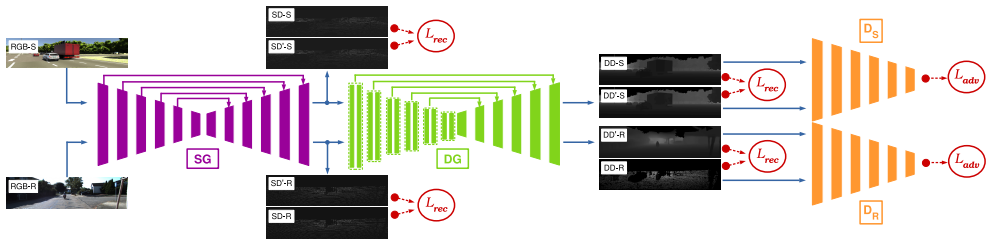
The load-bearing object is the two-stage sparse-to-dense generator $G(x) = \mathrm{DG}(\mathrm{SG}(x))$: the sparse generator is an encoder-decoder with skip connections that emits a sparse depth map, and the dense generator is a residual-block encoder-decoder that consumes that sparse map and emits dense depth. The key identity is the composite loss $$\mathcal{L} = \lambda_{\mathrm{recSG}}\|\mathrm{SG}(x)-y_s\|_1 + \lambda_{\mathrm{recDG}}\|M \odot \mathrm{DG}(\mathrm{SG}(x))-y_d\|_1 + \lambda_{\mathrm{adv}}\mathcal{L}_{\mathrm{adv}} + \lambda_s \mathcal{L}_s,$$ with the binary mask $M$ applied only to real-world dense ground truth. The mask lets incomplete real data supervise the model without penalizing missing sky and distant regions, while synthetic dense depth supplies the full-density signal that real data cannot provide.
What would settle it
Retrain the identical model on the KITTI depth-completion training split with every image belonging to the monocular test split of [14] excluded, then evaluate on that test split; if Abs Rel rises well above the reported 0.080, the headline gain was inflated by training on the test distribution. A cheaper check is to compare the sequence identifiers of the sampled training frames against the test split.
Extended reading notes
Core claim
The central discovery is that a single end-to-end model can perform both tasks, and that the completion stage is not a burden but the source of the gain. Concretely, the generator $G(x) = \mathrm{DG}(\mathrm{SG}(x))$ translates RGB to sparse depth and then to dense depth; the sparse generator is trained with an $\ell^1$ reconstruction loss against projected LiDAR-like sparse depth, while the dense generator is trained with a masked $\ell^1$ loss against real dense ground truth (masking out missing pixels) and an unmasked loss against synthetic dense depth. Two discriminators, one per data domain, provide adversarial supervision, and an edge-aware smoothness term penalizes large depth gradients where image gradients are small. The paper reports that this full configuration reaches Abs Rel 0.080 on the standard monocular test split of [14], beating the listed contemporary methods, and RMSE 892 mm on the depth-completion validation split of [54], competitive with the listed completion-specific methods.
Load-bearing premise
The paper's central numerical claim assumes the training frames sampled from the KITTI depth-completion set are disjoint from the standard monocular test images of [14]; the paper never states this exclusion, and the completion set contains many of the same sequences, so the reported 0.080 Abs Rel could partly reflect training on the test data.
Editorial extensions
If this is right
- A camera-only vehicle could run the full chain for monocular depth, while a LiDAR-equipped vehicle could run only the dense generator, reusing one training run for both deployment modes.
- Adding a sparse-completion auxiliary task is a viable recipe for boosting dense depth regression, even when the final output is dense depth from RGB alone.
- Blending synthetic dense depth with real sparse LiDAR depth can substitute for dense real-world ground truth, which is rarely available at scale.
- The reported runtimes (33.4 ms for monocular, 18.1 ms for completion) indicate the two-stage model operates near real-time on a single GPU, so the multi-task design is not purely academic.
Reading between the lines
- The paper does not state whether the sampled KITTI depth-completion training frames are disjoint from the standard monocular test images of [14]; if they are not, retraining on a strictly disjoint split is the decisive follow-up experiment.
- If the sparse intermediate task is what carries the gain, then attaching an SG-like auxiliary head should improve other dense depth backbones, not just this architecture; the paper does not test that.
- The dual-discriminator design suggests mixed-domain training is unstable under a single adversarial loss; a domain-weighting or adaptive discriminator might achieve the same benefit with less machinery.
- Because the method only needs dense synthetic depth and sparse real depth, it may transfer to indoor RGB-D scenarios where dense ground truth is also incomplete; this is an untested extrapolation.
Signed reviews
Editorial analysis
A structured set of objections, weighed in public.
Referee Report
Summary. The paper proposes a two-stage deep network for jointly solving monocular depth estimation and sparse depth completion. A sparse generator (SG) first maps an RGB image to a sparse depth map, and a dense generator (DG) then maps that sparse map to a dense depth map; the two sub-networks are trained end to end on a mixture of synthetic data [17] and real KITTI depth-completion data [54], using reconstruction, adversarial, and smoothness losses. For monocular depth estimation, the full SG+DG chain is evaluated on the Eigen split of KITTI and reported to achieve Abs Rel 0.080 (Table 1). For depth completion, DG alone is evaluated on the KITTI depth-completion validation set, reporting RMSE 892 mm (Table 2). The paper also presents ablations and qualitative generalisation results on local urban data.
Significance. If the reported monocular results are protocol-clean, the architecture is a useful contribution: the idea of explicitly generating a sparse intermediate depth representation as a scaffold for dense prediction is simple and well-motivated, and the paper provides a reasonably thorough ablation (loss components, single vs two-stage, synthetic vs real training). The adversarial-training component and the mixed-domain training strategy are consistent with prior practice, and the quantitative comparison against several published methods on both tasks gives the reader a meaningful baseline. However, the headline claim of outperforming contemporary state of the art on monocular depth estimation is not yet established because the comparison omits a stronger published method and because the training/evaluation protocol does not rule out train-test overlap. The depth-completion results are competitive but not state of the art, so the abstract's phrasing 'superior performance across both problem domains' overstates the findings. No code or trained models are released, which limits reproducibility.
major comments (3)
- [Section 4.1, Table 1] The claim that the approach outperforms 'contemporary state-of-the-art techniques' on monocular depth estimation is not supported by the evidence in Table 1 because DORN (Fu et al. [18], cited in the paper) is omitted. DORN reports Abs Rel 0.072, Sq Rel 0.307, RMSE 2.727, RMSE log 0.120, and delta1 0.932 on the same Eigen split, which is better than the paper's Our Approach row (Abs Rel 0.080, Sq Rel 0.836, RMSE 4.437, RMSE log 0.157, delta1 0.929) on every metric. If those numbers are protocol-comparable, the central monocular claim is false as stated. The authors should include DORN in the table, or, if there is a protocol difference (e.g., different crop or depth cap), state it explicitly and justify why the comparison is still fair.
- [Section 3 (data sampling) and Section 4.1 (evaluation)] The paper never states that the Eigen-split test images used in Table 1 were excluded from the training pool sampled from the KITTI depth-completion dataset [54]. The depth-completion dataset is assembled from KITTI raw sequences, and the Eigen test split is drawn from the same raw sequences, so at least partial overlap is likely if no exclusion was performed. This would directly inflate the reported monocular results. The authors must specify the exact exclusion procedure and, ideally, verify that no Eigen test frame appears in the training set, and then re-report Table 1 if any overlap is found.
- [Section 4.2, Table 2 and Abstract] The abstract claims the approach is capable of 'superior performance' 'across both problem domains,' but Table 2 shows that on the KITTI depth-completion validation set the method (RMSE 892 mm) ranks behind Van Gansbeke et al. [55] (802 mm) and Ma et al. [39] (879 mm). The contribution bullet in Section 1 is more careful in restricting the superiority claim to methods [10, 16, 40, 50, 54], but the abstract and the phrase 'outperforms contemporary state-of-the-art techniques across both problem domains' overstate the completion results. The authors should soften the wording to match the actual comparison, e.g., 'competitive with state-of-the-art' for completion.
minor comments (5)
- [Section 1] Typo: 'In order words' should be 'In other words'.
- [Section 4.1, Table 1] The row 'Train Set Mean [19]' is not a published method but a trivial baseline; consider labeling it explicitly as a lower-bound baseline rather than a competing method.
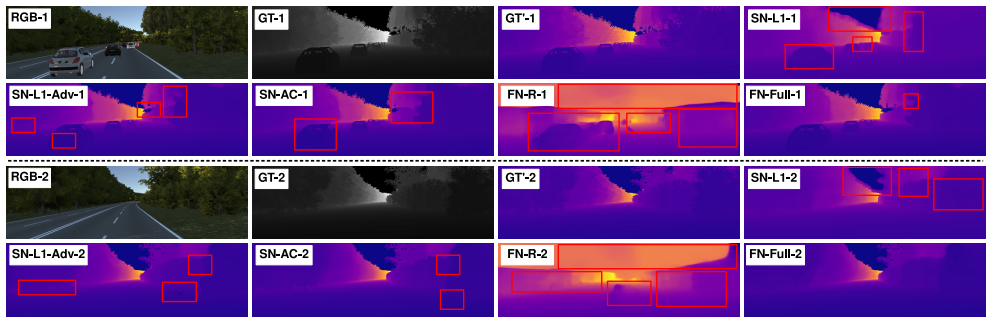
- [Section 4.3, Table 3] In the SN/L1/Adv row, the accuracy metric column labeled shift <1.25^2 reports 0.862, which is lower than the preceding shift <1.25 value of 0.913; this is almost certainly a typographical error and should be corrected.
- [Section 3.3] The grid-search procedure for the loss weights is only described as 'a basic grid search' without giving the ranges or step sizes; for reproducibility, provide the search space.
- [General] No mention is made of code or model release. Given that the exact training/test split and the random sampling from [54] are central to the validity of the results, a code release or a precise data-split specification is strongly recommended.
Circularity Check
No significant circularity: the depth predictions are produced by trained networks against external ground truth, and the small amount of self-citation is not load-bearing.
full rationale
The paper's derivation chain is empirical and self-contained in the relevant sense. The model defines two learned mappings: SG maps an RGB image to sparse depth under Eq. 1 (L1 against sparse ground truth), and DG maps that predicted sparse depth to dense depth under Eqs. 3 and 5 (L1 against dense ground truth, masked for real-world missing regions), with an adversarial loss (Eq. 6) and a smoothness loss (Eq. 7). Each quantity predicted by the network is compared against externally supplied depth labels from KITTI [19]/[54] and the synthetic dataset [17]; no predicted quantity is, by construction, equal to a training input or to a fitted parameter. The sparse synthetic ground truth in Eq. 2 is a preprocessing step that transfers a real sparse mask onto synthetic dense depth; it does not define the network output and is not circular. The loss weighting coefficients lambda are selected by grid search as hyperparameters, not fitted outputs renamed as predictions. The paper cites its own prior work [5, 7] as baselines and in related work, but it does not import a uniqueness theorem, an ansatz, or a definitional equivalence from those citations to force its central result; the architecture, losses, and training procedure are stated directly in the paper. Section 5's acknowledgement of degenerate upper-region content is a limitation statement about output quality, not evidence of circular reasoning. Concerns such as the omission of DORN from Table 1 or a possible unstated overlap between the [54] training pool and the Eigen split test set are experimental validity and comparison-completeness issues, not circularity of the derivation. No step reduces to its own input, so the paper should receive a non-circularity verdict.
Assumptions & free parameters
free parameters (5)
- lambda_recSG =
150
- lambda_recDG =
100
- lambda_adv =
10
- lambda_s =
1
- synthetic_real_sampling_ratio =
Not specified
assumptions (4)
- domain assumption Real-world KITTI depth completion ground truth plus synthetic depth provides sufficient supervision for both tasks.
- ad hoc to paper Synthetic sparse depth can be generated by overlaying a random real sparse mask on dense synthetic depth (Eq. 2).
- domain assumption The binary mask (Eq. 4-5) correctly handles missing real-world depth regions during training.
- domain assumption Adversarial training plus two discriminators stabilizes and improves output fidelity.
Cite this review
Pith. "Pith review of To complete or to estimate, that is the question: A Multi-Task Approach to Depth Completion and Monocular Depth Estimation." pith.science (2026). https://pith.science/paper/H2C3PGTN
@misc{pith2026190805540,
  author       = {Pith},
  title        = {Pith review of: To complete or to estimate, that is the question: A Multi-Task Approach to Depth Completion and Monocular Depth Estimation},
  year         = {2026},
  howpublished = {\url{https://pith.science/paper/H2C3PGTN}},
  note         = {Machine review of arXiv:1908.05540}
}
read the original abstract
Robust three-dimensional scene understanding is now an ever-growing area of research highly relevant in many real-world applications such as autonomous driving and robotic navigation. In this paper, we propose a multi-task learning-based model capable of performing two tasks:- sparse depth completion (i.e. generating complete dense scene depth given a sparse depth image as the input) and monocular depth estimation (i.e. predicting scene depth from a single RGB image) via two sub-networks jointly trained end to end using data randomly sampled from a publicly available corpus of synthetic and real-world images. The first sub-network generates a sparse depth image by learning lower level features from the scene and the second predicts a full dense depth image of the entire scene, leading to a better geometric and contextual understanding of the scene and, as a result, superior performance of the approach. The entire model can be used to infer complete scene depth from a single RGB image or the second network can be used alone to perform depth completion given a sparse depth input. Using adversarial training, a robust objective function, a deep architecture relying on skip connections and a blend of synthetic and real-world training data, our approach is capable of producing superior high quality scene depth. Extensive experimental evaluation demonstrates the efficacy of our approach compared to contemporary state-of-the-art techniques across both problem domains.
Figures


Figures from the paper (5 more)



Reference graph
Works this paper leans on
- [54]
-
[17]
E. Francis, K. Theodora, H. Alexander, and L. Bastian. Ex- ploring spatial context for 3D semantic segmentation of point clouds. In IEEE Int. Conf. Computer Vision Workshop, 2017. 1, 2, 3, 6, 7, 8
work page 2017
-
[18]
H. Fu, M. Gong, C. Wang, K. Batmanghelich, and D. Tao. Deep ordinal regression network for monocular depth esti- mation. In IEEE Conf. Computer Vision and Pattern Recog- nition, pages 2002–2011, 2018. 1
work page 2002
-
[55]
W. Van Gansbeke, D. Neven, B. De Brabandere, and L. Van Gool. Sparse and noisy LiDAR completion with RGB guidance and uncertainty. arXiv preprint arXiv:1902.05356,
arXiv 1902
-
[39]
F. Ma, G. V . Cavalheiro, and S. Karaman. Self- supervised Sparse-to-Dense: Self-supervised depth comple- tion from LiDAR and monocular camera. arXiv preprint arXiv:1807.00275, 2018. 1, 3, 6, 7, 8
arXiv 2018
-
[1]
A. Atapour-Abarghouei, S. Akcay, G. Payen de La Garan- derie, and T. Breckon. Generative adversarial framework for depth filling via Wasserstein metric, Cosine transform and domain transfer. Pattern Recognition, 91:232–244, 2019. 2, 6
work page 2019
-
[2]
A. Atapour-Abarghouei and T. Breckon. DepthComp: Real- time depth image completion based on prior semantic scene segmentation. In British Machine Vision Conference, pages 1–13. BMV A, 2017. 2
work page 2017
-
[3]
A. Atapour-Abarghouei and T. Breckon. A comparative re- view of plausible hole filling strategies in the context of scene depth image completion. Computers and Graphics, 72:39– 58, 2018. 1, 2
work page 2018
Show all 66 references
-
[4]
Atapour-Abarghouei and T
A. Atapour-Abarghouei and T. Breckon. Extended patch prioritization for depth filling within constrained exemplar- based RGB-D image completion. In Int. Conf. Image Analy- sis and Recognition, pages 306–314, 2018. 2
2018
-
[5]
Atapour-Abarghouei and T
A. Atapour-Abarghouei and T. Breckon. Real-time monocu- lar depth estimation using synthetic data with domain adap- tation via image style transfer. In IEEE Conf. Computer Vi- sion and Pattern Recognition, pages 2800–2810, 2018. 1, 2, 3, 4, 5, 6, 8
2018
-
[6]
Atapour-Abarghouei and T
A. Atapour-Abarghouei and T. Breckon. Monocular segment-wise depth: Monocular depth estimation based on a semantic segmentation prior. In Int. Conf. Image Process- ing, 2019. 1
2019
-
[7]
Atapour-Abarghouei and T
A. Atapour-Abarghouei and T. Breckon. Veritatem dies aperit-temporally consistent depth prediction enabled by a multi-task geometric and semantic scene understanding ap- proach. In IEEE Conf. Computer Vision and Pattern Recog- nition, 2019. 2, 5, 8
2019
-
[8]
Atapour-Abarghouei, G
A. Atapour-Abarghouei, G. Payen de La Garanderie, and T. P. Breckon. Back to Butterworth - a Fourier basis for 3D surface relief hole filling within RGB-D imagery. In Int. Conf. Pattern Recognition, pages 2813–2818. IEEE, 2016. 1, 2
2016
-
[9]
W. Chen, H. Yue, J. Wang, and X. Wu. An improved edge detection algorithm for depth map inpainting. Optics and Lasers in Engineering, 55:69–77, 2014. 2
2014
-
[10]
Chodosh, C
N. Chodosh, C. Wang, and S. Lucey. Deep convolutional compressed sensing for LiDAR depth completion. arXiv preprint arXiv:1803.08949, 2018. 1, 2, 3, 6, 7, 8
2018 arXiv
-
[11]
Ding and G
L. Ding and G. Sharma. Fusing structure from motion and lidar for dense accurate depth map estimation. In Proc. Int. Conf. Acoustics, Speech and Signal Processing, pages 1283–
-
[12]
Dosovitskiy and T
A. Dosovitskiy and T. Brox. Generating images with percep- tual similarity metrics based on deep networks. In Advances in Neural Information Processing Systems , pages 658–666,
-
[13]
Eigen and R
D. Eigen and R. Fergus. Predicting depth, surface normals and semantic labels with a common multi-scale convolu- tional architecture. In Int. Conf. Computer Vision , pages 2650–2658, 2015. 2
2015
-
[14]
Eigen, C
D. Eigen, C. Puhrsch, and R. Fergus. Depth map prediction from a single image using a multi-scale deep network. In Advances in Neural Information Processing Systems , pages 2366–2374, 2014. 1, 2, 5, 6, 8
2014
-
[15]
Eldesokey, M
A. Eldesokey, M. Felsberg, and F. S. Khan. Confidence prop- agation through CNNs for guided sparse depth regression. arXiv preprint arXiv:1811.01791, 2018. 6, 7, 8
2018 arXiv
-
[16]
Eldesokey, M
A. Eldesokey, M. Felsberg, and F. S. Khan. Propagating confidences through CNNs for sparse data regression. arXiv preprint arXiv:1805.11913, 2018. 1, 2, 3, 6, 7, 8
2018 arXiv
-
[19]
Geiger, P
A. Geiger, P. Lenz, C. Stiller, and R. Urtasun. Vision meets robotics: The KITTI dataset. Robotics Research , pages 1231–1237, 2013. 1, 2, 5, 6, 7, 8
2013
-
[20]
Godard, O
C. Godard, O. M. Aodha, and G. J. Brostow. Unsupervised monocular depth estimation with left-right consistency. In IEEE Conf. Computer Vision and Pattern Recognition, pages 6602 – 6611, 2017. 1, 2, 4, 5, 6, 8
2017
-
[21]
Goodfellow, J
I. Goodfellow, J. Pouget-Abadie, M. Mirza, B. Xu, D. Warde-Farley, S. Ozair, A. Courville, and Y . Bengio. Gen- erative adversarial nets. In Advances in Neural Information Processing Systems, pages 2672–2680, 2014. 2, 5
2014
-
[22]
K. He, X. Zhang, S. Ren, and J. Sun. Deep residual learning for image recognition. In IEEE Conf. Computer Vision and Pattern Recognition, pages 770–778, 2016. 6
2016
-
[23]
Heise, S
P. Heise, S. Klose, B. Jensen, and A. Knoll. Pm-huber: Patchmatch with huber regularization for stereo matching. In Int. Conf. Computer Vision, pages 2360–2367, 2013. 5
2013
-
[24]
Hirschmuller
H. Hirschmuller. Stereo processing by semiglobal matching and mutual information. IEEE Trans. Pattern Analysis and Machine Intelligence, 30(2):328–341, 2007. 3
2007
-
[25]
Isola, J.-Y
P. Isola, J.-Y . Zhu, T. Zhou, and A. Efros. Image-to- image translation with conditional adversarial networks. In IEEE Conf. Computer Vision and Pattern Recognition, pages 5967–5976, 2017. 5
2017
-
[26]
Jaderberg, K
M. Jaderberg, K. Simonyan, A. Zisserman, et al. Spatial transformer networks. In Advances in Neural Information Processing Systems, pages 2017–2025, 2015. 2
2017
-
[27]
Karsch, C
K. Karsch, C. Liu, and S. B. Kang. Depth transfer: Depth extraction from video using non-parametric sampling. IEEE Trans. Pattern Analysis and Machine Intelligence , 36(11):2144–2158, 2014. 2
2014
-
[28]
Kendall, Y
A. Kendall, Y . Gal, and R. Cipolla. Multi-task learning using uncertainty to weigh losses for scene geometry and seman- tics. In IEEE Conf. Computer Vision and Pattern Recogni- tion, pages 1–10, 2018. 8
2018
-
[29]
Kingma and J
D. Kingma and J. Ba. Adam: A method for stochastic op- timization. In Int. Conf. Learning Representations , pages 1–15, 2014. 6
2014
-
[30]
Kulkarni and A
M. Kulkarni and A. Rajagopalan. Depth inpainting by tensor voting. J. Optical Society of America A , 30(6):1155–1165,
-
[31]
Kuznietsov, J
Y . Kuznietsov, J. St ¨uckler, and B. Leibe. Semi-supervised deep learning for monocular depth map prediction. In IEEE Conf. Computer Vision and Pattern Recognition, pages 6647–6655, 2017. 1, 2, 4, 8
2017
-
[32]
Laina, C
I. Laina, C. Rupprecht, V . Belagiannis, F. Tombari, and N. Navab. Deeper depth prediction with fully convolutional residual networks. In Int. Conf. 3D Vision, pages 239–248,
-
[33]
B. Li, C. Shen, Y . Dai, A. van den Hengel, and M. He. Depth and surface normal estimation from monocular images us- ing regression on deep features and hierarchical CRFs. In IEEE Conf. Computer Vision and Pattern Recognition, pages 1119–1127, 2015. 2
2015
-
[34]
B. Liu, S. Gould, and D. Koller. Single image depth estima- tion from predicted semantic labels. InIEEE Conf. Computer Vision and Pattern Recognition, pages 1253–1260, 2010. 2
2010
-
[35]
C. Liu, J. Yuen, and A. Torralba. Sift flow: Dense corre- spondence across scenes and its applications. IEEE Trans. Pattern Analysis and Machine Intelligence , 33(5):978–994,
-
[36]
F. Liu, C. Shen, G. Lin, and I. Reid. Learning depth from single monocular images using deep convolutional neural fields. IEEE Trans. Pattern Analysis and Machine Intelli- gence, 38(10):2024–2039, 2016. 2, 5, 6, 8
2024
-
[37]
M. Liu, X. He, and M. Salzmann. Building scene models by completing and hallucinating depth and semantics. In Euro. Conf. Computer Vision, pages 258–274, 2016. 2
2016
-
[38]
M. Liu, M. Salzmann, and X. He. Discrete-continuous depth estimation from a single image. In IEEE Conf. Computer Vision and Pattern Recognition, pages 716–723, 2014. 2
2014
-
[40]
Ma and S
F. Ma and S. Karaman. Sparse-to-Dense: Depth prediction from sparse depth samples and a single image. In IEEE Int. Conf. Robotics and Automation, pages 1–8. IEEE, 2018. 2, 3, 6, 7, 8
2018
-
[41]
Matsuo and Y
K. Matsuo and Y . Aoki. Depth image enhancement using local tangent plane approximations. InIEEE Conf. Computer Vision and Pattern Recognition, pages 3574–3583, 2015. 2
2015
-
[42]
Orhan and X
E. Orhan and X. Pitkow. Skip connections eliminate singu- larities. In Int. Conf. Learning Representations, pages 1–11,
-
[43]
Paszke, S
A. Paszke, S. Gross, S. Chintala, G. Chanan, E. Yang, Z. De- Vito, Z. Lin, A. Desmaison, L. Antiga, and A. Lerer. Au- tomatic differentiation in PyTorch. In Advances in Neural Information Processing Systems, pages 1–4, 2017. 6
2017
-
[44]
Pathak, P
D. Pathak, P. Krahenbuhl, J. Donahue, T. Darrell, and A. Efros. Context encoders: Feature learning by inpaint- ing. In IEEE Conf. Computer Vision and Pattern Recogni- tion, pages 2536–2544, 2016. 6
2016
-
[45]
Radford, L
A. Radford, L. Metz, and S. Chintala. Unsupervised repre- sentation learning with deep convolutional generative adver- sarial networks. arXiv preprint arXiv:1511.06434, 2015. 6
2015 arXiv
-
[46]
Ronneberger, P
O. Ronneberger, P. Fischer, and T. Brox. U-net: Convolu- tional networks for biomedical image segmentation. In Int. Conf. Medical Image Computing and Computer-Assisted In- tervention, pages 234–241, 2015. 2, 6
2015
-
[47]
Saxena, S
A. Saxena, S. H. Chung, and A. Y . Ng. Learning depth from single monocular images. InAdvances in Neural Information Processing Systems, pages 1161–1168, 2006. 2
2006
-
[48]
Saxena, M
A. Saxena, M. Sun, and A. Y . Ng. Make3D: Learning 3D scene structure from a single still image.IEEE Trans. Pattern Analysis and Machine Intelligence, 31(5):824–840, 2008. 2
2008
-
[49]
Scharstein and R
D. Scharstein and R. Szeliski. A taxonomy and evaluation of dense two-frame stereo correspondence algorithms. Int. J. Computer Vision, 47:7–42, 2002. 1
2002
-
[50]
S. S. Shivakumar, T. Nguyen, I. D. Miller, S. W. Chen, and C. J. Taylor. DFuseNet: Deep fusion of RGB and sparse depth information for image guided dense depth completion. https://arxiv.org/pdf/1902.00761.pdf, 2019. 2, 3, 6, 7, 8
1902 arXiv
-
[51]
Silberman, D
N. Silberman, D. Hoiem, P. Kohli, and R. Fergus. Indoor segmentation and support inference from RGB-D images. In Euro. Conf. Computer Vision , pages 746–760. Springer,
-
[52]
S. Song, S. P. Lichtenberg, and J. Xiao. Sun RGB-D: A RGB-D scene understanding benchmark suite. In IEEE Conf. Computer Vision and Pattern Recognition, pages 567– 576, 2015. 2
2015
-
[53]
M. Tao, P. Srinivasan, J. Malik, S. Rusinkiewicz, and R. Ra- mamoorthi. Depth from shading, defocus, and correspon- dence using light-field angular coherence. In IEEE Conf. Computer Vision and Pattern Recognition , pages 1940– 1948, 2015. 1
1940
-
[56]
Vincent, H
P. Vincent, H. Larochelle, Y . Bengio, and P.-A. Manzagol. Extracting and composing robust features with denoising au- toencoders. In Int. Conf. Machine learning , pages 1096–
-
[57]
Vincent, H
P. Vincent, H. Larochelle, I. Lajoie, Y . Bengio, and P.-A. Manzagol. Stacked denoising autoencoders: Learning useful representations in a deep network with a local denoising cri- terion. J. Machine Learning Research, 11(Dec):3371–3408,
-
[58]
R. Woodham. Photometric method for determining sur- face orientation from multiple images. Optical Engineering, 19(1):191139, 1980. 1
1980
-
[59]
J. Xie, R. Girshick, and A. Farhadi. Deep3D: Fully automatic 2D-to-3D video conversion with deep convolutional neural networks. In Euro. Conf. Computer Vision, pages 842–857,
-
[60]
H. Xue, S. Zhang, and D. Cai. Depth image inpainting: Im- proving low rank matrix completion with low gradient regu- larization. IEEE Trans. Image Processing, 26(9):4311–4320,
-
[61]
Yeh ∗, C
R. Yeh ∗, C. Chen ∗, T. Y . Lim, S. Alexander, M. Hasegawa- Johnson, and M. Do. Semantic image inpainting with deep generative models. In IEEE Conf. Computer Vision and Pat- tern Recognition, pages 6882–6890, 2017. 5
2017
-
[62]
H. Zhan, R. Garg, C. S. Weerasekera, K. Li, H. Agarwal, and I. Reid. Unsupervised learning of monocular depth estima- tion and visual odometry with deep feature reconstruction. In IEEE Conf. Computer Vision and Pattern Recognition, pages 340–349, 2018. 2, 5, 6, 8
2018
-
[63]
Zhang and T
Y . Zhang and T. Funkhouser. Deep depth completion of a single RGB-D image. In IEEE Conf. Computer Vision and Pattern Recognition, pages 175–185, 2018. 2, 3
2018
-
[64]
S. Zhao, H. Fu, M. Gong, and D. Tao. Geometry-aware sym- metric domain adaptation for monocular depth estimation. arXiv preprint arXiv:1904.01870, 2019. 2
1904 arXiv
-
[65]
Zheng, T.-J
C. Zheng, T.-J. Cham, and J. Cai. T2Net: Synthetic-to- realistic translation for solving single-image depth estima- tion tasks. In Euro. Conf. Computer Vision, pages 767–783. Springer, 2018. 2
2018
-
[66]
T. Zhou, M. Brown, N. Snavely, and D. G. Lowe. Unsu- pervised learning of depth and ego-motion from video. In IEEE Conf. Computer Vision and Pattern Recognition, pages 6612–6619, 2017. 1, 2, 4, 5, 6, 8
2017
Reviewed August 14, 2026 · model on record in the stance chip above.
Discussion (0). Continue with ORCID to comment.